fuel pressure Ram 3500 Chassis Cab 2019 User Guide
[x] Cancel search | Manufacturer: RAM, Model Year: 2019, Model line: 3500 Chassis Cab, Model: Ram 3500 Chassis Cab 2019Pages: 607, PDF Size: 10.72 MB
Page 245 of 607

SAFETY 243
Periodic Safety Checks You Should Make Outside
The Vehicle
Tires
Examine tires for excessive tread wear and uneven wear
patterns. Check for stones, nails, glass, or other objects
lodged in the tread or sidewall. Inspect the tread for cuts and
cracks. Inspect sidewalls for cuts, cracks, and bulges. Check
the wheel bolts for tightness. Check the tires (including
spare) for proper cold inflation pressure.
Lights
Have someone observe the operation of brake lights and
exterior lights while you work the controls. Check turn
signal and high beam indicator lights on the instrument
panel.
Door Latches
Check for proper closing, latching, and locking.
Fluid Leaks
Check area under the vehicle after overnight parking for
fuel, coolant, oil, or other fluid leaks. Also, if gasoline fumes
are detected or if fuel, or brake fluid leaks are suspected. The
cause should be located and corrected immediately.
• ALWAYS make sure objects cannot fall or slide into the
driver’s side floor area when the vehicle is moving.
Objects can become trapped under accelerator, brake,
or clutch pedals and could cause a loss of vehicle
control.
• NEVER place any objects under the floor mat (e.g., towels, keys, etc.). These objects could change the posi -
tion of the floor mat and may cause interference with
the accelerator, brake, or clutch pedals.
• If the vehicle carpet has been removed and re-installed, always properly attach carpet to the floor and check the
floor mat fasteners are secure to the vehicle carpet.
Fully depress each pedal to check for interference with
the accelerator, brake, or clutch pedals then re-install
the floor mats.
• It is recommended to only use mild soap and water to clean your floor mats. After cleaning, always check
your floor mat has been properly installed and is
secured to your vehicle using the floor mat fasteners by
lightly pulling mat.
WARNING! (Continued)
4
Page 340 of 607

338 STARTING AND OPERATING
Payload
The payload of a vehicle is defined as the allowable load
weight a truck can carry, including the weight of the driver,
all passengers, options and cargo.
Gross Axle Weight Rating (GAWR)
The GAWR is the maximum permissible load on the front
and rear axles. The load must be distributed in the cargo area
so that the GAWR of each axle is not exceeded.
Each axle GAWR is determined by the components in the
system with the lowest load carrying capacity (axle, springs,
tires or wheels). Heavier axles or suspension components
sometimes specified by purchasers for increased durability
does not necessarily increase the vehicle's GVWR.
Tire Size
The tire size on the Vehicle Certification Label represents the
actual tire size on your vehicle. Replacement tires must be
equal to the load capacity of this tire size.
Rim Size
This is the rim size that is appropriate for the tire size listed.
Inflation Pressure
This is the cold tire inflation pressure for your vehicle for all
loading conditions up to full GAWR.
Curb Weight
The curb weight of a vehicle is defined as the total weight of
the vehicle with all fluids, including vehicle fuel, at full
capacity conditions, and with no occupants or cargo loaded
into the vehicle. The front and rear curb weight values are
determined by weighing your vehicle on a commercial scale
before any occupants or cargo are added.
Loading
The actual total weight and the weight of the front and rear
of your vehicle at the ground can best be determined by
weighing it when it is loaded and ready for operation.
The entire vehicle should first be weighed on a commercial
scale to insure that the GVWR has not been exceeded. The
weight on the front and rear of the vehicle should then be
determined separately to be sure that the load is properly
distributed over the front and rear axle. Weighing the vehicle
may show that the GAWR of either the front or rear axles has
been exceeded but the total load is within the specified
GVWR. If so, weight must be shifted from front to rear or
Page 418 of 607

416 SERVICING AND MAINTENANCE
Checking Oil Level — Gas Engine
To assure proper lubrication of your vehicle's engine, the
engine oil must be maintained at the correct level. Check the
oil level at regular intervals, such as every fuel stop. The best
time to check the engine oil level is about five minutes after
a fully warmed up engine is shut off.
Checking the oil while the vehicle is on level ground will
improve the accuracy of the oil level readings. Always main-
tain the oil level within the SAFE zone on the dipstick.
Adding one quart of oil when the reading is at the bottom of
the SAFE zone will result in a reading at the top of the safe
zone on these engines.
Adding Washer Fluid
The fluid reservoir is located under the hood and should be
checked for fluid level at regular intervals. Fill the reservoir
with windshield washer solvent only (not radiator anti -
freeze). When refilling the washer fluid reservoir, take some washer fluid and apply it to a cloth or towel and wipe the
wiper blades clean. This will help blade performance.
To prevent freeze-up of your windshield washer system in
cold weather, select a solution or mixture that meets or
exceeds the temperature range of your climate. This rating
information can be found on most washer fluid containers.
After the engine has warmed up, operate the defroster for a
few minutes to reduce the possibility of smearing or freezing
the fluid on the cold windshield. Windshield washer solu-
tion used with water as directed on the container, aids
cleaning action, reduces the freezing point to avoid line clog
-
ging, and is not harmful to paint or trim.
CAUTION!
Overfilling or underfilling will cause oil aeration or loss
of oil pressure. This could damage your engine.
WARNING!
Commercially available windshield washer solvents are
flammable. They could ignite and burn you. Care must
be exercised when filling or working around the washer
solution.
Page 456 of 607
454 SERVICING AND MAINTENANCE
(Continued)
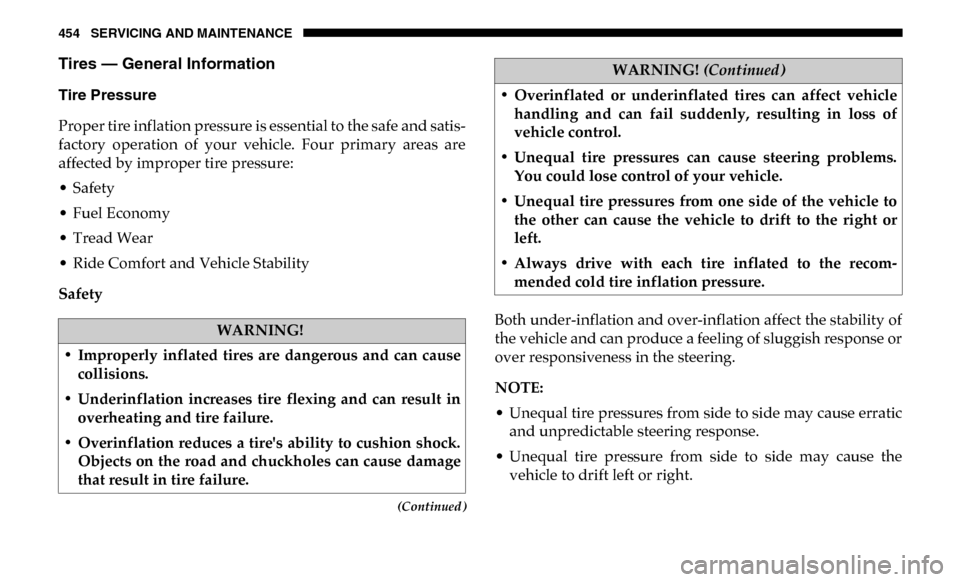
Tires — General Information
Tire Pressure
Proper tire inflation pressure is essential to the safe and satis-
factory operation of your vehicle. Four primary areas are
affected by improper tire pressure:
• Safety
• Fuel Economy
• Tread Wear
• Ride Comfort and Vehicle Stability
Safety
Both under-inflation and over-inflation affect the stability of
the vehicle and can produce a feeling of sluggish response or
over responsiveness in the steering.
NOTE:
• Unequal tire pressures from side to side may cause erraticand unpredictable steering response.
• Unequal tire pressure from side to side may cause the vehicle to drift left or right.
WARNING!
• Improperly inflated tires are dangerous and can cause collisions.
• Underinflation increases tire flexing and can result in overheating and tire failure.
• Overinflation reduces a tire's ability to cushion shock. Objects on the road and chuckholes can cause damage
that result in tire failure.
• Overinflated or underinflated tires can affect vehiclehandling and can fail suddenly, resulting in loss of
vehicle control.
• Unequal tire pressures can cause steering problems. You could lose control of your vehicle.
• Unequal tire pressures from one side of the vehicle to the other can cause the vehicle to drift to the right or
left.
• Always drive with each tire inflated to the recom -
mended cold tire inflation pressure.
WARNING! (Continued)
Page 457 of 607

SERVICING AND MAINTENANCE 455
Fuel Economy
Underinflated tires will increase tire rolling resistance
resulting in higher fuel consumption.
Tread Wear
Improper cold tire inflation pressures can cause abnormal
wear patterns and reduced tread life, resulting in the need
for earlier tire replacement.
Ride Comfort And Vehicle Stability
Proper tire inflation contributes to a comfortable ride.
Over-inflation produces a jarring and uncomfortable ride.
Tire Inflation Pressures
The proper cold tire inflation pressure is listed on the driver's
side B-Pillar or rear edge of the driver's side door.
At least once a month:
• Check and adjust tire pressure with a good qualitypocket-type pressure gauge. Do not make a visual judge -
ment when determining proper inflation. Tires may look
properly inflated even when they are under-inflated.
• Inspect tires for signs of tire wear or visible damage. Inflation pressures specified on the placard are always “cold
tire inflation pressure”. Cold tire inflation pressure is
defined as the tire pressure after the vehicle has not been
driven for at least three hours, or driven less than 1 mile
(1.6 km) after sitting for a minimum of three hours. The cold
tire inflation pressure must not exceed the maximum infla
-
tion pressure molded into the tire sidewall.
Check tire pressures more often if subject to a wide range of
outdoor temperatures, as tire pressures vary with tempera -
ture changes.
Tire pressures change by approximately 1 psi (7 kPa) per 12°F
(7°C) of air temperature change. Keep this in mind when
checking tire pressure inside a garage, especially in the Winter.
Example: If garage temperature = 68°F (20°C) and the
outside temperature = 32°F (0°C) then the cold tire inflation
pressure should be increased by 3 psi (21 kPa), which equals
1 psi (7 kPa) for every 12°F (7°C) for this outside temperature
condition. CAUTION!
After inspecting or adjusting the tire pressure, always
reinstall the valve stem cap. This will prevent moisture
and dirt from entering the valve stem, which could
damage the valve stem.
7
Page 493 of 607

MULTIMEDIA 491
Display
After pressing the “Display” button on the touchscreen, the following settings will be available.
Units — If Equipped
After pressing “Units” on the touchscreen, the following will be available:Setting Name
Selectable Options
Display Mode AutoManual
Set Language English, Français, Español
Touchscreen Beep OnOff
Fuel Saver Display OnOff
NOTE:
The “Fuel Saver Display” feature will allow you to enable fuel saver mode and will be displayed in the instrument cluster
display.
Setting Name Selectable Options
Units USMetric Custom
Speed MPH km/h
Distance mi km
Fuel Consumption MPG (UG)MPG (UK) L/100 km km/L
Pressure psikPa bar
9
Page 514 of 607

512 MULTIMEDIA
Units
After pressing the “Units” button on the touchscreen, you may select each unit of measure independently displayed in the
instrument cluster display, and navigation system (if equipped). The following selectable units of measure are listed below:Setting Name Selectable Options
Units USMetric Custom
NOTE:
When the “Custom” setting is selected, units will appear according to your personally configured settings. To configure these
settings, press the “Custom” bar. The following settings will appear: Speed MPH km/h
Distance mi km
Fuel Consumption MPG (US)MPG (UK) L/100 km km/L
Pressure psikPa bar
Power — If Equipped HP (US)
HP (UK) Kw
Temperature °F °C
Torque — If Equipped lb-ft Nm
Page 534 of 607

532 MULTIMEDIA
Units — If Equipped
After pressing “Units” on the touchscreen, the following will be available:
Voice
After pressing the “Voice” button on the touchscreen, the following settings will be available:Setting Name
Selectable Options
Units USMetric Custom
NOTE:
When the “Custom” setting is selected, units will appear according to your personally configured settings. To configure these
settings, press the “Custom” bar. The following settings will appear: Speed MPH km/h
Distance mi km
Fuel Consumption MPG (US)MPG (UK) L/100 km km/L
Pressure psikPa bar
Power — If Equipped HP (US)
HP (UK)
Kw
Temperature °F °C
Torque — If Equipped lb-ft Nm
Setting Name Selectable Options
Voice Response Length Brief Detailed
Show Command List Alwaysw/Help Never
Page 592 of 607

INDEX
A
Adaptive Cruise Control (ACC) (Cruise Control) ............. 288
Adding Engine Coolant (Antifreeze) ................................... 435
Adding Fuel ............................................................................. 336
Additives, Fuel ........................................................................ 480
Adjust Down....................................................................................... 42
Forward .................................................................................. 42
Rearward ................................................................................ 42
Up ............................................................................................ 42
Adjustable Pedals...................................................................... 55
Air Bag Air Bag Operation ............................................................... 205Air Bag Warning Light ....................................................... 203
Enhanced Accident Response ................................... 212, 409
Event Data Recorder (EDR) ............................................... 409
If Deployment Occurs ........................................................ 211
Knee Impact Bolsters .......................................................... 206Maintaining Your Air Bag System.................................... 213
Maintenance......................................................................... 213
Transporting Pets ................................................................ 240
Air Bag Light ........................................................... 146, 203, 241
Air Cleaner, Engine (Engine Air Cleaner Filter) ................ 420
Air Conditioner Maintenance ............................................... 421 Air Conditioner Refrigerant ..........................................421, 422
Air Conditioner System..........................................................421
Air Conditioning ................................................................. 77, 88
Air Conditioning Filter .....................................................91, 423
Air Conditioning System .........................................................89
Air Conditioning, Operating Tips ..........................................89
Air Filter ...................................................................................420
Air Pressure Tires .......................................................................................455
Alarm Panic ........................................................................................18
Security Alarm ...............................................................30, 148
Alterations/Modifications Vehicle.....................................................................................14
Android Auto ..........................................................................579
Antifreeze (Engine Coolant) ..................................................434 Capacites...............................................................................483
Disposal ................................................................................436
Anti-Lock Brake System (ABS) .............................................161
Anti-Lock Warning Light.......................................................154
Apple CarPlay .........................................................................581
Assist, Hill Start .......................................................................164
Audio Systems (Radio)........................................................... 487
Auto Down Power Windows ..................................................92
Page 599 of 607

597
Low Fuel ............................................................................... 152Malfunction Indicator (Check Engine)............................. 150Park ....................................................................................... 157Passing .................................................................................... 68
Seat Belt Reminder .............................................................. 146Security Alarm..................................................................... 148
Service ................................................................................... 371Traction Control .................................................................. 169
Transfer Case ....................................................................... 280Turn Signals ................................................... 70, 157, 243, 373
Warning Instrument Cluster Descriptions .............. 148, 157
Limited-Slip Differential ................................................ 281, 443
Load Shed Battery Saver Mode............................................. 144
Load Shed Battery Saver On ................................................. 144
Load Shed Electrical Load Reduction .................................. 144
Load Shed Intelligent Battery Sensor ................................... 144
Loading Vehicle ...................................................................... 337 Tires....................................................................................... 450
Locks Automatic Door..................................................................... 37
Child Protection .................................................................... 38
Power Door ............................................................................ 33
Low Tire Pressure System ..................................................... 177
Lubrication, Body ................................................................... 428
Lug Nuts/Bolts ....................................................... 396, 476, 477 M
Maintenance Free Battery ......................................................417
Maintenance Schedule............................................................ 410
Malfunction Indicator Light (Check Engine) ..............150, 159
Manual Park Release .........................................................................403
Service ...................................................................................589
Media Hub ...............................................................................551
Memory Seat ..............................................................................44
Methanol...................................................................................480
Mirrors ........................................................................................56 Electric Powered ....................................................................59
Heated .....................................................................................62
Memory...................................................................................44
Outside....................................................................................58
Rearview .............................................................56, 57, 58, 366 Trailer Towing .......................................................................61
Modifications/Alterations Vehicle.....................................................................................14
Monitor, Tire Pressure System ..............................................177
Mopar Parts..............................................................................588
MP3 Control ............................................................................. 551
Multi-Function Control Lever .................................................66 N
Navigation System (Uconnect GPS) .....................................326
New Vehicle Break-In Period ................................................251
11