key battery Ram 3500 Chassis Cab 2019 User Guide
[x] Cancel search | Manufacturer: RAM, Model Year: 2019, Model line: 3500 Chassis Cab, Model: Ram 3500 Chassis Cab 2019Pages: 607, PDF Size: 10.72 MB
Page 38 of 607
36 GETTING TO KNOW YOUR VEHICLE
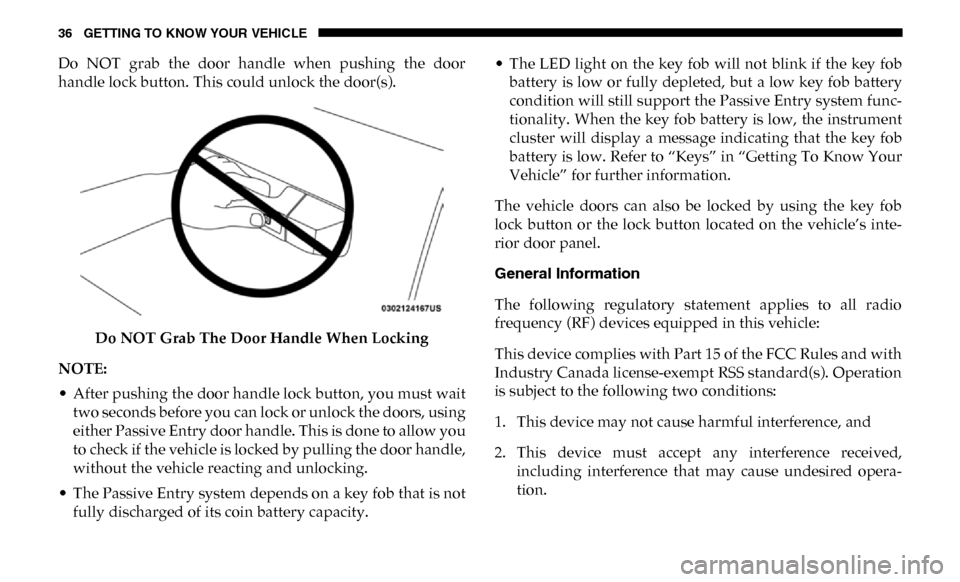
Do NOT grab the door handle when pushing the door
handle lock button. This could unlock the door(s).Do NOT Grab The Door Handle When Locking
NOTE:
• After pushing the door handle lock button, you must wait two seconds before you can lock or unlock the doors, using
either Passive Entry door handle. This is done to allow you
to check if the vehicle is locked by pulling the door handle,
without the vehicle reacting and unlocking.
• The Passive Entry system depends on a key fob that is not fully discharged of its coin battery capacity. • The LED light on the key fob will not blink if the key fob
battery is low or fully depleted, but a low key fob battery
condition will still support the Passive Entry system func -
tionality. When the key fob battery is low, the instrument
cluster will display a message indicating that the key fob
battery is low. Refer to “Keys” in “Getting To Know Your
Vehicle” for further information.
The vehicle doors can also be locked by using the key fob
lock button or the lock button located on the vehicle’s inte -
rior door panel.
General Information
The following regulatory statement applies to all radio
frequency (RF) devices equipped in this vehicle:
This device complies with Part 15 of the FCC Rules and with
Industry Canada license-exempt RSS standard(s). Operation
is subject to the following two conditions:
1. This device may not cause harmful interference, and
2. This device must accept any interference received, including interference that may cause undesired opera -
tion.
Page 73 of 607

GETTING TO KNOW YOUR VEHICLE 71
Cargo Lights — If Equipped
The cargo lights (if equipped) and trailer spotter lamps (if
equipped) are turned on by pushing the cargo lights button
located on the lower half of the headlight switch.Cargo Lights Button On Headlight Switch
The cargo lights will turn on for approximately 60 seconds
when a key fob unlock button is pushed, as part of the Illu-
minated Entry feature.
Battery Saver
To protect the life of your vehicle’s battery, load shedding is
provided for both the interior and exterior lights.
If the ignition is OFF, the interior lights will automatically
turn off when:
• Any door is left ajar for 10 minutes.
• The Dome Defeat button is pushed.
• The Cargo and Spotter lights are manually activated by the headlight switch.
NOTE:
Battery saver mode is canceled if the ignition is ON.
If the headlights remain on while the ignition is cycled OFF,
the exterior lights will automatically turn off after eight
minutes. If the headlights are turned on and left on for eight
minutes while the ignition is OFF, the exterior lights will
automatically turn off.
2
Page 119 of 607

GETTING TO KNOW YOUR VEHICLE 117
Some vehicles may be equipped with a rear cupholder that
consists of two cup wells for rear passenger convenience.Rear Cup Wells
Electrical Power Outlets
The auxiliary 12 Volt (13 Amp) power outlet can provide
power for in-cab accessories designed for use with the stan -
dard “cigar lighter” plug. The 12 Volt power outlets and 5 Volt
(2.5 Amp) USB Port (Charge Only) have a cap attached to the
outlet indicating “12V DC,” together with either a key symbol,
battery symbol, or USB symbol.
A key symbol indicates that the key must be in the ON/RUN
or ACC positions for the outlet to provide power. The battery
symbol indicates that the outlet is connected to the battery,
and can provide power at all times.
CAUTION!
• Do not exceed the maximum power of 160 Watts (13 Amps) at 12 Volts. If the 160 Watts (13 Amps) power rating is
exceeded, the fuse protecting the system will need to be
replaced.
• Power outlets are designed for accessory plugs only. Do not insert any other object in the power outlets as this
will damage the outlet and blow the fuse. Improper use
of the power outlet can cause damage not covered by
your New Vehicle Limited Warranty.2
Page 214 of 607

212 SAFETY
Enhanced Accident Response System
In the event of an impact, if the communication network
remains intact, and the power remains intact, depending on
the nature of the event, the ORC will determine whether to
have the Enhanced Accident Response System perform the
following functions:
• Cut off fuel to the engine (If Equipped)
• Cut off battery power to the electric motor (If Equipped)
• Flash hazard lights as long as the battery has power
• Turn on the interior lights, which remain on as long as thebattery has power or for 15 minutes from the intervention
of the Enhanced Accident Response System.
• Unlock the power door locks.
Your vehicle may also be designed to perform any of these
other functions in response to the Enhanced Accident
Response System:
• Turn off the Fuel Filter Heater, Turn off the HVAC Blower Motor, Close the HVAC Circulation Door • Cut off battery power to the:
• Engine
• Electric Motor (if equipped)
• Electric power steering
• Brake booster
• Electric park brake
• Automatic transmission gear selector
• Horn
• Front wiper
• Headlamp washer pump
NOTE:
After an accident, remember to cycle the ignition to the STOP
(OFF/LOCK) position and remove the key from the ignition
switch to avoid draining the battery. Carefully check the
vehicle for fuel leaks in the engine compartment and on the
ground near the engine compartment and fuel tank before
resetting the system and starting the engine. If there are no
fuel leaks or damage to the vehicle electrical devices (e.g.
headlights) after an accident, reset the system by following
the procedure described below. If you have any doubt,
contact an authorized dealer.
Page 252 of 607

250 STARTING AND OPERATING
accelerator pedal and the brake pedal, wait 10 to 15 seconds,
then repeat the “Normal Starting” procedure.If the engine has been flooded, it may start to run, but not
have enough power to continue running when the ignition
button/key is released. If this occurs, continue cranking with
the accelerator pedal pushed all the way to the floor. Release
the accelerator pedal and the ignition button/key once the
engine is running smoothly.
If the engine shows no sign of starting after a 10 second
period of engine cranking with the accelerator pedal held to
the floor, wait 10 to 15 seconds, then repeat the “Normal
Starting” procedure.
Cold Weather Operation (Below –22°F Or −30°C)
To ensure reliable starting at these temperatures, use of an
externally powered electric engine block heater (available
from your authorized dealer) is recommended.
After Starting
The idle speed is controlled automatically, and it will
decrease as the engine warms up.
WARNING!
• Never pour fuel or other flammable liquid into the throttle body air inlet opening in an attempt to start the
vehicle. This could result in flash fire causing serious
personal injury.
• Do not attempt to push or tow your vehicle to get it started. Vehicles equipped with an automatic transmis -
sion cannot be started this way. Unburned fuel could
enter the catalytic converter and once the engine has
started, ignite and damage the converter and vehicle.
• If the vehicle has a discharged battery, booster cables may be used to obtain a start from a booster battery or
the battery in another vehicle. This type of start can be
dangerous if done improperly. Refer to “Jump Starting
Procedure” in “In Case Of Emergency” for further
information.
CAUTION!
To prevent damage to the starter, do not crank the engine
for more than 10 seconds at a time. Wait 10 to 15 seconds
before trying again.
Page 258 of 607

256 STARTING AND OPERATING
Vehicles With Mechanical Key:
This vehicle is equipped with a Key Ignition Park Interlock
which requires the transmission to be in PARK before the
ignition can be turned to the OFF (key removal) position. The
key can only be removed from the ignition when the ignition
is in the OFF position, and the transmission is locked in
PARK whenever the ignition is in the OFF position. If the
vehicle's battery becomes discharged, the key will be
trapped in the ignition even when the gear selector is in
PARK. Recharge the battery to allow key removal.
NOTE:
If a malfunction occurs, the system will trap the key fob in
the ignition to warn you that this safety feature is inoperable.
The engine can be started and stopped but the key fob cannot
be removed until you obtain service.
Brake/Transmission Shift Interlock System
This vehicle is equipped with a Brake Transmission Shift
Interlock system (BTSI) that holds the transmission gear
selector in PARK unless the brakes are applied. For vehicles
with 8-speed transmission, to shift the transmission out of
PARK, the engine must be running and the brake pedal must
be pressed. The brake pedal must also be pressed to shift
from NEUTRAL into DRIVE or REVERSE when the vehicleis stopped or moving at low speeds. For vehicles with
6-speed transmission, to shift the transmission out of PARK,
the ignition must be in the ON/RUN mode (engine running
or not) and the brake pedal must be pressed.
Six–Speed Automatic Transmission — If Equipped
Chassis Cab models may use the AS66RC transmission
(which is equipped with a Power Take-Off (PTO) access
cover on the side of the transmission case).
The transmission gear position display (located in the instru-
ment cluster) indicates the transmission gear range. The gear
selector is mounted on the right side of the steering column.
You must press the brake pedal to move the gear selector out
of PARK (refer to “Brake/Transmission Shift Interlock
System” in this section). To drive, move the gear selector
from PARK or NEUTRAL to the DRIVE position. Pull the
gear selector toward you when shifting into REVERSE or
PARK, or when shifting out of PARK.
The electronically-controlled transmission provides a precise
shift schedule. The transmission electronics are self-cali
-
brating; therefore, the first few shifts on a new vehicle may
be somewhat abrupt. This is a normal condition, and preci -
sion shifts will develop within a few hundred miles (kilome -
ters).
Page 387 of 607

IN CASE OF EMERGENCY 385
F50–20 Amp Yellow Air Suspension Control Module – If Equipped
F51 –10 Amp Red Ignition Node Module / Keyless Ignition Node Module,
Radio Frequency Hub Module / Electric Steering
Column Lock - If Equipped
F52 –5 Amp Tan Battery Sensor
F53 –20 Amp Yellow Trailer Tow – Left Turn/Stop Lights - If Equipped
F54 –20 Amp Yellow Non Memory Adjustable Pedals - If Equipped
F56 –15 Amp Blue Additional Diesel Content - If Equipped (DS 1500 Only)
F57 –20 Amp Yellow TCM/PCM / Solenoid Trans Pressure SW (RFE Trans
Only) – If Equipped (HD Only)
Transmission (DS 1500 Only)
F58 –10 Amp Red Bed Lighting (LED) – If Equipped (HD Only)
F60 –15 Amp Blue Underhood Lamp / TCM – If Equipped (DS 1500 Only)
F61 –10 Amp Red UREA Sensor / PM Sensor – If Equipped (DS 1500 LD
Diesel & Cummins Diesel)
F62 –10 Amp Red Air Conditioning Clutch
F63 –20 Amp Yellow Ignition Coils (Gas), Ignition Coils Capacitors (Gas) /
Short Runner Valve Actuator / Urea Heater Control
Unit (DS 1500 LD Diesel) / RLY Coil Feed-SCR (DS 1500
LD Diesel)
Cavity Cartridge Fuse
Micro FuseDescription
6
Page 409 of 607

IN CASE OF EMERGENCY 407
Proper towing or lifting equipment is required to prevent
damage to your vehicle. Use only tow bars and other equip-
ment designed for this purpose, following equipment manu-
facturer’s instructions. Use of safety chains is mandatory.
Attach a tow bar or other towing device to main structural
members of the vehicle, not to bumpers or associated
brackets. State and local laws regarding vehicles under tow
must be observed.
If you must use the accessories (wipers, defrosters, etc.)
while being towed, the ignition must be in the ON/RUN
mode, not the ACC mode.
If the key fob is unavailable or the vehicle's battery is
discharged, refer to “Manual Park Release” or “Gear Selector
Override” in this section for instructions on shifting the auto -
matic transmission out of PARK for towing.Two-Wheel Drive Models
The manufacturer recommends towing your vehicle with all
four wheels OFF the ground using a flatbed.
If flatbed equipment is not available, and the transmission is
operable, the vehicle may be towed (with the rear wheels on
the ground) under the following conditions:
• The transmission must be in NEUTRAL. Refer to “Manual Park Release” in this section for instructions on shifting the
8–speed transmission to NEUTRAL when the engine is off.
• The towing speed must not exceed 30 mph (48 km/h).
• The towing distance must not exceed 15 miles (24 km) for 6–speed transmission, or 30 miles (48 km) for 8–speed
transmission.
If the transmission is not operable, or the vehicle must be
towed faster than 30 mph (48 km/h) or farther than 15 miles (24 km) for 6–speed transmission, or 30 miles (48 km) for
8–speed transmission, tow with the rear wheels OFF the
ground. Acceptable methods are to tow the vehicle on a
flatbed, or with the front wheels raised and the rear wheels
on a towing dolly, or (when using a suitable steering wheel
stabilizer to hold the front wheels in the straight position)
with rear wheels raised and the front wheels on the ground.
CAUTION!
• Do not use sling type equipment when towing. Vehicle damage may occur.
• When securing the vehicle to a flat bed truck, do not attach to front or rear suspension components. Damage
to your vehicle may result from improper towing.
6
Page 593 of 607

591
Auto Unlock, Doors ................................................................ 269
Automatic Door Locks ............................................................. 37
Automatic Headlights .............................................................. 68
Automatic Temperature Control (ATC) ................................ 89
Automatic Transmission ................................................ 265, 442 Adding Fluid ....................................................................... 442Fluid And Filter Change .................................................... 442
Fluid Change........................................................................ 442
Fluid Level Check ....................................................... 439, 440
Fluid Type .................................................................... 439, 486
Shifting.................................................................................. 256
Special Additives................................................................. 439
Automatic Transmission Limp Home Mode ...................... 269
Auxiliary Driving Systems .................................................... 174
Axle Fluid................................................................. 442, 443, 486
Axle Lubrication.............................................................. 442, 443 B
Back-Up .................................................................................... 326
Back-Up Camera ..................................................................... 326
Battery............................................................................... 148, 417 Charging System Light....................................................... 148
Keyless Key Fob Replacement ............................................ 19
Battery Saver Feature ............................................................... 71 Belts, Seat ................................................................................. 241
Body Builders Guide ................................................................ 14
Body Mechanism Lubrication ............................................... 428 B-Pillar Location ......................................................................450
Brake Assist System ................................................................163
Brake Control System .............................................................162
Brake Fluid .......................................................................438, 486
Brake System....................................................................438, 476 Fluid Check ..........................................................................438
Master Cylinder ...................................................................438Parking ..................................................................................252
Warning Light......................................................................146
Brake/Transmission Interlock ..............................................256
Bulb Replacement ...................................................................371
Bulbs, Light ......................................................................243, 371 C
Cab Top Clearance Lights ......................................................379
Camera...................................................................................... 326
Camera, Rear....................................................................326, 330
Capacities, Antifreeze (Engine Coolant) ..............................483
Capacities, Fluid ......................................................................483
Caps, Filler Oil (Engine) ..................................................................415, 419
Power Steering .....................................................................284
Radiator (Coolant Pressure)...............................................436
Car Washes ..............................................................................471
Carbon Monoxide Warning ...........................................240, 482
Cargo Light ................................................................................71 Cellular Phone .........................................................................555
11
Page 598 of 607

596
Inverter Outlet (115V) ............................................................ 119
iPod/USB/MP3 Control ........................................................ 551 J
Jack Location............................................................................ 390
Jack Operation ......................................................................... 390
Jacking And Tire Changing ................................................... 390
Jump Starting........................................................................... 398 K
Key Fob Panic Alarm ........................................................................... 18
Programming Additional Key Fobs ............................. 23, 29
Key Fob Battery Service (Remote Keyless Entry)................. 19
Key Fob Programming (Remote Keyless Entry) .................. 23
Keyless Enter-N-Go .......................................................... 34, 245 Lock The Vehicle’s Doors................................... 497, 519, 539
Passive Entry.......................................................................... 34
Passive Entry Programming ...................................... 519, 539
Keys............................................................................................. 17 Replacement........................................................................... 29 L
Lane Change And Turn Signals .............................................. 70 Lane Change Assist .................................................................. 70
Latches ...................................................................................... 243 Hood ....................................................................................... 95
Lead Free Gasoline ................................................................. 479
Leaks, Fluid.............................................................................. 243 Life Of Tires ............................................................................. 458
Light Bulbs .......................................................................243, 371
Lights ........................................................................................243 Air Bag ..................................................................146, 203, 241
Automatic High Beam ..........................................................67
Brake Assist Warning .........................................................169
Brake Warning .....................................................................146
Bulb Replacement................................................................371
Cab Top Clearance ..............................................................379
Cargo .......................................................................................71
Center Mounted Stop..........................................................377
Courtesy/Reading ................................................................72
Cruise ....................................................................................157 Daytime Running ..................................................................67
Electronic Stability Program(ESP) Indicator ...................148
Engine Temperature Warning ...........................................148
Exterior............................................................................66, 243Fog .........................................................................................377
Four Wheel Drive Indicator ...............................................280Hazard Warning Flasher ....................................................366
Headlights ........................................................................66, 68High Beam ..............................................................................67
Hill Descent Control Indicator .......................................... 171Illuminated Entry ..................................................................74
Interior ....................................................................................72
Lights On Reminder..............................................................69