automatic transmission Ram 3500 Chassis Cab 2019 Owner's Guide
[x] Cancel search | Manufacturer: RAM, Model Year: 2019, Model line: 3500 Chassis Cab, Model: Ram 3500 Chassis Cab 2019Pages: 607, PDF Size: 10.72 MB
Page 284 of 607

282 STARTING AND OPERATING
Stationary Mode
To operate the PTO in this mode the vehicle must meet the
following conditions:
• Transmission in PARK position.
• PTO switch has been activated.
• Brake pedal must not be applied.
• Vehicle engine must be running.
• No vehicle, or brake faults present.
• PTO must be correctly installed using the vehicle providedcircuits.
The instrument cluster will display a "PTO On" message for
five seconds if the above conditions are met. Otherwise, the
instrument cluster will display a message "To Operate PTO
Shift To Park" indicating what operator action should be
taken to engage the PTO mode.
The customer has the choice to operate the PTO by utilizing
the cruise control switches or by utilizing a remote control
(provided by the PTO supplier). To operate the feature using
the cruise control switches, the customer must first activate
the PTO switch which will turn on the PTO. In order to
increase or decrease the engine idle speed, to optimize the
PTO function, the “RESUME/ACCEL” and “DECEL” cruise switches can be used respectively. To disengage PTO opera
-
tion and return to “standard vehicle operation” simply
toggle the PTO switch to the OFF position.
The torque converter clutch (TCC) will automatically engage
at engine speeds above 1,200 RPM (engine speed) in PTO
stationary mode. Once engaged, the TCC will remain
applied and will not disengage until the engine speed falls
below 1,000 RPM. TCC engagement is desirable for certain
types of PTO applications (Automatic Transmission Only).
To operate the PTO via a remote switch, the customer must
make sure the above conditions are met. It is vital for proper
operation that the PTO and remote have been installed
correctly, paying special attention to ensure the vehicle
provided wiring has been connected properly. This is the
responsibility of the installer of the PTO and switches/
remote system. It is the responsibility of the PTO manufac -
turer to ensure that their electrical (switches and remote)
system is compatible with the vehicle’s electrical architecture
and software functionality.
NOTE:
Single set speed can be programmed via the PTO menu on
the instrument cluster display. Further details are available
at the Ram Truck Bodybuilders web site located at rambody-
builder.com
Page 292 of 607
290 STARTING AND OPERATING
Adaptive Cruise Control (ACC) Operation
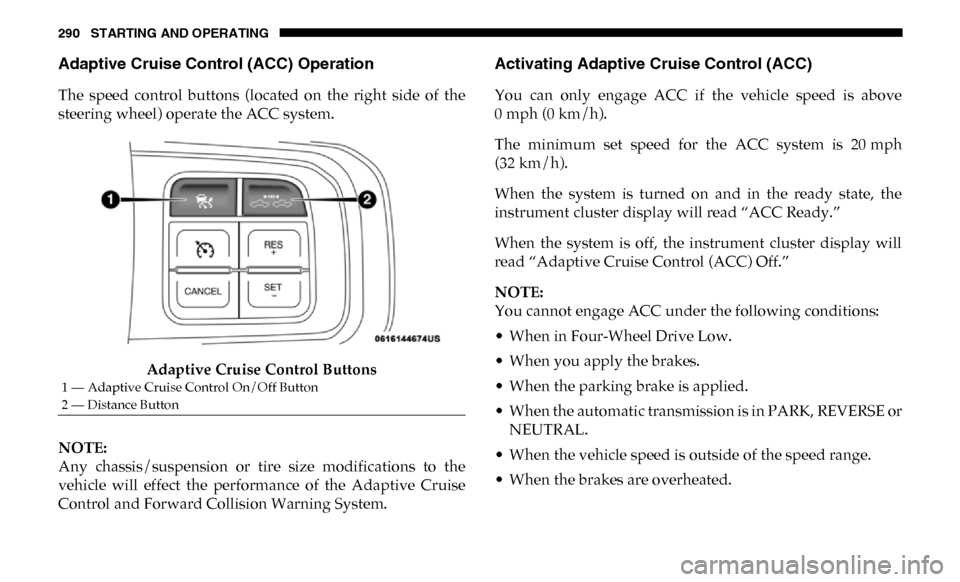
The speed control buttons (located on the right side of the
steering wheel) operate the ACC system.Adaptive Cruise Control Buttons
NOTE:
Any chassis/suspension or tire size modifications to the
vehicle will effect the performance of the Adaptive Cruise
Control and Forward Collision Warning System.
Activating Adaptive Cruise Control (ACC)
You can only engage ACC if the vehicle speed is above
0 mph (0 km/h).
The minimum set speed for the ACC system is 20 mph
(32 km/h).
When the system is turned on and in the ready state, the
instrument cluster display will read “ACC Ready.”
When the system is off, the instrument cluster display will
read “Adaptive Cruise Control (ACC) Off.”
NOTE:
You cannot engage ACC under the following conditions:
• When in Four-Wheel Drive Low.
• When you apply the brakes.
• When the parking brake is applied.
• When the automatic transmission is in PARK, REVERSE or NEUTRAL.
• When the vehicle speed is outside of the speed range.
• When the brakes are overheated.
1 — Adaptive Cruise Control On/Off Button
2 — Distance Button
Page 355 of 607

STARTING AND OPERATING 353
Seven-Pin Connector
Towing Tips
Before setting out on a trip, practice turning, stopping, and
backing up the trailer in an area located away from heavy
traffic.Automatic Transmission
The DRIVE range can be selected when towing. The trans
-
mission controls include a drive strategy to avoid frequent
shifting when towing. However, if frequent shifting does
occur while in DRIVE, select TOW/HAUL mode or select a
lower gear range (using the Electronic Range Select (ERS)
shift control).
NOTE:
Using TOW/HAUL mode or selecting a lower gear range
(using the ERS shift control) while operating the vehicle
under heavy loading conditions will improve performance
and extend transmission life by reducing excessive shifting
and heat build up. This action will also provide better engine
braking.
Six-Speed Automatic Transmission Only
When towing a loaded trailer up steep grades at low speeds
(20 mph [32 km/h] or below), holding your vehicle in first
gear (using the ERS shift control) can help to avoid transmis -
sion overheating.
1 — Battery 5 — Ground
2 — Backup Lamps 6 — Left Stop/Turn
3 — Right Stop/Turn 7 — Running Lamps
4 — Electric Brakes5
Page 356 of 607

354 STARTING AND OPERATING
If you regularly tow a trailer for more than 45 minutes of
continuous operation, then change the automatic transmis-
sion fluid and filter(s) as specified for "police, taxi, fleet, or
frequent trailer towing." Refer to the “Maintenance Plan” for
the proper maintenance intervals.
NOTE:
Check the automatic transmission fluid level before towing
(Six-speed automatic only).
Tow/Haul Mode
To reduce potential for automatic transmission overheating,
activate TOW/HAUL mode when driving in hilly areas, or
select a lower gear range (using the Electronic Range Select
(ERS) shift control) on more severe grades.
Speed Control — If Equipped
• Do not use on hilly terrain or with heavy loads.
• When using the speed control, if you experience speed drops greater than 10 mph (16 km/h), disengage until you
can get back to cruising speed.
• Use speed control in flat terrain and with light loads to maximize fuel efficiency. Cooling System
To reduce potential for engine and transmission over
-
heating, take the following actions:
City Driving
• In city traffic — while stopped, place the transmission in NEUTRAL, but do not increase engine idle speed.
Highway Driving
• Reduce speed.
• Temporarily turn off air conditioning.
Air Suspension System
To aid in attaching/detaching the trailer from the vehicle,
the air suspension system can be used. Refer to “Air Suspen -
sion System” in “Starting And Operating” for further infor -
mation.
NOTE:
The vehicle must remain in the engine running position
while attaching a trailer for proper leveling of the air suspen -
sion system.
Page 359 of 607

STARTING AND OPERATING 357
Over The Road Operation With Snowplow Attached
The blade restricts air flow to the radiator and causes the
engine to operate at higher than normal temperatures.
Therefore, when transporting the plow, angle the blade
completely and position it as low as road or surface condi-
tions permit. Do not exceed 40 mph (64 km/h). The operator
should always maintain a safe stopping distance and allow
adequate passing clearance.
Operating Tips
Under ideal snow plowing conditions, 20 mph (32 km/h)
should be maximum operating speed. The operator should
be familiar with the area and surface to be cleaned. Reduce
speed and use extreme caution when plowing unfamiliar
areas or under poor visibility. General Maintenance
Snowplows should be maintained in accordance with the
plow manufacturer's instructions.
Keep all snowplow electrical connections and battery termi
-
nals clean and free of corrosion.
When plowing snow, to avoid transmission and drivetrain
damage, the following precautions should be observed.
• Operate with transfer case in 4LO when plowing small or congested areas where speeds are not likely to exceed
15 mph (24 km/h). At higher speeds operate in 4HI.
• Vehicles with automatic transmissions should use 4LO range when plowing deep or heavy snow for extended
periods of time to avoid transmission overheating.
• Do not shift the transmission unless the engine has returned to idle and wheels have stopped. Make a practice
of stepping on the brake pedal while shifting the transmis -
sion.
5
Page 360 of 607

358 STARTING AND OPERATING
RECREATIONAL TOWING (BEHIND MOTORHOME, ETC.)
Towing This Vehicle Behind Another Vehicle
NOTE:
• When towing your vehicle, always follow applicable stateand provincial laws. Contact state and provincial
Highway Safety offices for additional details. Towing Condition
Wheels OFF The
Ground Two-Wheel
Drive Models Four-Wheel Drive Models
Flat Tow NONENOT ALLOWED See Instructions
• Automatic transmission in PARK
• Transfer case in NEUTRAL (N)
• Tow in forward direction
Dolly Tow Front
NOT ALLOWED NOT ALLOWED
Rear OK NOT ALLOWED
On Trailer ALLOK OK
Page 361 of 607

STARTING AND OPERATING 359
(Continued)
Recreational Towing — Two-Wheel Drive Models
DO NOT flat tow this vehicle. Damage to the drivetrain
will result.
Recreational towing (for two-wheel drive models) is allowed
ONLY if the rear wheels are OFF the ground. This may be
accomplished using a tow dolly or vehicle trailer. If using a
tow dolly, follow this procedure:
1. Properly secure the dolly to the tow vehicle, following the dolly manufacturer's instructions.
2. Drive the rear wheels onto the tow dolly.
3. Firmly apply the parking brake. Place automatic trans -
mission in PARK.
4. Properly secure the rear wheels to the dolly, following the dolly manufacturer's instructions.
5. Turn the ignition OFF and remove the key fob.
6. Install a suitable clamping device, designed for towing, to secure the front wheels in the straight position.
Recreational Towing — Four-Wheel Drive Models
NOTE:
Both the manual shift and electronic shift transfer cases must
be shifted into NEUTRAL (N) for recreational towing. Auto -
matic transmissions must be shifted into PARK for recre -
ational towing. Refer to the following for the proper transfer
case NEUTRAL (N) shifting procedure for your vehicle. CAUTION!
• Towing with the rear wheels on the ground will cause severe transmission damage. Damage from improper
towing is not covered under the New Vehicle Limited
Warranty.
• Do not disconnect the driveshaft because fluid may leak from the transmission, causing damage to internal
parts.
CAUTION!
• DO NOT dolly tow any 4WD vehicle. Towing with only one set of wheels on the ground (front or rear) will
cause severe transmission and/or transfer case damage.
Tow with all four wheels either ON the ground, or OFF
the ground (using a vehicle trailer).5
Page 362 of 607

360 STARTING AND OPERATING
Shifting Into NEUTRAL (N)
Use the following procedure to prepare your vehicle for
recreational towing.
1. Bring the vehicle to a complete stop on level ground, withthe engine running. Firmly apply the parking brake.
2. Shift the transmission to NEUTRAL.
• Tow only in the forward direction. Towing this vehicle
backwards can cause severe damage to the transfer case.
• Before recreational towing, the transfer case must be in NEUTRAL. To be certain the transfer case is fully in
NEUTRAL, perform the procedure outlined under
“Shifting Into NEUTRAL”. Internal transmission
damage will result, if the transfer case is not in
NEUTRAL during towing.
• The transmission must be placed in PARK for recre -
ational towing.
• Towing this vehicle in violation of the above require -
ments can cause severe transmission and/or transfer
case damage. Damage from improper towing is not
covered under the New Vehicle Limited Warranty.
• Do not disconnect the rear driveshaft because fluid will leak from the transfer case, causing damage to internal
parts.
• Do not use a bumper-mounted clamp-on tow bar on your vehicle. The bumper face bar will be damaged. CAUTION!
(Continued)
WARNING!
You or others could be injured or killed if you leave the
vehicle unattended with the transfer case in the
NEUTRAL (N) position without first fully engaging the
parking brake. The transfer case NEUTRAL (N) position
disengages both the front and rear driveshafts from the
powertrain, and will allow the vehicle to roll, even if the
automatic transmission is in PARK (or manual
transmission is in gear). The parking brake should
always be applied when the driver is not in the vehicle.
CAUTION!
It is necessary to follow these steps to be certain that the
transfer case is fully in NEUTRAL (N) before
recreational towing to prevent damage to internal parts.
Page 363 of 607

STARTING AND OPERATING 361
3. Press and hold the brake pedal.
4. Shift the transfer case into NEUTRAL:• With manual shift transfer case, shift the transfer caselever into NEUTRAL (N).
• With electronic shift transfer case, push and hold the transfer case NEUTRAL (N) button. Some models have
a small, recessed "N" button (at the center of the
transfer case switches) that must be pressed using a
ballpoint pen or similar object. Other models have a
rectangular NEUTRAL switch, below the rotary
transfer case control knob. The NEUTRAL (N) indi -
cator light will blink while the shift is in progress. The
light will stop blinking (stay on solid) when the shift to
NEUTRAL (N) is complete. After the shift is completed
and the NEUTRAL (N) light stays on, release the
NEUTRAL (N) button.
5. Release the parking brake.
6. Shift the transmission into REVERSE.
7. Release the brake pedal for five seconds and ensure that there is no vehicle movement.
8. Repeat steps six and seven with automatic transmission in DRIVE. 9. Shift the transmission to NEUTRAL. Firmly apply the
parking brake. Turn OFF the engine. For vehicles with
Keyless Enter-N-Go, push and hold the ENGINE
START/STOP button until the engine shuts off.
10. Shift the transmission into PARK.
11. Place the ignition in the OFF mode, and remove the key fob.
12. Attach the vehicle to the tow vehicle using a suitable tow bar.
13. Release the parking brake.
NOTE:
With electronic shift transfer case:
• Steps 2 through 3 are requirements that must be met before pushing the NEUTRAL (N) button, and must continue to
be met until the shift has been completed. If any of these
requirements are not met before pushing the NEUTRAL
(N) button or are no longer met during the shift, the
NEUTRAL (N) indicator light will flash continuously until
all requirements are met or until the NEUTRAL (N) button
is released.
5
Page 364 of 607

362 STARTING AND OPERATING
• The ignition must be in the ON/RUN mode for a shift totake place and for the position indicator lights to be oper -
able. If the ignition is not in the ON/RUN mode, the shift
will not take place and no position indicator lights will be
on or flashing.
• A flashing NEUTRAL (N) position indicator light indi -
cates that shift requirements have not been met.
Shifting Out Of NEUTRAL (N)
Use the following procedure to prepare your vehicle for
normal usage:
1. Bring the vehicle to a complete stop, leaving it connected to the tow vehicle.
2. Firmly apply the parking brake.
3. Press and hold the brake pedal.
4. Start the engine, and shift the transmission into NEUTRAL.
• With manual shift transfer case, shift the transfer case lever to the desired position.
• With electronic shift transfer case with rotary selector switch, push and hold the transfer case NEUTRAL (N)
button until the NEUTRAL (N) indicator light turns off. After the NEUTRAL (N) indicator light turns off,
release the NEUTRAL (N) button. After the NEUTRAL
(N) button has been released, the transfer case will shift
to the position indicated by the selector switch.
• With electronic shift transfer case with push-button selector switch, push and hold the switch for the
desired transfer case position, until the NEUTRAL (N)
indicator light turns off and the desired position indi -
cator light turns on.
NOTE:
When shifting out of transfer case NEUTRAL (N), turning
the engine OFF is not required, but may be helpful to avoid
gear clash. With 8-speed automatic transmission, the engine
must remain running, since turning the engine OFF will shift
the transmission to PARK (and the transmission must be in
NEUTRAL for the transfer case to shift out of NEUTRAL).
5. Turn the engine OFF. Shift automatic transmission into PARK. On 8-speed transmissions the shifter will auto -
matically select PARK when the engine is turned off.
6. Release the brake pedal.
7. Disconnect vehicle from the tow vehicle.
8. Start the engine.