fuse Ram 4500 Chassis Cab 2018 User Guide
[x] Cancel search | Manufacturer: RAM, Model Year: 2018, Model line: 4500 Chassis Cab, Model: Ram 4500 Chassis Cab 2018Pages: 529, PDF Size: 5.89 MB
Page 339 of 529

CavityCartridge Fuse Micro Fuse Description
F74 –20 Amp Yellow (Gas
Engine & 1500 LD Diesel) Brake Vacuum Pump Gas/Diesel – If
Equipped
F75 –10 Amp Red Coolant Temperature Valve Actuator
F76 –10 Amp Red Antilock Brakes / Electronic Stability Control
F77 –10 Amp Red Drivetrain Control Module/Front Axle Dis-
connect Module
F78 –10 Amp Red
Engine Control Module / Electric Power
Steering
F79 –15 Amp Blue Clearance Lights
F80 –10 Amp Red Universal Garage Door Opener / Compass
F81 –20 Amp Yellow Trailer Tow Right Turn / Stop Lights
F82 –10 Amp Red Steering Column Control Module / Cruise
Control
F84 –15 Amp Blue Switch Bank / Instrument Cluster
F85 –10 Amp Red Airbag Module
F86 –10 Amp Red Airbag Module
F87 –10 Amp Red Air Suspension – If Equipped / Trailer Tow
/ Steering Column Control Module
F88 –15 Amp Blue Instrument Panel Cluster
F90/F91 –20 Amp Yellow
Power Outlet (Rear Seats) Customer Selectable
7
IN CASE OF EMERGENCY 337
Page 340 of 529
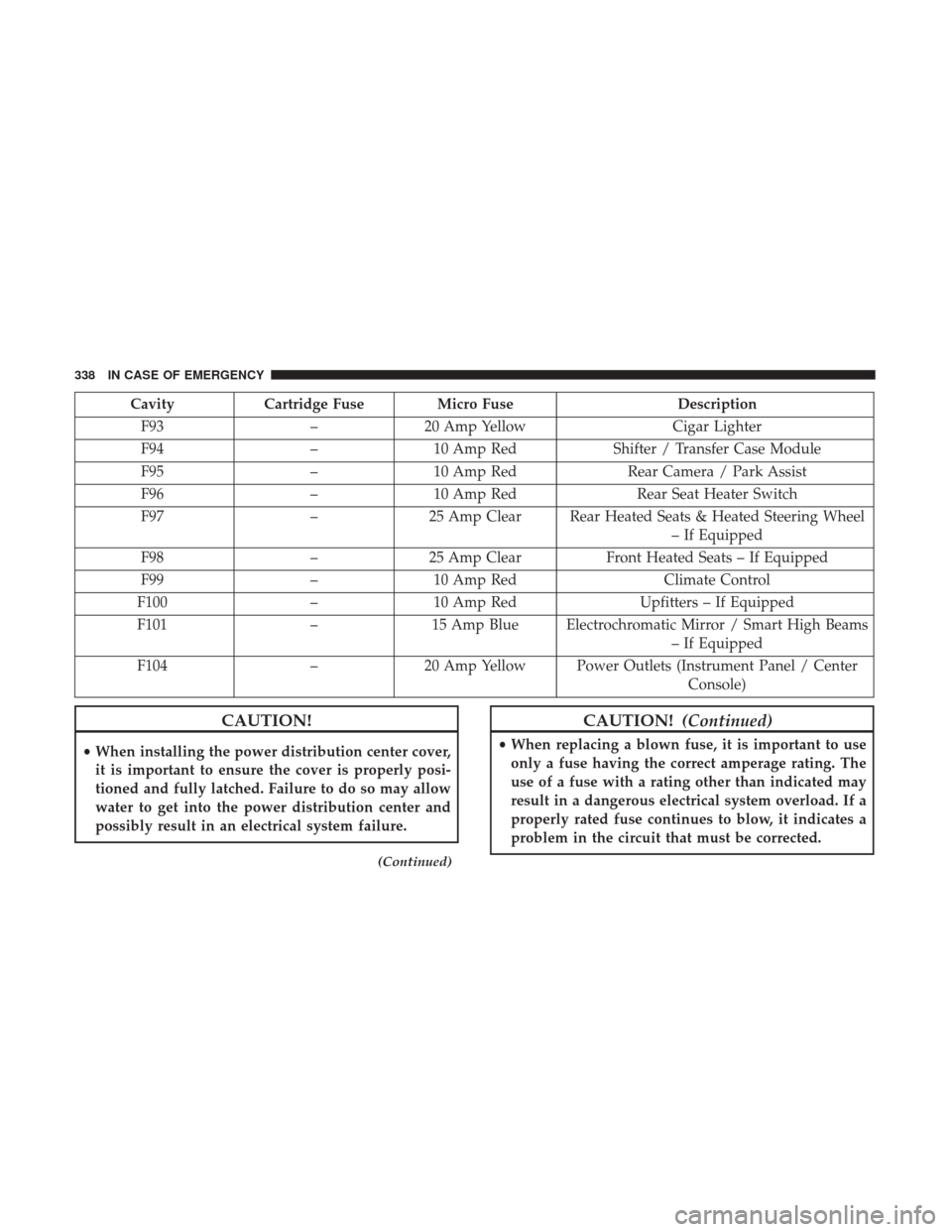
CavityCartridge Fuse Micro Fuse Description
F93 –20 Amp Yellow Cigar Lighter
F94 –10 Amp Red Shifter / Transfer Case Module
F95 –10 Amp Red Rear Camera / Park Assist
F96 –10 Amp Red Rear Seat Heater Switch
F97 –25 Amp Clear Rear Heated Seats & Heated Steering Wheel
– If Equipped
F98 –25 Amp Clear Front Heated Seats – If Equipped
F99 –10 Amp Red Climate Control
F100 –10 Amp Red Upfitters – If Equipped
F101 –15 Amp Blue Electrochromatic Mirror / Smart High Beams
– If Equipped
F104 –20 Amp Yellow Power Outlets (Instrument Panel / Center
Console)
CAUTION!
•When installing the power distribution center cover,
it is important to ensure the cover is properly posi-
tioned and fully latched. Failure to do so may allow
water to get into the power distribution center and
possibly result in an electrical system failure.
(Continued)
CAUTION! (Continued)
•When replacing a blown fuse, it is important to use
only a fuse having the correct amperage rating. The
use of a fuse with a rating other than indicated may
result in a dangerous electrical system overload. If a
properly rated fuse continues to blow, it indicates a
problem in the circuit that must be corrected.
338 IN CASE OF EMERGENCY
Page 348 of 529
Preparations For Jump Start
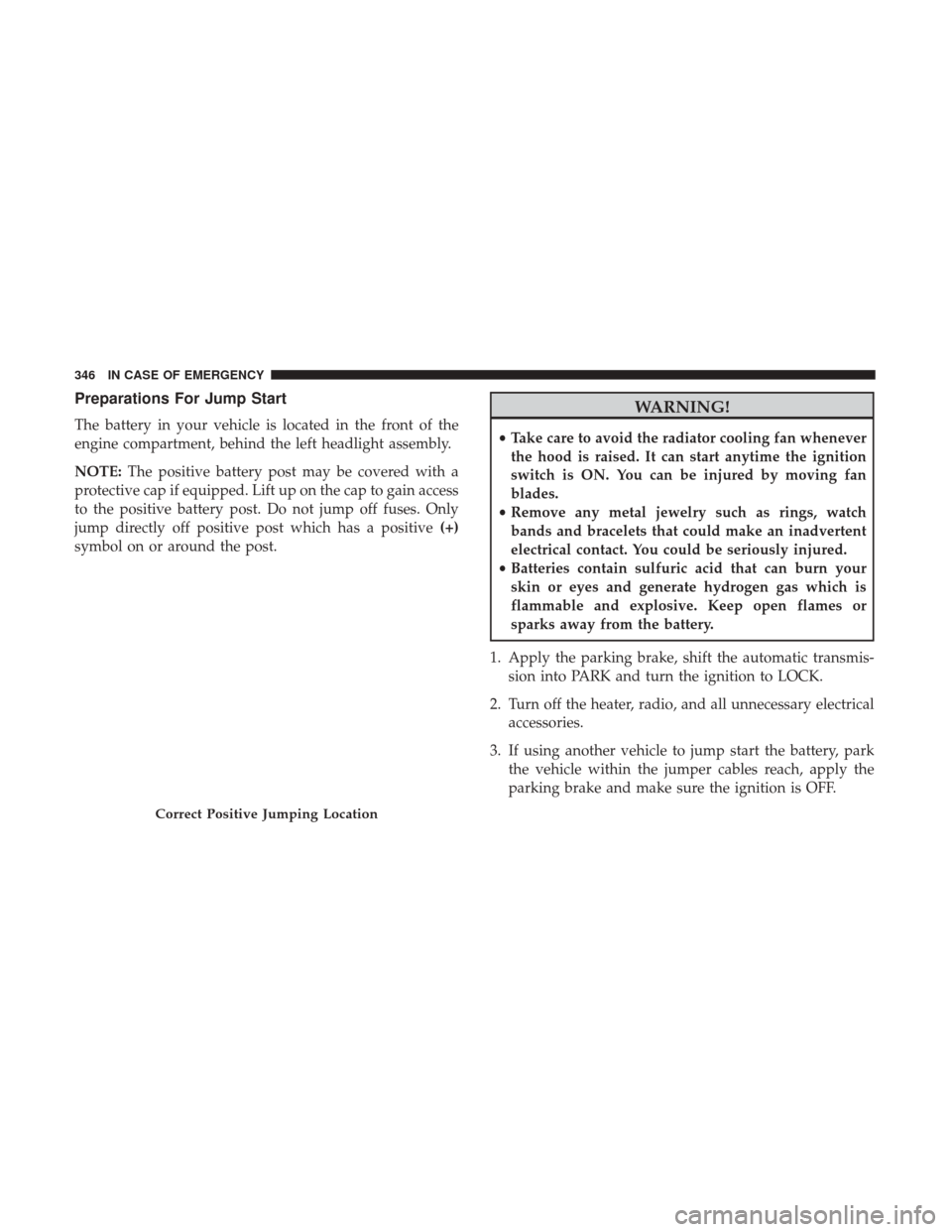
The battery in your vehicle is located in the front of the
engine compartment, behind the left headlight assembly.
NOTE:The positive battery post may be covered with a
protective cap if equipped. Lift up on the cap to gain access
to the positive battery post. Do not jump off fuses. Only
jump directly off positive post which has a positive (+)
symbol on or around the post.
WARNING!
• Take care to avoid the radiator cooling fan whenever
the hood is raised. It can start anytime the ignition
switch is ON. You can be injured by moving fan
blades.
• Remove any metal jewelry such as rings, watch
bands and bracelets that could make an inadvertent
electrical contact. You could be seriously injured.
• Batteries contain sulfuric acid that can burn your
skin or eyes and generate hydrogen gas which is
flammable and explosive. Keep open flames or
sparks away from the battery.
1. Apply the parking brake, shift the automatic transmis- sion into PARK and turn the ignition to LOCK.
2. Turn off the heater, radio, and all unnecessary electrical accessories.
3. If using another vehicle to jump start the battery, park the vehicle within the jumper cables reach, apply the
parking brake and make sure the ignition is OFF.
Correct Positive Jumping Location
346 IN CASE OF EMERGENCY
Page 349 of 529

WARNING!
Do not allow vehicles to touch each other as this could
establish a ground connection and personal injury
could result.
Jump Starting Procedure
WARNING!
Failure to follow this jump starting procedure could
result in personal injury or property damage due to
battery explosion.
CAUTION!
Failure to follow these procedures could result in
damage to the charging system of the booster vehicle
or the discharged vehicle.
Connecting The Jumper Cables
1. Connect the positive (+)end of the jumper cable to the
positive (+)post of the discharged vehicle.
NOTE: Do not jump off fuses. Only jump directly off
positive post. 2. Connect the opposite end of the positive
(+)jumper
cable to the positive (+)post of the booster battery.
3. Connect the negative (-)end of the jumper cable to the
negative (-)post of the booster battery.
4. Connect the opposite end of the negative (-)jumper
cable to a good engine ground (exposed metal part of
the discharged vehicle’s engine) away from the battery
and the fuel injection system.
WARNING!
Do not connect the jumper cable to the negative (-) post
of the discharged battery. The resulting electrical spark
could cause the battery to explode and could result in
personal injury. Only use the specific ground point, do
not use any other exposed metal parts.
5. Start the engine in the vehicle that has the booster battery, let the engine idle a few minutes, and then start
the engine in the vehicle with the discharged battery.
7
IN CASE OF EMERGENCY 347
Page 350 of 529

CAUTION!
Do not connect jumper cable to any of the fuses on the
positive battery terminal. The resulting electrical cur-
rent will blow the fuse.
6. Once the engine is started, remove the jumper cables in the reverse sequence:
Disconnecting The Jumper Cables
1. Disconnect the negative (-)end of the jumper cable from
the engine ground of the vehicle with the discharged
battery.
2. Disconnect the opposite end of the negative (-)jumper
cable from the negative (-)post of the booster battery.
3. Disconnect the positive (+)end of the jumper cable from
the positive (+)post of the booster battery.
4. Disconnect the opposite end of the positive (+)jumper
cable from the positive (+)post of the vehicle with the
discharged battery.
If frequent jump starting is required to start your vehicle
you should have the battery and charging system in-
spected at an authorized dealer.
CAUTION!
Accessories plugged into the vehicle power outlets
draw power from the vehicle’s battery, even when not
in use (i.e., cellular devices, etc.). Eventually, if plugged
in long enough without engine operation, the vehicle’s
battery will discharge sufficiently to degrade battery
life and/or prevent the engine from starting.
IF YOUR ENGINE OVERHEATS
In any of the following situations, you can reduce the
potential for overheating by taking the appropriate action.
• On the highways — slow down.
• In city traffic — while stopped, place the transmission in
NEUTRAL, but do not increase the engine idle speed
while preventing vehicle motion with the brakes.
NOTE: There are steps that you can take to slow down an
impending overheat condition:
• If your air conditioner (A/C) is on, turn it off. The A/C
system adds heat to the engine cooling system and
turning the A/C off can help remove this heat.
348 IN CASE OF EMERGENCY
Page 366 of 529

ENGINE COMPARTMENT
6.4L Engine
1 — Coolant Pressure Bottle6 — Battery
2 — Transmission Dipstick 7 — Power Distribution Center (Fuses)
3 — Engine Oil Fill 8 — Washer Solvent
4 — Engine Oil Dipstick 9 — Power Steering Fluid Reservoir
5 — Brake Fluid Reservoir 10 — Air Cleaner Filter
364 SERVICING AND MAINTENANCE
Page 518 of 529
Exterior Lights......................... .69, 236
Filters Air Cleaner ............................ .368
Air Conditioning ..................... .97, 372
Engine Fuel ........................... .435
Engine Oil ......................... .368, 435
Engine Oil Disposal ...................... .368
Flashers Turn Signal ...................... .75, 158, 236
Flash-To-Pass ..............................72
Flat Tire Stowage .......................... .344
Flooded Engine Starting ..................... .243
Fluid, Brake ............................. .437
Fluid Capacities ........................... .434
Fluid Leaks .............................. .236
Fluid Level Checks Automatic Transmission ....................390
Brake ................................ .388
Power Steering ......................... .269
Fluids And Lubricants ...................... .435
Fog Lights ......................... .74, 157, 328
Fold Flat Load Floor ........................117
Folding Rear Seat ...........................43
Four-Way Hazard Flasher .....................320 Four Wheel Drive
......................... .257
Freeing A Stuck Vehicle ..................... .350
Front Axle (Differential) ..................... .392
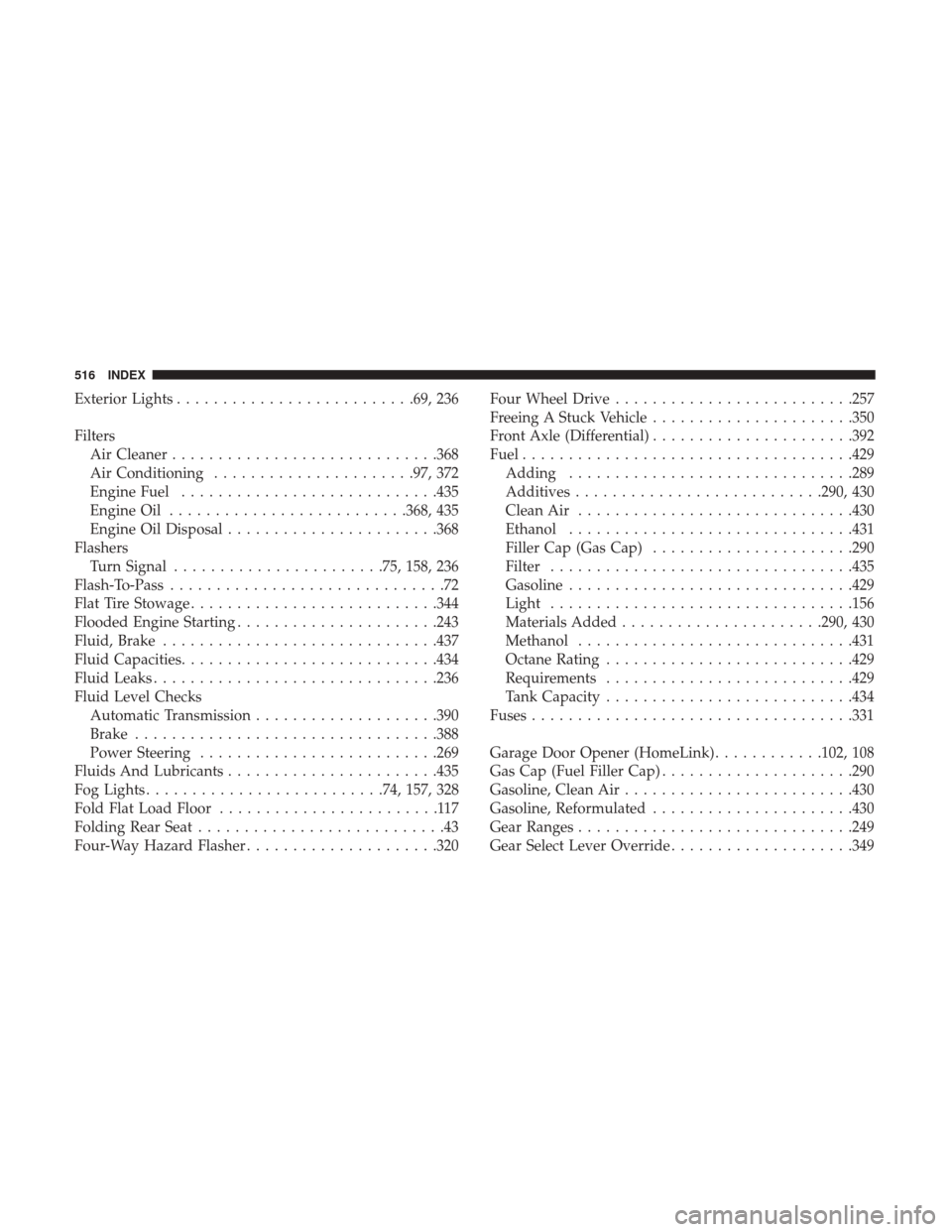
Fuel ................................... .429
Adding .............................. .289
Additives .......................... .290, 430
Clean Air ............................. .430
Ethanol .............................. .431
Filler Cap (Gas Cap) ..................... .290
Filter ................................ .435
Gasoline .............................. .429
Light ................................ .156
Materials Added ..................... .290, 430
Methanol ............................. .431
Octane
Rating .......................... .429
Requirements .......................... .429
Tank Capacity .......................... .434
Fuses .................................. .331
Garage Door Opener (HomeLink) ............102, 108
Gas Cap (Fuel Filler Cap) .....................290
Gasoline, Clean Air ........................ .430
Gasoline, Reformulated ..................... .430
Gear Ranges ............................. .249
Gear Select Lever Override ....................349
516 INDEX
Page 522 of 529

Occupant Restraints........................ .183
Octane Rating, Gasoline (Fuel) .................429
Oil, Engine ........................... .367, 435
Capacity .............................. .434
Change Interval ........................ .367
Dipstick .............................. .365
Disposal .............................. .368
Filter ............................. .368, 435
Filter Disposal .......................... .368
Identification Logo ...................... .367
Materials Added To ...................... .368
Pressure Warning Light ....................152
Recommendation ........................ .367
Synthetic ............................. .368
Viscosity .............................. .368
Oil Filter, Change ......................... .368
Oil Filter, Selection ......................... .368
Oil Pressure Light ......................... .152
Onboard Diagnostic System ...................159
Operating Precautions ...................... .159
Operator Manual (Owner’s Manual) ...............5
Outside Rearview Mirrors .....................62
Overdrive ............................... .255
Overdrive OFF Switch ...................... .255
Overheating, Engine ....................... .348Owner’s Manual (Operator Manual)
...........5,510
Paint Care ............................... .420
Panic Alarm ...............................22
Parking Brake ............................ .245
ParkSense System, Rear ...................273, 280
Passive Entry ..............................37
Pedals, Adjustable ...........................59
Personalized Menu Bar ..................... .441
Personal Settings .......................... .144
Pets ................................... .233
Placard, Tire And Loading Information ...........400
Power Distribution
Center (Fuses) ..................332
Door Locks ..............................37
Mirrors ................................63
Outlet (Auxiliary Electrical Outlet) .........123, 127
Seats ..................................46
Steering ........................... .268, 269
Take-Off Adapter ........................ .266
Take-Off Operation ...................... .266
Windows ...............................99
Power Seats Down .............................. .46, 48
Forward ............................ .46, 48
520 INDEX
Page 528 of 529

INSTALLATION OF RADIO TRANSMITTING
EQUIPMENTSpecial design considerations are incorporated into this
vehicle’s electronic system to provide immunity to radio
frequency signals. Mobile two-way radios and telephone
equipment must be installed properly by trained person-
nel. The following must be observed during installation.
The positive power connection should be made directly
to the battery and fused as close to the battery as possible.
The negative power connection should be made to body
sheet metal adjacent to the negative battery connection.
This connection should not be fused.
Antennas for two-way radios should be mounted on the
roof or the rear area of the vehicle. Care should be used
in mounting antennas with magnet bases. Magnets may
affect the accuracy or operation of the compass on
vehicles so equipped.The antenna cable should be as short as practical and
routed away from the vehicle wiring when possible. Use
only fully shielded coaxial cable.
Carefully match the antenna and cable to the radio to
ensure a low Standing Wave Ratio (SWR).
Mobile radio equipment with output power greater than
normal may require special precautions.
All installations should be checked for possible interfer-
ence between the communications equipment and the
vehicle’s electronic systems.