lock Ram 5500 Chassis Cab 2012 Diesel Supplement
[x] Cancel search | Manufacturer: RAM, Model Year: 2012, Model line: 5500 Chassis Cab, Model: Ram 5500 Chassis Cab 2012Pages: 173, PDF Size: 1.29 MB
Page 67 of 173
Shifting from DRIVE to PARK or REVERSE should be
done only after the accelerator pedal is released and the
vehicle is stopped. Be sure to keep your foot on the brake
pedal when moving the shift lever between these gears.
The transmission shift lever has only PARK, REVERSE,
NEUTRAL, and DRIVE shift positions. Manual down-
shifts can be made using the Electronic Range Select
(ERS) shift control (described later). Pressing the ERS
(-/+) switches (on the shift lever) while in the DRIVE
position will select the highest available transmission
gear, and will display that gear in the instrument cluster
as 6, 5, 4, 3, 2, 1.
Gear Ranges
DO NOT race the engine when shifting from PARK or
NEUTRAL into another gear range.PARK
This range supplements the parking brake by locking the
transmission. The engine can be started in this range.
Never attempt to use PARK while vehicle is in motion.
Apply the parking brake when leaving the vehicle in this
range.
When parking on a level surface, you may place the shift
lever in the PARK position first, and then apply the
parking brake.
When parking on a hill, apply the parking brake before
placing the shift lever in PARK, otherwise the load on the
transmission locking mechanism may make it difficult to
move the shift lever out of PARK. As an added precau-
tion, turn the front wheels toward the curb on a downhill
grade and away from the curb on an uphill grade.
4
STARTING AND OPERATING 65
Page 68 of 173
WARNING!
•Never use the PARK position as a substitute for
the parking brake. Always apply the parking
brake fully when parked to guard against vehicle
movement and possible injury or damage.
•Your vehicle could move and injure you and others
if it is not completely in PARK. Check by trying to
move the shift lever clockwise without first pull-
ing it toward you after you have placed it in PARK.
Make sure the transmission is in PARK before
leaving the vehicle.(Continued)
WARNING! (Continued)
•It is dangerous to move the shift lever out of PARK
or NEUTRAL if the engine speed is higher than
idle speed. If your foot is not firmly pressing on
the brake pedal, the vehicle could accelerate
quickly forward or in reverse. You could lose
control of the vehicle and hit someone or some-
thing. Only shift into gear when the engine is
idling normally and your foot is firmly pressed on
the brake pedal.(Continued)
66 STARTING AND OPERATING
Page 69 of 173
WARNING! (Continued)
•Unintended movement of a vehicle could injure
those in and near the vehicle. As with all vehicles,
you should never exit a vehicle while the engine is
running. Before exiting a vehicle, always apply the
parking brake, shift the transmission into PARK,
and remove the key fob. Once the key fob is
removed, the shift lever is locked in the PARK
position, securing the vehicle against unwanted
movement. Furthermore, you should never leave
unattended children inside a vehicle.
•Never leave children alone in a vehicle. Leaving
unattended children in a vehicle is dangerous for a
number of reasons. A child or others could be
seriously or fatally injured. Do not leave the key
fob in the vehicle. A child could operate power
windows, other controls, or move the vehicle.
CAUTION!
•Before moving the shift lever out of PARK, you
must turn the ignition switch from the LOCK/OFF
position to the ON/RUN position, and also press
the brake pedal. Otherwise, damage to the shift
lever could result.
•DO NOT race the engine when shifting from
PARK or NEUTRAL into another gear range, as
this can damage the drivetrain.
The following indicators should be used to ensure that
you have engaged the shift lever into the PARK position:
•When shifting into PARK, pull the shift lever toward
you and move it all the way counterclockwise until it
stops.
•Release the shift lever and make sure it is fully seated
in the PARK gate.
4
STARTING AND OPERATING 67
Page 73 of 173
2. Shift the transmission into PARK.
3. Turn the ignition switch to the LOCK/OFF position.
4. Wait approximately 10 seconds.
5. Restart the engine.
6. Shift into the desired gear range. If the problem is no
longer detected, the transmission will return to normal
operation.
NOTE:Even if the transmission can be reset, we recom-
mend that you visit your authorized dealer at your
earliest possible convenience. Your authorized dealer has
diagnostic equipment to determine if the problem could
recur.
If the transmission cannot be reset, authorized dealer
service is required.Electronic Range Select (ERS) Operation
The Electronic Range Select (ERS) shift control allows the
driver to limit the highest available gear when the shift
lever is in the DRIVE position. For example, if you shift
the transmission into 3 (third gear), the transmission will
never shift above third gear, but will shift down into
second and first gear normally.
You can switch between DRIVE and ERS mode at any
vehicle speed. When the shift lever is in the DRIVE
position, the transmission will operate automatically,
shifting between all available gears. Tapping the ERS (-)
switch will activate ERS mode, display the current gear in
the instrument cluster, and maintain that gear as the top
available gear. Once in ERS mode, tapping the ERS (-) or
(+) switch will change the top available gear.
4
STARTING AND OPERATING 71
Page 77 of 173
MANUAL TRANSMISSION — IF EQUIPPED
WARNING!
You or others could be injured if you leave the
vehicle unattended without having the parking
brake fully applied. The parking brake should al-
ways be applied when the driver is not in the vehicle,
especially on an incline.
CAUTION!
Never drive with your foot resting on the clutch
pedal, or attempt to hold the vehicle on a hill with the
clutch pedal partially engaged, as this will cause
abnormal wear on the clutch.
NOTE: During cold weather, you may experience in-
creased effort in shifting until the transmission fluid
warms up. This is normal.
Shifting
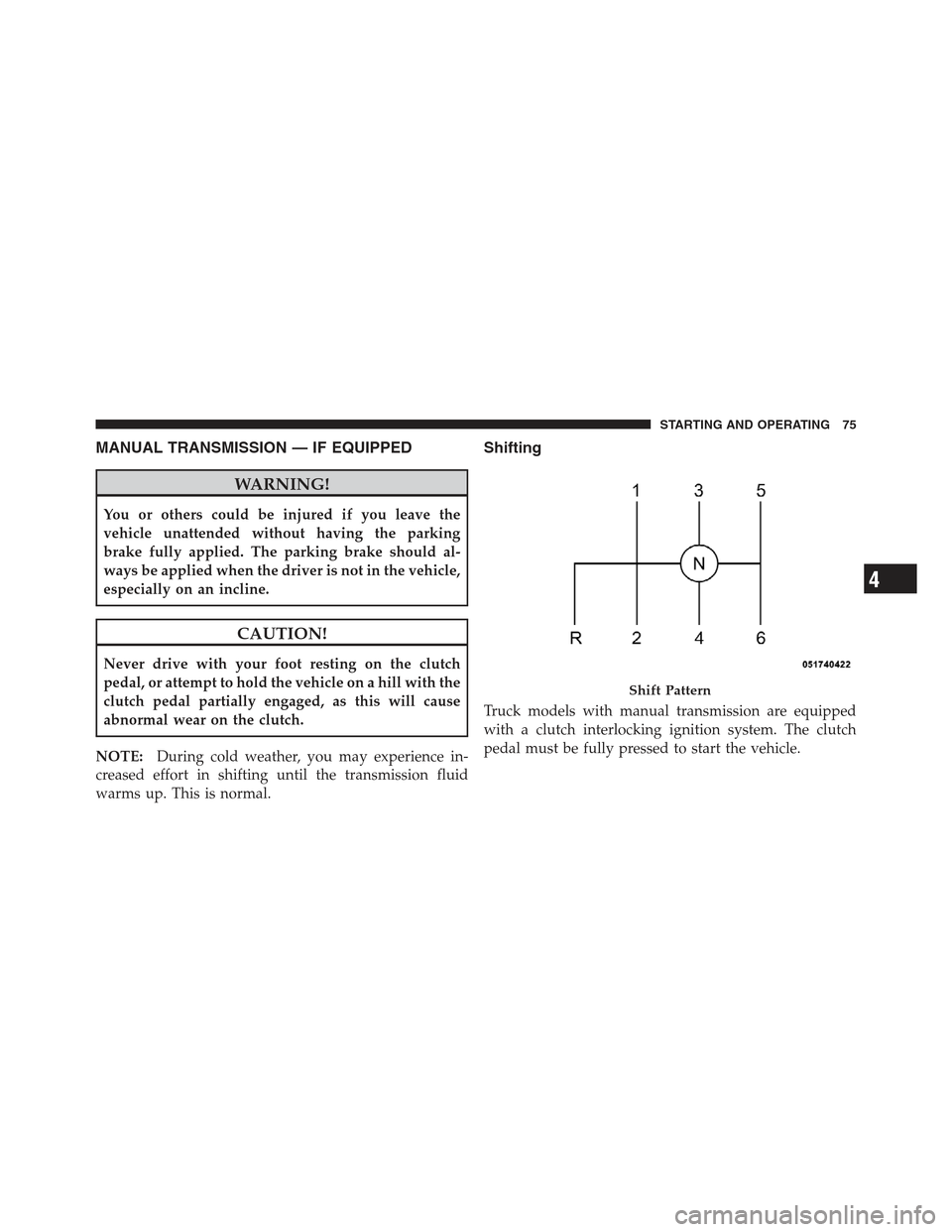
Truck models with manual transmission are equipped
with a clutch interlocking ignition system. The clutch
pedal must be fully pressed to start the vehicle.
Shift Pattern
4
STARTING AND OPERATING 75
Page 81 of 173
Stationary Mode
To operate the PTO in this mode the vehicle must meet
the following conditions:
•Be in PARK position (vehicles equipped with auto-
matic transmission)
•Upfitter provider (on/off) switch has been activated
•Parking brake applied (vehicles equipped with
manual transmission)
•Brake pedal must not be applied
•Vehicle engine must be running
•No vehicle, brake or clutch switch faults present
•PTO must be correctly installed using the vehicle
provided circuits
The customer has the choice to operate the PTO by
utilizing the cruise control switches or by utilizing a remote control (provided by the PTO supplier). To oper-
ate the feature using the cruise control switches, the
customer must first activate the upfitter-provided on/off
switch which will turn on the PTO. In order to increase or
decrease the engine idle speed, to optimize the PTO
function, the “RESUME/ACCEL” and “DECEL” cruise
switches can be used respectively. To disengage PTO
operation and return to “standard vehicle operation”
simply turn the upfitter-provided on/off switch to the
OFF position.
The torque converter lockup clutch will automatically
engage at engine speeds above 1,200 RPM (engine speed)
in PTO stationary mode. Once engaged, the lockup clutch
will remain on and not disengage until the engine speed
is below 1,000 RPM. Lockup clutch engagement is desir-
able for certain types of PTO applications (AS68RC
Six-Speed Automatic Transmission Only).
4
STARTING AND OPERATING 79
Page 95 of 173
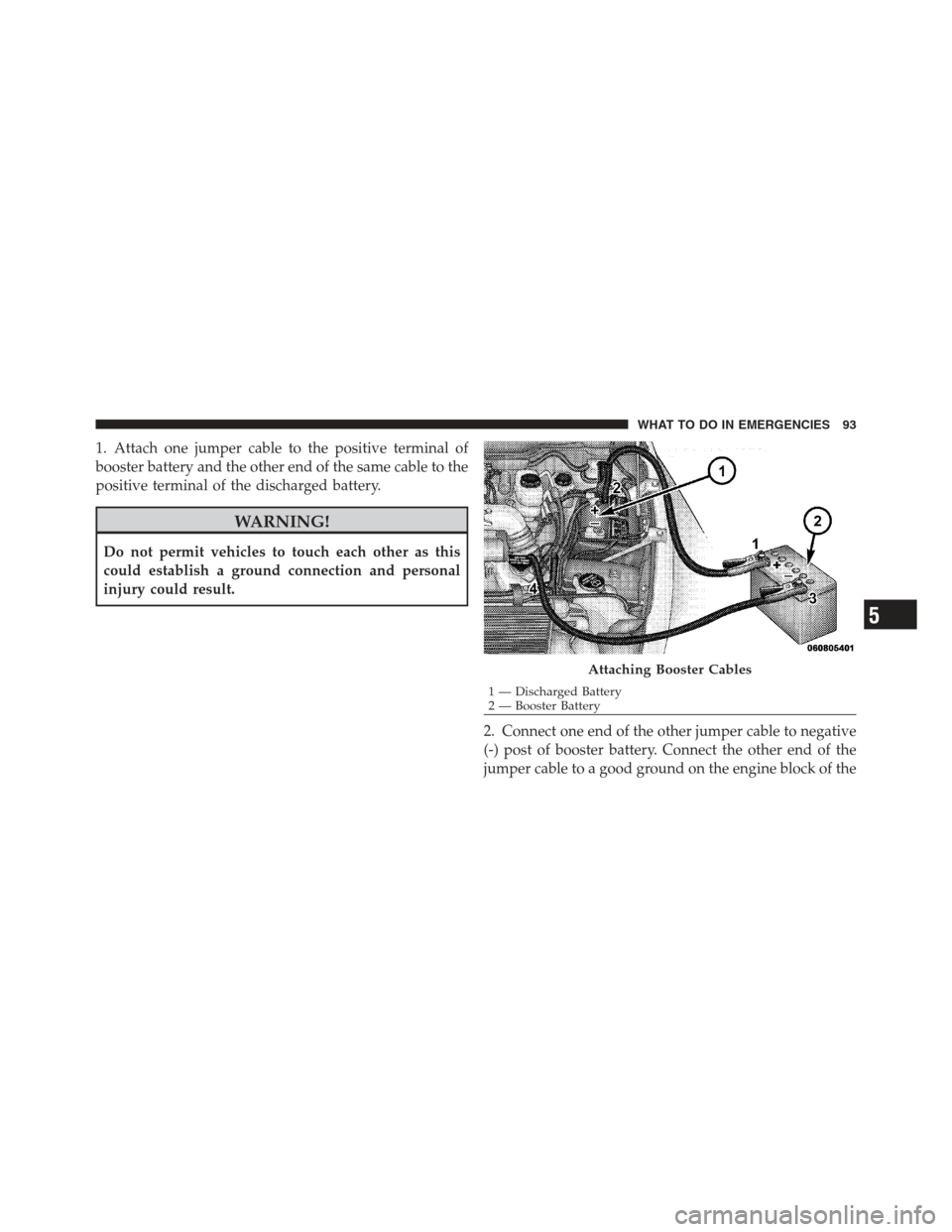
1. Attach one jumper cable to the positive terminal of
booster battery and the other end of the same cable to the
positive terminal of the discharged battery.
WARNING!
Do not permit vehicles to touch each other as this
could establish a ground connection and personal
injury could result.2. Connect one end of the other jumper cable to negative
(-) post of booster battery. Connect the other end of the
jumper cable to a good ground on the engine block of the
Attaching Booster Cables
1 — Discharged Battery
2 — Booster Battery
5
WHAT TO DO IN EMERGENCIES 93
Page 109 of 173
CAUTION!
If the “Water In Fuel Indicator Light” remains on, DO
NOT START the engine before you drain water from
the fuel filter to avoid engine damage.
If the “Water In Fuel Indicator Light” comes on and a
single chime is heard while you are driving, or with the
ignition switch in the ON position, there may be a
problem with your water separator wiring or sensor. See
your authorized dealer for service.
Upon proper draining of the water from the fuel filter, the
“Water In Fuel Indicator Light” will remain illuminated
for approximately 10 seconds. If the water was drained
while the engine was running, the “Water In Fuel Indi-
cator Light” may remain on for approximately three
minutes. NOTE:
Care should be taken in disposing of used fluids
from your vehicle. Used fluids, indiscriminately dis-
carded, can present a problem to the environment. Con-
tact an authorized dealer, service station, or government
agency for advice on recycling programs and for where
used fluids and filters can be properly disposed of in
your area.
Drain the fuel/water separator filter when the “Water In
Fuel Indicator Light” is ON. Within 10 minutes of vehicle
shutdown, turn the drain valve (located on the side of the
filter) counterclockwise 1/4 turn, turn the ignition switch
to the ON position, and allow any accumulated water to
drain. Leave the drain valve open until all water and
contaminants have been removed. When clean fuel is
visible, close the drain valve by turning it clockwise, and
turn the ignition switch to OFF.
6
MAINTAINING YOUR VEHICLE 107
Page 111 of 173
CAUTION! (Continued)
•Do not prefill the fuel filter when installing a new
fuel filter. There is a possibility debris could be
introduced into the fuel filter during this action. It
is best to install the filter dry and allow the in-tank
lift pump to prime the fuel system.
1. Ensure engine is turned off.
2. Place drain pan under the fuel filter drain hose.
3. Open the water drain valve 1/4 turn counterclockwise
and completely drain fuel and water into the approved
container.
4. Close the water drain valve.
5. Remove lid using a socket or strap wrench. Rotate
counterclockwise for removal. Remove used o-ring and
discard it. 6. Remove the used filter cartridge from the housing and
dispose of according to your local regulations.
7. Wipe clean the sealing surfaces of the lid and housing.
8. Install new o-ring back into ring groove on the filter
housing and lubricate with clean engine oil.
9. Remove new filter cartridge from plastic bag and
install into housing.
NOTE:
Do not remove cartridge from bag until you
reach this step in order to keep cartridge clean.
10. Push down on the cartridge to ensure it is properly
seated. Do not pre-fill the filter housing with fuel.
11. Install lid onto housing and tighten to 22.5 ft lbs
(30.5 N.m). Do not overtighten the lid.
12. Prime the engine using the procedure in “Priming If
The Engine Has Run Out Of Fuel.” Then start the engine
and confirm there are no leaks.
6
MAINTAINING YOUR VEHICLE 109
Page 166 of 173
Adding Fuel............................ 83
Air Cleaner, Engine (Engine Air Cleaner
Filter) ............................. 104,129
Air Filter .............................. 104
Airbag Light ............................ 24
Alarm Light ............................ 17
Anti-Lock Warning Light ................... 21
Antifreeze (Engine Coolant) .............. 116,117
Capacities .......................... 133
Disposal ........................... 119
Automatic Transmission .................... 64
Adding Fluid ....................... 125
Fluid Level Check .................... 124
Fluid Type ...................... 124,136
Shifting ............................ 54
Axle Fluid ............................. 136
Battery ............................... 114
Blanket .......................... 43,115Emergency Starting
.................... 92
Brake Fluid ............................ 136
Brake System ........................... 121
Fluid Check ........................ 121
Master Cylinder ..................... 121
Warning Light ....................... 19
Brake/Transmission Interlock ................ 53
Capacities, Antifreeze (Engine Coolant) ........ 133
Capacities, Fluid ........................ 133
Caps, Filler Oil (Engine) ........................ 103
Radiator (Coolant Pressure) ............. 118
Charge Air Cooler ....................... 121
Check Engine Light (Malfunction Indicator
Light) ................................. 23
Coolant Pressure Cap (Radiator Cap) .......... 118
Cooling System ......................... 115
Adding Coolant (Antifreeze) ............. 117
164 INDEX