belt Ram Cargo Van 2012 Owner's Guide
[x] Cancel search | Manufacturer: RAM, Model Year: 2012, Model line: Cargo Van, Model: Ram Cargo Van 2012Pages: 642, PDF Size: 9.7 MB
Page 79 of 642

Because air bag sensors measure vehicle deceleration
over time, vehicle speed and damage by themselves are
not good indicators of whether or not an air bag should
have deployed.
Seat belts are necessary for your protection in all acci-
dents, and also are needed to help keep you in position,
away from an inflating air bag.
The ORC monitors the readiness of the electronic parts of
the air bag system whenever the ignition switch is in the
START or ON/RUN position. If the key is in the OFF
position, in the ACC position, or not in the ignition, the
air bag system is not on and the air bags will not inflate.
The ORC contains a backup power supply system that
may deploy the air bags even if the battery loses power or
it becomes disconnected prior to deployment.Also, the ORC turns on the Air Bag Warning
Light in the instrument panel for approxi-
mately four to eight seconds for a self-check
when the ignition is first turned on. After the
self-check, the Air Bag Warning Light will turn off. If the
ORC detects a malfunction in any part of the system, it
turns on the Air Bag Warning Light, either momentarily
or continuously. A single chime will sound if the light
comes on again after initial startup.
It also includes diagnostics that will illuminate the instru-
ment cluster Air Bag Warning Light if a malfunction is
noted that could affect the air bag system. The diagnos-
tics also record the nature of the malfunction.
2
THINGS TO KNOW BEFORE STARTING YOUR VEHICLE 77
Page 82 of 642
are not belted and seated properly, or if items are
positioned in the area where the side curtain air bag
inflates. This especially applies to children. The side
curtain air bag is only about 3-1/2 in (9 cm) thick when
it is inflated.
Because air bag sensors estimate deceleration over time,
vehicle speed and damage are not good indicators of
whether or not an air bag should have deployed.
NOTE:In a rollover the pretensioners and/or SAB and
SABIC air bags may deploy on both sides of the vehicle.
Front And Side Impact Sensors
In front and side impacts, impact sensors can aid the
ORC in determining appropriate response to impact
events.
Enhanced Accident Response System
In the event of an impact causing air bag deployment, if
the communication network remains intact, and the
power remains intact, depending on the nature of the
event the ORC will determine whether to have the
Enhanced Accident Response System perform the follow-
ing functions:
•Cut off fuel to the engine.
•Flash hazard lights as long as the battery has power or
until the ignition key is turned off.
•Turn on the interior lights, which remain on as long as
the battery has power or until the ignition key is
removed.
•Unlock the doors automatically.
In order to reset the Enhanced Accident Response System
functions after an event, the ignition switch must be
changed from IGN ON to IGN OFF.
80 THINGS TO KNOW BEFORE STARTING YOUR VEHICLE
Page 84 of 642
WARNING!
Deployed air bags and seat belt pretensioners can not
protect you in another collision. Have the air bags,
seat belt pretensioners, and the front seat belt retrac-
tor assemblies replaced by an authorized dealer im-
mediately. Also, have the Occupant Restraint Con-
troller (ORC) system serviced as well.
Maintaining Your Air Bag System
WARNING!
•Modifications to any part of the air bag system
could cause it to fail when you need it. You could
be injured if the air bag system is not there to
protect you. Do not modify the components or
wiring, including adding any kind of badges or
stickers to the steering wheel hub trim cover or the
upper right side of the instrument panel. Do not
modify the front bumper, vehicle body structure,
or add aftermarket side steps or running boards.
•It is dangerous to try to repair any part of the air
bag system yourself. Be sure to tell anyone who
works on your vehicle that it has an air bag system.(Continued)
82 THINGS TO KNOW BEFORE STARTING YOUR VEHICLE
Page 86 of 642
NOTE:If the speedometer, tachometer, or any engine
related gauges are not working, the Occupant Restraint
Controller (ORC) may also be disabled. The air bags may
not be ready to inflate for your protection. Promptly
check the fuse block for blown fuses. Refer to the label
located on the inside of the fuse block cover for the
proper air bag fuses. See your authorized dealer if the
fuse is good.
Event Data Recorder (EDR)
This vehicle is equipped with an event data recorder
(EDR). The main purpose of an EDR is to record, in
certain crash or near crash-like situations, such as an air
bag deployment or hitting a road obstacle, data that will
assist in understanding how a vehicle’s systems per-
formed. The EDR is designed to record data related to
vehicle dynamics and safety systems for a short period of
time, typically 30 seconds or less. The EDR in this vehicle
is designed to record such data as:
•How various systems in your vehicle were operating;
•Whether or not the driver and passenger safety belts
wer e buckled/fastened;
•How far (if at all) the driver was depressing the
accelerator and/or brake pedal; and,
•How fast the vehicle was traveling.
These data can help provide a better understanding of
the circumstances in which crashes and injuries occur.
NOTE: EDR data are recorded by your vehicle only if a
non-trivial crash situation occurs; no data are recorded by
the EDR under normal driving conditions and no per-
sonal data (e.g., name, gender, age, and crash location)
are recorded. However, other parties, such as law en-
forcement, could combine the EDR data with the type of
personally identifying data routinely acquired during a
crash investigation.
84 THINGS TO KNOW BEFORE STARTING YOUR VEHICLE
Page 88 of 642
The infant carrier is only used rearward-facing in the
vehicle. It is recommended for children from birth until
they reach the weight or height limit of the infant carrier.
Convertible child seats can be used either rearward-
facing or forward-facing in the vehicle. Convertible child
seats often have a higher weight limit in the rearward-
facing direction than infant carriers do, so they can be
used rearward-facing by children who have outgrown
their infant carrier but are still less than at least two years
old. Children should remain rearward-facing until they
reach the highest weight or height allowed by their
convertible child seat. Both types of child restraints are
held in the vehicle by the lap/shoulder belt or the
LATCH child restraint anchor system. Refer to “Lower
Anchors and Tether for CHildren (LATCH)”.WARNING!
Rearward-facing child seats must never be used in
the front seat of a vehicle with the front passenger air
bag. An air bag deployment could cause severe
injury or death to infants in this position.
Older Children And Child Restraints
Children who are two years old or who have outgrown
their rear-facing convertible child seat can ride forward-
facing in the vehicle. Forward-facing child seats and
convertible child seats used in the forward-facing direc-
tion are for children who are over two years old or who
have outgrown the rear-facing weight or height limit of
their rear-facing convertible child seat. Children should
remain in a forward-facing child seat with a harness for
as long as possible, up to the highest weight or height
allowed by the child seat. These child seats are also held
86 THINGS TO KNOW BEFORE STARTING YOUR VEHICLE
Page 89 of 642
in the vehicle by the lap/shoulder belt or the LATCH
child restraint anchorage system. Refer to “Lower An-
chors and Tether for CHildren (LATCH)”.
All children whose weight or height is above the
forward-facing limit for the child seat should use a
belt-positioning booster seat until the vehicle’s seat belts
fit properly. If the child cannot sit with knees bent over
the vehicle’s seat cushion while the child’s back is against
the seatback, they should use a belt-positioning booster
seat. The child and belt-positioning booster seat are held
in the vehicle by the lap/shoulder belt.
Children Too Large For Booster Seats
Children who are large enough to wear the shoulder belt
comfortably, and whose legs are long enough to bend
over the front of the seat when their back is against the
seatback, should use the lap/shoulder belt in a rear seat.
•Make sure that the child is upright in the seat.
•The lap portion should be low on the hips and as snug
as possible.
•Check belt fit periodically. A child’s squirming or
slouching can move the belt out of position.
•If the shoulder belt contacts the face or neck, move the
child closer to the center of the vehicle. If this doesn’t
help, move the child to the center rear seating position
and use both the lap and shoulder belt. Never allow a
child to put the shoulder belt under an arm or behind
their back.
NOTE: For additional information, refer to
www.seatcheck.org or call 1–866–SEATCHECK. Cana-
dian residents should refer to Transport Canada’s web-
site for additional information: http://www.tc.gc.ca/
roadsafety/safedrivers/childsafety/index.htm
2
THINGS TO KNOW BEFORE STARTING YOUR VEHICLE 87
Page 90 of 642
WARNING!
•Improper installation can lead to failure of an
infant or child restraint. It could come loose in a
collision. The child could be badly injured or
killed. Follow the manufacturer’s directions ex-
actly when installing an infant or child restraint.
•A rearward-facing child restraint should only be
used in a rear seat. A rearward-facing child re-
straint in the front seat may be struck by a deploy-
ing passenger air bag which may cause severe or
fatal injury to the infant.
Here are some tips on getting the most out of your child
restraint:
•Before buying any restraint system, make sure that it
has a label certifying that it meets all applicable Safety
Standards. Chrysler Group LLC also recommends that you make sure that you can install the child restraint in
the vehicle where you will use it, before you buy it.
•The restraint must be appropriate for your child’s
weight and height. Check the label on the restraint for
weight and height limits.
•Carefully follow the instructions that come with the
restraint. If you install the restraint improperly, it may
not work when you need it.
•Buckle the child into the seat according to the child
restraint manufacturer’s directions.
WARNING!
When your child restraint is not in use, secure it in
the vehicle with the seat belt or remove it from the
vehicle. Do not leave it loose in the vehicle. In a
sudden stop or accident, it could strike the occupants
or seatbacks and cause serious personal injury.
88 THINGS TO KNOW BEFORE STARTING YOUR VEHICLE
Page 92 of 642
Installing The LATCH-Compatible Child Restraint
System
Each vehicle, except commercial cargo vehicles,
is equipped with the child restraint anchorage
system called LATCH, which stands for Lower
Anchors and Tether for CHildren. Two LATCH
child restraint anchorage systems are installed on all
second-row seats and in the center position on all third
row fold-in-floor seats. Second-row seats also feature
tether strap anchorages, located in the rear surface of the
seatback. In addition, all third row fold-in-floor seats are
equipped with a child restraint tether anchor at the center
seating position. NOTE:
•When using the LATCH attaching system to install a
child restraint, please ensure that all seat belts not
being used for occupant restraints are stowed and out
of reach of children. It is recommended that before
installing the child restraint, buckle the seat belt so the
seat belt is tucked behind the child restraint and out of
reach. If the buckled seat belt interferes with the child
restraint installation, instead of tucking the seat belt
behind the child restraint, route the seat belt through
the child restraint belt path and then buckle it. This
should stow the seat belt out of the reach of an
inquisitive child. Remind all children in the vehicle
that the seat belts are not toys and should not be
played with, and never leave your child unattended in
the vehicle.
•If your child restraint seat is not LATCH-compatible,
install the restraint using the vehicle seat belts.
90 THINGS TO KNOW BEFORE STARTING YOUR VEHICLE
Page 94 of 642
NOTE:It is recommended to loosen the top tether strap
and route it loosely prior to securing the lower anchors so
the top tether strap is not trapped between the vehicle
seat and child restraint.
3. Attach the lower child restraint attachment straps to
the vehicle’s lower anchor bars. Ensure that the lower
attachment strap is firmly engaged and that the hook is
secure.
4. Tighten the lower attachment strap while firmly push-
ing the child restraint rearward and downward into the
vehicle seat. Remove all slack in the lower attachment
straps. Reference the child restraint instructions for infor-
mation on properly removing slack. Installing the Top Tether Strap
(with either Lower Anchors or Vehicle Seat Belt):
1. Route the top tether strap under the adjustable head
restraint between the steel posts.
2. Provide enough slack (reference child restraint in-
structions) for the tether strap to reach the tether anchor
located near the bottom of the seat back.
3. Clip tether hook to tether anchor. Ensure that the hook
is firmly engaged and secure.
4. Remove all slack and tighten tether strap according to
child restraint manufacturer ’s instructions.
NOTE:
The top tether strap is always to be secured,
regardless of if the child restraint is installed with the
lower anchors or the vehicle seat belt.
92 THINGS TO KNOW BEFORE STARTING YOUR VEHICLE
Page 96 of 642
WARNING!
An incorrectly anchored tether strap could lead to
increased head motion and possible injury to the
child. Use only the anchor positions directly behind
the child seat to secure a child restraint top tether
strap.
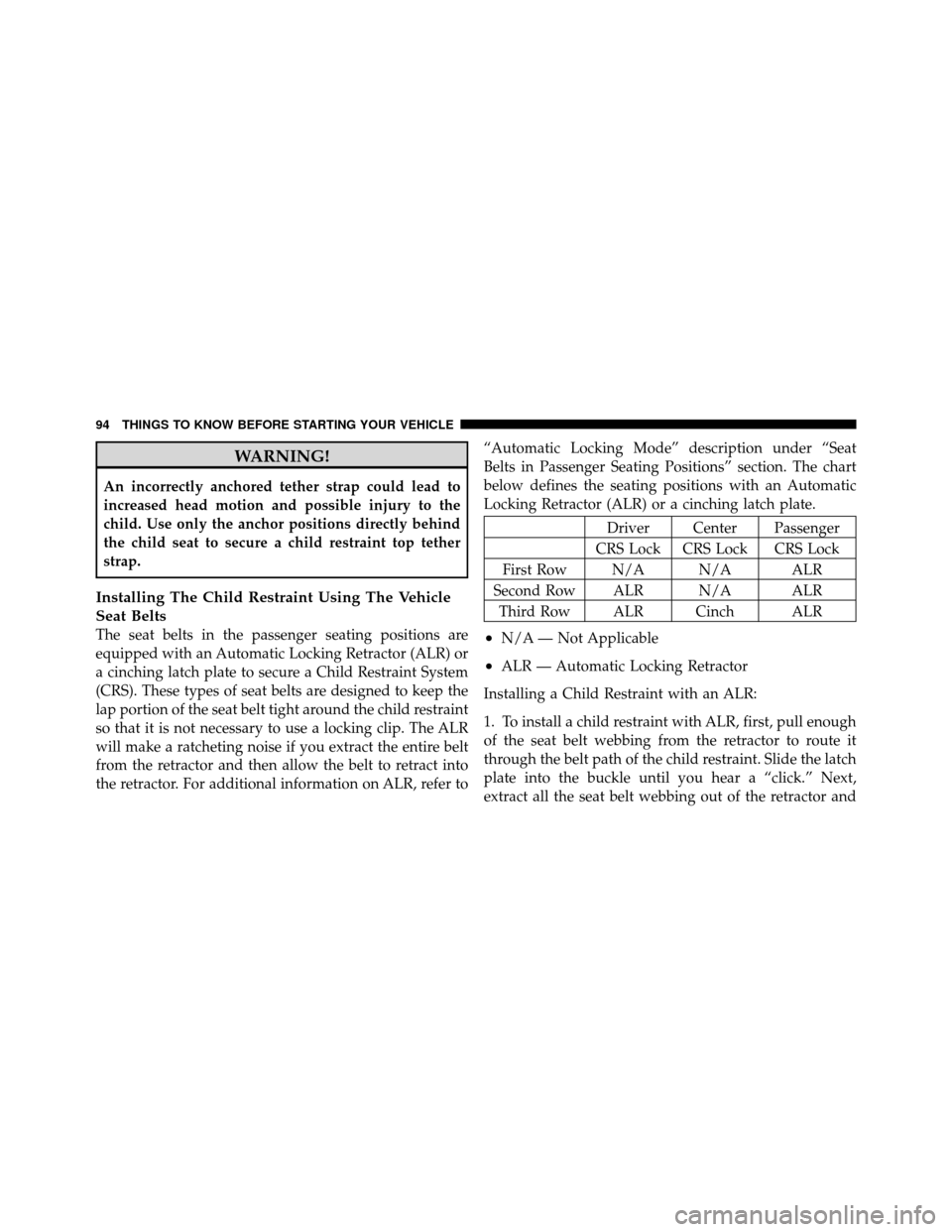
Installing The Child Restraint Using The Vehicle
Seat Belts
The seat belts in the passenger seating positions are
equipped with an Automatic Locking Retractor (ALR) or
a cinching latch plate to secure a Child Restraint System
(CRS). These types of seat belts are designed to keep the
lap portion of the seat belt tight around the child restraint
so that it is not necessary to use a locking clip. The ALR
will make a ratcheting noise if you extract the entire belt
from the retractor and then allow the belt to retract into
the retractor. For additional information on ALR, refer to“Automatic Locking Mode” description under “Seat
Belts in Passenger Seating Positions” section. The chart
below defines the seating positions with an Automatic
Locking Retractor (ALR) or a cinching latch plate.
Driver Center Passenger
CRS Lock CRS Lock CRS Lock
First Row N/A N/A ALR
Second Row ALR N/A ALR Third Row ALR Cinch ALR
•N/A — Not Applicable
•ALR — Automatic Locking Retractor
Installing a Child Restraint with an ALR:
1. To install a child restraint with ALR, first, pull enough
of the seat belt webbing from the retractor to route it
through the belt path of the child restraint. Slide the latch
plate into the buckle until you hear a “click.” Next,
extract all the seat belt webbing out of the retractor and
94 THINGS TO KNOW BEFORE STARTING YOUR VEHICLE