light RAM CHASSIS CAB 2007 Manual PDF
[x] Cancel search | Manufacturer: RAM, Model Year: 2007, Model line: CHASSIS CAB, Model: RAM CHASSIS CAB 2007Pages: 532, PDF Size: 2.69 MB
Page 255 of 532

attempting to start the engine. This can be accomplished
by turning the ignition OFF for at least 5 seconds and
then back ON after the WAIT TO START light has gone
off, but before the engine is started. However, repeated
cycling of the manifold heaters will result in damage to
the heater elements or reduced battery voltage.
NOTE: If multiple pre-heat cycles are used before
starting, additional engine run time may be required to
maintain battery state of charge at a satisfactory level.
• If the engine stalls after the initial start, the ignition
must be turned to the OFF position for at least 5
seconds and then to the ON position to recycle the
manifold heaters.
NOTE: Excessive white smoke and poor engine perfor-
mance will result if manifold heaters are not recycled.
• Heat generated by the manifold heaters dissipates
rapidly in a cold engine. If more than two minutes pass between the time the WAIT TO START light goes
OFF and the engine is started, recycle the manifold
heaters by turning the ignition OFF for at least 5
seconds and then back ON.
• If the vehicle is driven and vehicle speed exceeds 19
mph (31 km) before the manifold heater post-heat
(after start) cycle is complete, the manifold heaters will
shut off.
• If the engine is started before the WAIT TO START
light turns off, the preheat cycle will turn off.
• If the engine is cranked for more than 10 seconds, the
post-heat cycle will turn off.
NOTE: Engine idle speed will automatically increase to
1000 rpm at low coolant temperatures to improve engine
warm-up. STARTING AND OPERATING 255
5
Page 257 of 532

Starting Fluids
WARNING!STARTING FLUIDS or flammable liquids are
NEVER TO BE USED in the Cummins Diesel (see
Warning label). Never pour diesel fuel, flammable
liquid, starting fluids (ether) into the air cleaner
canister, air intake piping, or turbocharger inlet in an
attempt to start the vehicle. This could result in a
flash fire and explosion causing serious personal
injury and engine damage.
The engine is equipped with an automatic electric air
preheating system. If the instructions in this manual are
followed, the engine should start in all conditions. WARNING!Do not leave children or animals inside parked
vehicles in hot weather. Interior heat build up may
cause serious injury or death.
NORMAL OPERATION – DIESEL ENGINE
Observe the following when the engine is operating.
• All message center lights are off.
• Check Engine Lamp is off.
• Engine Oil Pressure is above 10 psi (69 kPa) at idle.
• Low Oil Pressure light is off.
• Voltmeter Operation:
• The voltmeter may show a gauge fluctuation if
certain engine temperatures are below 66°F (19°C).
This cycling operation is caused by the post-heat STARTING AND OPERATING 257
5
Page 270 of 532

• vehicle speed is above approximately 30 mph (48
km/h);
• the “TOW HAUL O/D OFF” switch has not been
activated;
• transmission has reached normal operating tempera-
ture.
NOTE: If the vehicle is started in extremely cold tem-
peratures, the transmission may not shift into Overdrive
and will automatically select the most desirable gear for
operation at this temperature. Normal operation will
resume when the transmission fluid temperature has
risen to a suitable level. Refer also to the Note under torque converter clutch, later in this section.
If the transmission temperature gets extremely hot, the
transmission will automatically select the most desirable
gear for operation at this temperature. If the transmission
temperature becomes hot enough the TRANS TEMP light
may illuminate and the transmission may downshift out
of Overdrive until the transmission cools down. After
cooldown, the transmission will resume normal opera-
tion.
The transmission will downshift from Overdrive to Drive
if the accelerator pedal is fully depressed at vehicle
speeds above approximately 35 mph (56 km/h).270 STARTING AND OPERATING
Page 271 of 532

When To Use “TOW HAUL” and “O/D OFF”
Modes
When driving in hilly areas, towing a trailer, carrying a
heavy load, etc., and frequent transmission shifting oc-
curs, press the “TOW HAUL O/D OFF” button once to
select TOW HAUL. This will improve performance and reduce the potential for transmission overheating or
failure due to excessive shifting. When operating in
“TOW HAUL” mode, 5th gear is disabled and 2-3 and 3-4
shift patterns are modified. Shifts into Overdrive (4th
gear) are allowed during steady cruise (for improved fuel
economy) and automatic closed-throttle downshifts to
3rd gear (for improved braking) will occur during steady
braking. Pressing the “TOW HAUL O/D OFF” button a
second time to select O/D OFF will disable 4th and 5th
gear completely, which should eliminate any excessive
transmission shifting.
The “TOW HAUL” or “O/D OFF” light will illuminate in
the instrument cluster to indicate when the switch has
been activated. Pressing the switch a third time restores
normal operation. If the “TOW HAUL” or “O/D OFF”
modes are desired, the button must be pressed each time
the engine is started.Tow Haul O/D Off Switch STARTING AND OPERATING 271
5
Page 272 of 532

When To Lock Out Overdrive
When driving in hilly areas, towing a trailer, carrying a
heavy load, etc., and frequent 4–3–4 transmission shifting
occurs, press the “TOW/HAUL” button twice to disable
the overdrive. This will improve performance and reduce
the potential for transmission overheating or failure due
to excessive shifting.
Torque Converter Clutch
A feature, designed to improve fuel economy, has been
included in the automatic transmission on your vehicle.
A clutch within the torque converter engages automati-
cally at calibrated speeds. This may result in a slightly
different feeling or response during normal operation in
high gear. When the vehicle speed drops or during
acceleration when the transmission downshifts to second
gear, the clutch automatically disengages.
NOTE: The torque converter clutch will not engage
until the transmission fluid and engine coolant are warm [usually after 1-3 miles (1.6 - 4.8 km) of driving]. Because
the engine speed is higher when the torque converter
clutch is not engaged, it may seem as if the transmission
is not shifting into Overdrive when cold. This is normal.
Pressing the “TOW/HAUL” button, when the transmis-
sion is sufficiently warm, will demonstrate that the
transmission is able to shift into and out of overdrive.
NOTE: If the vehicle has not been driven in several
days, the first few seconds of operation after shifting the
transmission into gear may seem sluggish. This is due to
the fluid partially draining from the torque converter into
the transmission. This condition is normal and will not
cause damage to the transmission. The torque converter
will refill within five seconds of shifting from Park into
any other gear position.272 STARTING AND OPERATING
Page 274 of 532

WARNING!Your vehicle could move and injure you and others if
it is not completely in P (Park). Check by trying to
move the gearshift lever back and forth without first
pulling it toward you after you have set it in P. Make
sure it is in Park before leaving the vehicle.
WARNING!It is dangerous to shift the selector lever out of “P” or
“N” if the engine speed is higher than idle speed. If
your foot is not firmly on the brake pedal, the
vehicle could accelerate quickly forward or in re-
verse. You could lose control of the vehicle and hit
someone or something. Only shift into gear when
the engine is idling normally and when your right
foot is firmly on the brake pedal. “R” Reverse
Use this range only after the vehicle has come to a
complete stop.
“N” Neutral
Shift to Neutral when the vehicle is standing for pro-
longed periods with the engine running. The engine may
be started in this range. Set the parking brake if you must
leave the vehicle.
“D” Drive
This position provides all forward gears, including 4th
gear direct and 5th or 6th (if equipped) gear overdrive
(see Overdrive Operation). Use this range for most city
and highway driving.
“3” Third
Use this position for driving in slight heavy city traffic or
on mountain roads where more precise speed control is
desirable. Use it also when climbing long grades, and for274 STARTING AND OPERATING
Page 276 of 532

NOTE: If the vehicle is started in extremely cold tem-
peratures, the transmission may not shift into Overdrive
and will automatically select the most desirable gear for
operation at this temperature. Normal operation will
resume when the transmission fluid temperature has
risen to a suitable level. Refer also to the Note under
torque converter clutch, later in this section.
If the transmission temperature gets extremely hot, the
transmission will automatically select the most desirable
gear for operation at this temperature. If the transmission
temperature becomes hot enough the TRANS TEMP light
may illuminate and the transmission may downshift out
of Overdrive until the transmission cools down. After
cooldown, the transmission will resume normal opera-
tion. The transmission will downshift from Overdrive to Drive
if the accelerator pedal is fully depressed at vehicle
speeds above approximately 37 mph (60 km/h) for 6th to
5th and 29 mph (47 km/h) for 5th to 4th.276 STARTING AND OPERATING
Page 277 of 532
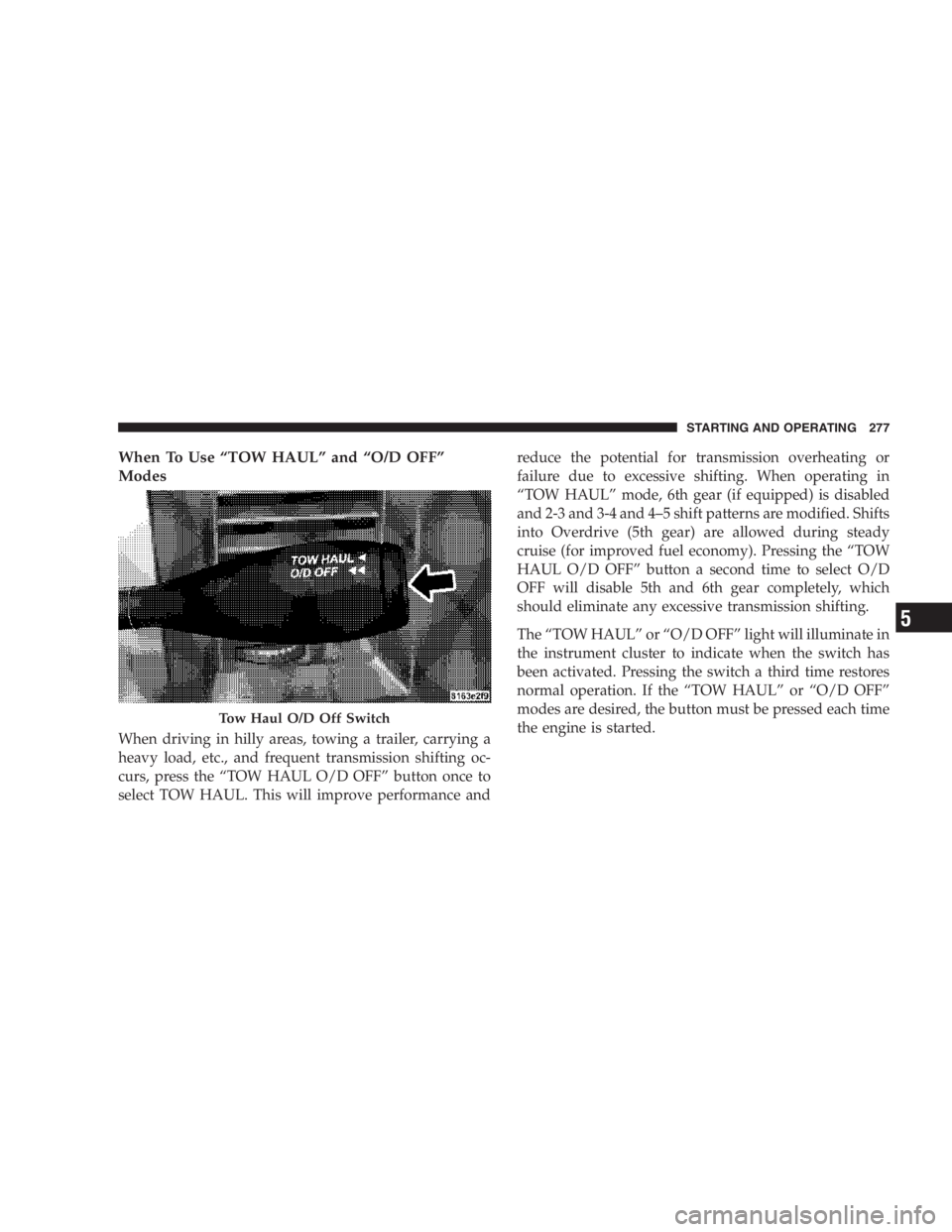
When To Use “TOW HAUL” and “O/D OFF”
Modes
When driving in hilly areas, towing a trailer, carrying a
heavy load, etc., and frequent transmission shifting oc-
curs, press the “TOW HAUL O/D OFF” button once to
select TOW HAUL. This will improve performance and reduce the potential for transmission overheating or
failure due to excessive shifting. When operating in
“TOW HAUL” mode, 6th gear (if equipped) is disabled
and 2-3 and 3-4 and 4–5 shift patterns are modified. Shifts
into Overdrive (5th gear) are allowed during steady
cruise (for improved fuel economy). Pressing the “TOW
HAUL O/D OFF” button a second time to select O/D
OFF will disable 5th and 6th gear completely, which
should eliminate any excessive transmission shifting.
The “TOW HAUL” or “O/D OFF” light will illuminate in
the instrument cluster to indicate when the switch has
been activated. Pressing the switch a third time restores
normal operation. If the “TOW HAUL” or “O/D OFF”
modes are desired, the button must be pressed each time
the engine is started.Tow Haul O/D Off Switch STARTING AND OPERATING 277
5
Page 278 of 532

WARNING!Do not use the Tow/Haul feature when driving in icy
or slippery conditions as the increased engine brak-
ing can cause the rear wheels to slide and the vehicle
to swing around with the possible loss of vehicle
control, which may cause an accident possibly result-
ing in personal injury or death.
When To Lock Out Overdrive
When driving in hilly areas, towing a trailer, carrying a
heavy load, etc., and frequent 6–5–6 or 5–4–5 transmis-
sion shifting occurs, press the “TOW/HAUL” button.
This will improve performance and reduce the potential
for transmission overheating or failure due to excessive
shifting. Torque Converter Clutch
A feature, designed to improve fuel economy, has been
included in the automatic transmission on your vehicle.
A clutch within the torque converter engages automati-
cally at calibrated speeds. This may result in a slightly
different feeling or response during normal operation in
high gear. When the vehicle speed drops or during
acceleration when the transmission downshifts to 1st
gear, the clutch automatically disengages.
NOTE: The torque converter clutch will not engage
until the transmission fluid and engine coolant are warm
[usually after 1-3 miles (1.6 - 4.8 km) of driving]. Because
the engine speed is higher when the torque converter
clutch is not engaged, it may seem as if the transmission
is not shifting into Overdrive when cold. This is normal.
Pressing the “TOW/HAUL” button, when the transmis-
sion is sufficiently warm, will demonstrate that the
transmission is able to shift into and out of overdrive.278 STARTING AND OPERATING
Page 279 of 532

NOTE: If the vehicle has not been driven in several
days, the first few seconds of operation after shifting the
transmission into gear may seem sluggish. This is due to
the fluid partially draining from the torque converter into
the transmission. This condition is normal and will not
cause damage to the transmission. The torque converter
will refill within five seconds of shifting from Park into
any other gear position.
MANUAL TRANSMISSION
WARNING!You or others could be injured if you leave the
vehicle unattended without having the parking
brake fully applied. The parking brake should al-
ways be applied when the driver is not in the
vehicle, especially on an incline. Truck models with manual transmission are equipped
with a clutch interlocking ignition system. The clutch
pedal must be fully depressed to start the vehicle.
Fully depress the clutch pedal before shifting gears. As
you release the clutch pedal, lightly depress the accelera-
tor pedal.
To shift into Reverse, come to a complete stop. Depress
the clutch and pause briefly to allow the gear train to
stop. Move the shift lever from the Neutral position
straight across and back into Reverse.
Never drive with your foot resting on the clutch pedal, or
attempt to hold the vehicle on a hill with the clutch pedal
partially engaged, as this will cause abnormal wear on
the clutch. STARTING AND OPERATING 279
5