light RAM CHASSIS CAB 2007 Owners Manual
[x] Cancel search | Manufacturer: RAM, Model Year: 2007, Model line: CHASSIS CAB, Model: RAM CHASSIS CAB 2007Pages: 532, PDF Size: 2.69 MB
Page 346 of 532
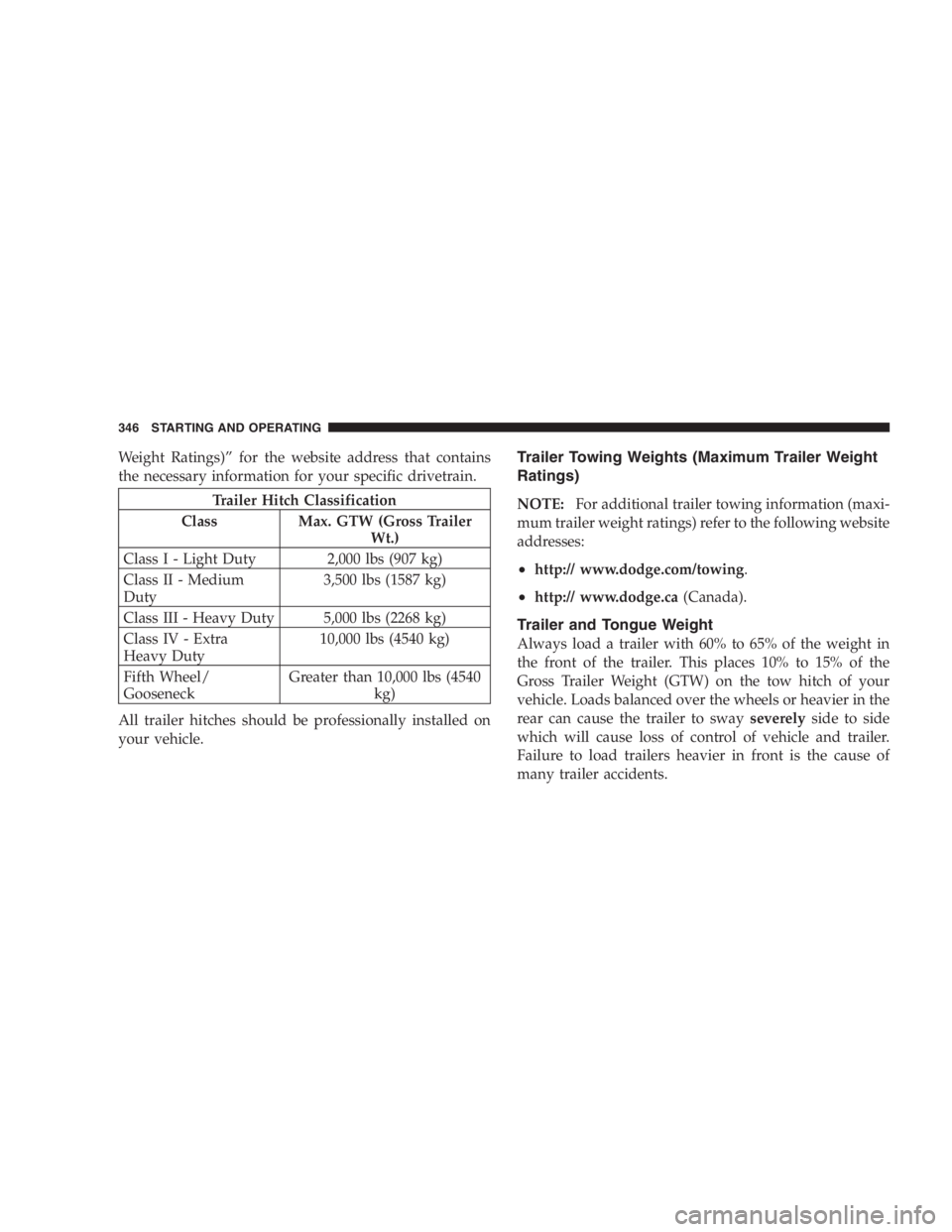
Weight Ratings)” for the website address that contains
the necessary information for your specific drivetrain.
Trailer Hitch Classification
Class Max. GTW (Gross Trailer
Wt.)
ClassI-Light Duty 2,000 lbs (907 kg)
Class II - Medium
Duty 3,500 lbs (1587 kg)
Class III - Heavy Duty 5,000 lbs (2268 kg)
Class IV - Extra
Heavy Duty 10,000 lbs (4540 kg)
Fifth Wheel/
Gooseneck Greater than 10,000 lbs (4540
kg)
All trailer hitches should be professionally installed on
your vehicle. Trailer Towing Weights (Maximum Trailer Weight
Ratings)
NOTE: For additional trailer towing information (maxi-
mum trailer weight ratings) refer to the following website
addresses:
• http:// www.dodge.com/towing .
• http:// www.dodge.ca (Canada).
Trailer and Tongue Weight
Always load a trailer with 60% to 65% of the weight in
the front of the trailer. This places 10% to 15% of the
Gross Trailer Weight (GTW) on the tow hitch of your
vehicle. Loads balanced over the wheels or heavier in the
rear can cause the trailer to sway severely side to side
which will cause loss of control of vehicle and trailer.
Failure to load trailers heavier in front is the cause of
many trailer accidents.346 STARTING AND OPERATING
Page 351 of 532

WARNING!Do not connect trailer brakes to your vehicle’s hy-
draulic brake lines. It can overload your brake sys-
tem and cause it to fail. You might not have brakes
when you need them and could have an accident.
Towing any trailer will increase your stopping dis-
tance. When towing you should allow for additional
space between your vehicle and the vehicle in front
of you. Failure to do so could result in an accident. Towing Requirements — Trailer Lights & Wiring
Whenever you pull a trailer, regardless of the trailer size,
stop lights and turn signals on the trailer are required for
motoring safety.
The Trailer Tow Package may includ ea4and7pin
wiring harness. Use a factory approved trailer harness
and connector.
NOTE: Do not cut or splice wiring into the vehicles
wiring harness. STARTING AND OPERATING 351
5
Page 353 of 532

If using a manual transmission vehicle for trailer towing,
all starts must be in FIRST gear to avoid excessive clutch
slippage.
Towing Tips — Automatic Transmission
The “D” range can be selected when towing. However, if
frequent shifting occurs while in this range, the “TOW
HAUL” or “OD/OFF” range should be selected.
NOTE: Using the “TOW HAUL” or “OD/OFF” range
while operating the vehicle under heavy operating con-
ditions will improve performance and extend transmis-
sion life by reducing excessive shifting and heat build up.
This action will also provide better engine braking.
The automatic transmission fluid and filter should be
changed if you REGULARLY tow a trailer for more than
45 minutes of continuous operation. See Schedule “B” in
section 8 of this manual for transmission fluid change
intervals. NOTE: Check the automatic transmission fluid level
before towing.
Towing Tips — Tow/Haul (If Equipped)
To reduce potential for automatic transmission overheat-
ing, turn the “TOW HAUL OD/OFF” feature ON when
driving in hilly areas or shift the transmission to Drive
position 2 on more severe grades.
Towing Tips — Electronic Speed Control (If
Equipped)
Don’t use in hilly terrain or with heavy loads.
When using the speed control, if you experience speed
drops greater than 10 mph (16 km/h), disengage until
you can get back to cruising speed.
Use speed control in flat terrain and with light loads to
maximize fuel efficiency. STARTING AND OPERATING 353
5
Page 356 of 532

NOTE: Before installation of a snowplow it is highly
recommended that the owner / installer obtain and
follow the recommendations contained within the cur-
rent Dodge BODY BUILDER’S GUIDE. See your dealer,
installer or snowplow manufacture for this information.
There are unique electrical systems that must be con-
nected to properly assure operator safety and prevent
overloading vehicle systems.
WARNING!Attaching a snowplow to this vehicle could ad-
versely affect performance of the airbag system in an
accident. Do not expect that the airbag will perform
as described earlier in this manual CAUTION!The “Lamp Out” indicator could illuminate if exte-
rior lamps are not properly installed.
Before plowing
• Check the hydraulic system for leaks and proper fluid
level.
• Check the mounting bolts and nuts for proper tight-
ness.
• Check the runners and cutting edge for excessive wear.
The cutting edge should be 1/4 to 1/2 inch above
ground in snow plowing position.
• Check that snowplow lighting is connected and func-
tioning properly.356 STARTING AND OPERATING
Page 364 of 532

6. Using the point of a ballpoint pen or similar object,
depress the recessed transfer case Neutral (N) button for
4 seconds.
7. After shift is completed and the Neutral (N) light
comes on release Neutral (N) button.
8. Start engine.
9. Shift automatic transmission into Reverse (R).
10. Release brake pedal for five seconds and ensure that
there is no vehicle movement.
11. Repeat steps 9 and 10 with the transmission in Drive
(D).
12. Shut engine OFF and place ignition key to the
unlocked OFF position.
13. Shift automatic transmission into Park (P).
14. Apply parking brake. 15. Attach vehicle to tow vehicle with tow bar.
16. Release parking brake.
NOTE: Items 1 through 5 are requirements that must be
met prior to depressing the Neutral (N) selection button,
and must continue to be met until the 4 seconds elapses
and the shift has been completed. If any of these require-
ments (with the exception of 3 - Key ON) are not met
prior to depressing the Neutral (N) button or are no
longer met during the 4 second timer, then the Neutral
(N) indicator light will flash continuously until all re-
quirements are met or until the Neutral (N) button is
released.
NOTE: The ignition key must be ON for a shift to take
place and for the position indicator lights to be operable.
If the key in not ON, the shift will not take place and no
position indicator lights will be on or flashing.364 STARTING AND OPERATING
Page 365 of 532

NOTE: Flashing neutral (N) position indicator light
indicates that shift requirements have not been met.
CAUTION!Damage to the transmission may occur if the trans-
mission is shifted into Park (P) with the transfer case
in Neutral (N) and the engine RUNNING. With the
transfer case in Neutral (N) ensure that the engine is
OFF prior to shifting the transmission into Park (P).
Returning to Normal Operation — Electronic Shift
Transfer Case
Use the following procedure to prepare your vehicle for
normal usage.
1. Bring vehicle to a complete stop.
2. Shut OFF the engine. 3. Turn the ignition key to the ON position, but do not
start the engine.
4. Depress the brake pedal.
5. Shift automatic transmission to Neutral (N) or depress
clutch on manual transmission.
6. Using the point of a ballpoint pen or similar object,
depress the recessed transfer case Neutral (N) button for
1 second.
7. After the Neutral (N) indicator light turns off release
the Neutral (N) button.
8. After the Neutral (N) button has been released the
transfer case will shift to the position identified by the
selector switch.
9. Shift automatic transmission into P (Park).
NOTE: The transfer case can not be shifted into Neutral
(N) from the 4Auto (if equipped) position. STARTING AND OPERATING 365
5
Page 366 of 532

NOTE: Items 1 through 5 are requirements that must be
met prior to depressing the Neutral (N) selection button,
and must continue to be met until 1 second elapses and
the shift has been completed. If any of these requirements
(with the exception of 3 - key ON) are not met prior to
depressing the Neutral (N) button or are no longer met
during the 1 second time, then all of the mode position
indicator lights will flash continuously until all require-
ments are met or until the Neutral (N) button is released.
NOTE: The ignition key must be ON for a shift to take
place and for the position indicator lights to be operable.
If the key is not ON, the shift will not take place and no
position indicator lights will be on or flashing.
NOTE: Flashing neutral (N) position indicator light
indicates that shift requirements have not been met. WARNING!You or others could be injured if you leave the
vehicle unattended with the transfer case in the
Neutral (N) position without first fully engaging the
parking brake. The transfer case Neutral (N) position
disengages both the front and rear driveshafts from
the powertrain and will allow the vehicle to move
despite the transmission position. The parking
brake should always be applied when the driver is
not in the vehicle.366 STARTING AND OPERATING
Page 370 of 532

HAZARD WARNING FLASHER
The Hazard Warning switch is mounted on the top of the
steering column as shown in the illustration.
To engage the Hazard Warning lights, depress the button
on the top of the steering column. When the Hazard
Warning switch is activated, all directional turn signals will flash off and on to warn oncoming traffic of an
emergency. Push the button a second time to turn off the
flashers.
This is an emergency warning system and should not be
used when the vehicle is in motion. Use it when your
vehicle is disabled and is creating a safety hazard for
other motorists.
When you must leave the vehicle to seek assistance, the
Hazard Warning lights will continue to operate even
though the ignition switch is OFF.
NOTE: With extended use, the Hazard Warning lights
may discharge your battery.Hazard Light Warning Switch370 WHAT TO DO IN EMERGENCIES
Page 376 of 532

4. By rotating the wheel wrench clockwise, raise the
vehicle until the wheel just clears the surface.
WARNING!Raising the vehicle higher than necessary can make
the vehicle unstable and cause an accident. It could
slip off the jack and hurt someone near it. Raise the
vehicle only enough to remove the tire.
5. Remove the wheel nuts and pull the wheel off. Install
the spare wheel and wheel nuts with the cone shaped end
of the nuts toward the wheel on single rear wheel (SRW)
models. On dual rear wheel models (DRW) the lug nuts
are a two piece assembly with a flat face. Lightly tighten
the nuts. To avoid risk of forcing the vehicle off the jack,
do not fully tighten the nuts until the vehicle has been
lowered. 6. Using the wheel wrench, finish tightening the nuts
using a crisscross pattern. Correct nut tightness is 135 ft.
lbs. (183 N·m) torque for single rear wheel (SRW) models
and 145 ft. lbs. (197 N·m) for dual rear wheel models. If in
doubt about the correct tightness, have them checked
with a torque wrench by your dealer or at a service
station.
WARNING!A loose tire or jack thrown forward in a collision or
hard stop could injure someone in the vehicle.
Always stow the jack parts and the extra tire and
wheel in the places provided.376 WHAT TO DO IN EMERGENCIES
Page 382 of 532

JUMP-STARTING
WARNING!To prevent personal injury or damage to clothing, do
not allow battery fluid to contact eyes, skin or
fabrics. Do not lean over a battery when connecting
jumper cables or allow cable clamps to touch each
other. Keep open flames or sparks away from battery
vent holes. Always wear eye protection when work-
ing with batteries.
Do not use a booster battery or any other booster
source that has a greater than 12 volt system, i.e. do
not use a 24 volt power source. NOTE: Replacement batteries should both be of equal
size to prevent damage to the vehicles charging system.
Your vehicle is equipped with two 12–volt batteries. If it
becomes necessary to use a booster battery, with jumper
cables, to start a vehicle’s engine because its batteries are
discharged, the following procedure should be followed:
Set the parking brake and place an automatic transmis-
sion in PARK (or NEUTRAL for a manual transmission).
Turn off lights, heater and other electrical loads. Observe
charge indicator (if equipped) in both batteries. If indica-
tor (if equipped) is light or yellow on either battery,
replace that battery.382 WHAT TO DO IN EMERGENCIES