lock RAM CHASSIS CAB 2021 Owners Manual
[x] Cancel search | Manufacturer: RAM, Model Year: 2021, Model line: CHASSIS CAB, Model: RAM CHASSIS CAB 2021Pages: 463, PDF Size: 21.5 MB
Page 343 of 463

IN CASE OF EMERGENCY341
1. If equipped, remove the spare wheel, jack,
and tools from storage.
2. Using the lug wrench, loosen, but do not remove, the lug nuts by turning them
counterclockwise one turn while the wheel
is still on the ground.
3. When changing the front wheel, assemble the jack driver to the jack and connect the
jack driver to the extension tube. Place the
jack under the axle as close to the tire as
possible with the jack driver extending to
the front. Connect the extension tubes and
lug wrench.
Front Jacking Locations
When changing a rear wheel, assemble the
jack driver to the jack and connect the jack
driver to the extension tubes. Securely
place the jack under the sway bar bracket
(unless both tires are flat on one side, then
place jack under shock bracket) facing for -
ward in vehicle. Connect the extension
tubes and lug wrench.
Rear Jacking Location
Before raising the wheel off the ground,
make sure that the jack will not damage
surrounding truck parts and adjust the jack
position as required.
NOTE:
If the jack will not lower by turning the dial
(thumbwheel) by hand, it may be necessary to
use the jack driver in order to lower the jack.
4. By rotating the lug wrench clockwise, raise the vehicle until the wheel just clears the
surface.
CAUTION!
Do not attempt to raise the vehicle by jacking
on locations other than those indicated in the
Jacking Instructions for this vehicle.
7
21_DPF_OM_EN_USC_t.book Page 341
Page 344 of 463

342IN CASE OF EMERGENCY
5. Remove the lug nuts and pull the wheel off.
Install the spare wheel and lug nuts with the
cone shaped end of the nuts toward the
wheel on Single Rear-Wheel (SRW) models.
On Dual Rear-Wheel models (DRW) the lug
nuts are a two-piece assembly with a flat
face. Lightly tighten the nuts. To avoid risk
of forcing the vehicle off the jack, do not
fully tighten the nuts until the vehicle has
been lowered.
6. Using the lug wrench, finish tightening the nuts using a crisscross pattern
Úpage 432. If in doubt about the correct
tightness, have them checked with a torque
wrench by an authorized dealer or at a
service station. 7. Install wheel center cap (if equipped) and
remove wheel blocks. Do not install chrome
or aluminum wheel center caps on the
spare wheel. This may result in cap damage.
8. Lower the jack to its fully closed position. If the jack will not lower by turning the dial
(thumbwheel) by hand, it may be necessary
to use the jack driver in order to lower the
jack. Stow the replaced tire, jack, and tools
as previously described.
9. Adjust the tire pressure when possible.
10. After 25 miles (40 km), check the lug nut torque Úpage 432 with a torque wrench to
ensure that all lug nuts are properly seated
against the wheel.
Dual Rear Wheels
Slots in the wheels will assist in properly
orienting the inner and outer wheels. Align
these slots when assembling the wheels
for best access to the tire valve on the inner
wheel. The tires of both dual wheels must be
completely off the ground when tightening to
ensure wheel centering and maximum wheel
clamping.
Dual wheel models require a special heavy-duty
lug nut tightening adapter (included with the
vehicle) to correctly tighten the lug nuts. Also,
when it is necessary to remove and install dual
rear wheels, use a proper vehicle lifting device.
NOTE:
When installing a spare tire (if equipped) as part
of a dual rear wheel end combination, the tire
diameter of the two individual tires must be
compared. If there is a significant difference,
the larger tire should be installed in a front loca-
tion. The correct direction of rotation for dual
tire installations must also be observed.
It is recommended that wheel stud nuts be kept
torqued to specifications at all times. Torque
wheel stud nuts to specifications at each
lubrication interval Ú page 432.WARNING!
Raising the vehicle higher than necessary can
make the vehicle less stable. It could slip off
the jack and hurt someone near it. Raise the
vehicle only enough to remove the tire.
WARNING!
A loose tire or jack thrown forward in a collision
or hard stop, could endanger the occupants of
the vehicle. Always stow the jack parts and the
spare tire in the places provided.
21_DPF_OM_EN_USC_t.book Page 342
Page 350 of 463

348IN CASE OF EMERGENCY
MANUAL PARK RELEASE — 8 – SPEED
TRANSMISSION
In order to move the vehicle in cases where the
transmission will not shift out of PARK (P) (such
as a depleted battery), a Manual Park Release
is available. Follow these steps to activate the Manual Park
Release:
1. Firmly apply the parking brake.
2. Using a small screwdriver or similar tool,
remove the Manual Park Release access
cover, which is just above the parking brake
release handle, below and to the left of the
steering column.
Manual Park Release Cover
3. Press and maintain firm pressure on the brake pedal.
4. Using the screwdriver or similar tool, push the Manual Park Release lever locking tab
(just below the middle of the lever) upwards.
Manual Park Release Pull Strap
5. While holding the locking tab in the disengaged position, pull the tether strap to
rotate the lever rearward, until it locks in
place pointing towards the driver's seat.
Release the locking tab and verify that the
Manual Park Release lever is locked in the
released position.
6. The vehicle is now out of PARK and can be towed. Release the parking brake only when
the vehicle is securely connected to a tow
vehicle.
WARNING!
Always secure your vehicle by fully applying
the parking brake before activating the
Manual Park Release. In addition, you should
be seated in the driver’s seat with your foot
firmly on the brake pedal when activating the
Manual Park Release. Activating the Manual
Park Release will allow your vehicle to roll
away if it is not secured by the parking brake,
or by proper connection to a tow vehicle.
Activating the Manual Park Release on an
unsecured vehicle could lead to serious injury
or death for those in or around the vehicle.
21_DPF_OM_EN_USC_t.book Page 348
Page 351 of 463

IN CASE OF EMERGENCY349
To Reset The Manual Park Release:
1. Push the locking tab to the right, to unlock
the lever.
2. Rotate the Manual Park Release lever forward to its original position, until the
locking tab snaps into place to secure the
lever.
3. Pull gently on the tether strap to confirm that the lever is locked in its stowed
position.
4. Re-install the access cover.
FREEING A STUCK VEHICLE
If your vehicle becomes stuck in mud, sand, or
snow, it can often be moved using a rocking
motion. Turn the steering wheel right and left to
clear the area around the front wheels. Then shift
back and forth between DRIVE (D) and REVERSE
(R), while gently pressing the accelerator. Use the
least amount of accelerator pedal pressure that
will maintain the rocking motion, without
spinning the wheels or racing the engine.
NOTE:
For trucks equipped with an 8–speed trans
-
mission, shifts between DRIVE and REVERSE
can only be achieved at wheel speeds of
5 mph (8 km/h) or less. Whenever the trans -
mission remains in NEUTRAL (N) for more
than two seconds, you must press the brake
pedal to engage DRIVE or REVERSE.
Push the ESC OFF switch, to place the
Electronic Stability Control (ESC) system in
“Partial Off” mode, before rocking the vehicle
Ú
page 274. Once the vehicle has been freed,
push the ESC OFF switch again to restore ESC
On mode.
WARNING!
Fast spinning tires can be dangerous. Forces
generated by excessive wheel speeds may
cause damage, or even failure, of the axle and
tires. A tire could explode and injure someone.
Do not spin your vehicle's wheels faster than
30 mph (48 km/h) or for longer than
30 seconds continuously without stopping
when you are stuck and do not let anyone near
a spinning wheel, no matter what the speed.
CAUTION!
Racing the engine or spinning the wheels
may lead to transmission overheating and
failure. Allow the engine to idle with the
transmission in NEUTRAL for at least one
minute after every five rocking-motion
cycles. This will minimize overheating and
reduce the risk of transmission failure during
prolonged efforts to free a stuck vehicle.
When “rocking” a stuck vehicle by shifting
between DRIVE and REVERSE, do not spin
the wheels faster than 15 mph (24 km/h), or drivetrain damage may result.
Revving the engine or spinning the wheels
too fast may lead to transmission over -
heating and failure. It can also damage the
tires. Do not spin the wheels above 30 mph
(48 km/h) while in gear (no transmission
shifting occurring).
7
21_DPF_OM_EN_USC_t.book Page 349
Page 377 of 463

SERVICING AND MAINTENANCE375
Some conditions can be caused by a faulty
component such as a belt pulley. Belt pulleys
should be carefully inspected for damage and
proper alignment.
Belt replacement on some models requires the
use of special tools, we recommend having your
vehicle serviced at an authorized dealer.
DRAINING FUEL/WATER SEPARATOR
F
ILTER
There are two fuel filter assemblies. One is
located on the driver's side of the engine.
The best access to this water drain valve is from
under the hood. The second one is on the under
body, located in front of the rear axle above the
drive shaft on pick-up models. The Chassis Cab
models second filter location is on the frame
behind the front axle. The best access to this
water drain valve is from under the vehicle. If water is detected in the water separator while
the engine is running, or while the ignition
switch is in the ON position, the “Water In Fuel
Indicator Light” will illuminate and an audible
chime will be heard five times. At this point you
should stop the engine and drain the water from
both of the filters.
If the “Water In Fuel Indicator Light” comes on
and a single chime is heard while you are
driving, or with the ignition switch in the ON
position, there may be a problem with your
water separator wiring or sensor. See an
authorized dealer for service.
Upon proper draining of the water from both
fuel filters, the “Water In Fuel Indicator Light”
will remain illuminated for approximately
10 seconds. If the water was drained while
the engine was running, the “Water In Fuel
Indicator Light” may remain on for
approximately three minutes.NOTE:
Care should be taken in disposing of used fluids
from your vehicle. Used fluids, indiscriminately
discarded, can present a problem to the envi
-
ronment. Contact an authorized dealer, service
station, or government agency for advice on
recycling programs and for where used fluids
and filters can be properly disposed of in your
area.
Drain the fuel/water separator filters when the
“Water In Fuel Indicator Light” is ON. Within
10 minutes of vehicle shutdown, turn the engine
mounted filter drain valve (located on the side of
the filter assembly) counterclockwise a quarter
turn, and turn the under body mounted filter
drain valve (located on the bottom of the filter
assembly) counterclockwise 1 full turn. Then turn
the ignition switch to the ON position, and allow
any accumulated water to drain. Leave the drain
valve open until all water and contaminants have
been removed. When clean fuel is visible, close
the drain valve following these guidelines:
1. Rotate the drain clockwise to close until you feel resistance from the internal seal.
2. Continue turning the drain half of a turn to properly compress the seal.
CAUTION!
Do not drain the fuel/water separator filter
when the engine is running.
Diesel fuel will damage blacktop paving
surfaces. Drain the filter into an appro-
priate container.
CAUTION!
If the “Water In Fuel Indicator Light” remains
on, DO NOT START the engine before you
drain water from the fuel filters to avoid
engine damage.
8
21_DPF_OM_EN_USC_t.book Page 375
Page 378 of 463

376SERVICING AND MAINTENANCE
NOTE:
Over-compression of the seal due to over-tight -
ening of the drain will damage the seal, cause
a leak, and require the entire sensor to be
replaced.
3. Turn the ignition switch to OFF.
The sensor drain should not be over-tightened
during normal service operations to avoid
internal damage and future fuel leaks.
The drain should be closed and secured
without the use of tools.
If more than a couple ounces/milliliters of fuel
have been drained, follow the directions for
“Priming If The Engine Has Run Out Of Fuel”
Ú page 378
ENGINE MOUNTED FUEL FILTER
R
EPLACEMENT
NOTE:
Using a fuel filter that does not meet the
manufacturer's filtration and water sepa -
rating requirements can severely impact fuel
system life and reliability.
The engine mounted filter housing is
equipped with a No-Filter-No-Run (NFNR)
feature. Engine will not run if:
a. No filter is installed.
b. Inferior/Non-approved filter is used. Use of OEM filter is required to ensure
vehicle will run.
Engine Mounted Fuel Filter Assembly
1. Ensure engine is turned off.
2. Place drain pan under the fuel filter drain
hose.
3. Open the water drain valve a quarter turn counterclockwise and completely drain fuel
and water into the approved container.
4. Close the water drain valve.
5. Remove lid using a socket or strap wrench. Rotate counterclockwise for removal.
Remove used o-ring and discard it.
1 — Drain Valve
CAUTION!
Diesel fuel will damage blacktop paving
surfaces. Drain the filter into an appro-
priate container.
Do not prefill the fuel filter when installing a
new fuel filter. There is a possibility debris
could be introduced into the fuel filter
during this action. It is best to install the
filter dry and allow the in-tank lift pump to
prime the fuel system.
21_DPF_OM_EN_USC_t.book Page 376
Page 379 of 463

SERVICING AND MAINTENANCE377
6. Remove the used filter cartridge from the
housing and dispose of according to your
local regulations.
7. Wipe clean the sealing surfaces of the lid and housing.
8. Install new o-ring back into ring groove on the filter housing and lubricate with clean
engine oil.
9. Remove new filter cartridge from plastic bag and install into housing.
NOTE:
Do not remove cartridge from bag until you
reach this step in order to keep cartridge clean.
10. Push down on the cartridge to ensure it is properly seated. Do not pre-fill the filter
housing with fuel.
11. Install lid onto housing and tighten to 22.5 ft lbs (30.5 N.m). Do not overtighten
the lid.
12. Prime the engine Ú page 378. Then start
the engine and confirm there are no leaks.UNDERBODY MOUNTED FUEL FILTER
R
EPLACEMENT
NOTE:
Using a fuel filter that does not meet the
manufacturer's filtration and water sepa -
rating requirements can severely impact fuel
system life and reliability.
The underbody mounted filter housing will
cause the engine not to run if:
a. No filter is installed.
Underbody Mounted Fuel Filter Assembly
1. Ensure engine is turned off.
2. Place drain pan under the fuel filter drain
hose.
3. Open the water drain valve one full turn counterclockwise and completely drain fuel
and water into the approved container.
4. Close the water drain valve.
5. Remove lid using a socket or strap wrench. Rotate counterclockwise for removal.
Remove used o-ring and discard it.
6. Remove the used filter cartridge from the housing and dispose of according to your
local regulations.
1 — Drain Valve
CAUTION!
Diesel fuel will damage blacktop paving
surfaces. Drain the filter into an appro-
priate container.
Do not prefill the fuel filter when installing a
new fuel filter. There is a possibility debris
could be introduced into the fuel filter
during this action. It is best to install the
filter dry and allow the in-tank lift pump to
prime the fuel system.
8
21_DPF_OM_EN_USC_t.book Page 377
Page 382 of 463

380SERVICING AND MAINTENANCE
BODY LUBRICATION
Locks and all body pivot points, including such
items as seat tracks, door hinge pivot points
and rollers, liftgate, tailgate, decklid, sliding
doors and hood hinges, should be lubricated
periodically with a lithium-based grease, such
as Mopar Spray White Lube to ensure quiet,
easy operation and to protect against rust and
wear. Prior to the application of any lubricant,
the parts concerned should be wiped clean to
remove dust and grit; after lubricating excess,
oil and grease should be removed. Particular
attention should also be given to hood latching
components to ensure proper function. When
performing other underhood services, the hood
latch, release mechanism and safety catch
should be cleaned and lubricated.
The external lock cylinders should be lubricated
twice a year, preferably in the Autumn and
Spring. Apply a small amount of a high quality
lubricant, such as Mopar Lock Cylinder
Lubricant directly into the lock cylinder.
WINDSHIELD WIPER BLADES
Clean the rubber edges of the wiper blades and
the windshield periodically with a sponge or soft
cloth and a mild nonabrasive cleaner. This will
remove accumulations of salt or road film.
Operation of the wipers on dry glass for long
periods may cause deterioration of the wiper
blades. Always use washer fluid when using
the wipers to remove salt or dirt from a dry
windshield.
Avoid using the wiper blades to remove frost or
ice from the windshield. Keep the blade rubber
out of contact with petroleum products such as
engine oil, gasoline, etc.
NOTE:
Life expectancy of wiper blades varies
depending on geographical area and frequency
of use. Poor performance of blades may be
present with chattering, marks, water lines
or wet spots. If any of these conditions are
present, clean the wiper blades or replace as
necessary. The wiper blades and wiper arms should be
inspected periodically, not just when wiper
performance problems are experienced.
This inspection should include the following
points:
Wear or uneven edges
Foreign material
Hardening or cracking
Deformation or fatigue
If a wiper blade or wiper arm is damaged,
replace the affected wiper arm or blade with a
new unit. Do not attempt to repair a wiper arm
or blade that is damaged.
Wiper Blade Removal/Installation
CAUTION!
Do not allow the wiper arm to spring back
against the glass without the wiper blade in
place or the glass may be damaged.
21_DPF_OM_EN_USC_t.book Page 380
Page 383 of 463
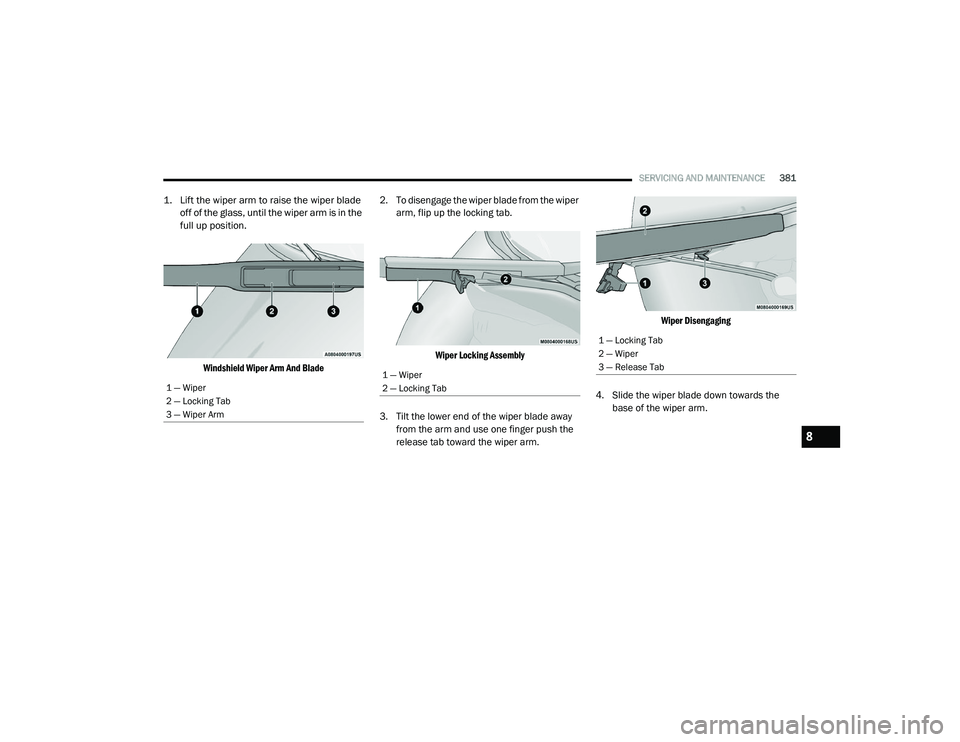
SERVICING AND MAINTENANCE381
1. Lift the wiper arm to raise the wiper blade
off of the glass, until the wiper arm is in the
full up position.
Windshield Wiper Arm And Blade
2. To disengage the wiper blade from the wiper
arm, flip up the locking tab.
Wiper Locking Assembly
3. Tilt the lower end of the wiper blade away from the arm and use one finger push the
release tab toward the wiper arm.
Wiper Disengaging
4. Slide the wiper blade down towards the base of the wiper arm.
1 — Wiper
2 — Locking Tab
3 — Wiper Arm
1 — Wiper
2 — Locking Tab
1 — Locking Tab
2 — Wiper
3 — Release Tab
8
21_DPF_OM_EN_USC_t.book Page 381
Page 384 of 463

382SERVICING AND MAINTENANCE
5. With the wiper blade disengaged, remove
the wiper blade from the wiper arm by
holding the wiper arm with one hand and
separating the wiper blade from the wiper
arm with the other hand (move the wiper
blade down toward the base of the wiper
arm and away from the J hook in the end of
the wiper arm).
Removing Wiper From Wiper Arm
6. Gently lower the wiper arm onto the glass. Installing The Front Wipers
1. Lift the wiper arm off of the glass, until the
wiper arm is in the full up position.
2. Position the wiper blade under the hook on the tip of the wiper arm with the wiper
locking tab open.
3. Insert the receiver bracket on the wiper assembly into the hook on the tip of the arm
through the opening in the wiper blade
under the locking tab.
4. Slide the wiper blade up into the hook on the wiper arm until it is latched
(engagement will be accompanied by an
audible click). Fold down the latch release
tab and snap it into its locked position.
5. Gently lower the wiper blade onto the glass.
EXHAUST SYSTEM
The best protection against carbon monoxide
entry into the vehicle body is a properly
maintained engine exhaust system.
If you notice a change in the sound of the exhaust
system; or if the exhaust fumes can be detected
inside the vehicle; or when the underside or rear
of the vehicle is damaged; have an authorized
technician inspect the complete exhaust system
and adjacent body areas for broken, damaged,
deteriorated, or mispositioned parts. Open
seams or loose connections could permit
exhaust fumes to seep into the passenger
compartment. In addition, have the exhaust
system inspected each time the vehicle is raised
for lubrication or oil change. Replace as required.
1 — Wiper
2 — Locking Tab
3 — Wiper Arm J Hook
WARNING!
Exhaust gases can injure or kill. They
contain carbon monoxide (CO), which is
colorless and odorless. Breathing it can
make you unconscious and can eventually
poison you Ú
page 333.
A hot exhaust system can start a fire if you
park over materials that can burn. Such
materials might be grass or leaves coming
into contact with your exhaust system.
Do not park or operate your vehicle in areas
where your exhaust system can contact
anything that can burn.
21_DPF_OM_EN_USC_t.book Page 382