oil RAM CHASSIS CAB 2021 Repair Manual
[x] Cancel search | Manufacturer: RAM, Model Year: 2021, Model line: CHASSIS CAB, Model: RAM CHASSIS CAB 2021Pages: 463, PDF Size: 21.5 MB
Page 407 of 463
SERVICING AND MAINTENANCE405
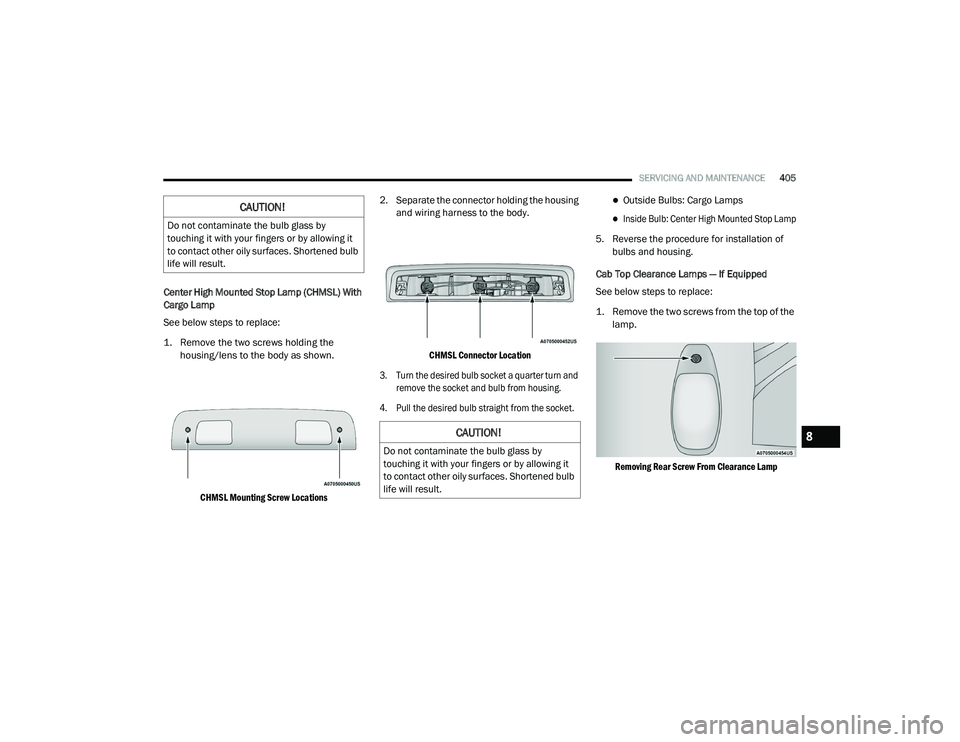
Center High Mounted Stop Lamp (CHMSL) With
Cargo Lamp
See below steps to replace:
1. Remove the two screws holding the
housing/lens to the body as shown.
CHMSL Mounting Screw Locations
2. Separate the connector holding the housing
and wiring harness to the body.
CHMSL Connector Location
3. Turn the desired bulb socket a quarter turn and remove the socket and bulb from housing.
4. Pull the desired bulb straight from the socket.
Outside Bulbs: Cargo Lamps
Inside Bulb: Center High Mounted Stop Lamp
5. Reverse the procedure for installation of bulbs and housing.
Cab Top Clearance Lamps — If Equipped
See below steps to replace:
1. Remove the two screws from the top of the lamp.
Removing Rear Screw From Clearance Lamp
CAUTION!
Do not contaminate the bulb glass by
touching it with your fingers or by allowing it
to contact other oily surfaces. Shortened bulb
life will result.
CAUTION!
Do not contaminate the bulb glass by
touching it with your fingers or by allowing it
to contact other oily surfaces. Shortened bulb
life will result.
8
21_DPF_OM_EN_USC_t.book Page 405
Page 419 of 463
SERVICING AND MAINTENANCE417
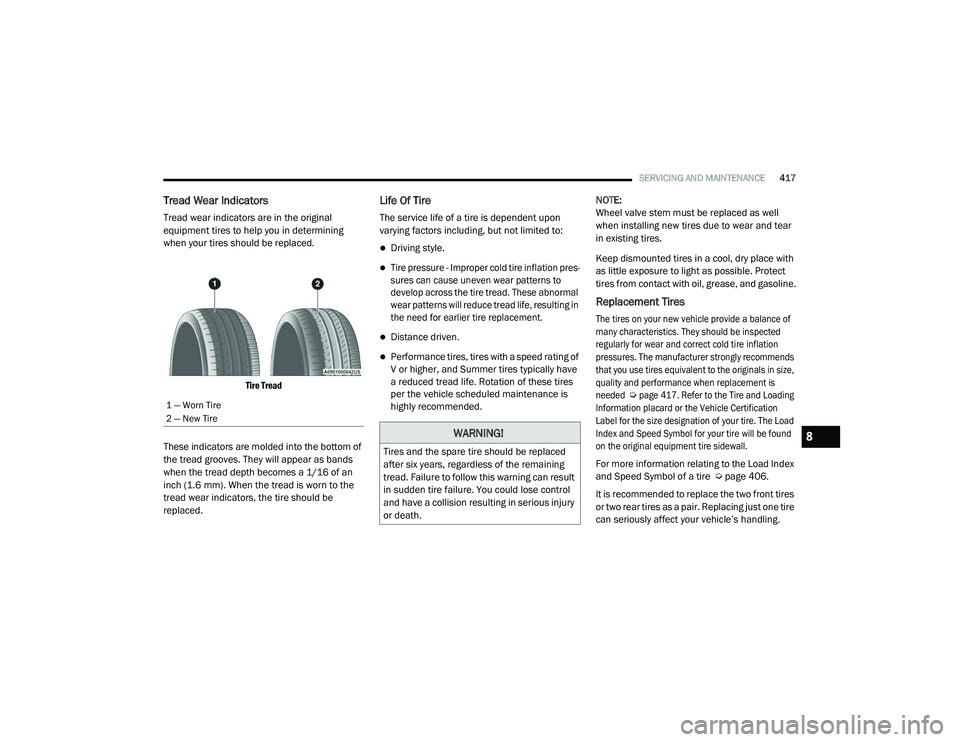
Tread Wear Indicators
Tread wear indicators are in the original
equipment tires to help you in determining
when your tires should be replaced.
Tire Tread
These indicators are molded into the bottom of
the tread grooves. They will appear as bands
when the tread depth becomes a 1/16 of an
inch (1.6 mm). When the tread is worn to the
tread wear indicators, the tire should be
replaced.
Life Of Tire
The service life of a tire is dependent upon
varying factors including, but not limited to:
Driving style.
Tire pressure - Improper cold tire inflation pres -
sures can cause uneven wear patterns to
develop across the tire tread. These abnormal
wear patterns will reduce tread life, resulting in
the need for earlier tire replacement.
Distance driven.
Performance tires, tires with a speed rating of
V or higher, and Summer tires typically have
a reduced tread life. Rotation of these tires
per the vehicle scheduled maintenance is
highly recommended. NOTE:
Wheel valve stem must be replaced as well
when installing new tires due to wear and tear
in existing tires.
Keep dismounted tires in a cool, dry place with
as little exposure to light as possible. Protect
tires from contact with oil, grease, and gasoline.
Replacement Tires
The tires on your new vehicle provide a balance of
many characteristics. They should be inspected
regularly for wear and correct cold tire inflation
pressures. The manufacturer strongly recommends
that you use tires equivalent to the originals in size,
quality and performance when replacement is
needed
Ú
page 417. Refer to the Tire and Loading
Information placard or the Vehicle Certification
Label for the size designation of your tire. The Load
Index and Speed Symbol for your tire will be found
on the original equipment tire sidewall.
For more information relating to the Load Index
and Speed Symbol of a tire Ú page 406.
It is recommended to replace the two front tires
or two rear tires as a pair. Replacing just one tire
can seriously affect your vehicle’s handling.
1 — Worn Tire
2 — New Tire
WARNING!
Tires and the spare tire should be replaced
after six years, regardless of the remaining
tread. Failure to follow this warning can result
in sudden tire failure. You could lose control
and have a collision resulting in serious injury
or death.
8
21_DPF_OM_EN_USC_t.book Page 417
Page 431 of 463

SERVICING AND MAINTENANCE429
Stain Repel Fabric Cleaning Procedure — If
Equipped
Stain Repel seats may be cleaned in the
following manner:
Remove as much of the stain as possible by
blotting with a clean, dry towel.
Blot any remaining stain with a clean, damp
towel.
For tough stains, apply Mopar Total Clean, or
a mild soap solution to a clean, damp cloth
and remove stain. Use a fresh, damp towel to
remove soap residue.
For grease stains, apply Mopar Multi-Purpose
Cleaner to a clean, damp cloth and remove
stain. Use a fresh, damp towel to remove
soap residue.
Do not use any harsh solvents or any other
form of protectants on Stain Repel products.
Seat Belt Maintenance
Do not bleach, dye or clean the belts with
chemical solvents or abrasive cleaners.
This will weaken the fabric. If the belts need cleaning, use a mild soap
solution or lukewarm water. Do not remove the
belts from the vehicle to wash them. Dry with a
soft cloth.
Sun damage can also weaken the fabric.
Replace the belts if they appear frayed or worn
or if the buckles do not work properly.
NOTE:
If the belts retract slowly, inspect the upper
turning loop for soiling. If soiling is present,
clean with a wet soft cloth until all residue is
removed.
PLASTIC AND COATED PARTS
Use Mopar Total Clean to clean vinyl upholstery.
Cleaning Plastic Instrument Cluster
Lenses
The lenses in front of the instruments in this
vehicle are molded in clear plastic. When
cleaning the lenses, care must be taken to
avoid scratching the plastic.
Clean with a wet soft cloth. A mild soap solution
may be used, but do not use high alcohol
content or abrasive cleaners. If soap is used,
wipe clean with a clean damp cloth. Dry with a
soft cloth.
WARNING!
A frayed or torn belt could rip apart in a
collision and leave you with no protection.
Inspect the belt system periodically, checking
for cuts, frays, or loose parts. Damaged parts
must be replaced immediately. Do not
disassemble or modify the system. Seat belt
assemblies must be replaced after a collision
if they have been damaged (i.e., bent
retractor, torn webbing, etc.).
CAUTION!
Direct contact of air fresheners, insect
repellents, suntan lotions, or hand sani
-
tizers to the plastic, painted, or decorated
surfaces of the interior may cause perma -
nent damage. Wipe away immediately.
Damage caused by these type of products
may not be covered by your New Vehicle
Limited Warranty.
8
21_DPF_OM_EN_USC_t.book Page 429
Page 432 of 463

430SERVICING AND MAINTENANCE
LEATHER SURFACES
Mopar Total Clean is specifically recommended
for leather upholstery.
Your leather upholstery can be best preserved by
regular cleaning with a damp soft cloth. Small
particles of dirt can act as an abrasive and
damage the leather upholstery and should be
removed promptly with a damp cloth. Stubborn
soils can be removed easily with a soft cloth and
Mopar Total Clean. Care should be taken to avoid
soaking your leather upholstery with any liquid.
Please do not use polishes, oils, cleaning fluids,
solvents, detergents, or ammonia-based
cleaners to clean your leather upholstery.
NOTE:
If equipped with light colored leather, it tends to
show any foreign material, dirt, and fabric dye
transfer more so than darker colors. The leather
is designed for easy cleaning, and FCA recom
-
mends Mopar total care leather cleaner applied
on a cloth to clean the leather seats as needed.
GLASS SURFACES
All glass surfaces should be cleaned on a
regular basis with Mopar Glass Cleaner, or any
commercial household-type glass cleaner.
Never use an abrasive type cleaner. Use caution
when cleaning the inside rear window equipped
with electric defrosters or windows equipped
with radio antennas. Do not use scrapers or
other sharp instruments that may scratch the
elements.
When cleaning the rear view mirror, spray
cleaner on the towel or cloth that you are using.
Do not spray cleaner directly on the mirror.
CAUTION!
Do not use Alcohol and Alcohol-based and/or
Ketone based cleaning products to clean
leather upholstery, as damage to the
upholstery may result.
21_DPF_OM_EN_USC_t.book Page 430
Page 434 of 463
432TECHNICAL SPECIFICATIONS
WHEEL AND TIRE TORQUE SPECIFICATIONS
Proper lug nut/bolt torque is very important to
ensure that the wheel is properly mounted to the
vehicle. Any time a wheel has been removed and
reinstalled on the vehicle, the lug nuts/bolts
should be torqued using a properly calibrated
torque wrench using a six sided (hex) deep wall
socket.
TORQUE SPECIFICATIONS
**Use only authorized dealer recommended
lug nuts/bolts and clean or remove any dirt or
oil before tightening. Inspect the wheel mounting surface prior to
mounting the tire and remove any corrosion or
loose particles.
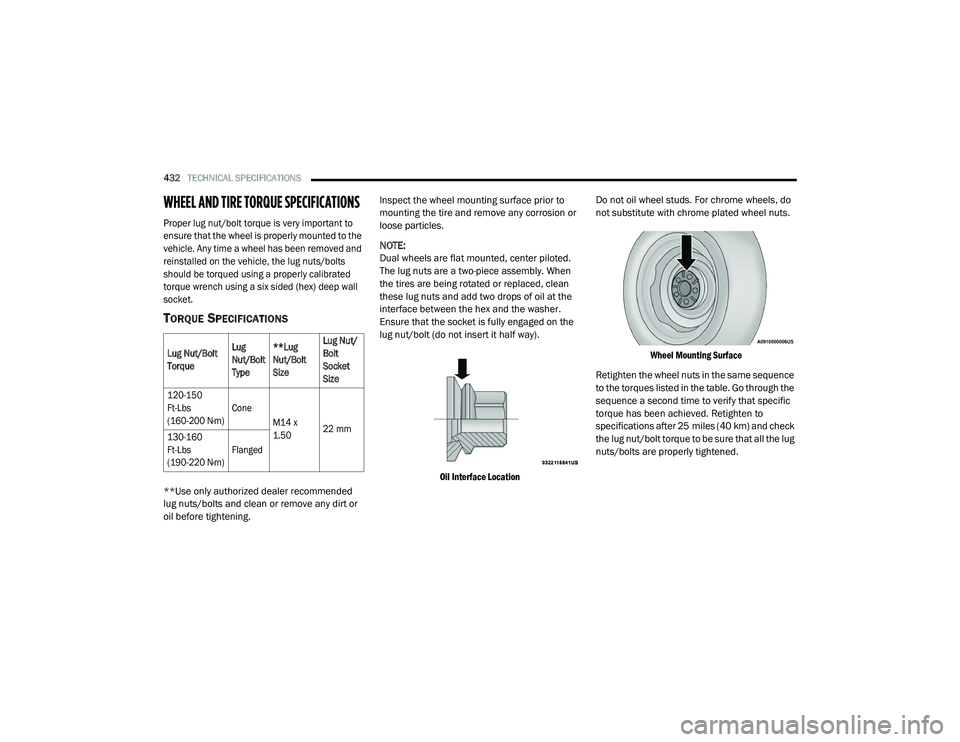
NOTE:
Dual wheels are flat mounted, center piloted.
The lug nuts are a two-piece assembly. When
the tires are being rotated or replaced, clean
these lug nuts and add two drops of oil at the
interface between the hex and the washer.
Ensure that the socket is fully engaged on the
lug nut/bolt (do not insert it half way).
Oil Interface Location
Do not oil wheel studs. For chrome wheels, do
not substitute with chrome plated wheel nuts.
Wheel Mounting Surface
Retighten the wheel nuts in the same sequence
to the torques listed in the table. Go through the
sequence a second time to verify that specific
torque has been achieved. Retighten to
specifications after 25 miles (40 km) and check
the lug nut/bolt torque to be sure that all the lug
nuts/bolts are properly tightened.
Lug Nut/Bolt
Torque
Lug
Nut/Bolt
Type**Lug
Nut/Bolt
Size Lug Nut/
Bolt
Socket
Size
120-150
Ft-Lbs
(160-200 N·m) Cone
M14 x
1.50 22 mm
130-160
Ft-Lbs
(190-220 N·m) Flanged
21_DPF_OM_EN_USC_t.book Page 432
Page 439 of 463

TECHNICAL SPECIFICATIONS437
In addition, commercially available fuel addi -
tives are not necessary for the proper opera -
tion of your Cummins diesel engine. However,
if seasonably adjusted fuel is not available and
you are operating below 20°F (-6°C), Mopar
Premium Diesel Fuel Treatment (or equivalent)
may be beneficial to avoid fuel gelling.
Number 1 Ultra Low Sulfur diesel fuel should
only be used where extended arctic condi -
tions (0°F or -18°C) exist.
BIODIESEL FUEL REQUIREMENTS
Chassis Cab Models
A maximum blend of 5% biodiesel meeting
ASTM specification D975 may be used with
your Cummins diesel engine. If operation with
biodiesel blends greater than 5% but not
greater than 20% (B6-B20) is desired, the truck
must first be reconfigured by an authorized
Ram dealer and the provisions in the following
section must be adhered to.
Pickup Models And Chassis Cab Models
Ordered With B20 Option
Your vehicle has been validated and approved
for the use of biodiesel in blends up to 20%
(B20) provided that you comply with the
requirements outlined below. It is important
that you understand and comply with these
requirements. Failure to comply with Oil Change
requirements for vehicles operating on
biodiesel blends up to B20 will result in
premature engine wear. Such wear is not
covered by the New Vehicle Limited Warranty.
Biodiesel is a fuel produced from renewable
resources typically derived from animal fat,
rapeseed oil (Rapeseed Methyl Ester (RME)
base), or soybean oil (Soy Methyl Ester (SME or
SOME) base). Biodiesel fuel has inherent
limitations which require that you understand
and adhere to the following requirements if you
use blends of biodiesel greater then 5% but not
greater than 20% (B6-B20). There are no
unique restrictions for the use of B5. Use of
blends greater than 20% is not approved. Use of
blends greater than 20% can result in engine
damage. Such damage is not covered by the
New Vehicle Limited Warranty.
Fuel Quality — Must Comply With ASTM
Standards
The quality of biodiesel fuel may vary widely.
Only fuel produced by a BQ9000 supplier to the
following specifications may be blended to
meet biodiesel blend (B6–B20) fuel meeting
ASTM specification D-7467:
Petrodiesel fuel meeting ASTM specification
D-975 and biodiesel fuel (B100) meeting
ASTM specification D-6751.
Fuel Oxidation Stability — Must Use Fuel
Within Six Months Of Manufacture
Biodiesel fuel has poor oxidation stability which
can result in long term storage problems. Fuel
produced to approved ASTM standards, if
stored properly, provides for protection against
fuel oxidation for up to six months.
9
21_DPF_OM_EN_USC_t.book Page 437
Page 440 of 463

438TECHNICAL SPECIFICATIONS
Fuel Water Separation — Must Use Mopar/
Cummins Approved Fuel Filter Elements
You must use Mopar/Cummins approved fuel
filter elements in both your engine mounted
filter and frame mounted filter.
Biodiesel fuel has a natural affinity to water and
water accelerates microbial growth. Your
Mopar/Cummins filtration system is designed
to provide adequate fuel water separation
capabilities.
Bio-Diesel Fuel Properties — Low Ambient
Temperatures
Biodiesel fuel may gel or solidify at low ambient
temperatures, which may pose problems for
both storage and operation. Precautions can be
necessary at low ambient temperatures, such
as storing the fuel in a heated building or a
heated storage tank, or using cold temperature
additives.
Fuel In Oil Dilution — Must Adhere To
Required Oil Change Interval
Fuel dilution of lubricating oil has been observed
with the use of biodiesel fuel. Fuel in oil must not
exceed 5%. To ensure this limit is met your oil
change interval must be maintained to the
following schedule:
Ram 3500/4500/5500 Chassis
Cab — 12,500 Miles (20,000 km)*
(*unless otherwise notified with a oil service
message)
CAUTION!
Under no circumstances should oil change
intervals exceed 12,500 miles (20,000 km)
if operation occurs with greater than 5%
biodiesel blends. Oil change intervals should
not exceed six months in either case. Failure
to comply with these Oil Change require -
ments for vehicles operating on biodiesel
blends up to B20 may result in premature
engine wear. Such wear is not covered by the
New Vehicle Limited Warranty.
B20 Biodiesel capable: The engine may
suffer severe damage if operated with
concentrations of Biodiesel higher than
20%.
21_DPF_OM_EN_USC_t.book Page 438
Page 441 of 463

TECHNICAL SPECIFICATIONS439
FLUID CAPACITIES
6.4L GASOLINE ENGINE
6.7L DIESEL ENGINE
US Metric
Fuel (Approximate)
Standard Rear Tank 52 Gallons197 Liters
Optional Midship Tank 22 Gallons83 Liters
Engine Oil With Filter
6.4L Engine 7 Quarts6.6 Liters
Cooling System
6.4L Engine 16.6 Quarts15.7 Liters
USMetric
Fuel (Approximate)
Standard Rear Tank 52 Gallons197 Liters
Optional Midship Tank 22 Gallons83 Liters
Diesel Exhaust Fluid Tank (Approximate) 8.7 Gallons33 Liters
Engine Oil With Filter
6.7L Turbo Diesel Engine 12 Quarts11.4 Liters
9
21_DPF_OM_EN_USC_t.book Page 439
Page 442 of 463

440TECHNICAL SPECIFICATIONS
ENGINE FLUIDS AND LUBRICANTS
6.4L GASOLINE ENGINE
Cooling System
6.7L Engine Chassis Cab 3500/4500 with AS69RC 22.3 Quarts21.1 Liters
6.7L Engine Chassis Cab 5500 with AS69RC 22.8 Quarts21.6 Liters
USMetric
Component Fluid, Lubricant, or Genuine Part
Engine CoolantWe recommend you use Mopar Antifreeze/Coolant 10–Year/150,000 Mile (240,000 km)
Formula OAT (Organic Additive Technology).
Engine Oil – 6.4L Engine For best performance and maximum protection under all types of operating conditions, the
manufacturer only recommends full synthetic engine oils that meet the American Petroleum
Institute (API) categories of SN. The manufacturer recommends the use of Pennzoil Ultra
0W-40 or equivalent Mopar engine oil meeting the requirements of FCA Material Standard
MS-12633 for use in all operating temperatures.
Engine Oil Filter – 6.4L Engine We recommend you use a Mopar Engine Oil Filter. If a Mopar Engine Oil Filter is unavailable
only use filters that meet or exceed SAE/USCAR-36 Filter Performance Requirements.
Fuel Selection – 6.4L Engine 87 Octane (R+M)/2 Method, 0-15% Ethanol (Do not use E-85).
21_DPF_OM_EN_USC_t.book Page 440
Page 443 of 463

TECHNICAL SPECIFICATIONS441
6.7L DIESEL ENGINE
Component Fluid, Lubricant, or Genuine Part
Engine CoolantWe recommend you use Mopar Antifreeze/Coolant 10 Year/150,000 Mile (240,000 km)
Formula OAT (Organic Additive Technology).
Engine Oil In ambient temperatures above 0°F (-18°C), we recommend you use 10W-30 engine oil such
as Mopar, Shell Rotella and Shell Rimula that meets FCA Material Standard MS-10902 and the
API CK-4 engine oil category is required. Products meeting Cummins CES 20081 may also be
used. The identification of these engine oils is typically located on the back of the oil container.
In ambient temperatures below 0°F (-18°C), we recommend you use 5W-40
synthetic engine
oil such as Mopar, Shell Rotella and Shell Rimula that meets FCA Material Standard MS-10902
and the API CK-4 engine oil category is required.
Engine Oil Filter We recommend you use a Mopar Engine Oil Filter. If a Mopar Engine Oil Filter is unavailable
only use filters that meet or exceed SAE/USCAR-36 Filter Performance Requirements.
Fuel Filters We recommend you use Mopar Fuel Filter. Must meet 3 micron rating (engine mounted filter).
Must meet 5 micron rating (chassis mounted filter).
Using a fuel filter that does not meet the
manufacturer’s filtration and water separating requirements can severely impact fuel system
life and reliability.
Crankcase Ventilation Filter We recommend you use Mopar CCV Filter.
9
21_DPF_OM_EN_USC_t.book Page 441