brake fluid RAM CHASSIS CAB 2021 Owners Manual
[x] Cancel search | Manufacturer: RAM, Model Year: 2021, Model line: CHASSIS CAB, Model: RAM CHASSIS CAB 2021Pages: 463, PDF Size: 21.5 MB
Page 6 of 463
4
ONBOARD DIAGNOSTIC SYSTEM — OBD II ... 116 Onboard Diagnostic System
(OBD II) Cybersecurity ................................116
EMISSIONS INSPECTION AND MAINTENANCE
PROGRAMS ........................................................ 117
STARTING AND OPERATING
STARTING THE ENGINE — GASOLINE
ENGINE ............................................................... 118
Automatic Transmission ............................118
Tip Start Feature .......................................118
Keyless Enter-N-Go — Ignition ...................118Normal Starting Using ENGINE
START/STOP Button .................................119 AutoPark — Rotary Shifter and Eight
Speed Transmission Only ..........................120 Cold Weather Operation
(Below –22°F Or −30°C) .........................122 After Starting ..............................................122
STARTING THE ENGINE — DIESEL ENGINE..... 122
Automatic Transmission ............................123
Keyless Enter-N-Go — Ignition ...................123Extreme Cold Weather...............................125
Normal Starting Procedure — Engine Manifold
Air Temperature Above 66°F (19°C) .......125 Starting Procedure — Engine Manifold
Air Temperature 0°F To 66°F
(–18°C to 19°C)........................................126 Starting Procedure — Engine Manifold Air
Temperature Below 0°F (-18°C) .............. 127 Starting Fluids ............................................ 128
NORMAL OPERATION — DIESEL ENGINE ........128
Cold Weather Precautions ........................ 129
Engine Idling ............................................. 131
Noise........................................................... 132
Stopping The Engine ................................. 133
Idle Shutdown ............................................ 133Programmable Maximum Vehicle
Speed ......................................................... 134 Operating Precautions............................... 134Cooling System Tips .................................. 134Diesel Particulate Filter (DPF) Manual
Regeneration - If Equipped ....................... 135
ENGINE BLOCK HEATER — IF EQUIPPED ........135
ENGINE BREAK-IN RECOMMENDATIONS —
GASOLINE ENGINE ............................................136
ENGINE BREAK-IN RECOMMENDATIONS —
DIESEL ENGINE...................................................137
PARKING BRAKE ............................................... 137
DIESEL EXHAUST BRAKE
(ENGINE BRAKING) ...........................................138
AUTOMATIC TRANSMISSION ............................ 140 Ignition Park Interlock ............................... 141Brake/Transmission Shift Interlock (BTSI)
System ....................................................... 141 Eight-Speed Automatic Transmission — If
Equipped .................................................... 141 Six-Speed Automatic
Transmission — If Equipped ..................... 146 AUXILIARY SWITCHES — IF EQUIPPED ........... 152
FOUR-WHEEL DRIVE OPERATION —
IF EQUIPPED ...................................................... 153
Electronically Shifted Transfer Case (Eight
Speed Transmission) — If Equipped ........ 153 Electronically Shifted Transfer Case
(Six Speed Transmission) — If Equipped .. 156 Manually Shifted Transfer Case —
If Equipped ................................................. 160
LIMITED-SLIP DIFFERENTIAL .......................... 162
POWER TAKE OFF (PTO) OPERATION — IF
EQUIPPED .......................................................... 163
POWER STEERING............................................. 163
Hydraulic Power Steering .......................... 163
CRUISE CONTROL SYSTEMS —
IF EQUIPPED ...................................................... 164
Cruise Control — If Equipped ................... 164
Adaptive Cruise Control (ACC) —
If Equipped ................................................ 166
PARKSENSE FRONT/REAR PARK
ASSIST — IF EQUIPPED ..................................... 177
ParkSense Sensors ................................... 178
ParkSense Warning Display...................... 178
ParkSense Display..................................... 178
Enabling And Disabling ParkSense .......... 181Service The ParkSense Park Assist
System........................................................ 182 Cleaning The ParkSense System.............. 182
ParkSense System Usage Precautions .... 182
21_DPF_OM_EN_USC_t.book Page 4
Page 8 of 463
6
SAFETY
SAFETY FEATURES ............................................ 273
Anti-Lock Brake System (ABS) ................. 273
Electronic Brake Control (EBC) System ...274
AUXILIARY DRIVING SYSTEMS ........................ 281
Forward Collision Warning (FCW) With
Mitigation — If Equipped............................281 Tire Pressure Monitoring
System (TPMS) ..........................................284
OCCUPANT RESTRAINT SYSTEMS .................. 292
Occupant Restraint Systems Features ....292
Important Safety Precautions ...................293Seat Belt Systems ..................................... 293Supplemental Restraint Systems (SRS) ...302Child Restraints..........................................312
SAFETY TIPS ...................................................... 330
Transporting Passengers ..........................330
Transporting Pets ......................................330
Safety Checks You Should Make Inside
The Vehicle ................................................330 Periodic Safety Checks You Should Make
Outside The Vehicle ...................................332 Exhaust Gas ...............................................333Carbon Monoxide Warnings ......................333
IN CASE OF EMERGENCY
HAZARD WARNING FLASHERS .......................334
ASSIST AND SOS SYSTEM — IF EQUIPPED..... 335
JACKING AND TIRE CHANGING ........................339
4500/5500 Models .................................. 339Preparations For Jacking........................... 339
Jacking Instructions 4500 And
5500 Series ............................................... 340 To Stow The Flat Or Spare —
If Equipped ................................................ 343 Hub Caps/Wheel Covers — If Equipped ... 343
JUMP STARTING ................................................ 344
Preparations For Jump Start ..................... 344Jump Starting Procedure .......................... 345
IF YOUR ENGINE OVERHEATS .........................346
GEAR SELECTOR OVERRIDE — 6–SPEED
TRANSMISSION ................................................. 347
MANUAL PARK RELEASE — 8 – SPEED
TRANSMISSION ................................................. 348
FREEING A STUCK VEHICLE .............................349
TOWING A DISABLED VEHICLE ........................350 Two-Wheel Drive Models ........................... 351
Four-Wheel Drive Models .......................... 351Emergency Tow Hooks — If Equipped ...... 352
ENHANCED ACCIDENT RESPONSE
SYSTEM (EARS) ................................................. 352
EVENT DATA RECORDER (EDR) .......................352
SERVICING AND MAINTENANCE
SCHEDULED SERVICING — GASOLINE
ENGINE ................................................................ 353
Maintenance Plan ..................................... 354
SCHEDULED SERVICING — DIESEL ENGINE .. 357
Oil Change Indicator System — Cummins
Diesel.......................................................... 357 Perform Service Indicator — Cummins
Diesel ......................................................... 358 Maintenance Plan — Cummins Diesel
Engine ....................................................... 359
ENGINE COMPARTMENT .................................. 364
6.4L Engine ............................................... 364
6.7L Engine ................................................ 365
Checking Oil Level ..................................... 366
Adding Washer Fluid ................................. 366Maintenance-Free Battery ....................... 366Pressure Washing...................................... 367
VEHICLE MAINTENANCE .................................. 367
Engine Oil .................................................. 368
Engine Oil Filter.......................................... 369
Engine Air Cleaner Filter ........................... 369
Air Conditioner Maintenance ................... 371
Accessory Drive Belt Inspection ............... 374Draining Fuel/Water Separator Filter....... 375Engine Mounted Fuel Filter
Replacement.............................................. 376
21_DPF_OM_EN_USC_t.book Page 6
Page 9 of 463
7
Underbody Mounted Fuel Filter
Replacement ..............................................377 Priming If The Engine Has Run Out
Of Fuel .......................................................378 Intervention Regeneration Strategy —
Message Process Flow .............................379 Diesel Exhaust Fluid ..................................379Body Lubrication ........................................380
Windshield Wiper Blades ..........................380
Exhaust System ........................................382
Cooling System .........................................383
Charge Air Cooler — Inter-Cooler ..............386
Brake System ............................................387
Automatic Transmission ............................387
Rear Axle And 4x4 Front Driving Axle
Fluid Level .................................................. 390 Transfer Case ............................................391
Noise Control System Required
Maintenance & Warranty .........................391
TIRES ................................................................... 406
Tire Safety Information .............................406Tires — General Information .....................414 Tire Types ................................................... 418
Spare Tires — If Equipped ......................... 419
Wheel And Wheel Trim Care .................... 421
Snow Traction Devices ............................. 422
Tire Rotation Recommendations .............. 424
DEPARTMENT OF TRANSPORTATION UNIFORM
TIRE QUALITY GRADES .....................................425
Treadwear .................................................. 426
Traction Grades ......................................... 426
Temperature Grades ................................. 426
STORING THE VEHICLE .....................................427
BODYWORK ........................................................ 427
Protection From Atmospheric Agents....... 427
Body And Underbody Maintenance .......... 427Preserving The Bodywork .......................... 428
INTERIORS ......................................................... 428
Seats And Fabric Parts .............................. 428
Plastic And Coated Parts ........................... 429
Leather Surfaces ....................................... 430Glass Surfaces .......................................... 430
TECHNICAL SPECIFICATIONS
VEHICLE IDENTIFICATION NUMBER (VIN) ..... 431
BRAKE SYSTEM ................................................ 431
Hydraulic Brake Assist — If Equipped....... 431
WHEEL AND TIRE TORQUE
SPECIFICATIONS ................................................ 432
Torque Specifications................................ 432
FUEL REQUIREMENTS — GASOLINE
ENGINE ................................................................ 433
6.4L Engine ................................................ 433
Reformulated Gasoline ............................ 433Materials Added To Fuel ........................... 434
Gasoline/Oxygenate Blends .................... 434Do Not Use E-85 In Non-Flex Fuel
Vehicles ...................................................... 434 CNG And LP Fuel System Modifications .. 435Methylcyclopentadienyl Manganese
Tricarbonyl (MMT) In Gasoline .................. 435 Fuel System Cautions................................ 435
21_DPF_OM_EN_USC_t.book Page 7
Page 14 of 463
12
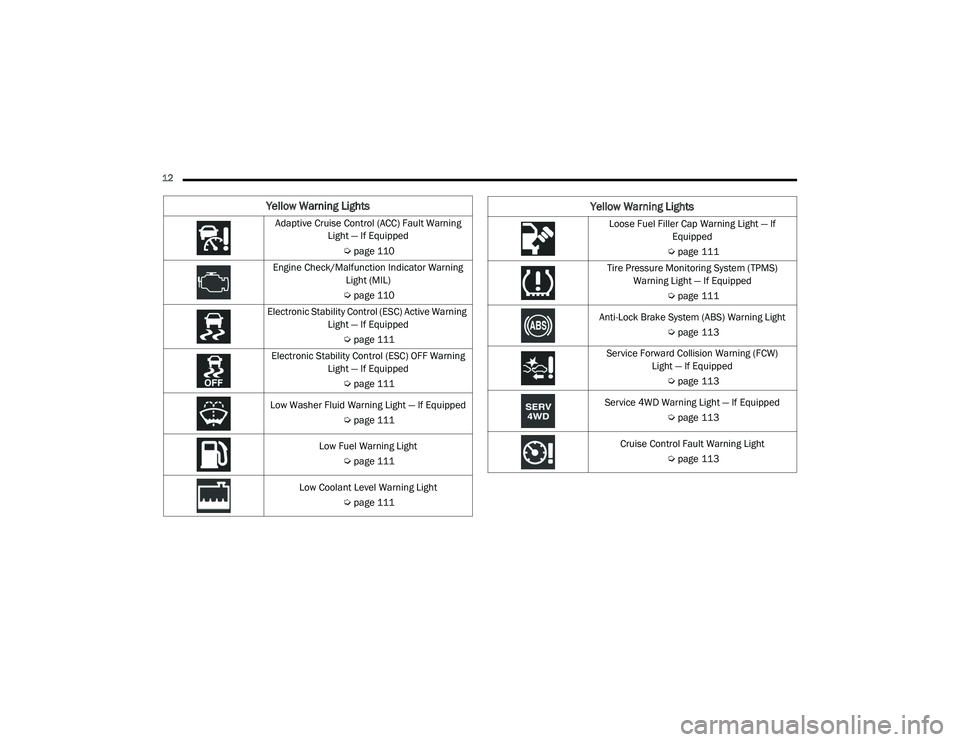
Yellow Warning Lights
Adaptive Cruise Control (ACC) Fault Warning Light — If Equipped
Úpage 110
Engine Check/Malfunction Indicator Warning Light (MIL)
Ú page 110
Electronic Stability Control (ESC) Active Warning Light — If Equipped
Úpage 111
Electronic Stability Control (ESC) OFF Warning Light — If Equipped
Úpage 111
Low Washer Fluid Warning Light — If Equipped Úpage 111
Low Fuel Warning Light Úpage 111
Low Coolant Level Warning Light Úpage 111Loose Fuel Filler Cap Warning Light — If
Equipped
Ú page 111
Tire Pressure Monitoring System (TPMS) Warning Light — If Equipped
Úpage 111
Anti-Lock Brake System (ABS) Warning Light Úpage 113
Service Forward Collision Warning (FCW) Light — If Equipped
Úpage 113
Service 4WD Warning Light — If Equipped Úpage 113
Cruise Control Fault Warning Light Úpage 113
Yellow Warning Lights
21_DPF_OM_EN_USC_t.book Page 12
Page 15 of 463
13
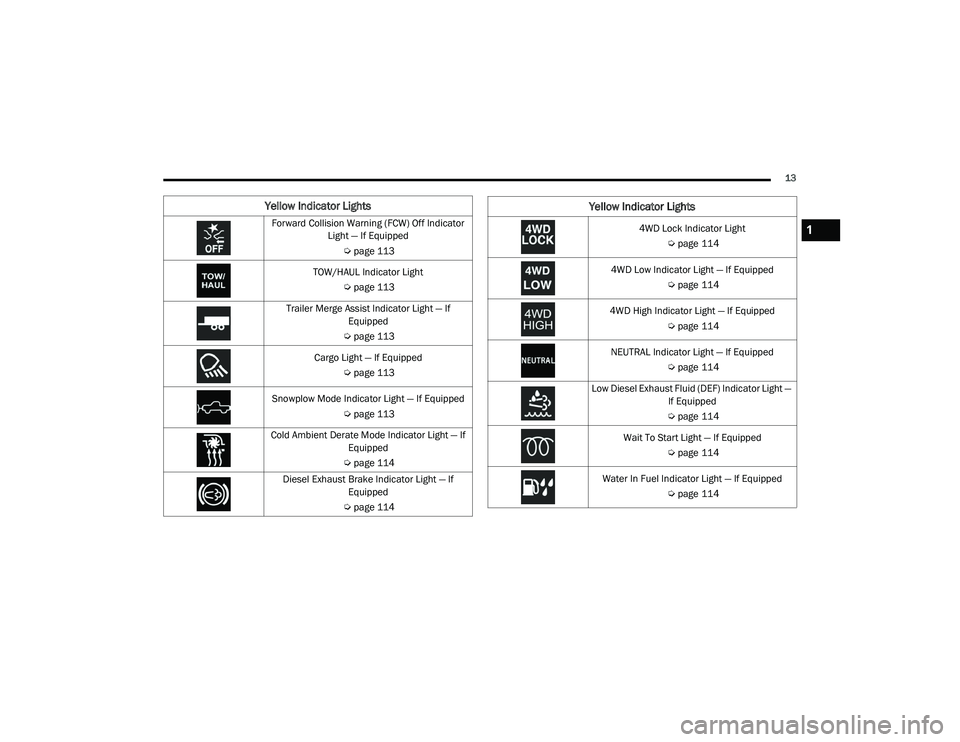
Yellow Indicator Lights
Forward Collision Warning (FCW) Off Indicator Light — If Equipped
Úpage 113
TOW/HAUL Indicator Light Úpage 113
Trailer Merge Assist Indicator Light — If Equipped
Ú page 113
Cargo Light — If Equipped Úpage 113
Snowplow Mode Indicator Light — If Equipped Úpage 113
Cold Ambient Derate Mode Indicator Light — If Equipped
Ú page 114
Diesel Exhaust Brake Indicator Light — If Equipped
Ú page 1144WD Lock Indicator Light
Úpage 114
4WD Low Indicator Light — If Equipped Úpage 114
4WD High Indicator Light — If Equipped Úpage 114
NEUTRAL Indicator Light — If Equipped Úpage 114
Low Diesel Exhaust Fluid (DEF) Indicator Light — If Equipped
Ú page 114
Wait To Start Light — If Equipped Úpage 114
Water In Fuel Indicator Light — If Equipped Úpage 114
Yellow Indicator Lights
1
21_DPF_OM_EN_USC_t.book Page 13
Page 109 of 463

GETTING TO KNOW YOUR INSTRUMENT PANEL107
WARNING LIGHTS AND MESSAGES
The warning/indicator lights will illuminate in the
instrument panel together with a dedicated
message and/or acoustic signal when
applicable. These indications are indicative
and precautionary and as such must not be
considered as exhaustive. Always refer to the
information in this chapter in the event of a
failure indication. All active telltales will display
first if applicable. The system check menu may
appear different based upon equipment options
and current vehicle status. Some telltales are
optional and may not appear.
RED WARNING LIGHTS
Seat Belt Reminder Warning Light
This warning light indicates when
the driver or passenger seat belt is
unbuckled. When the ignition is first
placed in the ON/RUN or ACC/ON/RUN
position and if the driver’s seat belt is unbuckled,
a chime will sound and the light will turn on.
When driving, if the driver or front passenger seat
belt remains unbuckled, the Seat Belt Reminder
Light will flash or remain on continuously and a
chime will sound
Ú
page 292.
Air Bag Warning Light
This warning light will illuminate to
indicate a fault with the air bag, and
will turn on for four to eight seconds
as a bulb check when the ignition
is placed in the ON/RUN or ACC/ON/RUN
position. This light will illuminate with a single
chime when a fault with the air bag has been
detected, it will stay on until the fault is cleared.
If the light is not on during startup, stays on,
or turns on while driving, have the system
inspected at an authorized dealer as soon as
possible.
Brake Warning Light
This warning light monitors various
brake functions, including brake fluid
level and parking brake application.
If the brake light turns on it may
indicate that the parking brake is applied, that
the brake fluid level is low, or that there is a
problem with the Anti-Lock Brake System
reservoir.
If the light remains on when the parking brake
has been disengaged, and the fluid level is at
the full mark on the master cylinder reservoir,
it indicates a possible brake hydraulic system
malfunction or that a problem with the Brake Booster has been detected by the Anti-Lock
Brake System (ABS) / Electronic Stability
Control (ESC) system. In this case, the light
will remain on until the condition has been
corrected. If the problem is related to the brake
booster, the ABS pump will run when applying
the brake, and a brake pedal pulsation may be
felt during each stop.
The dual brake system provides a reserve
braking capacity in the event of a failure to a
portion of the hydraulic system. A leak in either
half of the dual brake system is indicated by the
Brake Warning Light, which will turn on when
the brake fluid level in the master cylinder has
dropped below a specified level.
The light will remain on until the cause is
corrected.
NOTE:
The light may flash momentarily during sharp
cornering maneuvers, which change fluid level
conditions. The vehicle should have service
performed, and the brake fluid level checked.
If brake failure is indicated, immediate repair is
necessary.
3
21_DPF_OM_EN_USC_t.book Page 107
Page 111 of 463

GETTING TO KNOW YOUR INSTRUMENT PANEL109
Do not operate the vehicle until the cause is
corrected. This light does not indicate how
much oil is in the engine. The engine oil level
must be checked under the hood.
Oil Temperature Warning Light
This warning light will illuminate to
indicate the engine oil temperature is
high. If the light turns on while driving,
stop the vehicle and shut off the
engine as soon as possible. Wait for oil
temperature to return to normal levels.
Electronic Throttle Control (ETC) Warning
Light
This warning light will illuminate to
indicate a problem with the ETC
system. If a problem is detected while
the vehicle is running, the light will
either stay on or flash depending on the nature
of the problem. Cycle the ignition when the
vehicle is safely and completely stopped and
the transmission is placed in the PARK position.
The light should turn off. If the light remains
on with the vehicle running, your vehicle will
usually be drivable; however, see an authorized
dealer for service as soon as possible. NOTE:
This light may turn on if the accelerator and
brake pedals are pressed at the same time.
If the light continues to flash when the vehicle is
running, immediate service is required and you
may experience reduced performance, an
elevated/rough idle, or engine stall and your
vehicle may require towing. The light will come
on when the ignition is placed in the ON/RUN or
ACC/ON/RUN position and remain on briefly as
a bulb check. If the light does not come on
during starting, have the system checked by an
authorized dealer.Electric Power Steering (EPS) Fault
Warning Light
This warning light will turn on when
there's a fault with the EPS system
Ú
page 163.
Trailer Brake Disconnected Warning Light
This warning light will illuminate when
the Trailer Brake has been
disconnected Ú page 200.
Transmission Temperature Warning
Light — If Equipped
This warning light will illuminate to
warn of a high transmission fluid
temperature. This may occur with
strenuous usage such as trailer
towing. If this light turns on, stop the vehicle and
run the engine at idle or slightly faster, with the
transmission in PARK or NEUTRAL, until the
light turns off. Once the light turns off, you may
continue to drive normally.
WARNING!
Continued operation with reduced assist
could pose a safety risk to yourself and
others. Service should be obtained as soon
as possible.
WARNING!
If you continue operating the vehicle when
the Transmission Temperature Warning Light
is illuminated you could cause the fluid to boil
over, come in contact with hot engine or
exhaust components and cause a fire.
3
21_DPF_OM_EN_USC_t.book Page 109
Page 116 of 463

114GETTING TO KNOW YOUR INSTRUMENT PANEL
Cold Ambient Derate Mode Indicator
Light — If Equipped
This indicator light will illuminate
when a derate (engine power
reduction) is activated for protection
of the turbocharger in cold ambient
temperatures.
Diesel Exhaust Brake Indicator Light — If
Equipped
This indicator light will illuminate
when the Diesel Exhaust Brake has
been activated, and is in full strength
mode Ú page 138.
4WD Lock Indicator Light
This light alerts the driver that the
vehicle is in the 4WD LOCK mode.
The front and rear driveshafts are
mechanically locked together, forcing
the front and rear wheels to rotate at the same
speed Ú page 153.
4WD Low Indicator Light — If Equipped
This light alerts the driver that the
vehicle is in the 4WD Low mode.
The front and rear driveshafts are
mechanically locked together forcing the front and rear wheels to rotate at the same
speed. Low range provides a greater gear
reduction ratio to provide increased torque at
the wheels Ú
page 153.
4WD High Indicator Light — If Equipped
This light alerts the driver that the
vehicle is in the 4WD High mode.
The front and rear driveshafts are
mechanically locked together forcing
the front and rear wheels to rotate at the same
speed.
NEUTRAL Indicator Light — If Equipped
This light alerts the driver that the
4WD power transfer case is in the
NEUTRAL mode and the front and rear
driveshafts are disengaged from the
powertrain.
Low Diesel Exhaust Fluid (DEF) Indicator
Light — If Equipped
The Low DEF Indicator will illuminate if
the vehicle is low on DEF
Ú
page 379.
Wait To Start Light — If Equipped
This indicator light will illuminate for
approximately two seconds when the
ignition is turned to the RUN position.
Its duration may be longer based on
colder operating conditions. Vehicle will not
initiate start until telltale is no longer displayed
Ú page 122.
NOTE:
The “Wait To Start” telltale may not illuminate if the
intake manifold temperature is warm enough.
Water In Fuel Indicator Light — If Equipped
The “Water In Fuel Indicator Light”
will illuminate when there is water
detected in the fuel filter. If this light
remains on, DO NOT start the vehicle
before you drain the water from the fuel filter to
prevent engine damage Ú page 375.
21_DPF_OM_EN_USC_t.book Page 114
Page 130 of 463

128STARTING AND OPERATING
STARTING FLUIDS
The engine is equipped with an automatic
electric air preheating system. If the
instructions in this manual are followed,
the engine should start in all conditions.
NORMAL OPERATION — DIESEL ENGINE
Observe the following when the engine is
operating.
All message center lights are off.
Malfunction Indicator Light (MIL) is off.
Engine oil pressure is above 10 psi (69 kPa)
at idle.
Voltmeter operation:
The voltmeter may show a gauge fluctuation
at various engine temperatures. This cycling
operation is caused by the post-heat cycle of the
intake manifold heater system. The number of
cycles and the length of the cycling operation
is controlled by the engine control module.
Post-heat operation can run for several minutes,
and then the electrical system and voltmeter
needle will stabilize.
The cycling action will cause temporary
dimming of the headlamps, interior lamps, and
also a noticeable reduction in blower motor
speed.
WARNING!
Starting fluids or flammable liquids must
never be used in the Cummins diesel engine
(see Warning label). Never pour diesel fuel,
flammable liquid, starting fluids (ether) into
the air cleaner canister, air intake piping, or
turbocharger inlet in an attempt to start the
vehicle. This could result in a flash fire and
explosion causing serious personal injury and
engine damage.
WARNING!
Do not leave children or animals inside
parked vehicles in hot weather. Interior
heat build-up may cause serious injury or
death.
When leaving the vehicle, always remove
the key fob and lock your vehicle.
Never leave children alone in a vehicle, or
with access to an unlocked vehicle. Allowing
children to be in a vehicle unattended is
dangerous for a number of reasons. A child
or others could be seriously or fatally injured.
Children should be warned not to touch the
parking brake, brake pedal or the gear
selector. Do not leave the key fob in or near
the vehicle (or in a location accessible to chil -
dren), and do not leave the ignition of a
vehicle equipped with Keyless Enter-N-Go in
the ACC or ON/RUN mode. A child could
operate power windows, other controls, or
move the vehicle.
21_DPF_OM_EN_USC_t.book Page 128
Page 134 of 463

132STARTING AND OPERATING
Idle-Up Feature
The driver-controlled high idle speed feature will
help increase cylinder temperatures and provide
additional cab heat, however, excessive idling may
still cause the exhaust after-treatment system to not
properly regenerate. Extended periods of idle time
should be avoided.
The Idle-Up feature uses the Cruise Control
buttons to increase engine idle speed and
quickly warm the vehicle's interior.
1. With the transmission in PARK, the parking
brake applied, and the engine running,
turn on the Cruise Control, then push the
SET (-) button.
2. The engine RPM will go up to 1,100 RPM. To increase the RPM, push and hold the
RES (+) button and the idle speed will
increase to approximately 1,500 RPM.
To decrease the RPM, push and hold the
SET (-) button and the idle speed will
decrease to approximately 1,100 RPM. 3. To cancel the Idle–Up feature, either push
the CANCEL button, push the ON/OFF
button, or press the brake pedal.
NOISE
Diesel engines can create noises that may
seem as a concern. The nature of a diesel
engine is compression ignition where
compressed air and fuel are mixed and ignited.
Weather, barometric pressure, altitude and
temperature will affect how fuel is ignited in the
engine. Engines will sound different from day to
day or previous model years. Clicking, ticking, or
light knocking is normal and will change from
day to day, as the engine breaks in, and can
vary with changes in ambient temperature; this
is normal. Diesel equipped vehicles also have
an exhaust after treatment system to reduce
emissions utilizing a Diesel Particulate Filter
(DPF) and a Selective Reduction Catalyst (SCR). The SCR reduces Nox using the Diesel Exhaust
Fluid (DEF) system. DEF is injected directly into
the SCR through an dosing module. This
process will create a clicking sound and at
times, will make noise even with the vehicle
shut off. This is normal as the DEF dosing
module is purging DEF. Fuel pump noise may
increase during low speed/light load conditions
when ambient temperature is above 100°F
(38°C), and when fuel tank level is below 10%.
This is a normal condition of the fuel system and
controls strategy. If at any time the check
engine light is on, please visit an authorized
dealer.
21_DPF_OM_EN_USC_t.book Page 132