recommended oil RAM CHASSIS CAB 2022 User Guide
[x] Cancel search | Manufacturer: RAM, Model Year: 2022, Model line: CHASSIS CAB, Model: RAM CHASSIS CAB 2022Pages: 428, PDF Size: 20.18 MB
Page 360 of 428
358SERVICING AND MAINTENANCE
(Continued)
BRAKE SYSTEM
In order to ensure brake system performance, all
brake system components should be inspected
periodically Úpage 329.
Fluid Level Check — Brake Master Cylinder
The fluid level of the master cylinder should be
checked when performing under the hood service
or immediately if the Brake System Warning Light
indicates system failure.
If necessary, add fluid to bring level within the
designated marks on the side of the reservoir of
the brake master cylinder. Be sure to clean the top
of the master cylinder area before removing cap.
With disc brakes the fluid level can be expected to
fall as the brake linings wear. However, an
unexpected drop in fluid level may be caused by a
leak and a system check should be conducted.
For further information Ú page 407.
AUTOMATIC TRANSMISSION
Special Additives
The manufacturer strongly recommends against
using any special additives in the transmission.
Automatic Transmission Fluid (ATF) is an
engineered product and its performance may be
impaired by supplemental additives. Therefore, do
not add any fluid additives to the transmission. The
only exception to this policy is the use of special
dyes for diagnosing fluid leaks in 6-speed
transmissions. Avoid using transmission sealers as
they may adversely affect seals.
WARNING!
Riding the brakes can lead to brake failure and
possibly a collision. Driving with your foot resting
or riding on the brake pedal can result in
abnormally high brake temperatures, excessive
lining wear, and possible brake damage. You
would not have your full braking capacity in an
emergency.
WARNING!
Use only manufacturer's recommended brake
fluid Úpage 407. Using the wrong type of
brake fluid can severely damage your brake
system and/or impair its performance. The
proper type of brake fluid for your vehicle is
also identified on the original factory installed
hydraulic master cylinder reservoir.
To avoid contamination from foreign matter or
moisture, use only new brake fluid or fluid that
has been in a tightly closed container. Keep
the master cylinder reservoir cap secured at
all times. Brake fluid in an open container
absorbs moisture from the air resulting in a
lower boiling point. This may cause it to boil
unexpectedly during hard or prolonged
braking, resulting in sudden brake failure. This
could result in a collision.
Overfilling the brake fluid reservoir can result
in spilling brake fluid on hot engine parts,
causing the brake fluid to catch fire. Brake
fluid can also damage painted and vinyl
surfaces, care should be taken to avoid its
contact with these surfaces.
Do not allow petroleum based fluid to contam -
inate the brake fluid. Brake seal components
could be damaged, causing partial or
complete brake failure. This could result in a
collision.
CAUTION!
Do not use chemical flushes in your
transmission as the chemicals can damage your
transmission components. Such damage is not
covered by the New Vehicle Limited Warranty.
WARNING!
22_DPF_OM_EN_USC_t.book Page 358
Page 362 of 428
360SERVICING AND MAINTENANCE
NOTE:If it is necessary to check the transmission below
the operating temperature, the fluid level should
be between the two COLD (lower) holes on the
dipstick with the fluid at 68-86°F / 20-30°C. Only
use the COLD region of the dipstick as a rough
reference when setting the fluid level after a trans -
mission service or fluid change. Re-check the fluid
level, and adjust as required, once the trans -
mission reaches normal operating temperature.
Fluid And Filter Changes — 8-Speed
Transmission
Under normal operating conditions, the fluid
installed at the factory will provide satisfactory
lubrication for the life of the vehicle.
Routine fluid and filter changes are not required.
However, change the fluid and filter if the fluid
becomes contaminated (with water, etc.), or if the
transmission is disassembled for any reason.
Fluid And Filter Changes — 6-Speed
Transmission
For the proper maintenance intervals Úpage 329.
In addition, change the fluid and filters if the fluid
becomes contaminated (with water, etc.), or if the
transmission is disassembled for any reason.
Selection Of Lubricant
It is important to use the proper transmission fluid
to ensure optimum transmission performance and
life. Use only the manufacturer’s specified
transmission fluid Ú page 407. It is important to
maintain the transmission fluid at the correct level
using the recommended fluid. No chemical flushes
should be used in any transmission; only the
approved lubricant should be used.
REAR AXLE AND 4X4 FRONT DRIVING
A
XLE FLUID LEVEL
For normal service, periodic fluid level checks are
not required. When the vehicle is serviced for other
reasons the exterior surfaces of the axle assembly
should be inspected. If gear oil leakage is
suspected inspect the fluid level. This inspection
should be made with the vehicle in a level position.
When checking the fluid level, the vehicle should
be in a level position. The fluid level at room
temperature should be as follows:
3500 Front Axle: ¼ inch ± ¼ inch (6.4 mm ±
6.4 mm) below the bottom of the fill hole.
3500 Rear Axle: ¼ inch ± ¼ inch (6.4 mm ±
6.4 mm) below the bottom of the fill hole.
4500/5500 Front Axle: ¼ inch +/- ¼ inch (6.4 mm
± 6.4 mm) below the bottom of the fill hole.
4500/5500 Rear Axle: 1/8 inch +/- 1/8 inch
(3.2 mm +/- 3.2 mm) below the bottom of the fill
hole.
CAUTION!
If the fluid temperature is below 50°F (10°C) it
may not register on the dipstick. Do not add fluid
until the temperature is elevated enough to
produce an accurate reading. Run the engine at
idle, in PARK, to warm the fluid.
CAUTION!
Using a transmission fluid other than the
manufacturer’s recommended fluid may cause
deterioration in transmission shift quality and/or
torque converter shudder, and (for 6-speed
transmissions) will require more frequent fluid
and filter changes Ú page 407.
22_DPF_OM_EN_USC_t.book Page 360
Page 363 of 428
SERVICING AND MAINTENANCE361
Drain And Refill
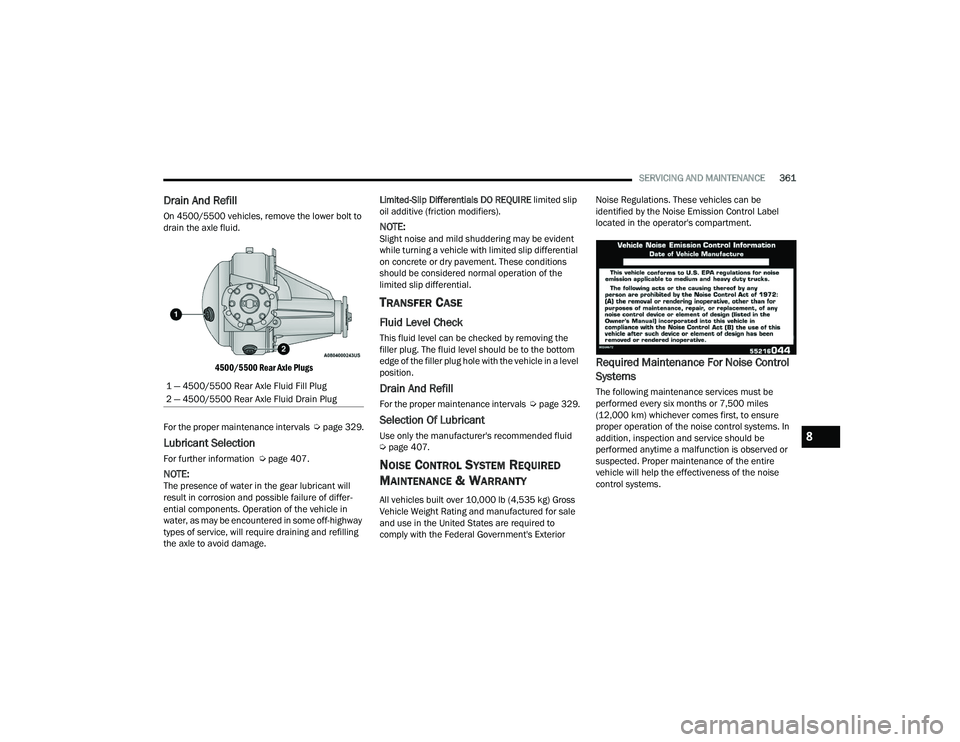
On 4500/5500 vehicles, remove the lower bolt to
drain the axle fluid.
4500/5500 Rear Axle Plugs
For the proper maintenance intervals Úpage 329.
Lubricant Selection
For further information Ú page 407.
NOTE:The presence of water in the gear lubricant will
result in corrosion and possible failure of differ -
ential components. Operation of the vehicle in
water, as may be encountered in some off-highway
types of service, will require draining and refilling
the axle to avoid damage. Limited-Slip Differentials DO REQUIRE
limited slip
oil additive (friction modifiers).
NOTE:Slight noise and mild shuddering may be evident
while turning a vehicle with limited slip differential
on concrete or dry pavement. These conditions
should be considered normal operation of the
limited slip differential.
TRANSFER CASE
Fluid Level Check
This fluid level can be checked by removing the
filler plug. The fluid level should be to the bottom
edge of the filler plug hole with the vehicle in a level
position.
Drain And Refill
For the proper maintenance intervals Úpage 329.
Selection Of Lubricant
Use only the manufacturer's recommended fluid
Úpage 407.
NOISE CONTROL SYSTEM REQUIRED
M
AINTENANCE & WARRANTY
All vehicles built over 10,000 lb (4,535 kg) Gross
Vehicle Weight Rating and manufactured for sale
and use in the United States are required to
comply with the Federal Government's Exterior Noise Regulations. These vehicles can be
identified by the Noise Emission Control Label
located in the operator's compartment.
Required Maintenance For Noise Control
Systems
The following maintenance services must be
performed every six months or 7,500 miles
(12,000 km) whichever comes first, to ensure
proper operation of the noise control systems. In
addition, inspection and service should be
performed anytime a malfunction is observed or
suspected. Proper maintenance of the entire
vehicle will help the effectiveness of the noise
control systems.
1 — 4500/5500 Rear Axle Fluid Fill Plug
2 — 4500/5500 Rear Axle Fluid Drain Plug
8
22_DPF_OM_EN_USC_t.book Page 361
Page 388 of 428
386SERVICING AND MAINTENANCE
Keep dismounted tires in a cool, dry place with as
little exposure to light as possible. Protect tires
from contact with oil, grease, and gasoline.
Replacement Tires
The tires on your new vehicle provide a balance of
many characteristics. They should be inspected
regularly for wear and correct cold tire inflation
pressures. The manufacturer strongly
recommends that you use tires equivalent to the
originals in size, quality and performance when
replacement is needed Ú page 385. Refer to the
Tire and Loading Information placard or the
Vehicle Certification Label for the size designation
of your tire. The Load Index and Speed Symbol for
your tire will be found on the original equipment
tire sidewall.
For more information relating to the Load Index
and Speed Symbol of a tire Ú page 376.
It is recommended to replace the two front tires or
two rear tires as a pair. Replacing just one tire can
seriously affect your vehicle’s handling. If you ever
replace a wheel, make sure that the wheel’s
specifications match those of the original wheels.
It is recommended you contact an authorized tire
dealer or original equipment dealer with any
questions you may have on tire specifications or
capability. Failure to use equivalent replacement
tires may adversely affect the safety, handling, and
ride of your vehicle.
TIRE TYPES
All Season Tires — If Equipped
All Season tires provide traction for all seasons
(Spring, Summer, Autumn, and Winter). Traction
levels may vary between different all season tires.
All season tires can be identified by the M+S, M&S,
M/S or MS designation on the tire sidewall. Use all
season tires only in sets of four; failure to do so
may adversely affect the safety and handling of
your vehicle.
Summer Or Three Season Tires —
If Equipped
Summer tires provide traction in both wet and dry
conditions, and are not intended to be driven in
snow or on ice. If your vehicle is equipped with
Summer tires, be aware these tires are not
designed for Winter or cold driving conditions.
Install Winter tires on your vehicle when ambient
temperatures are less than 40°F (5°C) or if roads
are covered with ice or snow. For more
information, contact an authorized dealer.
WARNING!
Do not use a tire, wheel size, load rating, or
speed rating other than that specified for your
vehicle. Some combinations of unapproved
tires and wheels may change suspension
dimensions and performance characteristics,
resulting in changes to steering, handling, and
braking of your vehicle. This can cause unpre -
dictable handling and stress to steering and
suspension components. You could lose
control and have a collision resulting in
serious injury or death. Use only the tire and
wheel sizes with load ratings approved for
your vehicle.
Never use a tire with a smaller load index or
capacity, other than what was originally
equipped on your vehicle. Using a tire with a
smaller load index could result in tire over -
loading and failure. You could lose control and
have a collision.
Failure to equip your vehicle with tires having
adequate speed capability can result in
sudden tire failure and loss of vehicle control.
CAUTION!
Replacing original tires with tires of a different
size may result in false speedometer and
odometer readings.
22_DPF_OM_EN_USC_t.book Page 386
Page 398 of 428

396SERVICING AND MAINTENANCE
Cleaning Plastic Instrument Cluster
Lenses
The lenses in front of the instruments in this
vehicle are molded in clear plastic. When cleaning
the lenses, care must be taken to avoid scratching
the plastic.
Clean with a wet soft cloth. A mild soap solution
may be used, but do not use high alcohol content
or abrasive cleaners. If soap is used, wipe clean
with a clean damp cloth. Dry with a soft cloth.
LEATHER SURFACES
Mopar® Total Clean is specifically recommended
for leather upholstery.
Your leather upholstery can be best preserved by
regular cleaning with a damp soft cloth. Small
particles of dirt can act as an abrasive and damage
the leather upholstery and should be removed
promptly with a damp cloth. Stubborn soils can be
removed easily with a soft cloth and Mopar® Total
Clean. Care should be taken to avoid soaking your
leather upholstery with any liquid. Please do not
use polishes, oils, cleaning fluids, solvents,
detergents, or ammonia-based cleaners to clean
your leather upholstery.
NOTE:If equipped with light colored leather, it tends to
show any foreign material, dirt, and fabric dye
transfer more so than darker colors. The leather is
designed for easy cleaning, and the manufacturer
recommends Mopar® Total Care leather cleaner
applied on a cloth to clean the leather seats as
needed.GLASS SURFACES
All glass surfaces should be cleaned on a regular
basis with Mopar® Glass Cleaner, or any
commercial household-type glass cleaner. Never
use an abrasive type cleaner. Use caution when
cleaning the inside rear window equipped with
electric defrosters or windows equipped with radio
antennas. Do not use scrapers or other sharp
instruments that may scratch the elements.
When cleaning the rear view mirror, spray cleaner
on the towel or cloth that you are using. Do not
spray cleaner directly on the mirror.
CAUTION!
Do not use Alcohol and Alcohol-based and/or
Ketone based cleaning products to clean leather
upholstery, as damage to the upholstery may
result.
22_DPF_OM_EN_USC_t.book Page 396
Page 399 of 428
397
TECHNICAL SPECIFICATIONS
VEHICLE IDENTIFICATION NUMBER (VIN)
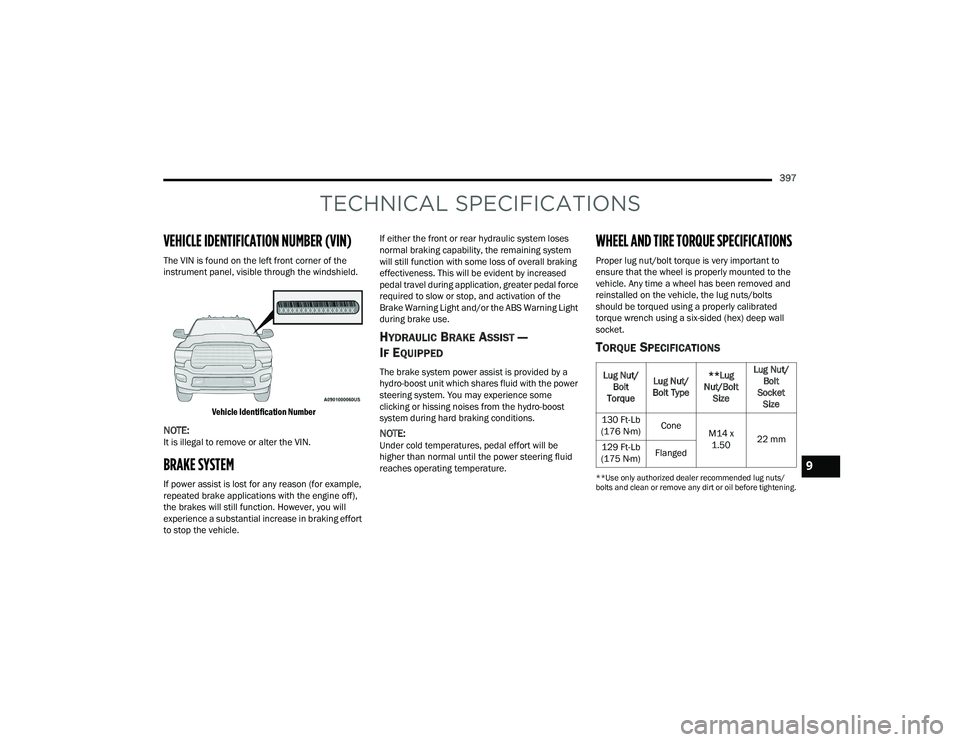
The VIN is found on the left front corner of the
instrument panel, visible through the windshield.
Vehicle Identification Number
NOTE:It is illegal to remove or alter the VIN.
BRAKE SYSTEM
If power assist is lost for any reason (for example,
repeated brake applications with the engine off),
the brakes will still function. However, you will
experience a substantial increase in braking effort
to stop the vehicle. If either the front or rear hydraulic system loses
normal braking capability, the remaining system
will still function with some loss of overall braking
effectiveness. This will be evident by increased
pedal travel during application, greater pedal force
required to slow or stop, and activation of the
Brake Warning Light and/or the ABS Warning Light
during brake use.
HYDRAULIC BRAKE ASSIST —
I
F EQUIPPED
The brake system power assist is provided by a
hydro-boost unit which shares fluid with the power
steering system. You may experience some
clicking or hissing noises from the hydro-boost
system during hard braking conditions.
NOTE:Under cold temperatures, pedal effort will be
higher than normal until the power steering fluid
reaches operating temperature.
WHEEL AND TIRE TORQUE SPECIFICATIONS
Proper lug nut/bolt torque is very important to
ensure that the wheel is properly mounted to the
vehicle. Any time a wheel has been removed and
reinstalled on the vehicle, the lug nuts/bolts
should be torqued using a properly calibrated
torque wrench using a six-sided (hex) deep wall
socket.
TORQUE SPECIFICATIONS
**Use only authorized dealer recommended lug nuts/
bolts and clean or remove any dirt or oil before tightening.
Lug Nut/
Bolt
Torque Lug Nut/
Bolt Type **Lug
Nut/Bolt Size Lug Nut/
Bolt
Socket Size
130 Ft-Lb
(176 N·m) Cone
M14 x
1.50 22 mm
129 Ft-Lb
(175 N·m) Flanged
9
22_DPF_OM_EN_USC_t.book Page 397
Page 400 of 428
398TECHNICAL SPECIFICATIONS
Inspect the wheel mounting surface prior to
mounting the tire and remove any corrosion or
loose particles.
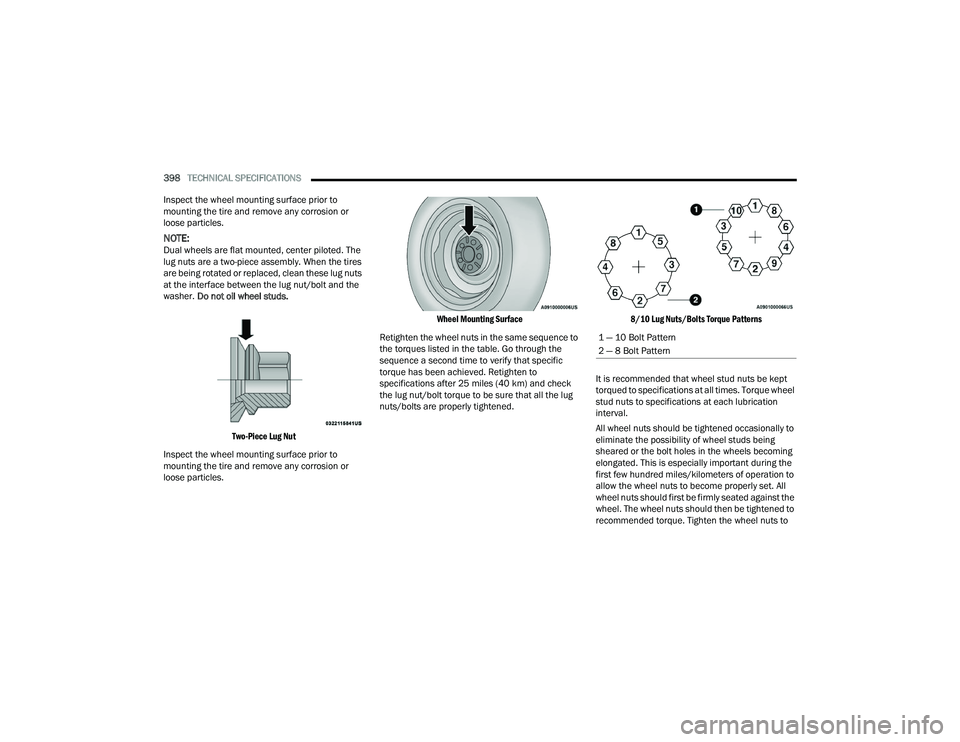
NOTE:Dual wheels are flat mounted, center piloted. The
lug nuts are a two-piece assembly. When the tires
are being rotated or replaced, clean these lug nuts
at the interface between the lug nut/bolt and the
washer. Do not oil wheel studs.
Two-Piece Lug Nut
Inspect the wheel mounting surface prior to
mounting the tire and remove any corrosion or
loose particles.
Wheel Mounting Surface
Retighten the wheel nuts in the same sequence to
the torques listed in the table. Go through the
sequence a second time to verify that specific
torque has been achieved. Retighten to
specifications after 25 miles (40 km) and check
the lug nut/bolt torque to be sure that all the lug
nuts/bolts are properly tightened.
8/10 Lug Nuts/Bolts Torque Patterns
It is recommended that wheel stud nuts be kept
torqued to specifications at all times. Torque wheel
stud nuts to specifications at each lubrication
interval.
All wheel nuts should be tightened occasionally to
eliminate the possibility of wheel studs being
sheared or the bolt holes in the wheels becoming
elongated. This is especially important during the
first few hundred miles/kilometers of operation to
allow the wheel nuts to become properly set. All
wheel nuts should first be firmly seated against the
wheel. The wheel nuts should then be tightened to
recommended torque. Tighten the wheel nuts to
1 — 10 Bolt Pattern
2 — 8 Bolt Pattern
22_DPF_OM_EN_USC_t.book Page 398