oil temperature RAM CHASSIS CAB 2022 Owner's Manual
[x] Cancel search | Manufacturer: RAM, Model Year: 2022, Model line: CHASSIS CAB, Model: RAM CHASSIS CAB 2022Pages: 428, PDF Size: 20.18 MB
Page 120 of 428
118STARTING AND OPERATING
Do Not Operate The Engine With Failed
Parts
All engine failures give some warning before the
parts fail. Be on the alert for changes in
performance, sounds, and visual evidence that the
engine requires service. Some important clues are:
Engine misfiring or vibrating severely.
Sudden loss of power.
Unusual engine noises.
Fuel, oil or coolant leaks.
Sudden change, outside the normal operating
range, in the engine operating temperature.
Excessive smoke.
Oil pressure drop.
DIESEL PARTICULATE FILTER (DPF)
M
ANUAL REGENERATION — IF EQUIPPED
On equipped Chassis Cabs, a manual regeneration
can be enable through the instrument cluster. The
manual regeneration will allow the DPF to
complete a regeneration, lowering the soot level
without having to drive the vehicle. The vehicle
must be in PARK to access this feature, and the
fuel level must be over 12.5% full. A message
displaying the time left on the regeneration will
appear on the instrument cluster, and the
instrument cluster will display the soot level
Ú page 81.
ENGINE BLOCK HEATER — IF EQUIPPED
The engine block heater warms the engine, and
permits quicker starts in cold weather. Connect the
cord to a standard 110-115 Volt AC electrical
outlet with a grounded, three-wire extension cord.
The engine block heater cord is routed behind the
front bumper and accessible through the right hole
of the air dam.
The engine block heater must be plugged in at
least one hour to have an adequate warming effect
on the engine.
It includes a removable cap that is secured by a
tethered strap. It also has a c-clip that is used for
storage when not in use for the Winter months.
During Winter months, remove the heater cord
wiring assembly from itself on the c-clip.
NOTE:The block heater will require 110 Volt AC and
6.5 Amps to activate the heater element.
Block Heater Usage
For ambient temperatures below 0°F (-18°C),
engine block heater usage is recommended.
For ambient temperatures below –20°F (-29°C),
engine block heater usage is required.
ENGINE BREAK-IN RECOMMENDATIONS —
GASOLINE ENGINE
A long break-in period is not required for the engine
and drivetrain (transmission and axle) in your
vehicle.
Drive moderately during the first 300 miles
(500 km). After the initial 60 miles (100 km),
speeds up to 50 or 55 mph (80 or 90 km/h) are
desirable.
While cruising, brief full-throttle acceleration within
the limits of local traffic laws contributes to a good
break-in. Wide-open throttle acceleration in low
gear can be detrimental and should be avoided.
The engine oil installed in the engine at the factory
is a high-quality energy conserving type lubricant.
Oil changes should be consistent with anticipated
climate conditions under which vehicle operations
will occur. For the recommended viscosity and
quality grades Ú page 404.
NOTE:A new engine may consume some oil during its first
few thousand miles (kilometers) of operation. This
should be considered a normal part of the break-in
CAUTION!
Never use Non-Detergent Oil or Straight Mineral
Oil in the engine or damage may result.
22_DPF_OM_EN_USC_t.book Page 118
Page 121 of 428

STARTING AND OPERATING119
(Continued)
and not interpreted as a problem. Please check
your oil level with the engine oil indicator often
during the break in period. Add oil as required.
ENGINE BREAK-IN RECOMMENDATIONS —
DIESEL ENGINE
The Cummins® Turbo Diesel engine does not
require a break-in period due to its construction.
Normal operation is allowed, providing the
following recommendations are followed:
Warm up the engine before placing it under
load.
Do not operate the engine at idle for prolonged
periods.
Use the appropriate transmission gear to
prevent engine lugging.
Observe vehicle oil pressure and temperature
indicators.
Check the coolant and oil levels frequently.
Vary throttle position at highway speeds when
carrying or towing significant weight.
NOTE:Light duty operation such as light trailer towing or
no load operation will extend the time before the
engine is at full efficiency. Reduced fuel economy
and power may be seen at this time.
For additional vehicle break-in requirements
Ú
page 177.
Because of the construction of the Cummins®
Turbo Diesel engine, engine run-in is enhanced by
loaded operating conditions which allow the
engine parts to achieve final finish and fit during
the first 6,000 miles (10,000 km).
PARKING BRAKE
Before leaving the vehicle, make sure that the
parking brake is fully applied. Also, be certain to
leave the transmission in PARK.
The foot operated parking brake is located below
the lower left corner of the instrument panel. To
apply the parking brake, firmly push the parking
brake pedal fully. To release the parking brake, pull
the parking brake release handle.
Parking Brake Release
When the parking brake is applied with the ignition
switch ON, the Brake Warning Light in the
instrument cluster will illuminate.
NOTE:
When the parking brake is applied and the
transmission is placed in gear, the Brake
Warning Light will flash. If vehicle speed is
detected, a chime will sound to alert the driver.
Fully release the parking brake before
attempting to move the vehicle.
This light only shows that the parking brake is
applied. It does not show the degree of brake
application.
When parking on a hill, it is important to turn the
front wheels toward the curb on a downhill grade
and away from the curb on an uphill grade. Apply
the parking brake before placing the gear selector
in PARK, otherwise the load on the transmission
locking mechanism may make it difficult to move
the gear selector out of PARK. The parking brake
should always be applied whenever the driver is
not in the vehicle.
WARNING!
Never use the PARK position as a substitute
for the parking brake. Always apply the
parking brake fully when parked to guard
against vehicle movement and possible injury
or damage.
4
22_DPF_OM_EN_USC_t.book Page 119
Page 258 of 428
256MULTIMEDIA
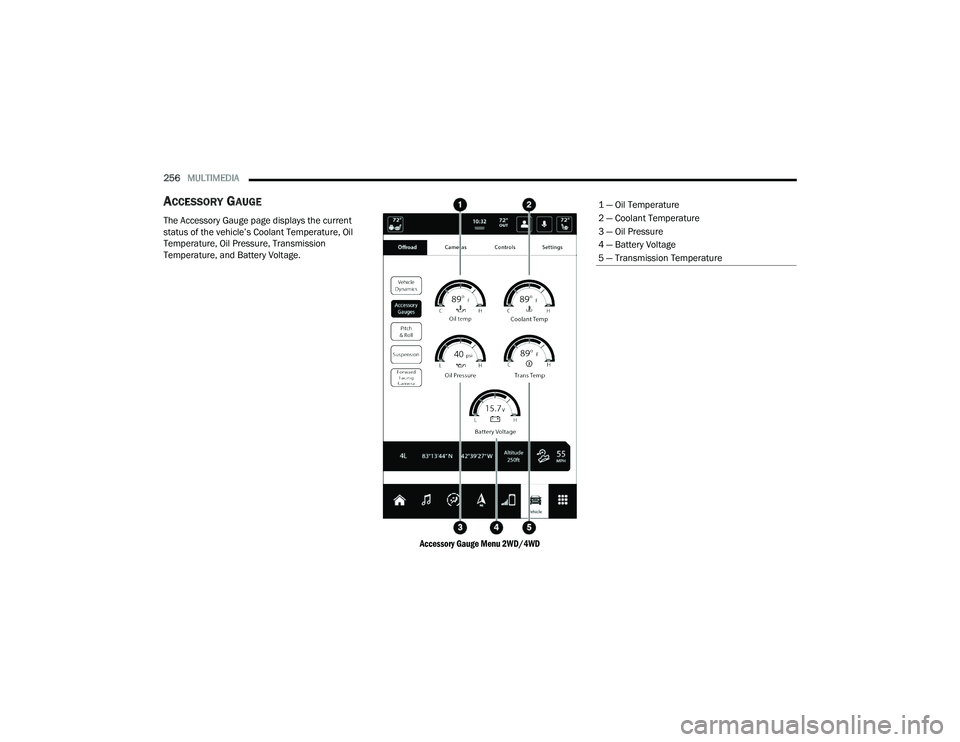
ACCESSORY GAUGE
The Accessory Gauge page displays the current
status of the vehicle’s Coolant Temperature, Oil
Temperature, Oil Pressure, Transmission
Temperature, and Battery Voltage.
Accessory Gauge Menu 2WD/4WD
1 — Oil Temperature
2 — Coolant Temperature
3 — Oil Pressure
4 — Battery Voltage
5 — Transmission Temperature
22_DPF_OM_EN_USC_t.book Page 256
Page 330 of 428

328
SERVICING AND MAINTENANCE
SCHEDULED SERVICING — GASOLINE
ENGINE
Your vehicle is equipped with an automatic oil
change indicator system. The oil change indicator
system will remind you that it is time to take your
vehicle in for scheduled maintenance.
Based on engine operation conditions, the oil
change indicator message will illuminate. This
means that service is required for your vehicle.
Operating conditions such as frequent short-trips,
trailer tow, extremely hot or cold ambient
temperatures will influence when the “Oil Change
Required” message is displayed. Have your vehicle
serviced as soon as possible, within the next
500 miles (805 km).An authorized dealer will reset the oil change
indicator message after completing the scheduled
oil change. If a scheduled oil change is performed
by someone other than an authorized dealer, the
message can be reset by referring to the steps
described under Instrument Cluster Display
Ú
page 81.
Under no circumstances should oil change
intervals exceed 8,000 miles (13,000 km),
12 months or 350 hours of engine run time,
whichever comes first. The 350 hours of engine
run or idle time is generally only a concern for fleet
customers. Once A Month Or Before A Long Trip:
Check engine oil level.
Check windshield washer fluid level.
Check the tire inflation pressures and look for
unusual wear or damage. Rotate at the first sign
of irregular wear.
Check the fluid levels of the coolant reservoir,
brake master cylinder, power steering and auto
-
matic transmission (6-speed only), and fill as
needed.
Check function of all interior and exterior lights.
22_DPF_OM_EN_USC_t.book Page 328
Page 335 of 428

SERVICING AND MAINTENANCE333
NOTE:
Under no circumstances should oil change inter -
vals exceed 15,000 miles (24,000 km) or
12 months or 500 hours, whichever comes first.
It is recommended that every 3,000 miles
(4,800 km), check the engine oil level at least
30 minutes after a fully warmed engine is shut
off. Checking the oil level while the vehicle is on
level ground will improve the accuracy of the oil
level reading. Add oil only when the level is at or
below the ADD or MIN mark.
Severe service (high ambient temperature,
short trips, heavy loading, trailer towing,
off-road, or law enforcement use) may reduce
oil change intervals. If models configured with optional B20 capability
are operated with greater than 5% levels of
biodiesel, the oil change interval must not exceed
12,500 miles (20,000 km) or 400 hours,
whichever comes first under any circumstances.
See the Fuel Requirements section for more
information regarding operation with biodiesel
blend (B6-B20) fuel meeting ASTM specification
D-7467.
PERFORM SERVICE INDICATOR —
D
IESEL ENGINE
Your vehicle will require emissions maintenance at
a set interval. To help remind you when this
maintenance is due, the instrument cluster will
display “Perform Service”. When the “Perform
Service” message is displayed on the instrument
cluster it is necessary to have the emissions
maintenance performed. Emissions maintenance
may include replacing the Closed Crankcase
Ventilation (CCV) filter element. The procedure for
clearing and resetting the “Perform Service”
indicator message is located in the appropriate
Service Information.
8
22_DPF_OM_EN_USC_t.book Page 333
Page 342 of 428
340SERVICING AND MAINTENANCE
CHECKING OIL LEVEL
To ensure proper engine lubrication, the engine oil
must be maintained at the correct level. Check the
oil level at regular intervals, such as every fuel
stop. The best time to check the engine oil level is
about five minutes after a fully warmed up engine
is shut off.
Checking the oil while the vehicle is on level ground
will improve the accuracy of the oil level readings.
There are four possible dipstick types:
Crosshatched zone.
Crosshatched zone marked SAFE.
Crosshatched zone marked with MIN at the low
end of the range and MAX at the high end of the
range.
Crosshatched zone marked with dimples at the
MIN and the MAX ends of the range.
NOTE:Always maintain the oil level within the crosshatch
markings on the dipstick.
Adding 1 quart (1 liter) of oil when the reading is at
the low end of the dipstick range will raise the oil
level to the high end of the range marking.
ADDING WASHER FLUID
The fluid reservoir is located under the hood and
should be checked for fluid level at regular
intervals. Fill the reservoir with windshield washer
solvent only (not radiator antifreeze). When
refilling the washer fluid reservoir, take some
washer fluid and apply it to a cloth or towel and
wipe the wiper blades clean. This will help blade
performance.
To prevent freeze-up of your windshield washer
system in cold weather, select a solution or mixture
that meets or exceeds the temperature range of
your climate. This rating information can be found
on most washer fluid containers.
After the engine has warmed up, operate the
defroster for a few minutes to reduce the
possibility of smearing or freezing the fluid on the
cold windshield. Windshield washer solution used
with water as directed on the container, aids
cleaning action, reduces the freezing point to avoid
line clogging, and is not harmful to paint or trim.
MAINTENANCE-FREE BATTERY
Your vehicle is equipped with a maintenance-free
battery. You will never have to add water, and
periodic maintenance is not required.
NOTE:Replacement batteries should both be of equal
capacity to prevent damage to the vehicle's
charging system.
CAUTION!
Overfilling or underfilling the crankcase will
cause oil aeration or loss of oil pressure. This
could damage your engine.
WARNING!
Commercially available windshield washer
solvents are flammable. They could ignite and
burn you. Care must be exercised when filling or
working around the washer solution.
WARNING!
Battery fluid is a corrosive acid solution and
can burn or even blind you. Do not allow
battery fluid to contact your eyes, skin, or
clothing. Do not lean over a battery when
attaching clamps. If acid splashes in eyes or
on skin, flush the area immediately with large
amounts of water Úpage 320.
Battery gas is flammable and explosive. Keep
flame or sparks away from the battery. Do not
use a booster battery or any other booster
source with an output greater than 12 Volts.
Do not allow cable clamps to touch each
other.
Battery posts, terminals, and related accesso -
ries contain lead and lead compounds. Wash
hands after handling.
22_DPF_OM_EN_USC_t.book Page 340
Page 360 of 428
358SERVICING AND MAINTENANCE
(Continued)
BRAKE SYSTEM
In order to ensure brake system performance, all
brake system components should be inspected
periodically Úpage 329.
Fluid Level Check — Brake Master Cylinder
The fluid level of the master cylinder should be
checked when performing under the hood service
or immediately if the Brake System Warning Light
indicates system failure.
If necessary, add fluid to bring level within the
designated marks on the side of the reservoir of
the brake master cylinder. Be sure to clean the top
of the master cylinder area before removing cap.
With disc brakes the fluid level can be expected to
fall as the brake linings wear. However, an
unexpected drop in fluid level may be caused by a
leak and a system check should be conducted.
For further information Ú page 407.
AUTOMATIC TRANSMISSION
Special Additives
The manufacturer strongly recommends against
using any special additives in the transmission.
Automatic Transmission Fluid (ATF) is an
engineered product and its performance may be
impaired by supplemental additives. Therefore, do
not add any fluid additives to the transmission. The
only exception to this policy is the use of special
dyes for diagnosing fluid leaks in 6-speed
transmissions. Avoid using transmission sealers as
they may adversely affect seals.
WARNING!
Riding the brakes can lead to brake failure and
possibly a collision. Driving with your foot resting
or riding on the brake pedal can result in
abnormally high brake temperatures, excessive
lining wear, and possible brake damage. You
would not have your full braking capacity in an
emergency.
WARNING!
Use only manufacturer's recommended brake
fluid Úpage 407. Using the wrong type of
brake fluid can severely damage your brake
system and/or impair its performance. The
proper type of brake fluid for your vehicle is
also identified on the original factory installed
hydraulic master cylinder reservoir.
To avoid contamination from foreign matter or
moisture, use only new brake fluid or fluid that
has been in a tightly closed container. Keep
the master cylinder reservoir cap secured at
all times. Brake fluid in an open container
absorbs moisture from the air resulting in a
lower boiling point. This may cause it to boil
unexpectedly during hard or prolonged
braking, resulting in sudden brake failure. This
could result in a collision.
Overfilling the brake fluid reservoir can result
in spilling brake fluid on hot engine parts,
causing the brake fluid to catch fire. Brake
fluid can also damage painted and vinyl
surfaces, care should be taken to avoid its
contact with these surfaces.
Do not allow petroleum based fluid to contam -
inate the brake fluid. Brake seal components
could be damaged, causing partial or
complete brake failure. This could result in a
collision.
CAUTION!
Do not use chemical flushes in your
transmission as the chemicals can damage your
transmission components. Such damage is not
covered by the New Vehicle Limited Warranty.
WARNING!
22_DPF_OM_EN_USC_t.book Page 358
Page 361 of 428

SERVICING AND MAINTENANCE359
Fluid Level Check — 8-Speed Transmission
The fluid level is preset at the factory and does not
require adjustment under normal operating
conditions. Routine fluid level checks are not
required, therefore the transmission has no
dipstick. An authorized dealer can check your
transmission fluid level using special service tools.
If you notice fluid leakage or transmission
malfunction, visit an authorized dealer
immediately to have the transmission fluid level
checked. Operating the vehicle with an improper
fluid level can cause severe transmission damage.
Fluid Level Check — 6-Speed Transmission
It is best to check the fluid level when the
transmission is at normal operating temperature
(158-176°F / 70-80°C). This normally occurs
after at least 15 miles (25 km) of driving. At normal
operating temperature the fluid cannot be held
comfortably between the fingertips. You can read
the transmission sump temperature in the
instrument cluster screen Ú page 81.Use the following procedure to check the
transmission fluid level properly:
1. Monitor the transmission temperature using
the instrument cluster display, and operate
the vehicle as required to reach the normal
operating temperature. If the transmission is
not functioning properly, or the vehicle cannot
be driven, see the NOTE and CAUTION below
about checking the fluid level at colder
temperatures.
2. Park the vehicle on level ground.
3. Run the engine at normal idle speed for at least 60 seconds, and leave the engine
running for the rest of this procedure.
4. Fully apply the parking brake, and press the brake pedal.
5. Place the gear selector momentarily into each gear position (allowing time for the
transmission to fully engage in each position),
ending with the transmission in PARK.
6. Remove the dipstick, wipe it clean and reinsert it until seated.
7. Remove the dipstick again and note the fluid level on both sides. The fluid level reading is
only valid if there is a solid coating of oil on
both sides of the dipstick. Note that the holes
in the dipstick will be full of fluid if the actual
level is at or above the hole. The fluid level
should be between the “HOT” (upper) reference holes on the dipstick at normal
operating temperature. If the fluid level is low,
add fluid through the dipstick tube to bring it to
the proper level.
Do not overfill. Use ONLY the
specified fluid Ú page 407. After adding any
quantity of oil through the dipstick tube, wait a
minimum of two minutes for the oil to fully
drain into the transmission before rechecking
the fluid level.
NOTE:If it is necessary to check the transmission below
the operating temperature, the fluid level should
be between the two “COLD” (lower) holes on the
dipstick with the fluid at 60-70°F / 16-21°C. Only
use the COLD region of the dipstick as a rough
reference when setting the fluid level after a trans -
mission service or fluid change. Re-check the fluid
level, and adjust as required, once the trans -
mission reaches normal operating temperature.
8. Reinsert the dipstick. Check for leaks. Release the parking brake.
CAUTION!
If a transmission fluid leak occurs, visit an
authorized dealer immediately. Severe
transmission damage may occur. An authorized
dealer has the proper tools to adjust the fluid
level accurately.
CAUTION!
If the fluid temperature is below 50°F (10°C) it
may not register on the dipstick. Do not add fluid
until the temperature is elevated enough to
produce an accurate reading. Run the engine at
idle, in PARK, to warm the fluid.
8
22_DPF_OM_EN_USC_t.book Page 359
Page 362 of 428
360SERVICING AND MAINTENANCE
NOTE:If it is necessary to check the transmission below
the operating temperature, the fluid level should
be between the two COLD (lower) holes on the
dipstick with the fluid at 68-86°F / 20-30°C. Only
use the COLD region of the dipstick as a rough
reference when setting the fluid level after a trans -
mission service or fluid change. Re-check the fluid
level, and adjust as required, once the trans -
mission reaches normal operating temperature.
Fluid And Filter Changes — 8-Speed
Transmission
Under normal operating conditions, the fluid
installed at the factory will provide satisfactory
lubrication for the life of the vehicle.
Routine fluid and filter changes are not required.
However, change the fluid and filter if the fluid
becomes contaminated (with water, etc.), or if the
transmission is disassembled for any reason.
Fluid And Filter Changes — 6-Speed
Transmission
For the proper maintenance intervals Úpage 329.
In addition, change the fluid and filters if the fluid
becomes contaminated (with water, etc.), or if the
transmission is disassembled for any reason.
Selection Of Lubricant
It is important to use the proper transmission fluid
to ensure optimum transmission performance and
life. Use only the manufacturer’s specified
transmission fluid Ú page 407. It is important to
maintain the transmission fluid at the correct level
using the recommended fluid. No chemical flushes
should be used in any transmission; only the
approved lubricant should be used.
REAR AXLE AND 4X4 FRONT DRIVING
A
XLE FLUID LEVEL
For normal service, periodic fluid level checks are
not required. When the vehicle is serviced for other
reasons the exterior surfaces of the axle assembly
should be inspected. If gear oil leakage is
suspected inspect the fluid level. This inspection
should be made with the vehicle in a level position.
When checking the fluid level, the vehicle should
be in a level position. The fluid level at room
temperature should be as follows:
3500 Front Axle: ¼ inch ± ¼ inch (6.4 mm ±
6.4 mm) below the bottom of the fill hole.
3500 Rear Axle: ¼ inch ± ¼ inch (6.4 mm ±
6.4 mm) below the bottom of the fill hole.
4500/5500 Front Axle: ¼ inch +/- ¼ inch (6.4 mm
± 6.4 mm) below the bottom of the fill hole.
4500/5500 Rear Axle: 1/8 inch +/- 1/8 inch
(3.2 mm +/- 3.2 mm) below the bottom of the fill
hole.
CAUTION!
If the fluid temperature is below 50°F (10°C) it
may not register on the dipstick. Do not add fluid
until the temperature is elevated enough to
produce an accurate reading. Run the engine at
idle, in PARK, to warm the fluid.
CAUTION!
Using a transmission fluid other than the
manufacturer’s recommended fluid may cause
deterioration in transmission shift quality and/or
torque converter shudder, and (for 6-speed
transmissions) will require more frequent fluid
and filter changes Ú page 407.
22_DPF_OM_EN_USC_t.book Page 360
Page 388 of 428
386SERVICING AND MAINTENANCE
Keep dismounted tires in a cool, dry place with as
little exposure to light as possible. Protect tires
from contact with oil, grease, and gasoline.
Replacement Tires
The tires on your new vehicle provide a balance of
many characteristics. They should be inspected
regularly for wear and correct cold tire inflation
pressures. The manufacturer strongly
recommends that you use tires equivalent to the
originals in size, quality and performance when
replacement is needed Ú page 385. Refer to the
Tire and Loading Information placard or the
Vehicle Certification Label for the size designation
of your tire. The Load Index and Speed Symbol for
your tire will be found on the original equipment
tire sidewall.
For more information relating to the Load Index
and Speed Symbol of a tire Ú page 376.
It is recommended to replace the two front tires or
two rear tires as a pair. Replacing just one tire can
seriously affect your vehicle’s handling. If you ever
replace a wheel, make sure that the wheel’s
specifications match those of the original wheels.
It is recommended you contact an authorized tire
dealer or original equipment dealer with any
questions you may have on tire specifications or
capability. Failure to use equivalent replacement
tires may adversely affect the safety, handling, and
ride of your vehicle.
TIRE TYPES
All Season Tires — If Equipped
All Season tires provide traction for all seasons
(Spring, Summer, Autumn, and Winter). Traction
levels may vary between different all season tires.
All season tires can be identified by the M+S, M&S,
M/S or MS designation on the tire sidewall. Use all
season tires only in sets of four; failure to do so
may adversely affect the safety and handling of
your vehicle.
Summer Or Three Season Tires —
If Equipped
Summer tires provide traction in both wet and dry
conditions, and are not intended to be driven in
snow or on ice. If your vehicle is equipped with
Summer tires, be aware these tires are not
designed for Winter or cold driving conditions.
Install Winter tires on your vehicle when ambient
temperatures are less than 40°F (5°C) or if roads
are covered with ice or snow. For more
information, contact an authorized dealer.
WARNING!
Do not use a tire, wheel size, load rating, or
speed rating other than that specified for your
vehicle. Some combinations of unapproved
tires and wheels may change suspension
dimensions and performance characteristics,
resulting in changes to steering, handling, and
braking of your vehicle. This can cause unpre -
dictable handling and stress to steering and
suspension components. You could lose
control and have a collision resulting in
serious injury or death. Use only the tire and
wheel sizes with load ratings approved for
your vehicle.
Never use a tire with a smaller load index or
capacity, other than what was originally
equipped on your vehicle. Using a tire with a
smaller load index could result in tire over -
loading and failure. You could lose control and
have a collision.
Failure to equip your vehicle with tires having
adequate speed capability can result in
sudden tire failure and loss of vehicle control.
CAUTION!
Replacing original tires with tires of a different
size may result in false speedometer and
odometer readings.
22_DPF_OM_EN_USC_t.book Page 386