air condition RAM CHASSIS CAB 2023 Workshop Manual
[x] Cancel search | Manufacturer: RAM, Model Year: 2023, Model line: CHASSIS CAB, Model: RAM CHASSIS CAB 2023Pages: 444, PDF Size: 20.51 MB
Page 401 of 444

SERVICING AND MAINTENANCE399
Run Flat Tires — If Equipped
Run Flat tires allow you the capability to drive
50 miles (80 km) at 50 mph (80 km/h) after a
rapid loss of inflation pressure. This rapid loss of
inflation is referred to as the Run Flat mode. A Run
Flat mode occurs when the tire inflation pressure is
of/or below 14 psi (96 kPa). Once a Run Flat tire
reaches the Run Flat mode it has limited driving
capabilities and needs to be replaced immediately.
A Run Flat tire is not repairable. When a Run Flat
tire is changed after being driven under a Run Flat
mode 14 psi (96 kPa) condition, please replace the
TPMS sensor as it is not designed to be reused.
NOTE:TPMS sensor must be replaced after driving the
vehicle on a flat tire condition.
It is not recommended driving a vehicle loaded at
full capacity or to tow a trailer while a tire is in the
Run Flat mode.
See the Tire Pressure Monitoring System section
for more information.
Tire Spinning
When stuck in mud, sand, snow, or ice conditions,
do not spin your vehicle's wheels above 30 mph
(48 km/h) or for longer than 30 seconds
continuously without stopping.
Tread Wear Indicators
Tread wear indicators are in the original equipment
tires to help you in determining when your tires
should be replaced.
Tire Tread
These indicators are molded into the bottom of the
tread grooves. They will appear as bands when the
tread depth becomes 1/16 of an inch (1.6 mm).
When the tread is worn to the tread wear
indicators, the tire should be replaced.
Life Of Tire
The service life of a tire is dependent upon varying
factors including, but not limited to:
Driving style.
Tire pressure - Improper cold tire inflation pres
-
sures can cause uneven wear patterns to
develop across the tire tread. These abnormal
wear patterns will reduce tread life, resulting in
the need for earlier tire replacement.
Distance driven.
Performance tires, tires with a speed rating of V
or higher, and Summer tires typically have a
reduced tread life. Rotation of these tires per
the vehicle scheduled maintenance is highly
recommended.
WARNING!
Fast spinning tires can be dangerous. Forces
generated by excessive wheel speeds may
cause tire damage or failure. A tire could
explode and injure someone. Do not spin your
vehicle's wheels faster than 30 mph (48 km/h)
for more than 30 seconds continuously when
you are stuck, and do not let anyone near a
spinning wheel, no matter what the speed.
1 — Tread Wear Indicators
WARNING!
Tires and the spare tire should be replaced after
six years, regardless of the remaining tread.
Failure to follow this warning can result in
sudden tire failure. You could lose control and
have a collision resulting in serious injury or
death.
8
23_DPF_OM_EN_USC_t.book Page 399
Page 402 of 444

400SERVICING AND MAINTENANCE
NOTE:Wheel valve stem must be replaced as well when
installing new tires due to wear and tear in existing
tires.
Keep dismounted tires in a cool, dry place with as
little exposure to light as possible. Protect tires
from contact with oil, grease, and gasoline.
Replacement Tires
The tires on your new vehicle provide a balance of
many characteristics. They should be inspected
regularly for wear and correct cold tire inflation
pressures. The manufacturer strongly
recommends that you use tires equivalent to the
originals in size, quality and performance when
replacement is needed Úpage 399. Refer to the
Tire And Loading Information Placard or the
Vehicle Certification Label for the size designation
of your tire. The Load Index and Speed Symbol for
your tire will be found on the original equipment
tire sidewall.
For more information relating to the Load Index
and Speed Symbol of a tire Ú page 389.
It is recommended to replace the two front tires or
two rear tires as a pair. Replacing just one tire can
seriously affect your vehicle’s handling. If you ever
replace a wheel, make sure that the wheel’s
specifications match those of the original wheels. It is recommended you contact an authorized tire
dealer or original equipment dealer with any
questions you may have on tire specifications or
capability. Failure to use equivalent replacement
tires may adversely affect the safety, handling, and
ride of your vehicle.
TIRE TYPES
All Season Tires — If Equipped
All Season tires provide traction for all seasons
(Spring, Summer, Autumn, and Winter). Traction
levels may vary between different all season tires.
All season tires can be identified by the M+S, M&S,
M/S or MS designation on the tire sidewall. Use all
season tires only in sets of four; failure to do so
may adversely affect the safety and handling of
your vehicle.
Summer Or Three Season Tires —
If Equipped
Summer tires provide traction in both wet and dry
conditions, and are not intended to be driven in
snow or on ice. If your vehicle is equipped with
Summer tires, be aware these tires are not
designed for Winter or cold driving conditions.
Install Winter tires on your vehicle when ambient
temperatures are less than 40°F (5°C) or if roads
are covered with ice or snow. For more
information, contact an authorized dealer.
WARNING!
Do not use a tire, wheel size, load rating, or
speed rating other than that specified for your
vehicle. Some combinations of unapproved
tires and wheels may change suspension
dimensions and performance characteristics,
resulting in changes to steering, handling, and
braking of your vehicle. This can cause unpre
-
dictable handling and stress to steering and
suspension components. You could lose
control and have a collision resulting in
serious injury or death. Use only the tire and
wheel sizes with load ratings approved for
your vehicle.
Never use a tire with a smaller load index or
capacity, other than what was originally
equipped on your vehicle. Using a tire with a
smaller load index could result in tire over -
loading and failure. You could lose control and
have a collision.
Failure to equip your vehicle with tires having
adequate speed capability can result in
sudden tire failure and loss of vehicle control.
CAUTION!
Replacing original tires with tires of a different
size may result in false speedometer and
odometer readings.
23_DPF_OM_EN_USC_t.book Page 400
Page 403 of 444

SERVICING AND MAINTENANCE401
Summer tires do not contain the all season
designation or mountain/snowflake symbol on the
tire sidewall. Use Summer tires only in sets of four;
failure to do so may adversely affect the safety and
handling of your vehicle.
Snow Tires
Some areas of the country require the use of snow
tires during the Winter. Snow tires can be identified
by a mountain/snowflake symbol on the tire
sidewall. If you need snow tires, select tires
equivalent in size and type to the original
equipment tires. Use snow tires only in
sets of four; failure to do so may
adversely affect the safety and handling of your
vehicle.
Snow tires generally have lower speed ratings than
what was originally equipped with your vehicle and
should not be operated at sustained speeds over
75 mph (120 km/h). For speeds above 75 mph
(120 km/h) refer to original equipment or an authorized tire dealer for recommended safe
operating speeds, loading and cold tire inflation
pressures.
While studded tires improve performance on ice,
skid and traction capability on wet or dry surfaces
may be poorer than that of non-studded tires.
Some states prohibit studded tires; therefore, local
laws should be checked before using these tire
types.
SPARE TIRES — IF EQUIPPED
For restrictions when towing with a spare tire
designated for temporary emergency use
Ú
page 187.
Spare Tire Matching Original Equipped Tire
And Wheel — If Equipped
Your vehicle may be equipped with a spare tire and
wheel equivalent in look and function to the
original equipment tire and wheel found on the
front or rear axle of your vehicle. This spare tire
may be used in the tire rotation for your vehicle. If your vehicle has this option, refer to an authorized
tire dealer for the recommended tire rotation
pattern.
Compact Spare Tire — If Equipped
The compact spare is for temporary emergency
use only. You can identify if your vehicle is
equipped with a compact spare by looking at the
spare tire description on the Tire And Loading
Information Placard located on the driver’s side
door opening or on the sidewall of the tire.
Compact spare tire descriptions begin with the
letter “T” or “S” preceding the size designation.
Example: T145/80D18 103M.
T, S = Temporary Spare Tire
Since this tire has limited tread life, the original
equipment tire should be repaired (or replaced)
and reinstalled on your vehicle at the first
opportunity.
Do not install a wheel cover or attempt to mount a
conventional tire on the compact spare wheel,
since the wheel is designed specifically for the
compact spare tire. Do not install more than one
compact spare tire and wheel on the vehicle at any
given time.
WARNING!
Do not use Summer tires in snow/ice conditions.
You could lose vehicle control, resulting in
severe injury or death. Driving too fast for
conditions also creates the possibility of loss of
vehicle control.
CAUTION!
Because of the reduced ground clearance, do
not take your vehicle through an automatic car
wash with a compact or limited use temporary
spare installed. Damage to the vehicle may
result.
8
23_DPF_OM_EN_USC_t.book Page 401
Page 409 of 444

SERVICING AND MAINTENANCE407
significantly from the norm due to
variations in driving habits, service
practices, and differences in road
characteristics and climate.
TRACTION GRADES
The Traction grades, from highest to
lowest, are AA, A, B, and C. These grades
represent the tire's ability to stop on wet
pavement, as measured under
controlled conditions on specified
government test surfaces of asphalt and
concrete. A tire marked C may have poor
traction performance.
TEMPERATURE GRADES
The Temperature grades are A (the
highest), B, and C, representing the tire's
resistance to the generation of heat and
its ability to dissipate heat, when tested
under controlled conditions on a
specified indoor laboratory test wheel.
Sustained high temperature can cause
the material of the tire to degenerate
and reduce tire life, and excessive
temperature can lead to sudden tire
failure. The grade C corresponds to a
level of performance, which all
passenger vehicle tires must meet
under the Federal Motor Vehicle Safety
Standard No. 109. Grades B and A
represent higher levels of performance
on the laboratory test wheel, than the
minimum required by law.
STORING THE VEHICLE
If you are storing your vehicle for more than three
weeks, we recommend that you take the following
steps to minimize the drain on your vehicle's
battery:
Disconnect the negative cable from battery.
Any time you store your vehicle or keep it out of
service (i.e., vacation) for two weeks or more,
run the air conditioning system at idle for about
five minutes in the fresh air and high blower
setting. This will ensure adequate system lubri-
cation to minimize the possibility of compressor
damage when the system is started again.
BODYWORK
PROTECTION FROM ATMOSPHERIC
A
GENTS
Vehicle body care requirements vary according to
geographic locations and usage. Chemicals that
make roads passable in snow and ice and those
that are sprayed on trees and road surfaces during
other seasons are highly corrosive to the metal in
your vehicle. Outside parking, which exposes your
vehicle to airborne contaminants, road surfaces on
which the vehicle is operated, extreme hot or cold
weather and other extreme conditions will have an
adverse effect on paint, metal trim, and underbody
protection.
WARNING!
The traction grade assigned to this tire is based
on straight-ahead braking traction tests, and
does not include acceleration, cornering,
hydroplaning, or peak traction characteristics.
WARNING!
The temperature grade for this tire is
established for a tire that is properly inflated and
not overloaded. Excessive speed, underinflation,
or excessive loading, either separately or in
combination, can cause heat buildup and
possible tire failure.
8
23_DPF_OM_EN_USC_t.book Page 407
Page 411 of 444

SERVICING AND MAINTENANCE409
INTERIORS
SEATS AND FABRIC PARTS
Use Mopar® Total Clean to clean fabric upholstery
and carpeting.
Stain Repel Fabric Cleaning Procedure —
If Equipped
Stain Repel seats may be cleaned in the following
manner:
Remove as much of the stain as possible by
blotting with a clean, dry towel.
Blot any remaining stain with a clean, damp
towel.
For tough stains, apply Mopar® Total Clean, or
a mild soap solution to a clean, damp cloth and
remove stain. Use a fresh, damp towel to
remove soap residue.
For grease stains, apply Mopar® Multi-Purpose
Cleaner to a clean, damp cloth and remove
stain. Use a fresh, damp towel to remove soap
residue.
Do not use any harsh solvents or any other form
of protectants on Stain Repel products.
Seat Belt Maintenance
Do not bleach, dye or clean the belts with chemical
solvents or abrasive cleaners. This will weaken the
fabric.
If the belts need cleaning, use a mild soap solution
or lukewarm water. Do not remove the belts from
the vehicle to wash them. Dry with a soft cloth.
Sun damage can also weaken the fabric. Replace
the belts if they appear frayed or worn or if the
buckles do not work properly.
NOTE:If the belts retract slowly, inspect the upper turning
loop for soiling. If soiling is present, clean with a
wet soft cloth until all residue is removed.
PLASTIC AND COATED PARTS
Use Mopar® Total Clean to clean vinyl upholstery.
WARNING!
Do not use volatile solvents for cleaning
purposes. Many are potentially flammable, and
if used in closed areas they may cause
respiratory harm.
WARNING!
A frayed or torn seat belt could rip apart in a
collision and leave you with no protection.
Inspect the seat belt system periodically,
checking for cuts, frays, or loose parts.
Damaged parts must be replaced immediately.
Do not disassemble or modify the seat belt
system. If your vehicle is involved in a collision,
or if you have questions regarding seat belt or
retractor conditions, take your vehicle to an
authorized FCA dealer or authorized FCA
Certified Collision Care Program facility for
inspection.
CAUTION!
Direct contact of air fresheners, insect repel -
lents, suntan lotions, or hand sanitizers to the
plastic, painted, or decorated surfaces of the
interior may cause permanent damage. Wipe
away immediately.
Damage caused by these type of products
may not be covered by your New Vehicle
Limited Warranty.
8
23_DPF_OM_EN_USC_t.book Page 409
Page 417 of 444
TECHNICAL SPECIFICATIONS415
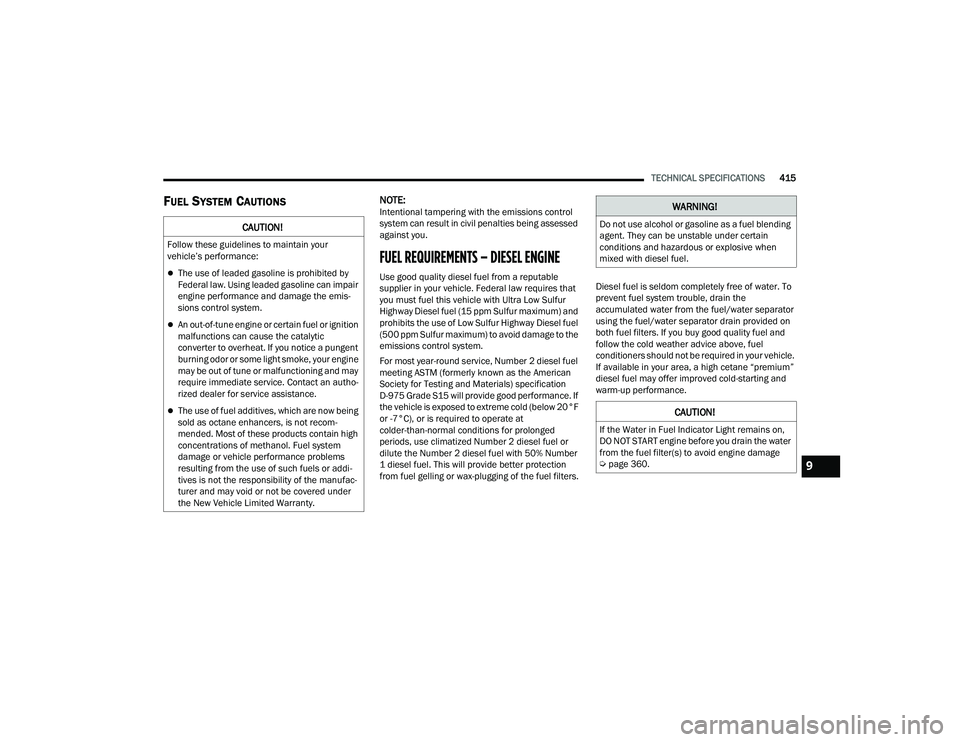
FUEL SYSTEM CAUTIONSNOTE:Intentional tampering with the emissions control
system can result in civil penalties being assessed
against you.
FUEL REQUIREMENTS – DIESEL ENGINE
Use good quality diesel fuel from a reputable
supplier in your vehicle. Federal law requires that
you must fuel this vehicle with Ultra Low Sulfur
Highway Diesel fuel (15 ppm Sulfur maximum) and
prohibits the use of Low Sulfur Highway Diesel fuel
(500 ppm Sulfur maximum) to avoid damage to the
emissions control system.
For most year-round service, Number 2 diesel fuel
meeting ASTM (formerly known as the American
Society for Testing and Materials) specification
D-975 Grade S15 will provide good performance. If
the vehicle is exposed to extreme cold (below 20°F
or -7°C), or is required to operate at
colder-than-normal conditions for prolonged
periods, use climatized Number 2 diesel fuel or
dilute the Number 2 diesel fuel with 50% Number
1 diesel fuel. This will provide better protection
from fuel gelling or wax-plugging of the fuel filters. Diesel fuel is seldom completely free of water. To
prevent fuel system trouble, drain the
accumulated water from the fuel/water separator
using the fuel/water separator drain provided on
both fuel filters. If you buy good quality fuel and
follow the cold weather advice above, fuel
conditioners should not be required in your vehicle.
If available in your area, a high cetane “premium”
diesel fuel may offer improved cold-starting and
warm-up performance.
CAUTION!
Follow these guidelines to maintain your
vehicle’s performance:
The use of leaded gasoline is prohibited by
Federal law. Using leaded gasoline can impair
engine performance and damage the emis
-
sions control system.
An out-of-tune engine or certain fuel or ignition
malfunctions can cause the catalytic
converter to overheat. If you notice a pungent
burning odor or some light smoke, your engine
may be out of tune or malfunctioning and may
require immediate service. Contact an autho -
rized dealer for service assistance.
The use of fuel additives, which are now being
sold as octane enhancers, is not recom -
mended. Most of these products contain high
concentrations of methanol. Fuel system
damage or vehicle performance problems
resulting from the use of such fuels or addi -
tives is not the responsibility of the manufac-
turer and may void or not be covered under
the New Vehicle Limited Warranty.
WARNING!
Do not use alcohol or gasoline as a fuel blending
agent. They can be unstable under certain
conditions and hazardous or explosive when
mixed with diesel fuel.
CAUTION!
If the Water in Fuel Indicator Light remains on,
DO NOT START engine before you drain the water
from the fuel filter(s) to avoid engine damage
Ú page 360.
9
23_DPF_OM_EN_USC_t.book Page 415
Page 425 of 444

CUSTOMER ASSISTANCE423
Who is Covered
You are covered by Roadside Assistance services if
you are a purchaser for use of the vehicle.
Roadside Assistance services last for five years or
60,000 miles on the odometer, whichever occurs
first, calculated from the start date of the Basic
Limited Warranty, as set forth in your Warranty
Information book.
1
1. Towing services provided through Cross Country Motor Club,
Inc. Medford, MA 02155, except in AK,CA, HI, OR, WI, and WY,
where services are provided by Cross Country Motor Club of
California, Inc., Thousand Oaks, CA 91360.
What to Do
If your vehicle requires jump start assistance, out
of gas/fuel delivery, tire service, lockout service or
towing as a result of a mechanical breakdown, dial
toll-free: USA: 1-800-521-2779/Canada:
1-800-363-4869. Provide your name, Vehicle
Identification Number (VIN) required for covered
services, license plate number, and your location,
including the telephone number from which you
are calling. Briefly describe the nature of the
problem and answer a few simple questions. You
will be given the name of the service provider and
an estimated time of arrival. If you feel you are in
an unsafe situation, please let us know. With your
consent, we will contact local police or safety
authorities. If Unable to Contact Roadside Assistance
If you are unable to contact Roadside Assistance or
unable to provide a valid Vehicle Identification
Number (VIN), and you obtain towing services on
your own, you may submit your original receipts
from the licensed towing or service facility, for
services rendered within30 days of the
occurrence. Be sure to include your VIN, odometer
mileage at the time of service, and current mailing
address. We will process the claim based on
vehicle and service eligibility. If eligible, we will
reimburse you for the reasonable amount actually
paid, based on the usual and customary charges
for that service in the area where they were
provided. FCA US LLC’s determination relating to
reimbursement is final. Correspondence should be
mailed to:
FCA US LLC Customer Assistance
P.O. Box 9145
Medford, MA 02155
Attention Claims Department
FCA US LLC reserves the right to modify the terms
or discontinue the Roadside Assistance Program
at any time. The Roadside Assistance program is
subject to restrictions and conditions of use, which
are determined solely by FCA US LLC.
Flat Tire Service
If you are inconvenienced by a flat tire, we will
dispatch a service provider to use your vehicle’s
temporary spare tire (if equipped) as
recommended in your Owner’s Manual. This is not
a permanent flat tire repair.
Out of Gas/Fuel Delivery
Drivers cannot always count on a gas station being
nearby, especially when traveling away from home.
We will dispatch a service provider to deliver a
small amount of fuel (maximum two gallons) to get
you to a nearby station. This service is limited to
two occurrences in a 12-month period.
Battery Jump Assistance
No time is a good time for a depleted battery. With
Roadside Assistance, you do not have to worry
about being stranded. We will dispatch a service
provider to provide you with a battery jump
anytime, day or night.
Lockout Service
Whether the keys are locked in your vehicle or
frozen locks are keeping you from getting on your
way, help is just a phone call away. This service is
limited to providing access to the vehicle’s seating
area. It does not cover the cost of replacement
keys.
10
23_DPF_OM_EN_USC_t.book Page 423
Page 430 of 444

428
INDEX
A
Adaptive Cruise Control (ACC)
(Cruise Control)
.................................... 148, 150Adding Engine Coolant (Antifreeze)............... 369Adding Fuel.................................................... 177Additives, Fuel............................................... 413AdjustDown........................................................... 33Forward....................................................... 33Rearward..................................................... 33Up................................................................ 33Adjustable Pedals............................................ 38Advance Phone Connectivity......................... 242Air BagAir Bag Operation...................................... 299Air Bag Warning Light................................ 297Enhanced Accident Response......... 302, 341Event Data Recorder (EDR)....................... 341If Deployment Occurs................................ 302Knee Impact Bolsters................................ 299Maintaining Your Air Bag System.............. 303Maintenance............................................. 303Redundant Air Bag Warning Light.............297Transporting Pets...................................... 322
Air Bag Light................................ 103, 297, 322Air Cleaner, Engine
(Engine Air Cleaner Filter).................... 355, 375Air Conditioner Maintenance........................ 357Air Conditioner Refrigerant........................... 357Air Conditioner System................................. 357Air Conditioning................................................ 62Air Conditioning Filter....................................... 65Air Conditioning System................................... 64Air Conditioning, Operating Tips....................... 64Air Filter........................................................ 355Air PressureTires......................................................... 397AlarmPanic........................................................... 16Security Alarm....................................23, 104Alterations/ModificationsVehicle......................................................... 10Antifreeze (Engine Coolant).......................... 368Capacities................................................. 418Disposal................................................... 370Anti-Lock Brake System (ABS)...................... 270Anti-Lock Warning Light................................ 108
Assist, Hill Start............................................. 276Audio Settings............................................... 230Audio Systems (Radio).................................. 199Auto Down Power Windows..............................75Automatic Door Locks......................................27Automatic Folding Mirrors................................44Automatic Headlights.......................................52Automatic Temperature Control (ATC)..............64Automatic Transmission....................... 132, 373Adding Fluid.............................................. 373Fluid And Filter Change............................. 373Fluid Change............................................. 373Fluid Level Check...................................... 372Fluid Type........................................ 373, 421Shifting..................................................... 135Special Additives...................................... 372Automatic Transmission Limp Home Mode... 133AutoPark....................................................... 113AUX Camera......................................... 173, 176Auxiliary Driving Systems.............................. 277Axle Fluid.............................................. 374, 421Axle Lubrication............................................ 374
23_DPF_OM_EN_USC_t.book Page 428
Page 433 of 444

431
Enhanced Accident Response Feature
.. 302, 341
Ethanol.......................................................... 414Exhaust Brake............................................... 129Exhaust Gas Cautions.................................... 324Exhaust System.......................... 324, 367, 375Exterior Lighting............................................... 51Exterior Lights......................................... 51, 324
F
Family Alerts.................................................. 258Filters Air Cleaner................................................. 355Air Conditioning.................................. 65, 358Engine Fuel..................................... 360, 419Engine Oil........................................ 354, 419Engine Oil Disposal................................... 354FlashersTurn Signals..............................54, 110, 324Flash-To-Pass.................................................. 52Flat Tire Stowage........................................... 332Fluid Capacities............................................. 418Fluid Leaks.................................................... 324Fluid Level ChecksBrake........................................................ 371Power Steering.......................................... 148Fog Lights............................................... 54, 387Fold Flat Load Floor......................................... 68Fold-Flat Seats................................................. 31Forward Collision Warning............................. 278Four Wheel Drive........................................... 140
Four-Way Hazard Flasher.............................. 325Freeing A Stuck Vehicle................................ 338Front Axle (Differential)................................. 374Fuel............................................. 177, 413, 415Adding...................................................... 177Additives................................................... 413Clean Air................................................... 413Diesel.............................................. 177, 415Ethanol..................................................... 414Filler Cap (Gas Cap).................................. 177Filter................................................ 360, 419Gasoline................................................... 413Light......................................................... 107Materials Added....................................... 413Methanol.................................................. 414Octane Rating........................................... 413Requirements.................................. 413, 415Specifications........................................... 416Tank Capacity........................................... 418Fuses............................................................ 377
G
Garage Door Opener (HomeLink®).................. 47Gas Cap (Fuel Filler Cap).............................. 177Gasoline, Clean Air........................................ 413Gasoline, Reformulated................................ 413GaugesVoltage..................................................... 122Gear Ranges................................................. 135Gear Selector Override................................. 336
Glass Cleaning.............................................. 410Glove Compartment Storage............................65Gross Axle Weight Rating.............................. 182Gross Vehicle Weight Rating......................... 181GuideBody Builders...............................................10GVWR............................................................ 180
H
HazardDriving Through Flowing, Rising, Or Shallow Standing Water
.................................... 198Hazard Warning Flashers.............................. 325Head Restraints...............................................36Head Rests......................................................36Headlights..................................................... 386Automatic High Beam..................................52Cleaning.................................................... 408High Beam...................................................52Lights On Reminder.....................................54Passing........................................................52Switch..........................................................51Heated Mirrors.................................................46Heated Seats...................................................35Hill Descent Control...................................... 274Hill Descent Control Indicator....................... 274Hill Start Assist.............................................. 276HitchesTrailer Towing........................................... 185
11
23_DPF_OM_EN_USC_t.book Page 431
Page 443 of 444
The driver’s primary responsibility is the safe operation of the vehicle. Driving while distracted can result in loss of vehicle control, resulting in an accident and personal injury. FCA US LLC strongly recommends that the driver use extreme caution when using any device or feature that may take their attention off the road. Use of any electrical devices, such as cellular telephones, computers, portable radios, vehicle navigation or other devices, by the driver while the vehicle is moving is dangerous and could lead to a serious accident. Texting while driving is also dangerous and should never be done while the vehicle is moving. If you find yourself unable to devote your full attention to vehicle operation, pull off the road to a safe location and stop your vehicle. Some states or provinces prohibit the use of cellular telephones or texting while driving. It is always the driver’s responsibility to comply with all local laws.
This Owner’s Manual has been prepared to help you get acquainted with your new Ram brand vehicle and to provide a convenient reference for common questions.
Not all features shown in this manual may apply to your vehicle. For additional information on accessories to help personalize your vehicle, visit mopar.com/om (USA), owners.mopar.ca (Canada) or your local Ram brand dealer.
This Owner’s Manual is intended to familiarize you with the important features of your vehicle. Your most up-to-date Owner’s Manual, Navigation/Uconnect manuals and Warranty Booklet can be found by visiting the website on the back cover.
U.S. Residents: If you are the first registered retail owner of your vehicle, you may obtain a complimentary printed copy of the Warranty Booklet by calling 1-866-726-4636 or by contacting your dealer. Replacement kits can be purchased by visiting www.techauthority.com.
Canadian Residents: If you are the first registered retail owner of your vehicle, you may obtain a complimentary printed copy of the Warranty Booklet or purchase a replacement kit by calling 1-800-387-1143 or by contacting your dealer.
DRIVING AND ALCOHOL
Drunk driving is one of the most frequent causes of accidents. Your driving ability can be seriously impaired with blood alcohol levels far below the legal minimum. If you are drinking, don’t drive. Ride with a designated non-drinking driver, call a cab, a friend or use public transportation.
WARNING
Driving after drinking can lead to an accident. Your perceptions are less sharp, your reflexes are slower and your judgment is impaired when you have been drinking. Never drink and then drive.
WARNING: Operating, servicing and maintaining a passenger vehicle or off-highway
motor vehicle can expose you to chemicals including engine exhaust, carbon monoxide, phthalates,
and lead, which are known to the State of California to cause cancer and birth defects or other
reproductive harm. To minimize exposure, avoid breathing exhaust, do not idle the engine except
as necessary, service your vehicle in a well-ventilated area and wear gloves or wash your hands frequently
when servicing your vehicle. For more information go to www.P65Warnings.ca.gov/passenger-vehicle.
This Owner’s Manual illustrates and describes the operation of features and equipment that are either standard or optional on this vehicle. This manual may also include a description of features and equipment that are no longer available or were not ordered on this vehicle. Please disregard any features and equipment described in this manual that are not on this vehicle. FCA US LLC reserves the right to make changes in design and specifications, and/or make additions to or improvements to its products without imposing any obligation upon itself to install them on products previously manufactured.
With respect to any vehicles sold in Canada, the name FCA US LLC shall be deemed to be deleted and the name FCA Canada Inc. used in substitution therefore.
FCA US LLC reserves the right to modify the terms or discontinue the Roadside Assistance Program at any time. The Roadside Assistance Program is subject to restrictions and conditions of use, that are determined solely by FCA US LLC.
ROADSIDE ASSISTANCE 24 HOURS, 7 DAYS A WEEK AT YOUR SERVICE. CALL 1-800-521-2779 OR VISIT CHRYSLER.RSAHELP.COM (USA) CALL 1-800-363-4869 OR VISIT FCA.ROADSIDEAID.COM (CANADA) SERVICES: Flat Tire Service, Out Of Gas/Fuel Delivery, Battery Jump Assistance, Lockout Service and Towing Service
Please see the Customer Assistance chapter in this Owner’s Manual for further information.