oil RAM CHASSIS CAB 2023 Repair Manual
[x] Cancel search | Manufacturer: RAM, Model Year: 2023, Model line: CHASSIS CAB, Model: RAM CHASSIS CAB 2023Pages: 444, PDF Size: 20.51 MB
Page 411 of 444

SERVICING AND MAINTENANCE409
INTERIORS
SEATS AND FABRIC PARTS
Use Mopar® Total Clean to clean fabric upholstery
and carpeting.
Stain Repel Fabric Cleaning Procedure —
If Equipped
Stain Repel seats may be cleaned in the following
manner:
Remove as much of the stain as possible by
blotting with a clean, dry towel.
Blot any remaining stain with a clean, damp
towel.
For tough stains, apply Mopar® Total Clean, or
a mild soap solution to a clean, damp cloth and
remove stain. Use a fresh, damp towel to
remove soap residue.
For grease stains, apply Mopar® Multi-Purpose
Cleaner to a clean, damp cloth and remove
stain. Use a fresh, damp towel to remove soap
residue.
Do not use any harsh solvents or any other form
of protectants on Stain Repel products.
Seat Belt Maintenance
Do not bleach, dye or clean the belts with chemical
solvents or abrasive cleaners. This will weaken the
fabric.
If the belts need cleaning, use a mild soap solution
or lukewarm water. Do not remove the belts from
the vehicle to wash them. Dry with a soft cloth.
Sun damage can also weaken the fabric. Replace
the belts if they appear frayed or worn or if the
buckles do not work properly.
NOTE:If the belts retract slowly, inspect the upper turning
loop for soiling. If soiling is present, clean with a
wet soft cloth until all residue is removed.
PLASTIC AND COATED PARTS
Use Mopar® Total Clean to clean vinyl upholstery.
WARNING!
Do not use volatile solvents for cleaning
purposes. Many are potentially flammable, and
if used in closed areas they may cause
respiratory harm.
WARNING!
A frayed or torn seat belt could rip apart in a
collision and leave you with no protection.
Inspect the seat belt system periodically,
checking for cuts, frays, or loose parts.
Damaged parts must be replaced immediately.
Do not disassemble or modify the seat belt
system. If your vehicle is involved in a collision,
or if you have questions regarding seat belt or
retractor conditions, take your vehicle to an
authorized FCA dealer or authorized FCA
Certified Collision Care Program facility for
inspection.
CAUTION!
Direct contact of air fresheners, insect repel -
lents, suntan lotions, or hand sanitizers to the
plastic, painted, or decorated surfaces of the
interior may cause permanent damage. Wipe
away immediately.
Damage caused by these type of products
may not be covered by your New Vehicle
Limited Warranty.
8
23_DPF_OM_EN_USC_t.book Page 409
Page 412 of 444

410SERVICING AND MAINTENANCE
Cleaning Plastic Instrument Cluster
Lenses
The lenses in front of the instruments in this
vehicle are molded in clear plastic. When cleaning
the lenses, care must be taken to avoid scratching
the plastic.
Clean with a wet soft cloth. A mild soap solution
may be used, but do not use high alcohol content
or abrasive cleaners. If soap is used, wipe clean
with a clean damp cloth. Dry with a soft cloth.
LEATHER SURFACES
Mopar® Total Clean is specifically recommended
for leather upholstery.
Your leather upholstery can be best preserved by
regular cleaning with a damp soft cloth. Small
particles of dirt can act as an abrasive and damage
the leather upholstery and should be removed
promptly with a damp cloth. Stubborn soils can be
removed easily with a soft cloth and Mopar® Total
Clean. Care should be taken to avoid soaking your
leather upholstery with any liquid. Please do not
use polishes, oils, cleaning fluids, solvents,
detergents, or ammonia-based cleaners to clean
your leather upholstery.
NOTE:If equipped with light colored leather, it tends to
show any foreign material, dirt, and fabric dye
transfer more so than darker colors. The leather is
designed for easy cleaning, and the manufacturer
recommends Mopar® Total Care leather cleaner
applied on a cloth to clean the leather seats as
needed.GLASS SURFACES
All glass surfaces should be cleaned on a regular
basis with Mopar® Glass Cleaner, or any
commercial household-type glass cleaner. Never
use an abrasive type cleaner. Use caution when
cleaning the inside rear window equipped with
electric defrosters or windows equipped with radio
antennas. Do not use scrapers or other sharp
instruments that may scratch the elements.
When cleaning the rearview mirror, spray cleaner
on the towel or cloth that you are using. Do not
spray cleaner directly on the mirror.
CAUTION!
Do not use alcohol and alcohol-based and/or
ketone-based cleaning products to clean leather
upholstery, as damage to the upholstery may
result.
23_DPF_OM_EN_USC_t.book Page 410
Page 413 of 444

411
TECHNICAL SPECIFICATIONS
VEHICLE IDENTIFICATION NUMBER (VIN)
The VIN is found on the left front corner of the
instrument panel, visible through the windshield.
Vehicle Identification Number
NOTE:It is illegal to remove or alter the VIN.
BRAKE SYSTEM
If power assist is lost for any reason (for example,
repeated brake applications with the engine off),
the brakes will still function. However, you will
experience a substantial increase in braking effort
to stop the vehicle. If either the front or rear hydraulic system loses
normal braking capability, the remaining system
will still function with some loss of overall braking
effectiveness. This will be evident by increased
pedal travel during application, greater pedal force
required to slow or stop, and activation of the
Brake Warning Light and/or the Anti-Lock Brake
System (ABS) Warning Light during brake use.
HYDRAULIC BRAKE ASSIST —
I
F EQUIPPED
The brake system power assist is provided by a
hydro-boost unit which shares fluid with the power
steering system. You may experience some
clicking or hissing noises from the hydro-boost
system during hard braking conditions.
NOTE:Under cold temperatures, pedal effort will be
higher than normal until the power steering fluid
reaches operating temperature.
WHEEL AND TIRE TORQUE SPECIFICATIONS
Proper lug nut/bolt torque is very important to
ensure that the wheel is properly mounted to the
vehicle. Any time a wheel has been removed and
reinstalled on the vehicle, the lug nuts/bolts
should be torqued using a properly calibrated
torque wrench using a six-sided (hex) deep wall
socket.
TORQUE SPECIFICATIONS
**Use only authorized dealer recommended lug
nuts/bolts and clean or remove any dirt or oil
before tightening.
Lug Nut/
Bolt
Torque Lug Nut/
Bolt Type**Lug
Nut/Bolt
SizeLug Nut/
Bolt
Socket
Size
130 ft-lb
(176 N·m) Cone
M14 x
1.5022 mm
129 ft-lb
(175 N·m) Flanged
9
23_DPF_OM_EN_USC_t.book Page 411
Page 414 of 444
412TECHNICAL SPECIFICATIONS
Inspect the wheel mounting surface prior to
mounting the tire and remove any corrosion or
loose particles.
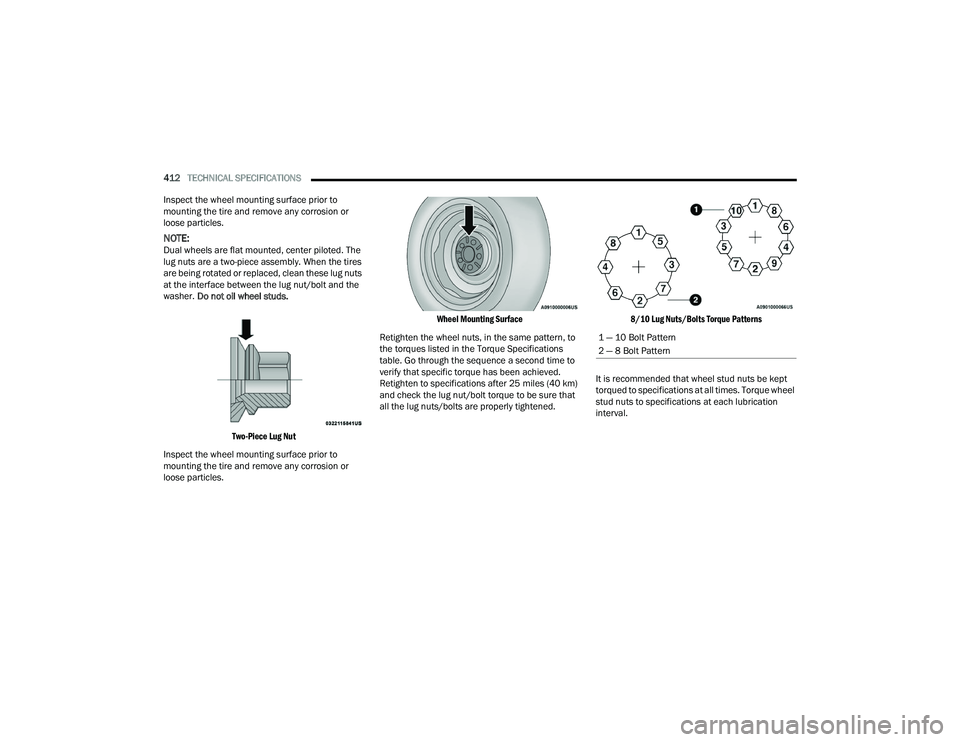
NOTE:Dual wheels are flat mounted, center piloted. The
lug nuts are a two-piece assembly. When the tires
are being rotated or replaced, clean these lug nuts
at the interface between the lug nut/bolt and the
washer. Do not oil wheel studs.
Two-Piece Lug Nut
Inspect the wheel mounting surface prior to
mounting the tire and remove any corrosion or
loose particles.
Wheel Mounting Surface
Retighten the wheel nuts, in the same pattern, to
the torques listed in the Torque Specifications
table. Go through the sequence a second time to
verify that specific torque has been achieved.
Retighten to specifications after 25 miles (40 km)
and check the lug nut/bolt torque to be sure that
all the lug nuts/bolts are properly tightened.
8/10 Lug Nuts/Bolts Torque Patterns
It is recommended that wheel stud nuts be kept
torqued to specifications at all times. Torque wheel
stud nuts to specifications at each lubrication
interval.
1 — 10 Bolt Pattern
2 — 8 Bolt Pattern
23_DPF_OM_EN_USC_t.book Page 412
Page 418 of 444

416TECHNICAL SPECIFICATIONS
FUEL SPECIFICATIONS
The Cummins® Turbo Diesel engine has been
developed to take advantage of the high energy
content and generally lower cost Number 2 Ultra
Low Sulfur diesel fuel or Number 2 Ultra Low Sulfur
climatized diesel fuels. Experience has shown that
it also operates on Number 1 Ultra Low Sulfur
diesel fuels or other fuels within specification.
NOTE:
If you accidentally fill the fuel tank with gasoline
on your diesel vehicle, Do not start the vehicle.
If you restart your vehicle you risk damaging the
engine and fuel system. Please call an autho-
rized dealer for service.
A maximum blend of 20% biodiesel meeting
ASTM specification D-7467 may be used with
your Cummins® diesel engine. (Models config -
ured with B20 Capability.)
In addition, commercially available fuel addi -
tives are not necessary for the proper operation
of your Cummins® diesel engine. However, if
seasonably adjusted fuel is not available and
you are operating below 20°F (-6°C), Mopar®
Premium Diesel Fuel Treatment (or equivalent)
may be beneficial to avoid fuel gelling.
Number 1 Ultra Low Sulfur diesel fuel should
only be used where extended arctic conditions
(0°F or -18°C) exist.
BIODIESEL FUEL REQUIREMENTS
Chassis Cab Models Ordered With B20
Option
Your vehicle has been validated and approved for
the use of biodiesel in blends up to 20% (B20)
provided that you comply with the requirements
outlined below. It is important that you understand
and comply with these requirements. Failure to
comply with Oil Change requirements for vehicles
operating on biodiesel blends up to B20 will result
in premature engine wear. Such wear is not
covered by the New Vehicle Limited Warranty.
Biodiesel is a fuel produced from renewable
resources typically derived from animal fat,
rapeseed oil (Rapeseed Methyl Ester (RME) base),
or soybean oil (Soy Methyl Ester (SME or SOME)
base). Biodiesel fuel has inherent limitations which
require that you understand and adhere to the
following requirements if you use blends of
biodiesel greater then 5% but not greater than
20% (B6-B20). There are no unique restrictions for
the use of B5. Use of blends greater than 20% is
not approved. Use of blends greater than 20% can
result in engine damage. Such damage is not
covered by the New Vehicle Limited Warranty. Fuel Quality — Must Comply With ASTM Standards
The quality of biodiesel fuel may vary widely. Only
fuel produced by a BQ9000 supplier to the
following specifications may be blended to meet
biodiesel blend (B6–B20) fuel meeting ASTM
specification D-7467:
Petrodiesel fuel meeting ASTM specification
D-975 and biodiesel fuel (B100) meeting ASTM
specification D-6751.
Fuel Oxidation Stability — Must Use Fuel
Within Six Months Of Manufacture
Biodiesel fuel has poor oxidation stability which
can result in long term storage problems. Fuel
produced to approved ASTM standards, if stored
properly, provides for protection against fuel
oxidation for up to six months.
23_DPF_OM_EN_USC_t.book Page 416
Page 419 of 444

TECHNICAL SPECIFICATIONS417
Fuel Water Separation — Must Use
Mopar®/Cummins® Approved Fuel Filter
Elements
You must use Mopar®/Cummins® approved fuel
filter elements in both your engine mounted filter
and frame mounted filter.
Biodiesel fuel has a natural affinity to water and
water accelerates microbial growth. Your Mopar®/
Cummins® filtration system is designed to provide
adequate fuel water separation capabilities.
Biodiesel Fuel Properties — Low Ambient
Temperatures
Biodiesel fuel may gel or solidify at low ambient
temperatures, which may pose problems for both
storage and operation. Precautions can be
necessary at low ambient temperatures, such as
storing the fuel in a heated building or a heated
storage tank, or using cold temperature additives.
Fuel In Oil Dilution — Must Adhere To
Required Oil Change Interval
Fuel dilution of lubricating oil has been observed
with the use of biodiesel fuel. Fuel in oil must not
exceed 5%. To ensure this limit is met your oil
change interval must be maintained to the
following schedule:
Ram 3500/4500/5500 Chassis Cab —
12,500 Miles (20,000 km)*
(*unless otherwise notified with a oil service
message)
CAUTION!
Under no circumstances should oil change
intervals exceed 12,500 miles (20,000 km) if
operation occurs with greater than 5%
biodiesel blends. Oil change intervals should
not exceed six months in either case. Failure
to comply with these Oil Change requirements
for vehicles operating on biodiesel blends up
to B20 may result in premature engine wear.
Such wear is not covered by the New Vehicle
Limited Warranty.
B20 Biodiesel capable: The engine may suffer
severe damage if operated with concentra -
tions of Biodiesel higher than 20%.
9
23_DPF_OM_EN_USC_t.book Page 417
Page 420 of 444

418TECHNICAL SPECIFICATIONS
FLUID CAPACITIES
6.4L GASOLINE ENGINE
6.7L DIESEL ENGINE
US Metric
Fuel (Approximate)
Standard Rear Tank 52 gal197 L
Optional Midship Tank 22 gal83 L
Engine Oil With Filter
6.4L Engine 7 qt6.6 L
Cooling System
6.4L Engine 18.5 qt17.5 L
USMetric
Fuel (Approximate)
Standard Rear Tank 52 gal197 L
Optional Midship Tank 22 gal83 L
Diesel Exhaust Fluid Tank (Approximate) 8.7 gal33 L
Engine Oil With Filter
6.7L Turbo Diesel Engine 12 qt11.4 L
Cooling System
6.7L Engine Chassis Cab 3500/4500 with AS69RC 22.3 qt21.1 L
6.7L Engine Chassis Cab 5500 with AS69RC 22.8 qt21.6 L
23_DPF_OM_EN_USC_t.book Page 418
Page 421 of 444

TECHNICAL SPECIFICATIONS419
ENGINE FLUIDS AND LUBRICANTS
6.4L GASOLINE ENGINE
6.7L DIESEL ENGINE
Component Fluid, Lubricant, or Genuine Part
Engine CoolantWe recommend using Mopar® Antifreeze/Coolant 10–Year/150,000 Mile
(240,000 km) Formula OAT (Organic Additive Technology).
Engine Oil We recommend using Mopar® API Certified SAE 0W-40 Full Synthetic Engine Oil which meets the
requirements of the manufacturer Material Standard MS-A0921. Equivalent full synthetic SAE 0W-40
engine oil can be used but must have the API Donut trademark Ú
page 354.
Fuel Selection 87 Octane (R+M)/2 Method, 0-15% Ethanol (Do not use E-85).
Component Fluid, Lubricant, or Genuine Part
Engine CoolantWe recommend using Mopar® Antifreeze/Coolant 10 Year/150,000 Mile
(240,000 km) Formula OAT (Organic Additive Technology).
Engine Oil In ambient temperatures above 0°F (-18°C), we recommend using 10W-30 engine oil such as Mopar®,
Shell Rotella and Shell Rimula that meets the manufacturer Material Standard MS-10902 and the API CK-4
engine oil category is required. Products meeting Cummins® CES 20081 may also be used. The
identification of these engine oils is typically located on the back of the oil container.
In ambient temperatures below 0°F (-18°C), we recommend using 5W-40
synthetic engine oil such as
Mopar®, Shell Rotella and Shell Rimula that meets the manufacturer Material Standard MS-10902 and the
API CK-4 engine oil category is required.
Fuel Filters We recommend using Mopar® Fuel Filter. Must meet 3 micron rating (engine mounted filter). Must meet
5 micron rating (chassis mounted filter).
Using a fuel filter that does not meet the manufacturer’s filtration
and water separating requirements can severely impact fuel system life and reliability.
Crankcase Ventilation Filter We recommend using Mopar® CCV Filter.
9
23_DPF_OM_EN_USC_t.book Page 419
Page 431 of 444

429
B
Back Up Camera
............................................ 166Back-Up......................................................... 166Battery................................................. 104, 352Blanket...................................................... 123Charging System Light............................... 104Keyless Key Fob Replacement.................... 16Battery Saver Feature...................................... 55Belts, Seat..................................................... 322Blind Spot Assist Cameras............................. 277Bluetooth Connecting To A Particular Mobile PhoneOr Audio Device After Pairing
................238Body Builders Guide........................................ 10Body Mechanism Lubrication........................ 364B-Pillar Location............................................. 394Brake Assist System...................................... 271Brake Control System.................................... 271Brake Fluid.......................................... 371, 421Brake System...................................... 371, 411Fluid Check............................................... 371Master Cylinder......................................... 371Parking...................................................... 128Warning Light............................................ 103Brake/Transmission Interlock....................... 131Bulb Replacement......................................... 384Bulbs, Light.......................................... 324, 384
C
Cab Top Clearance Lights............................. 388Camera......................................................... 166Camera, AUX........................................ 173, 176Camera, Rear....................................... 166, 168Camera, Trailer Surround View..................... 173Capacities, Antifreeze (Engine Coolant)........ 418Capacities, Fluid........................................... 418Caps, FillerOil (Engine)............................................... 350Power Steering......................................... 148Radiator (Coolant Pressure)..................... 369Car Washes................................................... 408Carbon Monoxide Warning............................ 324Cargo Light....................................................... 54CD................................................................. 232Cellular Phone.............................................. 263Center High Mounted Stop Light................... 388Center Seat Storage Compartment.................. 66Changing A Flat Tire...................................... 329Charge Air Cooler.......................................... 370Chart, Tire Sizing........................................... 390Check Engine Light
(Malfunction Indicator Light)......................... 112Checking Your Vehicle For Safety................. 321Checks, Safety.............................................. 321Child Restraint.............................................. 305
Child RestraintsBooster Seats........................................... 308Child Seat Installation...................... 315, 317How To Stow An unused ALR Seat Belt..... 313Infant And Child Restraints....................... 307Locating The LATCH Anchorages.............. 312Lower Anchors And Tethers For Children.. 310Older Children And Child Restraints.......... 308Seating Positions...................................... 309Clean Air Gasoline......................................... 413CleaningWheels...................................................... 403Climate Control................................................58Automatic....................................................59Manual........................................................62Cold Weather Operation................................ 117Compact Spare Tire...................................... 401Connected Services...................................... 244Connected Services FAQ............................... 258Connected Services Features....................... 247Connected Services, Getting Started............ 246Connected Services, Introduction................. 244Contract, Service........................................... 424Controls........................................................ 224Cooling Pressure Cap (Radiator Cap)............ 369
11
23_DPF_OM_EN_USC_t.book Page 429
Page 432 of 444

430 Cooling System
.............................................. 368Adding Coolant (Antifreeze)....................... 369Coolant Level.................................. 368, 370Cooling Capacity........................................ 418Disposal Of Used Coolant.......................... 370Drain, Flush, And Refill.............................. 368Inspection................................................. 370Points To Remember................................. 370Pressure Cap............................................. 369Radiator Cap............................................. 369Selection Of Coolant (Antifreeze)..... 368, 419Corrosion Protection...................................... 407Cruise Control (Speed Control)... 148, 149, 150Cruise Light................................................... 110Customer Assistance..................................... 422Cybersecurity................................................. 199
D
Daytime Running Lights................................... 52Dealer Service............................................... 353Defroster, Rear Window................................... 62Defroster, Windshield............................. 62, 322Delay (Intermittent) Wipers.............................. 57Deleting A Phone........................................... 238Diagnostic System, Onboard......................... 111Diesel Exhaust Brake.................................... 129Diesel Fuel..................................................... 415Diesel Fuel Requirements............................. 415Diesel Fuel System, Re-Priming..................... 363Differential, Limited Slip................................ 147
Dipsticks Power Steering......................................... 148Disabled Vehicle Towing............................... 339Disc Drive..................................................... 232Disconnecting............................................... 238DisposalAntifreeze (Engine Coolant)...................... 370Disturb.......................................................... 241Door Ajar....................................................... 105Door Ajar Light.............................................. 105Door LocksAutomatic.................................................... 27Doors............................................................... 24Draining Fuel/Water Separator Filter............ 360Driver Memory Presets................................. 230Driver’s Seat Back Tilt...................................... 31DrivingThrough Flowing, Rising, Or Shallow Standing Water
................................................... 198Dual Rear Wheels....................... 332, 406, 411
E
Electric Brake Control System....................... 271Anti-Lock Brake System............................ 270Electronic Roll Mitigation................. 272, 277Electrical Power Outlets................................... 71Electronic Range Select (ERS)............. 134, 137Electronic Stability Control (ESC).................. 272Electronic Throttle Control Warning Light...... 104Electronically Shifted Transfer Case.... 140, 143
Emergency Braking.............................. 128, 280Emergency, In Case OfFreeing Vehicle When Stuck..................... 338Hazard Warning Flasher........................... 325Jacking...................................................... 329Jump Starting........................................... 333Emission Control System Maintenance......... 112Engine.................................................. 350, 351Air Cleaner................................................ 355Block Heater............................................. 119Break-In Recommendations............ 127, 128Compartment........................................... 351Compartment Identification...................... 350Coolant (Antifreeze).................................. 419Exhaust Gas Caution................................ 324Fails To Start............................................. 116Flooded, Starting...................................... 116Fuel Requirements................................... 413Identification............................................. 351Idling......................................................... 124Jump Starting........................................... 333Oil.................................................... 353, 419Oil Filler Cap............................................. 350Oil Filter.................................................... 354Oil Reset......................................................92Oil Selection.............................................. 353Oil Synthetic.............................................. 354Overheating.............................................. 335Runaway................................................... 176Starting..................................................... 115
23_DPF_OM_EN_USC_t.book Page 430