cooling Ram ProMaster 2015 Diesel Supplement
[x] Cancel search | Manufacturer: RAM, Model Year: 2015, Model line: ProMaster, Model: Ram ProMaster 2015Pages: 130, PDF Size: 0.59 MB
Page 103 of 130
•Mixing engine coolant (antifreeze) types is not recom-
mended and can result in cooling system damage. If
HOAT and OAT coolant are mixed in an emergency,
have a authorized dealer drain, flush, and refill with
OAT coolant (conforming to MS.90032) as soon as
possible.
Cooling System Pressure Cap
The cap must be fully tightened to prevent loss of engine
coolant (antifreeze), and to ensure that the engine coolant
(antifreeze) will return to the radiator from the coolant
expansion bottle.
The cap should be inspected and cleaned if there is any
accumulation of foreign material on the sealing surfaces.
WARNING!
• Do not open hot engine cooling system. Never add
engine coolant (antifreeze) when the engine is
overheated. Do not loosen or remove the cap to cool
an overheated engine. Heat causes pressure to
build up in the cooling system. To prevent scalding
or injury, do not remove the pressure cap while the
system is hot or under pressure.
• Do not use a pressure cap other than the one
specified for your vehicle. Personal injury or en-
gine damage may result.
Disposal Of Used Engine Coolant
Used ethylene glycol-based engine coolant (antifreeze) is
a regulated substance requiring proper disposal. Check
with your local authorities to determine the disposal
rules for your community. To prevent ingestion by ani-
mals or children, do not store ethylene glycol-based
6
MAINTAINING YOUR VEHICLE 101
Page 104 of 130
engine coolant (antifreeze) in open containers or allow it
to remain in puddles on the ground. If ingested by a child
or pet, seek emergency assistance immediately. Clean up
any ground spills immediately.
Points To Remember
NOTE:When the vehicle is stopped after a few miles/
kilometers of operation, you may observe vapor coming
from the front of the engine compartment. This is nor-
mally a result of moisture from rain, snow, or high
humidity accumulating on the radiator and being vapor-
ized when the thermostat opens, allowing hot engine
coolant (antifreeze) to enter the radiator.
If an examination of your engine compartment shows no
evidence of radiator or hose leaks, the vehicle may be
safely driven. The vapor will soon dissipate.
• Do not overfill the coolant expansion bottle. •
Check the coolant freeze point in the radiator and in the
coolant expansion bottle. If engine coolant (antifreeze)
needs to be added, the contents of the coolant expansion
bottle must also be protected against freezing.
• If frequent engine coolant (antifreeze) additions are
required, the cooling system should be pressure tested
for leaks.
• Maintain engine coolant (antifreeze) concentration at a
minimum of 50% OAT coolant (conforming to
MS.90032) and distilled water for proper corrosion
protection of your engine which contains aluminum
components.
• Make sure that the coolant expansion bottle overflow
hoses are not kinked or obstructed.
• Keep the front of the radiator clean. If your vehicle is
equipped with air conditioning, keep the front of the
condenser clean.
102 MAINTAINING YOUR VEHICLE
Page 107 of 130
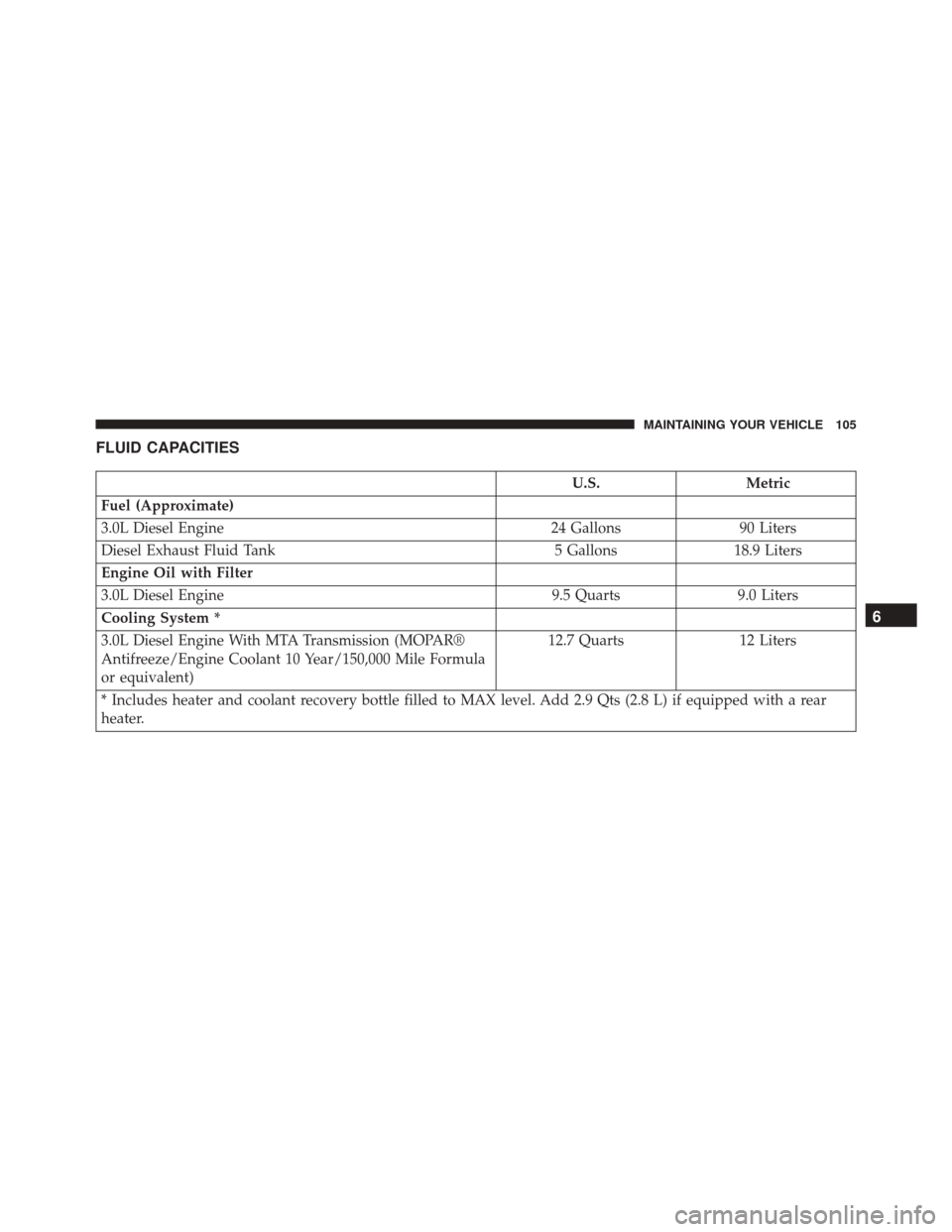
FLUID CAPACITIES
U.S.Metric
Fuel (Approximate)
3.0L Diesel Engine 24 Gallons90 Liters
Diesel Exhaust Fluid Tank 5 Gallons18.9 Liters
Engine Oil with Filter
3.0L Diesel Engine 9.5 Quarts9.0 Liters
Cooling System *
3.0L Diesel Engine With MTA Transmission (MOPAR®
Antifreeze/Engine Coolant 10 Year/150,000 Mile Formula
or equivalent) 12.7 Quarts
12 Liters
* Includes heater and coolant recovery bottle filled to MAX level. Add 2.9 Qts (2.8 L) if equipped with a rear
heater.
6
MAINTAINING YOUR VEHICLE 105
Page 110 of 130
NOTE:If the vehicle is exposed to extreme cold (below
20°F or -7°C), or is required to operate at colder-than-
normal conditions for prolonged periods, use climatized
No. 2 diesel fuel or dilute the No. 2 diesel fuel with 50%
No. 1 diesel fuel. This will provide better protection from
fuel gelling or wax-plugging of the fuel filter.
CAUTION!
• Mixing of engine coolant (antifreeze) other than
specified Organic Additive Technology (OAT) en-
gine coolant (antifreeze), may result in engine
damage and may decrease corrosion protection.
Organic Additive Technology (OAT) engine cool-
ant is different and should not be mixed with
Hybrid Organic Additive Technology (HOAT) en-
gine coolant (antifreeze) or any “globally compat-
ible” coolant (antifreeze). If a non-OAT engine
(Continued)
CAUTION! (Continued)
coolant (antifreeze) is introduced into the cooling
system in an emergency, the cooling system will
need to be drained, flushed, and refilled with fresh
OAT coolant (conforming to MS.90032), by an au-
thorized dealer as soon as possible.
• Do not use water alone or alcohol-based engine
coolant (antifreeze) products. Do not use additional
rust inhibitors or antirust products, as they may not
be compatible with the radiator engine coolant and
may plug the radiator.
• This vehicle has not been designed for use with
propylene glycol-based engine coolant (antifreeze).
Use of propylene glycol-based engine coolant (an-
tifreeze) is not recommended.
108 MAINTAINING YOUR VEHICLE
Page 115 of 130
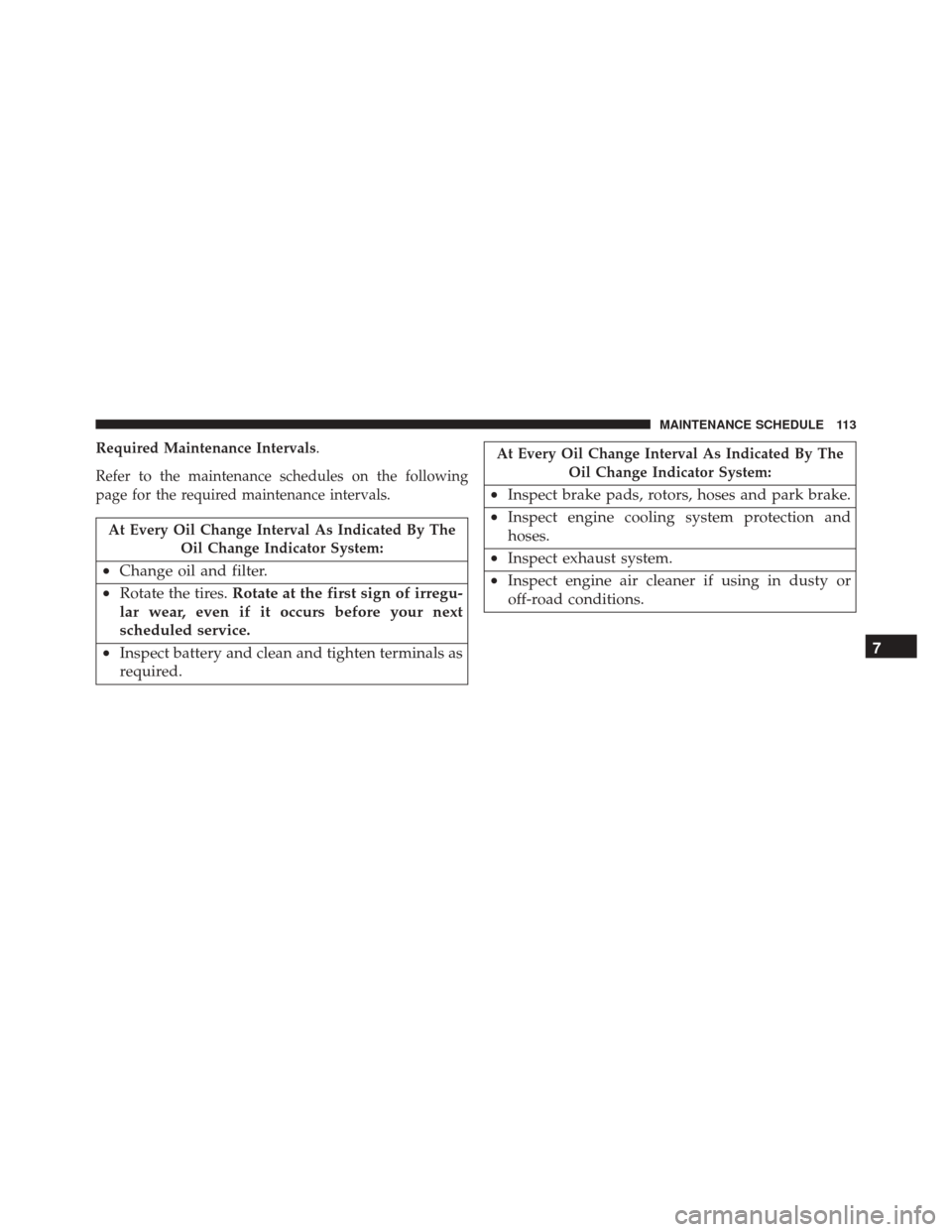
Required Maintenance Intervals.
Refer to the maintenance schedules on the following
page for the required maintenance intervals.
At Every Oil Change Interval As Indicated By TheOil Change Indicator System:
•Change oil and filter.
• Rotate the tires. Rotate at the first sign of irregu-
lar wear, even if it occurs before your next
scheduled service.
• Inspect battery and clean and tighten terminals as
required.
At Every Oil Change Interval As Indicated By The
Oil Change Indicator System:
•Inspect brake pads, rotors, hoses and park brake.
• Inspect engine cooling system protection and
hoses.
• Inspect exhaust system.
• Inspect engine air cleaner if using in dusty or
off-road conditions.
7
MAINTENANCE SCHEDULE 113
Page 124 of 130
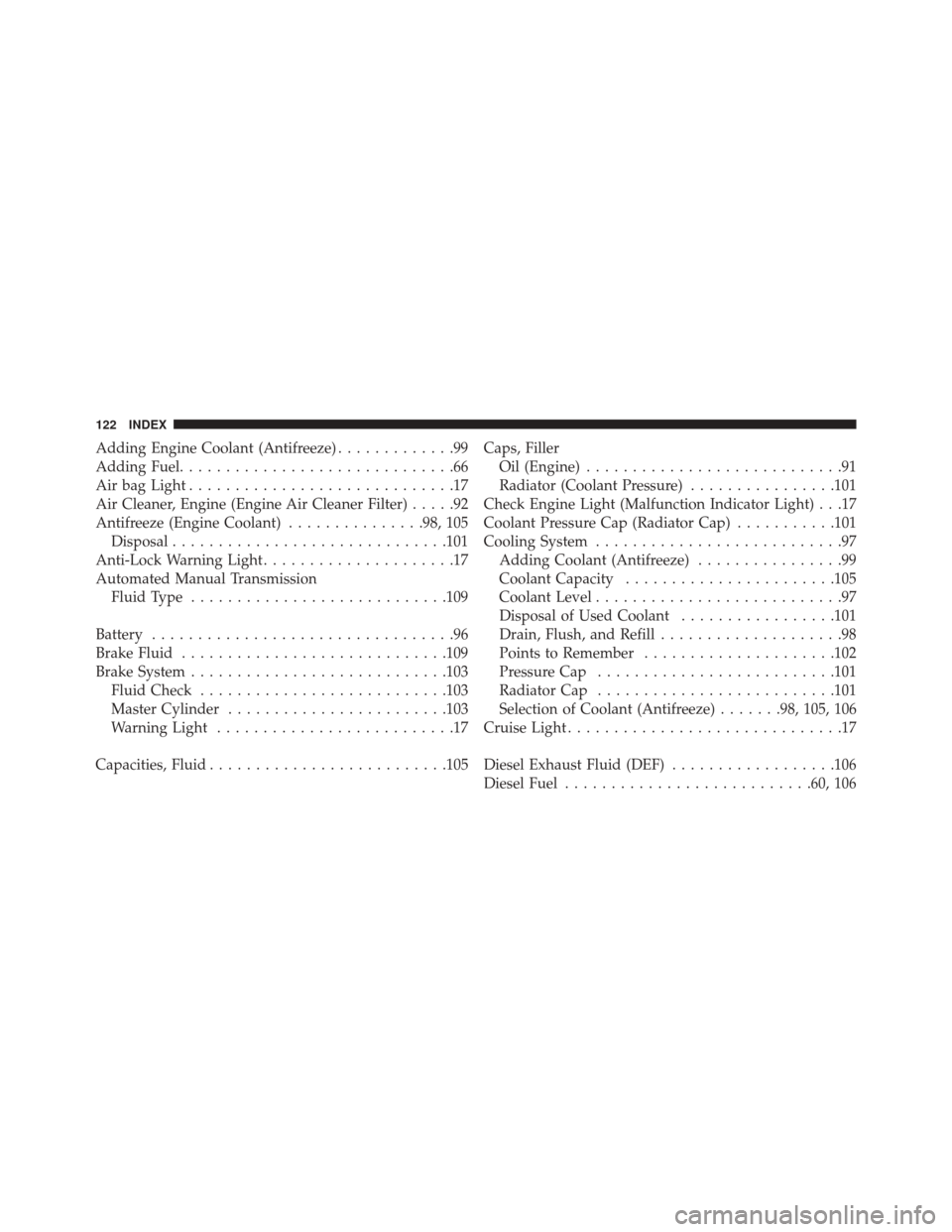
Adding Engine Coolant (Antifreeze).............99
Adding Fuel ..............................66
Air bag Light .............................17
Air Cleaner, Engine (Engine Air Cleaner Filter) .....92
Antifreeze (Engine Coolant) ...............98, 105
Disposal ............................. .101
Anti-Lock Warning Light .....................17
Automated Manual Transmission Fluid Type ........................... .109
Battery .................................96
Brake Fluid ............................ .109
Brake System ........................... .103
Fluid Check .......................... .103
Master Cylinder ....................... .103
Warning Light ..........................17
Capacities, Fluid ......................... .105Caps, Filler
Oil (Engine) ............................91
Radiator (Coolant Pressure) ................101
Check Engine Light (Malfunction Indicator Light) . . .17
Coolant Pressure Cap (Radiator Cap) ...........101
Cooling System ...........................97
Adding Coolant (Antifreeze) ................99
Coolant Capacity ...................... .105
Coolant Level ...........................97
Disposal of Used Coolant .................101
Drain, Flush, and Refill ....................98
Points to Remember .....................102
Pressure Cap ......................... .101
Radiator Cap ......................... .101
Selection of Coolant (Antifreeze) .......98, 105, 106
Cruise Light ..............................17
Diesel Exhaust Fluid (DEF) ..................106
Diesel Fuel .......................... .60, 106
122 INDEX
Page 128 of 130
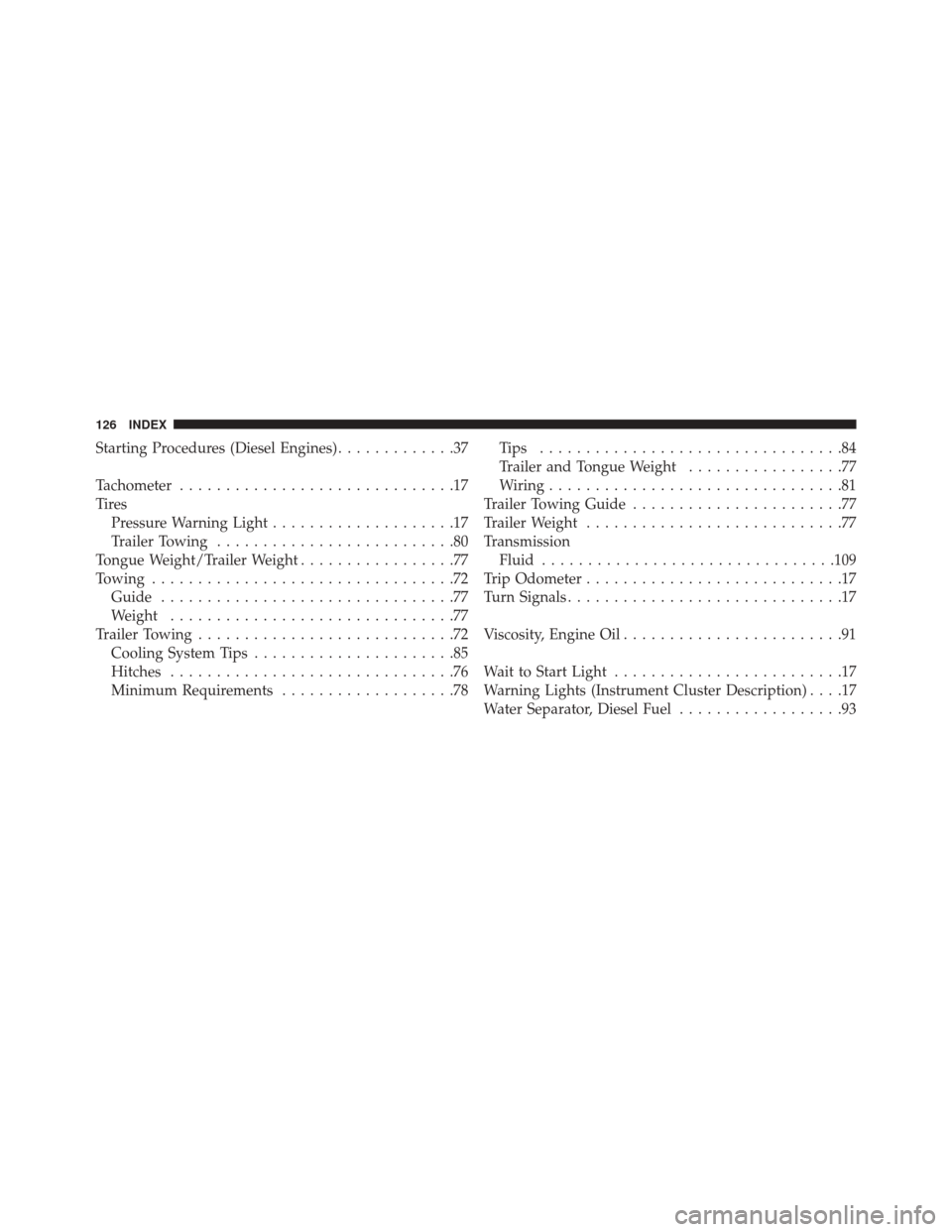
Starting Procedures (Diesel Engines).............37
Tachometer ..............................17
Ti re s Pressure Warning Light ....................17
Trailer Towing ..........................80
Tongue Weight/Trailer Weight .................77
Towing .................................72
Guide ................................77
Weight ...............................77
Trailer Towing ............................72
Cooling System Tips ......................85
Hitches ...............................76
Minimum Requirements ...................78 Tips .................................84
Trailer and Tongue Weight
.................77
Wiring ................................81
Trailer Towing Guide .......................77
Trailer Weight ............................77
Transmission Fluid ............................... .109
Trip Odometer ............................17
Turn Signals ..............................17
Viscosity, Engine Oil ........................91
Wait to Start Light .........................17
Warning Lights (Instrument Cluster Description) ....17
Water Separator, Diesel Fuel ..................93
126 INDEX