lock Ram ProMaster 2019 Workshop Manual
[x] Cancel search | Manufacturer: RAM, Model Year: 2019, Model line: ProMaster, Model: Ram ProMaster 2019Pages: 332, PDF Size: 3.66 MB
Page 183 of 332
Replacing Exterior Bulbs
Headlamps Low Beam And High beam
1. Remove one screw on the lower headlamp filler panel.
2. Remove two screws on the upper headlamp filler panel.
3. Remove one upper screw from the headlamp housing.
4. Remove two lower screws from the headlamp housing.
5. Pull Headlamp forward.
6. Remove appropriate plastic cap from the back of theheadlamp housing.
7. Push down on the upper portion of the socket.
8. Pull the socket outward from reflector.
9. Pull bulb outward from socket.
10. Install new bulb.
11. Push socket back into reflector until it locks back into place.
12. Install access cap.
13. Carefully reinstall headlamp in the same position on the vehicle, so as not to affect headlamp aiming. 14. Install one upper screw on the headlamp housing.
15. Install two lower screws on the headlamp housing.
16. Carefully reinstall one screw on the lower headlamp
filler panel.
17. Carefully reinstall two screws on the upper headlamp filler panel.
Front Turn Signal/Parking Lamps
1. Remove one screw on the lower headlamp filler panel.
2. Remove two screws on the upper headlamp filler panel.
3. Remove one upper screw from the headlamp housing.
4. Remove two lower screws from the headlamp housing.
5. Pull Headlamp forward.
6. Rotate the bulb counter clockwise and remove.
7. Install the bulb into socket, and rotate bulb/socketclockwise into lamp locking it in place.
8. Carefully reinstall headlamp in the same position on the vehicle, so as not to affect headlamp aiming.
9. Install the one upper screw on headlamp housing.
7
IN CASE OF EMERGENCY 181
Page 184 of 332
10. Install the two lower screws on headlamp housing.
11. Carefully reinstall one screw on the lower headlampfiller panel.
12. Carefully reinstall two screws the on upper headlamp filler panel.
Daytime Running Lamp (DRL)/Front Side Marker
Lamp
1. Remove one screw on the lower headlamp filler panel.
2. Remove two screws on the upper headlamp filler panel.
3. Remove one upper screw from the headlamp housing.
4. Remove two lower screws from the headlamp housing.
5. Pull Headlamp forward.
6.
Remove the DRL, side marker bulb by pulling straight out.
7. Replace lamp as required and lock in place.
8. Reinstall plastic cap.
9. Carefully reinstall headlamp in the same position on thevehicle, as not to affect headlamp aiming.
10. Install the one upper screw on the headlamp housing.
11. Install the two lower screws on the headlamp housing. 12. Carefully reinstall one screw on the lower headlamp
filler panel.
13. Carefully reinstall two screws on the upper headlamp filler panel.
Front Fog Lamps
1. Turn front wheels inboard to access cover in wheel liner.
2. Open the cover on the front of the wheel liner.
3. Remove connection and replace the bulb.
4. Connect the wire and rotate bulb/socket clockwise intolamp locking it in place.
5. Reinstall the plastic cap and close the cover on the wheel liner.
Front, Rear Roof Lamps
1. Remove two screw and remove the lamp assembly.
2. Remove the socket bulb by turning counterclockwise.
3. Remove bulb and replace as needed.
4. Reinstall the bulb socket and rotate clockwise to lock inplace.
5. Reinstall lamp.
182 IN CASE OF EMERGENCY
Page 185 of 332
Rear Tail, Stop, Backup, Turn Signal And Rear Side
Marker Lamps
1. Open rear doors.
2. Remove the two screws and remove the tail lamp.
3. Remove the tail/stop, turn signal, backup and rear sidemarker bulb/socket by rotating counter-clockwise.
4. Remove the bulb and replace as needed.
5. Reinstall bulb/socket and rotate clockwise to lock in place.
6. Reinstall lamp.
Replacing Interior Bulbs
Cargo Lamp
1. Using a suitable tool, remove either the lamp above the back door or the sliding door lamp as needed and
disconnect it.
Rear Cargo Lamp Bulb Access
7
IN CASE OF EMERGENCY 183
Page 194 of 332
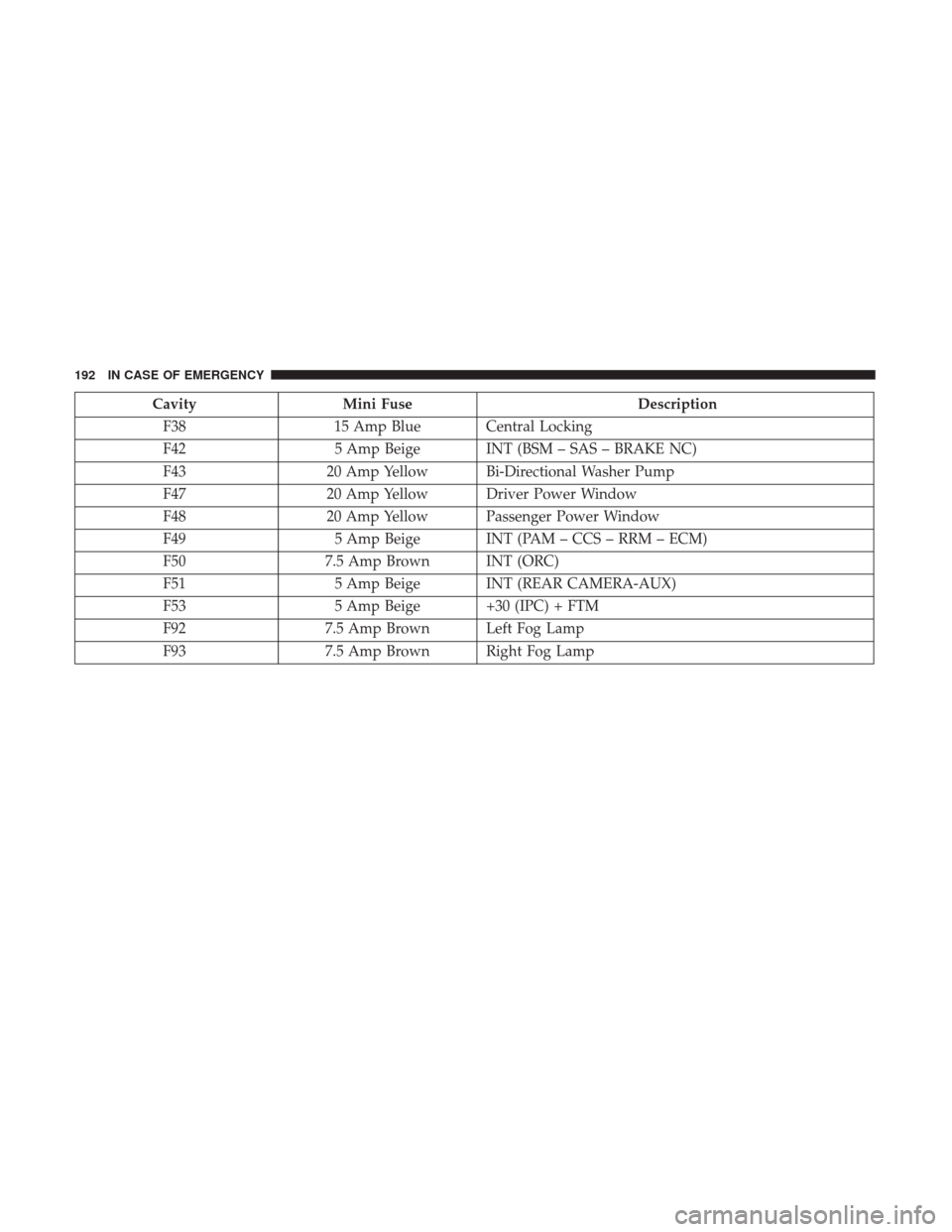
CavityMini Fuse Description
F38 15 Amp Blue Central Locking
F42 5 Amp Beige INT (BSM – SAS – BRAKE NC)
F43 20 Amp Yellow Bi-Directional Washer Pump
F47 20 Amp Yellow Driver Power Window
F48 20 Amp Yellow Passenger Power Window
F49 5 Amp Beige INT (PAM – CCS – RRM – ECM)
F50 7.5 Amp Brown INT (ORC)
F51 5 Amp Beige INT (REAR CAMERA-AUX)
F53 5 Amp Beige +30 (IPC) + FTM
F92 7.5 Amp Brown Left Fog Lamp
F93 7.5 Amp Brown Right Fog Lamp
192 IN CASE OF EMERGENCY
Page 196 of 332
JACKING AND TIRE CHANGING
WARNING!
•Do not attempt to change a tire on the side of the
vehicle close to moving traffic. Pull far enough off
the road to avoid the danger of being hit when
operating the jack or changing the wheel.
• Being under a jacked-up vehicle is dangerous. The
vehicle could slip off the jack and fall on you. You
could be crushed. Never put any part of your body
under a vehicle that is on a jack. If you need to get
under a raised vehicle, take it to a service center
where it can be raised on a lift.
• Never start or run the engine while the vehicle is on
a jack.
• The jack is designed to be used as a tool for changing
tires only. The jack should not be used to lift the
vehicle for service purposes. The vehicle should be
jacked on a firm level surface only. Avoid ice or
slippery areas.
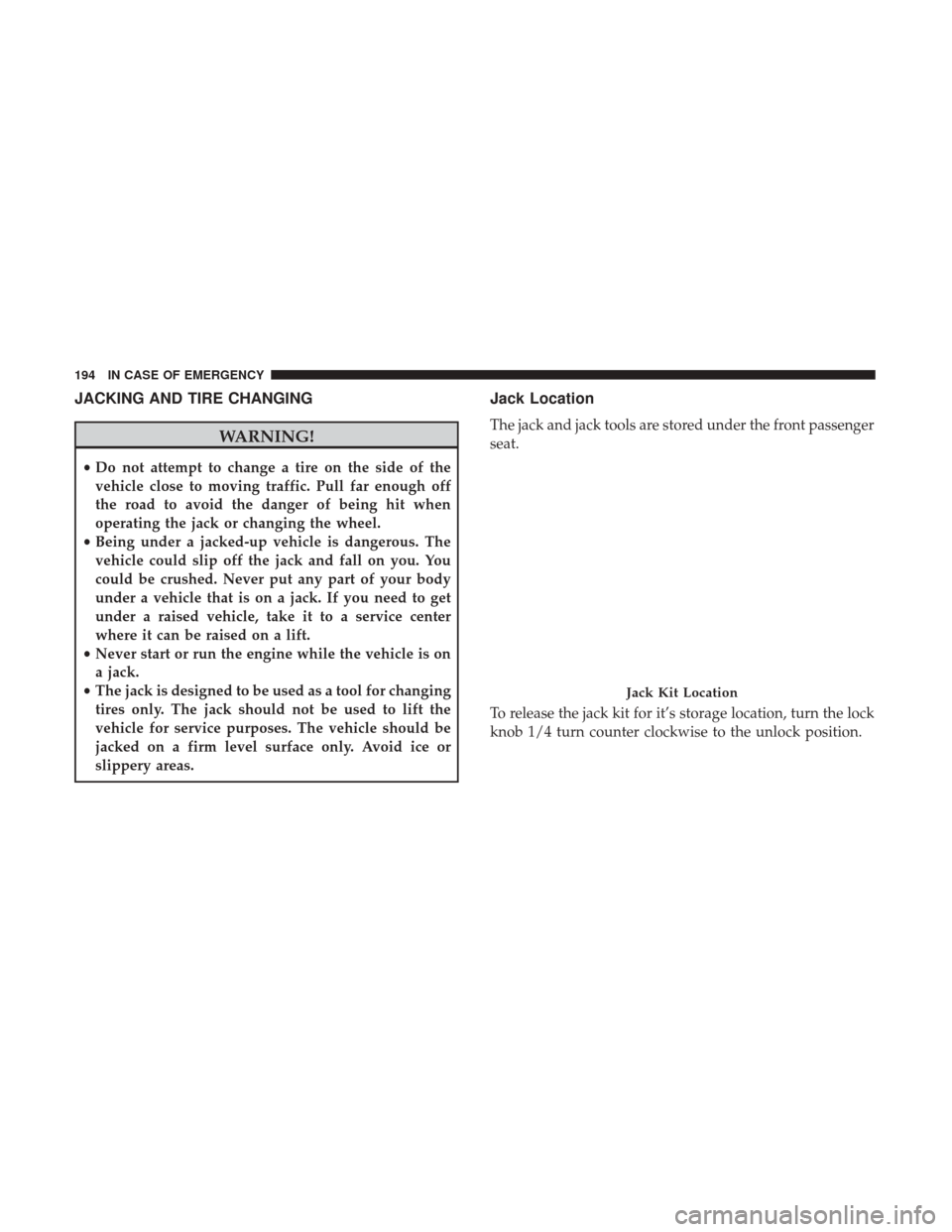
Jack Location
The jack and jack tools are stored under the front passenger
seat.
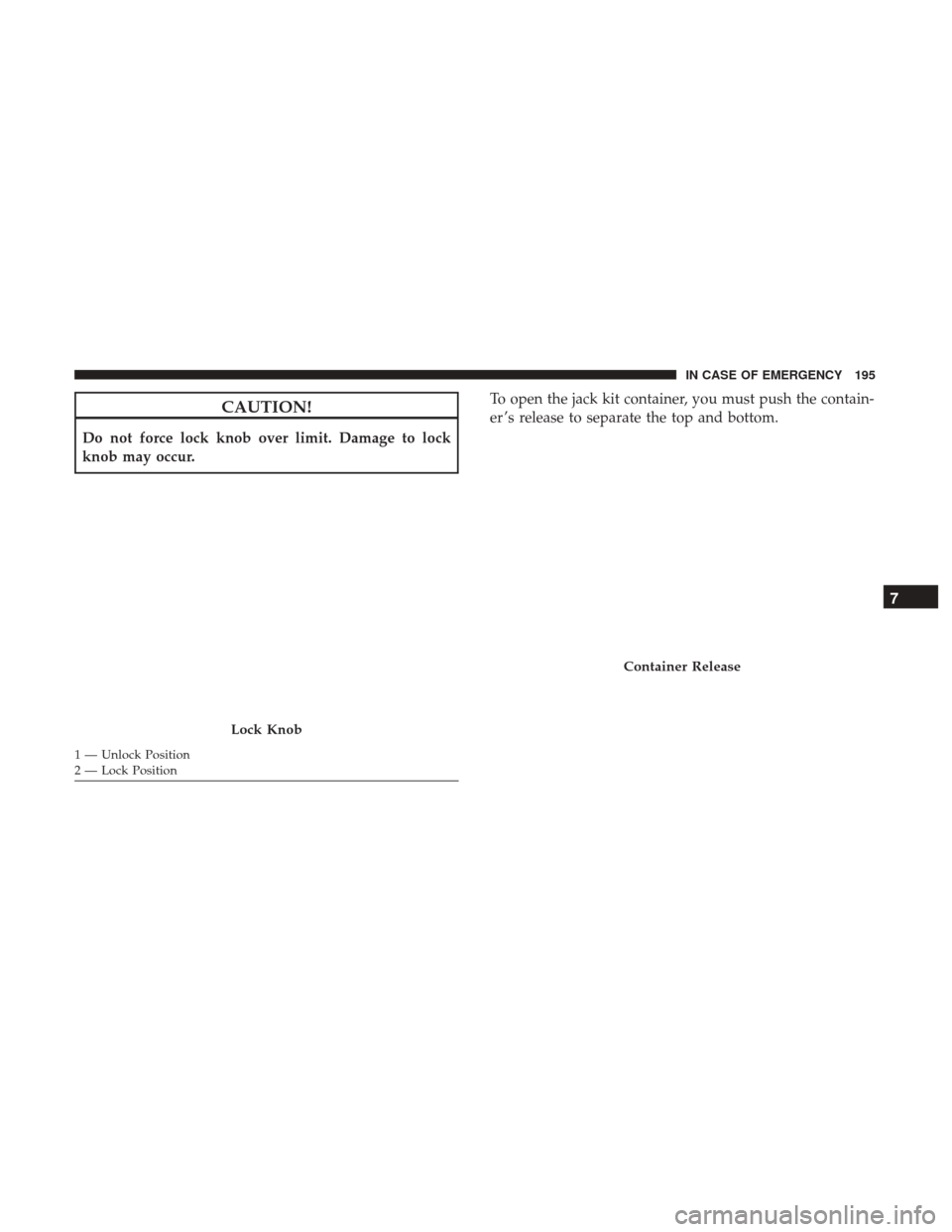
To release the jack kit for it’s storage location, turn the lock
knob 1/4 turn counter clockwise to the unlock position.
Jack Kit Location
194 IN CASE OF EMERGENCY
Page 197 of 332
CAUTION!
Do not force lock knob over limit. Damage to lock
knob may occur.To open the jack kit container, you must push the contain-
er ’s release to separate the top and bottom.
Lock Knob
1 — Unlock Position
2 — Lock Position
Container Release
7
IN CASE OF EMERGENCY 195
Page 199 of 332
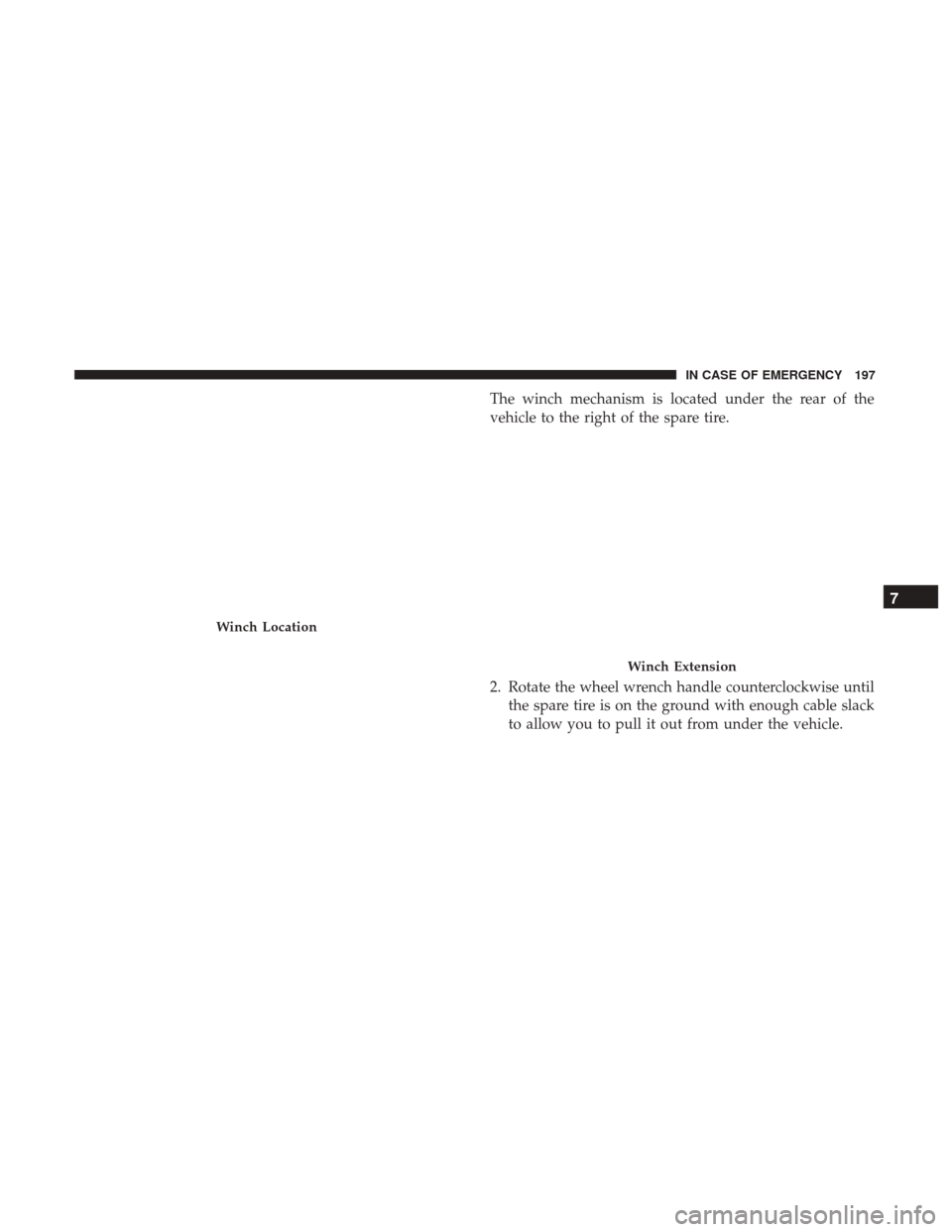
The winch mechanism is located under the rear of the
vehicle to the right of the spare tire.
2. Rotate the wheel wrench handle counterclockwise untilthe spare tire is on the ground with enough cable slack
to allow you to pull it out from under the vehicle.
Winch Location
Winch Extension
7
IN CASE OF EMERGENCY 197
Page 202 of 332
Preparations For Jacking
1. Park the vehicle on a firm, level surface. Avoid ice orslippery areas.
WARNING!
Do not attempt to change a tire on the side of the
vehicle close to moving traffic. Pull far enough off the
road to avoid being hit when operating the jack or
changing the wheel.
2. Turn on the Hazard Warning flasher.
3. Apply the parking brake firmly.
4. Place the transmission in PARK (REVERSE for manual transmission) .
5. Turn the ignition OFF. 6. Block both the front and rear of the wheel diagonally
opposite the jacking position. For example, if the right
front wheel is being changed, block the left rear wheel.
NOTE:Passengers should not remain in the
vehicle when the vehicle is being jacked.
Jacking Instructions
WARNING!
Carefully follow these tire changing warnings to help
prevent personal injury or damage to your vehicle:
•
Always park on a firm, level surface as far from the edge
of the roadway as possible before raising the vehicle.
• Turn on the Hazard Warning flashers.
• Block the wheel diagonally opposite the wheel to be
raised.
• Apply the parking brake firmly and place an auto-
matic transmission in PARK; a manual transmission
in REVERSE.
(Continued)
200 IN CASE OF EMERGENCY
Page 207 of 332
CAUTION!
Be sure to mount the spare tire with the valve stem
facing outward. The vehicle could be damaged if the
spare tire is mounted incorrectly.
NOTE: Do not install the wheel cover on the spare tire.
7. Lower the vehicle by turning the jack screw to the left.
8. Refer to “Wheel And Tire Torque Specifications” in “Technical Specifications” for proper wheel lug bolt
torque.
9. Lower the jack to its fully-closed position.
10. Stow the damaged wheel/spare tire with the cable and wheel spacer before driving the vehicle.
11. Install the winch extension and rotate the wrench
handle clockwise until the winch mechanism opera-
tor hears “3 clicks” from the device to indicate the
wheel is properly stowed under the vehicle.
12. Stow the jack, jack handle and winch handle tools back in the storage compartment.
WARNING!
A loose tire or jack thrown forward in a collision or
hard stop could endanger the occupants of the vehicle.
Always stow the jack parts and the spare tire in the
places provided. Have the deflated (flat) tire repaired
or replaced immediately.
13. Check the spare tire pressure as soon as possible. Correct the tire pressure, as required.
For vehicles with aluminum wheels:
The center cap must be pushed out from the rear to install
the retainer and stow the tire.
Wheel Covers
CAUTION!
Use a back-and-forth motion to remove the hub cap.
Do not use a twisting motion when removing the hub
cap, damage to the hub cap finish may occur.
The wheel covers on the vehicle are held in place by the
wheel lug bolts and can be removed after the wheel lug
bolts are taken off.
7
IN CASE OF EMERGENCY 205
Page 215 of 332
5. Remove the Speed Limit sticker from the instrumentpanel after the tire has been repaired.
6. Replace the Sealant Bottle (4) and Sealant Hose (3) assembly at an authorized dealer as soon as possible.
Refer to “(F) Sealant Bottle And Hose Replacement”.
NOTE: When having the tire serviced, advise the autho-
rized dealer or service center that the tire has been sealed
using the Tire Service Kit.
(F) Sealant Bottle And Hose Replacement:
1. Uncoil the Sealant Hose (3) (clear in color).
2. Locate the red colored round Sealant Bottle release button at the lower right hand corner of the kit.
3. Push and hold the Sealant Bottle release button, then pull out the bottle holding the button.
4. Clean any remaining sealant from the Tire Service Kit housing.
5. Position the new Sealant Bottle (4) in the housing so that the Sealant Hose (3) aligns with the hose slot in the front
of the housing. Push and hold the Sealant Bottle release
button, then push the bottle into the housing by holding the button. An audible click will be heard indicating the
bottle is locked into place. Release the button.
6. Verify that the cap is installed on the fitting at the end of the Sealant Hose (3) and return the hose to its storage
area (located on top of the housing).
7. Return the Tire Service Kit to its storage location in the vehicle.
JUMP STARTING
If your vehicle has a discharged battery, it can be jump
started using a set of jumper cables and a battery in another
vehicle or by using a portable battery booster pack. Jump
starting can be dangerous if done improperly, so please
follow the procedures in this section carefully.
NOTE: When using a portable battery booster pack, follow
the manufacturer ’s operating instructions and precautions.
WARNING!
Do not attempt jump starting if the battery is frozen. It
could rupture or explode and cause personal injury.
7
IN CASE OF EMERGENCY 213