brake light Ram ProMaster 2020 User Guide
[x] Cancel search | Manufacturer: RAM, Model Year: 2020, Model line: ProMaster, Model: Ram ProMaster 2020Pages: 264, PDF Size: 10.11 MB
Page 97 of 264
STARTING AND OPERATING95
(Continued)
AUTOMATIC TRANSMISSION
Do not leave the key fob in or near the
vehicle, or in a location accessible to chil-
dren, and do not leave a vehicle equipped
with Keyless Enter-N-Go in the ACC or ON/
RUN mode. A child could operate power
windows, other controls, or move the
vehicle.
Be sure the parking brake is fully disen -
gaged before driving; failure to do so can
lead to brake failure and a collision.
Always fully apply the parking brake when
leaving your vehicle or it may roll and cause
damage or injury. Also, be certain to leave
the transmission in PARK. Failure to do so
may cause the vehicle to roll and cause
damage or injury.
CAUTION!
If the Brake System Warning Light remains on
with the parking brake released, a brake
system malfunction is indicated. Have the
brake system serviced by an authorized
dealer immediately.
WARNING!
(Continued)
WARNING!
It is dangerous to shift out of PARK or
NEUTRAL if the engine speed is higher than
idle speed. If your foot is not firmly pressing
the brake pedal, the vehicle could accel -
erate quickly forward or in reverse. You
could lose control of the vehicle and hit
someone or something. Only shift into gear
when the engine is idling normally and your
foot is firmly pressing the brake pedal.
Unintended movement of a vehicle could
injure those in or near the vehicle. As with
all vehicles, you should never exit a vehicle
while the engine is running. Before exiting a
vehicle always come to a complete stop,
then apply the parking brake, shift the
transmission into PARK, turn the engine
OFF, and remove the ignition key. Once the
key is removed, the transmission is locked
in PARK, securing the vehicle against
unwanted movement.
When leaving the vehicle, always remove
the ignition key from the vehicle and lock
the vehicle.
Never leave children alone in a vehicle, or
with access to an unlocked vehicle.
Allowing children to be in a vehicle unat -
tended is dangerous for a number of
reasons. A child or others could be seriously
or fatally injured. Children should be
warned not to touch the parking brake,
brake pedal or the transmission gear
selector.
Do not leave the ignition key in or near the
vehicle (or in a location accessible to chil -
dren). A child could operate power
windows, other controls, or move the
vehicle.
WARNING!
(Continued)
5
20_VF_OM_EN_US_t.book Page 95
Page 107 of 264

STARTING AND OPERATING105
To Accelerate For Passing
Press the accelerator as you would normally.
When the pedal is released, the vehicle will
return to the set speed.
Using Speed Control On Hills
The transmission may downshift on hills to
maintain the vehicle set speed.
NOTE:
The Speed Control system maintains speed up
and down hills. A slight speed change on
moderate hills is normal.
On steep hills, a greater speed loss or gain may
occur so it may be preferable to drive without
Speed Control.
To Resume Speed
To resume a previously set speed, push the RES
button and release. Resume can be used at any
speed above 20 mph (32 km/h) up to the
maximum speed of 100 mph (160 km/h).
To Deactivate
A soft tap on the brake pedal, pushing the RES
button, or normal brake pressure while slowing
the vehicle will deactivate Speed Control
without erasing the set speed memory. Rotating
the center ring upward to turn the system off or
placing the ignition in the STOP (OFF/LOCK)
position erases the set speed memory.
PARKSENSE REAR PARK ASSIST — IF
EQUIPPED
The ParkSense Rear Park Assist system
provides an audible indication of the distance
between the rear fascia/bumper and a
detected obstacle when backing up (e.g. during
a parking maneuver). Refer to “ParkSense
System Usage Precautions” in this section for
limitations of this system and recommenda -
tions.
The ParkSense Rear Park Assist is automati -
cally activated when the transmission is placed
into REVERSE. As the distance from an obstacle
behind the vehicle decreases, the audible alert
becomes more frequent.
Interaction With Trailer Towing
The Rear Park Assist system is automatically
deactivated when a trailer is hitched to the
vehicle. The system will be automatically acti -
vated as soon as the trailer is removed.
WARNING!
Speed Control can be dangerous where the
system cannot maintain a constant speed.
Your vehicle could go too fast for the
conditions, and you could lose control and
have an accident. Do not use Speed Control
in heavy traffic or on roads that are winding,
icy, snow-covered or slippery.
5
20_VF_OM_EN_US_t.book Page 105
Page 120 of 264
118STARTING AND OPERATING
Towing Requirements — Trailer Lights And Wiring
Whenever you pull a trailer, regardless of the
trailer size, stoplights and turn signals on the
trailer are required for motoring safety.
The Trailer Tow Package may include a four- and
seven-pin wiring harness. Use a factory
approved trailer harness and connector.
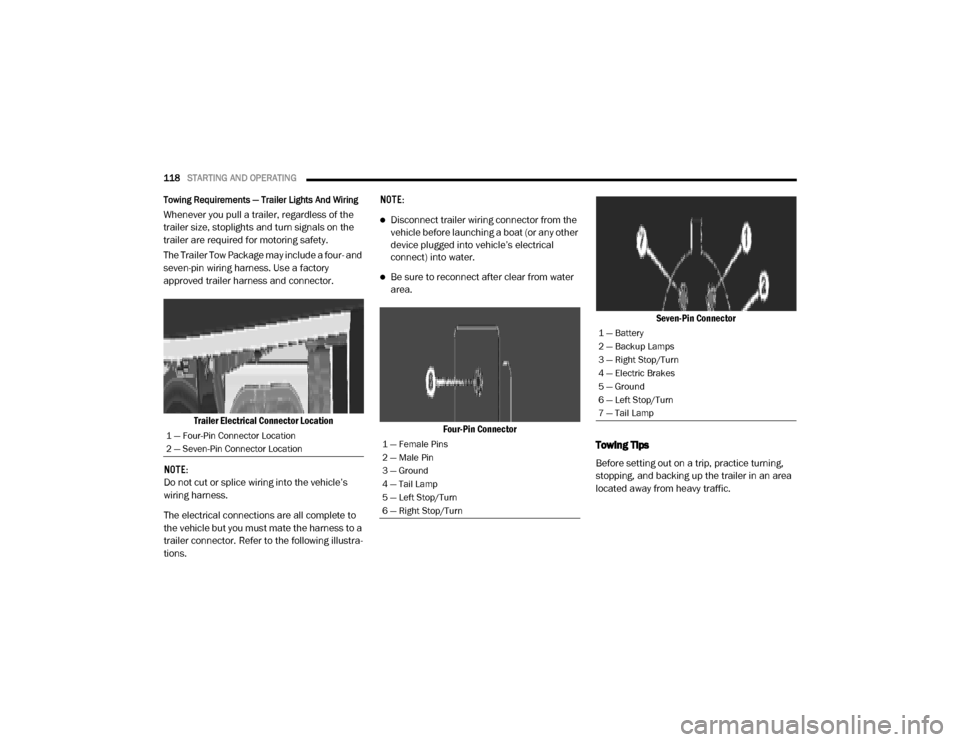
Trailer Electrical Connector Location
NOTE:
Do not cut or splice wiring into the vehicle’s
wiring harness.
The electrical connections are all complete to
the vehicle but you must mate the harness to a
trailer connector. Refer to the following illustra -
tions. NOTE:Disconnect trailer wiring connector from the
vehicle before launching a boat (or any other
device plugged into vehicle’s electrical
connect) into water.
Be sure to reconnect after clear from water
area.
Four-Pin Connector Seven-Pin Connector
Towing Tips
Before setting out on a trip, practice turning,
stopping, and backing up the trailer in an area
located away from heavy traffic.
1 — Four-Pin Connector Location
2 — Seven-Pin Connector Location1 — Female Pins
2 — Male Pin
3 — Ground
4 — Tail Lamp
5 — Left Stop/Turn
6 — Right Stop/Turn
1 — Battery
2 — Backup Lamps
3 — Right Stop/Turn
4 — Electric Brakes
5 — Ground
6 — Left Stop/Turn
7 — Tail Lamp
20_VF_OM_EN_US_t.book Page 118
Page 124 of 264
122STARTING AND OPERATING
(Continued)
Shallow Standing Water
Although your vehicle is capable of driving
through shallow standing water, consider the
following Cautions and Warnings before doing
so.
WARNING!
Driving through standing water limits your
vehicle’s traction capabilities. Do not
exceed 5 mph (8 km/h) when driving
through standing water.
Driving through standing water limits your
vehicle’s braking capabilities, which
increases stopping distances. Therefore,
after driving through standing water, drive
slowly and lightly press on the brake pedal
several times to dry the brakes.
Failure to follow these warnings may result
in injuries that are serious or fatal to you,
your passengers, and others around you.
CAUTION!
Always check the depth of the standing
water before driving through it. Never drive
through standing water that is deeper than
the bottom of the tire rims mounted on the
vehicle.
Determine the condition of the road or the
path that is under water and if there are any
obstacles in the way before driving through
the standing water.
Do not exceed 5 mph (8 km/h) when
driving through standing water. This will
minimize wave effects.
Driving through standing water may cause
damage to your vehicle’s drivetrain compo -
nents. Always inspect your vehicle’s fluids
(i.e., engine oil, transmission, axle, etc.) for
signs of contamination (i.e., fluid that is
milky or foamy in appearance) after driving
through standing water. Do not continue to
operate the vehicle if any fluid appears
contaminated, as this may result in further
damage. Such damage is not covered by
the New Vehicle Limited Warranty.
Getting water inside your vehicle’s engine
can cause it to lock up and stall out, and
cause serious internal damage to the
engine. Such damage is not covered by the
New Vehicle Limited Warranty.
CAUTION!
(Continued)
20_VF_OM_EN_US_t.book Page 122
Page 133 of 264
IN CASE OF EMERGENCY131
Interior Fuses
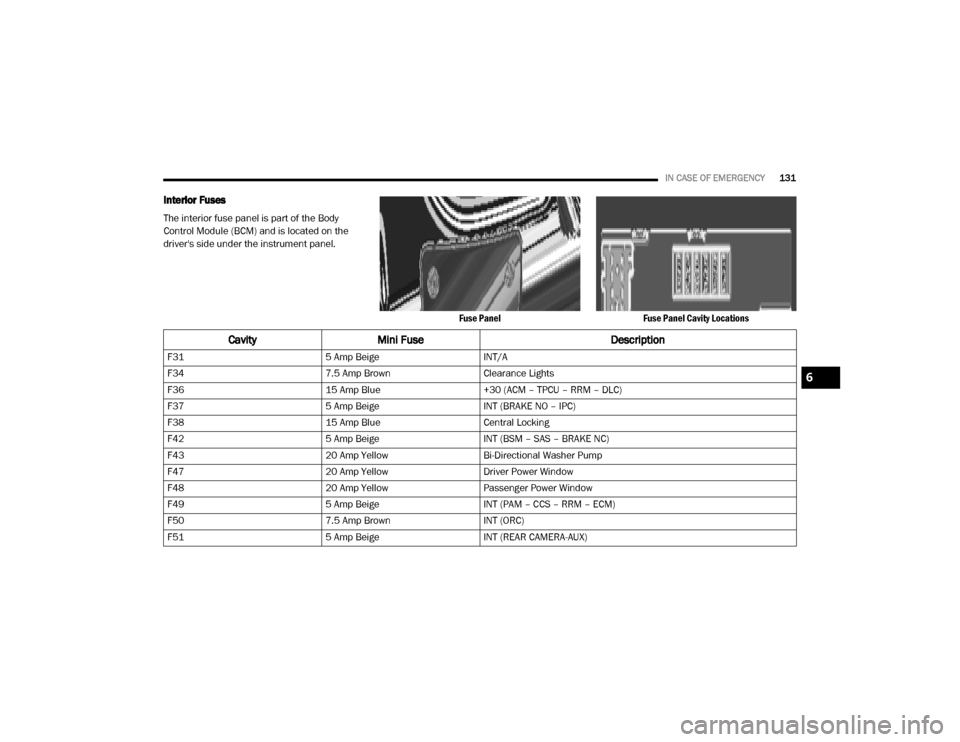
The interior fuse panel is part of the Body
Control Module (BCM) and is located on the
driver's side under the instrument panel.
Fuse PanelFuse Panel Cavity Locations
CavityMini Fuse Description
F315 Amp BeigeINT/A
F34 7.5 Amp BrownClearance Lights
F36 15 Amp Blue+30 (ACM – TPCU – RRM – DLC)
F37 5 Amp BeigeINT (BRAKE NO – IPC)
F38 15 Amp BlueCentral Locking
F42 5 Amp BeigeINT (BSM – SAS – BRAKE NC)
F43 20 Amp YellowBi-Directional Washer Pump
F47 20 Amp YellowDriver Power Window
F48 20 Amp YellowPassenger Power Window
F49 5 Amp BeigeINT (PAM – CCS – RRM – ECM)
F50 7.5 Amp BrownINT (ORC)
F51 5 Amp BeigeINT (REAR CAMERA-AUX)
6
20_VF_OM_EN_US_t.book Page 131
Page 154 of 264
152
SERVICING AND MAINTENANCE
SCHEDULED SERVICING
Your vehicle is equipped with an automatic oil
change indicator system. The oil change indi-
cator system will remind you that it is time to
take your vehicle in for scheduled maintenance.
Based on engine operation conditions, the oil
change indicator message will illuminate in the
instrument cluster. This means that service is
required for your vehicle. Operating conditions
such as frequent short-trips, trailer tow, and
extremely hot or cold ambient temperatures will
influence when the “Oil Change Required”
message is displayed. Severe Operating Condi-
tions can cause the change oil message to illu -
minate as early as 3,500 miles (5,600 km)
since last reset. Have the vehicle serviced as
soon as possible, within the next 500 miles
(805 km). An authorized dealer will reset the oil change
indicator message after completing the sched
-
uled oil change. If a scheduled oil change is
performed by someone other than an autho -
rized dealer, the message can be reset by refer -
ring to the steps described under “Instrument
Cluster Display” in “Getting To Know Your
Instrument Panel” for further information.
NOTE:
Under no circumstances should oil change
intervals exceed 10,000 miles (16,000 km),
12 months or 350 hours of engine run time,
whichever comes first. The 350 hours of engine
run or idle time is generally only a concern for
fleet customers.
Severe Duty All Models
Change Engine Oil at 4,000 miles (6,500 km) or
350 hours of engine run time if the vehicle is
operated in a dusty and off road environment or
is operated predominately at idle or only very
low engine RPM. This type of vehicle use is
considered Severe Duty. Once A Month Or Before A Long Trip:Check engine oil level
Check windshield washer fluid level
Check the tire inflation pressures and look
for unusual wear or damage. Rotate at the
first sign of irregular wear, even if it occurs
before the oil indicator system turns on
Check the fluid levels of the coolant reservoir,
brake master cylinder, and power steering
and fill as needed
Check function of all interior and exterior
lights
Maintenance Plan
Required Maintenance Intervals
Refer to the maintenance plan on the following
pages for the required maintenance intervals.
20_VF_OM_EN_US_t.book Page 152
Page 186 of 264
184SERVICING AND MAINTENANCE
(Continued)
NOTE:
If you intend parking or storing your vehicle for
an extended period after cleaning the wheels
with wheel cleaner, drive your vehicle and apply
the brakes to remove the water droplets from
the brake components. This activity will remove
the red rust on the brake rotors and prevent
vehicle vibration when braking. Dark Vapor Chrome, Black Satin Chrome, or
Low Gloss Clear Coat Wheels
Tire Chains And Traction Devices
Use of traction devices require sufficient
tire-to-body clearance. Due to limited clearance
the following traction devices are recom
-
mended. Follow these recommendations to
guard against damage.
Traction device must be of proper size for the
tire, as recommended by the traction device
manufacturer.
No other tire sizes are recommended for use
with a tire chain or traction device.
Install on front tires only.
For LT225/75R16 and 215/75R16C tires
use of a Quality Chain Corp Light Truck
Highway Service (Non-Cam) tire chain or
equivalent snow traction device is recom -
mended.
CAUTION!
Do not use scouring pads, steel wool, a bristle
brush, metal polishes or oven cleaner. These
products may damage the wheel's protective
finish. Such damage is not covered by the
New Vehicle Limited Warranty. Only car wash
soap, Mopar Wheel Cleaner or equivalent is
recommended.CAUTION!
If your vehicle is equipped with these
specialty wheels, DO NOT USE wheel
cleaners, abrasives, or polishing compounds.
They will permanently damage this finish and
such damage is not covered by the New
Vehicle Limited Warranty. HAND WASH ONLY
USING MILD SOAP AND WATER WITH A SOFT
CLOTH. Used on a regular basis; this is all that
is required to maintain this finish.
WARNING!
Using tires of different size and type (M+S,
Snow) between front and rear axles can
cause unpredictable handling. You could lose
control and have a collision.
CAUTION!
To avoid damage to your vehicle or tires,
observe the following precautions:
Because of restricted traction device clear -
ance between tires and other suspension
components, it is important that only trac-
tion devices in good condition are used.
Broken devices can cause serious damage.
Stop the vehicle immediately if noise
occurs that could indicate device breakage.
Remove the damaged parts of the device
before further use.
20_VF_OM_EN_US_t.book Page 184
Page 193 of 264
191
TECHNICAL SPECIFICATIONS
IDENTIFICATION DATA
Vehicle Identification Number
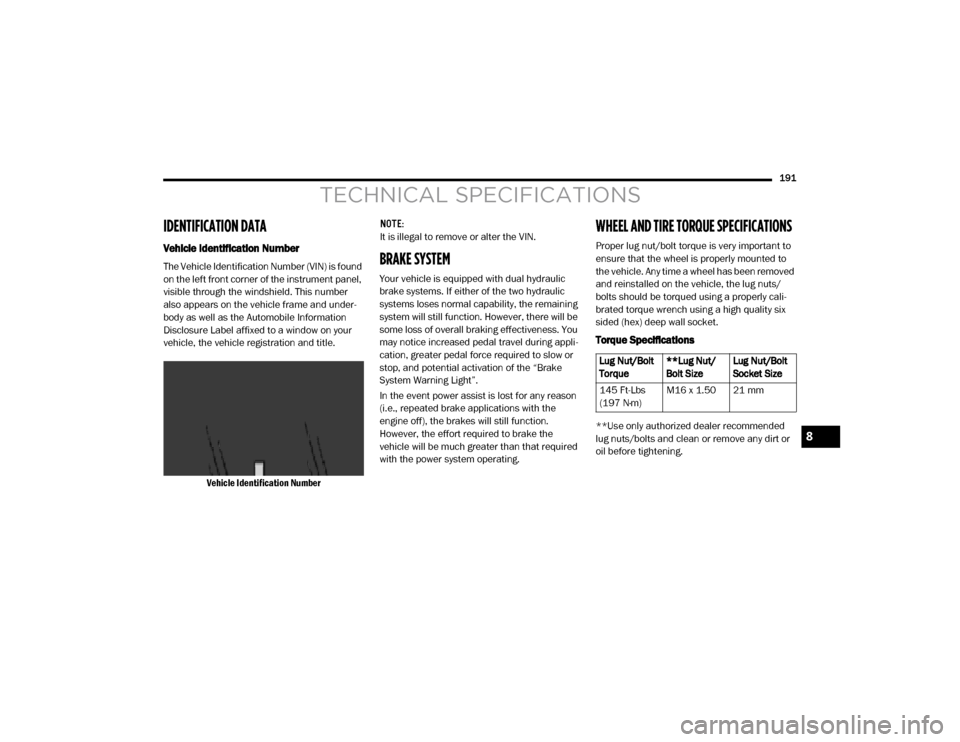
The Vehicle Identification Number (VIN) is found
on the left front corner of the instrument panel,
visible through the windshield. This number
also appears on the vehicle frame and under-
body as well as the Automobile Information
Disclosure Label affixed to a window on your
vehicle, the vehicle registration and title.
Vehicle Identification Number NOTE:
It is illegal to remove or alter the VIN.BRAKE SYSTEM
Your vehicle is equipped with dual hydraulic
brake systems. If either of the two hydraulic
systems loses normal capability, the remaining
system will still function. However, there will be
some loss of overall braking effectiveness. You
may notice increased pedal travel during appli
-
cation, greater pedal force required to slow or
stop, and potential activation of the “Brake
System Warning Light”.
In the event power assist is lost for any reason
(i.e., repeated brake applications with the
engine off), the brakes will still function.
However, the effort required to brake the
vehicle will be much greater than that required
with the power system operating.
WHEEL AND TIRE TORQUE SPECIFICATIONS
Proper lug nut/bolt torque is very important to
ensure that the wheel is properly mounted to
the vehicle. Any time a wheel has been removed
and reinstalled on the vehicle, the lug nuts/
bolts should be torqued using a properly cali -
brated torque wrench using a high quality six
sided (hex) deep wall socket.
Torque Specifications
**Use only authorized dealer recommended
lug nuts/bolts and clean or remove any dirt or
oil before tightening.
Lug Nut/Bolt
Torque **Lug Nut/
Bolt SizeLug Nut/Bolt
Socket Size
145 Ft-Lbs
(197 N·m) M16 x 1.50 21 mm
8
20_VF_OM_EN_US_t.book Page 191
Page 252 of 264

250
INDEX
A
Adding Engine Coolant (Antifreeze)
............... 164
Adding Washing Fluid
............................... 157
Additives, Fuel
....................................... 193
Air Bag
................................................. 74Air Bag Operation............................... 75Air Bag Warning Light.......................... 73Enhanced Accident Response.............. 151Event Data Recorder (EDR)................. 151If Deployment Occurs.......................... 80Maintaining Your Air Bag System............ 81Maintenance..................................... 81Side Air Bags..................................... 76Transporting Pets............................... 89
Air Bag Light
............................... 47, 73, 90
Air Cleaner, Engine (Engine Air Cleaner Filter)
... 159
Air Conditioner Maintenance
...................... 160
Air Conditioner Refrigerant
......................... 160
Air Conditioner System
............................. 160
Air Conditioning Filter
......................... 34, 160
Air Conditioning, Operating Tips
............... 33, 34
Air Filter
.............................................. 159
Air Pressure
Tires.............................................. 177
Alarm
Security Alarm............................. 13, 49
Alarm System
Security Alarm.................................... 13
Alterations/Modifications
Vehicle...............................................8
Antifreeze (Engine Coolant)
................ 164, 195Disposal......................................... 165
Anti-Lock Brake System (ABS)
.......................56
Anti-Lock Warning Light
.............................. 52
Assist, Hill Start
........................................ 60
Auto Down Power Windows
.......................... 35
Auto Up Power Windows
.............................. 35
Automatic Door Locks
................................15
Automatic Transmission
...................... 95, 168Adding Fluid.................................... 168Fluid And Filter Change...................... 168Fluid Change................................... 168Fluid Level Check...................... 167, 168Fluid Type............................... 167, 197Special Additives.............................. 167
AUX Cord
............................................. 238
Auxiliary Driving Systems
............................. 61
B
Battery
......................................... 47, 157Charging System Light......................... 47Keyless Key Fob Replacement............... 10
Belts, Seat
............................................. 90
Body Builders Guide
................................... 8
Body Mechanism Lubrication
..................... 161
B-Pillar Location
.................................... 173
Brake Assist System
................................. 57
Brake Control System, Electronic
................... 57
Brake Fluid
...................................166, 197
Brake System
................................166, 191Anti-Lock (ABS).................................. 56Fluid Check.................................... 166Master Cylinder............................... 166Parking............................................ 94Warning Light.................................... 48
Brake, Parking
........................................ 94
Brake/Transmission Interlock
...................... 96
Bulb Replacement
.................................. 123
Bulbs, Light
....................................91, 123
C
Camera, Rear
....................................... 109
Capacities, Fluid
.................................... 195
Caps, Filler
Fuel.............................................. 111Oil (Engine)..................................... 156Power Steering................................ 103Radiator (Coolant Pressure)................ 165
Car Washes
......................................... 187
Carbon Monoxide Warning
...................89, 194
20_VF_OM_EN_US_t.book Page 250
Page 253 of 264

251
Cargo Area Cover
..................................... 37
Cargo Compartment
.................................. 37
Cargo Light
............................................ 26
Certification Label
.................................. 112
Change Oil Indicator
.................................. 44
Changing A Flat Tire
........................ 133, 168
Chart, Tire Sizing
.................................... 169
Check Engine Light
(Malfunction Indicator Light)
......................... 55
Checking Your Vehicle For Safety
................... 89
Checks, Safety
........................................ 89
Child Restraint
........................................ 83
Child Restraints
Booster Seats.................................... 86Child Seat Installation.......................... 88Infant And Child Restraints................... 85Older Children And Child Restraints........ 85
Clean Air Gasoline
.................................. 192
Cleaning
Wheels........................................... 183
Climate Control
........................................ 28Manual............................................ 28Rear................................................ 32
Cold Weather Operation
.............................. 92
Compact Spare Tire
................................. 181
Contract, Service
.................................... 247
Cooling Pressure Cap (Radiator Cap)
............. 165
Cooling System
...................................... 163Adding Coolant (Antifreeze)................. 164Coolant Level........................... 163, 165Cooling Capacity............................... 195Disposal Of Used Coolant................... 165Drain, Flush, And Refill....................... 163Inspection....................................... 165Points To Remember......................... 165Pressure Cap................................... 165Radiator Cap................................... 165Selection Of Coolant (Antifreeze).. 164, 195
Corrosion Protection
................................ 187
Cruise Light
............................................53
Cupholders
..................................... 38, 190
Customer Assistance
............................... 246
Customer Programmable Features
................ 199
Cybersecurity
........................................ 198
D
Dealer Service
....................................... 158
Defroster, Windshield
.................................90
Diagnostic System, Onboard
......................... 54
Dimmer Control Switch
............................... 27
Dimmer Switch
Headlight..........................................24
Dipsticks
Automatic Transmission..................... 168Power Steering................................. 103
Disable Vehicle Towing
............................. 149
Disposal
Antifreeze (Engine Coolant)................ 165
Door Ajar
.............................................. 47
Door Ajar Light
........................................ 47
Door Locks
............................................ 14Automatic........................................ 15
Doors
.................................................. 14
Driver’s Seat Back Tilt
............................... 15
Driving
Through Flowing, Rising, Or Shallow
Standing Water
............................... 121
E
Electric Brake Control System
....................... 57
Electric Remote Mirrors
.............................. 22
Electrical Power Outlets
............................. 39
Electronic Speed Control (Cruise Control)
....... 103
Electronic Stability Control (ESC)
................... 57
Electronic Throttle Control Warning Light
.......... 48
Emergency, In Case Of
Freeing Vehicle When Stuck............... 149Jacking...................................133, 168Jump Starting.................................. 145
Emission Control System Maintenance
............ 55
11
20_VF_OM_EN_US_t.book Page 251