Seats Ram ProMaster City 2020 Owner's Guide
[x] Cancel search | Manufacturer: RAM, Model Year: 2020, Model line: ProMaster City, Model: Ram ProMaster City 2020Pages: 350, PDF Size: 13.27 MB
Page 148 of 350

SAFETY 145
Installing Child Restraints Using The Vehicle Seat Belt In
Vehicles With Rear Seating
Child restraint systems are designed to be secured in vehicle
seats by lap belts or the lap belt portion of a lap/shoulder
belt.
The seat belts in the passenger seating positions are
equipped with a Switchable Automatic Locking Retractor
(ALR) that is designed to keep the lap portion of the seat belt
tight around the child restraint so that it is not necessary to
use a locking clip. The ALR retractor can be “switched” into
a locked mode by pulling all of the webbing out of the
retractor and then letting the webbing retract back into the
retractor. If it is locked, the ALR will make a clicking noise
while the webbing is pulled back into the retractor. Refer to
the “Automatic Locking Mode” description in “Switchable
Automatic Locking Retractors (ALR)” under “Occupant
Restraint Systems” for additional information on ALR.Lap/Shoulder Belt Systems For Installing Child
Restraints In This Vehicle
Automatic Locking Retractor (ALR) Locations — Vehicle With Rear Seating
WARNING!
• Improper installation or failure to properly secure a child restraint can lead to failure of the restraint. The
child could be badly injured or killed.
• Follow the child restraint manufacturer’s directions exactly when installing an infant or child restraint.
ALR — Switchable Automatic Locking Retractor
Top Tether Anchorage Symbol
4
2020_RAM_PROMASTER_CITY_OM_USA=GUID-7B6A7FCA-79B0-423F-95C5-ED2A949C3D13=1=en=.book Page 145
Page 150 of 350

SAFETY 147
Installing A Child Restraint With A Switchable Automatic
Locking Retractor (ALR):
Child restraint systems are designed to be secured in vehicle
seats by lap belts or the lap belt portion of a lap/shoulder
belt.
1. Place the child seat in the center of the seating position.
2. Pull enough of the seat belt webbing from the retractor topass it through the belt path of the child restraint. Do not
twist the belt webbing in the belt path.
3. Slide the latch plate into the buckle until you hear a “click.”
4. Pull on the webbing to make the lap portion tight against the child seat. 5. To lock the seat belt, pull down on the shoulder part of
the belt until you have pulled all the seat belt webbing out
of the retractor. Then, allow the webbing to retract back
into the retractor. As the webbing retracts, you will hear
a clicking sound. This means the seat belt is now in the
Automatic Locking mode.
6. Try to pull the webbing out of the retractor. If it is locked, you should not be able to pull out any webbing. If the
retractor is not
locked, repeat step 5.
7. Finally, pull up on any excess webbing to tighten the lap portion around the child restraint while you push the child
restraint rearward and downward into the vehicle seat.
8. If the child restraint has a top tether strap and the seating position has a top tether anchorage, connect the tether
strap to the anchorage and tighten the tether strap. See the
section “Installing Child Restraints Using the Top Tether
Anchorage” for directions to attach a tether anchor.
9. Test that the child restraint is installed tightly by pulling back and forth on the child seat at the belt path. It should
not move more than 1 inch (25.4 mm) in any direction.
Any seat belt system will loosen with time, so check the belt
occasionally, and pull it tight if necessary.
WARNING!
• Improper installation or failure to properly secure a child restraint can lead to failure of the restraint. The
child could be badly injured or killed.
• Follow the child restraint manufacturer’s directions exactly when installing an infant or child restraint.
4
2020_RAM_PROMASTER_CITY_OM_USA=GUID-7B6A7FCA-79B0-423F-95C5-ED2A949C3D13=1=en=.book Page 147
Page 153 of 350
150 SAFETY
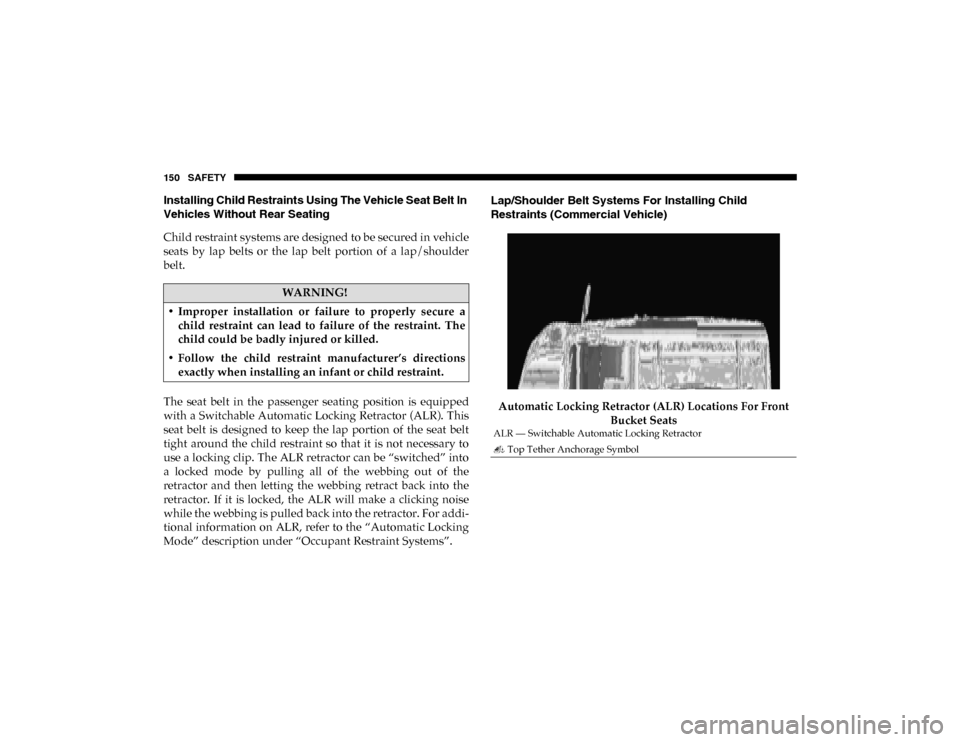
Installing Child Restraints Using The Vehicle Seat Belt In
Vehicles Without Rear Seating
Child restraint systems are designed to be secured in vehicle
seats by lap belts or the lap belt portion of a lap/shoulder
belt.
The seat belt in the passenger seating position is equipped
with a Switchable Automatic Locking Retractor (ALR). This
seat belt is designed to keep the lap portion of the seat belt
tight around the child restraint so that it is not necessary to
use a locking clip. The ALR retractor can be “switched” into
a locked mode by pulling all of the webbing out of the
retractor and then letting the webbing retract back into the
retractor. If it is locked, the ALR will make a clicking noise
while the webbing is pulled back into the retractor. For addi-
tional information on ALR, refer to the “Automatic Locking
Mode” description under “Occupant Restraint Systems”. Lap/Shoulder Belt Systems For Installing Child
Restraints (Commercial Vehicle)
Automatic Locking Retractor (ALR) Locations For Front Bucket Seats
WARNING!
• Improper installation or failure to properly secure a child restraint can lead to failure of the restraint. The
child could be badly injured or killed.
• Follow the child restraint manufacturer’s directions exactly when installing an infant or child restraint.
ALR — Switchable Automatic Locking Retractor
Top Tether Anchorage Symbol
2020_RAM_PROMASTER_CITY_OM_USA=GUID-7B6A7FCA-79B0-423F-95C5-ED2A949C3D13=1=en=.book Page 150
Page 154 of 350
SAFETY 151
Installing A Child Restraint With A Switchable Automatic
Locking Retractor (ALR):
Child restraint systems are designed to be secured in vehicle
seats by lap belts or the lap belt portion of a lap/shoulder
belt.
1. Place the child seat in the center of the seating position.
2. Pull enough of the seat belt webbing from the retractor topass it through the belt path of the child restraint. Do not
twist the belt webbing in the belt path.
3. Slide the latch plate into the buckle until you hear a “click.”
4. Pull on the webbing to make the lap portion tight against the child seat. 5. To lock the seat belt, pull down on the shoulder part of
the belt until you have pulled all the seat belt webbing out
of the retractor. Then, allow the webbing to retract back
into the retractor. As the webbing retracts, you will hear
a clicking sound. This means the seat belt is now in the
Automatic Locking mode.
6. Try to pull the webbing out of the retractor. If it is locked, you should not be able to pull out any webbing. If the
retractor is not
locked, repeat step 5.
7. Finally, pull up on any excess webbing to tighten the lap portion around the child restraint while you push the child
restraint rearward and downward into the vehicle seat.
8. If the child restraint has a top tether strap and the seating position has a top tether anchorage, connect the tether
strap to the anchorage and tighten the tether strap. See the
section “Installing Child Restraints Using the Top Tether
Anchorage” for directions to attach a tether anchor.
9. Test that the child restraint is installed tightly by pulling back and forth on the child seat at the belt path. It should
not move more than 1 inch (25.4 mm) in any direction.
Any seat belt system will loosen with time, so check the belt
occasionally, and pull it tight if necessary.
WARNING!
• Improper installation or failure to properly secure a child restraint can lead to failure of the restraint. The
child could be badly injured or killed.
• Follow the child restraint manufacturer’s directions exactly when installing an infant or child restraint.
4
2020_RAM_PROMASTER_CITY_OM_USA=GUID-7B6A7FCA-79B0-423F-95C5-ED2A949C3D13=1=en=.book Page 151
Page 156 of 350
SAFETY 153
Transporting Pets
Air Bags deploying in the front seat could harm your pet. An
unrestrained pet will be thrown about and possibly injured,
or injure a passenger during panic braking or in a collision.
Pets should be restrained in the rear seat (if equipped) in pet
harnesses or pet carriers that are secured by seat belts.
SAFETY TIPS
Transporting Passengers
NEVER TRANSPORT PASSENGERS IN THE CARGO AREA.
Exhaust Gas
The best protection against carbon monoxide entry into the
vehicle body is a properly maintained engine exhaust
system.
WARNING!
• Do not leave children or animals inside parked vehicles in hot weather. Interior heat build-up may cause
serious injury or death.
• It is extremely dangerous to ride in a cargo area, inside or outside of a vehicle. In a collision, people riding in these
areas are more likely to be seriously injured or killed.
• Do not allow people to ride in any area of your vehicle that is not equipped with seats and seat belts.
• Be sure everyone in your vehicle is in a seat and using a seat belt properly.
WARNING!
Exhaust gases can injure or kill. They contain carbon
monoxide (CO), which is colorless and odorless.
Breathing it can make you unconscious and can
eventually poison you. To avoid breathing (CO), follow
these safety tips:
• Do not run the engine in a closed garage or in confined areas any longer than needed to move your vehicle in or
out of the area.
• If you are required to drive with the trunk/liftgate/rear doors open, make sure that all windows are closed and
the climate control BLOWER switch is set at high
speed. DO NOT use the recirculation mode.
• If it is necessary to sit in a parked vehicle with the engine running, adjust your heating or cooling controls
to force outside air into the vehicle. Set the blower at
high speed.
4
2020_RAM_PROMASTER_CITY_OM_USA=GUID-7B6A7FCA-79B0-423F-95C5-ED2A949C3D13=1=en=.book Page 153
Page 185 of 350
182 STARTING AND OPERATING
NOTE:
• Tighten the fuel filler cap until you hear a “clicking”sound. This is an indication that the fuel filler cap is prop -
erly tightened.
• If the gas cap is not tightened properly, the MIL may come on. Be sure the gas cap is tightened every time the vehicle
is refueled.
VEHICLE LOADING
As required by National Highway Traffic Safety Administra -
tion regulations, your vehicle has a certification label affixed
to the driver's side door or B-Pillar.
If seats are removed for carrying cargo, do not exceed the
specified GVWR and GAWR.
Vehicle Certification Label
Your vehicle has a Vehicle Certification Label affixed to the
drivers side B-Pillar or the rear of the driver’s door.
The label contains the following information:
• Name of manufacturer
• Month and year of manufacture
• Gross Vehicle Weight Rating (GVWR)
• Gross Axle Weight Rating (GAWR) front
• Gross Axle Weight Rating (GAWR) rear
• Vehicle Identification Number (VIN)
• Type of vehicle
• Month, Day, and Hour of manufacture (MDH)
The bar code allows a computer scanner to read the VIN.
• A fire may result if gasoline is pumped into a portable
container that is inside of a vehicle. You could be
burned. Always place gas containers on the ground
while filling.
CAUTION!
• Damage to the fuel system or emissions control system could result from using an improper fuel tank filler
tube cap. A poorly fitting cap could let impurities into
the fuel system and may cause the “Malfunction Indi -
cator Light (MIL)” to turn on, due to fuel vapors
escaping from the system.
• To avoid fuel spillage and overfilling, do not “top off” the fuel tank after filling.
WARNING! (Continued)
2020_RAM_PROMASTER_CITY_OM_USA=GUID-7B6A7FCA-79B0-423F-95C5-ED2A949C3D13=1=en=.book Page 182
Page 210 of 350
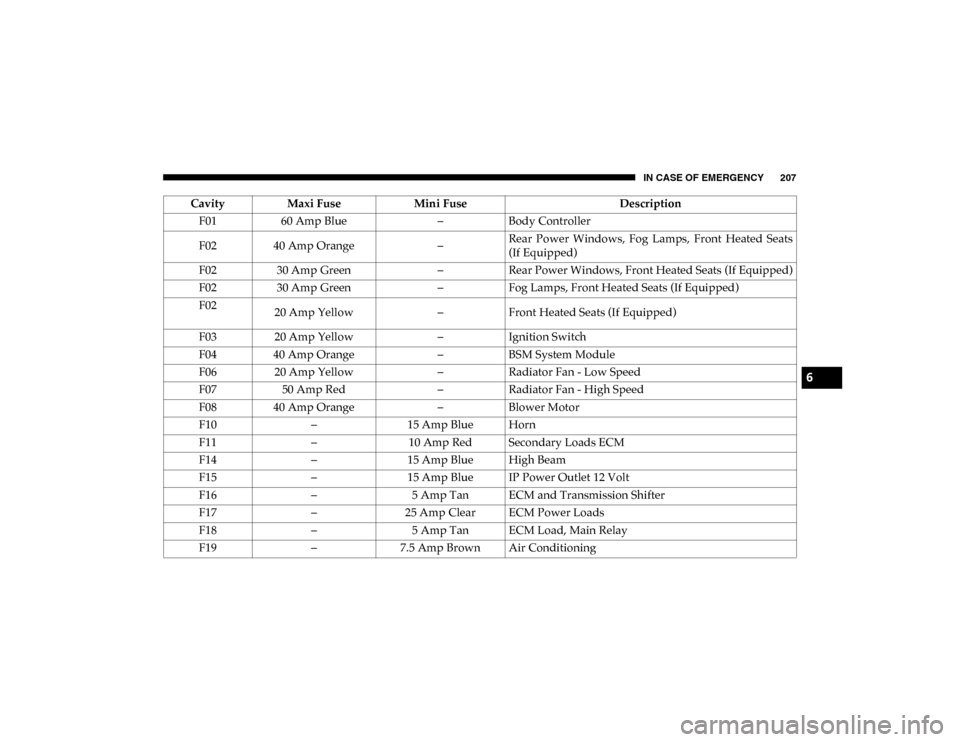
IN CASE OF EMERGENCY 207
CavityMaxi Fuse Mini Fuse Description
F01 60 Amp Blue –Body Controller
F02 40 Amp Orange –Rear Power Windows, Fog Lamps, Front Heated Seats
(If Equipped)
F02 30 Amp Green –Rear Power Windows, Front Heated Seats (If Equipped)
F02 30 Amp Green –Fog Lamps, Front Heated Seats (If Equipped)
F02 20 Amp Yellow
–Front Heated Seats (If Equipped)
F03 20 Amp Yellow –Ignition Switch
F04 40 Amp Orange –BSM System Module
F06 20 Amp Yellow –Radiator Fan - Low Speed
F07 50 Amp Red –Radiator Fan - High Speed
F08 40 Amp Orange –Blower Motor
F10 –15 Amp Blue Horn
F11 –10 Amp Red Secondary Loads ECM
F14 –15 Amp Blue High Beam
F15 –15 Amp Blue IP Power Outlet 12 Volt
F16 –5 Amp Tan ECM and Transmission Shifter
F17 –25 Amp Clear ECM Power Loads
F18 –5 Amp Tan ECM Load, Main Relay
F19 –7.5 Amp Brown Air Conditioning
6
2020_RAM_PROMASTER_CITY_OM_USA=GUID-7B6A7FCA-79B0-423F-95C5-ED2A949C3D13=1=en=.book Page 207
Page 295 of 350
292 SERVICING AND MAINTENANCE
INTERIORS
Seats And Fabric Parts
Use Mopar Total Clean to clean fabric upholstery and
carpeting.
NOTE:
Power washing is not allowed inside the vehicle (both
passenger and cargo area).
Plastic And Coated Parts
Use Mopar Total Clean to clean vinyl upholstery.
Cleaning Plastic Instrument Cluster Lenses
The lenses in front of the instruments in this vehicle are
molded in clear plastic. When cleaning the lenses, care must
be taken to avoid scratching the plastic.
1. Clean with a wet soft cloth. A mild soap solution may beused, but do not use high alcohol content or abrasive
cleaners. If soap is used, wipe clean with a clean damp
cloth.
2. Dry with a soft cloth.
WARNING!
Do not use volatile solvents for cleaning purposes. Many
are potentially flammable, and if used in closed areas
they may cause respiratory harm.
CAUTION!
• Direct contact of air fresheners, insect repellents, suntan lotions, or hand sanitizers to the plastic,
painted, or decorated surfaces of the interior may cause
permanent damage. Wipe away immediately.
• Damage caused by these type of products may not be covered by your New Vehicle Limited Warranty.
2020_RAM_PROMASTER_CITY_OM_USA=GUID-7B6A7FCA-79B0-423F-95C5-ED2A949C3D13=1=en=.book Page 292
Page 296 of 350

SERVICING AND MAINTENANCE 293
Leather Parts
Mopar Total Clean is specifically recommended for leather
upholstery.
Your leather upholstery can be best preserved by regular
cleaning with a damp soft cloth. Small particles of dirt can act
as an abrasive and damage the leather upholstery and
should be removed promptly with a damp cloth. Stubborn
soils can be removed easily with a soft cloth and Mopar Total
Clean. Care should be taken to avoid soaking your leather
upholstery with any liquid. Please do not use polishes, oils,
cleaning fluids, solvents, detergents, or ammonia-based
cleaners to clean your leather upholstery. Application of a
leather conditioner is not required to maintain the original
condition.
NOTE:
If equipped with light colored leather, it tends to show any
foreign material, dirt, and fabric dye transfer more so than
darker colors. The leather is designed for easy cleaning, and
FCA recommends Mopar total care leather cleaner applied
on a cloth to clean the leather seats as needed.
Glass Surfaces
All glass surfaces should be cleaned on a regular basis with
Mopar Glass Cleaner, or any commercial household-type
glass cleaner. Never use an abrasive type cleaner. Use
caution when cleaning the inside rear window equipped
with electric defrosters or windows equipped with radio
antennas. Do not use scrapers or other sharp instruments
that may scratch the elements.
When cleaning the rear view mirror, spray cleaner on the
towel or cloth that you are using. Do not spray cleaner
directly on the mirror.CAUTION!
Do not use Alcohol and Alcohol-based and/or Ketone
based cleaning products to clean leather upholstery, as
damage to the upholstery may result.
7
2020_RAM_PROMASTER_CITY_OM_USA=GUID-7B6A7FCA-79B0-423F-95C5-ED2A949C3D13=1=en=.book Page 293
Page 339 of 350

336
B
Battery................................................................................. 86, 247 Charging System Light......................................................... 86
Keyless Key Fob Replacement ............................................ 15
Belts, Seat ................................................................................. 154
Body Builders Guide ................................................................ 12
Body Mechanism Lubrication ............................................... 252
B-Pillar Location...................................................................... 272
Brake Assist System .................................................................. 98
Brake Fluid ............................................................................... 304
Brake System ................................................................... 260, 295 Anti-Lock (ABS) .................................................................... 97
Fluid Check .................................................................. 260, 304
Master Cylinder................................................................... 260 Parking.................................................................................. 161
Warning Light ....................................................................... 85
Brake, Parking ......................................................................... 161
Brake/Transmission Interlock .............................................. 164
Bulb Replacement ................................................................... 200
Bulbs, Light ...................................................................... 156, 200 C
Camera, Rear ........................................................................... 179
Capacities, Fluid...................................................................... 301
Caps, Filler Fuel ........................................................................................ 181Oil (Engine) .................................................................. 245, 249 Power Steering .....................................................................171
Radiator (Coolant Pressure)...............................................257
Car Washes ..............................................................................291
Carbon Monoxide Warning ...........................................153, 300
Cargo Area Cover .....................................................................66
Cargo Area Features .................................................................66
Cargo Compartment .................................................................66
Cargo Tie-Downs ......................................................................66
Cellular Phone .........................................................................320
Certification Label ...................................................................182
Chains, Tire ..............................................................................287
Changing A Flat Tire ......................................................212, 266
Chart, Tire Sizing .................................................................... 268
Check Engine Light (Malfunction Indicator Light)..............95
Checking Your Vehicle For Safety ........................................153
Checks, Safety ..........................................................................153
Child Restraint.........................................................................133
Child Restraints Booster Seats ........................................................................137Child Seat Installation.................................................147, 151
How To Stow An unused ALR Seat Belt .........................144Infant And Child Restraints...............................................136
Locating The LATCH Anchorages ...................................142
Lower Anchors And Tethers For Children .....................139Older Children And Child Restraints ..............................136Seating Positions..................................................................138
2020_RAM_PROMASTER_CITY_OM_USA=GUID-7B6A7FCA-79B0-423F-95C5-ED2A949C3D13=1=en=.book Page 336