light Ram ProMaster City 2020 Manual PDF
[x] Cancel search | Manufacturer: RAM, Model Year: 2020, Model line: ProMaster City, Model: Ram ProMaster City 2020Pages: 350, PDF Size: 13.27 MB
Page 229 of 350
226 IN CASE OF EMERGENCY
Vehicles Equipped With Wheel Covers
1. Mount the road tire on the axle.
2. To ease the installation process for steel wheels withwheel covers, install two wheel bolts on the wheel. Install
the wheel bolts with the threaded end of the bolt toward
the wheel. Lightly tighten the wheel bolts.
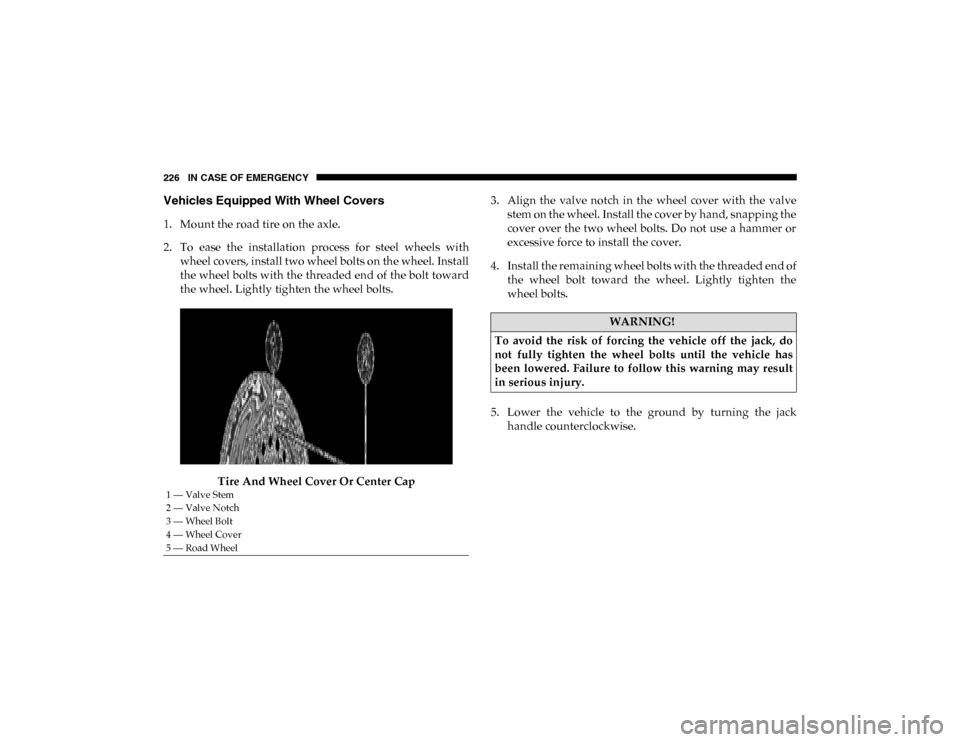
Tire And Wheel Cover Or Center Cap 3. Align the valve notch in the wheel cover with the valve
stem on the wheel. Install the cover by hand, snapping the
cover over the two wheel bolts. Do not use a hammer or
excessive force to install the cover.
4. Install the remaining wheel bolts with the threaded end of the wheel bolt toward the wheel. Lightly tighten the
wheel bolts.
5. Lower the vehicle to the ground by turning the jack handle counterclockwise.
1 — Valve Stem
2 — Valve Notch
3 — Wheel Bolt
4 — Wheel Cover
5 — Road Wheel
WARNING!
To avoid the risk of forcing the vehicle off the jack, do
not fully tighten the wheel bolts until the vehicle has
been lowered. Failure to follow this warning may result
in serious injury.
2020_RAM_PROMASTER_CITY_OM_USA=GUID-7B6A7FCA-79B0-423F-95C5-ED2A949C3D13=1=en=.book Page 226
Page 234 of 350
IN CASE OF EMERGENCY 231
JUMP STARTING
If your vehicle has a discharged battery, it can be jump
started using a set of jumper cables and a battery in another
vehicle or by using a portable battery booster pack. Jump
starting can be dangerous if done improperly, so please
follow the procedures in this section carefully.
NOTE:
When using a portable battery booster pack, follow the
manufacturer’s operating instructions and precautions.
Preparations For Jump Starting
The battery in your vehicle is located in the front of the
engine compartment, behind the left headlight assembly.
NOTE:
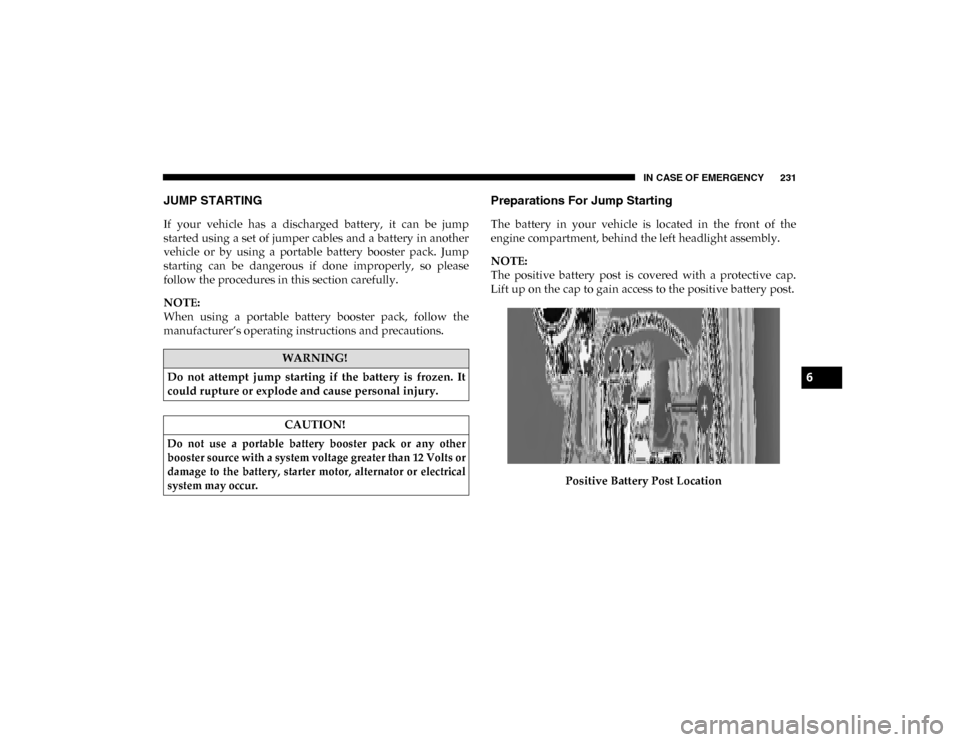
The positive battery post is covered with a protective cap.
Lift up on the cap to gain access to the positive battery post.Positive Battery Post Location
WARNING!
Do not attempt jump starting if the battery is frozen. It
could rupture or explode and cause personal injury.
CAUTION!
Do not use a portable battery booster pack or any other
booster source with a system voltage greater than 12 Volts or
damage to the battery, starter motor, alternator or electrical
system may occur.
6
2020_RAM_PROMASTER_CITY_OM_USA=GUID-7B6A7FCA-79B0-423F-95C5-ED2A949C3D13=1=en=.book Page 231
Page 244 of 350

241
SERVICING AND MAINTENANCE
SCHEDULED SERVICING
Your vehicle is equipped with an automatic oil change indicator
system. The oil change indicator system will remind you that it is
time to take your vehicle in for scheduled maintenance.
Based on engine operation conditions, the oil change indi-
cator message will illuminate. This means that service is
required for your vehicle. Operating conditions such as
frequent short-trips, trailer tow, extended engine idle time,
extremely hot or cold ambient temperatures will influence
when the “Oil Change Required” message is displayed.
Severe Operating Conditions can cause the change oil
message to illuminate as early as 3,500 miles (5,600 km) since
last reset. Have your vehicle serviced as soon as possible,
within the next 500 miles (805 km).
Your authorized dealer will reset the oil change indicator message
after completing the scheduled oil change. If a scheduled oil change
is performed by someone other than your authorized dealer, the
message can be reset by referring to the steps described under “Oil
Change Reset” in “Instrument Cluster Display” in “Getting To
Know Your Instrument Panel” for further information.
NOTE:
Under no circumstances should oil change intervals exceed
10,000 miles (16,000 km), 350 hours of engine run time or
12 months, whichever comes first. The 350 hours of engine run
or idle time is generally only a concern for fleet customers.
Severe Duty All Models
Change Engine Oil at 4,000 miles (6,500 km) or 350 hours of engine
run time if the vehicle is operated in a dusty and off road environ -
ment or is operated predominantly at idle, or only very low engine
RPM. This type of vehicle use is considered Severe Duty.
Once A Month Or Before A Long Trip:
• Check engine oil level.
• Check windshield washer fluid level.
• Check tire pressure and look for unusual wear or damage. Rotate tires at the first sign of irregular wear, even if it
occurs before the oil indicator system turns on.
• Check the fluid levels of the coolant reservoir and brake master cylinder, fill as needed.
• Check function of all interior and exterior lights.
7
2020_RAM_PROMASTER_CITY_OM_USA=GUID-7B6A7FCA-79B0-423F-95C5-ED2A949C3D13=1=en=.book Page 241
Page 263 of 350
260 SERVICING AND MAINTENANCE
(Continued)
Brake System
In order to ensure brake system performance, all brake
system components should be inspected periodically. Refer
to the “Maintenance Plan” in this section for the proper
maintenance intervals.
Brake Master Cylinder
The fluid in the master cylinder should be checked when
performing under hood services or immediately if the
“Brake Warning Light” is illuminated.
Be sure to clean the top of the master cylinder area before
removing the cap. If necessary, add fluid to bring the fluid
level up to the requirements described on the brake fluid
reservoir. With disc brakes, fluid level can be expected to fallas the brake pads wear. Brake fluid level should be checked
when pads are replaced. However, low fluid level may be
caused by a leak and a checkup may be needed.
Use only manufacturer's recommended brake fluid. Refer to
“Fluids And Lubricants” in “Technical Specifications” for
further information.
WARNING!
Riding the brakes can lead to brake failure and possibly
a collision. Driving with your foot resting or riding on
the brake pedal can result in abnormally high brake
temperatures, excessive lining wear, and possible brake
damage. You would not have your full braking capacity
in an emergency.
WARNING!
• Use only manufacturer's recommended brake fluid. Refer to “Fluids And Lubricants” in “Technical Speci -
fications” for further information. Using the wrong
type of brake fluid can severely damage your brake
system and/or impair its performance. The proper type
of brake fluid for your vehicle is also identified on the
original factory installed hydraulic master cylinder
reservoir.
• To avoid contamination from foreign matter or mois -
ture, use only new brake fluid or fluid that has been in
a tightly closed container. Keep the master cylinder
reservoir cap secured at all times. Brake fluid in a open
container absorbs moisture from the air resulting in a
lower boiling point. This may cause it to boil unexpect -
edly during hard or prolonged braking, resulting in
sudden brake failure. This could result in a collision.
2020_RAM_PROMASTER_CITY_OM_USA=GUID-7B6A7FCA-79B0-423F-95C5-ED2A949C3D13=1=en=.book Page 260
Page 267 of 350
264 SERVICING AND MAINTENANCE
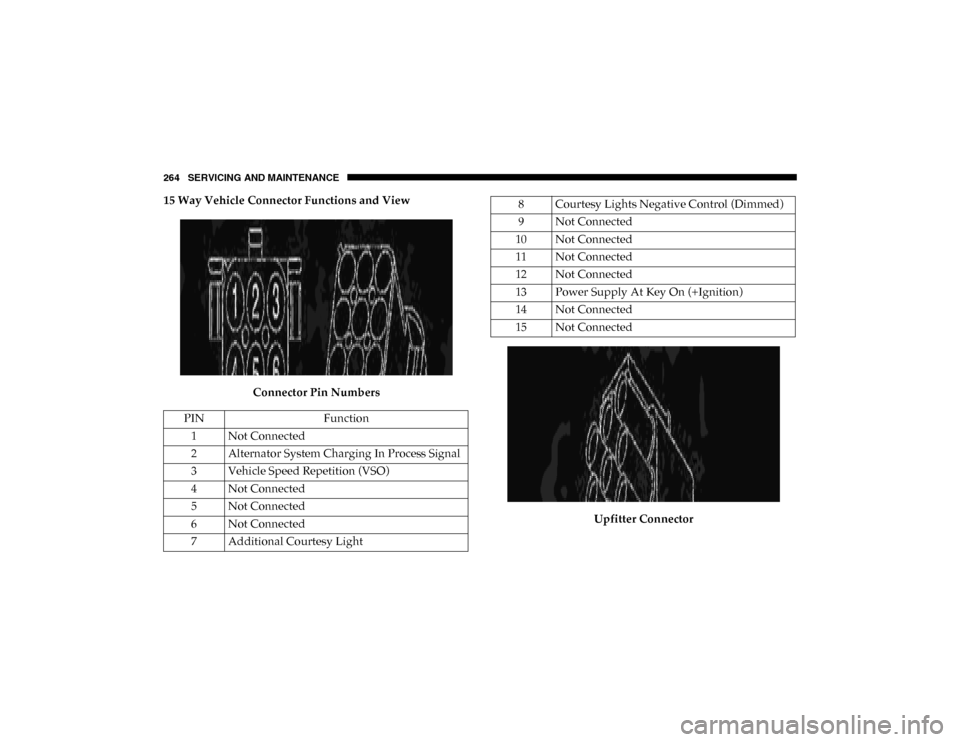
15 Way Vehicle Connector Functions and ViewConnector Pin Numbers Upfitter Connector
PIN
Function
1 Not Connected
2 Alternator System Charging In Process Signal
3 Vehicle Speed Repetition (VSO) 4 Not Connected
5 Not Connected
6 Not Connected
7 Additional Courtesy Light8 Courtesy Lights Negative Control (Dimmed)
9 Not Connected
10 Not Connected
11 Not Connected
12 Not Connected
13 Power Supply At Key On (+Ignition) 14 Not Connected
15 Not Connected
2020_RAM_PROMASTER_CITY_OM_USA=GUID-7B6A7FCA-79B0-423F-95C5-ED2A949C3D13=1=en=.book Page 264
Page 270 of 350

SERVICING AND MAINTENANCE 267
NOTE:
• P (Passenger) — Metric tire sizing is based on US designstandards. P-Metric tires have the letter “P” molded into
the sidewall preceding the size designation. Example:
P215/65R15 95H.
• European — Metric tire sizing is based on European design standards. Tires designed to this standard have the
tire size molded into the sidewall beginning with the
section width. The letter "P" is absent from this tire size
designation. Example: 215/65R15 96H.
• LT (Light Truck) — Metric tire sizing is based on US design standards. The size designation for LT-Metric tires is the
same as for P-Metric tires except for the letters “LT” that
are molded into the sidewall preceding the size designa -
tion. Example: LT235/85R16. • Temporary spare tires are designed for temporary emer
-
gency use only. Temporary high pressure compact spare
tires have the letter “T” or “S” molded into the sidewall
preceding the size designation. Example: T145/80D18
103M.
• High flotation tire sizing is based on US design standards and it begins with the tire diameter molded into the side -
wall. Example: 31x10.5 R15 LT.
7
2020_RAM_PROMASTER_CITY_OM_USA=GUID-7B6A7FCA-79B0-423F-95C5-ED2A949C3D13=1=en=.book Page 267
Page 271 of 350

268 SERVICING AND MAINTENANCE
Tire Sizing Chart EXAMPLE:
Example Size Designation: P215/65R15XL 95H, 215/65R15 96H, LT235/85R16C, T145/80D18 103M, 31x10.5 R15 LT
P = Passenger car tire size based on US design standards, or
"....blank...." = Passenger car tire based on European design standards, or
LT = Light truck tire based on US design standards, or
T or S = Temporary spare tire or
31 = Overall diameter in inches (in)
215, 235, 145 = Section width in millimeters (mm)
65, 85, 80 = Aspect ratio in percent (%)
• Ratio of section height to section width of tire, or
10.5 = Section width in inches (in)
R = Construction code
• "R" means radial construction, or
• "D" means diagonal or bias construction
15, 16, 18 = Rim diameter in inches (in)
2020_RAM_PROMASTER_CITY_OM_USA=GUID-7B6A7FCA-79B0-423F-95C5-ED2A949C3D13=1=en=.book Page 268
Page 272 of 350

SERVICING AND MAINTENANCE 269
Service Description:
95 = Load Index
• A numerical code associated with the maximum load a tire can carry
H = Speed Symbol
• A symbol indicating the range of speeds at which a tire can carry a load corresponding to its load index under certain oper -
ating conditions
• The maximum speed corresponding to the speed symbol should only be achieved under specified operating conditions (i.e., tire pressure, vehicle loading, road conditions, and posted speed limits)
Load Identification:
Absence of the following load identification symbols on the sidewall of the tire indicates a Standard Load (SL) tire:
• XL = Extra load (or reinforced) tire, or
• LL = Light load tire or
• C, D, E, F, G = Load range associated with the maximum load a tire can carry at a specified pressure
Maximum Load – Maximum load indicates the maximum load this tire is designed to carry
Maximum Pressure – Maximum pressure indicates the maximum permissible cold tire inflation pressure for this tire EXAMPLE:
7
2020_RAM_PROMASTER_CITY_OM_USA=GUID-7B6A7FCA-79B0-423F-95C5-ED2A949C3D13=1=en=.book Page 269
Page 283 of 350
280 SERVICING AND MAINTENANCE
Tread Wear Indicators
Tread wear indicators are in the original equipment tires to
help you in determining when your tires should be replaced.
These indicators are molded into the bottom of the tread
grooves. They will appear as bands when the tread depth
becomes a 1/16 of an inch (1.6 mm). When the tread is worn
to the tread wear indicators, the tire should be replaced.
Refer to “Replacement Tires” in this section for further infor-
mation.
Life Of Tire
The service life of a tire is dependent upon varying factors
including, but not limited to:
• Driving style.
• Tire pressure - Improper cold tire inflation pressures can cause uneven wear patterns to develop across the tire
tread. These abnormal wear patterns will reduce tread life,
resulting in the need for earlier tire replacement.
• Distance driven.
• Performance tires, tires with a speed rating of V or higher, and Summer tires typically have a reduced tread life. Rota -
tion of these tires per the vehicle scheduled maintenance is
highly recommended. NOTE:
Wheel Valve Stem must be replaced as well when installing
new tires due to wear and tear in existing tires.
Keep dismounted tires in a cool, dry place with as little expo
-
sure to light as possible. Protect tires from contact with oil,
grease, and gasoline.
Replacement Tires
The tires on your new vehicle provide a balance of many
characteristics. They should be inspected regularly for wear
and correct cold tire inflation pressures. The manufacturer
strongly recommends that you use tires equivalent to the
originals in size, quality and performance when replacement
is needed. Refer to the paragraph on “Tread Wear Indica -
tors” in this section. Refer to the Tire and Loading Informa -WARNING!
Tires and the spare tire should be replaced after six
years, regardless of the remaining tread. Failure to follow
this warning can result in sudden tire failure. You could
lose control and have a collision resulting in serious
injury or death.
2020_RAM_PROMASTER_CITY_OM_USA=GUID-7B6A7FCA-79B0-423F-95C5-ED2A949C3D13=1=en=.book Page 280
Page 293 of 350

290 SERVICING AND MAINTENANCE
BODYWORK
Protection From Atmospheric Agents
Vehicle body care requirements vary according to
geographic locations and usage. Chemicals that make roads
passable in snow and ice and those that are sprayed on trees
and road surfaces during other seasons are highly corrosive
to the metal in your vehicle. Outside parking, which exposes
your vehicle to airborne contaminants, road surfaces on
which the vehicle is operated, extreme hot or cold weather
and other extreme conditions will have an adverse effect on
paint, metal trim, and underbody protection.
The following maintenance recommendations will enable
you to obtain maximum benefit from the corrosion resistance
built into your vehicle.
What Causes Corrosion?
Corrosion is the result of deterioration or removal of paint
and protective coatings from your vehicle.
The most common causes are:
• Road salt, dirt and moisture accumulation
• Stone and gravel impact• Insects, tree sap and tar
• Salt in the air near seacoast localities
• Atmospheric fallout/industrial pollutants
Body And Underbody Maintenance
Cleaning Headlights
Your vehicle is equipped with plastic headlights and fog
lights that are lighter and less susceptible to stone breakage
than glass headlights.
Plastic is not as scratch resistant as glass and therefore
different lens cleaning procedures must be followed.
To minimize the possibility of scratching the lenses and
reducing light output, avoid wiping with a dry cloth. To
remove road dirt, wash with a mild soap solution followed
by rinsing.
Do not use abrasive cleaning components, solvents, steel
wool or other aggressive material to clean the lenses.
2020_RAM_PROMASTER_CITY_OM_USA=GUID-7B6A7FCA-79B0-423F-95C5-ED2A949C3D13=1=en=.book Page 290