towing capacity RAM PROMASTER CITY 2022 Owners Manual
[x] Cancel search | Manufacturer: RAM, Model Year: 2022, Model line: PROMASTER CITY, Model: RAM PROMASTER CITY 2022Pages: 260, PDF Size: 8.45 MB
Page 70 of 260

68STARTING AND OPERATING
OVERLOADING
The load carrying components (axle, springs, tires,
wheels, etc.) of your vehicle will provide
satisfactory service as long as you do not exceed
the GVWR and the front and rear GAWR.
The best way to figure out the total weight of your
vehicle is to weigh it when it is fully loaded and
ready for operation. Weigh it on a commercial scale
to ensure that it is not over the GVWR.
Figure out the weight on the front and rear of the
vehicle separately. It is important that you distribute
the load evenly over the front and rear axles.
Overloading can cause potential safety hazards
and shorten useful service life. Heavier axles or
suspension components do not necessarily
increase the vehicle's GVWR.
LOADING
To load your vehicle properly, first figure out its
empty weight, axle-by-axle and side-by-side. Store
heavier items down low and be sure you distribute
their weight as evenly as possible. Stow all loose
items securely before driving. If weighing the
loaded vehicle shows that you have exceeded
either GAWR, but the total load is within the
specified GVWR, you must redistribute the weight.
Improper weight distribution can have an adverse
effect on the way your vehicle steers and handles
and the way the brakes operate.
NOTE:Refer to the “Vehicle Certification Label” affixed to
the B-pillar or the rear of the driver's door for your
vehicle's GVWR and GAWR.
TRAILER TOWING
In this section you will find safety tips and
information on limits to the type of towing you can
reasonably do with your vehicle. Before towing a
trailer, carefully review this information to tow your
load as efficiently and safely as possible.
To maintain the New Vehicle Limited Warranty
coverage, follow the requirements and
recommendations in this manual concerning
vehicles used for trailer towing.
COMMON TOWING DEFINITIONS
The following trailer towing related definitions will
assist you in understanding the following
information:
Gross Vehicle Weight Rating (GVWR)
The GVWR is the total allowable weight of your
vehicle. This includes driver, passengers, cargo
and tongue weight. The total load must be limited
so that you do not exceed the GVWR Ú page 67.
Gross Combination Weight Rating (GCWR)
The GCWR is the total allowable weight of your
vehicle and trailer when weighed in combination.
Gross Trailer Weight (GTW)
The GTW is the weight of the trailer plus the weight
of all cargo, consumables and equipment
(permanent or temporary) loaded in or on the
trailer in its "loaded and ready for operation"
condition.
The recommended way to measure GTW is to put
your fully loaded trailer on a vehicle scale. The
entire weight of the trailer must be supported by
the scale.
Gross Axle Weight Rating (GAWR)
The GAWR is the maximum capacity of the front
and rear axles. Distribute the load over the front
and rear axles evenly. Make sure that you do not
exceed either front or rear GAWR Úpage 67.
WARNING!
It is important that you do not exceed the
maximum front or rear GAWR. A dangerous
driving condition can result if either rating is
exceeded. You could lose control of the vehicle
and have a collision.
22_VM_OM_EN_USC_t.book Page 68
Page 74 of 260

72STARTING AND OPERATING
(Continued)
Towing Requirements — Tires
Do not attempt to tow a trailer while using a
compact spare tire.
Do not drive more than 50 mph (80 km/h) when
towing while using a full size spare tire.
Proper tire inflation pressures are essential to
the safe and satisfactory operation of your
vehicle.
Check the trailer tires for proper tire inflation
pressures before trailer usage.
Check for signs of tire wear or visible tire
damage before towing a trailer.
When replacing tires with a higher load carrying
capacity they will not increase the vehicle's
GVWR and GAWR limits.
For further information Ú page 217.
WARNING!
Make certain that the load is secured in the
trailer and will not shift during travel. When
trailering cargo that is not fully secured,
dynamic load shifts can occur that may be
difficult for the driver to control. You could lose
control of your vehicle and have a collision.
When hauling cargo or towing a trailer, do not
overload your vehicle or trailer. Overloading
can cause a loss of control, poor performance
or damage to brakes, axle, engine, transmis -
sion, steering, suspension, chassis structure
or tires.
Safety chains must always be used between
your vehicle and trailer. Always connect the
chains to the hook retainers of the vehicle
hitch. Cross the chains under the trailer
tongue and allow enough slack for turning
corners.
Vehicles with trailers should not be parked on
a grade. When parking, apply the parking
brake on the tow vehicle. Put the tow vehicle
transmission in PARK. For four-wheel drive
vehicles, make sure the transfer case is not in
NEUTRAL. Always, block or "chock" the trailer
wheels.
GCWR must not be exceeded.
Total weight must be distributed between the
tow vehicle and the trailer such that the
following four ratings are not exceeded :
GVWR
GTW
GAWR
Tongue weight rating for the trailer hitch
utilized.
WARNING!
22_VM_OM_EN_USC_t.book Page 72
Page 75 of 260
STARTING AND OPERATING73
Towing Requirements — Trailer Brakes
Do not interconnect the hydraulic brake system
or vacuum system of your vehicle with that of
the trailer. This could cause inadequate braking
and possible personal injury.
An electronically actuated trailer brake
controller is required when towing a trailer with
electronically actuated brakes. When towing a
trailer equipped with a hydraulic surge actuated
brake system, an electronic brake controller is
not required.
Trailer brakes are recommended for trailers
over 1,000 lb (453 kg) and required for trailers
in excess of 2,000 lb (907 kg).
Towing Requirements — Trailer Lights And
Wiring
Whenever you pull a trailer, regardless of the trailer
size, stoplights and turn signals on the trailer are
required for motoring safety.
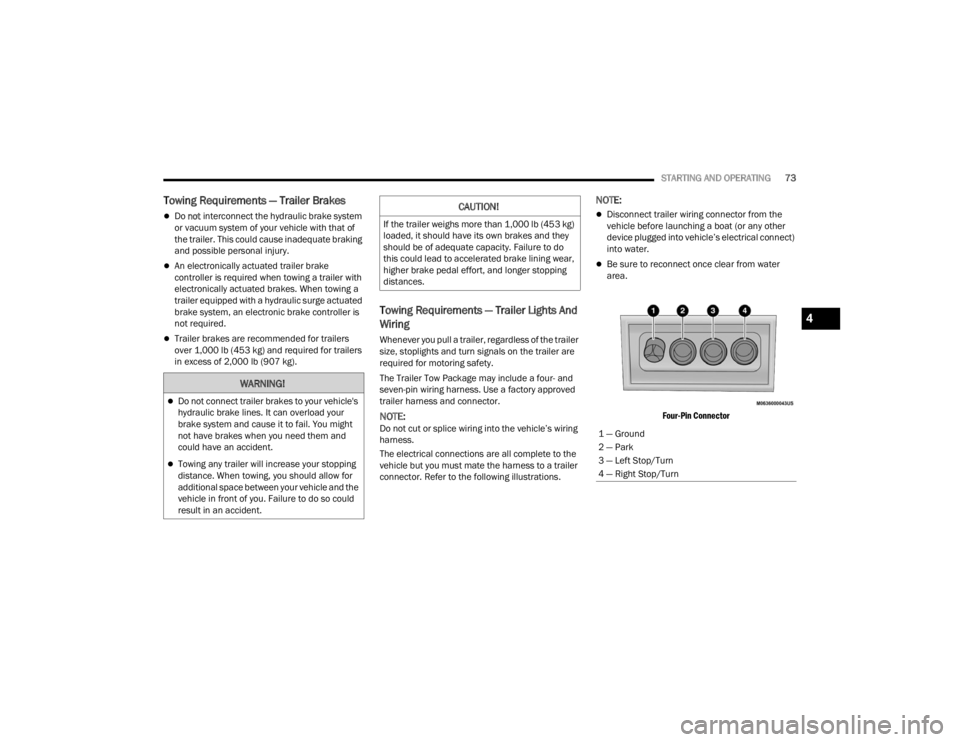
The Trailer Tow Package may include a four- and
seven-pin wiring harness. Use a factory approved
trailer harness and connector.
NOTE:Do not cut or splice wiring into the vehicle’s wiring
harness.
The electrical connections are all complete to the
vehicle but you must mate the harness to a trailer
connector. Refer to the following illustrations.
NOTE:
Disconnect trailer wiring connector from the
vehicle before launching a boat (or any other
device plugged into vehicle’s electrical connect)
into water.
Be sure to reconnect once clear from water
area.
Four-Pin Connector
WARNING!
Do not connect trailer brakes to your vehicle's
hydraulic brake lines. It can overload your
brake system and cause it to fail. You might
not have brakes when you need them and
could have an accident.
Towing any trailer will increase your stopping
distance. When towing, you should allow for
additional space between your vehicle and the
vehicle in front of you. Failure to do so could
result in an accident.
CAUTION!
If the trailer weighs more than 1,000 lb (453 kg)
loaded, it should have its own brakes and they
should be of adequate capacity. Failure to do
this could lead to accelerated brake lining wear,
higher brake pedal effort, and longer stopping
distances.
1 — Ground
2 — Park
3 — Left Stop/Turn
4 — Right Stop/Turn
4
22_VM_OM_EN_USC_t.book Page 73
Page 224 of 260
222SERVICING AND MAINTENANCE
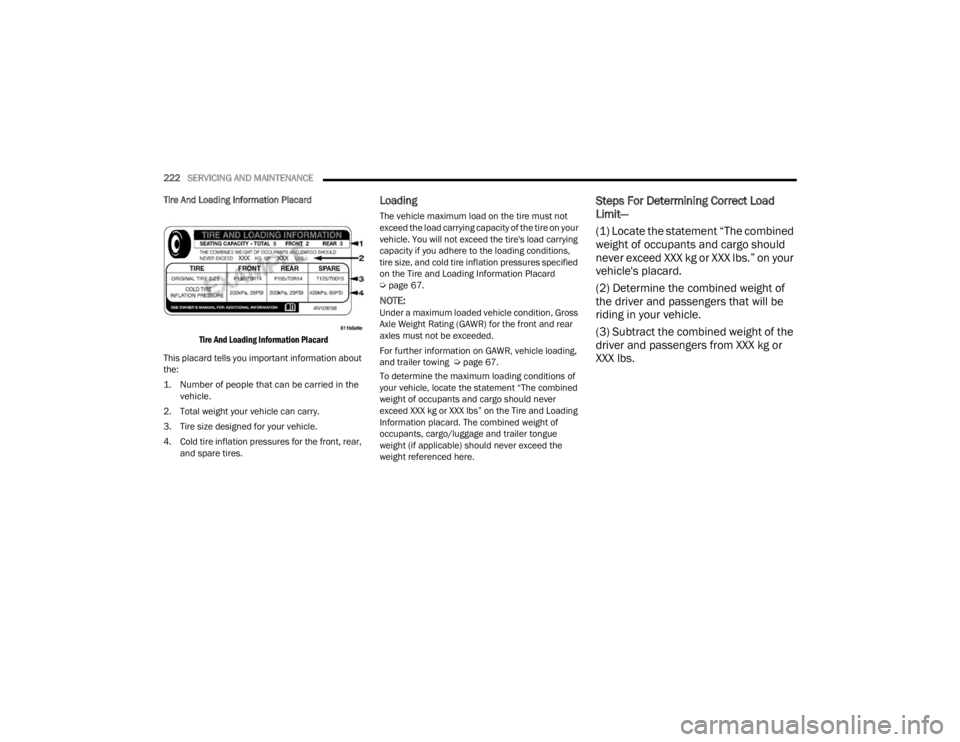
Tire And Loading Information Placard
Tire And Loading Information Placard
This placard tells you important information about
the:
1. Number of people that can be carried in the vehicle.
2. Total weight your vehicle can carry.
3. Tire size designed for your vehicle.
4. Cold tire inflation pressures for the front, rear, and spare tires.
Loading
The vehicle maximum load on the tire must not
exceed the load carrying capacity of the tire on your
vehicle. You will not exceed the tire's load carrying
capacity if you adhere to the loading conditions,
tire size, and cold tire inflation pressures specified
on the Tire and Loading Information Placard
Úpage 67.
NOTE:Under a maximum loaded vehicle condition, Gross
Axle Weight Rating (GAWR) for the front and rear
axles must not be exceeded.
For further information on GAWR, vehicle loading,
and trailer towing Ú page 67.
To determine the maximum loading conditions of
your vehicle, locate the statement “The combined
weight of occupants and cargo should never
exceed XXX kg or XXX lbs” on the Tire and Loading
Information placard. The combined weight of
occupants, cargo/luggage and trailer tongue
weight (if applicable) should never exceed the
weight referenced here.
Steps For Determining Correct Load
Limit—
(1) Locate the statement “The combined
weight of occupants and cargo should
never exceed XXX kg or XXX lbs.” on your
vehicle's placard.
(2) Determine the combined weight of
the driver and passengers that will be
riding in your vehicle.
(3) Subtract the combined weight of the
driver and passengers from XXX kg or
XXX lbs.
22_VM_OM_EN_USC_t.book Page 222
Page 225 of 260

SERVICING AND MAINTENANCE223
(4) The resulting figure equals the
available amount of cargo and luggage
load capacity. For example, if “XXX”
amount equals 1400 lbs. and there will
be five 150 lb passengers in your
vehicle, the amount of available cargo
and luggage load capacity is 650 lbs.
(1400-750 (5x150) = 650 lbs.)
(5) Determine the combined weight of
luggage and cargo being loaded on the
vehicle. That weight may not safely
exceed the available cargo and luggage
load capacity calculated in Step 4. (6) If your vehicle will be towing a trailer,
load from your trailer will be transferred
to your vehicle. Consult this manual to
determine how this reduces the
available cargo and luggage load
capacity of your vehicle.
Metric Example For Load Limit
For example, if “XXX” amount equals 635 kg and
there will be five 68 kg passengers in your vehicle,
the amount of available cargo and luggage load
capacity is 295 kg (635-340 (5x68) = 295 kg) as
shown in step 4.
NOTE:
If your vehicle will be towing a trailer, load from
your trailer will be transferred to your vehicle.
The following table shows examples on how to
calculate total load, cargo/luggage, and towing
capacities of your vehicle with varying seating
configurations and number and size of occu
-
pants. This table is for illustration purposes only
and may not be accurate for the seating and
load carry capacity of your vehicle.
For the following example, the combined weight
of occupants and cargo should never exceed
865 lb (392 kg).
8
22_VM_OM_EN_USC_t.book Page 223
Page 249 of 260

247
C
Camera, Rear
.................................................. 65Capacities, Fluid............................................ 240Caps, Filler Fuel............................................................. 66Oil (Engine)................................................ 193Power Steering............................................ 60Radiator (Coolant Pressure)...................... 201Car Washes................................................... 234Carbon Monoxide Warning............................ 170Cargo Area Cover............................................. 37Cargo Compartment........................................ 37Cargo Tie-Downs.............................................. 37Certification Label........................................... 67Chains, Tire.................................................... 232Changing A Flat Tire....................................... 171Chart, Tire Sizing............................................ 218Check Engine Light (Malfunction
Indicator Light)................................................ 51Checking Your Vehicle For Safety.................. 168Checks, Safety............................................... 168Child Restraint............................................... 152Child RestraintsBooster Seats............................................ 155Child Seat Installation..................... 164, 166How To Stow An unused ALR Seat Belt..... 161Infant And Child Restraints....................... 154
Locating The LATCH Anchorages.............. 160Lower Anchors And Tethers For Children.. 157Older Children And Child Restraints......... 154Seating Positions...................................... 156Clean Air Gasoline......................................... 238CleaningWheels..................................................... 231Climate Control................................................ 28Cold Weather Operation.................................. 52Compact Spare Tire...................................... 229Contract, Service.......................................... 243Cooling Pressure Cap (Radiator Cap)............ 201Cooling System............................................. 199Adding Coolant (Antifreeze)...................... 200Coolant Level............................................ 201Cooling Capacity....................................... 240Disposal Of Used Coolant......................... 201Drain, Flush, And Refill............................. 200Inspection........................................ 199, 201Points To Remember................................ 202Pressure Cap............................................ 201Radiator Cap............................................ 201Selection Of Coolant (Antifreeze)..... 200, 240Corrosion Protection..................................... 233Cruise Light...................................................... 50Customer Assistance.................................... 242Customer Programmable Features.................. 79Cybersecurity................................................... 78
D
Defroster, Windshield................................... 168Deleting A Phone........................................... 104Diagnostic System, Onboard............................50DipsticksOil (Engine)............................................... 194Power Steering............................................60Disable Vehicle Towing................................. 187Disconnecting............................................... 104DisplayedValues..........................................................44DisposalAntifreeze (Engine Coolant)...................... 201Door Ajar..........................................................45Door Ajar Light.................................................45Door Locks.......................................................13Doors...............................................................13Driver’s Seat Back Tilt......................................16DrivingThrough Flowing, Rising, Or Shallow Standing Water
.......................................76
E
Electric Brake Control System....................... 132Electric Remote Mirrors...................................23Electrical Outlet, Auxiliary (Power Outlet).........32Electronic Range Select (ERS).........................5911
22_VM_OM_EN_USC_t.book Page 247
Page 250 of 260

248 Electronic Stability Control (ESC)
...................132Electronic Throttle Control Warning Light........ 46Emergency, In Case Of Freeing Vehicle When Stuck...................... 185Jacking...................................................... 171Jump Starting............................................ 181Towing....................................................... 187Emission Control System Maintenance........... 51Engine........................................................... 193Air Cleaner................................................. 196Block Heater............................................... 53Break-In Recommendations........................ 54Checking Oil Level..................................... 194Coolant (Antifreeze)................................... 240Cooling...................................................... 199Exhaust Gas Caution................................. 170Fails To Start............................................... 53Flooded, Starting......................................... 53Jump Starting............................................ 181Oil.................................................... 195, 240Oil Filler Cap.............................................. 193Oil Filter..................................................... 196Oil Selection.................................... 195, 240Oil Synthetic.............................................. 196Overheating............................................... 183Starting....................................................... 52
Enhanced Accident Response Feature...150, 188
Ethanol......................................................... 238Exhaust Gas Cautions................................... 170Exhaust System................................... 170, 198Exterior Lights.........................................24, 170
F
FiltersAir Cleaner
................................................ 196Air Conditioning........................................... 31Engine Oil........................................ 196, 240Engine Oil Disposal................................... 196FlashersHazard Warning........................................ 171Turn Signals.......................................49, 170Flooded Engine Starting................................... 53Fluid Capacities............................................ 240Fluid Leaks................................................... 170Fluid Level ChecksBrake........................................................ 202Engine Oil................................................. 194Power Steering............................................ 60Fluid, Brake.................................................. 241Fog Lights........................................................ 25Fold-Flat Seats................................................. 16Four-Way Hazard Flasher.............................. 171Freeing A Stuck Vehicle................................ 185
Fuel............................................................... 237Additives................................................... 239Clean Air................................................... 238Ethanol..................................................... 238Filler Cap (Gas Cap).....................................66Gasoline................................................... 237Materials Added....................................... 239Methanol.................................................. 238Octane Rating.................................. 237, 240Specifications........................................... 240Tank Capacity........................................... 240Fuses............................................................ 207
G
Gas Cap (Fuel Filler Cap)..................................66Gasoline, (Fuel)............................................. 237Gasoline, Clean Air........................................ 238Gasoline, Reformulated................................ 238Gear Ranges....................................................57Gear Selector Override.................................. 184Glass Cleaning.............................................. 235Gross Axle Weight Rating.......................... 67, 68Gross Vehicle Weight Rating.....................67, 68GuideBody Builders................................................. 7GVWR...............................................................67
22_VM_OM_EN_USC_t.book Page 248
Page 254 of 260

252 Speed Control Cancel
......................................................... 62Speed Control (Cruise Control)........................ 60Starting............................................................ 52Automatic Transmission.............................. 52Cold Weather.............................................. 52Engine Fails To Start................................... 53Steering........................................................... 16Power.......................................................... 60Tilt Column.................................................. 16Wheel, Tilt................................................... 16Steering Wheel Audio Controls...................... 128Steering Wheel Mounted Sound
System Controls............................................ 128Storage............................................................ 31Storage, Vehicle...................................... 30, 233Storing Your Vehicle...................................... 233Sun Visor Extension......................................... 22Sway Control, Trailer...................................... 134Symbol Glossary................................................ 8Synthetic Engine Oil....................................... 196
T
Telescoping Steering Column.......................... 16Tie Down Hooks, Cargo.................................... 37Tilt Steering Column........................................ 16Tire And Loading Information Placard........... 221Tire Markings................................................. 217Tire Safety Information.................................. 217Tire Service Kit.............................................. 179
Tires...................................169, 225, 229, 232Aging (Life Of Tires).................................. 227Air Pressure.............................................. 225Chains...................................................... 232Changing.................................................. 171Compact Spare......................................... 229General Information........................ 225, 229High Speed............................................... 226Inflation Pressure..................................... 225Jacking..................................................... 171Life Of Tires.............................................. 227Load Capacity.................................. 221, 222Pressure Monitoring System (TPMS)..47, 135Quality Grading......................................... 232Radial....................................................... 226Replacement............................................ 228Rotation.................................................... 232Safety.............................................. 217, 225Sizes......................................................... 218Snow Tires................................................ 229Spare Tires...................................... 229, 230Spinning................................................... 227Trailer Towing.............................................. 72Tread Wear Indicators.............................. 227Wheel Nut Torque..................................... 236To Open Hood.................................................. 36Tongue Weight/Trailer Weight......................... 71
Towing..............................................................68Disabled Vehicle....................................... 187Guide...........................................................71Recreational................................................75Weight.........................................................71Towing Behind A Motorhome...........................75Traction............................................................76Traction Control............................................ 134Trailer Sway Control (TSC)............................. 134Trailer Towing...................................................68Hitches........................................................70Minimum Requirements..............................71Tips..............................................................74Trailer And Tongue Weight...........................71Wiring..........................................................73Trailer Towing Guide........................................71Trailer Weight...................................................71Transmission....................................................56Automatic................................... 55, 56, 203Fluid.......................................................... 241Maintenance............................................ 203Transporting Pets.......................................... 168Tread Wear Indicators................................... 227Trip Computer..................................................43Turn Signals.....................................................49
22_VM_OM_EN_USC_t.book Page 252