TPMS RENAULT ALASKAN 2017 User Guide
[x] Cancel search | Manufacturer: RENAULT, Model Year: 2017, Model line: ALASKAN, Model: RENAULT ALASKAN 2017Pages: 340, PDF Size: 6.93 MB
Page 213 of 340
•
Replacing tyres with those not originally speci-
fied by RENAULT could affect the proper op-
eration of the TPMS.
• RENAULT recommends using only the Emer-
gency Tyre Sealant provided with your vehicle.
Other tyre sealants may damage the valve
stem seal which can cause the tyre to lose air
pressure. Visit an approved dealer or quali-
fied workshop as soon as possible after using
tyre repair sealant (for models equipped with
the emergency tyre puncture repair kit).
CAUTION
• The TPMS may not function properly when the
wheels are equipped with tyre chains or the
wheels are buried in snow.
• Do not place metallised film or any metal parts
(antenna, etc.) on the windows. This may
cause poor reception of the signals from the
tyre pressure sensors, and the TPMS will not
function properly.
Some devices and transmitters may tempo-
rarily interfere with the operation of the TPMS
and cause the TPMS indicator light to illumi-
nate. Some examples are:
–F acilities or electric devices using similar
radio frequencies are near the vehicle.
–I fatransmitter set to similar frequencies is
being used in or near the vehicle. –I
fac omputer (or similar equipment) or a
DC/AC converter is being used in or near
the vehicle.
–I fdevices which transmit electrical noise
are connected to the vehicle’s 12V power
supply.
• When inflating the tyres and checking the tyre
pressure, never bend the valves.
• Special aluminium valves are fitted to mount
the TPMS sensors on the wheels. The TPMS
sensor is fixed at the wheels by
anut. The nut
needs to be correctly fitted at atorque setting
of 7.5 ±0.5 N•m. If the TPMS sensor is tight-
ened exceeding the limit, there is apossibility
the sensor grommet will be damaged. If the
sensor is tightened under the limit, there is a
possibility of causing an air leak.
• Use valve caps that comply with the factory-
fitted valve cap specifications.
• Do not use metal valve caps.
• Fit the valve caps properly. Without the valve
caps the valve and tyre pressure monitor sen-
sors could be damaged.
• Do not damage the valves and sensors when
storing the wheels or fitting different tyres.
• Replace the sensor grommet and washer dur-
ing
atyre change. Once they have been re-
moved, the sensor grommet and washer can-
not be reused and must be replaced. The
TPMS sensors can be used again. •
Use caution when using tyre inflation equip-
ment with
arigid air supply tube, as leverage
applied by the long nozzle can damage the
valve stem.
Starting and driving 5-11
Page 214 of 340
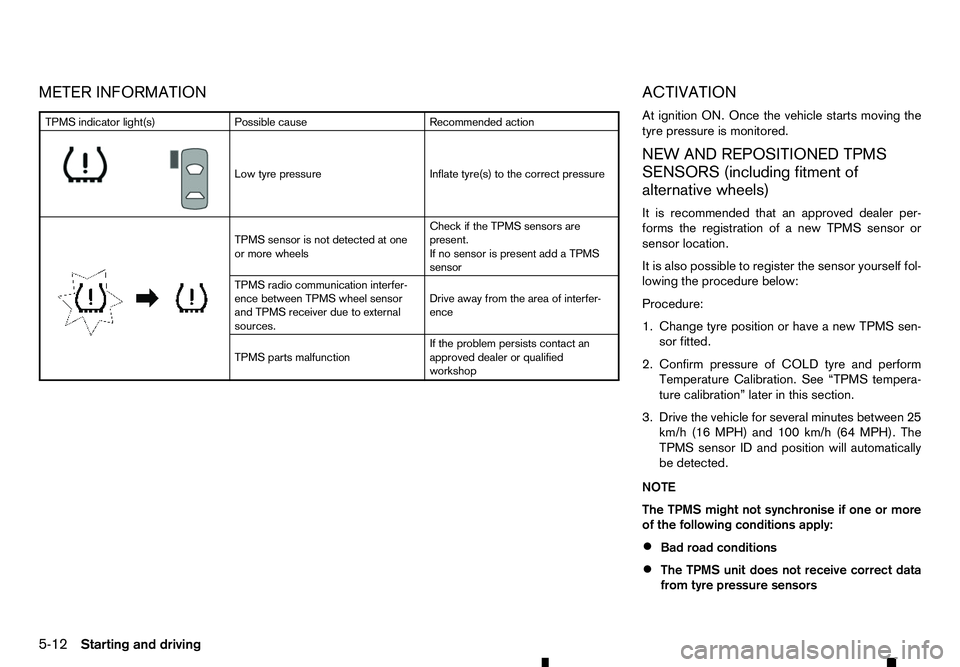
METER INFORMATION
ACTIVATION
At ignition ON. Once the vehicle starts moving the
tyre pressure is monitored.
NEW AND REPOSITIONED TPMSSENSORS (including fitment of
alternative wheels)
It is recommended that an approved dealer per-
forms the registration of anew TPMS sensor or
sensor location.
It is also possible to register the sensor yourself fol-
lowing the procedure below:
Procedure:
1. Change tyre position or have anew TPMS sen-
sor fitted.
2. Confirm pressure of COLD tyre and perform Temperature Calibration. See “TPMS tempera-
ture calibration” later in this section.
3. Drive the vehicle for several minutes between 25 km/h (16 MPH) and 100 km/h (64 MPH). The
TPMS sensor ID and position will automatically
be detected.
NOTE
The TPMS might not synchronise if one or more
of the following conditions apply:
• Bad road conditions
• The TPMS unit does not receive correct data
from tyre pressure sensors TPMS indicator light(s)
Possible cause Recommended action
m Low
tyre pressure
Inflate tyre(s) to the correct pressure
m TPMS
sensor is not detected at one
or more wheels Check if the TPMS sensors are
present.
If no sensor is present add aTPMS
sensor
TPMS radio communication interfer-
ence between TPMS wheel sensor
and TPMS receiver due to external
sources. Drive away from the area of interfer-
ence
TPMS parts malfunction If the problem persists contact an
approved dealer or qualified
workshop
5-12 Starting and driving
Page 215 of 340
•
Driving below 25 km/h (16 MPH)
• Driving above 100 km/h (64 MPH)
• High acceleration
• High deceleration
• In stop and go traffic or traffic waves
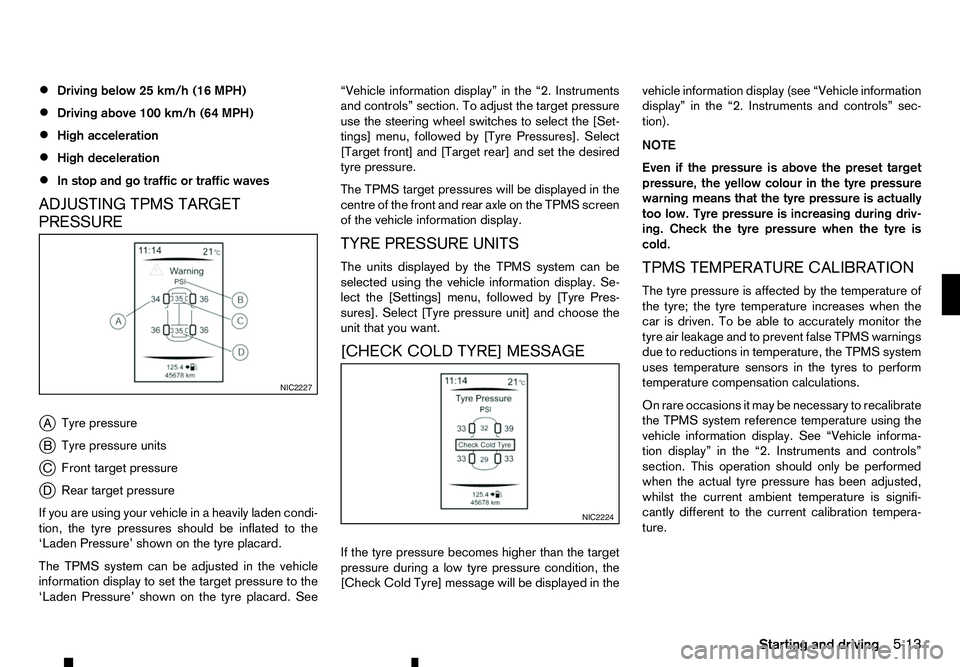
ADJUSTING TPMS TARGET
PRESSURE
j A Tyre pressure
j B Tyre pressure units
j C Front target pressure
j D Rear target pressure
If you are using your vehicle in aheavily laden condi-
tion, the tyre pressures should be inflated to the
‘Laden Pressure’ shown on the tyre placard.
The TPMS system can be adjusted in the vehicle
information display to set the target pressure to the
‘Laden Pressure’ shown on the tyre placard. See “Vehicle information display” in the “2. Instruments
and controls” section. To adjust the target pressure
use the steering wheel switches to select the [Set-
tings] menu, followed by [Tyre Pressures]. Select
[Target front] and [Target rear] and set the desired
tyre pressure.
The TPMS target pressures will be displayed in the centre of the front and rear axle on the TPMS screen
of the vehicle information display.
TYRE PRESSURE UNITS
The units displayed by the TPMS system can be
selected using the vehicle information display. Se-
lect the [Settings] menu, followed by [Tyre Pres-
sures]. Select [Tyre pressure unit] and choose the
unit that you want.
[CHECK COLD TYRE] MESSAGE
If the tyre pressure becomes higher than the target
pressure during alow tyre pressure condition, the
[Check Cold Tyre] message will be displayed in the vehicle information display (see “Vehicle information
display” in the “2. Instruments and controls” sec-
tion).
NOTE
Even if the pressure is above the preset target
pressure, the yellow colour in the tyre pressure
warning means that the tyre pressure is actually
too low. Tyre pressure is increasing during driv-
ing. Check the tyre pressure when the tyre is
cold.
TPMS TEMPERATURE CALIBRATION
The tyre pressure is affected by the temperature of
the tyre; the tyre temperature increases when the
car is driven. To be able to accurately monitor the
tyre air leakage and to prevent false TPMS warnings
due to reductions in temperature, the TPMS system
uses temperature sensors in the tyres to perform
temperature compensation calculations.
On rare occasions it may be necessary to recalibrate
the TPMS system reference temperature using the
vehicle information display. See “Vehicle informa-
tion display” in the “2. Instruments and controls”
section. This operation should only be performed
when the actual tyre pressure has been adjusted,
whilst the current ambient temperature is signifi-
cantly different to the current calibration tempera-
ture. NIC2227
NIC2224
Starting and driving
5-13
Page 216 of 340
![RENAULT ALASKAN 2017 User Guide To initiate TPMS temperature calibration use the
steering wheel switches to select the [Settings]
menu, followed by [Tyre Pressures]. Select [Cali-
brate] followed by [Start]. While the calibration pr](/img/7/58394/w960_58394-215.png "RENAULT ALASKAN 2017 User Guide To initiate TPMS temperature calibration use the
steering wheel switches to select the [Settings]
menu, followed by [Tyre Pressures]. Select [Cali-
brate] followed by [Start]. While the calibration pr")
To initiate TPMS temperature calibration use the
steering wheel switches to select the [Settings]
menu, followed by [Tyre Pressures]. Select [Cali-
brate] followed by [Start]. While the calibration pro-
cess is active, the message: [Resetting tyre pres-
sure system] will be displayed in the vehicle informa-
tion display. WARNING
Never remove the key or turn the ignition switch
to the
ing wheel will lock. This will cause the driver to
lose control of the vehicle and could result in
serious vehicle damage or personal injury.
MANUAL TRANSMISSION (MT)
The switch includes an anti-theft steering lock de-
vice.
The ignition key can only be removed when theswitch is in the
(0).
There is an “OFF” position ➀in between
and
cylinder.
To lock the steering wheel, remove the key. To
unlock the steering wheel, insert the key and turn
it gently while rotating the steering wheel slightly
right and left. KEY POSITIONS
LOCK (Normal parking position) (0):
The ignition key can only be removed at this posi-
tion.
OFF (1):
The engine can be turned off without locking the
steering wheel.
ACC (Accessories) (2):
This position activates electrical accessories such
as the radio when the engine is not running.
ON (Normal operating position) (3):
This position turns on the ignition system and elec-
trical accessories.
START (4):
This position starts the engine. As soon as the en-
gine has started, release the key immediately. It will
automatically return to the
STEERING LOCK
Locking the steering wheel
1) Place the ignition switch in the
tion.
2) Remove the key from the ignition switch.
3) Turn the steering wheel 1/6 of aturn clockwise
from the straight up position. SSD0392Z
IGNITION SWITCH (models without
Remote Control Key system)
5-14 Starting and driving
Page 264 of 340
If the pressure drops again,
the tyre cannot be
repaired with this tyre puncture repair kit. Con-
tact an approved dealer or qualified workshop.
When the tyre pressure is the specified
pressure:
The temporary repair is completed.
See an approved dealer or qualified workshop for
the repair/replacement as soon as possible.
After repairing tyre
See an approved dealer or qualified workshop for
tyre repair or replacement and for anew tyre seal-
ant bottle and hose, as soon as possible.
CAUTION
• Before driving, ensure tyre is adjusted to rec-
ommended inflation pressure as indicated on
vehicle placard. Monitor tyre pressure until
sealed tyre is replaced.
• Do not drive the vehicle at speeds faster than
50 MPH (80 km/h), and the damaged tyre
must be replaced as quickly as possible
(within
amaximum driving distance of 200 km
(120 miles)). You must not continue to drive if
heavy vibrations, unsteady steering behaviour
or noises should occur while driving.
• Immediately after using Emergency Tyre Seal-
ant to repair
aminor tyre puncture, take your
vehicle to an approved dealer or qualified
workshop to inspect, and repair or replace
the tyre. The Emergency Tyre Sealant cannot
permanently seal apunctured tyre. Continu- ing operation of the vehicle without
aperma-
nent tyre repair can lead to acrash.
• If you used Emergency Tyre Sealant to repair
am
inor tyre puncture, your approved dealer
or qualified workshop will also need to re-
place the TPMS sensor in addition to repair-
ing or replacing the tyre.
• RENAULT recommends using only RENAULT
Genuine Emergency Tyre Sealant provided
with your vehicle. Other tyre sealants may
damage the valve stem seal which can cause
the tyre to lose air pressure. WARNING
• Incorrect jump starting can lead to
abattery
explosion. The battery explosion may result in
severe injury or death. It may also result in
damage to the vehicle. Be sure to follow the
instructions in this section.
• Explosive hydrogen gas is always present in
the vicinity of the battery. Keep all sparks and
flames away from the battery.
• Always wear suitable eye protection and re-
move rings, bracelets, and any other jewellery
whenever working on or near
abattery.
• Never lean over the battery while jump start-
ing.
• Never allow battery fluid to come into contact
with eyes, skin, clothes or the vehicle’s
painted surfaces. Battery fluid is
acorrosive
sulphuric acid which can cause severe burns.
If the fluid comes into contact with anything,
immediately flush the contacted area with
plenty of water.
• Keep the battery out of the reach of children.
• The booster battery must be rated at 12 volts.
Use of an incorrectly rated battery will dam-
age your vehicle.
• Never attempt to jump start
afrozen battery.
It could explode and cause serious injury.
JUMP STARTING
6-10 In case of emergency
Page 279 of 340
Lights*:
Clean the headlights on
aregular basis. Make sure
that the headlights, stop lights, tail lights, turn signal
lights, and other lights are all operating properly and
installed securely. Also check the aim of the head-
lights.
Tyres*:
Check the pressure with agauge often and always
prior to long distance trips. Adjust the pressure in all
tyres, including the spare, to the pressure specified.
Check carefully for damage, cuts or excessive wear.
Tyre rotation*:
In the case of Two-Wheel Drive (2WD), and where
front and rear tyres are the same size: tyres should
be rotated every 10,000 km (6,000 miles). Tyres
marked with directional indicators can only be ro-
tated between front and rear. Make sure that the
directional indicators point in the direction of wheel
rotation after the tyre rotation is completed.
In the case of the Four-Wheel Drive and All Wheel
Drive (4WD/AWD), and where front and rear tyres
are the same size: tyres should be rotated every
5,000 km (3,000 miles). Tyres marked with direc-
tional indicators can only be rotated between front
and rear. Make sure that the directional indicators
point in the direction of wheel rotation after the tyre
rotation is completed.
In the case that front tyres are different size from
rear tyres: tyres cannot be rotated.
The timing for tyre rotation may vary according to
your driving habits and the road surface conditions. Tyre Pressure Monitoring System (TPMS)
transmitter components (where fitted):
Replace the TPMS transmitter grommet seal, valve
core and cap when the tyres are replaced due to
wear or age.
Wheel alignment and balance:
If the vehicle should pull to either side while driving
on astraight and level road, or if you detect uneven
or abnormal tyre wear, there may be aneed for
wheel alignment. If the steering wheel or seat vi-
brates at normal highway speeds, wheel balancing
may be needed.
Windscreen:
Clean the windscreen on aregular basis. Check the
windscreen at least every six months for cracks or
other damage. Repair as necessary.
Wiper blades*:
Check for cracks or wear if not functioning cor-
rectly. Replace as necessary.
Inside vehicle
The maintenance items listed here should be
checked on aregular basis, such as when perform-
ing periodic maintenance, cleaning the vehicle, etc.
Accelerator pedal:
Check the pedal for smooth operation and make
sure that the pedal does not catch or require uneven
effort. Keep the floor mats away from the pedal. Brake pedal*:
Check the pedal for smooth operation and make
sure that it is the proper distance from the floor mat
when depressed fully. Check the brake booster
function. Be sure to keep the floor mats away from
the pedal.
Parking brake*:
Check the parking brake operation regularly. Check
that the lever (where fitted) or the pedal (where fit-
ted) has the proper travel. Also make sure that the
vehicle is held securely on
afairly steep hill when
only the parking brake is applied.
Seat belts:
Check that all parts of the seat belt system (for
example, buckles, anchors, adjusters and retrac-
tors) operate properly and smoothly, and are in-
stalled securely. Check the belt webbing for cuts,
fraying, wear or damage.
Steering wheel:
Check for changes in the steering condition, such
as excessive play, hard steering or strange noises.
Warning lights and chimes:
Make sure that all warning lights and chimes are
operating properly.
Windscreen defogger:
Check that the air comes out of the defogger outlets
properly and in good quantity when operating the
heater or air conditioner.
Maintenance and do-it-yourself 8-3
Page 331 of 340
Travelling ........................................................................V
....... 9-7
Turbocharger ........................................................................V
5-8
Turn signal
–R eplacement ................................................................. 8-23
Tyre Pressure Monitoring System (TPMS) ............................. 5-9
–M eter information .......................................................... 5-12
–R adio approval numbers .................................................. 9-9
–S ettings ........................................................................V
. 5-13
Tyres
–4 WD model ................................................................... 5-32
–A ge ........................................................................V
....... 8-28
–C old weather ................................................................ 5-51
–F lat tyre ........................................................................V
... 6-2
–I nflation pressure ........................................................... 8-26
–P lacard ........................................................................V
.... 9-8
–R epairing flat tyre ............................................................ 6-6
–R otation ........................................................................V
. 8-27
–S izes ........................................................................V
....... 9-4
–S now chains ................................................................. 8-27
–T ypes ........................................................................V
.... 8-26
–W ear and damage ......................................................... 8-28
–W heels and tyres .......................................................... 8-26
U Universal child restraints
–F ront and rear seats ...................................................... 1-15
V Vanity mirror
–L ights ........................................................................V
.... 2-45
Variable voltage control system ............................................ 8-17
Vehicle battery .................................................................... 8-13 Vehicle identification .............................................................. 9-7
–A
ir conditioner label ......................................................... 9-8
–E ngine serial number ....................................................... 9-7
–L abel ........................................................................V
....... 9-7
–N umber (VIN) (chassis number) ....................................... 9-7
–N umber (VIN) plate .......................................................... 9-7
–T yre placard .................................................................... 9-8
Vehicle security ................................................................... 5-49
–T heft warning system ..................................................... 3-15
Vents ........................................................................V
.......... 4-20
W Warning/indicator lights and audible reminders
–W arning lights ................................................................. 2-5
Wheels
–B locking ........................................................................V
.. 6-4
–C leaning ........................................................................V
.. 7-3
–I nstallation ....................................................................... 6-6
–R emoval ........................................................................V
.. 6-4
–S izes ........................................................................V
....... 9-4
–S towing ........................................................................V
... 6-6
Window washer fluid ........................................................... 8-11
Windows
–D efogger ....................................................................... 2-34
Windscreen
–W iper and washer switch .............................................. 2-34
Winter
–P recautions ................................................................... 5-51
–S pecial equipment ......................................................... 5-52
Wipers
–B lades replacement ....................................................... 8-17
–O peration (Windscreen) ................................................ 2-34
–W asher nozzle ............................................................... 8-16
–W indow washer cleaner fluid ......................................... 8-11
–W iper and washer switch .............................................. 2-34
Index10-9