automatic transmission RENAULT ALASKAN 2017 User Guide
[x] Cancel search | Manufacturer: RENAULT, Model Year: 2017, Model line: ALASKAN, Model: RENAULT ALASKAN 2017Pages: 340, PDF Size: 6.93 MB
Page 218 of 340
range, it is possible for anyone, even someone who
does not carry the Remote Control Key, to push the
ignition switch to start the engine.
• The cargo bed area is not included in the operat-
ing range of the engine start function.
• If the Remote Control Key is placed on the in-
strument panel, inside the glove box, door pocket
or the corner of the interior compartment, the
Remote Control Key may not function.
• If the Remote Control Key is placed near the
door or window outside the vehicle, the Remote
Control Key may function.
AUTOMATIC TRANSMISSION (AT)
The ignition lock is designed so that the ignition
switch cannot be switched to the “LOCK” position
until the shift lever is moved to the P(Park) position.
When pushing the ignition switch to the “OFF” posi-
tion, make sure the shift lever is in the P(Park) posi-
tion.
When the ignition switch cannot be switched to the
“LOCK” position:
1. [Shift to Park] warning appears on the vehicle
information display and achime sounds.
2. Move the shift lever to the P(Park) position.
3. If the ignition switch is in the “ACC” position, [PUSH] warning appears on the vehicle informa-
tion display.
4. Push the ignition switch. The ignition switch is switched to the “OFF” position. 5. Open the door. The ignition switch turns to the
“LOCK” position.
For warnings and indicators on the vehicle informa-
tion display, see “Indicators for operation” in the
“2. Instruments and controls” section.
If the ignition switch is switched to the “LOCK”
position, the shift lever cannot be moved from the P
(Park) position. The shift lever can be moved if the
ignition switch is in the “ON” position with the foot-
brake pedal depressed.
STEERING LOCK
The ignition switch is equipped with an anti-theft
steering lock device.
To lock steering wheel
1. Place the ignition switch in the “OFF” position where the ignition switch position indicator will
not illuminate.
2. Open or close the door. The ignition switch turns to the “LOCK” position.
3. Turn the steering wheel 1/6 of aturn to the right
or left from the straight up position.
To unlock steering wheel
Push the ignition switch, and the steering wheel will
be automatically unlocked.
CAUTION
• If the battery of the vehicle is discharged, the
push-button ignition switch cannot be
switched from the “LOCK” position. •
If the steering lock release malfunction indi-
cator (where fitted) appears in the vehicle in-
formation display, push the ignition switch
again while rotating the steering wheel slightly
to the right and left. (See “Vehicle information
display” in the “2. Instruments and controls”
section.)
IGNITION SWITCH POSITIONS WARNING
Never place the ignition switch in the “OFF” posi-
tion while driving. The steering wheel may lock
and cause the driver to lose control of the ve-
hicle, resulting in serious vehicle damage or per-
sonal injury.
CAUTION
• Do not leave the vehicle for extended periods
of time when the ignition switch is in the “ON”
position and the engine is not running. This
can discharge the battery.
• Use electrical accessories with the engine
running to avoid discharging the vehicle bat-
tery. If you must use accessories while the
engine is not running, do not use them for
extended periods of time and do not use mul-
tiple electrical accessories at the same time.
5-16 Starting and driving
Page 219 of 340
When the ignition switch is pushed without depress-
ing the brake pedal (automatic transmission model)
or the clutch pedal (manual transmission model),
the ignition switch position will change as follows:
• Push once to change to “ACC”.
• Push two times to change to “ON”.
• Push three times to change to “OFF”.
• Push four times to return to “ACC”.
• Open or close any door to return to “LOCK”
from the “OFF” position.
LOCK position
The ignition switch and steering lock can only be
locked at this position.
The ignition switch will be unlocked when it is
pushed to the “ACC” position while carrying the
Remote Control Key. ACC position
The electrical accessory power activates at this po-
sition without the engine turned on.
ON position
The ignition system and the electrical accessory
power activate at this position without the engine
turned on.
OFF position
The engine is turned off with the steering wheel
unlocked.
REMOTE CONTROL KEY BATTERY
DISCHARGE
If the battery of the Remote Control Key is dis-
charged, or environmental conditions interfere with
the Remote Control Key operation, start the engine
according to the following procedure:
1.
Automatic Transmission (AT) model:
Move the shift lever to the P(Park) position. Manual Transmission (MT) model:
Move the shift lever to the
N(Neutral) position.
2. Firmly depress the brake pedal.
3. Touch the ignition switch with the Remote Con- trol Key as illustrated. (A chime will sound.)
4. Push the ignition switch while depressing the brake pedal (AT model) or the clutch pedal (MT
model) within 10 seconds after the chime
sounds. The engine will start.
After step 3isperformed, when the ignition switch
is pushed without depressing the brake pedal (AT
model) or the clutch pedal (MT model), the ignition
switch position will change to “ACC”.
NOTE
• When the ignition switch is pushed to the
“ACC” or “ON” position or the engine is started
by the above procedures, the Key Battery low
warning appears on the vehicle information
display even if the Remote Control Key is in-
side the vehicle. This is not
amalfunction. To
turn off the warning, touch the ignition switch
with the Remote Control Key again.
• If the Key Battery low warning appears on the
vehicle information display, replace the bat-
tery as soon as possible. (See “Remote Con-
trol Key battery replacement” in the “8. Main-
tenance and do-it-yourself” section.) JVS0241XZ
SSD0944Z
Starting and driving
5-17
Page 220 of 340
1. Apply the parking brake.
2. Depress the footbrake pedal.
3. Automatic Transmission (AT) model:
Move the shift lever to the P(Park) or the N(Neu-
tral) position.
The starter is designed to operate only when
the shift lever is in the proper position.
Manual Transmission (MT) model:
Move the shift lever to the N(Neutral) position
and depress the clutch pedal to the floor while
starting the engine.
4. Crank the engine with your foot off the accelera- tor pedal by turning the ignition switch to the
For diesel engine models: Turn the ignition
switch to the
glow plug indicator light turns off.
5. Immediately release the ignition switch when the engine starts. If the engine starts, but fails to run,
repeat the above procedures.
6. Allow the engine to idle for at least 30 seconds after starting the engine to warm-up. Drive at
moderate speeds for ashort distance first, espe-
cially in cold weather.
CAUTION
Do not leave the vehicle unattended while the
engine is warming up. 1. Apply the parking brake.
2.
Automatic Transmission (AT) model:
Move the shift lever to the P(Park) or the N(Neu-
tral) position.
The starter is designed to operate only when
the shift lever is in the proper position.
Manual Transmission (MT) model:
Move the shift lever to the N(Neutral) position.
The Remote Control Key must be carried when operating the ignition switch.
3. Place the ignition switch in the “ON” position. Depress the brake pedal (AT model) or the clutch
pedal (MT model) and push the ignition switch to
start the engine.
For diesel engine models: Wait until the glow
plug indicator light goes out.
To start the engine immediately, push and re-
lease the ignition switch while depressing the
brake pedal or clutch pedal with the ignition
switch in any position.
4. Immediately release the ignition switch when the engine starts. If the engine starts, but fails to run,
repeat the above procedures.
5. Allow the engine to idle for at least 30 seconds after starting the engine to warm-up. Drive at
moderate speeds for ashort distance first, espe-
cially in cold weather. CAUTION
Do not leave the vehicle unattended while the
engine is warming up.
6. To stop the engine, move the shift lever to the P (Park) (AT model) or N(Neutral) (MT model) po-
sition, apply the parking brake, and push the igni-
tion switch to the “OFF” position.
STARTING ENGINE (models
without Remote Control Key system)
STARTING ENGINE (models with
Remote Control Key system)
5-18 Starting and driving
Page 221 of 340
DRIVING WITH AUTOMATIC
TRANSMISSION (AT)
The Automatic Transmission (AT) in your vehicle is
electronically controlled to produce maximum power
and smooth operation.
The recommended operating procedures for this
transmission are shown on the following pages. Fol-
low these procedures for maximum vehicle perfor-
mance and driving enjoyment. WARNING
Do not downshift abruptly on slippery roads. This
may cause aloss of control.
CAUTION
• The cold engine idle speed is high, so use
caution when shifting into aforward or re-
verse gear before the engine has warmed up.
• Avoid revving up the engine while the vehicle
is stopped. This could cause unexpected ve-
hicle movement.
• Never shift to either the
P(Park) or R(Re-
verse) position while the vehicle is moving
forward and P(Park) or D(Drive) position
while the vehicle is reversing. This could cause an accident or damage the transmis-
sion. •
Except in an emergency, do not shift to the N
(Neutral) position while driving. Coasting with
the transmission in the
N(Neutral) position
may cause serious damage to the transmis-
sion.
• Start the engine in either the
P(Park) or N
(Neutral) position. The engine will not start in
any other gear position. If it does, have your
vehicle checked by an approved dealer or
qualified workshop.
• Shift into the
P(Park) position and apply the
parking brake when at astandstill for longer
than ashort waiting period.
• Keep the engine at idling speed while shifting
from the
N(Neutral) position to any driving
position.
• To avoid possible damage to your vehicle;
when stopping the vehicle on an uphill grade,
do not hold the vehicle by depressing the ac-
celerator pedal. The footbrake should be used
for this purpose.
Starting vehicle
1. After starting the engine, fully depress the foot- brake pedal before attempting to move the shift
lever out of the P(Park) position.
2. Keep the footbrake pedal depressed and move the shift lever into adriving position.
3. Release the parking brake, the footbrake pedal, and then gradually start the vehicle in motion. The AT is designed so the footbrake pedal MUST
be depressed before shifting from the
P(Park)
position to any driving position while the ignition
switch is in the “ON” position.
The shift lever cannot be moved out of the P
(Park) position and into any of the other gear
positions if the ignition switch is placed in the
“LOCK”, “OFF” or “ACC” position.
CAUTION
• DEPRESS THE FOOTBRAKE PEDAL
-Shifting
the shift lever to D(Drive), R(Reverse), or
manual shift mode without depressing the
footbrake pedal causes the vehicle to move
slowly when the engine is running. Make sure
the footbrake pedal is depressed fully and the
vehicle is stopped before shifting the shift le-
ver.
• MAKE SURE OF THE SHIFT LEVER POSITION
-M
ake sure the shift lever is in the desired
position. D(Drive) and manual shift mode are
used to move forward and R(Reverse) to re-
verse. Depress the accelerator pedal to start
the vehicle and merge with traffic (avoid
abrupt starting and spinning the wheels).
• WARM UP THE ENGINE
-Due to the higher
idle speeds when the engine is cold, extra
caution must be exercised when shifting the
shift lever into the driving position immedi-
ately after starting the engine.
DRIVING THE VEHICLE
Starting and driving5-19
Page 223 of 340
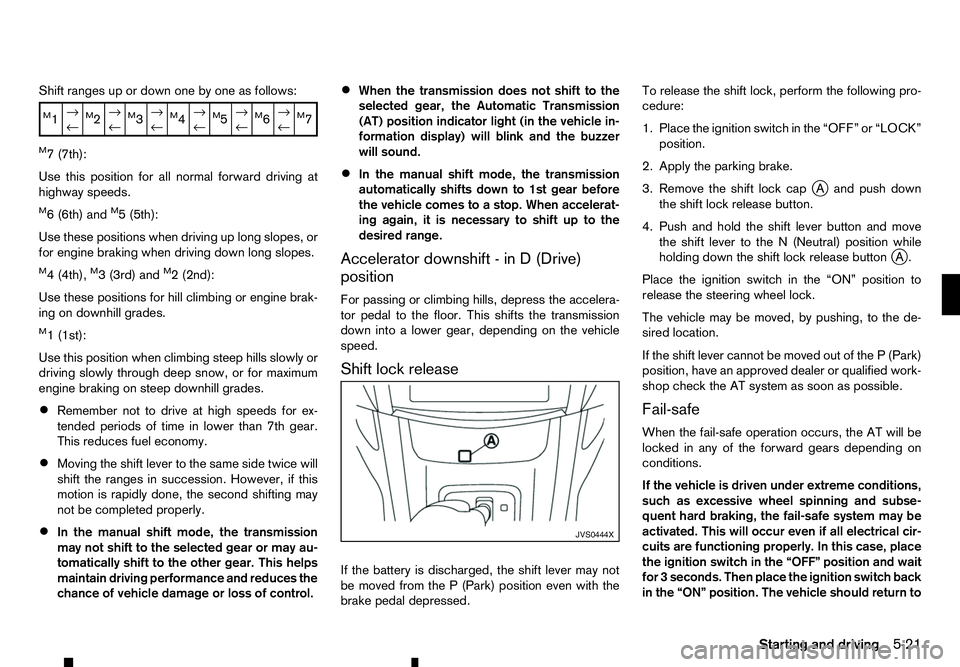
Shift ranges up or down one by one as follows:
M1
→
←M2→
←M3→
←M4→
←M5→
←M6→
←M7
M7(
7th):
Use this position for all normal forward driving at
highway speeds.
M6( 6th) andM5(5th):
Use these positions when driving up long slopes, or
for engine braking when driving down long slopes.
M4( 4th),M3(3rd) andM2(2nd):
Use these positions for hill climbing or engine brak-
ing on downhill grades.
M1( 1st):
Use this position when climbing steep hills slowly or
driving slowly through deep snow, or for maximum
engine braking on steep downhill grades.
• Remember not to drive at high speeds for ex-
tended periods of time in lower than 7th gear.
This reduces fuel economy.
• Moving the shift lever to the same side twice will
shift the ranges in succession. However, if this
motion is rapidly done, the second shifting may
not be completed properly.
• In the manual shift mode, the transmission
may not shift to the selected gear or may au-
tomatically shift to the other gear. This helps
maintain driving performance and reduces the
chance of vehicle damage or loss of control. •
When the transmission does not shift to the
selected gear, the Automatic Transmission
(AT) position indicator light (in the vehicle in-
formation display) will blink and the buzzer
will sound.
• In the manual shift mode, the transmission
automatically shifts down to 1st gear before
the vehicle comes to
astop. When accelerat-
ing again, it is necessary to shift up to the
desired range.
Accelerator downshift -inD(Drive)
position
For passing or climbing hills, depress the accelera-
tor pedal to the floor. This shifts the transmission
down into alower gear, depending on the vehicle
speed.
Shift lock release
If the battery is discharged, the shift lever may not
be moved from the P(Park) position even with the
brake pedal depressed. To release the shift lock, perform the following pro-
cedure:
1. Place the ignition switch in the “OFF” or “LOCK”
position.
2. Apply the parking brake.
3. Remove the shift lock cap jAa nd push down
the shift lock release button.
4. Push and hold the shift lever button and move the shift lever to the N(Neutral) position while
holding down the shift lock release button j
A.
Place the ignition switch in the “ON” position to
release the steering wheel lock.
The vehicle may be moved, by pushing, to the de-
sired location.
If the shift lever cannot be moved out of the P(Park)
position, have an approved dealer or qualified work-
shop check the AT system as soon as possible.
Fail-safe
When the fail-safe operation occurs, the AT will be
locked in any of the forward gears depending on
conditions.
If the vehicle is driven under extreme conditions,
such as excessive wheel spinning and subse-
quent hard braking, the fail-safe system may be
activated. This will occur even if all electrical cir-
cuits are functioning properly. In this case, place
the ignition switch in the “OFF” position and wait
for 3seconds. Then place the ignition switch back
in the “ON” position. The vehicle should return to JVS0444X
Starting
and driving
5-21
Page 225 of 340
The Stop/Start System is designed to prevent un-
necessary fuel consumption, exhaust emissions,
and noise during ajourney:
• When you stop the vehicle with the shift lever in
N(
Neutral) and clutch pedal released, the en-
gine is turned off automatically.
• When you push the clutch pedal, the engine is
automatically turned on.
CAUTION
At the end of the journey the engine must be
stopped and ignition turned off. Lock the vehicle
as normal. Turning the ignition switch OFF will
shut down all electrical systems. Failure to do
this may result in aflat battery.
NOTE
For model with Stop/Start System, use the spe-
cial battery that is enhanced in regard to the
charge-discharge capacity and life performance.
Avoid using anon-special battery for the Stop/
Start System, as this may cause early deteriora-
tion of the battery or amalfunction of the Stop/
Start System. For the battery, it is recommended
to use Genuine RENAULT parts. For more infor-
mation, contact an approved dealer or qualified
workshop.
NOTE
The Stop/Start System will not activate under
the following conditions:
• When the engine is kept idling without any
driving after the engine is turned on. •
When the engine coolant temperature is low.
• When the battery capacity is low.
• When the battery temperature is low.
• When the vehicle is moved.
• When the vacuum in the brake servo
decreases.
• When the engine bonnet is opened with the
engine running.
• When the engine is turned on with the engine
bonnet open.
• When the driver’s seat belt is not fastened.
• When the driver’s door is open.
• When the Stop/Start System indicator blinks
at
alow speed.
• When the fan speed control is in any position
other than OFF (0) while the air flow control is
in the front defogger position.
• When the front defogger switch is on.
• When the temperature inside the vehicle is
too high or low. (When the Auto air condition-
ing system is off, the Stop/Start System will
operate.)
• When the fan speed of the air conditioner is
set to the maximum speed.
• When the Stop/Start OFF switch is turned on.
• When the power consumption is large. •
When the vehicle is travelling at altitudes
higher than 2000
m(6562 ft) (MT model).
• For Manual Transmission (MT) models
• When the shift lever is in any position except
the
N(Neutral) position.
• When the clutch pedal is depressed.
• When the Remote Control Key is not in the
vehicle.
• When the steering wheel is turning or turned
more than 45 degrees.
NOTE
The engine will not restart even if the clutch pedal
is pressed while the Stop/Start System is acti-
vated under the following condition:
• When the engine bonnet is opened.
• When the driver seat belt is unfastened and
the driver’s door is opened.
• When the shift lever is not in the
N(Neutral)
position.
NOTE
It may take some time until the Stop/Start Sys-
tem activates under the following conditions:
• When the battery is discharged.
• When the outside temperature is low or high.
• When the battery is replaced or the battery
terminal is disconnected for extended peri-
ods and then reconnected.
STOP/START SYSTEM
(where fitted)
Starting and driving5-23
Page 231 of 340
WARNING
AT model: If the 4WD mode indicator is “OFF” or
the ATP warning light is “ON”, this indicates that
the automatic transmission P(Park) position will
not function and could result in the vehicle mov-
ing unexpectedly, causing serious personal in-
jury or property damage. Always set the parking
brake.
CAUTION
To avoid vehicle damage:
• Do not operate the 4WD mode switch when
cornering, reversing or if the rear wheels are
spinning freely. The vehicle must be moving
straight ahead.
• Do not move the shift lever (AT model) or
release the clutch pedal (MT model) when the
4LO indicator is blinking. Failure to do this
may cause the gears to grind and damaging
the powertrain.
• MT model: Do not accelerate rapidly from a
stopped position when the 4LO indicator is
blinking. Drive straight ahead at
alow speed
until the 4LO indicator is lit. The 4LO indicator
blinks when shifting between <4LO> and
<4H>.
• If the 4WD warning light comes on, perform
the following procedure:
1) Turn off the engine.
2) Start the engine. 3) Check if the 4WD warning light comes on.
If the 4WD warning light is still on after following
the above procedure, have the system checked
and serviced immediately by an approved dealer
or qualified workshop.
The transfer case 4WD mode switch is used to
select either Two-Wheel Drive (2WD) or
Four-Wheel Drive (4WD) depending on the driving
conditions. Turn the 4WD mode switch to select a drive mode (<2WD>, <4H> or <4LO>).
To change into or out of 4LO mode:
1. The vehicle MUST BE standing still.
2. Depress the clutch pedal (MT model) and the brake pedal and move the shift lever to N(Neu-
tral).
3. Depress and turn the 4WD mode switch to change into or out of <4LO>. WARNING
• When parking, apply the parking brake before
stopping the engine and make sure that the
4WD mode indicator is on and that the ATP
warning light or ATP warning message is off,
otherwise, the vehicle could unexpectedly
move even if the automatic transmission is in
the P(Park) position.
• The 4LO indicator must stop blinking and re-
main on or turn off before shifting the trans-
mission into gear. The vehicle may move un- expectedly if the shift lever is shifted from the
N(
Neutral) position to any other gear while
the 4LO indicator is blinking.
CAUTION
• Never turn the 4WD mode switch between
<4LO> and <4H> while driving.
• The <4H> drive mode provides greater power
and traction. Avoid excessive speed as it will
cause increased fuel consumption and higher
oil temperatures, and could damage power
train components. Speeds over 100 km/h (60
MPH) in <4H> are not recommended.
• The <4LO> drive mode provides maximum
power and traction. Avoid raising vehicle
speed excessively. The maximum speed is
approximately 50 km/h (30 MPH).
• The 4WD mode switch can be turned between
<2WD> and <4H> while driving straight ahead.
Do not turn the 4WD mode switch while mak-
ing
aturn or reversing.
• Do not turn the 4WD mode switch between
<2WD> and <4H> while driving on steep
downhill grades. Use the engine brake and
low transmission gears for engine braking.
• Do not turn the 4WD mode switch between
<2WD> and <4H> with the rear wheels spin-
ning.
Starting and driving 5-29
Page 240 of 340
WARNING
• Never rely solely on the hill descent control
system to control vehicle speed when driving
on steep downhill grades. Always drive care-
fully when using the hill descent control sys-
tem and decelerate the vehicle speed by de- pressing the brake pedal if necessary. Be
especially careful when driving on frozen,
muddy or extremely steep downhill roads.
Failure to control vehicle speed may result in
al oss of control of the vehicle and possible
serious injury or death.
• The hill descent control system may not con-
trol the vehicle speed on
ahill under all load
or road conditions. Always be prepared to de-
press the brake pedal to control vehicle
speed. Failure to do so may result in acolli-
sion or serious personal injury.
When the hill descent control system is activated, it
automatically applies smooth brakes to control
speed on asteep and slippery descent or off the
road without brake or accelerator operation. The hill
descent control system helps maintain vehicle speed
when driving under 25 km/h (16 MPH) on asteep
descent that engine braking alone in the <4H> or
<4LO> mode cannot control the speed.
NOTE
When the hill descent control system operates
continuously for along time, the temperature of
the Electronic Stability Programme (ESP) system
actuator may increase and the hill descent con- trol system may be temporarily disabled. The hill
descent control system on indicator light will turn
off. The hill descent control system will resume
operating automatically and the indicator light
will illuminate again when the temperature of the
ESP system actuator is reduced. If the indicator
light does not illuminate, turn off the system.
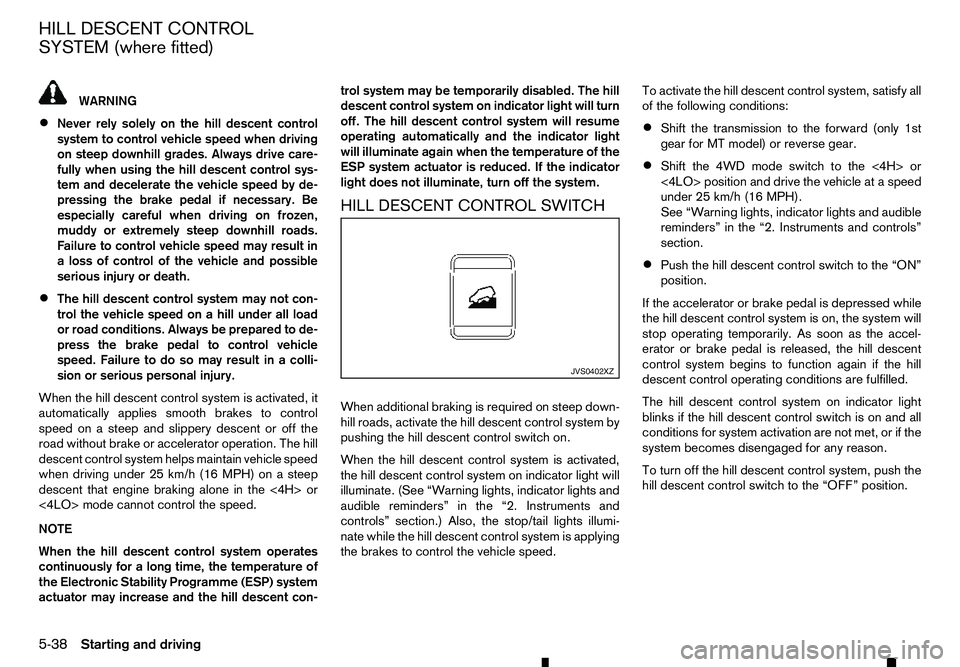
HILL DESCENT CONTROL SWITCH
When additional braking is required on steep down-
hill roads, activate the hill descent control system by
pushing the hill descent control switch on.
When the hill descent control system is activated,
the hill descent control system on indicator light will
illuminate. (See “Warning lights, indicator lights and audible reminders” in the “2. Instruments and
controls” section.) Also, the stop/tail lights illumi-
nate while the hill descent control system is applying
the brakes to control the vehicle speed. To activate the hill descent control system, satisfy all
of the following conditions:
• Shift the transmission to the forward (only 1st
gear for MT model) or reverse gear.
• Shift the 4WD mode switch to the <4H> or
<4LO> position and drive the vehicle at
aspeed
under 25 km/h (16 MPH).
See “Warning lights, indicator lights and audible
reminders” in the “2. Instruments and controls”
section.
• Push the hill descent control switch to the “ON”
position.
If the accelerator or brake pedal is depressed while
the hill descent control system is on, the system will
stop operating temporarily. As soon as the accel- erator or brake pedal is released, the hill descent
control system begins to function again if the hill
descent control operating conditions are fulfilled.
The hill descent control system on indicator light
blinks if the hill descent control switch is on and all
conditions for system activation are not met, or if the
system becomes disengaged for any reason.
To turn off the hill descent control system, push the
hill descent control switch to the “OFF” position. JVS0402XZ
HILL DESCENT CONTROL
SYSTEM (where fitted)
5-38 Starting and driving
Page 241 of 340
WARNING
• Never rely solely on the hill start assist system
to prevent the vehicle from moving backward on ahill. Always drive carefully and attentively.
Depress the brake pedal when the vehicle is
stopped on asteep hill. Be especially careful
when stopped on ahill on frozen or muddy
roads. Failure to prevent the vehicle from roll-
ing backwards may result in aloss of control
of the vehicle and possible serious injury or
death.
• The hill start assist system is not designed to
hold the vehicle at
astandstill on ahill. De-
press the brake pedal when the vehicle is
stopped on asteep hill. Failure to do so may
cause the vehicle to roll backwards and may
result in acollision or serious personal injury.
• The hill start assist system may not prevent
the vehicle from rolling backwards on ahill
under all load or road conditions. Always be
prepared to depress the brake pedal to pre-
vent the vehicle from rolling backwards. Fail-
ure to do so may result in acollision or seri-
ous personal injury.
The hill start assist system automatically keeps the
brakes applied to help prevent the vehicle from roll-
ing backwards in the time it takes the driver to re-
lease the brake pedal and apply the accelerator
when the vehicle is stopped on ahill. The hill start assist system will operate automatically
under the following conditions:
• The transmission is shifted to
aforward or re-
verse gear.
• The vehicle is stopped completely on
ahill by
applying the brake.
The maximum holding time is 2seconds. After 2
seconds the vehicle will begin to roll back and the
hill start assist system will stop operating completely.
The hill start assist system will not operate when the
transmission is shifted to the N(Neutral) or P(Park)
position or on aflat and level road.
When the Electronic Stability Programme (ESP)
warning light illuminates in the meter, the hill start
assist system will not operate. (See “Electronic Sta-
bility Programme (ESP) system (where fitted)” ear-
lier in this section.) The cruise control system allows driving at constant
speeds without keeping your foot on the accelerator
pedal. WARNING
• The cruise control system ONLY maintains a
constant vehicle speed, it does not replace
the driver.
• Always observe the posted speed limits and
do not set the speed over them.
• Do not use the cruise control when driving
under the following conditions. Doing so
could cause
aloss of vehicle control and re-
sult in an accident.
–W hen it is not possible to keep the vehicle
at ac onstant speed
–W hen driving in heavy traffic
–W hen driving in traffic that varies speed
–W hen driving in windy areas
–W hen driving on winding or hilly roads
–W hen driving on slippery (rain, snow, ice,
etc.) roads
CAUTION
On manual Transmission (MT) model, do not shift
to the N(Neutral) position without depressing
the clutch pedal when the cruise control is oper-
HILL START ASSIST SYSTEM
(where fitted)
CRUISE CONTROL (where fitted)
Starting and driving 5-39
Page 242 of 340
ated. Should this occur, depress the clutch pedal
and turn the cruise control MAIN switch off im-
mediately. Failure to do so may cause engine
damage.
When the cruise control system is on the speed lim-
iter cannot be operated.
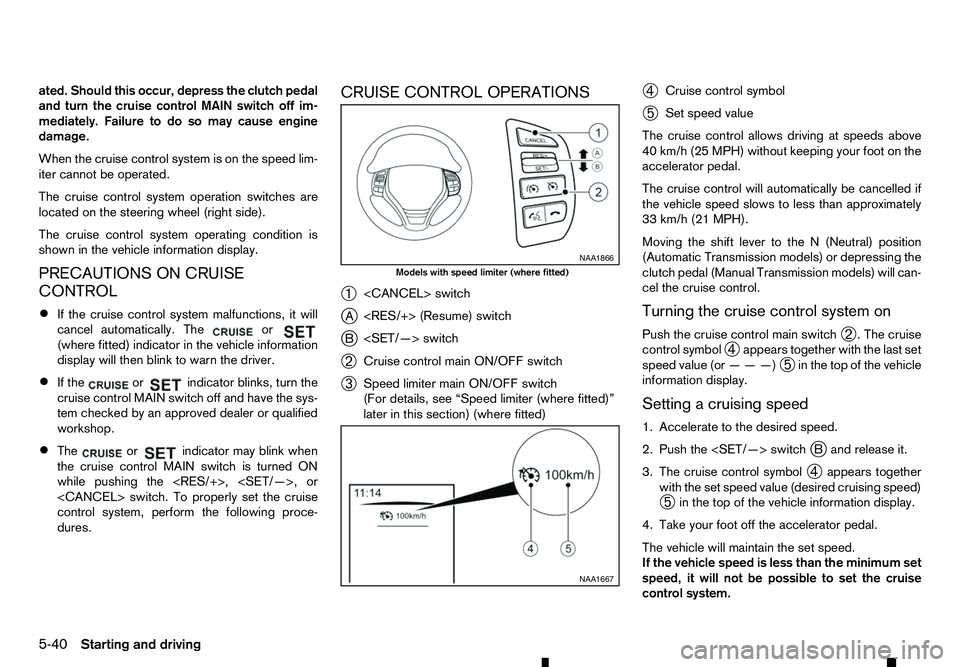
The cruise control system operation switches are
located on the steering wheel (right side).
The cruise control system operating condition is
shown in the vehicle information display.
PRECAUTIONS ON CRUISE
CONTROL
• If the cruise control system malfunctions, it will
cancel automatically. The or
(where fitted) indicator in the vehicle information
display will then blink to warn the driver.
• If the or indicator blinks, turn the
cruise control MAIN switch off and have the sys-
tem checked by an approved dealer or qualified
workshop.
• The or indicator may blink when
the cruise control MAIN switch is turned ON
while pushing the
control system, perform the following proce-
dures. CRUISE CONTROL OPERATIONS
➀
j A
j B
➁ Cruise control main ON/OFF switch
➂ Speed limiter main ON/OFF switch
(For details, see “Speed limiter (where fitted)”
later in this section) (where fitted) ➃
Cruise control symbol
➄ Set speed value
The cruise control allows driving at speeds above
40 km/h (25 MPH) without keeping your foot on the
accelerator pedal.
The cruise control will automatically be cancelled if
the vehicle speed slows to less than approximately
33 km/h (21 MPH).
Moving the shift lever to the N(Neutral) position
(Automatic Transmission models) or depressing the
clutch pedal (Manual Transmission models) will can-
cel the cruise control.
Turning the cruise control system on
Push the cruise control main switch ➁.T
he cruise
control symbol ➃appears together with the last set
speed value (or ———)
➄in the top of the vehicle
information display.
Setting acruising speed
1. Accelerate to the desired speed.
2. Push the
3. The cruise control symbol ➃appears together
with the set speed value (desired cruising speed)
➄ in the top of the vehicle information display.
4. Take your foot off the accelerator pedal.
The vehicle will maintain the set speed.
If the vehicle speed is less than the minimum set
speed, it will not be possible to set the cruise
control system. NAA1866
Models with speed limiter (where fitted)
NAA1667
5-40 Starting and driving