automatic transmission RENAULT ALASKAN 2017 Owner's Manual
[x] Cancel search | Manufacturer: RENAULT, Model Year: 2017, Model line: ALASKAN, Model: RENAULT ALASKAN 2017Pages: 340, PDF Size: 6.93 MB
Page 246 of 340
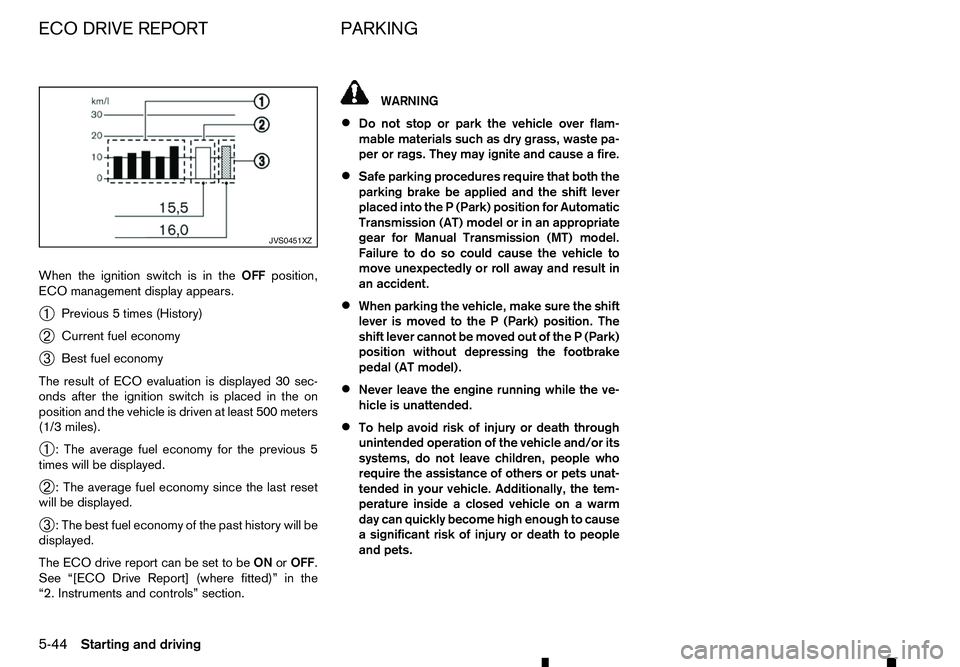
When the ignition switch is in the
OFFposition,
ECO management display appears.
➀ Previous
5times (History)
➁ Current fuel economy
➂ Best fuel economy
The result of ECO evaluation is displayed 30 sec-
onds after the ignition switch is placed in the on
position and the vehicle is driven at least 500 meters
(1/3 miles).
➀ :T
he average fuel economy for the previous 5
times will be displayed.
➁ :T
he average fuel economy since the last reset
will be displayed.
➂ :T
he best fuel economy of the past history will be
displayed.
The ECO drive report can be set to be ONorOFF.
See “[ECO Drive Report] (where fitted)” in the
“2. Instruments and controls” section. WARNING
• Do not stop or park the vehicle over flam-
mable materials such as dry grass, waste pa-
per or rags. They may ignite and cause afire.
• Safe parking procedures require that both the
parking brake be applied and the shift lever
placed into the
P(Park) position for Automatic
Transmission (AT) model or in an appropriate
gear for Manual Transmission (MT) model.
Failure to do so could cause the vehicle to
move unexpectedly or roll away and result in
an accident.
• When parking the vehicle, make sure the shift
lever is moved to the
P(Park) position. The
shift lever cannot be moved out of the P(Park)
position without depressing the footbrake
pedal (AT model).
• Never leave the engine running while the ve-
hicle is unattended.
• To help avoid risk of injury or death through
unintended operation of the vehicle and/or its systems, do not leave children, people who
require the assistance of others or pets unat-
tended in your vehicle. Additionally, the tem-
perature inside aclosed vehicle on awarm
day can quickly become high enough to cause
as ignificant risk of injury or death to people
and pets. JVS0451XZ
ECO DRIVE REPORT
PARKING
5-44 Starting and driving
Page 247 of 340
1. Firmly apply the parking brake.
2. Automatic Transmission (AT) model: Move the shift lever to the P(Park) position.
Manual Transmission (MT) model: Move the shift
lever to the R(Reverse) position. When parking
on an uphill grade, move the shift lever to the 1
(1st) position. 3. To help prevent the vehicle from moving into traf-
fic when parked on an incline, it is agood prac-
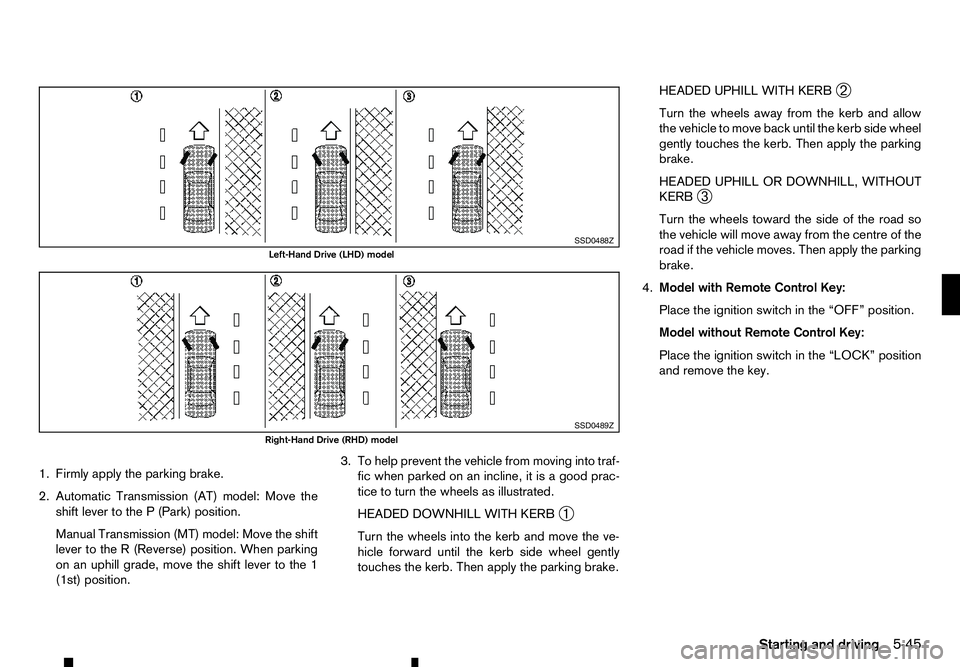
tice to turn the wheels as illustrated.
HEADED DOWNHILL WITH KERB ➀
Turn the wheels into the kerb and move the ve-
hicle forward until the kerb side wheel gently
touches the kerb. Then apply the parking brake. HEADED UPHILL WITH KERB
➁
Turn the wheels away from the kerb and allow
the vehicle to move back until the kerb side wheel
gently touches the kerb. Then apply the parking
brake.
HEADED UPHILL OR DOWNHILL, WITHOUT
KERB ➂
Turn the wheels toward the side of the road so
the vehicle will move away from the centre of the
road if the vehicle moves. Then apply the parking
brake.
4. Model with Remote Control Key:
Place the ignition switch in the “OFF” position.
Model without Remote Control Key:
Place the ignition switch in the “LOCK” position
and remove the key. SSD0488Z
Left-Hand Drive (LHD) model
SSD0489Z
Right-Hand Drive (RHD) model
Starting and driving5-45
Page 250 of 340
Your new vehicle was designed to be used primarily
to carry passengers and luggage.
Towing atrailer will place additional loads on your
vehicle’s engine, drive train, steering, braking and
other systems. The towing of atrailer will exagger-
ate other conditions such as sway caused by cross-
winds, rough road surfaces or passing trucks.
Your driving style and speed must be adjusted ac-
cording to the circumstances. Before towing a
trailer, see an approved dealer or qualified work-
shop for an explanation about the proper use of tow-
ing equipment.
OPERATING PRECAUTIONS
• Avoid towing
atrailer during the running-in pe-
riod.
• Before driving, make sure that the lighting sys-
tem of the trailer works properly.
• Observe the legal maximum speeds for trailer
operation.
• Avoid abrupt starts, accelerations and stops.
• Avoid sharp turns and lane changes.
• Always drive your vehicle at
amoderate speed.
• Follow the trailer manufacturer’s instructions.
• Choose proper coupling devices (trailer hitch,
safety chain, roof carrier, etc.) for your vehicle
and trailer. These devices are available from an
approved dealer or qualified workshop where
you can also obtain more detailed information
about trailer towing. •
Never allow the total trailer load (trailer weight
plus its cargo weight) to exceed the maximum
set for the vehicle and the coupling device. See
an approved dealer or qualified workshop for
more information.
• The trailer must be loaded so that heavy goods
are placed over the axle. The maximum allowable
vertical load on the trailer hitch must not be ex-
ceeded.
• Have your vehicle serviced more often than at
the intervals specified in
aseparate maintenance
booklet.
• Trailer towing requires more fuel than under nor-
mal circumstances because of
aconsiderable
increase in traction power and resistance.
While towing atrailer, check the engine coolant
temperature indicator to prevent the vehicle from
overheating.
TYRE PRESSURE
When towing atrailer, inflate the vehicle tyres to the
maximum recommended COLD tyre pressure (for
full loading) indicated on the tyre placard.
Do not tow atrailer when the vehicle is installed with
at emporary spare tyre or acompact spare tyre.
SAFETY CHAINS
Always use asuitable chain between the vehicle
and trailer. The chain should be crossed and should
be attached to the hitch, not to the vehicle bumper
or axle. Be sure to leave enough slack in the chain
to permit turning corners. TRAILER BRAKES
Ensure that trailer brakes are installed as required
by local regulations. Also check that all other trailer
equipment conforms to local regulations.
Always block the wheels on both the vehicle and
trailer when parking. Apply the hand brake on the
trailer where fitted. Parking on
asteep slope is not
recommended.
If parking on asteep slope is unavoidable, place the
shift lever in the P(Park) position (Automatic trans-
mission model), or in an appropriate position
(Manual transmission model), and turn the front
wheels towards the kerb.
TRAILER DETECTION (where fitted)
When towing atrailer with agenuine RENAULT tow
bar electrical kit and the turn signal switch is used,
the electrical system of the vehicle will detect the
additional electrical load of the trailer lighting. As a
result, the direction indicator tone will be different.
TRAILER TOWING
5-48
Starting and driving
Page 256 of 340
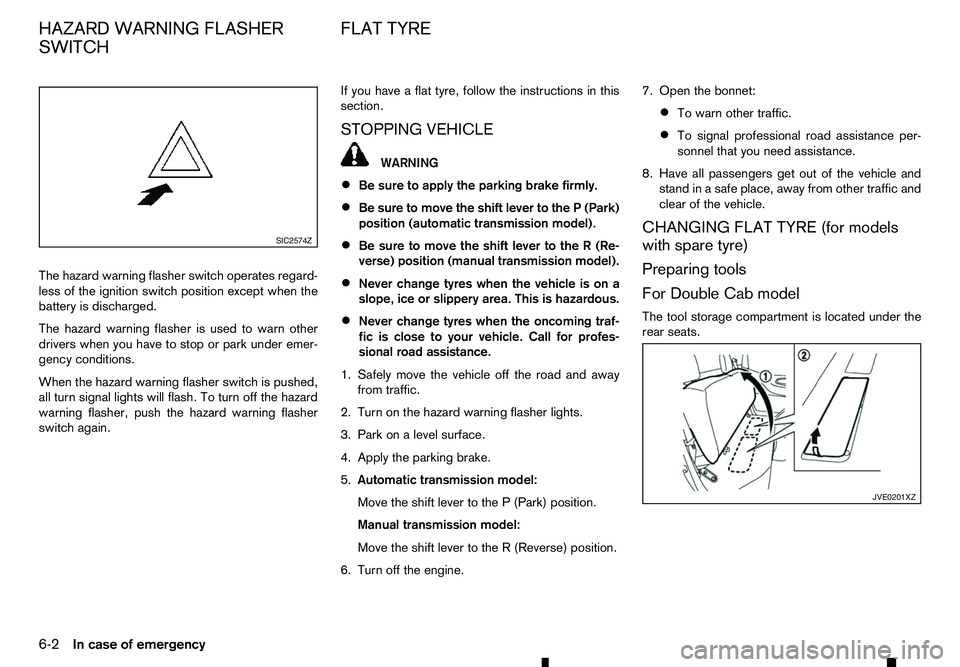
The hazard warning flasher switch operates regard-
less of the ignition switch position except when the
battery is discharged.
The hazard warning flasher is used to warn other drivers when you have to stop or park under emer-
gency conditions.
When the hazard warning flasher switch is pushed,
all turn signal lights will flash. To turn off the hazard
warning flasher, push the hazard warning flasher
switch again. If you have
aflat tyre, follow the instructions in this
section.
STOPPING VEHICLE WARNING
• Be sure to apply the parking brake firmly.
• Be sure to move the shift lever to the
P(Park)
position (automatic transmission model).
• Be sure to move the shift lever to the
R(Re-
verse) position (manual transmission model).
• Never change tyres when the vehicle is on a
slope, ice or slippery area. This is hazardous.
• Never change tyres when the oncoming traf-
fic is close to your vehicle. Call for profes-
sional road assistance.
1. Safely move the vehicle off the road and away from traffic.
2. Turn on the hazard warning flasher lights.
3. Park on alevel surface.
4. Apply the parking brake.
5. Automatic transmission model:
Move the shift lever to the P(Park) position.
Manual transmission model:
Move the shift lever to the R(Reverse) position.
6. Turn off the engine. 7. Open the bonnet:
• To warn other traffic.
• To signal professional road assistance per-
sonnel that you need assistance.
8. Have all passengers get out of the vehicle and stand in asafe place, away from other traffic and
clear of the vehicle.
CHANGING FLAT TYRE (for models
with spare tyre)
Preparing tools
For Double Cab model
The tool storage compartment is located under the
rear seats. SIC2574Z
JVE0201XZ
HAZARD WARNING FLASHER
SWITCH FLAT TYRE
6-2 In case of emergency
Page 265 of 340
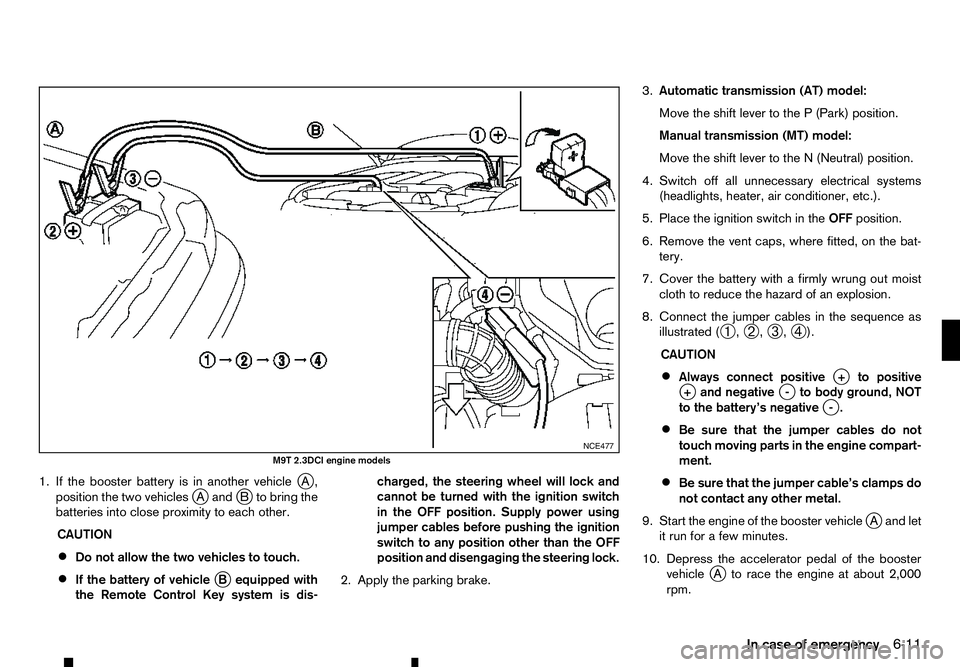
1. If the booster battery is in another vehicle
jA,
position the two vehicles j
Aa ndjBt obring the
batteries into close proximity to each other.
CAUTION
• Do not allow the two vehicles to touch.
• If the battery of vehicle
jBe quipped with
the Remote Control Key system is dis- charged, the steering wheel will lock and
cannot be turned with the ignition switch
in the OFF position. Supply power using
jumper cables before pushing the ignition
switch to any position other than the OFF
position and disengaging the steering lock.
2. Apply the parking brake. 3.
Automatic transmission (AT) model:
Move the shift lever to the P(Park) position.
Manual transmission (MT) model:
Move the shift lever to the N(Neutral) position.
4. Switch off all unnecessary electrical systems (headlights, heater, air conditioner, etc.).
5. Place the ignition switch in the OFFposition.
6. Remove the vent caps, where fitted, on the bat- tery.
7. Cover the battery with afirmly wrung out moist
cloth to reduce the hazard of an explosion.
8. Connect the jumper cables in the sequence as illustrated ( ➀,
➁ ,
➂ ,
➃ ).
CAUTION
• Always connect positive
j+t opositive
j +a nd negative j-t obody ground, NOT
to the battery’s negative j
-.
• Be sure that the jumper cables do not
touch moving parts in the engine compart-
ment.
• Be sure that the jumper cable’s clamps do
not contact any other metal.
9. Start the engine of the booster vehicle j
Aa nd let
it run for afew minutes.
10. Depress the accelerator pedal of the booster vehicle j
At orace the engine at about 2,000
rpm. NCE477
M9T 2.3DCI engine models
In case of emergency6-11
Page 266 of 340
11. Start the engine of the jumped vehicle
jBi nthe
normal manner.
CAUTION
Never keep the starter motor engaged for
more than 10 seconds. If the engine does not
start right away, place the ignition switch in
the “LOCK” position and wait at least 10 sec-
onds before trying again.
12. After the engine is started, carefully disconnect the jumper cables in the opposite sequence
from that illustrated ( ➃,
➂ ,
➁ ,
➀ ).
13. Remove and dispose of the cloth properly as it may be contaminated with corrosive acid.
14. Replace the vent caps, if removed. Do not attempt to start the engine by pushing the
vehicle.
CAUTION
• Automatic Transmission (AT) model cannot
be started by pushing. Attempting to do so
may cause damage to the transmission.
• Three-way catalyst equipped model should
not be started by pushing. Attempting to do
so may cause damage to the three-way cata-
lyst.
• Diesel Oxidation Catalyst equipped model
should not be started by pushing. Attempting
to do so may cause damage to the catalyst.
• Never try to start the engine by towing. When
the engine starts, the forward surge could
cause the vehicle to collide with the towing
vehicle. WARNING
• Never continue driving if your vehicle over-
heats. Doing so could cause engine damage
and/or avehicle fire.
• Never open the bonnet if steam is coming
out.
• Never remove the radiator or coolant reser-
voir cap while the engine is hot. If the radiator
or coolant reservoir cap is removed when the
engine is hot, pressurised hot water will spurt
out and possibly cause burning, scalding or
serious injury.
• If steam or coolant is coming from the engine,
stand clear of the vehicle to prevent getting
scalded.
• The engine cooling fan can start at any time
when the coolant temperature exceeds pre-
set degrees.
• Be careful not to allow your hands, hair, jewel-
lery or clothing to come into contact with, or
to get caught in the cooling fan or drive belts.
If your vehicle is overheating, or if you feel alack of
engine power, detect unusual noise, etc., take the
following steps:
1. Safely move the vehicle off the road away from traffic.
2. Turn on the hazard indicator flashers.
3. Apply the parking brake.
PUSH STARTING
IF YOUR VEHICLE OVERHEATS
6-12 In case of emergency
Page 267 of 340
4.
Automatic transmission model:
Move the shift lever to the P(Park) position.
Manual transmission model:
Move the shift lever to the N(Neutral) position.
DO NOT STOP THE ENGINE.
5. Open all the windows.
6. Turn off the air conditioner. Move the tempera- ture control to maximum hot and the fan control
to high speed.
7. Get out from the vehicle.
8. Visually inspect and listen for steam or coolant escaping from the radiator before opening the
bonnet. Wait until no steam or coolant can be
seen before proceeding.
9. Open the engine bonnet.
10. Visually inspect if the cooling fan is running.
11. Visually inspect the radiator and radiator hoses for leakage. If the cooling fan is not running or
the coolant is leaking, stop the engine.
12. After the engine cools down, check the coolant level in the reservoir with the engine running.
Do not open the radiator or coolant reservoir
cap.
13. Add coolant to the reservoir if necessary.
Have your vehicle inspected/repaired at an
approved dealer or qualified workshop. When towing your vehicle, local regulations for tow-
ing must be followed. Incorrect towing equipment
could damage your vehicle. To assure proper tow-
ing and to prevent accidental damage to your ve-
hicle, RENAULT recommends that you have profes-
sional road assistance personnel tow your vehicle. It
is advisable to have the professional road assistant
carefully read the following precautions.
TOWING PRECAUTIONS
• Be sure that the transmission, steering system
and powertrain are in working condition before
towing. If any units are damaged, the vehicle
must be towed using
adolly or flatbed tow truck.
(Two- Wheel Drive (2WD) model)
• RENAULT recommends that your vehicle be
towed with the driving wheels off the ground.
(Two- Wheel Drive (2WD) model)
• To tow
avehicle with automatic transmission,
and appropriate vehicle dolly MUSTbe placed
under the towed vehicles drive wheels. Always
follow the dolly manufacturer’s recommenda-
tions when using their product.
• Always attach safety chains before towing.
• Never tow Four-Wheel Drive (4WD) model with
any of the wheels on the ground as this may
cause serious and expensive damage to the driv-
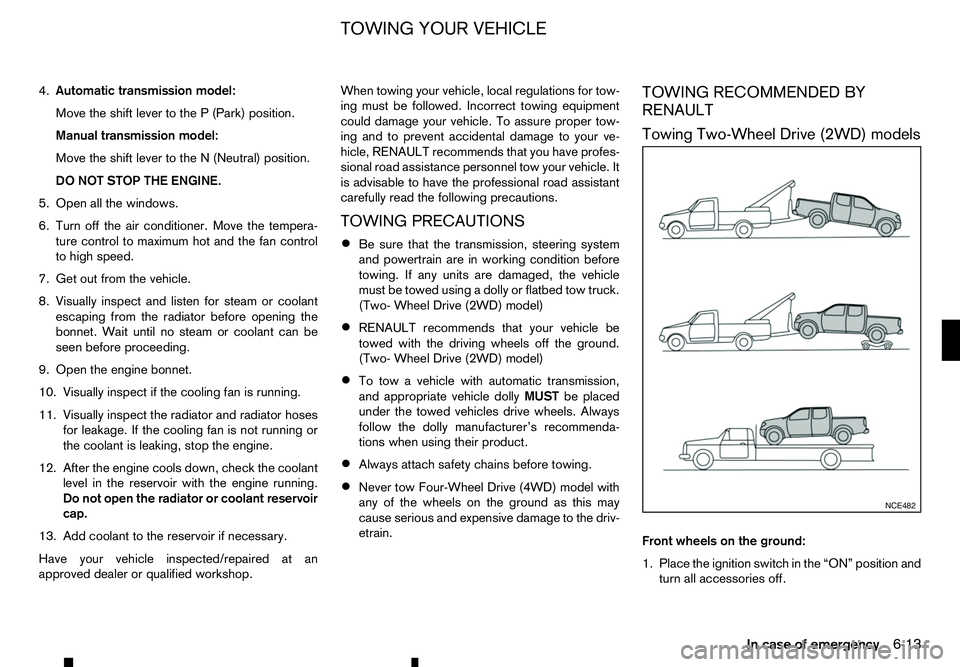
etrain. TOWING RECOMMENDED BY
RENAULT
Towing Two-Wheel Drive (2WD) models
Front wheels on the ground:
1. Place the ignition switch in the “ON” position and
turn all accessories off. NCE482
TOWING YOUR VEHICLE
In case of emergency6-13
Page 268 of 340

2. Secure the steering wheel in
astraight ahead
position with rope or similar device.
3. Move the shift lever to the N(Neutral) position.
4. Release the parking brake.
5. Attach safety chains before towing.
Rear wheels on the ground:
RENAULT recommends that towing dollies be used
under the rear wheels when towing your vehicle or
the vehicle be placed on aflatbed tow truck as illus-
trated.
CAUTION
Never tow Automatic Transmission (AT) model
with the rear wheels on the ground. Doing so will
cause serious and expensive damage to the
transmission.
Manual Transmission (MT) model:
If you have to tow aMTvehicle with rear wheels on
the ground, perform the following procedures.
CAUTION
Observe the following restricted towing speeds
and distances.
• Speed: Below 50 km/h (30 MPH)
• Distance: Less than 65 km (40 miles)
1. Place the ignition switch in the “ON” position and turn all accessories off.
2. Move the shift lever to the N(Neutral) position.
3. Release the parking brake. 4. Attach safety chains whenever towing.
All four wheels on the ground:
RENAULT recommends that the vehicle be placed
on
aflatbed tow truck as illustrated.
CAUTION
Never tow Automatic Transmission (AT) model
with all four wheels on the ground. Doing so will
cause serious and expensive damage to the driv-
etrain.
Manual Transmission (MT) model:
If you have to tow aMTvehicle with all four wheels
on the ground, perform the following procedures.
CAUTION
• Never tow
aManual Transmission (MT) model
backward with all four wheels on the ground.
• Observe the following restricted towing
speeds and distances.
–S
peed: Below 50 km/h (30 MPH)
–D istance: Less than 65 km (40 miles)
1. Place the ignition switch in the “ON” position and turn all accessories off.
2. Move the shift lever to the N(Neutral) position.
3. Release the parking brake.
6-14 In case of emergency
Page 277 of 340
8
Maintenance and do-it-yourself
Maintenance and do-it-yourself
Maintenance requirements ....................................... 8-2 Scheduled maintenance...................................... 8-2
General maintenance .......................................... 8-2
Where to go for service ...................................... 8-2
General maintenance ............................................... 8-2 Explanation of general maintenance items ........... 8-2
Maintenance precautions .................................... 8-4
Engine compartment check locations ....................... 8-5
Engine cooling system ............................................. 8-5 Checking engine coolant level............................. 8-6
Changing engine coolant .................................... 8-6
Engine oil................................................................. 8-6
Checking engine oil level .................................... 8-6
Changing engine oil and oil filter ......................... 8-7
Protect environment ............................................ 8-7
AdBlue® tank (where fitted for diesel engine
model) ..................................................................... 8-7 Refilling the AdBlue® tank .................................. 8-7
Drive belt ................................................................. 8-8
Automatic Transmission Fluid (ATF) (where fitted).... 8-8 7-speed Automatic Transmission (AT) model....... 8-8
Power steering fluid ................................................. 8-8
Brakes ..................................................................... 8-9 Checking parking brake ...................................... 8-9
Checking footbrake ............................................ 8-9
Brake booster ..................................................... 8-9
Brake fluid ............................................................... 8-10
Clutch fluid (where fitted) ......................................... 8-11 Window washer fluid ............................................... 8-11
Battery..................................................................... 8-12
Vehicle battery .................................................... 8-13
Remote controller battery (where fitted) .............. 8-13
Remote Control Key battery (where fitted)........... 8-14
Air cleaner filter........................................................ 8-15
Wiper blades ........................................................... 8-16 Windscreen wiper blades ................................... 8-16
Variable voltage control system (where fitted) ........... 8-17
Fuses ...................................................................... 8-18 Engine compartment ........................................... 8-18
Passenger compartment ..................................... 8-19
Lights ...................................................................... 8-20
Headlights .......................................................... 8-20
Exterior lights ...................................................... 8-21
Interior lights....................................................... 8-22
Light locations .................................................... 8-23
Tyres and wheels ..................................................... 8-26 Tyre inflation pressure......................................... 8-26
Types of tyres ..................................................... 8-26
Tyre chains ......................................................... 8-27
Tyre rotation ....................................................... 8-27
Tyre wear and damage ....................................... 8-28
Tyre age ............................................................. 8-28
Changing tyres and wheels................................. 8-28
Wheel balance.................................................... 8-28
Spare tyre .......................................................... 8-28
Page 281 of 340
•
Your vehicle is fitted with an automatic en-
gine cooling fan. It may come on at any time
without warning, even if the ignition switch is
in the OFF position and the engine is not run-
ning. To avoid injury, always disconnect the
negative battery cable before working near
the fan.
• Always wear eye protection whenever you
work on your vehicle.
• Never leave the engine or the transmission
related component harness connector
disconnected while the ignition switch is in
the ON position.
• Avoid direct contact with used engine oil and
coolant. Improperly disposed engine oil, en-
gine coolant, and/or other vehicle fluids can
hurt the environment. Always conform to lo-
cal regulations for disposal of vehicle fluids.
This “8. Maintenance and do-it-yourself” section
provides instructions regarding only those items
which are relatively easy for an owner to perform.
You should be aware that incomplete or improper
servicing may result in operating difficulties or ex-
cessive emissions, and could affect your warranty
coverage. If in doubt about any servicing, have it
done by an approved dealer or qualified work-
shop. For an overview of the engine compartment, see
“Engine compartment” in the “0. Illustrated table
of contents” section. WARNING
• Never remove the radiator or coolant reser-
voir cap when the engine is hot. Serious burns
could be caused by high-pressure fluid es-
caping from the radiator. Wait until the engine
and radiator cool down.
• Engine coolant is poisonous and should be
stored carefully in marked containers out of
the reach of children.
The engine cooling system is filled at the factory
with ahigh-quality, year-round, anti-freeze coolant
solution. The anti-freeze solution contains rust and
corrosion inhibitors, therefore additional cooling sys-
tem additives are not necessary.
CAUTION
• Never use any cooling system additives such
as radiator sealer. Additives may clog the
cooling system and cause damage to the en-
gine, transmission and/or cooling system.
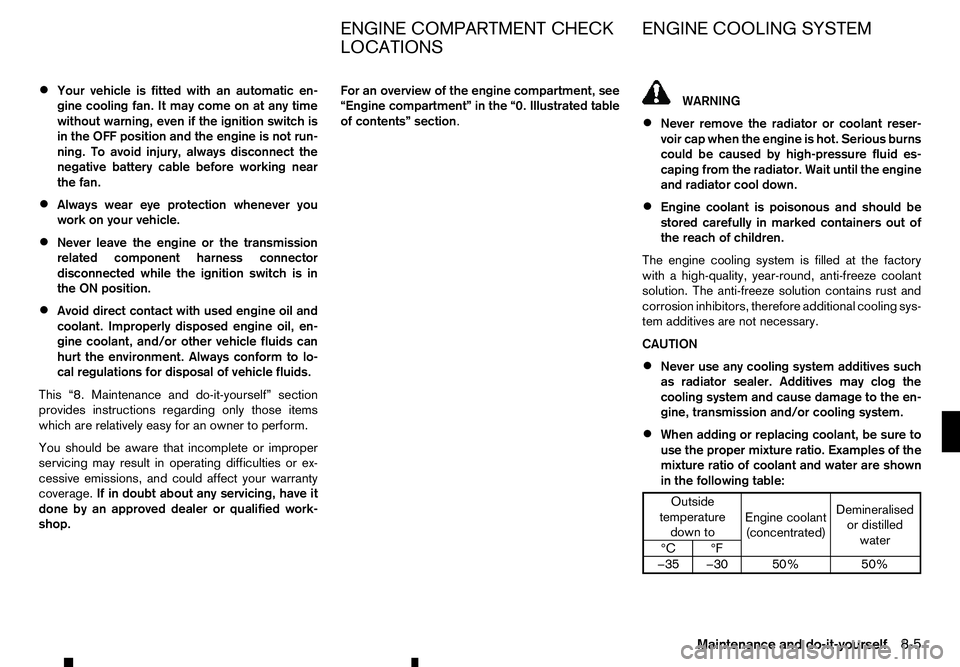
• When adding or replacing coolant, be sure to
use the proper mixture ratio. Examples of the
mixture ratio of coolant and water are shown
in the following table: Outside
temperature
down to
Engine coolant
(concentrated) Demineralised
or distilled water
°C °F
−35 −30 50% 50%
ENGINE COMPARTMENT CHECK
LOCATIONS
ENGINE COOLING SYSTEM
Maintenance and do-it-yourself 8-5