brake light RENAULT ALASKAN 2017 User Guide
[x] Cancel search | Manufacturer: RENAULT, Model Year: 2017, Model line: ALASKAN, Model: RENAULT ALASKAN 2017Pages: 340, PDF Size: 6.93 MB
Page 195 of 340
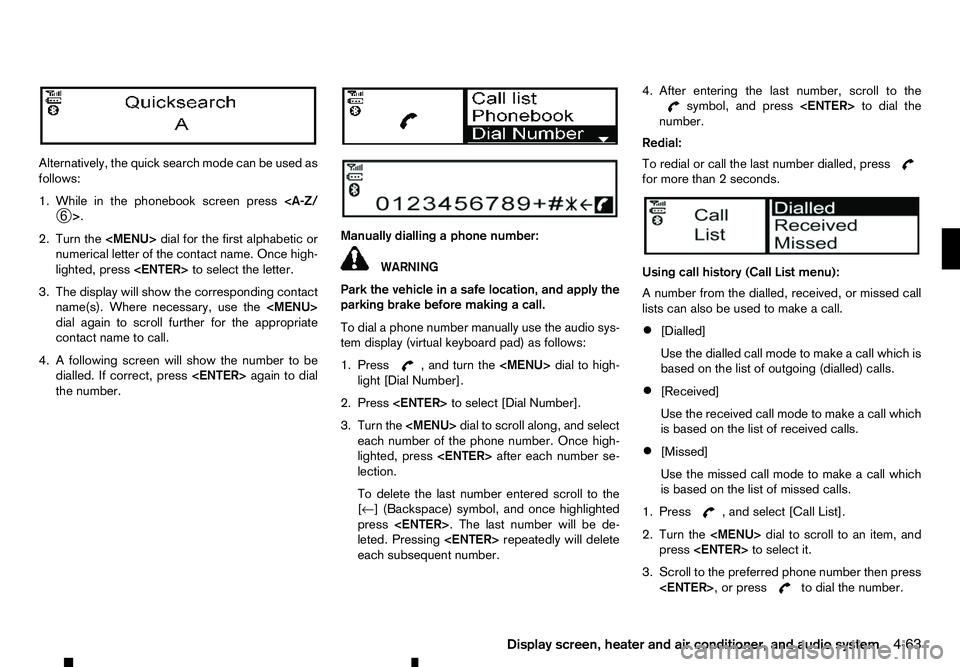
Alternatively, the quick search mode can be used as
follows:
1. While in the phonebook screen press
2. Turn the
Page 204 of 340
During the first 1,600 km (1,000 miles), follow these
recommendations to obtain maximum engine per-
formance and ensure the future reliability and
economy of your new vehicle. Failure to follow these
recommendations may result in shortened engine
life and reduced engine performance.
• Do not drive at
aconstant speed, either fast or
slow, for long periods of time.
• Do not run the engine over 4,000 rpm.
• Do not accelerate at full throttle in any gear.
• Do not start quickly.
• Do not brake hard as much as possible.
• Do not tow
atrailer for at least the first 800 km
(500 miles). WARNING
The driving characteristics of your vehicle will
change remarkably by any additional load and its
distribution, as well as by adding optional equip-
ment (trailer coupling, roof rail, etc.). Your driv-
ing style and speed must be adjusted according
to the circumstances. Especially when carrying
heavy loads, your speed must be reduced ad-
equately.
• Make sure the area around the vehicle is clear.
• Check fluid levels such as engine oil, coolant,
brake (and clutch) fluid, window washer fluid as
frequently as possible, at least whenever you
refuel.
• Visually inspect tyres for their appearance and
condition. Measure and check the tyre pressure
for proper inflation.
• Check that all windows and lights are clean.
• Adjust the seat and head restraint positions.
• Adjust the inside and outside rearview mirror po-
sitions.
• Fasten your seat belt and ask all passengers to
do the same.
• Check that all doors are closed.
• Check the operation of the warning lights when
the ignition switch is placed in the “ON” position. •
Maintenance items in the “8. Maintenance and
do-it-yourself” section should be checked peri-
odically.
RUNNING-IN SCHEDULE
BEFORE STARTING ENGINE
5-2 Starting and driving
Page 209 of 340
•
Do not drive across steep slopes. Instead
drive either straight up or straight down the
slopes. Off-road vehicles can tip over side-
ways much more easily than they can forward
or backward.
• Many hills are too steep for any vehicle. If you
drive up them, you may stall. If you drive down
them, you may not be able to control your
speed. If you drive across them, you may roll
over.
• Do not shift ranges while driving on downhill
grades as this could cause loss of control of
the vehicle.
• Stay alert when driving to the top of
ahill. At
the top there could be adrop-off or other haz-
ard that could cause an accident.
• If your engine stalls or you cannot make it to
the top of
asteep hill, never attempt to turn
around. Your vehicle could tip or roll over.
Always back straight down in R(Reverse)
range. Never back down in N(Neutral) or with
the clutch pedal depressed (MT model) using
only the brake, as this could cause loss of
control.
• Heavy braking going down
ahill could cause
your brakes to overheat and fade, resulting in
loss of control and an accident. Apply brakes
lightly and use alow range to control your
speed.
• Unsecured cargo can be thrown around when
driving over rough terrain. Properly secure all cargo so it will not be thrown forward and
cause injury to you or your passengers.
• To avoid raising the centre of gravity exces-
sively, do not exceed the rated capacity of the
roof rail (where fitted) and evenly distribute
the load. Secure heavy loads in the cargo area
as far forward and as low as possible. Do not
equip the vehicle with tyres larger than speci-
fied in this manual. This could cause your ve-
hicle to roll over.
• Do not grip the inside or spokes of the steer-
ing wheel when driving off-road. The steering
wheel could move suddenly and injure your
hands. Instead drive with your fingers and
thumbs on the outside of the rim.
• Before operating the vehicle, ensure that the
driver and all passengers have their seat belts
fastened.
• Always drive with the floor mats in place as
the floor may became hot.
• Lower your speed when encountering strong
crosswinds. With
ahigher centre of gravity,
your vehicle is more affected by strong side
winds. Slower speeds ensure better vehicle
control.
• Do not drive beyond the performance capabil-
ity of the tyres, even with 4WD engaged.
• Do not attempt to raise two wheels off the
ground and shift the transmission to any drive
or reverse position with the engine running.
Doing so may result in drivetrain damage or unexpected vehicle movement which could
result in serious vehicle damage or personal
injury.
• Do not attempt to test
a4WD equipped ve-
hicle on a2-wheel dynamometer or similar
equipment even if the other two wheels are
raised off the ground. Make sure you inform
test facility personnel that your vehicle is
equipped with 4WD before it is placed on a dynamometer. Using the wrong test equip-
ment may result in drivetrain damage or unex-
pected vehicle movement which could result
in serious vehicle damage or personal injury.
• When
awheel is off the ground due to an
unlevel surface, do not spin the wheel exces-
sively.
• Accelerating quickly, sharp steering manoeu-
vres or sudden braking may cause loss of con-
trol.
• If at all possible, avoid sharp turning manoeu-
vres, particularly at high speeds. Your vehicle
has
ahigher centre of gravity than aconven-
tional passenger car. The vehicle is not de-
signed for cornering at the same speeds as
conventional passenger cars. Failure to oper- ate this vehicle correctly could result in loss
of control and/or arollover accident.
• Always use tyres of the same type, size, brand,
construction (bias, bias-belted or radial), and
tread pattern on all four wheels. Install tyre
chains on the rear wheels when driving on
slippery roads and drive carefully.
Starting and driving 5-7
Page 218 of 340
range, it is possible for anyone, even someone who
does not carry the Remote Control Key, to push the
ignition switch to start the engine.
• The cargo bed area is not included in the operat-
ing range of the engine start function.
• If the Remote Control Key is placed on the in-
strument panel, inside the glove box, door pocket
or the corner of the interior compartment, the
Remote Control Key may not function.
• If the Remote Control Key is placed near the
door or window outside the vehicle, the Remote
Control Key may function.
AUTOMATIC TRANSMISSION (AT)
The ignition lock is designed so that the ignition
switch cannot be switched to the “LOCK” position
until the shift lever is moved to the P(Park) position.
When pushing the ignition switch to the “OFF” posi-
tion, make sure the shift lever is in the P(Park) posi-
tion.
When the ignition switch cannot be switched to the
“LOCK” position:
1. [Shift to Park] warning appears on the vehicle
information display and achime sounds.
2. Move the shift lever to the P(Park) position.
3. If the ignition switch is in the “ACC” position, [PUSH] warning appears on the vehicle informa-
tion display.
4. Push the ignition switch. The ignition switch is switched to the “OFF” position. 5. Open the door. The ignition switch turns to the
“LOCK” position.
For warnings and indicators on the vehicle informa-
tion display, see “Indicators for operation” in the
“2. Instruments and controls” section.
If the ignition switch is switched to the “LOCK”
position, the shift lever cannot be moved from the P
(Park) position. The shift lever can be moved if the
ignition switch is in the “ON” position with the foot-
brake pedal depressed.
STEERING LOCK
The ignition switch is equipped with an anti-theft
steering lock device.
To lock steering wheel
1. Place the ignition switch in the “OFF” position where the ignition switch position indicator will
not illuminate.
2. Open or close the door. The ignition switch turns to the “LOCK” position.
3. Turn the steering wheel 1/6 of aturn to the right
or left from the straight up position.
To unlock steering wheel
Push the ignition switch, and the steering wheel will
be automatically unlocked.
CAUTION
• If the battery of the vehicle is discharged, the
push-button ignition switch cannot be
switched from the “LOCK” position. •
If the steering lock release malfunction indi-
cator (where fitted) appears in the vehicle in-
formation display, push the ignition switch
again while rotating the steering wheel slightly
to the right and left. (See “Vehicle information
display” in the “2. Instruments and controls”
section.)
IGNITION SWITCH POSITIONS WARNING
Never place the ignition switch in the “OFF” posi-
tion while driving. The steering wheel may lock
and cause the driver to lose control of the ve-
hicle, resulting in serious vehicle damage or per-
sonal injury.
CAUTION
• Do not leave the vehicle for extended periods
of time when the ignition switch is in the “ON”
position and the engine is not running. This
can discharge the battery.
• Use electrical accessories with the engine
running to avoid discharging the vehicle bat-
tery. If you must use accessories while the
engine is not running, do not use them for
extended periods of time and do not use mul-
tiple electrical accessories at the same time.
5-16 Starting and driving
Page 220 of 340
1. Apply the parking brake.
2. Depress the footbrake pedal.
3. Automatic Transmission (AT) model:
Move the shift lever to the P(Park) or the N(Neu-
tral) position.
The starter is designed to operate only when
the shift lever is in the proper position.
Manual Transmission (MT) model:
Move the shift lever to the N(Neutral) position
and depress the clutch pedal to the floor while
starting the engine.
4. Crank the engine with your foot off the accelera- tor pedal by turning the ignition switch to the
For diesel engine models: Turn the ignition
switch to the
glow plug indicator light turns off.
5. Immediately release the ignition switch when the engine starts. If the engine starts, but fails to run,
repeat the above procedures.
6. Allow the engine to idle for at least 30 seconds after starting the engine to warm-up. Drive at
moderate speeds for ashort distance first, espe-
cially in cold weather.
CAUTION
Do not leave the vehicle unattended while the
engine is warming up. 1. Apply the parking brake.
2.
Automatic Transmission (AT) model:
Move the shift lever to the P(Park) or the N(Neu-
tral) position.
The starter is designed to operate only when
the shift lever is in the proper position.
Manual Transmission (MT) model:
Move the shift lever to the N(Neutral) position.
The Remote Control Key must be carried when operating the ignition switch.
3. Place the ignition switch in the “ON” position. Depress the brake pedal (AT model) or the clutch
pedal (MT model) and push the ignition switch to
start the engine.
For diesel engine models: Wait until the glow
plug indicator light goes out.
To start the engine immediately, push and re-
lease the ignition switch while depressing the
brake pedal or clutch pedal with the ignition
switch in any position.
4. Immediately release the ignition switch when the engine starts. If the engine starts, but fails to run,
repeat the above procedures.
5. Allow the engine to idle for at least 30 seconds after starting the engine to warm-up. Drive at
moderate speeds for ashort distance first, espe-
cially in cold weather. CAUTION
Do not leave the vehicle unattended while the
engine is warming up.
6. To stop the engine, move the shift lever to the P (Park) (AT model) or N(Neutral) (MT model) po-
sition, apply the parking brake, and push the igni-
tion switch to the “OFF” position.
STARTING ENGINE (models
without Remote Control Key system)
STARTING ENGINE (models with
Remote Control Key system)
5-18 Starting and driving
Page 222 of 340
•
PARKING THE VEHICLE
-Depress the foot-
brake pedal and, once the vehicle stops, move
the shift lever into the P(Park) position, pull
the parking brake lever and release the foot-
brake pedal.
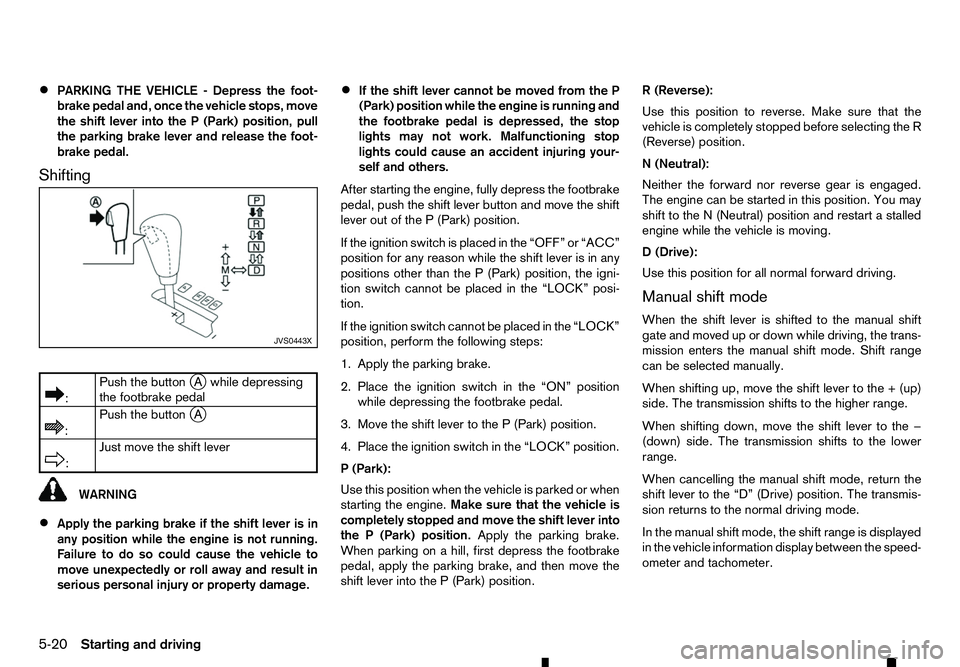
Shifting
m :
Push
the button
jAw hile depressing
the footbrake pedal
m :
Push
the button
jA
m :
Just
move the shift lever
WARNING
• Apply the parking brake if the shift lever is in
any position while the engine is not running.
Failure to do so could cause the vehicle to
move unexpectedly or roll away and result in
serious personal injury or property damage. •
If the shift lever cannot be moved from the P
(Park) position while the engine is running and
the footbrake pedal is depressed, the stop
lights may not work. Malfunctioning stop
lights could cause an accident injuring your-
self and others.
After starting the engine, fully depress the footbrake
pedal, push the shift lever button and move the shift
lever out of the P(Park) position.
If the ignition switch is placed in the “OFF” or “ACC”
position for any reason while the shift lever is in any
positions other than the P(Park) position, the igni-
tion switch cannot be placed in the “LOCK” posi-
tion.
If the ignition switch cannot be placed in the “LOCK”
position, perform the following steps:
1. Apply the parking brake.
2. Place the ignition switch in the “ON” position
while depressing the footbrake pedal.
3. Move the shift lever to the P(Park) position.
4. Place the ignition switch in the “LOCK” position.
P( Park):
Use this position when the vehicle is parked or when
starting the engine. Make sure that the vehicle is
completely stopped and move the shift lever into
the P(Park) position. Apply the parking brake.
When parking on ahill, first depress the footbrake
pedal, apply the parking brake, and then move the
shift lever into the P(Park) position. R(
Reverse):
Use this position to reverse. Make sure that the
vehicle is completely stopped before selecting the R
(Reverse) position.
N( Neutral):
Neither the forward nor reverse gear is engaged.
The engine can be started in this position. You may
shift to the N(Neutral) position and restart astalled
engine while the vehicle is moving.
D( Drive):
Use this position for all normal forward driving.
Manual shift mode
When the shift lever is shifted to the manual shift
gate and moved up or down while driving, the trans-
mission enters the manual shift mode. Shift range
can be selected manually.
When shifting up, move the shift lever to the +(up)
side. The transmission shifts to the higher range.
When shifting down, move the shift lever to the −
(down) side. The transmission shifts to the lower
range.
When cancelling the manual shift mode, return the
shift lever to the “D” (Drive) position. The transmis-
sion returns to the normal driving mode.
In the manual shift mode, the shift range is displayed
in the vehicle information display between the speed-
ometer and tachometer. JVS0443X
5-20 Starting and driving
Page 223 of 340
Shift ranges up or down one by one as follows:
M1
→
←M2→
←M3→
←M4→
←M5→
←M6→
←M7
M7(
7th):
Use this position for all normal forward driving at
highway speeds.
M6( 6th) andM5(5th):
Use these positions when driving up long slopes, or
for engine braking when driving down long slopes.
M4( 4th),M3(3rd) andM2(2nd):
Use these positions for hill climbing or engine brak-
ing on downhill grades.
M1( 1st):
Use this position when climbing steep hills slowly or
driving slowly through deep snow, or for maximum
engine braking on steep downhill grades.
• Remember not to drive at high speeds for ex-
tended periods of time in lower than 7th gear.
This reduces fuel economy.
• Moving the shift lever to the same side twice will
shift the ranges in succession. However, if this
motion is rapidly done, the second shifting may
not be completed properly.
• In the manual shift mode, the transmission
may not shift to the selected gear or may au-
tomatically shift to the other gear. This helps
maintain driving performance and reduces the
chance of vehicle damage or loss of control. •
When the transmission does not shift to the
selected gear, the Automatic Transmission
(AT) position indicator light (in the vehicle in-
formation display) will blink and the buzzer
will sound.
• In the manual shift mode, the transmission
automatically shifts down to 1st gear before
the vehicle comes to
astop. When accelerat-
ing again, it is necessary to shift up to the
desired range.
Accelerator downshift -inD(Drive)
position
For passing or climbing hills, depress the accelera-
tor pedal to the floor. This shifts the transmission
down into alower gear, depending on the vehicle
speed.
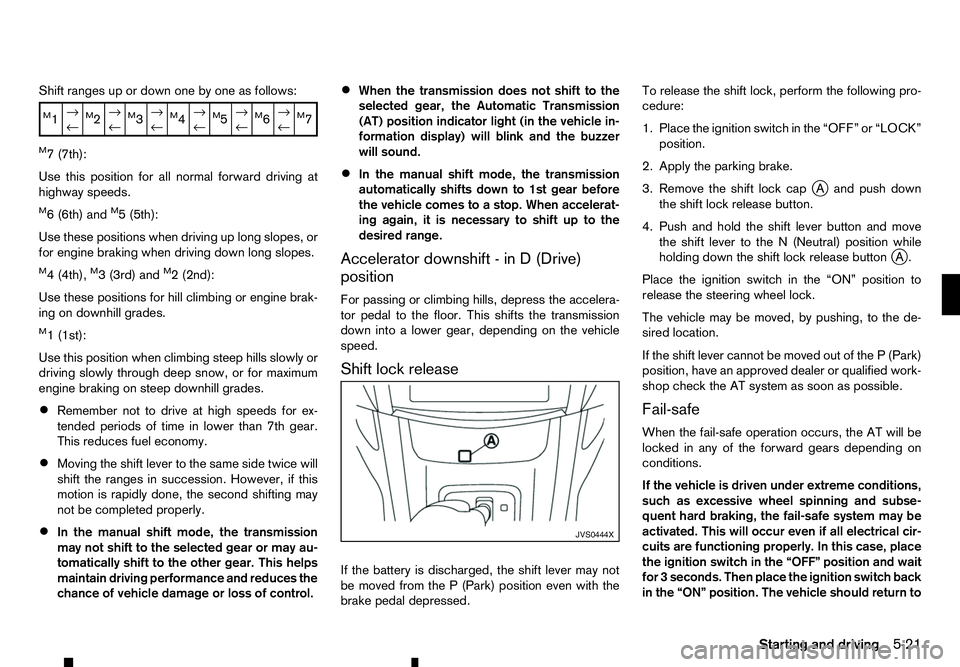
Shift lock release
If the battery is discharged, the shift lever may not
be moved from the P(Park) position even with the
brake pedal depressed. To release the shift lock, perform the following pro-
cedure:
1. Place the ignition switch in the “OFF” or “LOCK”
position.
2. Apply the parking brake.
3. Remove the shift lock cap jAa nd push down
the shift lock release button.
4. Push and hold the shift lever button and move the shift lever to the N(Neutral) position while
holding down the shift lock release button j
A.
Place the ignition switch in the “ON” position to
release the steering wheel lock.
The vehicle may be moved, by pushing, to the de-
sired location.
If the shift lever cannot be moved out of the P(Park)
position, have an approved dealer or qualified work-
shop check the AT system as soon as possible.
Fail-safe
When the fail-safe operation occurs, the AT will be
locked in any of the forward gears depending on
conditions.
If the vehicle is driven under extreme conditions,
such as excessive wheel spinning and subse-
quent hard braking, the fail-safe system may be
activated. This will occur even if all electrical cir-
cuits are functioning properly. In this case, place
the ignition switch in the “OFF” position and wait
for 3seconds. Then place the ignition switch back
in the “ON” position. The vehicle should return to JVS0444X
Starting
and driving
5-21
Page 224 of 340
its normal operating condition. If it does not re-
turn to its normal operating condition, have an
approved dealer or qualified workshop check the
transmission and repair it if necessary.
DRIVING WITH MANUAL
TRANSMISSION (MT) WARNING
• Do not downshift abruptly on slippery roads.
This may cause aloss of control.
• Do not over-rev the engine when shifting to a
lower gear. This may cause
aloss of vehicle
control or engine damage.
CAUTION
• Do not rest your foot on the clutch pedal while
driving. This may damage the clutch system.
• Fully depress the clutch pedal before shifting
to help prevent transmission damage.
• Stop the vehicle completely before shifting
into the
R(Reverse) position.
• When the vehicle is stopped for
aperiod of
time, for example, waiting at stoplights, shift
to the N(Neutral) position and release the
clutch pedal with the footbrake pedal
depressed. Starting vehicle
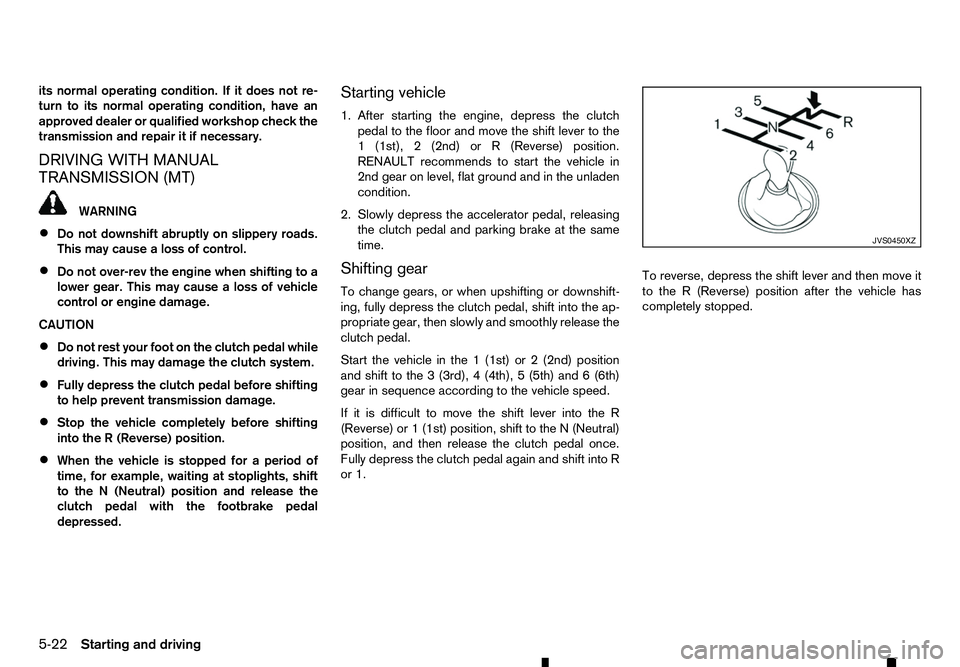
1. After starting the engine, depress the clutch
pedal to the floor and move the shift lever to the
1( 1st), 2(2nd) or R(Reverse) position.
RENAULT recommends to start the vehicle in
2nd gear on level, flat ground and in the unladen
condition.
2. Slowly depress the accelerator pedal, releasing the clutch pedal and parking brake at the same
time.
Shifting gear
To change gears, or when upshifting or downshift-
ing, fully depress the clutch pedal, shift into the ap-
propriate gear, then slowly and smoothly release the
clutch pedal.
Start the vehicle in the 1(1st) or 2(2nd) position
and shift to the 3(3rd), 4(4th), 5(5th) and 6(6th)
gear in sequence according to the vehicle speed.
If it is difficult to move the shift lever into the R
(Reverse) or 1(1st) position, shift to the N(Neutral)
position, and then release the clutch pedal once.
Fully depress the clutch pedal again and shift into R
or 1. To reverse, depress the shift lever and then move it
to the
R(Reverse) position after the vehicle has
completely stopped. JVS0450XZ
5-22 Starting and driving
Page 228 of 340
•
Whenever the Stop/Start System is deactivated
the indicator light ➀on the Stop/Start OFF
switch illuminates. In this condition the Stop/
Start System cannot prevent unnecessary fuel
consumption, exhaust emissions, or noise dur-
ing your journey.
• If the Stop/Start System is malfunctioning, the
indicator light
➀on the Stop/Start OFF switch
illuminates.
NOTE
The Stop/Start System ON or OFF messages dis-
played for afew seconds in the vehicle informa-
tion display when the Stop/Start OFF switch is
pressed. See “Stop/Start System display” earlier
in this section. WARNING
• Do not attempt to raise two wheels off the
ground and shift the transmission to any drive
or reverse position with the engine running.
Doing so may result in drivetrain damage or
unexpected vehicle movement which could
result in serious vehicle damage or personal
injury.
• Do not attempt to test
a4WD equipped ve-
hicle on a2-wheel dynamometer or similar
equipment even if the other two wheels are
raised off the ground. Make sure you inform
test facility personnel that your vehicle is
equipped with 4WD before it is placed on a
dynamometer. Using the wrong test equip-
ment may result in drivetrain damage or unex-
pected vehicle movement which could result
in serious vehicle damage or personal injury.
CAUTION
• Do not drive the vehicle in the <4H> or <4LO>
position on dry hard surface roads. Driving on
dry, hard surfaces in <4H> or <4LO> may
cause unnecessary noise, tyre wear and in-
creased fuel consumption.
If the Four-Wheel Drive (4WD) warning light
turns on when driving on dry hard surface
roads:
–i
nthe <4H> position, shift the 4WD mode
switch to <2WD>. –i
nthe <4LO> position, stop the vehicle and
shift the transmission lever to the N(Neu-
tral) position with the brake pedal
depressed and shift the 4WD mode switch
to <2WD>.
If the 4WD warning light is still on after the
above operation, have your vehicle
checked by an approved dealer or quali-
fied workshop as soon as possible.
• The transfer case may be damaged if you con-
tinue driving with the 4WD warning light blink-
ing.
See “On-road and off-road driving precautions” ear-
lier in this section for other precautions.
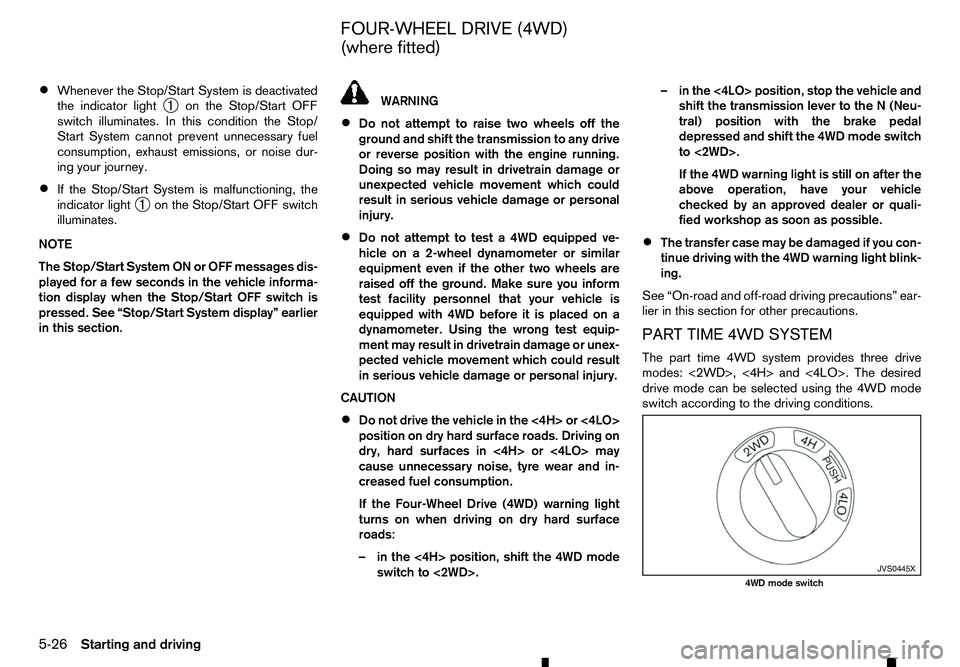
PART TIME 4WD SYSTEM
The part time 4WD system provides three drive
modes: <2WD>, <4H> and <4LO>. The desired
drive mode can be selected using the 4WD mode
switch according to the driving conditions. JVS0445X
4WD mode switch
FOUR-WHEEL DRIVE (4WD)
(where fitted)
5-26 Starting and driving
Page 230 of 340
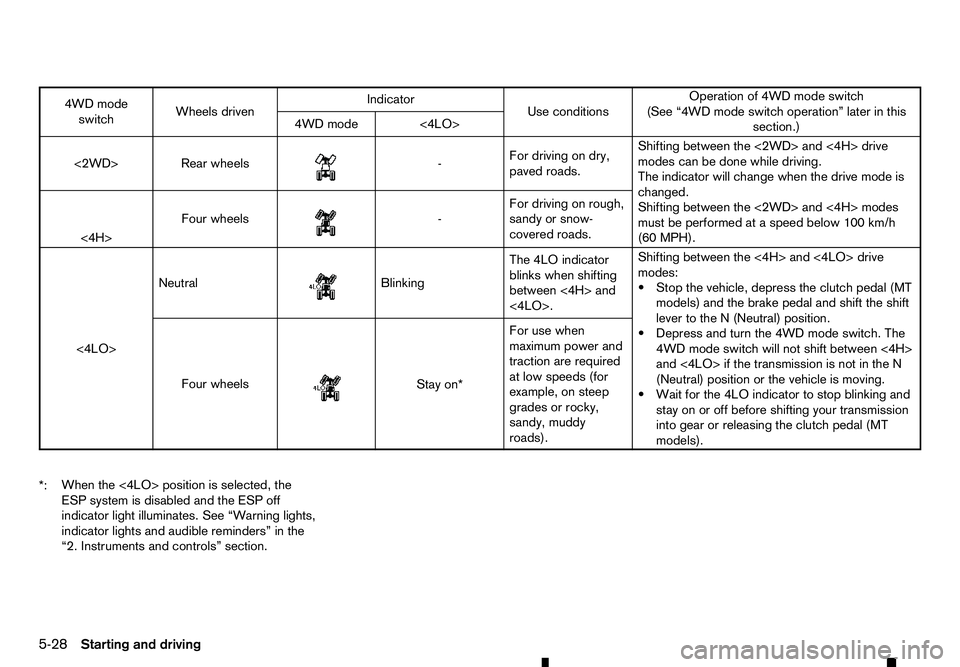
4WD mode
switch Wheels driven Indicator
Use conditions Operation of 4WD mode switch
(See “4WD mode switch operation” later in this section.)
4WD mode <4LO>
<2WD> Rear wheels
m -
For
driving on dry,
paved roads. Shifting between the <2WD> and <4H> drive
modes can be done while driving.
The indicator will change when the drive mode is
changed.
Shifting between the <2WD> and <4H> modes
must be performed at
aspeed below 100 km/h
(60 MPH).
<4H> Four wheels
m -
For
driving on rough,
sandy or snow-
covered roads.
<4LO> Neutral
m Blinking
The
4LO indicator
blinks when shifting
between <4H> and
<4LO>. Shifting between the <4H> and <4LO> drive
modes:
•S
top the vehicle, depress the clutch pedal (MT
models) and the brake pedal and shift the shift
lever to the N(Neutral) position.
•D epress and turn the 4WD mode switch. The
4WD mode switch will not shift between <4H>
and <4LO> if the transmission is not in the N
(Neutral) position or the vehicle is moving.
•W ait for the 4LO indicator to stop blinking and
stay on or off before shifting your transmission into gear or releasing the clutch pedal (MT
models).
Four wheels
m Stay
on*
For use when
maximum power and
traction are required
at low speeds (for
example, on steep
grades or rocky,
sandy, muddy
roads).
*: When the <4LO> position is selected, the
ESP system is disabled and the ESP off
indicator light illuminates. See “Warning lights,
indicator lights and audible reminders” in the
“2. Instruments and controls” section.
5-28 Starting and driving