cooling RENAULT ALASKAN 2017 User Guide
[x] Cancel search | Manufacturer: RENAULT, Model Year: 2017, Model line: ALASKAN, Model: RENAULT ALASKAN 2017Pages: 340, PDF Size: 6.93 MB
Page 277 of 340
8
Maintenance and do-it-yourself
Maintenance and do-it-yourself
Maintenance requirements ....................................... 8-2 Scheduled maintenance...................................... 8-2
General maintenance .......................................... 8-2
Where to go for service ...................................... 8-2
General maintenance ............................................... 8-2 Explanation of general maintenance items ........... 8-2
Maintenance precautions .................................... 8-4
Engine compartment check locations ....................... 8-5
Engine cooling system ............................................. 8-5 Checking engine coolant level............................. 8-6
Changing engine coolant .................................... 8-6
Engine oil................................................................. 8-6
Checking engine oil level .................................... 8-6
Changing engine oil and oil filter ......................... 8-7
Protect environment ............................................ 8-7
AdBlue® tank (where fitted for diesel engine
model) ..................................................................... 8-7 Refilling the AdBlue® tank .................................. 8-7
Drive belt ................................................................. 8-8
Automatic Transmission Fluid (ATF) (where fitted).... 8-8 7-speed Automatic Transmission (AT) model....... 8-8
Power steering fluid ................................................. 8-8
Brakes ..................................................................... 8-9 Checking parking brake ...................................... 8-9
Checking footbrake ............................................ 8-9
Brake booster ..................................................... 8-9
Brake fluid ............................................................... 8-10
Clutch fluid (where fitted) ......................................... 8-11 Window washer fluid ............................................... 8-11
Battery..................................................................... 8-12
Vehicle battery .................................................... 8-13
Remote controller battery (where fitted) .............. 8-13
Remote Control Key battery (where fitted)........... 8-14
Air cleaner filter........................................................ 8-15
Wiper blades ........................................................... 8-16 Windscreen wiper blades ................................... 8-16
Variable voltage control system (where fitted) ........... 8-17
Fuses ...................................................................... 8-18 Engine compartment ........................................... 8-18
Passenger compartment ..................................... 8-19
Lights ...................................................................... 8-20
Headlights .......................................................... 8-20
Exterior lights ...................................................... 8-21
Interior lights....................................................... 8-22
Light locations .................................................... 8-23
Tyres and wheels ..................................................... 8-26 Tyre inflation pressure......................................... 8-26
Types of tyres ..................................................... 8-26
Tyre chains ......................................................... 8-27
Tyre rotation ....................................................... 8-27
Tyre wear and damage ....................................... 8-28
Tyre age ............................................................. 8-28
Changing tyres and wheels................................. 8-28
Wheel balance.................................................... 8-28
Spare tyre .......................................................... 8-28
Page 281 of 340
•
Your vehicle is fitted with an automatic en-
gine cooling fan. It may come on at any time
without warning, even if the ignition switch is
in the OFF position and the engine is not run-
ning. To avoid injury, always disconnect the
negative battery cable before working near
the fan.
• Always wear eye protection whenever you
work on your vehicle.
• Never leave the engine or the transmission
related component harness connector
disconnected while the ignition switch is in
the ON position.
• Avoid direct contact with used engine oil and
coolant. Improperly disposed engine oil, en-
gine coolant, and/or other vehicle fluids can
hurt the environment. Always conform to lo-
cal regulations for disposal of vehicle fluids.
This “8. Maintenance and do-it-yourself” section
provides instructions regarding only those items
which are relatively easy for an owner to perform.
You should be aware that incomplete or improper
servicing may result in operating difficulties or ex-
cessive emissions, and could affect your warranty
coverage. If in doubt about any servicing, have it
done by an approved dealer or qualified work-
shop. For an overview of the engine compartment, see
“Engine compartment” in the “0. Illustrated table
of contents” section. WARNING
• Never remove the radiator or coolant reser-
voir cap when the engine is hot. Serious burns
could be caused by high-pressure fluid es-
caping from the radiator. Wait until the engine
and radiator cool down.
• Engine coolant is poisonous and should be
stored carefully in marked containers out of
the reach of children.
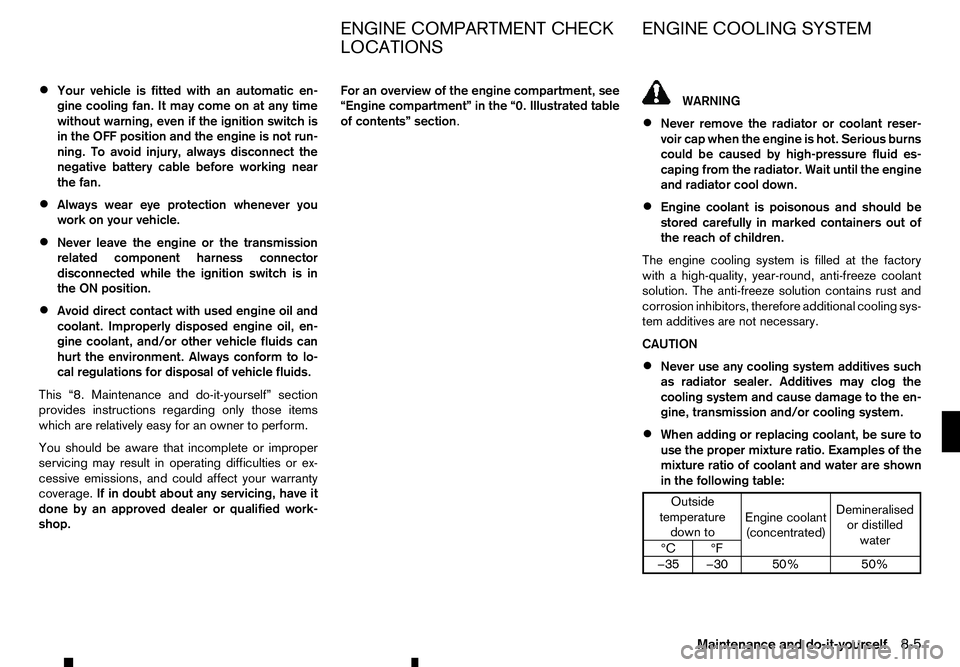
The engine cooling system is filled at the factory
with ahigh-quality, year-round, anti-freeze coolant
solution. The anti-freeze solution contains rust and
corrosion inhibitors, therefore additional cooling sys-
tem additives are not necessary.
CAUTION
• Never use any cooling system additives such
as radiator sealer. Additives may clog the
cooling system and cause damage to the en-
gine, transmission and/or cooling system.
• When adding or replacing coolant, be sure to
use the proper mixture ratio. Examples of the
mixture ratio of coolant and water are shown
in the following table: Outside
temperature
down to
Engine coolant
(concentrated) Demineralised
or distilled water
°C °F
−35 −30 50% 50%
ENGINE COMPARTMENT CHECK
LOCATIONS
ENGINE COOLING SYSTEM
Maintenance and do-it-yourself 8-5
Page 282 of 340
The radiator is fitted with
apressure cap. To prevent
engine damage, use only aGenuine RENAULT ra-
diator cap or its equivalent when replacement is
required.
CHECKING ENGINE COOLANT
LEVEL
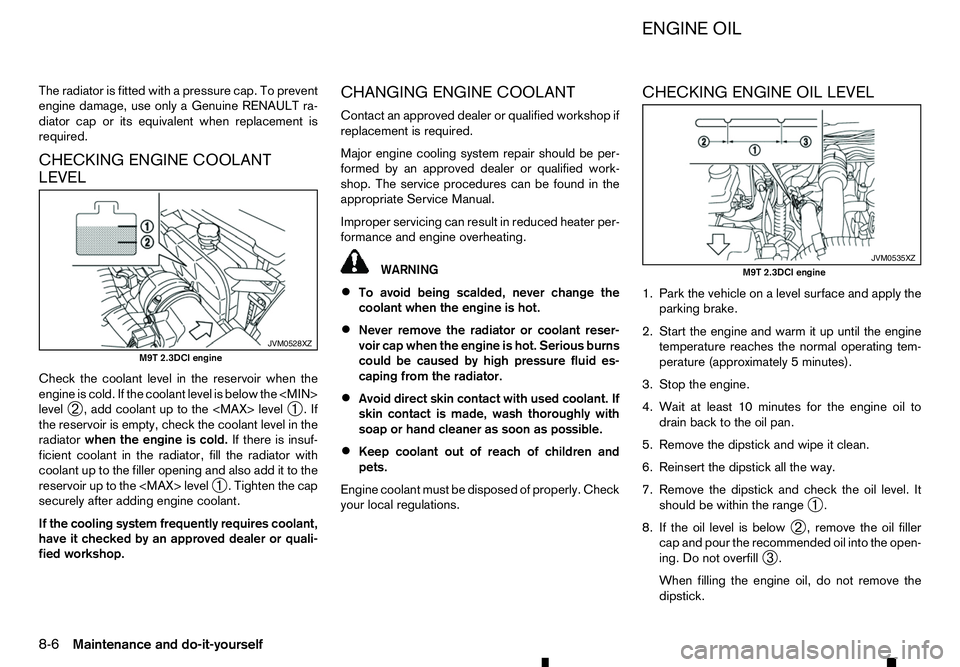
Check the coolant level in the reservoir when the
engine is cold. If the coolant level is below the
level ➁,a
dd coolant up to the
➀.If
the reservoir is empty, check the coolant level in the
radiator when the engine is cold. If there is insuf-
ficient coolant in the radiator, fill the radiator with
coolant up to the filler opening and also add it to the
reservoir up to the
ighten the cap
securely after adding engine coolant.
If the cooling system frequently requires coolant,
have it checked by an approved dealer or quali-
fied workshop. CHANGING ENGINE COOLANT
Contact an approved dealer or qualified workshop if
replacement is required.
Major engine cooling system repair should be per-
formed by an approved dealer or qualified work-
shop. The service procedures can be found in the
appropriate Service Manual.
Improper servicing can result in reduced heater per-
formance and engine overheating.
WARNING
• To avoid being scalded, never change the
coolant when the engine is hot.
• Never remove the radiator or coolant reser-
voir cap when the engine is hot. Serious burns
could be caused by high pressure fluid es-
caping from the radiator.
• Avoid direct skin contact with used coolant. If
skin contact is made, wash thoroughly with
soap or hand cleaner as soon as possible.
• Keep coolant out of reach of children and
pets.
Engine coolant must be disposed of properly. Check
your local regulations. CHECKING ENGINE OIL LEVEL
1. Park the vehicle on
alevel surface and apply the
parking brake.
2. Start the engine and warm it up until the engine temperature reaches the normal operating tem-
perature (approximately 5minutes).
3. Stop the engine.
4. Wait at least 10 minutes for the engine oil to drain back to the oil pan.
5. Remove the dipstick and wipe it clean. 6. Reinsert the dipstick all the way.
7. Remove the dipstick and check the oil level. It should be within the range ➀.
8. If the oil level is below ➁,r
emove the oil filler
cap and pour the recommended oil into the open-
ing. Do not overfill ➂.
When filling the engine oil, do not remove the
dipstick. JVM0528XZ
M9T 2.3DCI engine JVM0535XZ
M9T 2.3DCI engine
ENGINE OIL
8-6 Maintenance and do-it-yourself
Page 324 of 340
–B
ooster ........................................................................V
... 8-9
–C hecking footbrake ......................................................... 8-9
–C hecking parking brake ................................................... 8-9
–E lectronic Stability Programme (ESP) ............................ 5-33
–F luid ....................................................................... 8-10, 9-2
–P ad wear warning ........................................................... 8-9
–P recautions ................................................................... 5-49
C Capacities and recommendations
–B rake and clutch fluid ...................................................... 9-2
–C oolant ........................................................................V
... 9-2
–F uel ........................................................................V
......... 9-2
–O il ........................................................................V
........... 9-2
–R efrigerant ...................................................................... 9-2
Cargo
–B ed ........................................................................V
....... 3-20
Changing
–E ngine oil filter ................................................................. 8-7
–F lat tyre ........................................................................V
... 6-3
Checking
–B attery fluid level ........................................................... 8-13
–B rake pedal ..................................................................... 8-9
–E ngine oil level ................................................................ 8-6
–P arking brake .................................................................. 8-9
Child restraints .................................................................... 1-14
–A nchorage ........................................................... 1-20, 1-21
–I SOFIX ........................................................ 1-18, 1-19, 1-22
–P recautions ................................................................... 1-14
–S eat belt installation ....................................................... 1-24
–U niversal child restraints (front and rear seats) ............... 1-15
Child safety
–S eat belts ...................................................................... 1-11
Cleaning
–C hrome parts .................................................................. 7-3 –E
xterior ........................................................................V
.... 7-2
–F loor mats ....................................................................... 7-4
–G lass ....................................................................... 7-3, 7-4
–H eadlights ..................................................................... 2-35
–I nterior ........................................................................V
.... 7-3
–S eat belts ........................................................................V
7-4
–U nderbody ...................................................................... 7-3
–W ashing ........................................................................V
.. 7-2
–W axing ........................................................................V
.... 7-2
–W heels ........................................................................V
.... 7-3
–W indow washer nozzle .................................................. 8-16
Clock ........................................................................V
.......... 2-30
Clutch
–F luid ....................................................................... 8-11, 9-2
Cockpit
–O verview ........................................................................V
. 0-6
Cold weather ...................................................................... 5-51
–B attery ........................................................................V
.. 5-51
–C orrosion protection ...................................................... 5-52
–E ngine coolant ............................................................... 5-51
–P arking brake ................................................................ 5-52
–T yre equipment .............................................................. 5-51
–W inter equipment .......................................................... 5-52
Compass
–V ehicle information display ............................................. 2-23
Console box ........................................................................V
2-39
Console side pockets .......................................................... 2-40
Coolant
–C apacity ........................................................................V
.. 9-2
–C hanging engine coolant ................................................. 8-6
–C hecking coolant level ..................................................... 8-6
–C old weather ................................................................ 5-51
–E ngine cooling system ..................................................... 8-5
Corrosion protection ............................................................. 7-5
–C old weather ................................................................ 5-52
–E nvironmental factors ...................................................... 7-5
10-2 Index