oil temperature RENAULT ALASKAN 2017 User Guide
[x] Cancel search | Manufacturer: RENAULT, Model Year: 2017, Model line: ALASKAN, Model: RENAULT ALASKAN 2017Pages: 340, PDF Size: 6.93 MB
Page 282 of 340
The radiator is fitted with
apressure cap. To prevent
engine damage, use only aGenuine RENAULT ra-
diator cap or its equivalent when replacement is
required.
CHECKING ENGINE COOLANT
LEVEL
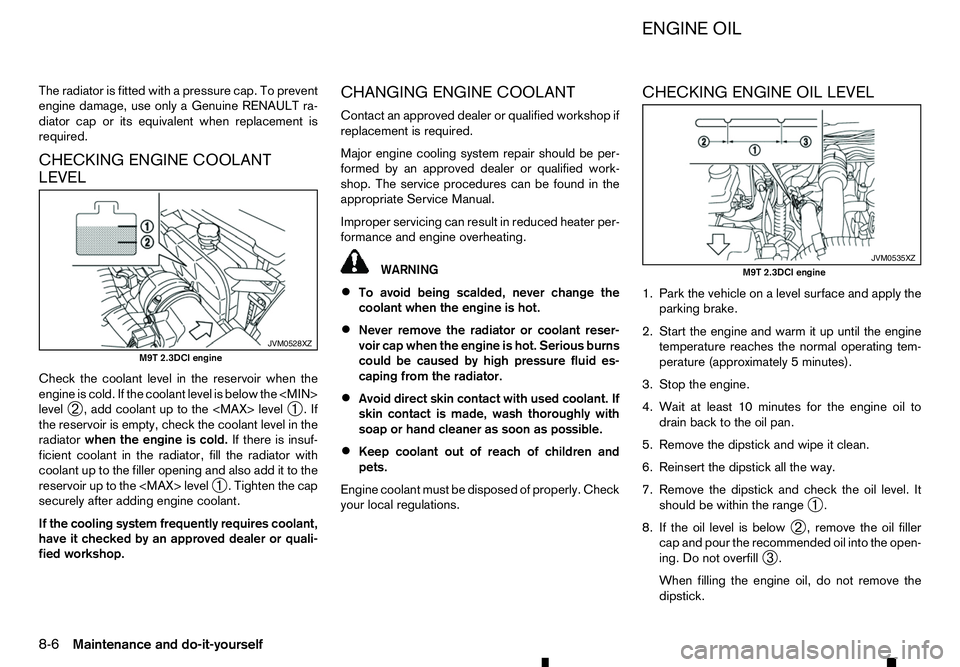
Check the coolant level in the reservoir when the
engine is cold. If the coolant level is below the
level ➁,a
dd coolant up to the
➀.If
the reservoir is empty, check the coolant level in the
radiator when the engine is cold. If there is insuf-
ficient coolant in the radiator, fill the radiator with
coolant up to the filler opening and also add it to the
reservoir up to the
ighten the cap
securely after adding engine coolant.
If the cooling system frequently requires coolant,
have it checked by an approved dealer or quali-
fied workshop. CHANGING ENGINE COOLANT
Contact an approved dealer or qualified workshop if
replacement is required.
Major engine cooling system repair should be per-
formed by an approved dealer or qualified work-
shop. The service procedures can be found in the
appropriate Service Manual.
Improper servicing can result in reduced heater per-
formance and engine overheating.
WARNING
• To avoid being scalded, never change the
coolant when the engine is hot.
• Never remove the radiator or coolant reser-
voir cap when the engine is hot. Serious burns
could be caused by high pressure fluid es-
caping from the radiator.
• Avoid direct skin contact with used coolant. If
skin contact is made, wash thoroughly with
soap or hand cleaner as soon as possible.
• Keep coolant out of reach of children and
pets.
Engine coolant must be disposed of properly. Check
your local regulations. CHECKING ENGINE OIL LEVEL
1. Park the vehicle on
alevel surface and apply the
parking brake.
2. Start the engine and warm it up until the engine temperature reaches the normal operating tem-
perature (approximately 5minutes).
3. Stop the engine.
4. Wait at least 10 minutes for the engine oil to drain back to the oil pan.
5. Remove the dipstick and wipe it clean. 6. Reinsert the dipstick all the way.
7. Remove the dipstick and check the oil level. It should be within the range ➀.
8. If the oil level is below ➁,r
emove the oil filler
cap and pour the recommended oil into the open-
ing. Do not overfill ➂.
When filling the engine oil, do not remove the
dipstick. JVM0528XZ
M9T 2.3DCI engine JVM0535XZ
M9T 2.3DCI engine
ENGINE OIL
8-6 Maintenance and do-it-yourself
Page 289 of 340
VEHICLE BATTERY
WARNING
Do not operate the vehicle if the fluid in the bat-
tery is low. Low battery fluid can cause ahigher
load on the battery which can generate heat, re-
duce battery life, and in some cases lead to an
explosion.
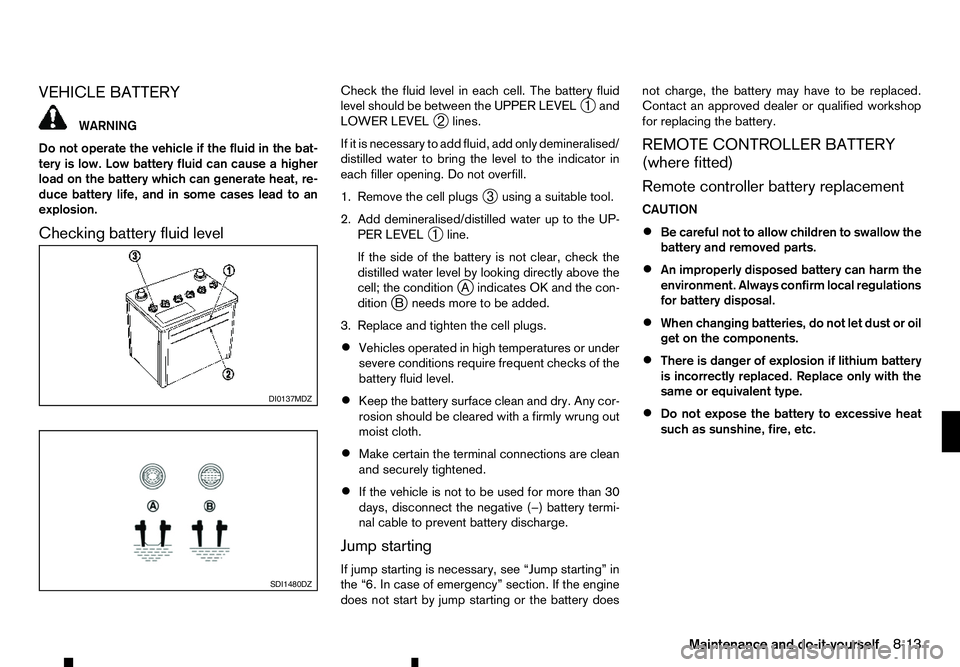
Checking battery fluid level Check the fluid level in each cell. The battery fluid
level should be between the UPPER LEVEL
➀and
LOWER LEVEL ➁lines.
If it is necessary to add fluid, add only demineralised/
distilled water to bring the level to the indicator in
each filler opening. Do not overfill.
1. Remove the cell plugs ➂using
asuitable tool.
2. Add demineralised/distilled water up to the UP- PER LEVEL ➀line.
If the side of the battery is not clear, check the
distilled water level by looking directly above the
cell; the condition j
Ai ndicates OK and the con-
dition jBn eeds more to be added.
3. Replace and tighten the cell plugs.
• Vehicles operated in high temperatures or under
severe conditions require frequent checks of the
battery fluid level.
• Keep the battery surface clean and dry. Any cor-
rosion should be cleared with
afirmly wrung out
moist cloth.
• Make certain the terminal connections are clean
and securely tightened.
• If the vehicle is not to be used for more than 30
days, disconnect the negative (−) battery termi-
nal cable to prevent battery discharge.
Jump starting
If jump starting is necessary, see “Jump starting” in
the “6. In case of emergency” section. If the engine
does not start by jump starting or the battery does not charge, the battery may have to be replaced.
Contact an approved dealer or qualified workshop
for replacing the battery.
REMOTE CONTROLLER BATTERY
(where fitted)
Remote controller battery replacement
CAUTION
• Be careful not to allow children to swallow the
battery and removed parts.
• An improperly disposed battery can harm the
environment. Always confirm local regulations
for battery disposal.
• When changing batteries, do not let dust or oil
get on the components.
• There is danger of explosion if lithium battery
is incorrectly replaced. Replace only with the
same or equivalent type.
• Do not expose the battery to excessive heat
such as sunshine, fire, etc. DI0137MDZ
SDI1480DZ
Maintenance and do-it-yourself
8-13
Page 308 of 340
Refer to the maintenance service booklet for your
vehicle for details of recommended fluids/lubricants
and capacities.
FUEL INFORMATION
Diesel engine*
M9T 2.3DCI engine:
Diesel fuel above 50 cetane and with less than 10
ppm of sulphur (EN590) must be used.
* If two types of diesel fuel are available, use
summer or winter fuel properly according to
the following temperature conditions.
• Above –7°C (20°F) ... Summer type diesel fuel.
• Below –7°C (20°F) ... Winter type diesel fuel.
CAUTION
• Do not use home heating oil, petrol or other
alternate fuels in your diesel engine. The use
of those or adding those to diesel fuel can
cause engine damage.
• Do not use summer fuel at temperatures be-
low –7°C (20°F). The cold temperatures will
cause wax to form in the fuel. As
aresult, it
may prevent the engine from running
smoothly. AUTOMATIC TRANSMISSION FLUID
(ATF)
Contact an approved dealer or qualified workshop if
checking or replacement is required.
CAUTION
• Use only ATF that is recommended in the
Maintenance Service Booklet. Do not mix with
other fluids.
• Using automatic transmission fluid other than
the ATF that is recommended in the Mainte-
nance Service Booklet may cause deteriora-
tion in driveability and automatic transmission
durability and may damage the automatic
transmission. Such damage is not covered by
the warranty.
AIR CONDITIONER SYSTEM
REFRIGERANT AND LUBRICANT
The air conditioner system of your vehicle must be
charged with the refrigerant HFC-134a (R134a) and the lubricant specified in the maintenance service
booklet for your vehicle..
CAUTION
Use of any other refrigerants or lubricants will
cause severe damage, and you may need to re-
place your vehicle’s entire air conditioner sys-
tem. The release of refrigerants into the atmosphere is
prohibited in many countries and regions. The re-
frigerant HFC-134a (R-134a) in your vehicle will not
harm the Earth’s ozone layer. However, it may con-
tribute in asmall part to the global warming effect.
RENAULT recommends that the refrigerant be ap-
propriately recovered and recycled. Contact an ap-
proved dealer or qualified workshop when servicing
the air conditioner system.
RECOMMENDED FLUIDS/
LUBRICANTS AND CAPACITIES
9-2
Technical information
Page 332 of 340
FUEL INFORMATION
Diesel engine*
M9T 2.3DCI engine:
Diesel fuel above 50 cetane and with less than 10
ppm of sulphur (EN590) must be used. * If two types of diesel fuel are available, use
summer or winter fuel properly according to
the following temperature conditions.
• Above −7°C (20°F) ... Summer type diesel fuel.
• Below −7°C (20°F) ... Winter type diesel fuel.
CAUTION
• Do not use home heating oil, petrol, or other
alternate fuels in your diesel engine. The use
of those or adding those to diesel fuel can
cause engine damage.
• Do not use summer fuel at temperatures be-
low −7°C (20°F). The cold temperatures will
cause wax to form in the fuel. As
aresult, it
may prevent the engine from running
smoothly.
TYRE COLD PRESSURE
See the tyre placard affixed to the driver’s side
centre pillar. PETROL STATION INFORMATION