park assist RENAULT ALASKAN 2017 User Guide
[x] Cancel search | Manufacturer: RENAULT, Model Year: 2017, Model line: ALASKAN, Model: RENAULT ALASKAN 2017Pages: 340, PDF Size: 6.93 MB
Page 267 of 340
4.
Automatic transmission model:
Move the shift lever to the P(Park) position.
Manual transmission model:
Move the shift lever to the N(Neutral) position.
DO NOT STOP THE ENGINE.
5. Open all the windows.
6. Turn off the air conditioner. Move the tempera- ture control to maximum hot and the fan control
to high speed.
7. Get out from the vehicle.
8. Visually inspect and listen for steam or coolant escaping from the radiator before opening the
bonnet. Wait until no steam or coolant can be
seen before proceeding.
9. Open the engine bonnet.
10. Visually inspect if the cooling fan is running.
11. Visually inspect the radiator and radiator hoses for leakage. If the cooling fan is not running or
the coolant is leaking, stop the engine.
12. After the engine cools down, check the coolant level in the reservoir with the engine running.
Do not open the radiator or coolant reservoir
cap.
13. Add coolant to the reservoir if necessary.
Have your vehicle inspected/repaired at an
approved dealer or qualified workshop. When towing your vehicle, local regulations for tow-
ing must be followed. Incorrect towing equipment
could damage your vehicle. To assure proper tow-
ing and to prevent accidental damage to your ve-
hicle, RENAULT recommends that you have profes-
sional road assistance personnel tow your vehicle. It
is advisable to have the professional road assistant
carefully read the following precautions.
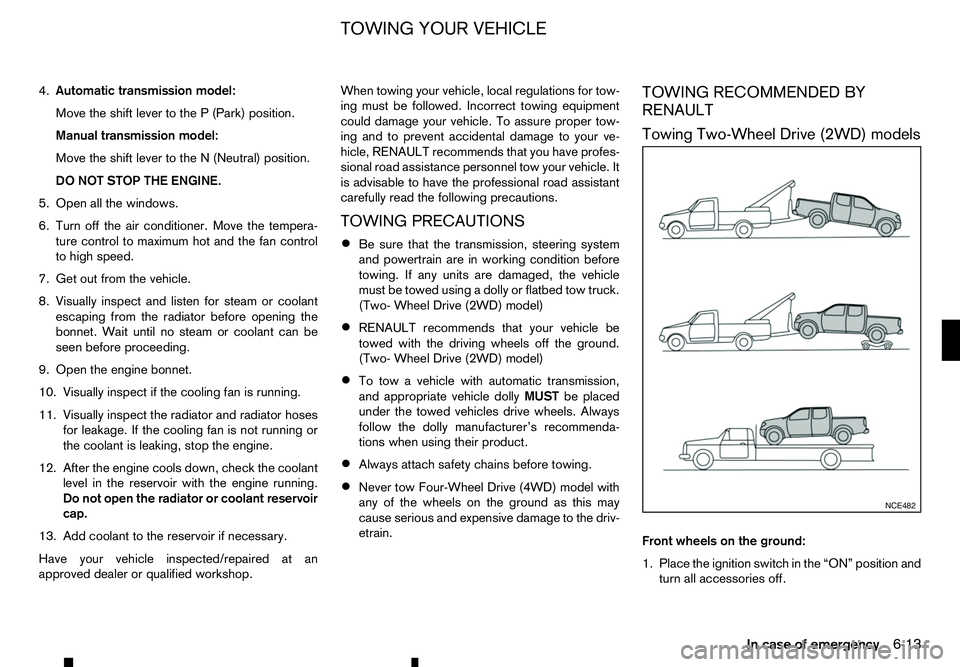
TOWING PRECAUTIONS
• Be sure that the transmission, steering system
and powertrain are in working condition before
towing. If any units are damaged, the vehicle
must be towed using
adolly or flatbed tow truck.
(Two- Wheel Drive (2WD) model)
• RENAULT recommends that your vehicle be
towed with the driving wheels off the ground.
(Two- Wheel Drive (2WD) model)
• To tow
avehicle with automatic transmission,
and appropriate vehicle dolly MUSTbe placed
under the towed vehicles drive wheels. Always
follow the dolly manufacturer’s recommenda-
tions when using their product.
• Always attach safety chains before towing.
• Never tow Four-Wheel Drive (4WD) model with
any of the wheels on the ground as this may
cause serious and expensive damage to the driv-
etrain. TOWING RECOMMENDED BY
RENAULT
Towing Two-Wheel Drive (2WD) models
Front wheels on the ground:
1. Place the ignition switch in the “ON” position and
turn all accessories off. NCE482
TOWING YOUR VEHICLE
In case of emergency6-13
Page 272 of 340
In order to maintain the appearance of your vehicle,
it is important to take proper care of it.
Whenever possible, park your vehicle inside aga-
rage or in acovered area to minimise the chances
of damaging the paint surface of your vehicle.
When it is necessary to park outside, park in ashady
area or protect the vehicle with abody cover. Be
careful not to scratch the paint surface when put-
ting on or removing the body cover.
WASHING
In the following instances, wash your vehicle as soon
as possible to protect the paint surface:
• After
arainfall, which may cause the paint sur-
face damage from acid rain.
• After driving on coastal roads, which may cause
rusting from the sea breeze.
• When contaminants such as soot, bird drop-
pings, tree sap, metal particles or bugs get on
the paint surface.
• When dust or mud builds up on the paint sur-
face.
1. Wash the vehicle surface with awet sponge and
plenty of water.
2. Clean the vehicle surface gently and thoroughly using amild soap, aspecial vehicle soap or a
general purpose dishwashing liquid mixed with
clean, lukewarm (never hot) water. CAUTION
• Do not wash the vehicle with strong house-
hold soap, strong chemical detergents,
petrol or solvents.
• Do not wash the vehicle in direct sunlight
or while the vehicle body is hot, as the
paint surface may become water-spotted.
• Avoid using tight-napped or rough cloths,
such as washing mitts. Care must be taken
when removing caked-on dirt or other for-
eign substances so the paint surface is not
scratched or damaged.
• Lock all doors before going through auto-
matic car wash. Locking doors helps pre-
vent fuel filler lid from opening and be-
coming damaged.
3. Rinse the vehicle thoroughly with plenty of clean water.
4. Use adampened chamois to dry the paint sur-
face and avoid leaving water spots.
When washing the vehicle, take care of the follow- ing:
• Inside flanges, joints and folds on the doors,
hatches and bonnet are particularly vulnerable to
the effects of road salt. Therefore, these areas
must be cleaned regularly.
• Be sure that the drain holes in the lower edge of
the doors are not clogged. •
Spray water on the underbody and in the wheel
wells to loosen the dirt and/or wash away road
salt.
REMOVING SPOTS
Remove tar and oil spots, industrial dust, insects,
and tree sap as quickly as possible from the paint
surface to avoid lasting damage or staining. Special
cleaning products are available at an approved
dealer or any automotive accessory store.
WAXING
Regular waxing protects the paint surface and helps
maintain anew vehicle appearance.
After waxing, polishing is recommended to remove
built-up residue and to avoid aweathered appear-
ance.
An approved dealer can assist you in choosing the
appropriate waxing products.
CAUTION
• Wash your vehicle thoroughly and completely
before applying wax to the paint surface.
• Always follow the manufacturer’s instructions
supplied with the wax.
• Do not use
awax containing any abrasives,
cutting compounds or cleaners that may dam-
age the vehicle finish.
Machine compounding or aggressive polishing on a
base coat/clear coat paint finish may dull the finish
or leave swirl marks.
CLEANING EXTERIOR
7-2
Appearance and care