roof RENAULT ALASKAN 2017 User Guide
[x] Cancel search | Manufacturer: RENAULT, Model Year: 2017, Model line: ALASKAN, Model: RENAULT ALASKAN 2017Pages: 340, PDF Size: 6.93 MB
Page 209 of 340
•
Do not drive across steep slopes. Instead
drive either straight up or straight down the
slopes. Off-road vehicles can tip over side-
ways much more easily than they can forward
or backward.
• Many hills are too steep for any vehicle. If you
drive up them, you may stall. If you drive down
them, you may not be able to control your
speed. If you drive across them, you may roll
over.
• Do not shift ranges while driving on downhill
grades as this could cause loss of control of
the vehicle.
• Stay alert when driving to the top of
ahill. At
the top there could be adrop-off or other haz-
ard that could cause an accident.
• If your engine stalls or you cannot make it to
the top of
asteep hill, never attempt to turn
around. Your vehicle could tip or roll over.
Always back straight down in R(Reverse)
range. Never back down in N(Neutral) or with
the clutch pedal depressed (MT model) using
only the brake, as this could cause loss of
control.
• Heavy braking going down
ahill could cause
your brakes to overheat and fade, resulting in
loss of control and an accident. Apply brakes
lightly and use alow range to control your
speed.
• Unsecured cargo can be thrown around when
driving over rough terrain. Properly secure all cargo so it will not be thrown forward and
cause injury to you or your passengers.
• To avoid raising the centre of gravity exces-
sively, do not exceed the rated capacity of the
roof rail (where fitted) and evenly distribute
the load. Secure heavy loads in the cargo area
as far forward and as low as possible. Do not
equip the vehicle with tyres larger than speci-
fied in this manual. This could cause your ve-
hicle to roll over.
• Do not grip the inside or spokes of the steer-
ing wheel when driving off-road. The steering
wheel could move suddenly and injure your
hands. Instead drive with your fingers and
thumbs on the outside of the rim.
• Before operating the vehicle, ensure that the
driver and all passengers have their seat belts
fastened.
• Always drive with the floor mats in place as
the floor may became hot.
• Lower your speed when encountering strong
crosswinds. With
ahigher centre of gravity,
your vehicle is more affected by strong side
winds. Slower speeds ensure better vehicle
control.
• Do not drive beyond the performance capabil-
ity of the tyres, even with 4WD engaged.
• Do not attempt to raise two wheels off the
ground and shift the transmission to any drive
or reverse position with the engine running.
Doing so may result in drivetrain damage or unexpected vehicle movement which could
result in serious vehicle damage or personal
injury.
• Do not attempt to test
a4WD equipped ve-
hicle on a2-wheel dynamometer or similar
equipment even if the other two wheels are
raised off the ground. Make sure you inform
test facility personnel that your vehicle is
equipped with 4WD before it is placed on a dynamometer. Using the wrong test equip-
ment may result in drivetrain damage or unex-
pected vehicle movement which could result
in serious vehicle damage or personal injury.
• When
awheel is off the ground due to an
unlevel surface, do not spin the wheel exces-
sively.
• Accelerating quickly, sharp steering manoeu-
vres or sudden braking may cause loss of con-
trol.
• If at all possible, avoid sharp turning manoeu-
vres, particularly at high speeds. Your vehicle
has
ahigher centre of gravity than aconven-
tional passenger car. The vehicle is not de-
signed for cornering at the same speeds as
conventional passenger cars. Failure to oper- ate this vehicle correctly could result in loss
of control and/or arollover accident.
• Always use tyres of the same type, size, brand,
construction (bias, bias-belted or radial), and
tread pattern on all four wheels. Install tyre
chains on the rear wheels when driving on
slippery roads and drive carefully.
Starting and driving 5-7
Page 210 of 340
•
Be sure to check the brakes immediately af-
ter driving in mud or water. See “Brake
system” later in this section for wet brakes.
• Avoid parking your vehicle on steep hills. If
you get out of the vehicle and it rolls forward,
backward or sideways, you could be injured.
• Whenever you drive off-road through sand,
mud or water as deep as the wheel hub, more
frequent maintenance may be required. See
the maintenance information in
aseparate
maintenance booklet.
• Rinse the underside of the vehicle with fresh
water after driving through mud or sand. Re-
move any brush or sticks that are trapped. The turbocharger system uses engine oil for lubrica-
tion and cooling of its rotating components. The tur-
bocharger turbine turns at extremely high speeds
and it can reach an extremely high temperature. It is
essential to maintain
aflow of clean oil through the
turbocharger system. Asudden interruption to the
oil supply may cause amalfunction in the turbo-
charger.
To ensure prolonged life and performance of the
turbocharger, it is essential to comply with the fol-
lowing maintenance procedure:
CAUTION
• Change the engine oil of the turbo-charged
diesel engine as prescribed. See the sepa-
rately provided maintenance booklet for addi-
tional information.
• Use only the recommended engine oil. For
details, refer to the maintenance service
booklet for your vehicle.
• If the engine has been operating at high rpm
for an extended period of time, let it idle for a
few minutes prior to shutdown.
• Do not accelerate the engine to high rpm im-
mediately after starting it.
• When starting the engine at ambient tempera-
tures below −5°C (23°F), an engine protection
mode may be activated. During this time, the
engine output is reduced. The engine protec-
tion mode is switched off automatically after
am
aximum of 3minutes (provided the accel-
erator pedal is released completely). Driving your vehicle to fit the circumstances is es-
sential for your safety and comfort. As
adriver, you
should be the one who knows best how to drive in
the given circumstances.
ENGINE COLD START PERIOD
Due to the higher engine speeds, when the engine
is cold, extra caution must be exercised when se-
lecting agear during the engine warm-up period
after starting the engine.
LOADING LUGGAGE
Loads and their distribution and the attachment of
equipment (roof baggage carriers, etc.) will consid-
erably change the driving characteristics of the ve-
hicle. Your driving style and speed must be adjusted
according to the circumstances.
DRIVING IN WET CONDITIONS
• Avoid accelerating or stopping suddenly.
• Avoid sharp turning or lane changing suddenly.
• Avoid following too close to the vehicle in front.
When water covers the road surface with water
puddles, small water streams, etc., reduce speed to
prevent hydroplaning which can cause skidding and
loss of control. Worn tyres will increase this risk.
DRIVING IN WINTER CONDITIONS • Drive cautiously.
• Avoid accelerating or stopping suddenly.
• Avoid sharp turning or lane changing suddenly.
TURBOCHARGER SYSTEM CARE WHEN DRIVING
5-8 Starting and driving
Page 250 of 340
Your new vehicle was designed to be used primarily
to carry passengers and luggage.
Towing atrailer will place additional loads on your
vehicle’s engine, drive train, steering, braking and
other systems. The towing of atrailer will exagger-
ate other conditions such as sway caused by cross-
winds, rough road surfaces or passing trucks.
Your driving style and speed must be adjusted ac-
cording to the circumstances. Before towing a
trailer, see an approved dealer or qualified work-
shop for an explanation about the proper use of tow-
ing equipment.
OPERATING PRECAUTIONS
• Avoid towing
atrailer during the running-in pe-
riod.
• Before driving, make sure that the lighting sys-
tem of the trailer works properly.
• Observe the legal maximum speeds for trailer
operation.
• Avoid abrupt starts, accelerations and stops.
• Avoid sharp turns and lane changes.
• Always drive your vehicle at
amoderate speed.
• Follow the trailer manufacturer’s instructions.
• Choose proper coupling devices (trailer hitch,
safety chain, roof carrier, etc.) for your vehicle
and trailer. These devices are available from an
approved dealer or qualified workshop where
you can also obtain more detailed information
about trailer towing. •
Never allow the total trailer load (trailer weight
plus its cargo weight) to exceed the maximum
set for the vehicle and the coupling device. See
an approved dealer or qualified workshop for
more information.
• The trailer must be loaded so that heavy goods
are placed over the axle. The maximum allowable
vertical load on the trailer hitch must not be ex-
ceeded.
• Have your vehicle serviced more often than at
the intervals specified in
aseparate maintenance
booklet.
• Trailer towing requires more fuel than under nor-
mal circumstances because of
aconsiderable
increase in traction power and resistance.
While towing atrailer, check the engine coolant
temperature indicator to prevent the vehicle from
overheating.
TYRE PRESSURE
When towing atrailer, inflate the vehicle tyres to the
maximum recommended COLD tyre pressure (for
full loading) indicated on the tyre placard.
Do not tow atrailer when the vehicle is installed with
at emporary spare tyre or acompact spare tyre.
SAFETY CHAINS
Always use asuitable chain between the vehicle
and trailer. The chain should be crossed and should
be attached to the hitch, not to the vehicle bumper
or axle. Be sure to leave enough slack in the chain
to permit turning corners. TRAILER BRAKES
Ensure that trailer brakes are installed as required
by local regulations. Also check that all other trailer
equipment conforms to local regulations.
Always block the wheels on both the vehicle and
trailer when parking. Apply the hand brake on the
trailer where fitted. Parking on
asteep slope is not
recommended.
If parking on asteep slope is unavoidable, place the
shift lever in the P(Park) position (Automatic trans-
mission model), or in an appropriate position
(Manual transmission model), and turn the front
wheels towards the kerb.
TRAILER DETECTION (where fitted)
When towing atrailer with agenuine RENAULT tow
bar electrical kit and the turn signal switch is used,
the electrical system of the vehicle will detect the
additional electrical load of the trailer lighting. As a
result, the direction indicator tone will be different.
TRAILER TOWING
5-48
Starting and driving
Page 251 of 340
When leaving your vehicle unoccupied:
• Always take the key with you
-even when leav-
ing the vehicle in your own garage.
• Close all windows completely and lock all doors.
• Always park your vehicle where it can be seen.
Park in
awell lit area during the night.
• If the security system is equipped, use it
-even
for ashort period.
• Never leave children or pets in the vehicle unat-
tended.
• Never leave valuables inside the vehicle. Always
take valuables with you.
• Never leave the vehicle documents in the ve-
hicle.
• Never leave articles on
aroof rail. Remove them
from the rack and keep and lock them inside the
vehicle.
• Never leave the spare key in the vehicle. WARNING
If the engine is not running or is turned off while
driving, the power assist for the steering will not
work. The steering will be much harder to oper-
ate.
The power assisted steering is designed to use a
hydraulic pump driven by the engine, to assist steer-
ing.
If the engine stops or the drive belt breaks, you will
still have control of the vehicle. However, greater
steering effort is needed, especially in sharp turns
and at low speeds. The brake system has two separate hydraulic cir-
cuits. If one circuit malfunctions, you will still have
braking ability at two wheels.
BRAKE PRECAUTIONS
Vacuum assisted brakes
The brake booster aids braking by using engine
vacuum. If the engine stops, you can stop the ve-
hicle by depressing the footbrake pedal. However,
greater foot pressure on the footbrake pedal will be
required to stop the vehicle. The stopping distance
will be longer.
If the engine is not running or is turned off while driv-
ing, the power assisted brakes will not function.
Braking will be harder. WARNING
Do not coast with the engine stopped.
Using brakes
Avoid resting your foot on the footbrake pedal while
driving. This will overheat the brakes, wear out the
brake linings/pads faster, and increase fuel con-
sumption.
To help reduce brake wear and to prevent the brakes
from overheating, reduce speed and downshift to a
lower gear before going down aslope or long grade.
Overheated brakes may reduce braking perfor-
mance and could result in loss of vehicle control.
VEHICLE SECURITY
POWER STEERING SYSTEM BRAKE SYSTEM
Starting and driving5-49
Page 311 of 340
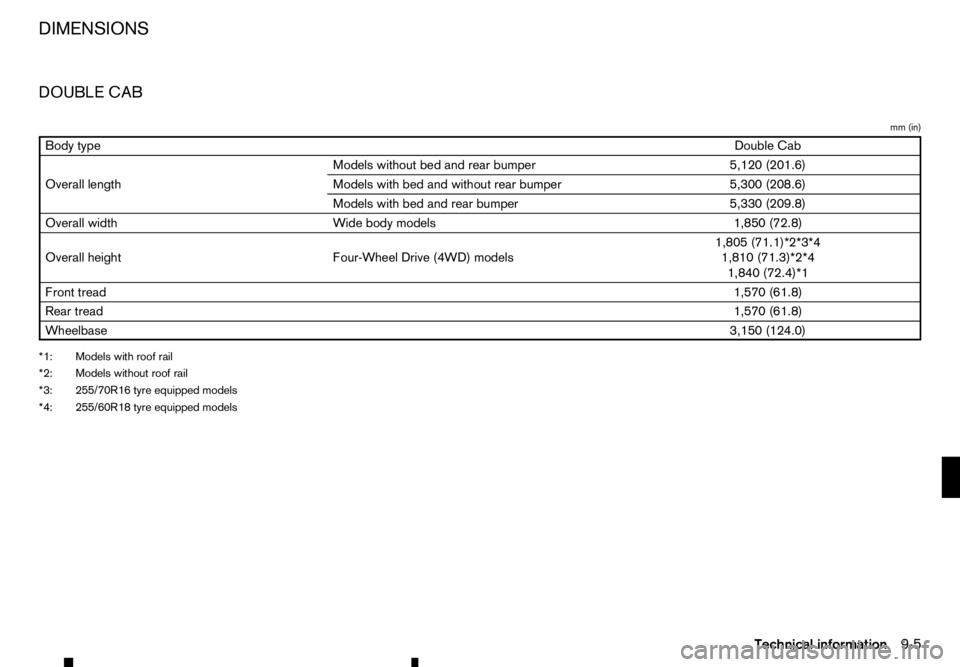
DOUBLE CAB
mm (in)Body type
Double Cab
Overall length Models without bed and rear bumper
5,120 (201.6)
Models with bed and without rear bumper 5,300 (208.6)
Models with bed and rear bumper 5,330 (209.8)
Overall width Wide body models 1,850 (72.8)
Overall height Four-Wheel Drive (4WD) models 1,805 (71.1)*2*3*4
1,810 (71.3)*2*4
1,840 (72.4)*1
Front tread 1,570 (61.8)
Rear tread 1,570 (61.8)
Wheelbase 3,150 (124.0)
*1: Models with roof rail
*2: Models without roof rail
*3: 255/70R16 tyre equipped models
*4: 255/60R18 tyre equipped models DIMENSIONS
Technical information9-5
Page 329 of 340
–M
irrors -Outside ........................................................... 3-25
Remote Control Key .............................................................. 3-7
–B attery -Discharge ........................................................ 5-17
–O perating range .............................................................. 3-9
–O peration ........................................................................V
3-9
–P ush-button ignition switch ............................................ 5-15
–R adio approval numbers and information ......................... 9-9
–R emote keyless entry ..................................................... 3-14
–S tarting engine .............................................................. 5-18
–S ystem ........................................................................V
.. 5-15
–T roubleshooting guide ................................................... 3-12
–W arning signals ............................................................. 3-11
Remote keyless entry .......................................................... 3-14
Replacement
–A ir bags ........................................................................V
1-40
–A ir cleaner filter ............................................................. 8-15
–B attery (Key fob) ........................................................... 8-13
–E ngine coolant ................................................................. 8-6
–E ngine oil ........................................................................V
8-7
–E ngine oil filter ................................................................. 8-7
–F uses ........................................................................V
.... 8-18
–L ights ........................................................................V
.... 8-23
–R emote Control Key battery ........................................... 8-14
–W iper blades ................................................................. 8-17
Reversing camera ................................................................. 4-7
–S ettings ........................................................................V
. 4-10
–T ips ........................................................................V
....... 4-10
Roof rail ........................................................................V
...... 2-41
Room light
–O peration ...................................................................... 2-44
–R eplacement ................................................................. 8-23
Running-in schedule .............................................................. 5-2 SSafety
–H
ead restraints ................................................................ 1-6
Seat belts ........................................................................V
...... 1-9
–A djustment .................................................................... 1-12
–C ENTER mark ............................................................... 1-11
–C hecking ...................................................................... 1-13
–C hild safety ................................................................... 1-11
–C hildren -Infants ........................................................... 1-11
–C hildren -Larger ........................................................... 1-11
–C hildren -Small ............................................................. 1-11
–C leaning ........................................................................V
.. 7-4
–I njured persons ............................................................. 1-11
–M aintenance .................................................................. 1-14
–P recautions ..................................................................... 1-9
–P regnant women ........................................................... 1-11
–T hree-point type ............................................................ 1-12
–T wo-point type ............................................................... 1-13
Seats ........................................................................V
............ 1-2
–A djustment (Manual) ........................................................ 1-2
–A djustment (Power) ......................................................... 1-3
–F olding ........................................................................V
.... 1-5
–F ront seats ...................................................................... 1-2
–H ead restraints ................................................................ 1-6
–I SOFIX child restraints ......................................... 1-18, 1-19
–J ump seat ........................................................................V
1-6
–L umbar support ............................................................... 1-4
–R ear ........................................................................V
........ 1-5
–U niversal child restraints (front and rear seats) ............... 1-15
Security system ................................................................... 3-15
Service
–M aintenance .................................................................... 8-2
Spare tyre ........................................................................V
..... 6-3
Speed limiter
–O peration ...................................................................... 5-42
Speedometer ........................................................................V
2-2
Index10-7
Page 330 of 340
Starting
–J
ump starting ................................................................. 6-10
–P ush starting ................................................................. 6-12
–W ithout Remote Control Key ......................................... 5-18
Steering
–P hone operating buttons ................................................ 4-64
–P ower steering system .................................................. 5-49
–S teering wheel switches for phone control ..................... 4-64
Steering wheel .................................................................... 3-23
–A djustment .................................................................... 3-23
–S witches —Audio control ............................................. 4-58
–S witches —Hands-free telephone control ............ 4-59, 4-65
Stop/Start System ............................................................... 5-23
–D isplay ........................................................................V
.. 5-24
–O FF switch ................................................................... 5-25
Storage ........................................................................V
....... 2-39
–C ard holder ................................................................... 2-41
–C onsole box .................................................................. 2-39
–C onsole side pockets .................................................... 2-40
–C up holders .................................................................. 2-40
–G love box ...................................................................... 2-39
–R oof rail ........................................................................V
2-41
–S unglasses holder ......................................................... 2-40
Sun visors ........................................................................V
... 2-41
–C ard holder ................................................................... 2-41
Sunroof ........................................................................V
....... 2-42
–O peration ...................................................................... 2-42
Sunshade ........................................................................V
.... 2-42
Supplemental Restraint System (SRS) ................................. 1-29
–O verview ........................................................................V
. 0-2
–R epair and replacement procedure ................................ 1-40
Switches
–D efogger ....................................................................... 2-34
–E lectronic Stability Programme (ESP) OFF switch ......... 5-35
–F og lights ...................................................................... 2-33
–H azard indicator flasher switch ........................................ 6-2
–H eadlight cleaner .......................................................... 2-35 –H
ill descent control ........................................................ 5-38
–I gnition switch ............................................................... 5-14
–I nterior lights ................................................................. 2-43
–P arking sensor system ................................................... 5-47
–S eat adjustment .............................................................. 1-3
–S eat heating .................................................................... 1-5
–S teering-wheel —Audio ................................................ 4-58
–W iper and washer ......................................................... 2-34
T Tailgate ........................................................................V
....... 3-20
Theft warning system .......................................................... 3-15
Tools ........................................................................V
............. 6-2
Touchscreen Navigation ...................................................... 4-57
Towing
–P recautions ................................................................... 6-13
–R ecommendations ......................................................... 6-13
–R ecommended towing for four-wheel drive (4WD)
models ........................................................................V
.. 6-15
–R ecommended towing for two-wheel drive (2WD)
models ........................................................................V
.. 6-13
–T railer ........................................................................V
.... 5-48
–Y our vehicle .................................................................. 6-13
Trailer
–B rakes ........................................................................V
.. 5-48
–P recautions ................................................................... 5-48
–S afety chains ................................................................. 5-48
–T owing ........................................................................V
.. 5-48
–T railer detection ............................................................. 5-48
–T yre pressure ................................................................ 5-48
Transferring registration to another country ............................ 9-7
Transmission
–A utomatic transmission fluid (ATF) ................................... 8-8
Transmitter
–R adio ........................................................................V
...... 9-8
10-8 Index