wheel size RENAULT ALASKAN 2017 User Guide
[x] Cancel search | Manufacturer: RENAULT, Model Year: 2017, Model line: ALASKAN, Model: RENAULT ALASKAN 2017Pages: 340, PDF Size: 6.93 MB
Page 303 of 340
For additional traction on icy roads, studded tyres
may be used. However, some states and provinces
prohibit their use. Check local, state and provincial
laws before installing studded tyres. Skid and trac-
tion capabilities of studded snow tyres on wet or dry
surfaces may be poorer than that of non-studded
snow tyres.
Four-Wheel Drive (4WD) model
CAUTION
• Always use tyres of the same type, size, brand,
construction (bias, bias-belted or radial), and
tread pattern on all four wheels. Failure to do
so may result in
acircumference difference
between tyres on the front and rear axles
which will cause excessive tyre wear and may
damage the transmission, transfer case and
differential gears.
• ONLY use spare tyres specified for the 4WD
model.
If excessive tyre wear is found, it is recommended
that all four tyres be replaced with tyres of the same
size, brand, construction and tread pattern. The tyre
pressure and wheel alignment should also be
checked and corrected as necessary. Contact an
approved dealer or qualified workshop. TYRE CHAINS
Use of tyre chains may be prohibited according to
location. Check the local laws before installing tyre
chains. When installing tyre chains, make sure that
they are of proper size for the tyres on your vehicle
and are installed according to the chain manufactur-
er’s instructions.
Use chain tensioners when recommended by the
tyre chain manufacturer to ensure
atight fit. Loose
end links of the tyre chains must be secured or
removed to prevent the possibility of whipping ac-
tion damage to the wings or underbody. If possible,
avoid fully loading your vehicle when using tyre
chains. In addition, drive at areduced speed. Oth-
erwise, your vehicle may be damaged and/or ve-
hicle handling and performance may be adversely
affected.
Tyre chains must be installed only on the rear
wheels and not on the front wheels.
Do not drive with tyre chains on paved roads which
are clear of snow. Driving with chains in such condi-
tions can cause damage to the various mechanisms
of the vehicle due to some overstress. TYRE ROTATION
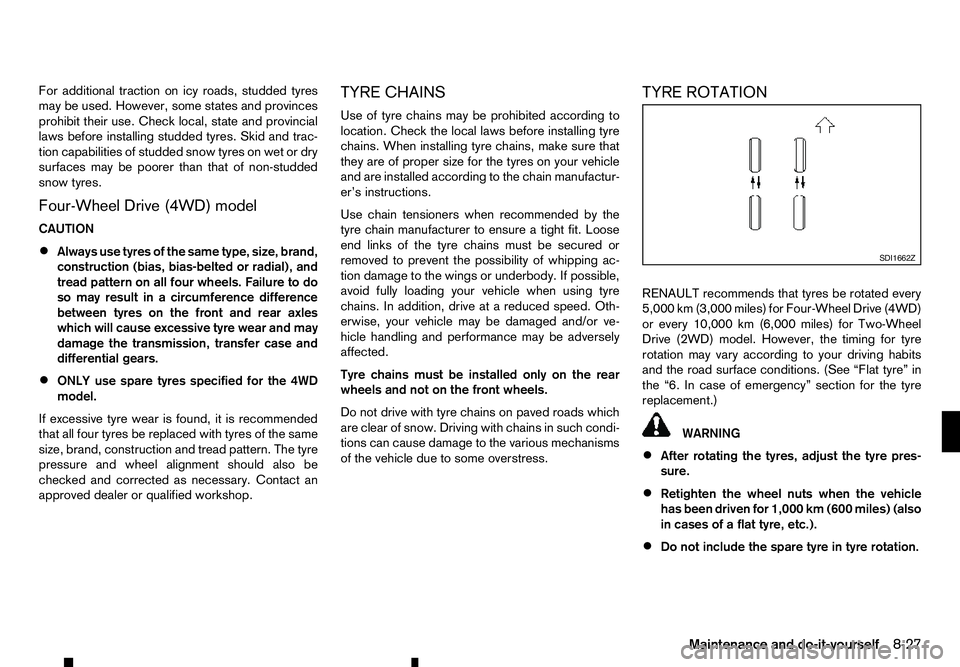
RENAULT recommends that tyres be rotated every
5,000 km (3,000 miles) for Four-Wheel Drive (4WD)
or every 10,000 km (6,000 miles) for Two-Wheel
Drive (2WD) model. However, the timing for tyre
rotation may vary according to your driving habits
and the road surface conditions. (See “Flat tyre” in
the “6. In case of emergency” section for the tyre
replacement.)
WARNING
• After rotating the tyres, adjust the tyre pres-
sure.
• Retighten the wheel nuts when the vehicle
has been driven for 1,000 km (600 miles) (also
in cases of
aflat tyre, etc.).
• Do not include the spare tyre in tyre rotation. SDI1662Z
Maintenance and do-it-yourself
8-27
Page 304 of 340
•
Incorrect tyre selection, fitting, care or main-
tenance can affect vehicle safety with risk of
accident and injury. If in doubt, consult an
approved dealer or qualified workshop or the
tyre manufacturer.
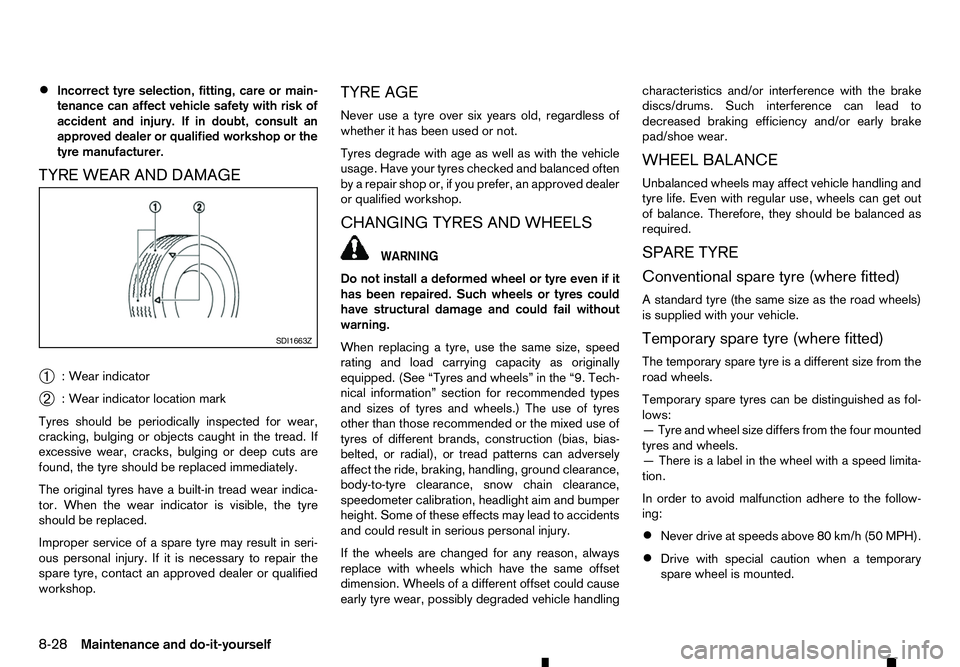
TYRE WEAR AND DAMAGE
➀ :W
ear indicator
➁ :W
ear indicator location mark
Tyres should be periodically inspected for wear,
cracking, bulging or objects caught in the tread. If
excessive wear, cracks, bulging or deep cuts are
found, the tyre should be replaced immediately.
The original tyres have abuilt-in tread wear indica-
tor. When the wear indicator is visible, the tyre
should be replaced.
Improper service of aspare tyre may result in seri-
ous personal injury. If it is necessary to repair the
spare tyre, contact an approved dealer or qualified
workshop. TYRE AGE
Never use
atyre over six years old, regardless of
whether it has been used or not.
Tyres degrade with age as well as with the vehicle
usage. Have your tyres checked and balanced often
by arepair shop or, if you prefer, an approved dealer
or qualified workshop.
CHANGING TYRES AND WHEELS WARNING
Do not install
adeformed wheel or tyre even if it
has been repaired. Such wheels or tyres could
have structural damage and could fail without
warning.
When replacing atyre, use the same size, speed
rating and load carrying capacity as originally
equipped. (See “Tyres and wheels” in the “9. Tech-
nical information” section for recommended types
and sizes of tyres and wheels.) The use of tyres
other than those recommended or the mixed use of
tyres of different brands, construction (bias, bias-
belted, or radial), or tread patterns can adversely
affect the ride, braking, handling, ground clearance,
body-to-tyre clearance, snow chain clearance,
speedometer calibration, headlight aim and bumper
height. Some of these effects may lead to accidents
and could result in serious personal injury.
If the wheels are changed for any reason, always
replace with wheels which have the same offset
dimension. Wheels of adifferent offset could cause
early tyre wear, possibly degraded vehicle handling characteristics and/or interference with the brake
discs/drums. Such interference can lead to
decreased braking efficiency and/or early brake
pad/shoe wear.
WHEEL BALANCE
Unbalanced wheels may affect vehicle handling and
tyre life. Even with regular use, wheels can get out
of balance. Therefore, they should be balanced as
required.
SPARE TYRE
Conventional spare tyre (where fitted)
As tandard tyre (the same size as the road wheels)
is supplied with your vehicle.
Temporary spare tyre (where fitted)
The temporary spare tyre is adifferent size from the
road wheels.
Temporary spare tyres can be distinguished as fol-
lows:
—T yre and wheel size differs from the four mounted
tyres and wheels.
—T here is alabel in the wheel with aspeed limita-
tion.
In order to avoid malfunction adhere to the follow-
ing:
• Never drive at speeds above 80 km/h (50 MPH).
• Drive with special caution when
atemporary
spare wheel is mounted. SDI1663Z
8-28 Maintenance and do-it-yourself
Page 310 of 340
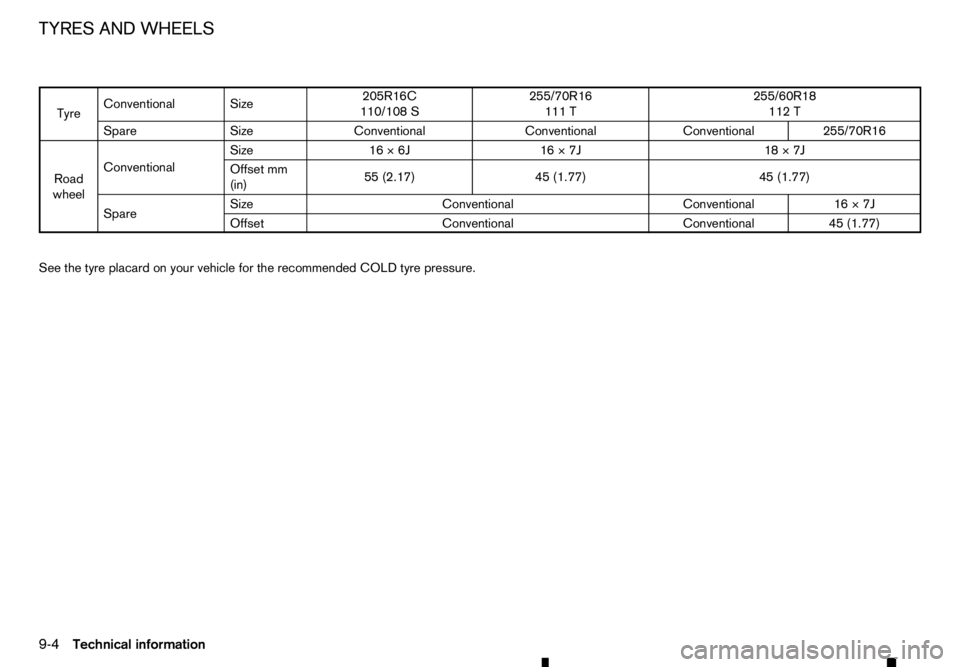
Tyre
Conventional Size
205R16C
110/108 S 255/70R16
111 T 255/60R18
112 T
Spare SizeConventional ConventionalConventional255/70R16
Road
wheel Conventional
Size
16×6 J1 6×7J1 8×7J
Offset mm
(in) 55 (2.17)
45 (1.77) 45 (1.77)
Spare Size
Conventional Conventional16×7J
Offset Conventional Conventional45 (1.77)
See the tyre placard on your vehicle for the recommended COLD tyre pressure.
TYRES AND WHEELS
9-4
Technical information