ECU RENAULT ALASKAN 2017 Workshop Manual
[x] Cancel search | Manufacturer: RENAULT, Model Year: 2017, Model line: ALASKAN, Model: RENAULT ALASKAN 2017Pages: 340, PDF Size: 6.93 MB
Page 259 of 340
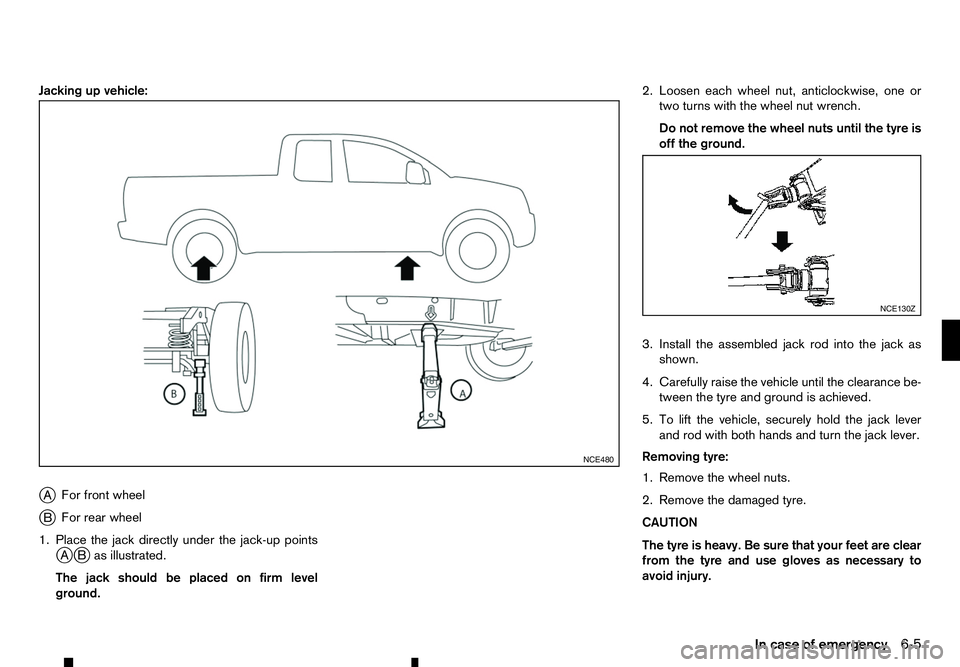
Jacking up vehicle:
j A For front wheel
j B For rear wheel
1. Place the jack directly under the jack-up points jA jBa sillustrated.
The jack should be placed on firm level
ground. 2. Loosen each wheel nut, anticlockwise, one or
two turns with the wheel nut wrench.
Do not remove the wheel nuts until the tyre is
off the ground.
3. Install the assembled jack rod into the jack as shown.
4. Carefully raise the vehicle until the clearance be- tween the tyre and ground is achieved.
5. To lift the vehicle, securely hold the jack lever and rod with both hands and turn the jack lever.
Removing tyre:
1. Remove the wheel nuts.
2. Remove the damaged tyre.
CAUTION
The tyre is heavy. Be sure that your feet are clear
from the tyre and use gloves as necessary to
avoid injury. NCE480 NCE130Z
In case of emergency
6-5
Page 260 of 340
Installing spare tyre
WARNING
• Never use wheel nuts which are not provided
with your vehicle. Incorrect wheel nuts or im-
properly tightened wheel nuts may cause the
wheel to become loose or come off. This
could cause an accident.
• Never use oil or grease on the wheel studs or
nuts. This may cause the wheel nuts to be-
come loose.
1. Clean any mud or dirt from the surface between the wheel and hub.
2. Carefully put the spare tyre on and tighten the wheel nuts with your fingers. Check that all the
wheel nuts contact the wheel surface horizon-
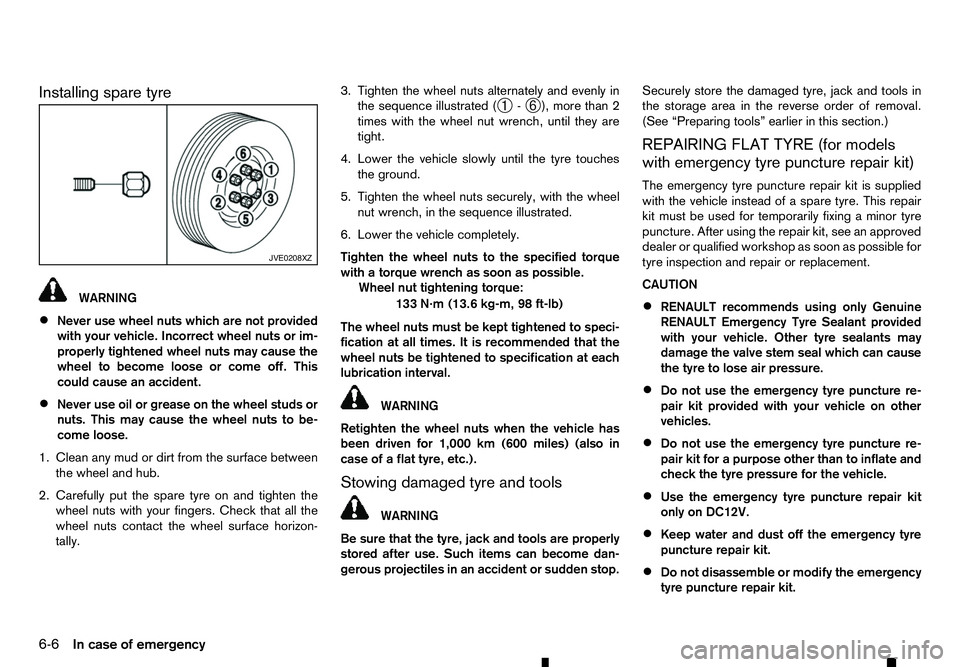
tally. 3. Tighten the wheel nuts alternately and evenly in
the sequence illustrated ( ➀-
➅ ), more than 2
times with the wheel nut wrench, until they are
tight.
4. Lower the vehicle slowly until the tyre touches the ground.
5. Tighten the wheel nuts securely, with the wheel nut wrench, in the sequence illustrated.
6. Lower the vehicle completely.
Tighten the wheel nuts to the specified torque
with atorque wrench as soon as possible.
Wheel nut tightening torque:
133 N·m (13.6 kg-m, 98 ft-lb)
The wheel nuts must be kept tightened to speci-
fication at all times. It is recommended that the
wheel nuts be tightened to specification at each
lubrication interval. WARNING
Retighten the wheel nuts when the vehicle has
been driven for 1,000 km (600 miles) (also in
case of aflat tyre, etc.).
Stowing damaged tyre and tools WARNING
Be sure that the tyre, jack and tools are properly
stored after use. Such items can become dan-
gerous projectiles in an accident or sudden stop. Securely store the damaged tyre, jack and tools in
the storage area in the reverse order of removal.
(See “Preparing tools” earlier in this section.)
REPAIRING FLAT TYRE (for models
with emergency tyre puncture repair kit)
The emergency tyre puncture repair kit is supplied
with the vehicle instead of aspare tyre. This repair
kit must be used for temporarily fixing aminor tyre
puncture. After using the repair kit, see an approved
dealer or qualified workshop as soon as possible for
tyre inspection and repair or replacement.
CAUTION
• RENAULT recommends using only Genuine
RENAULT Emergency Tyre Sealant provided
with your vehicle. Other tyre sealants may
damage the valve stem seal which can cause
the tyre to lose air pressure.
• Do not use the emergency tyre puncture re-
pair kit provided with your vehicle on other
vehicles.
• Do not use the emergency tyre puncture re-
pair kit for
apurpose other than to inflate and
check the tyre pressure for the vehicle.
• Use the emergency tyre puncture repair kit
only on DC12V.
• Keep water and dust off the emergency tyre
puncture repair kit.
• Do not disassemble or modify the emergency
tyre puncture repair kit. JVE0208XZ
6-6 In case of emergency
Page 262 of 340
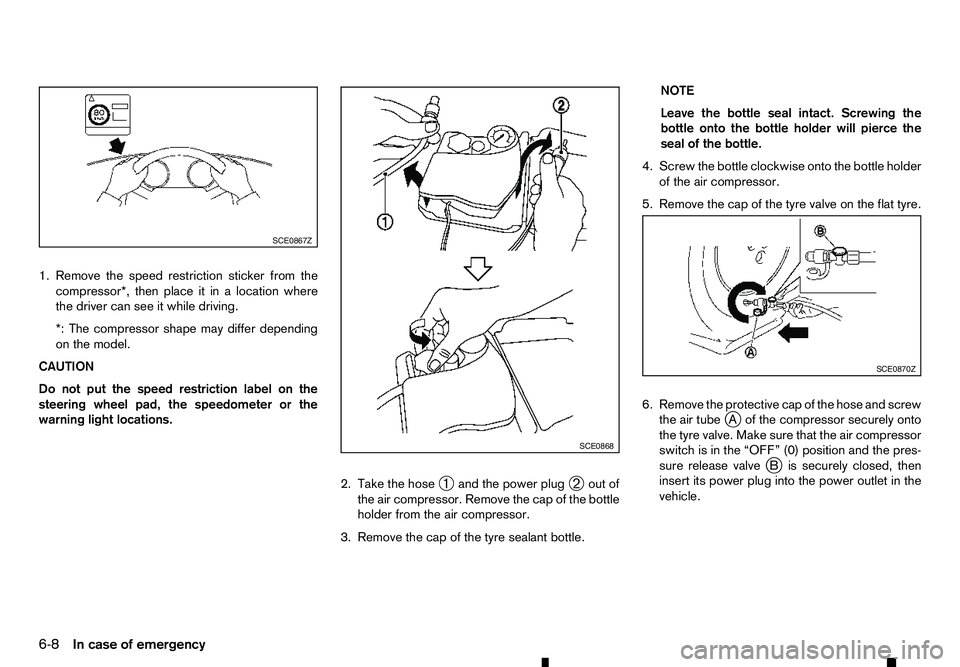
1. Remove the speed restriction sticker from the
compressor*, then place it in alocation where
the driver can see it while driving.
*: The compressor shape may differ depending
on the model.
CAUTION
Do not put the speed restriction label on the
steering wheel pad, the speedometer or the
warning light locations.
2. Take the hose➀and the power plug
➁out of
the air compressor. Remove the cap of the bottle holder from the air compressor.
3. Remove the cap of the tyre sealant bottle. NOTE
Leave the bottle seal intact. Screwing the
bottle onto the bottle holder will pierce the
seal of the bottle.
4. Screw the bottle clockwise onto the bottle holder of the air compressor.
5. Remove the cap of the tyre valve on the flat tyre.
6. Remove the protective cap of the hose and screw the air tube j
Ao fthe compressor securely onto
the tyre valve. Make sure that the air compressor
switch is in the “OFF” (0) position and the pres-
sure release valve j
Bi ssecurely closed, then
insert its power plug into the power outlet in the
vehicle. SCE0867Z
SCE0868 SCE0870Z
6-8 In case of emergency
Page 263 of 340
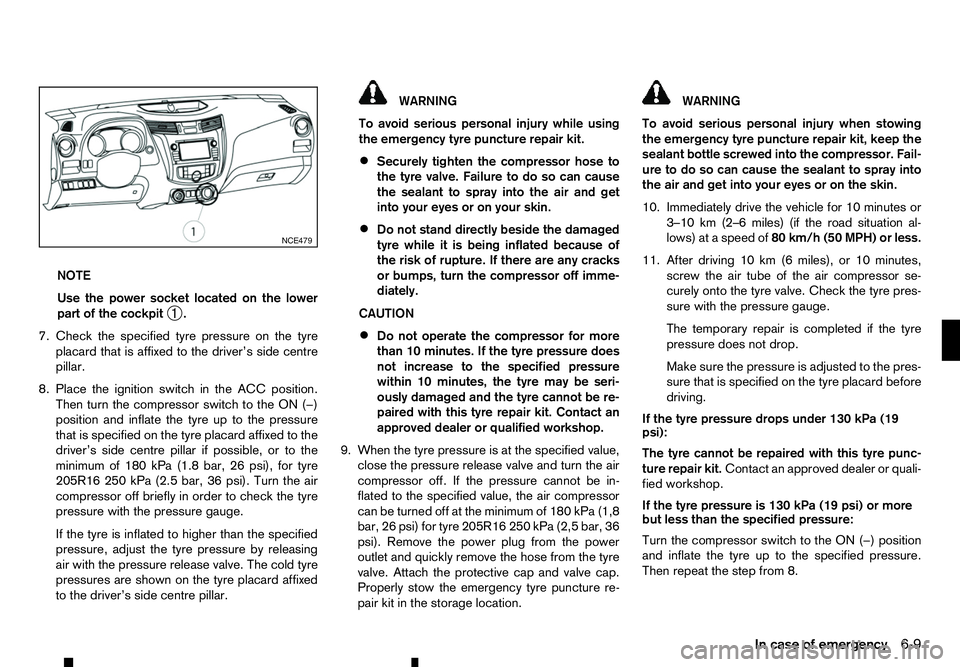
NOTE
Use the power socket located on the lower
part of the cockpit ➀.
7. Check the specified tyre pressure on the tyre placard that is affixed to the driver’s side centre
pillar.
8. Place the ignition switch in the ACC position. Then turn the compressor switch to the ON (−)
position and inflate the tyre up to the pressure
that is specified on the tyre placard affixed to the
driver’s side centre pillar if possible, or to the
minimum of 180 kPa (1.8 bar, 26 psi), for tyre
205R16 250 kPa (2.5 bar, 36 psi). Turn the air
compressor off briefly in order to check the tyre
pressure with the pressure gauge.
If the tyre is inflated to higher than the specified
pressure, adjust the tyre pressure by releasing
air with the pressure release valve. The cold tyre
pressures are shown on the tyre placard affixed
to the driver’s side centre pillar. WARNING
To avoid serious personal injury while using
the emergency tyre puncture repair kit.
• Securely tighten the compressor hose to
the tyre valve. Failure to do so can cause
the sealant to spray into the air and get
into your eyes or on your skin.
• Do not stand directly beside the damaged
tyre while it is being inflated because of
the risk of rupture. If there are any cracks
or bumps, turn the compressor off imme-
diately.
CAUTION
• Do not operate the compressor for more
than 10 minutes. If the tyre pressure does
not increase to the specified pressure
within 10 minutes, the tyre may be seri-
ously damaged and the tyre cannot be re-
paired with this tyre repair kit. Contact an
approved dealer or qualified workshop.
9. When the tyre pressure is at the specified value, close the pressure release valve and turn the air
compressor off. If the pressure cannot be in-
flated to the specified value, the air compressor
can be turned off at the minimum of 180 kPa (1,8
bar, 26 psi) for tyre 205R16 250 kPa (2,5 bar, 36
psi). Remove the power plug from the power
outlet and quickly remove the hose from the tyre
valve. Attach the protective cap and valve cap.
Properly stow the emergency tyre puncture re-
pair kit in the storage location. WARNING
To avoid serious personal injury when stowing
the emergency tyre puncture repair kit, keep the
sealant bottle screwed into the compressor. Fail-
ure to do so can cause the sealant to spray into
the air and get into your eyes or on the skin.
10. Immediately drive the vehicle for 10 minutes or
3–10 km (2–6 miles) (if the road situation al-lows) at aspeed of 80 km/h (50 MPH) or less.
11. After driving 10 km (6 miles), or 10 minutes, screw the air tube of the air compressor se-
curely onto the tyre valve. Check the tyre pres-
sure with the pressure gauge.
The temporary repair is completed if the tyre
pressure does not drop.
Make sure the pressure is adjusted to the pres-
sure that is specified on the tyre placard before
driving.
If the tyre pressure drops under 130 kPa (19
psi):
The tyre cannot be repaired with this tyre punc-
ture repair kit. Contact an approved dealer or quali-
fied workshop.
If the tyre pressure is 130 kPa (19 psi) or more
but less than the specified pressure:
Turn the compressor switch to the ON (−) position
and inflate the tyre up to the specified pressure.
Then repeat the step from 8. NCE479
In case of emergency
6-9
Page 268 of 340

2. Secure the steering wheel in
astraight ahead
position with rope or similar device.
3. Move the shift lever to the N(Neutral) position.
4. Release the parking brake.
5. Attach safety chains before towing.
Rear wheels on the ground:
RENAULT recommends that towing dollies be used
under the rear wheels when towing your vehicle or
the vehicle be placed on aflatbed tow truck as illus-
trated.
CAUTION
Never tow Automatic Transmission (AT) model
with the rear wheels on the ground. Doing so will
cause serious and expensive damage to the
transmission.
Manual Transmission (MT) model:
If you have to tow aMTvehicle with rear wheels on
the ground, perform the following procedures.
CAUTION
Observe the following restricted towing speeds
and distances.
• Speed: Below 50 km/h (30 MPH)
• Distance: Less than 65 km (40 miles)
1. Place the ignition switch in the “ON” position and turn all accessories off.
2. Move the shift lever to the N(Neutral) position.
3. Release the parking brake. 4. Attach safety chains whenever towing.
All four wheels on the ground:
RENAULT recommends that the vehicle be placed
on
aflatbed tow truck as illustrated.
CAUTION
Never tow Automatic Transmission (AT) model
with all four wheels on the ground. Doing so will
cause serious and expensive damage to the driv-
etrain.
Manual Transmission (MT) model:
If you have to tow aMTvehicle with all four wheels
on the ground, perform the following procedures.
CAUTION
• Never tow
aManual Transmission (MT) model
backward with all four wheels on the ground.
• Observe the following restricted towing
speeds and distances.
–S
peed: Below 50 km/h (30 MPH)
–D istance: Less than 65 km (40 miles)
1. Place the ignition switch in the “ON” position and turn all accessories off.
2. Move the shift lever to the N(Neutral) position.
3. Release the parking brake.
6-14 In case of emergency
Page 278 of 340
Some day-to-day and regular maintenance is essen-
tial to maintain your vehicle’s good mechanical con-
dition, as well as its emission and engine perfor-
mance.
It is the owner’s responsibility to make sure that the
specified maintenance, as well as general mainte-
nance, is performed.
As the vehicle owner, you are the only one who can
ensure that your vehicle receives the proper mainte-
nance care.
SCHEDULED MAINTENANCE
For your convenience, the required scheduled main-
tenance items are described and listed in aseparate
Warranty Information and Maintenance booklet. You
must refer to that booklet to ensure that necessary
maintenance is performed on your vehicle at regular
intervals.
GENERAL MAINTENANCE
General maintenance includes those items which should be checked during normal day-to-day opera-
tion of the vehicle. They are essential if your vehicle
is to continue to operate properly. It is your respon-
sibility to perform these procedures regularly as pre- scribed.
Performing general maintenance checks requires
minimal mechanical skill and only afew general au-
tomotive tools.
These checks or inspections can be done by your-
self, aqualified technician, or if you prefer, your
approved dealer or qualified workshop. WHERE TO GO FOR SERVICE
If maintenance service is required or your vehicle
appears to malfunction, have the systems checked
and tuned by an authorised approved dealer or
qualified workshop.
During normal day-to-day operation of the vehicle,
general maintenance should be performed regularly
as prescribed in this section. If you detect any un-
usual sounds, vibrations or smells, be sure to check
for the cause or have an approved dealer or quali-
fied workshop do it promptly. In addition, you should
notify an approved dealer or qualified workshop if
you think that repairs are required.
When performing any checks or maintenance work,
closely observe “Maintenance precautions” later in
this section.
EXPLANATION OF GENERAL
MAINTENANCE ITEMS
Additional information on the following items with
“*” is found later in this section.
Outside vehicle
The maintenance items listed here should be per-
formed from time to time, unless otherwise speci-
fied.
Doors and bonnet:
Check that all doors and the bonnet operate
smoothly as well as the tailgate. Also make sure that
all latches lock securely. Lubricate if necessary.
Make sure that the secondary latch keeps the bon-
net from opening when the primary latch is released.
When driving in areas using road salt or other cor-
rosive materials, check lubrication frequently.
MAINTENANCE REQUIREMENTS
GENERAL MAINTENANCE
8-2 Maintenance and do-it-yourself
Page 279 of 340
Lights*:
Clean the headlights on
aregular basis. Make sure
that the headlights, stop lights, tail lights, turn signal
lights, and other lights are all operating properly and
installed securely. Also check the aim of the head-
lights.
Tyres*:
Check the pressure with agauge often and always
prior to long distance trips. Adjust the pressure in all
tyres, including the spare, to the pressure specified.
Check carefully for damage, cuts or excessive wear.
Tyre rotation*:
In the case of Two-Wheel Drive (2WD), and where
front and rear tyres are the same size: tyres should
be rotated every 10,000 km (6,000 miles). Tyres
marked with directional indicators can only be ro-
tated between front and rear. Make sure that the
directional indicators point in the direction of wheel
rotation after the tyre rotation is completed.
In the case of the Four-Wheel Drive and All Wheel
Drive (4WD/AWD), and where front and rear tyres
are the same size: tyres should be rotated every
5,000 km (3,000 miles). Tyres marked with direc-
tional indicators can only be rotated between front
and rear. Make sure that the directional indicators
point in the direction of wheel rotation after the tyre
rotation is completed.
In the case that front tyres are different size from
rear tyres: tyres cannot be rotated.
The timing for tyre rotation may vary according to
your driving habits and the road surface conditions. Tyre Pressure Monitoring System (TPMS)
transmitter components (where fitted):
Replace the TPMS transmitter grommet seal, valve
core and cap when the tyres are replaced due to
wear or age.
Wheel alignment and balance:
If the vehicle should pull to either side while driving
on astraight and level road, or if you detect uneven
or abnormal tyre wear, there may be aneed for
wheel alignment. If the steering wheel or seat vi-
brates at normal highway speeds, wheel balancing
may be needed.
Windscreen:
Clean the windscreen on aregular basis. Check the
windscreen at least every six months for cracks or
other damage. Repair as necessary.
Wiper blades*:
Check for cracks or wear if not functioning cor-
rectly. Replace as necessary.
Inside vehicle
The maintenance items listed here should be
checked on aregular basis, such as when perform-
ing periodic maintenance, cleaning the vehicle, etc.
Accelerator pedal:
Check the pedal for smooth operation and make
sure that the pedal does not catch or require uneven
effort. Keep the floor mats away from the pedal. Brake pedal*:
Check the pedal for smooth operation and make
sure that it is the proper distance from the floor mat
when depressed fully. Check the brake booster
function. Be sure to keep the floor mats away from
the pedal.
Parking brake*:
Check the parking brake operation regularly. Check
that the lever (where fitted) or the pedal (where fit-
ted) has the proper travel. Also make sure that the
vehicle is held securely on
afairly steep hill when
only the parking brake is applied.
Seat belts:
Check that all parts of the seat belt system (for
example, buckles, anchors, adjusters and retrac-
tors) operate properly and smoothly, and are in-
stalled securely. Check the belt webbing for cuts,
fraying, wear or damage.
Steering wheel:
Check for changes in the steering condition, such
as excessive play, hard steering or strange noises.
Warning lights and chimes:
Make sure that all warning lights and chimes are
operating properly.
Windscreen defogger:
Check that the air comes out of the defogger outlets
properly and in good quantity when operating the
heater or air conditioner.
Maintenance and do-it-yourself 8-3
Page 280 of 340
Windscreen wiper and washer*:
Check that the wipers and washer operate properly
and that the wipers do not streak.
Under bonnet and vehicle
The maintenance items listed here should be
checked periodically (for example, each time you
check the engine oil or refuel).
Battery (except for maintenance free batter-
ies)*:
Check the fluid level in each cell. It should be be-
tween the
operated in high temperatures or under severe con-
ditions require frequent checks of the battery fluid
level.
Brake (and clutch) fluid level(s)*:
For Manual Transmission (MT) model: make sure
that the brake and clutch fluid levels are between
the
Except for Manual Transmission (MT) model: make
sure that the brake fluid level is between the
and
Engine coolant level*:
Check the coolant level when the engine is cold.
Make sure that the coolant level is between the
Engine drive belt(s)*:
Make sure that drive belt(s) is/are not frayed, worn,
cracked or oily. Engine oil level*:
Check the level after parking the vehicle (on
alevel
ground) and turning off the engine.
Fluid leaks:
Check under the vehicle for fuel, oil, water or other
fluid leaks after the vehicle has been parked for a
while. Water dripping from the air conditioner after
use is normal. If you should notice any leaks or if fuel
fumes are evident, check for cause and have it cor-
rected immediately.
Power steering fluid level and lines*:
Check the level when the fluid is cold, with the en-
gine off. Check the lines for proper attachment,
leaks, cracks, etc.
Windscreen washer fluid*:
Check that there is adequate fluid in the reservoir.
MAINTENANCE PRECAUTIONS
When performing any inspection or maintenance
work on your vehicle, always take care to prevent
serious accidental injury to yourself or damage to
the vehicle. The following are general precautions
which should be closely observed. WARNING
• Park the vehicle on
alevel surface, apply the
parking brake securely and block the wheels
to prevent the vehicle from moving. Move the
shift lever to the P(Park) position (AT model)
or the shift lever to the N(Neutral) position
(MT model). •
Be sure the ignition switch is in the LOCK
position when performing any parts replace-
ment or repairs.
• Do not work under the bonnet while the en-
gine is hot. Always turn off the engine and
wait until it cools down.
• If you must work with the engine running,
keep your hands, clothing, hair and tools away
from moving fans, belts and any other moving
parts.
• It is advisable to secure or remove any loose
clothing and any jewellery, such as rings,
watches, etc. before working on your vehicle.
• If you must run the engine in an enclosed
space such as
agarage, be sure there is
proper ventilation for exhaust gasses to es-
cape.
• DO NOT GET UNDER
AVEHICLE THAT IS
SUPPORTED BY AJACK.
• Keep smoking materials, flame and sparks
away from fuel and the battery.
• Never connect or disconnect either the bat-
tery or any transistorised component connec-
tor while the ignition switch is in the ON posi-
tion.
8-4 Maintenance and do-it-yourself
Page 282 of 340
The radiator is fitted with
apressure cap. To prevent
engine damage, use only aGenuine RENAULT ra-
diator cap or its equivalent when replacement is
required.
CHECKING ENGINE COOLANT
LEVEL
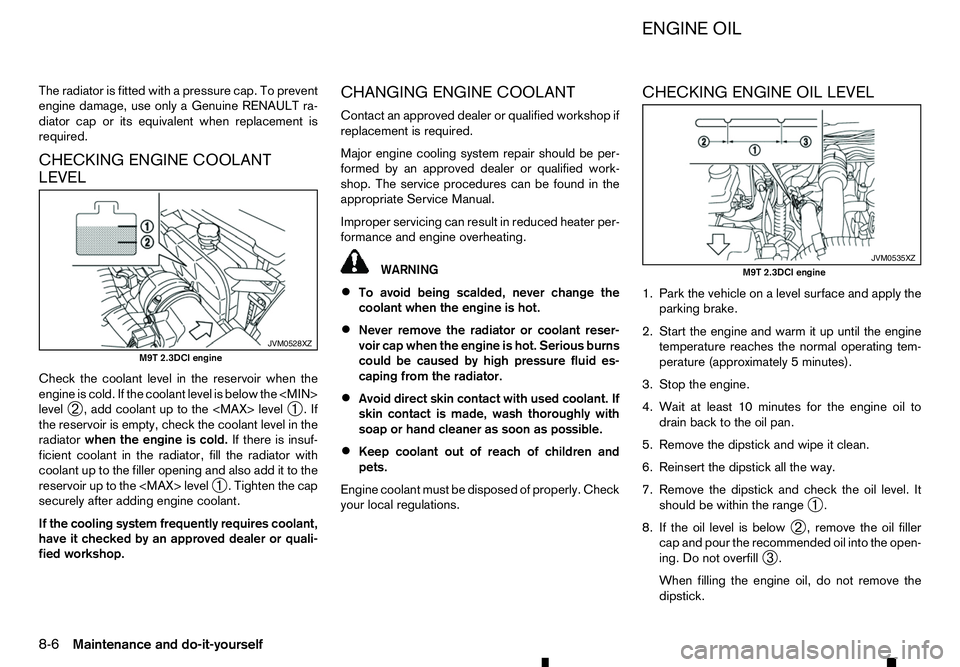
Check the coolant level in the reservoir when the
engine is cold. If the coolant level is below the
level ➁,a
dd coolant up to the
➀.If
the reservoir is empty, check the coolant level in the
radiator when the engine is cold. If there is insuf-
ficient coolant in the radiator, fill the radiator with
coolant up to the filler opening and also add it to the
reservoir up to the
ighten the cap
securely after adding engine coolant.
If the cooling system frequently requires coolant,
have it checked by an approved dealer or quali-
fied workshop. CHANGING ENGINE COOLANT
Contact an approved dealer or qualified workshop if
replacement is required.
Major engine cooling system repair should be per-
formed by an approved dealer or qualified work-
shop. The service procedures can be found in the
appropriate Service Manual.
Improper servicing can result in reduced heater per-
formance and engine overheating.
WARNING
• To avoid being scalded, never change the
coolant when the engine is hot.
• Never remove the radiator or coolant reser-
voir cap when the engine is hot. Serious burns
could be caused by high pressure fluid es-
caping from the radiator.
• Avoid direct skin contact with used coolant. If
skin contact is made, wash thoroughly with
soap or hand cleaner as soon as possible.
• Keep coolant out of reach of children and
pets.
Engine coolant must be disposed of properly. Check
your local regulations. CHECKING ENGINE OIL LEVEL
1. Park the vehicle on
alevel surface and apply the
parking brake.
2. Start the engine and warm it up until the engine temperature reaches the normal operating tem-
perature (approximately 5minutes).
3. Stop the engine.
4. Wait at least 10 minutes for the engine oil to drain back to the oil pan.
5. Remove the dipstick and wipe it clean. 6. Reinsert the dipstick all the way.
7. Remove the dipstick and check the oil level. It should be within the range ➀.
8. If the oil level is below ➁,r
emove the oil filler
cap and pour the recommended oil into the open-
ing. Do not overfill ➂.
When filling the engine oil, do not remove the
dipstick. JVM0528XZ
M9T 2.3DCI engine JVM0535XZ
M9T 2.3DCI engine
ENGINE OIL
8-6 Maintenance and do-it-yourself
Page 283 of 340
9. Recheck the oil level with the dipstick.
CAUTION
• The oil level should be checked regularly. Op-
erating your vehicle with an insufficient
amount of oil can damage the engine, and
such damage is not covered by the warranty.
• It is normal to add some oil between oil main-
tenance intervals or during the running-in pe-
riod, depending on the severity of operating
conditions.
CHANGING ENGINE OIL AND OIL
FILTER
Contact an approved dealer or qualified workshop
when the engine oil and oil filter require replace-
ment.
PROTECT ENVIRONMENT
It is illegal to pollute drains, watercourses and soil.
Use authorised waste collection facilities, including
civil amenity sites and garages providing facilities
for disposal of used oil and used oil filters. If in
doubt, contact your local authority for advice on dis-
posal.
The regulations concerning the pollution of the
environment will vary from country to country. REFILLING THE AdBlue® TANK
When the [Refill AdBlue] warning appears in the
vehicle information display, refill the AdBlue® tank
before the tank is empty (see “AdBlue® Selective
Catalytic Reduction (SCR) system (where fitted for
diesel engine model)” in the “5. Starting and driving”
section for the AdBlue® warning display.) Refill the
AdBlue® tank according to the procedures shown
in this section.
CAUTION
•
Use only AdBlue®. Using other fluids will
damage the AdBlue® Selective Catalytic Re-
duction (SCR) system.
• Be careful not to spill AdBlue®. If the AdBlue®
is spilled on the vehicle body, wipe it away
with
awet cloth immediately to avoid paint
damage.
• AdBlue® residues crystallize after
aperiod of
time and contaminate the paint surfaces. If
the spilled AdBlue® has crystallized, use a
sponge and cold water to clean it.
• Be careful not to inhale any ammonia vapours
that may be released. Fill the AdBlue® tank in
well-ventilated areas.
The AdBlue® tank is located underneath the ve-
hicle. (see “AdBlue® filler lid and cap” in the “3. Pre-
driving checks and adjustments” section for the
AdBlue® filler lid location.)
1. Apply the parking brake. 2. Automatic Transmission (AT) model: Move the
shift lever to the P(Park) position.
Manual Transmission (MT) model: Move the shift
lever to the N(Neutral) position.
3. Place the ignition switch in the OFFposition.
4. Open the AdBlue® filler lid.
5. Remove the AdBlue® tank cap by turning it anticlockwise.
6. Refill the AdBlue® tank.
7. Securely install the AdBlue® tank cap.
8. Close the AdBlue® filler lid.
9. Place the ignition switch in the ONposition and
wait for approximately 1minute until the [Refill
AdBlue] warning turns off.
NOTE
In the case that the [ENG can’t start Refill
AdBlue] warning was displayed, check that
the warning turned off, place the ignition
switch in the OFF position once and then startthe engine.
AdBlue® TANK (where fitted for
diesel engine model)
Maintenance and do-it-yourself8-7