warning light RENAULT ALASKAN 2017 Repair Manual
[x] Cancel search | Manufacturer: RENAULT, Model Year: 2017, Model line: ALASKAN, Model: RENAULT ALASKAN 2017Pages: 340, PDF Size: 6.93 MB
Page 262 of 340
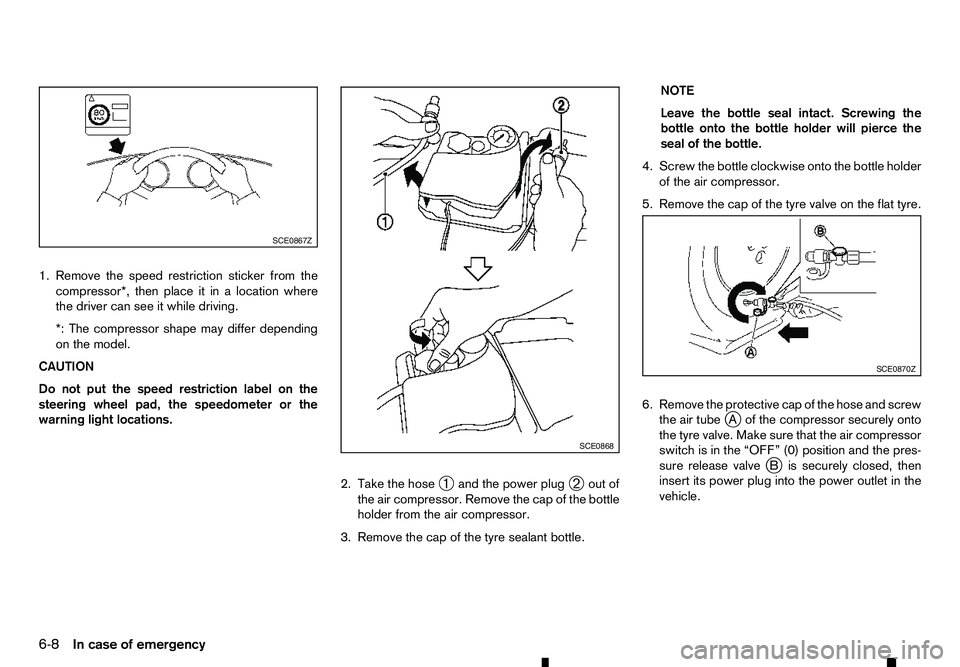
1. Remove the speed restriction sticker from the
compressor*, then place it in alocation where
the driver can see it while driving.
*: The compressor shape may differ depending
on the model.
CAUTION
Do not put the speed restriction label on the
steering wheel pad, the speedometer or the
warning light locations.
2. Take the hose➀and the power plug
➁out of
the air compressor. Remove the cap of the bottle holder from the air compressor.
3. Remove the cap of the tyre sealant bottle. NOTE
Leave the bottle seal intact. Screwing the
bottle onto the bottle holder will pierce the
seal of the bottle.
4. Screw the bottle clockwise onto the bottle holder of the air compressor.
5. Remove the cap of the tyre valve on the flat tyre.
6. Remove the protective cap of the hose and screw the air tube j
Ao fthe compressor securely onto
the tyre valve. Make sure that the air compressor
switch is in the “OFF” (0) position and the pres-
sure release valve j
Bi ssecurely closed, then
insert its power plug into the power outlet in the
vehicle. SCE0867Z
SCE0868 SCE0870Z
6-8 In case of emergency
Page 279 of 340
Lights*:
Clean the headlights on
aregular basis. Make sure
that the headlights, stop lights, tail lights, turn signal
lights, and other lights are all operating properly and
installed securely. Also check the aim of the head-
lights.
Tyres*:
Check the pressure with agauge often and always
prior to long distance trips. Adjust the pressure in all
tyres, including the spare, to the pressure specified.
Check carefully for damage, cuts or excessive wear.
Tyre rotation*:
In the case of Two-Wheel Drive (2WD), and where
front and rear tyres are the same size: tyres should
be rotated every 10,000 km (6,000 miles). Tyres
marked with directional indicators can only be ro-
tated between front and rear. Make sure that the
directional indicators point in the direction of wheel
rotation after the tyre rotation is completed.
In the case of the Four-Wheel Drive and All Wheel
Drive (4WD/AWD), and where front and rear tyres
are the same size: tyres should be rotated every
5,000 km (3,000 miles). Tyres marked with direc-
tional indicators can only be rotated between front
and rear. Make sure that the directional indicators
point in the direction of wheel rotation after the tyre
rotation is completed.
In the case that front tyres are different size from
rear tyres: tyres cannot be rotated.
The timing for tyre rotation may vary according to
your driving habits and the road surface conditions. Tyre Pressure Monitoring System (TPMS)
transmitter components (where fitted):
Replace the TPMS transmitter grommet seal, valve
core and cap when the tyres are replaced due to
wear or age.
Wheel alignment and balance:
If the vehicle should pull to either side while driving
on astraight and level road, or if you detect uneven
or abnormal tyre wear, there may be aneed for
wheel alignment. If the steering wheel or seat vi-
brates at normal highway speeds, wheel balancing
may be needed.
Windscreen:
Clean the windscreen on aregular basis. Check the
windscreen at least every six months for cracks or
other damage. Repair as necessary.
Wiper blades*:
Check for cracks or wear if not functioning cor-
rectly. Replace as necessary.
Inside vehicle
The maintenance items listed here should be
checked on aregular basis, such as when perform-
ing periodic maintenance, cleaning the vehicle, etc.
Accelerator pedal:
Check the pedal for smooth operation and make
sure that the pedal does not catch or require uneven
effort. Keep the floor mats away from the pedal. Brake pedal*:
Check the pedal for smooth operation and make
sure that it is the proper distance from the floor mat
when depressed fully. Check the brake booster
function. Be sure to keep the floor mats away from
the pedal.
Parking brake*:
Check the parking brake operation regularly. Check
that the lever (where fitted) or the pedal (where fit-
ted) has the proper travel. Also make sure that the
vehicle is held securely on
afairly steep hill when
only the parking brake is applied.
Seat belts:
Check that all parts of the seat belt system (for
example, buckles, anchors, adjusters and retrac-
tors) operate properly and smoothly, and are in-
stalled securely. Check the belt webbing for cuts,
fraying, wear or damage.
Steering wheel:
Check for changes in the steering condition, such
as excessive play, hard steering or strange noises.
Warning lights and chimes:
Make sure that all warning lights and chimes are
operating properly.
Windscreen defogger:
Check that the air comes out of the defogger outlets
properly and in good quantity when operating the
heater or air conditioner.
Maintenance and do-it-yourself 8-3
Page 285 of 340
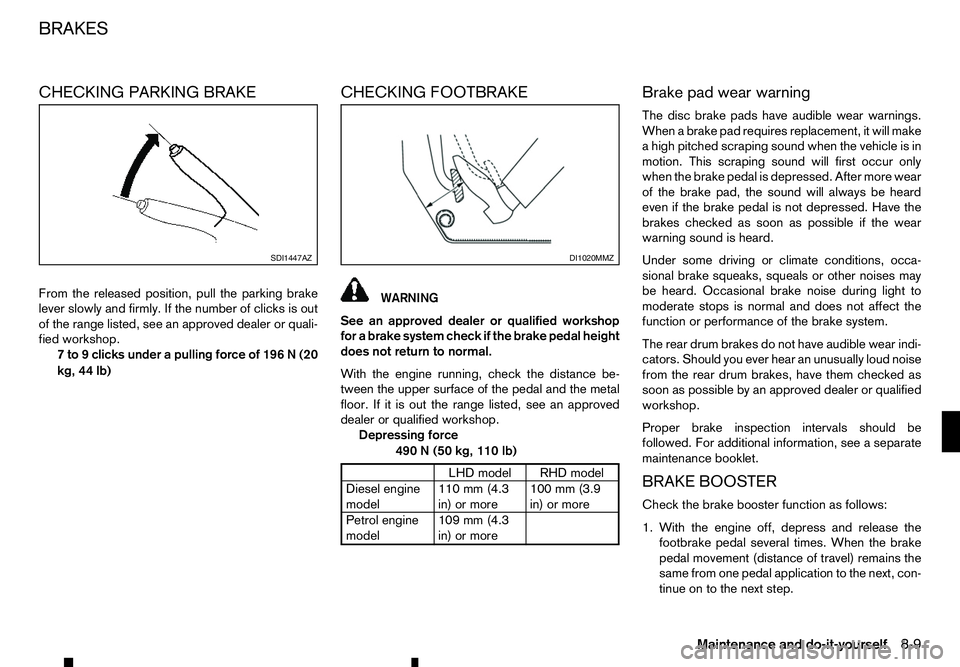
CHECKING PARKING BRAKE
From the released position, pull the parking brake
lever slowly and firmly. If the number of clicks is out
of the range listed, see an approved dealer or quali- fied workshop.
7to9c licks under apulling force of 196 N(20
kg, 44 lb) CHECKING FOOTBRAKE WARNING
See an approved dealer or qualified workshop
for abrake system check if the brake pedal height
does not return to normal.
With the engine running, check the distance be-
tween the upper surface of the pedal and the metal
floor. If it is out the range listed, see an approved
dealer or qualified workshop. Depressing force
490N(50 kg, 110 lb) LHD model RHD model
Diesel engine
model 110 mm (4.3
in) or more100 mm (3.9
in) or more
Petrol engine
model 109 mm (4.3
in) or more Brake pad wear warning
The disc brake pads have audible wear warnings.
When
abrake pad requires replacement, it will make
ah igh pitched scraping sound when the vehicle is in
motion. This scraping sound will first occur only
when the brake pedal is depressed. After more wear
of the brake pad, the sound will always be heard
even if the brake pedal is not depressed. Have the
brakes checked as soon as possible if the wear
warning sound is heard.
Under some driving or climate conditions, occa-
sional brake squeaks, squeals or other noises may
be heard. Occasional brake noise during light to
moderate stops is normal and does not affect the
function or performance of the brake system.
The rear drum brakes do not have audible wear indi-
cators. Should you ever hear an unusually loud noise
from the rear drum brakes, have them checked as
soon as possible by an approved dealer or qualified
workshop.
Proper brake inspection intervals should be
followed. For additional information, see aseparate
maintenance booklet.
BRAKE BOOSTER
Check the brake booster function as follows:
1. With the engine off, depress and release the footbrake pedal several times. When the brake
pedal movement (distance of travel) remains the
same from one pedal application to the next, con-
tinue on to the next step. SDI1447AZ DI1020MMZ
BRAKES
Maintenance and do-it-yourself
8-9
Page 286 of 340
2. While depressing the footbrake pedal, start the
engine. The pedal height should drop alittle.
3. With the footbrake pedal depressed, stop the engine. Keep the pedal depressed for about 30
seconds. The pedal height should not change.
4. Run the engine for 1minute without depressing
the footbrake pedal, then turn it off. Depress the
footbrake pedal several times. The pedal travel
distance will decrease gradually with each de-
pression as the vacuum is released from the
booster.
If the brakes do not operate properly, have the
brakes checked by an approved dealer or qualified
workshop. WARNING
• Use only new fluid from
asealed container.
Old, inferior, or contaminated fluid may dam-
age the brake system. The use of improper
fluids can damage the brake system and af-
fect the vehicle’s stopping ability.
• Clean the filler cap before removing.
• Brake fluid is poisonous and should be stored
carefully in marked containers out of the reach
of children.
CAUTION
• Refilling and checking the brake system
should be left to an approved dealer or quali-
fied workshop who will have the necessary
brake fluid and technical knowledge.
• Do not spill the fluid on painted surfaces. This
will damage the paint. If fluid is spilled, wash
with water.
For details of recommended fluids, refer to the main-
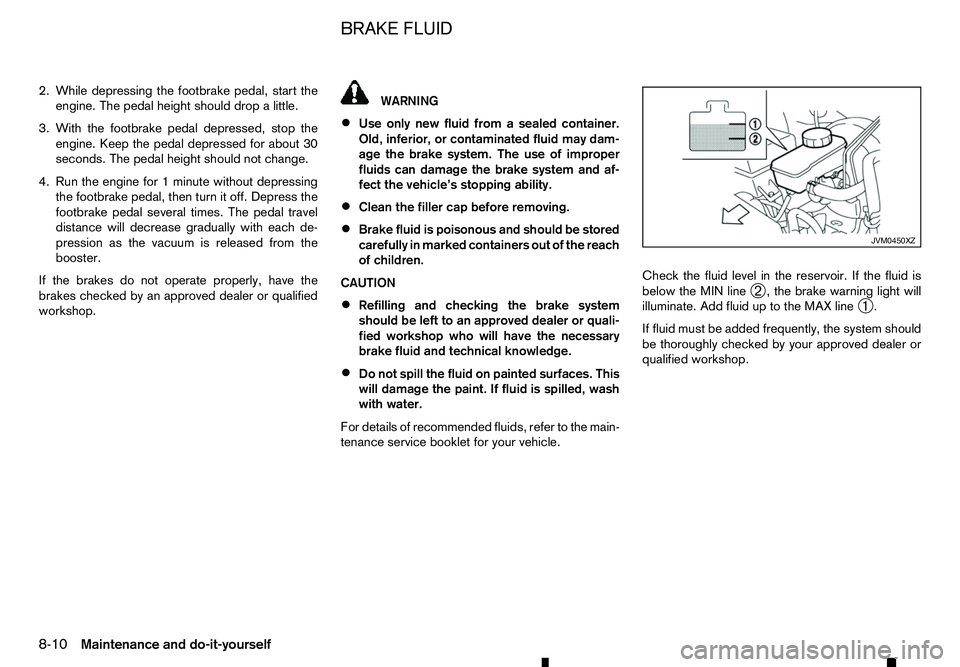
tenance service booklet for your vehicle. Check the fluid level in the reservoir. If the fluid is
below the MIN line
➁,t
he brake warning light will
illuminate. Add fluid up to the MAX line ➀.
If fluid must be added frequently, the system should
be thoroughly checked by your approved dealer or
qualified workshop. JVM0450XZ
BRAKE FLUID
8-10 Maintenance and do-it-yourself
Page 287 of 340
WARNING
• Use only new fluid from
asealed container.
Old, inferior, or contaminated fluid may dam- age the clutch system.
• Clean the filler cap before removing.
• Clutch fluid is poisonous and should be stored
carefully in marked containers out of the reach
of children.
CAUTION
• Refilling and checking the clutch system
should be left to an approved dealer or quali-
fied workshop who will have the necessary
clutch fluid and technical knowledge.
• Do not spill the fluid on painted surfaces. This
will damage the paint. If fluid is spilled, wash
with water.
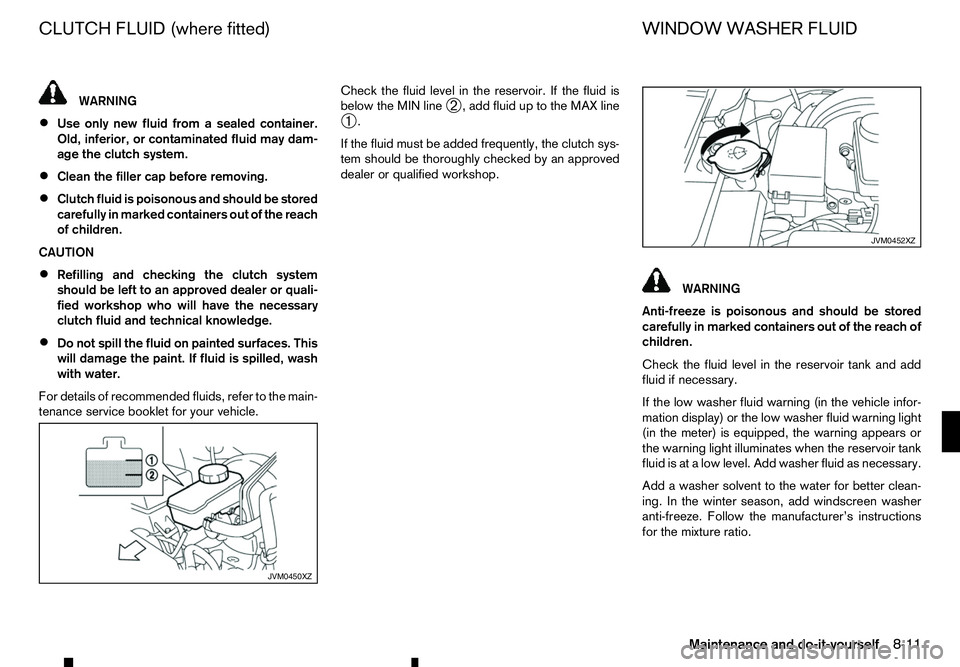
For details of recommended fluids, refer to the main- tenance service booklet for your vehicle. Check the fluid level in the reservoir. If the fluid is
below the MIN line
➁,a
dd fluid up to the MAX line
➀ .
If the fluid must be added frequently, the clutch sys-
tem should be thoroughly checked by an approved
dealer or qualified workshop. WARNING
Anti-freeze is poisonous and should be stored
carefully in marked containers out of the reach of
children.
Check the fluid level in the reservoir tank and add
fluid if necessary.
If the low washer fluid warning (in the vehicle infor-
mation display) or the low washer fluid warning light
(in the meter) is equipped, the warning appears or
the warning light illuminates when the reservoir tank
fluid is at alow level. Add washer fluid as necessary.
Add awasher solvent to the water for better clean-
ing. In the winter season, add windscreen washer
anti-freeze. Follow the manufacturer’s instructions
for the mixture ratio. JVM0450XZ JVM0452XZ
CLUTCH FLUID (where fitted)
WINDOW WASHER FLUID
Maintenance and do-it-yourself 8-11
Page 296 of 340
1. Be sure the ignition switch is in the OFF position.
2. Be sure the headlight switch is in the OFF posi- tion.
3. Remove the fuse box cover j
Af rom beneath the
glove box.
4. Locate the fuse that needs to be replaced.
5. Remove the fuse using the fuse puller located in the main fuse box.
6. If the fuse is open, replace it with anew fuse.
7. Install the fuse box cover.
If the new fuse also opens, after installing, have the
electrical system checked, and if necessary
repaired, by an approved dealer or qualified work-
shop.
Extended storage fuse switch
(where fitted) To reduce battery drain, the extended storage fuse
switch comes from the factory switched off. Prior to
delivery of your vehicle, the switch is pushed in
(switched on) and should always remain on.
If the extended storage fuse switch is not pushed in
(switched on), the [Shipping Mode On Push Stor-
age Fuse] warning may appear in the vehicle infor-
mation display. See “Indicators for operation” in the
“2. Instruments and controls” section.
If any electrical equipment does not operate, re-
move the extended storage fuse switch and check for an open fuse.
NOTE
If the extended storage fuse switch malfunctions
or if the fuse is open, it is not necessary to re-
place the switch. In this case, remove the ex- tended storage fuse switch and replace it with a
new fuse of the same rating.
How to remove the extended storage fuse
switch:
1. To remove the extended storage fuse switch, be sure the ignition switch is in the OFF or LOCK
position.
2. Be sure the headlight switch is in the OFF posi- tion.
3. Remove the fuse box cover.
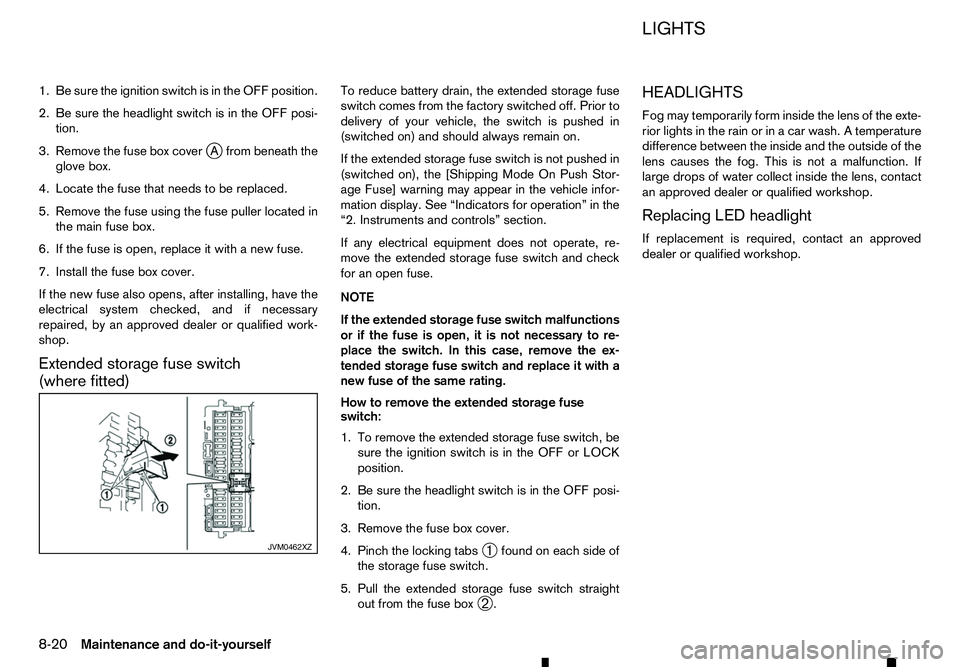
4. Pinch the locking tabs ➀found on each side of
the storage fuse switch.
5. Pull the extended storage fuse switch straight out from the fuse box ➁. HEADLIGHTS
Fog may temporarily form inside the lens of the exte-
rior lights in the rain or in
acar wash. Atemperature
difference between the inside and the outside of the
lens causes the fog. This is not amalfunction. If
large drops of water collect inside the lens, contact
an approved dealer or qualified workshop.
Replacing LED headlight
If replacement is required, contact an approved
dealer or qualified workshop. JVM0462XZ LIGHTS
8-20 Maintenance and do-it-yourself
Page 304 of 340
•
Incorrect tyre selection, fitting, care or main-
tenance can affect vehicle safety with risk of
accident and injury. If in doubt, consult an
approved dealer or qualified workshop or the
tyre manufacturer.
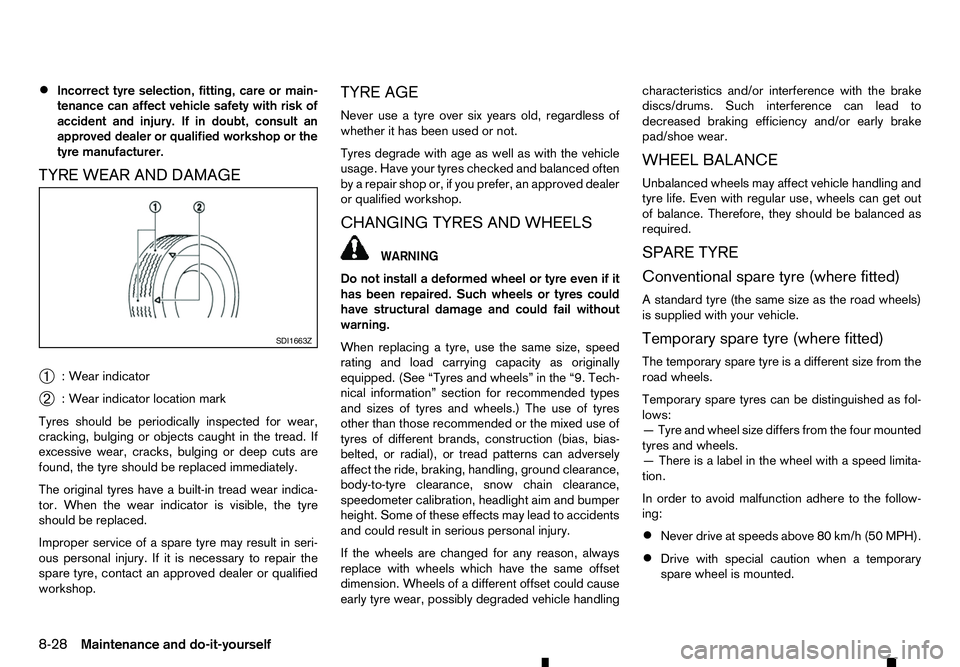
TYRE WEAR AND DAMAGE
➀ :W
ear indicator
➁ :W
ear indicator location mark
Tyres should be periodically inspected for wear,
cracking, bulging or objects caught in the tread. If
excessive wear, cracks, bulging or deep cuts are
found, the tyre should be replaced immediately.
The original tyres have abuilt-in tread wear indica-
tor. When the wear indicator is visible, the tyre
should be replaced.
Improper service of aspare tyre may result in seri-
ous personal injury. If it is necessary to repair the
spare tyre, contact an approved dealer or qualified
workshop. TYRE AGE
Never use
atyre over six years old, regardless of
whether it has been used or not.
Tyres degrade with age as well as with the vehicle
usage. Have your tyres checked and balanced often
by arepair shop or, if you prefer, an approved dealer
or qualified workshop.
CHANGING TYRES AND WHEELS WARNING
Do not install
adeformed wheel or tyre even if it
has been repaired. Such wheels or tyres could
have structural damage and could fail without
warning.
When replacing atyre, use the same size, speed
rating and load carrying capacity as originally
equipped. (See “Tyres and wheels” in the “9. Tech-
nical information” section for recommended types
and sizes of tyres and wheels.) The use of tyres
other than those recommended or the mixed use of
tyres of different brands, construction (bias, bias-
belted, or radial), or tread patterns can adversely
affect the ride, braking, handling, ground clearance,
body-to-tyre clearance, snow chain clearance,
speedometer calibration, headlight aim and bumper
height. Some of these effects may lead to accidents
and could result in serious personal injury.
If the wheels are changed for any reason, always
replace with wheels which have the same offset
dimension. Wheels of adifferent offset could cause
early tyre wear, possibly degraded vehicle handling characteristics and/or interference with the brake
discs/drums. Such interference can lead to
decreased braking efficiency and/or early brake
pad/shoe wear.
WHEEL BALANCE
Unbalanced wheels may affect vehicle handling and
tyre life. Even with regular use, wheels can get out
of balance. Therefore, they should be balanced as
required.
SPARE TYRE
Conventional spare tyre (where fitted)
As tandard tyre (the same size as the road wheels)
is supplied with your vehicle.
Temporary spare tyre (where fitted)
The temporary spare tyre is adifferent size from the
road wheels.
Temporary spare tyres can be distinguished as fol-
lows:
—T yre and wheel size differs from the four mounted
tyres and wheels.
—T here is alabel in the wheel with aspeed limita-
tion.
In order to avoid malfunction adhere to the follow-
ing:
• Never drive at speeds above 80 km/h (50 MPH).
• Drive with special caution when
atemporary
spare wheel is mounted. SDI1663Z
8-28 Maintenance and do-it-yourself
Page 324 of 340
–B
ooster ........................................................................V
... 8-9
–C hecking footbrake ......................................................... 8-9
–C hecking parking brake ................................................... 8-9
–E lectronic Stability Programme (ESP) ............................ 5-33
–F luid ....................................................................... 8-10, 9-2
–P ad wear warning ........................................................... 8-9
–P recautions ................................................................... 5-49
C Capacities and recommendations
–B rake and clutch fluid ...................................................... 9-2
–C oolant ........................................................................V
... 9-2
–F uel ........................................................................V
......... 9-2
–O il ........................................................................V
........... 9-2
–R efrigerant ...................................................................... 9-2
Cargo
–B ed ........................................................................V
....... 3-20
Changing
–E ngine oil filter ................................................................. 8-7
–F lat tyre ........................................................................V
... 6-3
Checking
–B attery fluid level ........................................................... 8-13
–B rake pedal ..................................................................... 8-9
–E ngine oil level ................................................................ 8-6
–P arking brake .................................................................. 8-9
Child restraints .................................................................... 1-14
–A nchorage ........................................................... 1-20, 1-21
–I SOFIX ........................................................ 1-18, 1-19, 1-22
–P recautions ................................................................... 1-14
–S eat belt installation ....................................................... 1-24
–U niversal child restraints (front and rear seats) ............... 1-15
Child safety
–S eat belts ...................................................................... 1-11
Cleaning
–C hrome parts .................................................................. 7-3 –E
xterior ........................................................................V
.... 7-2
–F loor mats ....................................................................... 7-4
–G lass ....................................................................... 7-3, 7-4
–H eadlights ..................................................................... 2-35
–I nterior ........................................................................V
.... 7-3
–S eat belts ........................................................................V
7-4
–U nderbody ...................................................................... 7-3
–W ashing ........................................................................V
.. 7-2
–W axing ........................................................................V
.... 7-2
–W heels ........................................................................V
.... 7-3
–W indow washer nozzle .................................................. 8-16
Clock ........................................................................V
.......... 2-30
Clutch
–F luid ....................................................................... 8-11, 9-2
Cockpit
–O verview ........................................................................V
. 0-6
Cold weather ...................................................................... 5-51
–B attery ........................................................................V
.. 5-51
–C orrosion protection ...................................................... 5-52
–E ngine coolant ............................................................... 5-51
–P arking brake ................................................................ 5-52
–T yre equipment .............................................................. 5-51
–W inter equipment .......................................................... 5-52
Compass
–V ehicle information display ............................................. 2-23
Console box ........................................................................V
2-39
Console side pockets .......................................................... 2-40
Coolant
–C apacity ........................................................................V
.. 9-2
–C hanging engine coolant ................................................. 8-6
–C hecking coolant level ..................................................... 8-6
–C old weather ................................................................ 5-51
–E ngine cooling system ..................................................... 8-5
Corrosion protection ............................................................. 7-5
–C old weather ................................................................ 5-52
–E nvironmental factors ...................................................... 7-5
10-2 Index
Page 326 of 340
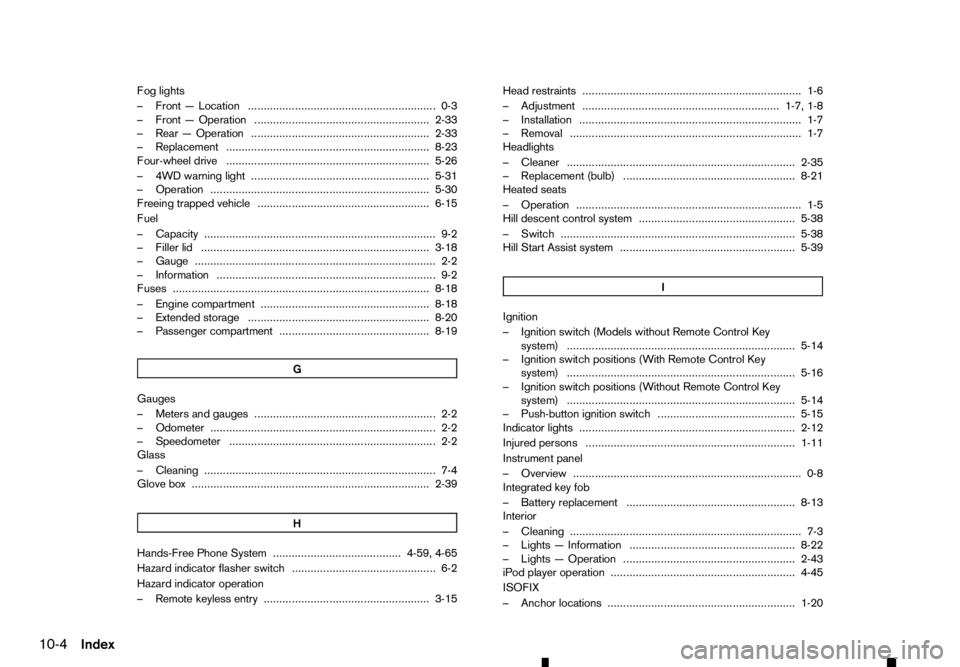
Fog lights
–F ront—Location ............................................................ 0-3
–F ront—O peration ........................................................ 2-33
–R ear—O peration ......................................................... 2-33
–R eplacement ................................................................. 8-23
Four-wheel drive ................................................................. 5-26
–4 WD warning light ......................................................... 5-31
–O peration ...................................................................... 5-30
Freeing trapped vehicle ....................................................... 6-15
Fuel
–C apacity ........................................................................V
.. 9-2
–F iller lid ........................................................................V
. 3-18
–G auge ........................................................................V
..... 2-2
–I nformation ...................................................................... 9-2
Fuses ........................................................................V
.......... 8-18
–E ngine compartment ...................................................... 8-18
–E xtended storage .......................................................... 8-20
–P assenger compartment ................................................ 8-19
G Gauges
–M
eters and gauges .......................................................... 2-2
–O dometer ........................................................................V
2-2
–S peedometer .................................................................. 2-2
Glass
–C leaning ........................................................................V
.. 7-4
Glove box ........................................................................V
.... 2-39
HHands-Free Phone System ......................................... 4-59, 4-65
Hazard indicator flasher switch .............................................. 6-2
Hazard indicator operation
–R emote keyless entry ..................................................... 3-15 Head restraints ...................................................................... 1-6
–A
djustment ............................................................... 1-7, 1-8
–I nstallation ....................................................................... 1-7
–R emoval ........................................................................V
.. 1-7
Headlights
–C leaner ........................................................................V
. 2-35
–R eplacement (bulb) ....................................................... 8-21
Heated seats
–O peration ........................................................................V
1-5
Hill descent control system .................................................. 5-38
–S witch ........................................................................V
... 5-38
Hill Start Assist system ........................................................ 5-39
I Ignition
–I
gnition switch (Models without Remote Control Key
system) ........................................................................V
. 5-14
–I gnition switch positions (With Remote Control Key
system) ........................................................................V
. 5-16
–I gnition switch positions (Without Remote Control Key
system) ........................................................................V
. 5-14
–P ush-button ignition switch ............................................ 5-15
Indicator lights ..................................................................... 2-12
Injured persons ................................................................... 1-11
Instrument panel
–O verview ........................................................................V
. 0-8
Integrated key fob
–B attery replacement ...................................................... 8-13
Interior
–C leaning ........................................................................V
.. 7-3
–L ights —Information ..................................................... 8-22
–L ights —Operation ....................................................... 2-43
iPod player operation ........................................................... 4-45
ISOFIX
–A nchor locations ............................................................ 1-20
10-4 Index
Page 327 of 340
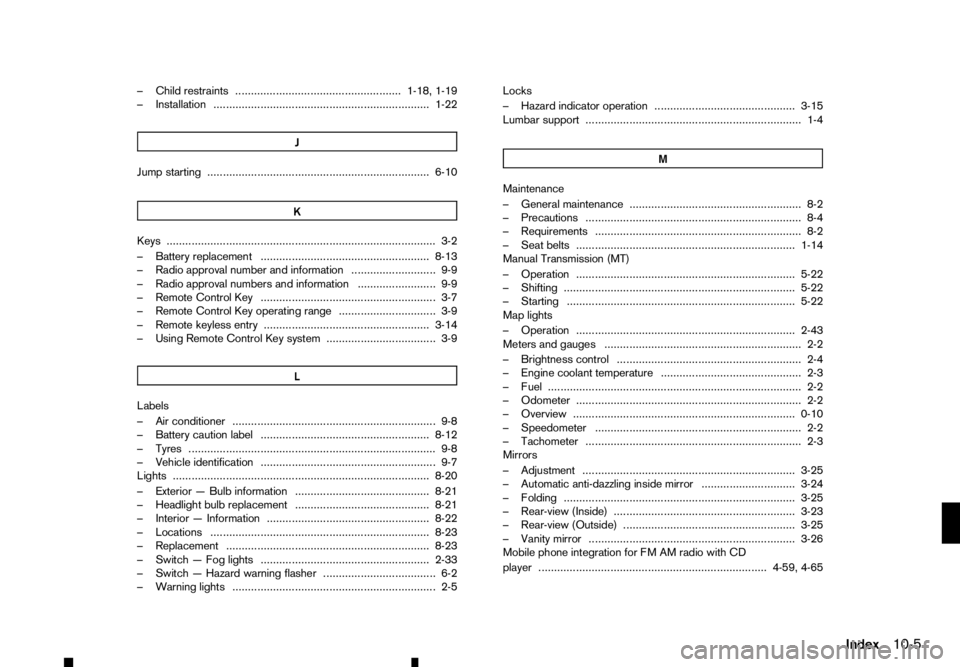
–C
hild restraints ..................................................... 1-18, 1-19
–I nstallation ..................................................................... 1-22
J Jump starting ....................................................................... 6-10
K Keys ........................................................................V
.............. 3-2
–B attery replacement ...................................................... 8-13
–R adio approval number and information ........................... 9-9
–R adio approval numbers and information ......................... 9-9
–R emote Control Key ........................................................ 3-7
–R emote Control Key operating range ............................... 3-9
–R emote keyless entry ..................................................... 3-14
–U sing Remote Control Key system ................................... 3-9
L Labels
–A
ir conditioner ................................................................. 9-8
–B attery caution label ...................................................... 8-12
–T yres ........................................................................V
....... 9-8
–V ehicle identification ........................................................ 9-7
Lights ........................................................................V
.......... 8-20
–E xterior —Bulb information ........................................... 8-21
–H eadlight bulb replacement ........................................... 8-21
–I nterior —Information .................................................... 8-22
–L ocations ...................................................................... 8-23
–R eplacement ................................................................. 8-23
–S witch —Fog lights ...................................................... 2-33
–S witch —Hazard warning flasher .................................... 6-2
–W arning lights ................................................................. 2-5 Locks
–H
azard indicator operation ............................................. 3-15
Lumbar support ..................................................................... 1-4
M Maintenance
–G
eneral maintenance ....................................................... 8-2
–P recautions ..................................................................... 8-4
–R equirements .................................................................. 8-2
–S eat belts ...................................................................... 1-14
Manual Transmission (MT)
–O peration ...................................................................... 5-22
–S hifting ........................................................................V
.. 5-22
–S tarting ........................................................................V
. 5-22
Map lights
–O peration ...................................................................... 2-43
Meters and gauges ............................................................... 2-2
–B rightness control ........................................................... 2-4
–E ngine coolant temperature ............................................. 2-3
–F uel ........................................................................V
......... 2-2
–O dometer ........................................................................V
2-2
–O verview ....................................................................... 0-10
–S peedometer .................................................................. 2-2
–T achometer ..................................................................... 2-3
Mirrors
–A djustment .................................................................... 3-25
–A utomatic anti-dazzling inside mirror .............................. 3-24
–F olding ........................................................................V
.. 3-25
–R ear-view (Inside) .......................................................... 3-23
–R ear-view (Outside) ....................................................... 3-25
–V anity mirror .................................................................. 3-26
Mobile phone integration for FM AM radio with CD
player ........................................................................V
. 4-59, 4-65
Index10-5