Eco button RENAULT CAPTUR 2017 1.G Owner's Manual
[x] Cancel search | Manufacturer: RENAULT, Model Year: 2017, Model line: CAPTUR, Model: RENAULT CAPTUR 2017 1.GPages: 248, PDF Size: 6.56 MB
Page 137 of 248
3.9
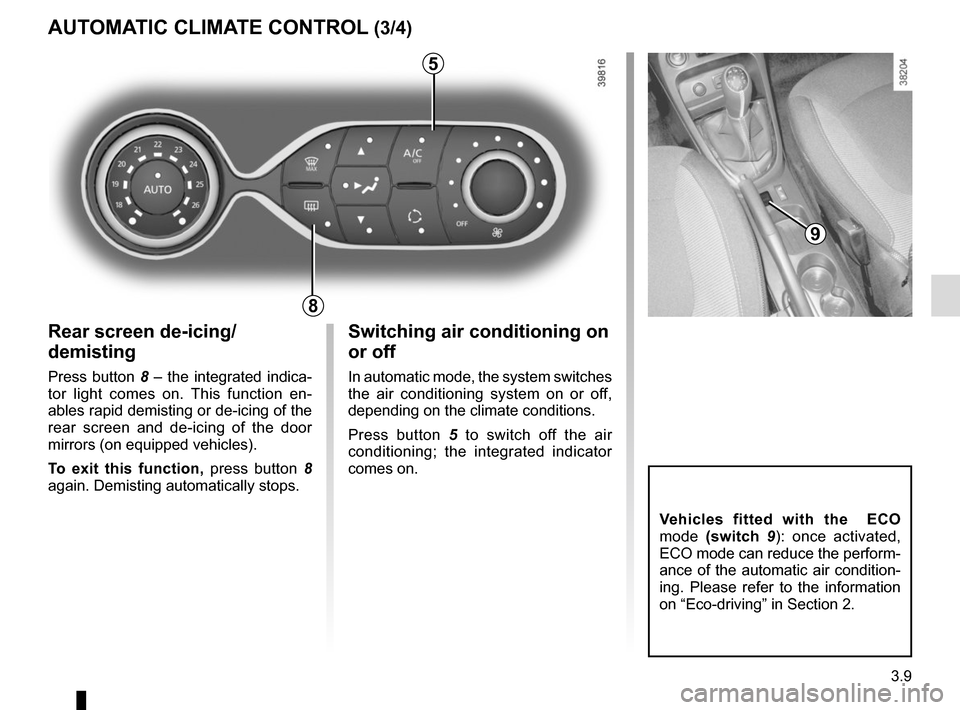
Rear screen de-icing/
demisting
Press button 8 – the integrated indica-
tor light comes on. This function en-
ables rapid demisting or de-icing of the
rear screen and de-icing of the door
mirrors (on equipped vehicles).
To exit this function, press button 8
again. Demisting automatically stops.
AUTOMATIC CLIMATE CONTROL (3/4)
8
Switching air conditioning on
or off
In automatic mode, the system switches
the air conditioning system on or off,
depending on the climate conditions.
Press button 5 to switch off the air
conditioning; the integrated indicator
comes on.
5
Vehicles fitted with the ECO
mode (switch 9): once activated,
ECO mode can reduce the perform-
ance of the automatic air condition-
ing. Please refer to the information
on “Eco-driving” in Section 2.
9
Page 164 of 248
4.4
– remove the dipstick and wipe with a clean, lint-free cloth;
– push the dipstick in as far as it will go (for vehicles equipped with a cap-
type dipstick C, screw the cap in as
far as it will go);
– take out the dipstick again;
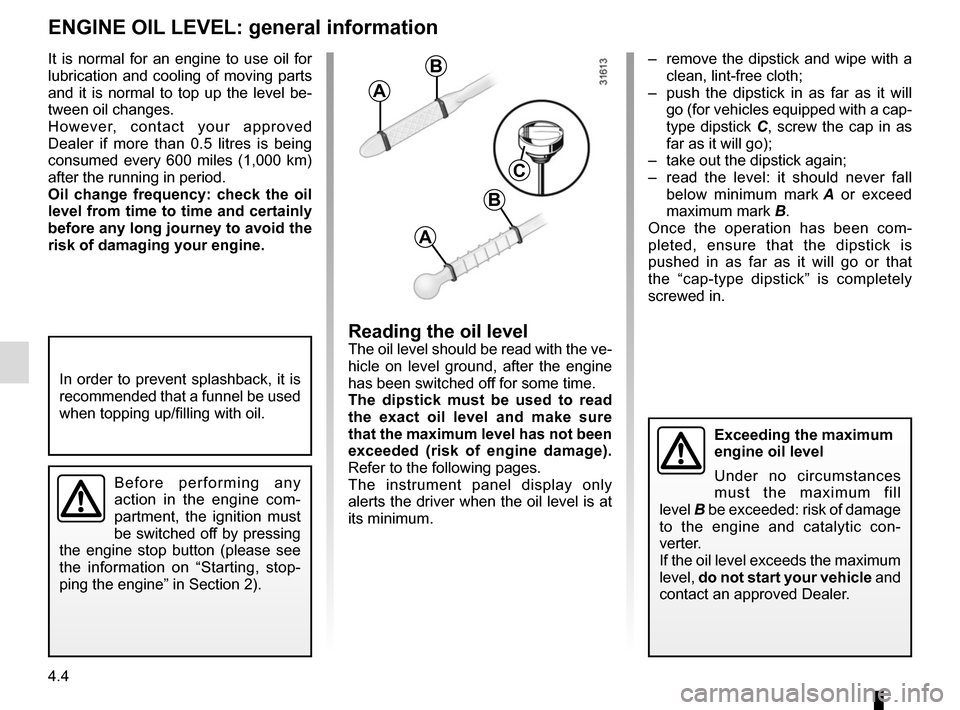
– read the level: it should never fall below minimum mark A or exceed
maximum mark B.
Once the operation has been com-
pleted, ensure that the dipstick is
pushed in as far as it will go or that
the “cap-type dipstick” is completely
screwed in.
Reading the oil levelThe oil level should be read with the ve-
hicle on level ground, after the engine
has been switched off for some time.
The dipstick must be used to read
the exact oil level and make sure
that the maximum level has not been
exceeded (risk of engine damage).
Refer to the following pages.
The instrument panel display only
alerts the driver when the oil level is at
its minimum.
It is normal for an engine to use oil for
lubrication and cooling of moving parts
and it is normal to top up the level be-
tween oil changes.
However, contact your approved
Dealer if more than 0.5 litres is being
consumed every 600 miles (1,000 km)
after the running in period.
Oil change frequency: check the oil
level from time to time and certainly
before any long journey to avoid the
risk of damaging your engine.
ENGINE OIL LEVEL: general information
A
B
A
B
C
In order to prevent splashback, it is
recommended that a funnel be used
when topping up/filling with oil.
Before performing any
action in the engine com-
partment, the ignition must
be switched off by pressing
the engine stop button (please see
the information on “Starting, stop-
ping the engine” in Section 2).
Exceeding the maximum
engine oil level
Under no circumstances
must the maximum fill
level B be exceeded: risk of damage
to the engine and catalytic con-
verter.
If the oil level exceeds the maximum
level, do not start your vehicle and
contact an approved Dealer.
Page 165 of 248
4.5
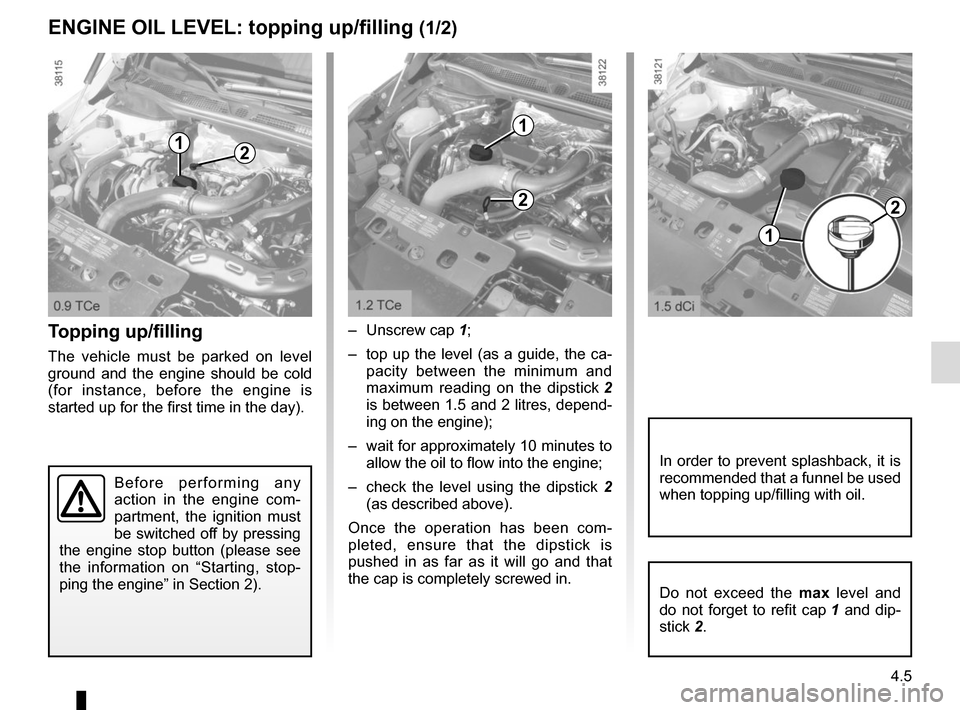
Topping up/filling
The vehicle must be parked on level
ground and the engine should be cold
(for instance, before the engine is
started up for the first time in the day).– Unscrew cap
1;
– top up the level (as a guide, the ca- pacity between the minimum and
maximum reading on the dipstick 2
is between 1.5 and 2 litres, depend-
ing on the engine);
– wait for approximately 10 minutes to allow the oil to flow into the engine;
– check the level using the dipstick 2
(as described above).
Once the operation has been com-
pleted, ensure that the dipstick is
pushed in as far as it will go and that
the cap is completely screwed in.
ENGINE OIL LEVEL: topping up/filling (1/2)
12
Do not exceed the max level and
do not forget to refit cap 1 and dip-
stick 2.
In order to prevent splashback, it is
recommended that a funnel be used
when topping up/filling with oil.
2
1
1
2
Before performing any
action in the engine com-
partment, the ignition must
be switched off by pressing
the engine stop button (please see
the information on “Starting, stop-
ping the engine” in Section 2).
Page 187 of 248
5.5
TYRE PRESSURE KIT (2/3)
Depending on the vehicle, in the event
of a puncture, use the kit located in the
boot or underneath the luggage com-
partment carpet.
Vehicle fitted with a tyre pressure
loss warning system
If under-inflated (puncture, low pres-
sure, etc.), the warning light
lights up on the instrument panel. See
“Tyre pressure loss warning” in
Section 2.
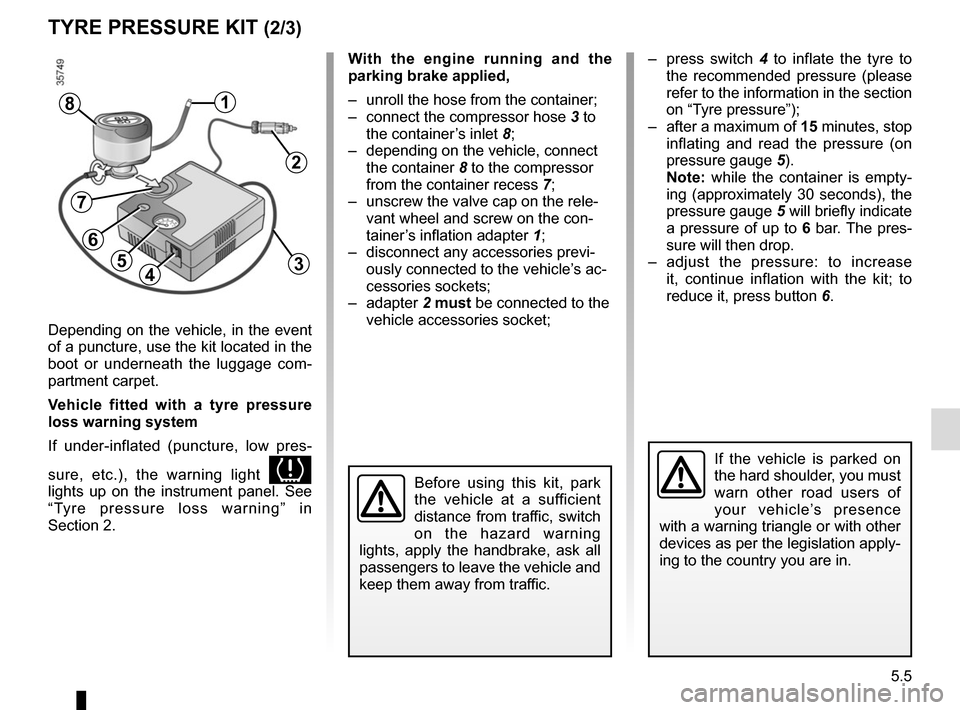
With the engine running and the
parking brake applied,
– unroll the hose from the container;
– connect the compressor hose 3 to
the container’s inlet 8;
– depending on the vehicle, connect the container 8 to the compressor
from the container recess 7;
– unscrew the valve cap on the rele- vant wheel and screw on the con-
tainer’s inflation adapter 1;
– disconnect any accessories previ- ously connected to the vehicle’s ac-
cessories sockets;
– adapter 2 must be connected to the
vehicle accessories socket;
45
1
Before using this kit, park
the vehicle at a sufficient
distance from traffic, switch
on the hazard warning
lights, apply the handbrake, ask all
passengers to leave the vehicle and
keep them away from traffic.
8
If the vehicle is parked on
the hard shoulder, you must
warn other road users of
your vehicle’s presence
with a warning triangle or with other
devices as per the legislation apply-
ing to the country you are in.
– press switch 4 to inflate the tyre to
the recommended pressure (please
refer to the information in the section
on “Tyre pressure”);
– after a maximum of 15 minutes, stop inflating and read the pressure (on
pressure gauge 5).
Note: while the container is empty-
ing (approximately 30 seconds), the
pressure gauge 5 will briefly indicate
a pressure of up to 6 bar. The pres-
sure will then drop.
– adjust the pressure: to increase it, continue inflation with the kit; to
reduce it, press button 6.
2
3
7
6
Page 210 of 248
5.28
BATTERY: breakdown recovery (1/2)
To avoid all risk of sparks:
– Ensure that any electrical consumers (courtesy lights, etc.) are switched
off before disconnecting or recon-
necting the battery.
– When charging, stop the charger before connecting or disconnecting
the battery.
– Do not place metal objects on the battery to avoid creating a short cir-
cuit between the terminals.
– Always wait at least one minute after the engine has been switched off
before disconnecting a battery.
– Make sure that you reconnect the battery terminals after refitting.
Connecting a battery charger
The battery charger must be com-
patible with a battery with nominal
voltage of 12 volts.
Do not disconnect the battery when the
engine is running. Follow the instruc-
tions given by the manufacturer of
the battery charger you are using.
Special procedures may be
required to charge some
batteries. Contact your ap-
proved dealer.
Avoid all risk of sparks which may
cause an immediate explosion, and
charge the battery in a well-venti-
lated area. Risk of serious injury.
Handle the battery with care
as it contains sulphuric acid,
which must not come into
contact with eyes or skin. If
it does, wash the affected area with
plenty of cold water. If necessary,
consult a doctor.
Ensure that naked flames, red hot
objects and sparks do not come into
contact with the battery as there is a
risk of explosion.
The engine may be hot when car-
rying out operations in close prox-
imity. In addition, the engine cooling
fan can come on at any moment.
Risk of injury.
Before performing any
action in the engine com-
partment, the ignition must
be switched off by pressing
the engine stop button (please see
the information on “Starting, stop-
ping the engine” in Section 2).
Page 213 of 248
5.31
WINDSCREEN WIPER BLADES (1/2)
Check the condition of the wiper
blades. You are responsible for their
service life:
– clean the blades, windscreen and rear screen regularly with soapy
water;
– do not use them when the wind- screen or rear screen are dry;
– free them from the windscreen or rear screen when they have not
been used for a long time.
– In frosty weather, make
sure that the wiper blades
are not stuck by ice (to
avoid the risk of the motor
overheating).
– Check the condition of the wiper
blades.
They should be replaced as soon
as they become less efficient: ap-
proximately once a year.
When changing the blade, when it
has been removed, do not let the
wiper arm fall against the window:
risk of breaking the window.
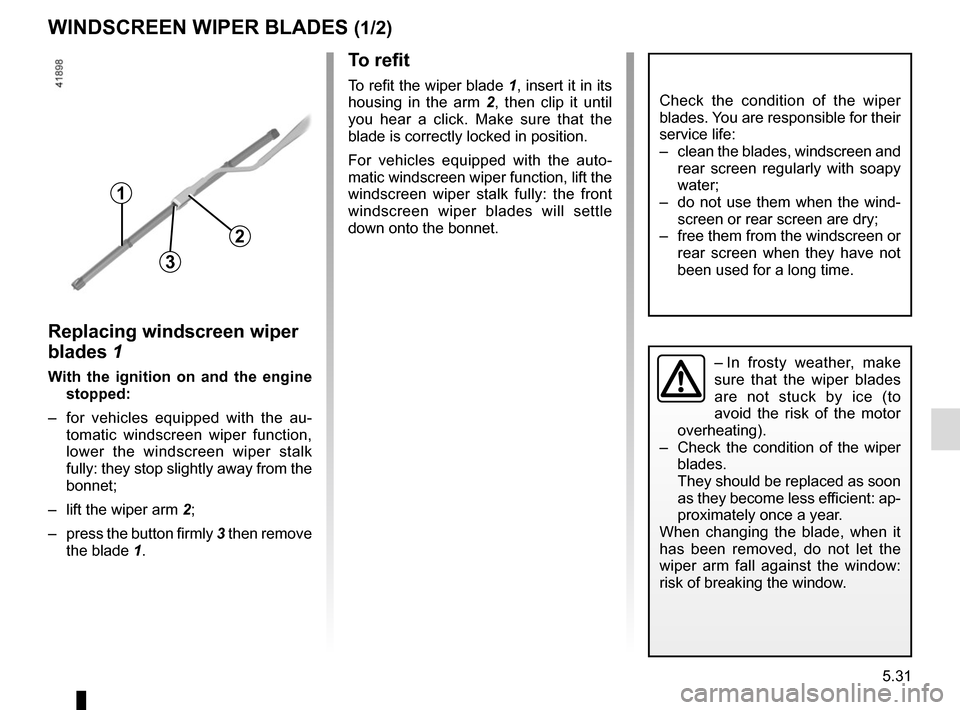
To refit
To refit the wiper blade 1, insert it in its
housing in the arm 2, then clip it until
you hear a click. Make sure that the
blade is correctly locked in position.
For vehicles equipped with the auto-
matic windscreen wiper function, lift the
windscreen wiper stalk fully: the front
windscreen wiper blades will settle
down onto the bonnet.
Replacing windscreen wiper
blades 1
With the ignition on and the engine stopped:
– for vehicles equipped with the au- tomatic windscreen wiper function,
lower the windscreen wiper stalk
fully: they stop slightly away from the
bonnet;
– lift the wiper arm 2;
– press the button firmly 3 then remove the blade 1.
2
1
3
Page 215 of 248
5.33
TOWING: breakdown recovery (1/2)
Before towing, unlock the steering
column: with the clutch depressed,
engage first gear (lever in position N
or R for vehicles with automatic gear-
boxes), insert the RENAULT card in the
card reader, then press the engine start
button for two seconds.
Reposition the lever to neutral (posi-
tion N for vehicles fitted with an auto-
matic gearbox).
The column is unlocked, the acces-
sory functions are supplied: the vehi-
cle lights can be used (indicators, brake
lights etc.). At night the vehicle must
have its lights on.
Once you have finished towing, press
the engine start button twice (risk of
running down the battery). The speed specified by current legis-
lation for towing must always be ob-
served. If your vehicle is the towing
vehicle, do not exceed the maximum
towing weight for your vehicle (refer to
the information on “Weights” in Section
6).
Towing a vehicle with an
automatic gearbox
With the engine switched off, the trans-
mission is no longer lubricated. It is
preferable to tow this type of vehicle on
a trailer or tow it with the front wheels
off the ground.
Under
exceptional circumstances, you
may tow the vehicle with all four wheels
on the ground, only going forward, with
the gear lever in the neutral N position,
and for a distance not exceeding
30 miles (50 km).
Do not remove the
RENAULT card from the
reader when the vehicle is
being towed.
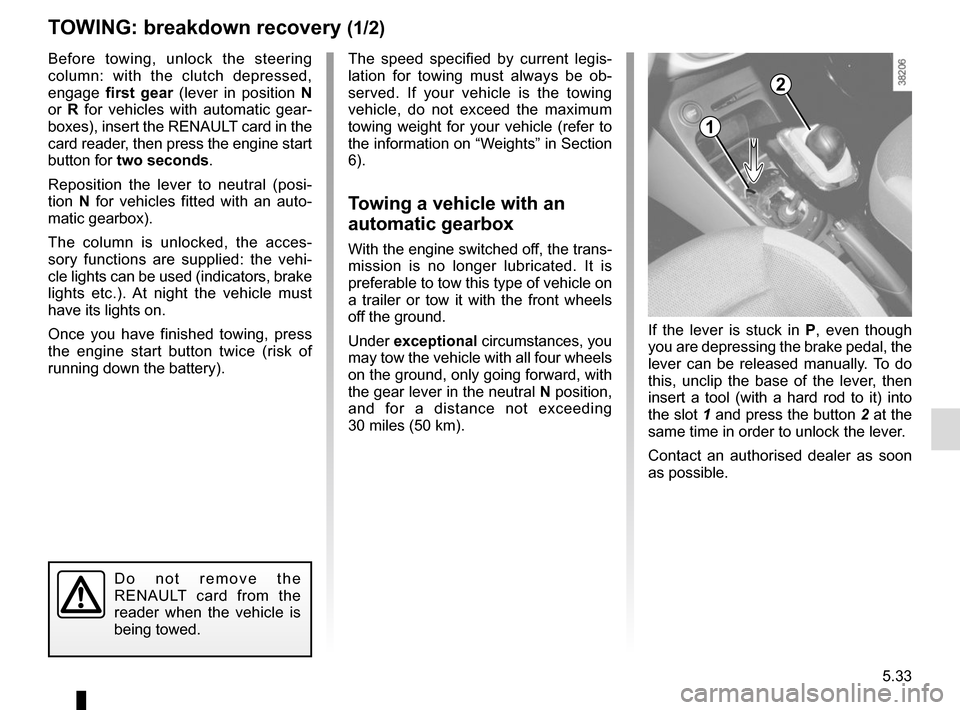
1
2
If the lever is stuck in P , even though
you are depressing the brake pedal, the
lever can be released manually. To do
this, unclip the base of the lever, then
insert a tool (with a hard rod to it) into
the slot 1 and press the button 2 at the
same time in order to unlock the lever.
Contact an authorised dealer as soon
as possible.
Page 218 of 248
5.36
OPERATING FAULTS (2/6)
The starter is activatedPOSSIBLE CAUSES WHAT TO DO
The instrument panel indicator lights are
weak or fail to light up and the starter
does not turn. Battery terminals not tight,
battery terminals discon-
nected or oxidised.Retighten or reconnect the terminals, or clean them if
they are oxidised.
Discharged battery or not
operational. Connect another battery to the faulty battery. Refer to
information on “Battery: troubleshooting” in Section 5
or replace the battery if necessary.
Do not push the vehicle if the steering column is
locked.
Faulty circuit. Consult an approved dealer.
The engine will not start. Starting conditions are not
fulfilled.Please refer to the information on “Starting, stopping
the engine” in Section 2.
The RENAULT “hands-free”
card does not work. Insert the card in the card reader in order to start the
engine.
Please refer to the information on “Starting, stopping
the engine” in Section 2.
The engine cannot be switched off. Card not detected. Insert the card in card reader.
Electronic fault. Press the starter button quickly five times.
The steering column remains locked. Steering wheel locked. Move the steering wheel while pressing the engine
start button (please refer to Section 2 “Starting, stop-
ping the engine”).
Faulty circuit. Consult an approved dealer.
Page 242 of 248
7.2
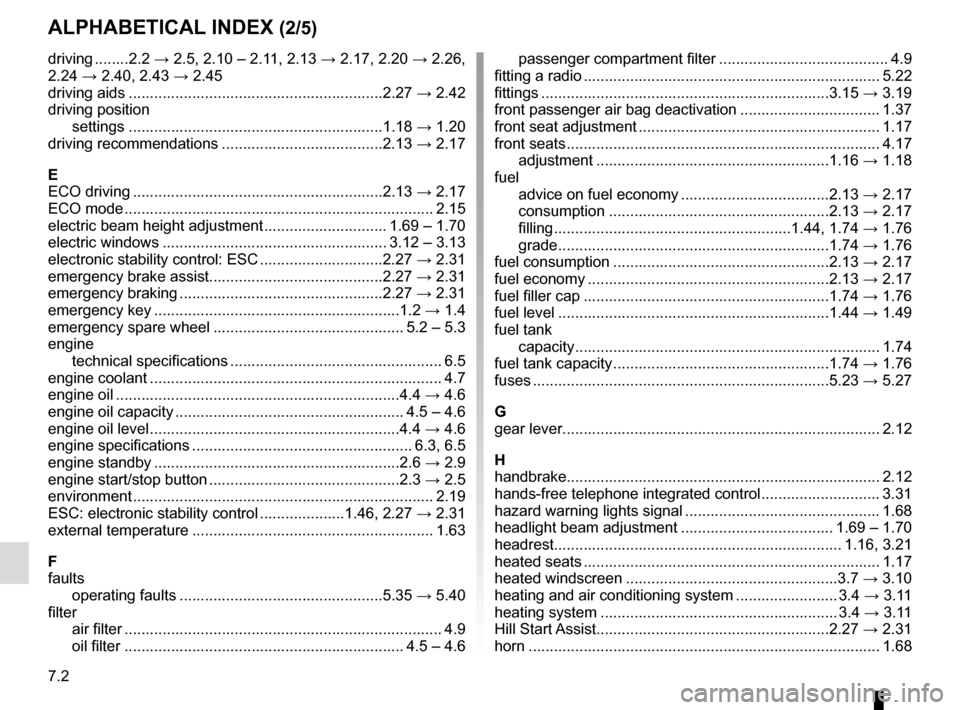
ALPHABETICAL INDEX (2/5)
driving ........2.2 → 2.5, 2.10 – 2.11, 2.13 → 2.17, 2.20 → 2.26,
2.24 → 2.40, 2.43 → 2.45
driving aids ............................................................2.27 → 2.42
driving position settings ............................................................1.18 → 1.20
driving recommendations ......................................2.13 → 2.17
E
ECO driving ...........................................................2.13 → 2.17
ECO mode ........................................................................\
. 2.15
electric beam height adjustment ............................. 1.69 – 1.70
electric windows ..................................................... 3.12 – 3.13
electronic stability control: ESC .............................2.27 → 2.31
emergency brake assist.........................................2.27 → 2.31
emergency braking ................................................2.27 → 2.31
emergency key ..........................................................1.2 → 1.4
emergency spare wheel ............................................. 5.2 – 5.3
engine technical specifications .................................................. 6.5
engine coolant ..................................................................... 4.7
engine oil ...................................................................4.4 → 4.6
engine oil capacity ...................................................... 4.5 – 4.6
engine oil level ...........................................................4.4 → 4.6
engine specifications .................................................... 6.3, 6.5
engine standby ..........................................................2.6 → 2.9
engine start/stop button .............................................2.3 → 2.5
environment ............................................................\
........... 2.19
ESC: electronic stability control ....................1.46, 2.27 → 2.31
external temperature ......................................................... 1.63
F
faults operating faults ................................................5.35 → 5.40
filter air filter ........................................................................\
... 4.9
oil filter .................................................................. 4.5 – 4.6 passenger compartment filter ........................................ 4.9
fitting a radio ...................................................................... 5.22
fittings ...............................................................\
.....3.15 → 3.19
front passenger air bag deactivation ................................. 1.37
front seat adjustment ......................................................... 1.17
front seats ........................................................................\
.. 4.17 adjustment .......................................................1.16 → 1.18
fuel advice on fuel economy ...................................2.13 → 2.17
consumption ....................................................2.13 → 2.17
filling ........................................................1.44, 1.74 → 1.76
grade ................................................................1.74 → 1.76
fuel consumption ...................................................2.13 → 2.17
fuel economy .........................................................2.13 → 2.17
fuel filler cap ..........................................................1.74 → 1.76
fuel level ................................................................1.44 → 1.49
fuel tank capacity ...............................................................\
......... 1.74
fuel tank capacity ...................................................1.74 →
1.76
fuses ..................................................................\
....5.23 → 5.27
G
gear lever
........................................................................\
... 2.12
H
handbrake........................................................................\
.. 2.12
hands-free telephone integrated control ............................ 3.31
hazard warning lights signal .............................................. 1.68
headlight beam adjustment .................................... 1.69 – 1.70
headrest.................................................................... 1.16, 3.21
heated seats ...................................................................... 1.17
heated windscreen ..................................................3.7 → 3.10
heating and air conditioning system ........................ 3.4 → 3.11
heating system ........................................................ 3.4 → 3.11
Hill Start Assist.......................................................2.27 → 2.31
horn ...................................................................\
................ 1.68