seats RENAULT CAPTUR 2018 User Guide
[x] Cancel search | Manufacturer: RENAULT, Model Year: 2018, Model line: CAPTUR, Model: RENAULT CAPTUR 2018Pages: 258, PDF Size: 7.15 MB
Page 42 of 258

1.36
CHILD SAFETY: fitting a child seat (2/4)
In the rear side seat
A carrycot can be installed across the
vehicle and will take up at least two
seats.
Position the child with their feet nearest
the door.
Move the front seat as far forward as
possible to install a rear-facing child
seat, then move back the seat in front
as far as it will go, although without al-
lowing it to come into contact with the
child seat.
For the safety of the child in the for-
ward-facing position:
– Move the relevant seat backwards as far as possible;
– Move the seat in front of the child forwards, and set the position of the
seatback to avoid contact between
the seat and the child’s legs.
Always remove the headrest from the
rear seat used for the child seat (see
“Rear headrests” in Section 3). If nec-
essary, position the rear seat as far
back as possible. This must be done
before fitting the child seat. Check that
the child seat is resting against the
back of the vehicle seat.
Fit the child seat in a rear
seat wherever possible.
Fitting a seat ISOFIX in
the rear-left seat means
the middle seat cannot be used.
The central seat belt will no longer
be either accessible or useable. To
install an ISOFIX seat in this seat,
detach the central seat belt by hand
before engaging the bolts.
A child seat with floor sup-
ports must never be in-
stalled on the rear centre
seat.
RISK OF DEATH OR SERIOUS
INJURY.
Page 43 of 258

1.37
³ Check the status of the airbag
before fitting a child seat or allowing a
passenger to use the seat.
CHILD SAFETY: fitting a child seat (3/4)
Child seat attached using the belt
¬ Seat which allows a seat with
“universal” approval to be fitted using a
seat belt;
− Seat which allows a rearfac-
ing seat with “universal” approval only
to be attached with a seat belt.
Using a child safety system which is not approved for this vehicle will \
not
correctly protect the baby or child. They risk serious or even fatal injury.
RISK OF DEATH OR
SERIOUS INJURY: Before
installing a child seat on the
front passenger seat, check
that the airbag has been deacti-
vated (please refer to “Child safety:
front passenger airbag deactivation
and activation” in Section 1).
Fitting diagramChild seat attached using the ISOFIX
mounting
ü Seat which allows an ISOFIX
child seat to be fitted.
±The seats ISOFIX are fitted with
an anchorage point which allows a
forward-facing ISOFIX child seat with
“Universal” approval to be attached.
The anchorage points
are located
in the boot for the rear seats, and on the
seatbacks for the front seats.
The size of the ISOFIX child seat is in-
dicated by a letter:
– A, B and B1: for forward-facing seats in group 1 (9 to 18 kg);
– C and D: shell seat or rear-facing seats in group 0+ (less than 13 kg)
or group 1 (9 to 18 kg);
– E: rear-facing shell seats in group 0 (less than 10 kg) or 0+ (less than
13 kg);
– F and G: carrycots in group 0 (less than 10 kg).
Page 44 of 258

The table below summarises the information already shown on the diagram \
on the previous page, to ensure the regula-
tions in force are respected.
Type o")
1.38
CHILD SAFETY: fitting a child seat (4/4)
The table below summarises the information already shown on the diagram \
on the previous page, to ensure the regula-
tions in force are respected.
Type of child seatWeight of
the child Seat sizeFront passenger
seat (5) (1) Rear side seats Rear centre
seat
Carrycot fitted across the
vehicle
Group 0 < 10 kg F, G X U (2) X
Rear-facing shell seat
Group 0 or 0+ < 10 kg and
< 13 kg
E U - IL U - IL (3) X
rear-facing seat
Group 0+ and 1 < 13 kg and 9 to
18 kg
C, D U - IL U - IL (3) X
Forward-facing seat
Group 1 9 to 18 kg A, B, B1 IUF - IL U - IUF - IL (4) X
Booster seat
Group 2 and 3 15 to 25 kg and
22 to 36 kg
- X U (4) X
X = Seat not suitable for fitting child seats.
U = Seat which allows a child seat with “Universal” approval to be ins\
talled using a seat belt; check that it can be fitted.
IUF/IL = On equipped vehicles, seat which allows an approved “Universal/semi-u\
niversal or vehicle specific” child seat to be at-
tached using the ISOFIX system; check that it can be fitted.
(1) raise the seat to the maximum and position it as far back as possi\
ble, tilting the seatback slightly (approximately 25°).
(2) A carrycot can be installed across the vehicle and will take up at least \
two seats. Position the child with their feet nearest the
door.
(3) Move the front seat as far forward as possible to install a rear-facing \
child seat, then move back the seat in front as far as it will
go, although without allowing it to come into contact with the child sea\
t.
(4) Forward-facing child seat; position the seatback of the child seat in co\
ntact with the seatback of the vehicle seat. In all sit ua-
tions, remove the rear headrest of the seat on which the child seat is p\
ositioned. This must be done before fitting the child s eat.
Refer to the information on “Rear headrests” in Section 3.
(5) RISK OF DEATH OR SERIOUS INJURY: before installing a child seat on the front passenger seat, check that \
the
air bag has been deactivated (refer to “Child safety: front passenge\
r air bag deactivation/activation” Section 1).
Page 77 of 258
1.71
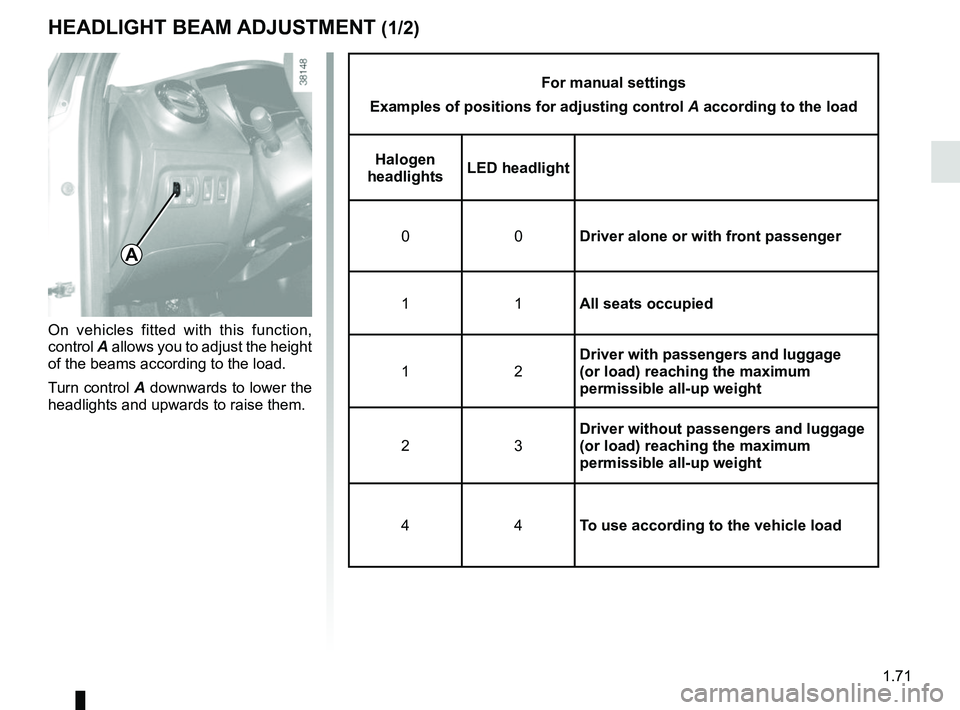
HEADLIGHT BEAM ADJUSTMENT (1/2)
On vehicles fitted with this function,
control A allows you to adjust the height
of the beams according to the load.
Turn control A downwards to lower the
headlights and upwards to raise them.
A
For manual settings
Examples of positions for adjusting control A according to the load
Halogen
headlights LED headlight
00 Driver alone or with front passenger
11 All seats occupied
12 Driver with passengers and luggage
(or load) reaching the maximum
permissible all-up weight
23 Driver without passengers and luggage
(or load) reaching the maximum
permissible all-up weight
44 To use according to the vehicle load
Page 147 of 258
3.13
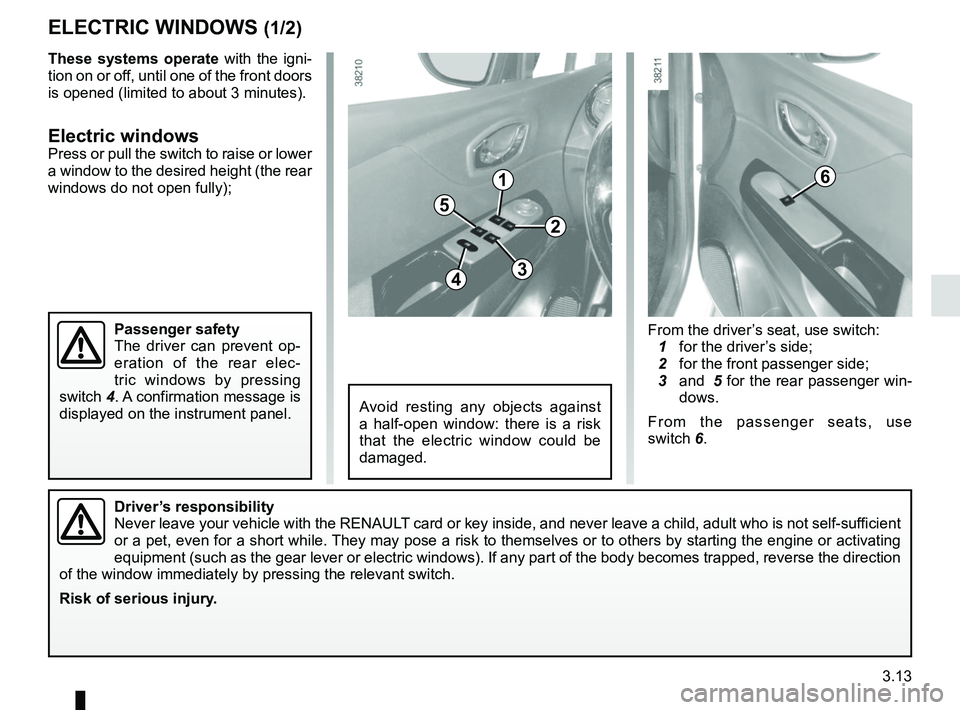
ELECTRIC WINDOWS (1/2)
1
2
34
5
6
From the driver’s seat, use switch:
1 for the driver’s side;
2 for the front passenger side;
3 and 5 for the rear passenger win-
dows.
From the passenger seats, use
switch 6.
Avoid resting any objects against
a half-open window: there is a risk
that the electric window could be
damaged.
Driver’s responsibility
Never leave your vehicle with the RENAULT card or key inside, and never leave a child, adult who is not self-sufficient
or a pet, even for a short while. They may pose a risk to themselves or to others by starting the engine o\
r activating
equipment (such as the gear lever or electric windows). If any part of\
the body becomes trapped, reverse the direction
of the window immediately by pressing the relevant switch.
Risk of serious injury.
These systems operate with the igni-
tion on or off, until one of the front doors
is opened (limited to about 3 minutes).
Electric windowsPress or pull the switch to raise or lower
a window to the desired height (the rear
windows do not open fully);
Passenger safety
The driver can prevent op-
eration of the rear elec-
tric windows by pressing
switch 4. A confirmation message is
displayed on the instrument panel.
Page 159 of 258

3.25
SLIDING REAR BENCH SEAT (1/2)
To move forwards or
backwards
To unlock the seat:
– in the rear, lift the two levers 1 simul-taneously;
– from the boot, pull the handle 2.
Move the seat forwards or back to the
required position.
Release lever 1 or handle 2 and make
sure that the seat is locked correctly in
position.
For safety reasons, carry
out any adjustments when
the vehicle is not being
driven.
1
When moving the rear
seats, ensure that nothing
obstructs the anchorage
points (passenger’s arm or
leg, a pet, gravel, cloth, toys, etc.).
2
Page 160 of 258

3.26
B
To fold down the seatback
Ensure that the front seats are far
enough forward.
Lower the headrests fully.
Place the seat belts in their guides A.
Lift the handle 3 and lower the seat-
back B.
Before moving the seatback, put
the seat belt in belt guide A to avoid
damaging it.
To replace the seatback, proceed in
the reverse order to removal.
Refit the seatback and click it back into
place.
For safety reasons, carry
out any adjustments when
the vehicle is not being
driven.
The configuration of the two-seat
bench with the small seatback B
pulled down, does not allow the
central seat to be used as it would
be impossible to buckle the seat belt
(belt buckles inaccessible).
When moving the rear
seats, ensure that nothing
obstructs the anchorage
points (passenger’s arm or
leg, a pet, gravel, cloth, toys, etc.).
When refitting the seat-
back, make sure it is cor-
rectly locked in place.
If seat covers are fitted ,
make sure these do not prevent the
seatback latch from locking in.
Make sure that the seat belts are
positioned correctly.
Reposition the headrests.
SLIDING REAR BENCH SEAT (2/2)
A
3
Page 165 of 258

3.31
Always position the heavi-
est items directly on the
floor. Use the lashing
points 1 on the boot floor, if
these are fitted to the vehicle. The
luggage should be loaded in such a
way that no items will be thrown for-
ward and strike the occupants if the
driver has to brake suddenly. Fasten
the rear seat belts, even if the seats
are not occupied.
TRANSPORTING OBJECTS IN THE LUGGAGE COMPARTMENT
Always position the objects transported
so that the largest surface is against:
– The rear bench seatback for normal loads (example A).
– The front seatbacks with the rear
seatbacks folded down, the mobile
floor in the flat-floor position (exam-
ple B).
– The front seatbacks with the rear seatbacks folded down, the mobile
floor in the stored-away position, as is
the case for maximum loads (exam-
ple C).
If you have to place objects on the folded
seatback, it is necessary that you lower
the headrests before folding the seat-
back so that it can be folded as flat as
possible against the seat.
B
A
1
C
Page 184 of 258

4.16
Glass instrument panel(e.g. instrument panel, clock, exterior
temperature display, radio display, etc.)
Use a soft cloth (or cotton wool).
If this does not clean them properly,
use a soft cloth (or cotton wool) slightly
moistened with soapy water and then
wipe clean with another soft damp cloth
or cotton wool.
Finally, carefully dry off with a soft dry
cloth.
Do not use products containing alco-
hol and/or spray fluids on the area.
Seat belts
These must be kept clean.
Use products selected by our Technical
Department (Approved outlets) or
warm, soapy water and a sponge and
wipe with a dry cloth.
Detergents or dyes must not be used
under any circumstances.
INTERIOR TRIM MAINTENANCE (1/2)
Textiles (seats, door trim, etc)
Vacuum-clean the textiles regularly.
Liquid stain
Use soapy water.
Dab lightly (never rub) with a soft cloth,
rinse and remove the excess.
Solid or pasty stain
Carefully remove the excess solid or
pasty material immediately with a
spatula (working from the edges to the
centre to avoid spreading the stain).
Clean as for a liquid stain.
Special instructions for sweets or
chewing gum
Put an ice cube on the stain to solidify
it, then proceed as for a solid stain.
A well-maintained vehicle will last
longer. It is therefore recommended to
maintain the interior of the vehicle regu-
larly.
A stain should always be dealt with
swiftly.
Whatever type of stain is on the trim,
use
cold (or warm) soapy water with
natural soap.
Detergents (washing-up liquid, pow-
dered products, alcohol-based prod-
ucts) should not be used.
Use a soft cloth.
Rinse and soak up the excess.
For further recommendations for
maintaining the interior, and/or for
any unsatisfactory results, please
see an authorised dealer.
Page 186 of 258

4.18
SEAT COVERINGS (1/5)
Depending on the vehicle, it is possible
to remove the seat covers (cleaning,
customisation, etc.).
Principle of seat cover
removal
Whether it’s for the back or the base,
always remove as shown in the pic-
ture above A : do not rip the self-grip
bands out.
Precautions in use
Once the covers are removed:
– do not use the seats;
– take care with the self-grip bands.
Washing instructions
Follow the washing instructions
shown on the seat covers (labels) in
particular;
– wash the seat covers separately from other materials;
– spin at a maximum speed of 800 rpm;
– do not wash them more than five times.
Once they are dry, do not fold the
seat covers and do not pile them up
(they may show marks).
Serious risk of deterioration.
For safety reasons, carry
out these operations when
the vehicle is stationary.
A
With the seat covers off,
ensure that the seatbelt
buckles and ISOFIX attach-
ments are clear.
Depending on the vehicle, certain
seat covers have markings to show
that the front passenger seat has
ISOFIX attachments. Make sure
when refitting or replacing the seat
cover that it has the same markings
as the original.