VIN RENAULT DUSTER 2016 Owner's Guide
[x] Cancel search | Manufacturer: RENAULT, Model Year: 2016, Model line: DUSTER, Model: RENAULT DUSTER 2016Pages: 256, PDF Size: 6.49 MB
Page 77 of 256

Running in, Ignition switch . . . . . . . . . . . . . . . . . . . . . . . . . . . . . . . . . . . . \
. . . . . . .")
2.1
Section 2: Driving
(Advice on use relating to fuel economy and the environment)
Running in, Ignition switch . . . . . . . . . . . . . . . . . . . . . . . . . . . . . . . . . . . . \
. . . . . . . . . . . . . . . . . . . . . 2.2
Starting/stopping the engine . . . . . . . . . . . . . . . . . . . . . . . . . . . . . . . . . . . .\
. . . . . . . . . . . . . . . . . . . 2.3
Stop and Start Function . . . . . . . . . . . . . . . . . . . . . . . . . . . . . . . . . . . . \
. . . . . . . . . . . . . . . . . . . . . . . 2.7
Special features of petrol versions . . . . . . . . . . . . . . . . . . . . . . . . . . . . . . . . . . . .\
. . . . . . . . . . . . . . 2.10
Special features of diesel versions . . . . . . . . . . . . . . . . . . . . . . . . . . . . . . . . . . . .\
. . . . . . . . . . . . . . 2.11
Special features of LPG versions . . . . . . . . . . . . . . . . . . . . . . . . . . . . . . . . . . . .\
. . . . . . . . . . . . . . . 2.12
Driving advice, eco-driving . . . . . . . . . . . . . . . . . . . . . . . . . . . . . . . . . . . .\
. . . . . . . . . . . . . . . . . . . . 2.15
Maintenance and antipollution advice . . . . . . . . . . . . . . . . . . . . . . . . . . . . . . . . . . . . \
. . . . . . . . . . . . 2.20
Environment . . . . . . . . . . . . . . . . . . . . . . . . . . . . . . . . . . . .\
. . . . . . . . . . . . . . . . . . . . . . . . . . . . . . . 2.21
Tyre pressure loss warning . . . . . . . . . . . . . . . . . . . . . . . \
. . . . . . . . . . . . . . . . . . . . . . . . . . . . . . . . . 2.22
Gear lever, Handbrake . . . . . . . . . . . . . . . . . . . . . . . . . . . . . . . . . . . .\
. . . . . . . . . . . . . . . . . . . . . . . 2.29
Transmission: 4-wheel drive (4WD) . . . . . . . . . . . . . . . . . . . . . . . . . . . . . . . . . . . .\
. . . . . . . . . . . . . 2.30
Driver correction devices/aids . . . . . . . . . . . . . . . . . . . . . . . . . . . . . . . . . . . . \
. . . . . . . . . . . . . . . . . . 2.34
Speed limiter . . . . . . . . . . . . . . . . . . . . . . . . . . . . . \
. . . . . . . . . . . . . . . . . . . . . . . . . . . . . . . . . . . . . . 2.38
Cruise control . . . . . . . . . . . . . . . . . . . . . . . . . . . . . . . . . . . .\
. . . . . . . . . . . . . . . . . . . . . . . . . . . . . . 2.41
Automatic gearbox. . . . . . . . . . . . . . . . . . . . . . . . . . . .\
. . . . . . . . . . . . . . . . . . . . . . . . . . . . . . . . . . . 2.45
Parking distance control . . . . . . . . . . . . . . . . . . . . . . . . . . . . . . . . . . . .\
. . . . . . . . . . . . . . . . . . . . . . 2.49
Reversing camera . . . . . . . . . . . . . . . . . . . . . . . . . . . . . . . . . . . . \
. . . . . . . . . . . . . . . . . . . . . . . . . . . 2.51
Page 79 of 256
2.3
LPG versions
The engine is always started using
petrol:
– activate the starter without accelerat-ing;
– release the key as soon as the engine starts.
The system will automatically deter-
mine the switchover from petrol to LPG.
When operating on LPG, the fuel gauge
may indicate a drop in the petrol level
and the on-board computer will not op-
erate.
Under certain winter conditions the
system may delay or disable operation
with LPG.
After stopping the engine, if the envi-
ronmental conditions are once again
suitable, the system may once again
permit LPG mode.
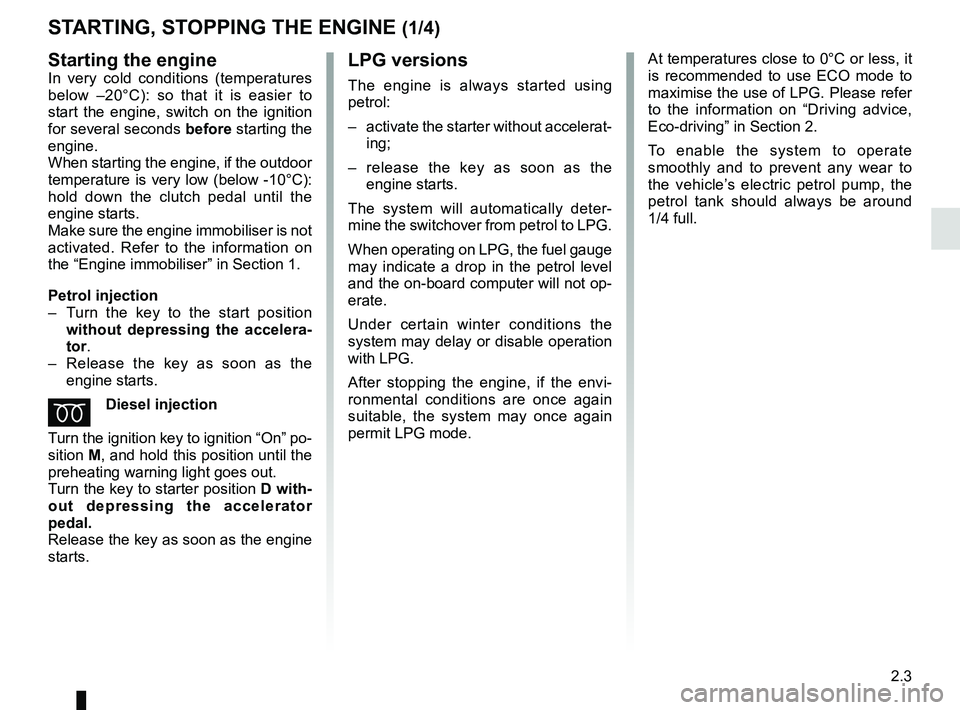
Starting the engineIn very cold conditions (temperatures
below –20°C): so that it is easier to
start the engine, switch on the ignition
for several seconds before starting the
engine.
When starting the engine, if the outdoor
temperature is very low (below -10°C):
hold down the clutch pedal until the
engine starts.
Make sure the engine immobiliser is not
activated. Refer to the information on
the “Engine immobiliser” in Section 1.
Petrol injection
– Turn the key to the start position without depressing the accelera-
tor.
– Release the key as soon as the engine starts.
ÉDiesel injection
Turn the ignition key to ignition “On” po-
sition M, and hold this position until the
preheating warning light goes out.
Turn the key to starter position D with-
out depressing the accelerator
pedal.
Release the key as soon as the engine
starts.
STARTING, STOPPING THE ENGINE (1/4)
At temperatures close to 0°C or less, it
is recommended to use ECO mode to
maximise the use of LPG. Please refer
to the information on “Driving advice,
Eco-driving” in Section 2.
To enable the system to operate
smoothly and to prevent any wear to
the vehicle’s electric petrol pump, the
petrol tank should always be around
1/4 full.
Page 83 of 256
2.7
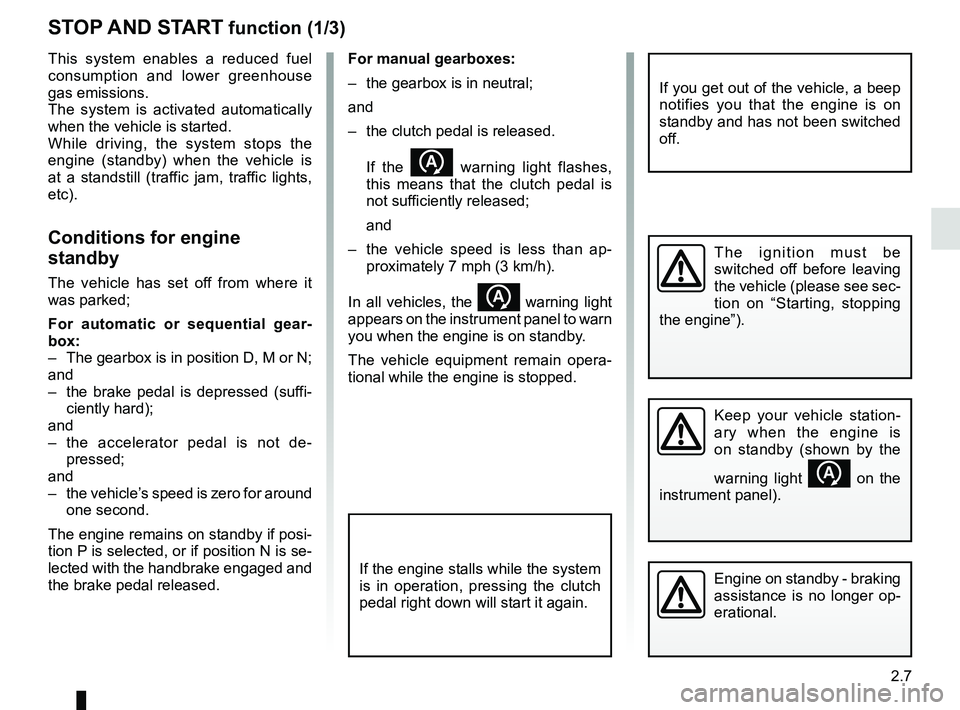
For manual gearboxes:
– the gearbox is in neutral;
and
– the clutch pedal is released.If the
warning light flashes,
this means that the clutch pedal is
not sufficiently released;
and
– the vehicle speed is less than ap- proximately 7 mph (3 km/h).
In all vehicles, the
warning light
appears on the instrument panel to warn
you when the engine is on standby.
The vehicle equipment remain opera-
tional while the engine is stopped.
STOP AND START function (1/3)
This system enables a reduced fuel
consumption and lower greenhouse
gas emissions.
The system is activated automatically
when the vehicle is started.
While driving, the system stops the
engine (standby) when the vehicle is
at a standstill (traffic jam, traffic lights,
etc).
Conditions for engine
standby
The vehicle has set off from where it
was parked;
For automatic or sequential gear-
box:
– The gearbox is in position D, M or N;
and
– the brake pedal is depressed (suffi- ciently hard);
and
– the accelerator pedal is not de- pressed;
and
– the vehicle’s speed is zero for around one second.
The engine remains on standby if posi-
tion P is selected, or if position N is se-
lected with the handbrake engaged and
the brake pedal released.
Engine on standby - braking
assistance is no longer op-
erational.
The ignition must be
switched off before leaving
the vehicle (please see sec-
tion on “Starting, stopping
the engine”).
Keep your vehicle station-
ary when the engine is
on standby (shown by the
warning light
on the
instrument panel).
If you get out of the vehicle, a beep
notifies you that the engine is on
standby and has not been switched
off.
If the engine stalls while the system
is in operation, pressing the clutch
pedal right down will start it again.
Page 86 of 256
2.10
SPECIAL FEATURES OF PETROL VERSIONS
The following operating conditions:
– driving for long periods when the low fuel level warning light is lit;
– using leaded petrol;
– using oil or fuel additives which are not approved by the manufacturer.
Or operating faults such as:
– faulty ignition system, running out of fuel or disconnected spark plugs re-
sulting in the engine misfiring or cut-
ting out when driving;
– loss of power,
may cause the catalytic converter to
overheat, reducing its efficiency which
may irreparably damage it and cause
heat damage to the vehicle. If you notice any of the above operating
faults, have the necessary repairs car-
ried out as soon as possible by an ap-
proved Dealer.
These faults may be avoided by reg-
ularly taking your vehicle to your ap-
proved dealer at the intervals speci-
fied in your Maintenance Service
Document.
Starting problems
To avoid damaging the catalytic con-
verter,
do not keep trying to start the
engine (using the start button, or by
pushing or towing the vehicle) without
having identified and corrected the
starting fault.
If the fault cannot be identified, do not
continue to try and start the engine, but
contact an approved dealer.
Do not park the vehicle or
run the engine in locations
where combustible sub-
stances or materials such
as grass or leaves can come into
contact with a hot exhaust system.
Page 87 of 256
2.11
SPECIAL FEATURES OF DIESEL VERSIONS
Diesel engine speed
Diesel engines are fitted with an injec-
tion pump which prevents the engine
speed being exceeded irrespective of
the gear selected.
If the
Ä and Ò warning lights
come on, consult an approved dealer
as soon as possible.
When driving, depending on the fuel
grade used, it is possible that white
smoke may be emitted.
This is due to the exhaust particle filter
being cleaned automatically, and does
not affect the way the vehicle runs.
Running out of fuel
If the tank has been completely
drained, the system must be reprimed
after the tank is refilled: see information
on the “Fuel tank” in Section 1 before
restarting the engine.
Precautions to be taken in
winter
To avoid any faults in icy weather:
– ensure that the battery is always fully charged;
– always keep the diesel tank rela- tively full to avoid water vapour con-
densing in it and accumulating at the
bottom of the tank.
Do not park the vehicle or
run the engine in locations
where combustible sub-
stances or materials such
as grass or leaves can come into
contact with a hot exhaust system.
Page 89 of 256
2.13
SPECIAL FEATURES OF LPG VERSIONS (2/3)
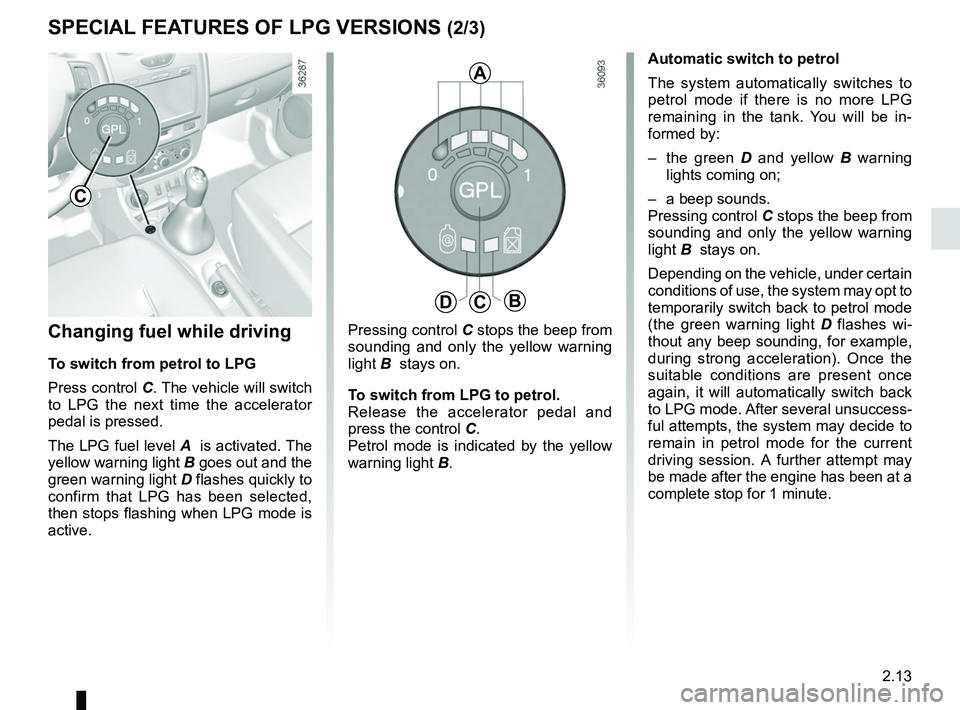
Changing fuel while driving
To switch from petrol to LPG
Press control C. The vehicle will switch to LPG the next time the accelerator
pedal is pressed.
The LPG fuel level A is activated. The
yellow warning light B goes out and the
green warning light D flashes quickly to
confirm that LPG has been selected,
then stops flashing when LPG mode is
active.
Pressing control C stops the beep from
sounding and only the yellow warning
light B stays on.
To switch from LPG to petrol.
Release the accelerator pedal and
press the control C.
Petrol mode is indicated by the yellow
warning light B. Automatic switch to petrol
The system automatically switches to
petrol mode if there is no more LPG
remaining in the tank. You will be in-
formed by:
– the green
D and yellow B warning
lights coming on;
– a beep sounds.
Pressing control C stops the beep from
sounding and only the yellow warning
light B stays on.
Depending on the vehicle, under certain
conditions of use, the system may opt to
temporarily switch back to petrol mode
(the green warning light D flashes wi-
thout any beep sounding, for example,
during strong acceleration). Once the
suitable conditions are present once
again, it will automatically switch back
to LPG mode. After several unsuccess-
ful attempts, the system may decide to
remain in petrol mode for the current
driving session. A further attempt may
be made after the engine has been at a
complete stop for 1 minute.
DCB
A
C
Page 90 of 256
2.14
SPECIAL FEATURES OF LPG VERSIONS (3/3)
If driving under severe
conditions
If driving under severe conditions (hea-
vily laden vehicle, high outside tempe-
rature, starting on a steep slope, etc),
you are recommended to switch to
petrol mode.
At temperatures close to 0°C or less, it
is recommended to use ECO mode to
maximise the use of LPG. Please refer
to the information on “Driving advice,
Eco-driving” in Section 2.
In the event of an accident
The main precautions to be taken are
the same as with petrol vehicles:
– apply the handbrake;
– stop the engine (a safety device that stops LPG from entering the engine
is automatically triggered);
– switch off the ignition;
– observe local regulations.
LPG has a very specific
smell so you will be able to
detect any leaks easily. If
you smell gas in your vehi-
cle or immediately surrounding your
vehicle:
– switch to petrol mode immedia- tely and make sure there are no
flames or sources of fire near the
vehicle;
– go to an authorised dealer.
Do not touch, hit or dis-
mantle any part of the LPG
system components.
Operating fault
In the event of a fault which may affect
the correct operation of the engine, the
system automatically switches from
LPG to petrol mode.
This is confirmed by:
– the appearance of the yellow war- ning light B;
– slow flashing of the green warning light D;
– a beep sounds.
Page 91 of 256
2.15
Fuel consumption is accredited in ac-
cordance with a standard regulatory
method. Identical for all manufactur-
ers, this enables vehicles to be com-
pared with one another. Consumption
in real time depends on vehicle usage
conditions, the equipment fitted and the
user’s driving style. To optimise fuel
consumption, please refer to the follow-
ing advice.
Depending on the vehicle, you will have
various functions which enable you to
lower your fuel consumption:
– the rev counter;
– gear change indicator;
– ECO mode – activated by the ECO button.
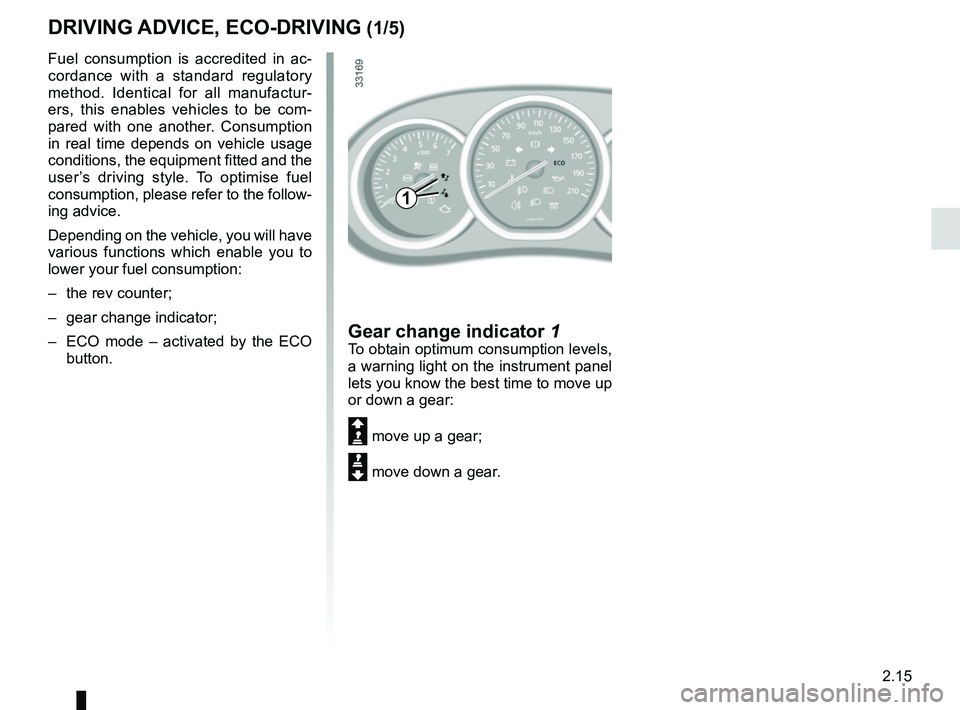
Gear change indicator 1To obtain optimum consumption levels,
a warning light on the instrument panel
lets you know the best time to move up
or down a gear:
Š move up a gear;
‰ move down a gear.
DRIVING ADVICE, ECO-DRIVING (1/5)
1
Page 92 of 256
2.16
DRIVING ADVICE, ECO-DRIVING (2/5)
ECO mode
ECO mode is a function which opti-
mises fuel consumption. This acts on
certain consumption components, such
as the engine.
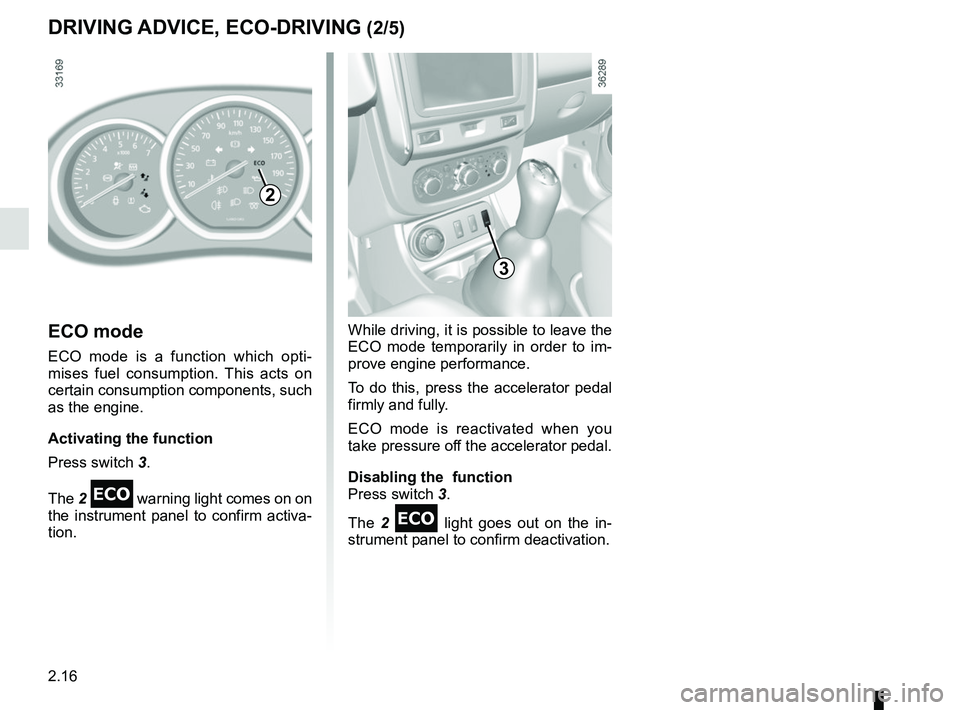
Activating the function
Press switch 3.
The 2
warning light comes on on
the instrument panel to confirm activa-
tion.
While driving, it is possible to leave the
ECO mode temporarily in order to im-
prove engine performance.
To do this, press the accelerator pedal
firmly and fully.
ECO mode is reactivated when you
take pressure off the accelerator pedal.
Disabling the function
Press switch 3.
The 2
light goes out on the in-
strument panel to confirm deactivation.
2
3
Page 93 of 256
2.17
DRIVING ADVICE, ECO-DRIVING (3/5)
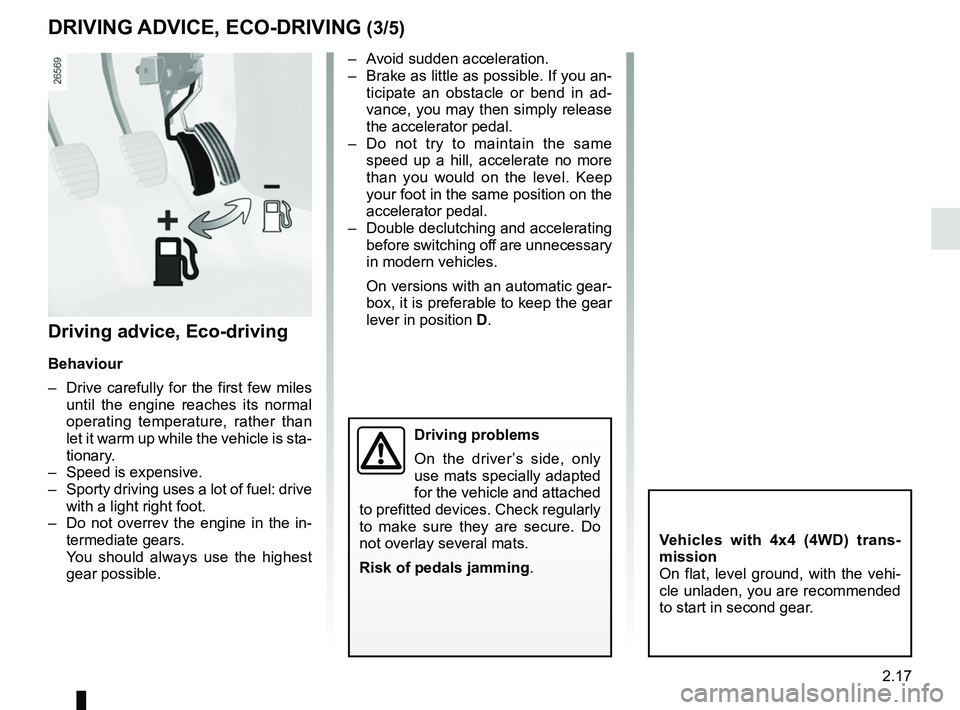
– Avoid sudden acceleration.
– Brake as little as possible. If you an-ticipate an obstacle or bend in ad-
vance, you may then simply release
the accelerator pedal.
– Do not try to maintain the same speed up a hill, accelerate no more
than you would on the level. Keep
your foot in the same position on the
accelerator pedal.
– Double declutching and accelerating before switching off are unnecessary
in modern vehicles.
On versions with an automatic gear-
box, it is preferable to keep the gear
lever in position D.
Vehicles with 4x4 (4WD) trans-
mission
On flat, level ground, with the vehi-
cle unladen, you are recommended
to start in second gear.
Driving advice, Eco-driving
Behaviour
– Drive carefully for the first few miles
until the engine reaches its normal
operating temperature, rather than
let it warm up while the vehicle is sta-
tionary.
– Speed is expensive.
– Sporty driving uses a lot of fuel: drive with a light right foot.
– Do not overrev the engine in the in- termediate gears.
You should always use the highest gear possible.
Driving problems
On the driver’s side, only
use mats specially adapted
for the vehicle and attached
to prefitted devices. Check regularly
to make sure they are secure. Do
not overlay several mats.
Risk of pedals jamming .