VIN RENAULT DUSTER 2016 Manual PDF
[x] Cancel search | Manufacturer: RENAULT, Model Year: 2016, Model line: DUSTER, Model: RENAULT DUSTER 2016Pages: 256, PDF Size: 6.49 MB
Page 138 of 256
3.10
ELECTRIC WINDOWS (3/3)
One-touch windows
When the vehicle is equipped with this
function, the one-touch mode works in
addition to the operation of the electric
windows described previously.
It is only fitted to the driver’s window.
– Fully and briefly press down on the
relevant switch down: the window
will open completely.
– Fully and briefly lift the relevant
switch: the window will close com-
pletely.
Pressing the switch again while the
window is moving will stop its move-
ment.
Special features
If the window detects resistance when
closing (e.g.: branch of a tree, etc.) it
stops and then lowers again by a few
centimetres.
If you use the switch while the window
is moving, it stops working.
Operating faults
In case of a fault when closing a window,
the system reverts to normal mode: pull
the switch concerned up to fully close
the window, then hold the switch (still
on the closure side) for three seconds
then lower and raise the window fully to
reinitialise the system.
If necessary, contact an approved
Dealer.
When closing the windows,
ensure that no part of the
body (arm, hand, etc.) is
protruding from the vehicle.
Risk of serious injury.
Avoid resting any objects against
a half-open window: there is a risk
that the electric window could be
damaged.
Page 144 of 256
3.16
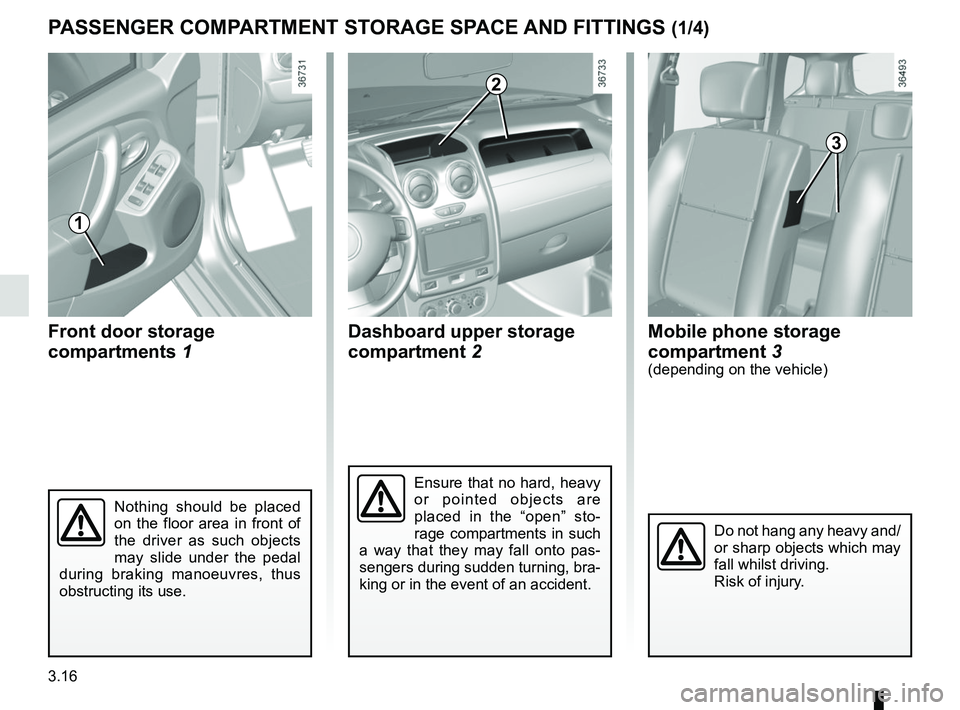
Dashboard upper storage
compartment 2
PASSENGER COMPARTMENT STORAGE SPACE AND FITTINGS (1/4)
Front door storage
compartments 1
Ensure that no hard, heavy
or pointed objects are
placed in the “open” sto-
rage compartments in such
a way that they may fall onto pas-
sengers during sudden turning, bra-
king or in the event of an accident.
Nothing should be placed
on the floor area in front of
the driver as such objects
may slide under the pedal
during braking manoeuvres, thus
obstructing its use.
1
2
Mobile phone storage
compartment 3
(depending on the vehicle)
Do not hang any heavy and/
or sharp objects which may
fall whilst driving.
Risk of injury.
3
Page 148 of 256
3.20
Lower the rear headrests completely
(refer to the information on the “Rear
headrests” in Section 3).
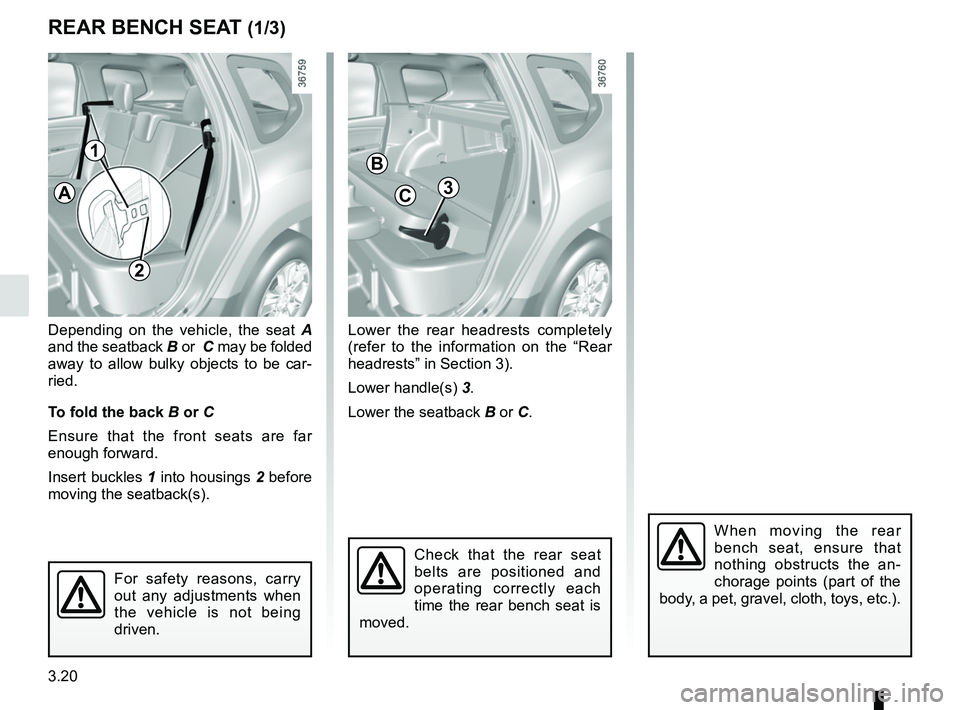
Lower handle(s) 3.
Lower the seatback B or C.Depending on the vehicle, the seat A
and the seatback B or C may be folded
away to allow bulky objects to be car-
ried.
To fold the back B or C
Ensure that the front seats are far
enough forward.
Insert buckles 1 into housings 2 before
moving the seatback(s).
For safety reasons, carry
out any adjustments when
the vehicle is not being
driven.
REAR BENCH SEAT (1/3)
When moving the rear
bench seat, ensure that
nothing obstructs the an-
chorage points (part of the
body, a pet, gravel, cloth, toys, etc.).
B
C3
1
2
A
Check that the rear seat
belts are positioned and
operating correctly each
time the rear bench seat is
moved.
Page 150 of 256
3.22
REAR BENCH SEAT (3/3)
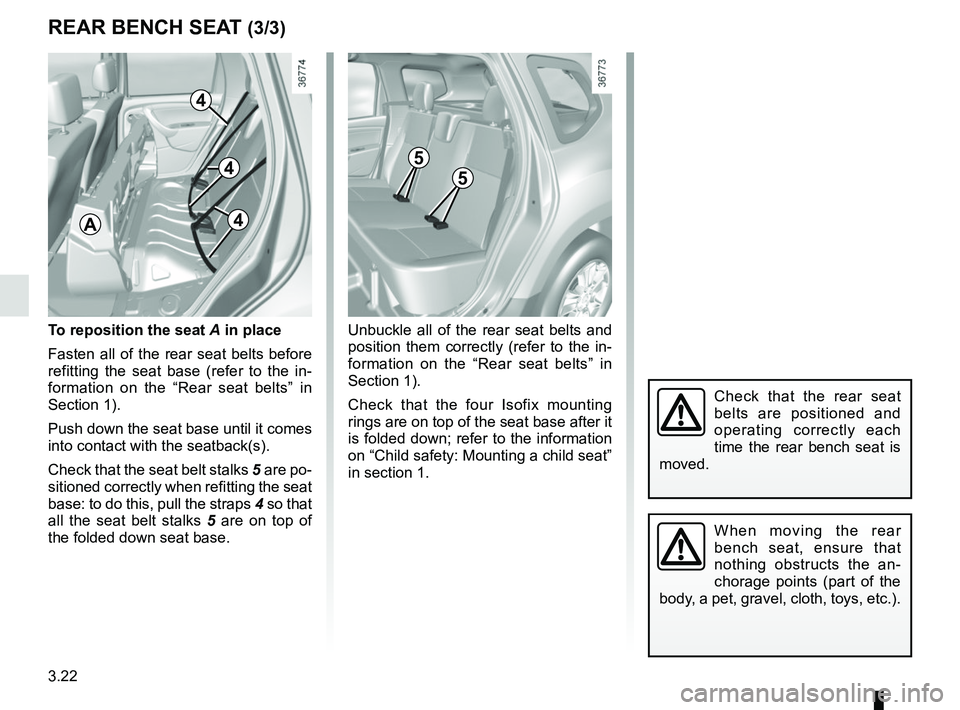
To reposition the seat A in place
Fasten all of the rear seat belts before
refitting the seat base (refer to the in-
formation on the “Rear seat belts” in
Section 1).
Push down the seat base until it comes
into contact with the seatback(s).
Check that the seat belt stalks 5 are po-
sitioned correctly when refitting the seat
base: to do this, pull the straps 4 so that
all the seat belt stalks 5 are on top of
the folded down seat base. Unbuckle all of the rear seat belts and
position them correctly (refer to the in-
formation on the “Rear seat belts” in
Section 1).
Check that the four Isofix mounting
rings are on top of the seat base after it
is folded down; refer to the information
on “Child safety: Mounting a child seat”
in section 1.
When moving the rear
bench seat, ensure that
nothing obstructs the an-
chorage points (part of the
body, a pet, gravel, cloth, toys, etc.).
Check that the rear seat
belts are positioned and
operating correctly each
time the rear bench seat is
moved.
5
5
4
4
4
A
Page 161 of 256
4.3
Make sure nothing is left
in the engine compartment
(cloth, tools, etc.).
Otherwise, this may lead to
engine damage or cause a fire.
In the event of even a slight
impact involving the radia-
tor grille or bonnet, have
the bonnet lock checked by
an approved Dealer as soon as pos-
sible.
Ensure that the bonnet is prop-
erly locked. Check that nothing is
preventing the catch from locking
(gravel, cloth, etc.).
BONNET (2/2)
Never activate the remote
engine start-up function
or its programming before
opening the bonnet or when
it is open.
Risk of burns or serious injury .
Page 162 of 256
4.4
ENGINE OIL LEVEL: general information
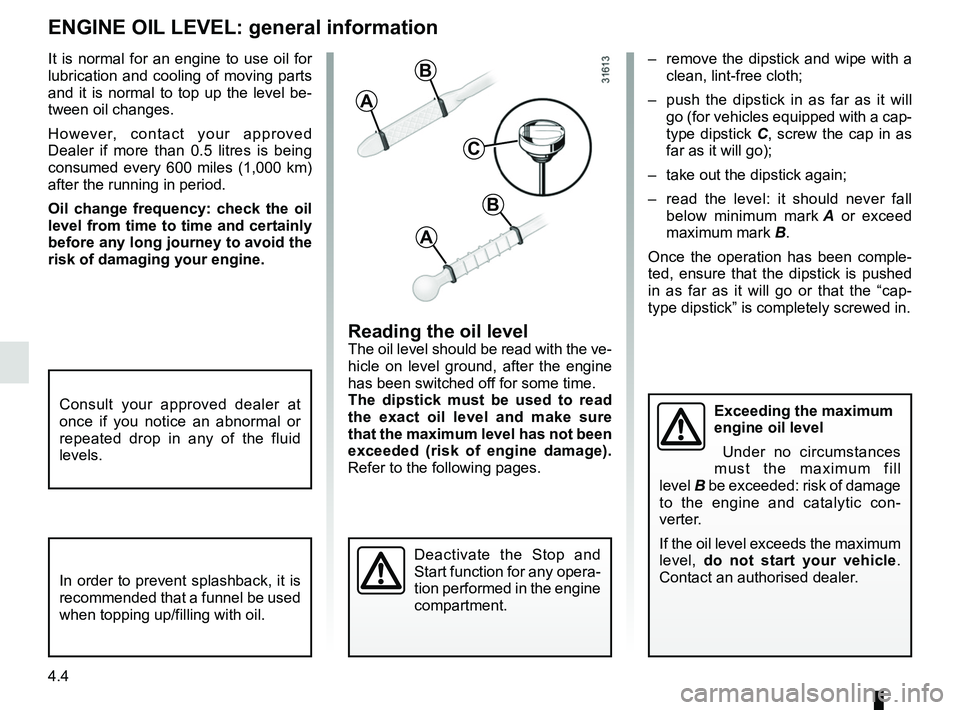
Reading the oil levelThe oil level should be read with the ve-
hicle on level ground, after the engine
has been switched off for some time.
The dipstick must be used to read
the exact oil level and make sure
that the maximum level has not been
exceeded (risk of engine damage).
Refer to the following pages.
C
A
B
A
B
Exceeding the maximum
engine oil level
Under no circumstances
must the maximum fill
level B be exceeded: risk of damage
to the engine and catalytic con-
verter.
If the oil level exceeds the maximum
level, do not start your vehicle .
Contact an authorised dealer.
It is normal for an engine to use oil for
lubrication and cooling of moving parts
and it is normal to top up the level be-
tween oil changes.
However, contact your approved
Dealer if more than 0.5 litres is being
consumed every 600 miles (1,000 km)
after the running in period.
Oil change frequency: check the oil
level from time to time and certainly
before any long journey to avoid the
risk of damaging your engine.
Consult your approved dealer at
once if you notice an abnormal or
repeated drop in any of the fluid
levels.
In order to prevent splashback, it is
recommended that a funnel be used
when topping up/filling with oil.
– remove the dipstick and wipe with a clean, lint-free cloth;
– push the dipstick in as far as it will go (for vehicles equipped with a cap-
type dipstick C, screw the cap in as
far as it will go);
– take out the dipstick again;
– read the level: it should never fall below minimum mark A or exceed
maximum mark B.
Once the operation has been comple-
ted, ensure that the dipstick is pushed
in as far as it will go or that the “cap-
type dipstick” is completely screwed in.
Deactivate the Stop and
Start function for any opera-
tion performed in the engine
compartment.
Page 170 of 256
4.12
TYRE PRESSURE (1/2)
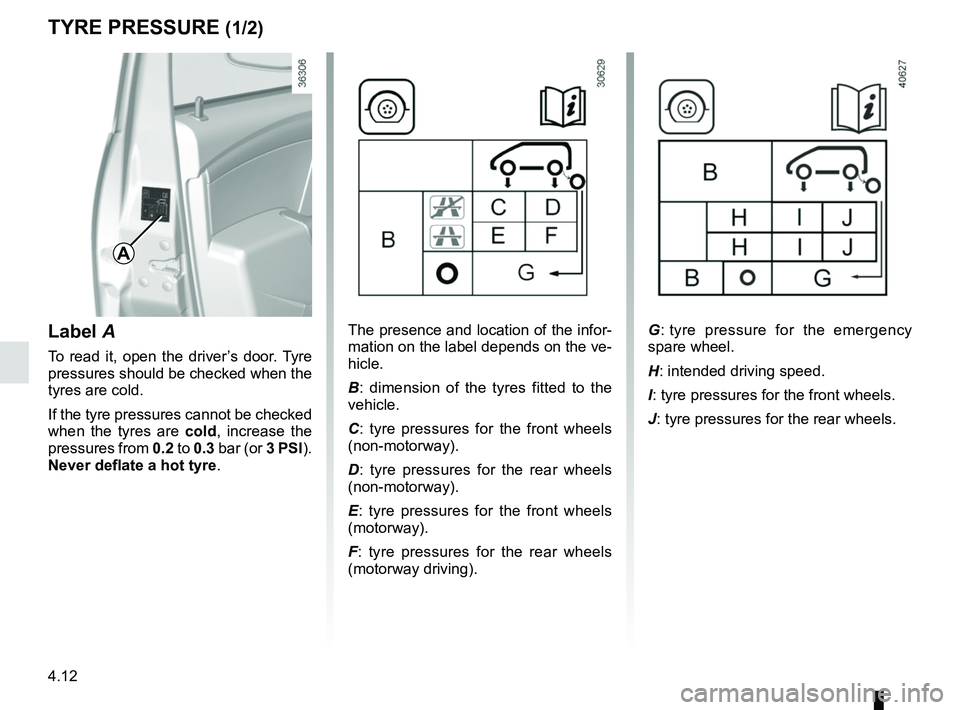
The presence and location of the infor-
mation on the label depends on the ve-
hicle.
B: dimension of the tyres fitted to the
vehicle.
C : tyre pressures for the front wheels
(non-motorway).
D : tyre pressures for the rear wheels
(non-motorway).
E : tyre pressures for the front wheels
(motorway).
F : tyre pressures for the rear wheels
(motorway driving).
A
Label A
To read it, open the driver’s door. Tyre
pressures should be checked when the
tyres are cold.
If the tyre pressures cannot be checked
when the tyres are cold, increase the
pressures from 0.2 to 0.3 bar (or 3 PSI).
Never deflate a hot tyre . G
: tyre pressure for the emergency
spare wheel.
H: intended driving speed.
I: tyre pressures for the front wheels.
J: tyre pressures for the rear wheels.
Page 172 of 256
4.14
BATTERY (1/2)
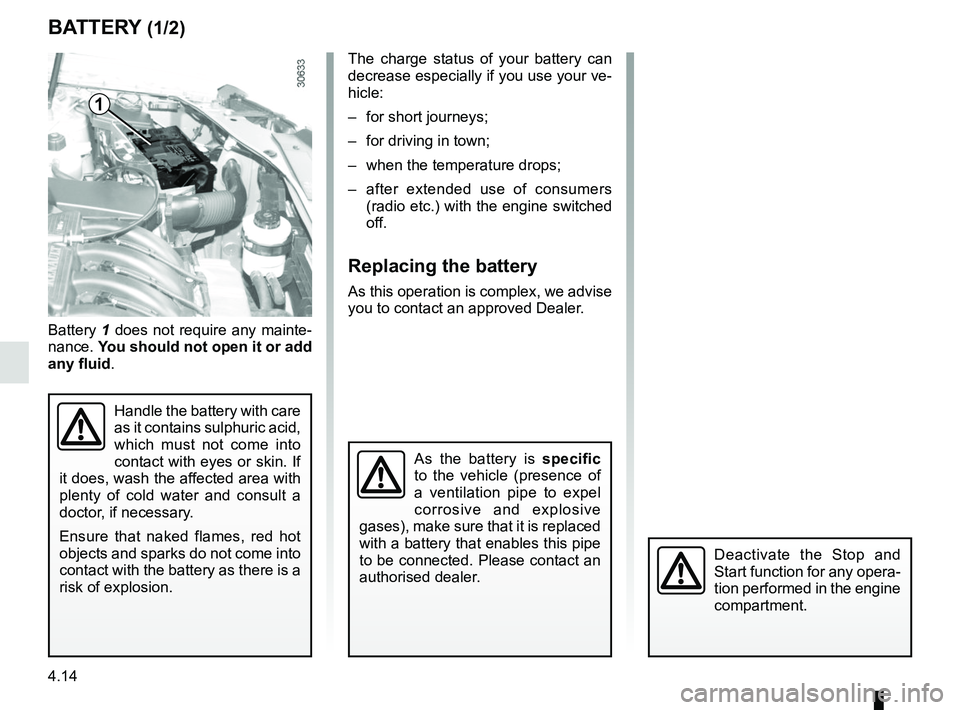
Battery 1 does not require any mainte-
nance. You should not open it or add
any fluid .
Handle the battery with care
as it contains sulphuric acid,
which must not come into
contact with eyes or skin. If
it does, wash the affected area with
plenty of cold water and consult a
doctor, if necessary.
Ensure that naked flames, red hot
objects and sparks do not come into
contact with the battery as there is a
risk of explosion.
1
The charge status of your battery can
decrease especially if you use your ve-
hicle:
– for short journeys;
– for driving in town;
– when the temperature drops;
– after extended use of consumers (radio etc.) with the engine switched
off.
Replacing the battery
As this operation is complex, we advise
you to contact an approved Dealer.
As the battery is specific
to the vehicle (presence of
a ventilation pipe to expel
corrosive and explosive
gases), make sure that it is replaced
with a battery that enables this pipe
to be connected. Please contact an
authorised dealer.
Deactivate the Stop and
Start function for any opera-
tion performed in the engine
compartment.
Page 175 of 256
4.17
Respect local regulations about wash-
ing vehicles (e.g. do not wash your ve-
hicle on a public highway).
Observe the vehicle stopping distances
when driving on gravelled surfaces to
prevent paint damage.
Repair, or have repaired quickly, areas
where the paint has been damaged, to
prevent corrosion spreading.
Remember to visit the body shop pe-
riodically in order to maintain your
anti-corrosion warranty. Refer to the
Maintenance Document.
If it is necessary to clean mechani-
cal components, hinges, etc., spray
them with products approved by our
Technical Department to protect them
after they have been cleaned.
BODYWORK MAINTENANCE (2/2)
We have selected special products
to care for your vehicle and you can
obtain these from the manufactur-
er’s accessory outlets.
Using a roller type car wash
Return the windscreen wiper stalk to
the Park position (refer to the informa-
tion on the “Windscreen washer, wiper”
in Section 1). Check the mounting of
external accessories, additional lights
and mirrors, and ensure that the wiper
blades are secured with adhesive tape.
Remove the radio aerial mast if your
vehicle is fitted with this equipment.
Remember to remove the tape and refit
the antenna after washing.
Cleaning the headlights
As the headlights are made of plastic
“glass”, use a soft cloth or cotton wool
to clean them. If this does not clean
them properly, moisten the cloth with
soapy water, then wipe clean with a soft
damp cloth or cotton wool.
Finally, carefully dry off with a soft dry
cloth.
Cleaning products containing alco-
hol must not be used.
Vehicles with a matte paint
finish
This type of paint requires certain pre-
cautions.
Do not do the following
– use wax-based products (polishing);
– rub hard;
– wash the vehicle in a roller-type car
wash;
– wash the vehicle using a high-pres-
sure device;
– attach stickers to the paintwork (risk
of leaving marks).
You should do the following
Wash the vehicle by hand using plenty
of water, using a soft cloth or a gentle
sponge.
Page 177 of 256
4.19
You are strongly recom-
mended not to use high-
pressure or spray cleaning
equipment inside the pas-
senger compartment: use of such
equipment could impair the correct
functioning of the electrical or elec-
tronic components in the vehicle, or
have other detrimental effects.
INTERIOR TRIM MAINTENANCE (2/2)
You should not:
You are strongly advised not to po-
sition objects such as deodorants,
scents, etc. near air vents, as this could
damage your dashboard trim.
Removal/replacing removable
equipment originally fitted in
the vehicle
If you need to remove equipment in
order to clean the passenger com-
partment (for example, mats), always
ensure that they are correctly refitted
and are the right way around (the driv-
er’s mat should be fitted on the driver’s
side, etc.) and fit them with the compo-
nents supplied with the equipment (for
example, the driver mat should always
be fixed using the pre-fitted mounting
components).
With the vehicle stationary, always
ensure that nothing will impede driving
(anything obstructing the pedals, heel
wedged by the mat etc.).