belt RENAULT ESPACE 2012 J81 / 4.G Owner's Manual
[x] Cancel search | Manufacturer: RENAULT, Model Year: 2012, Model line: ESPACE, Model: RENAULT ESPACE 2012 J81 / 4.GPages: 267, PDF Size: 8.95 MB
Page 44 of 267
air bagdeactivating the front passenger air bags ........ (current page)
front passenger air bag deactivation ..................... (current page)
1.38
ENG_UD20343_1
Sécurité enfants : désactivation/activation airbag passager ava\
nt (X81 - J81 - Renault)
ENG_NU_932-3_X81ph3_Renault_1
Jaune NoirNoir texte
Deactivating/activating the front passenger air bag
deactivating the front
passenger air bags
(on equipped vehicles)
You must deactivate the devices in ad-
dition to the front passenger seat belt
before fitting a child seat in the front
passenger seat.
Passenger seats with seat base
height adjustment
You must adjust the cushion to the
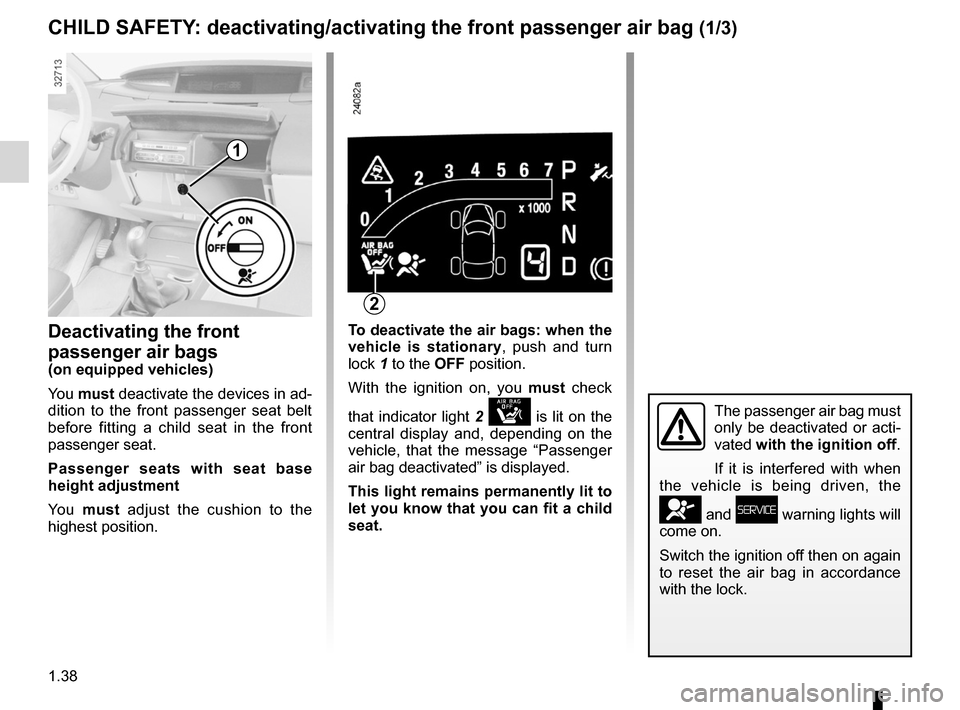
highest position. To deactivate the air bags: when the
vehicle is stationary
, push and turn
lock 1 to the Off position.
With the ignition on, you must check
that indicator light 2
ã is lit on the
central display and, depending on the
vehicle, that the message “Passenger
air bag deactivated” is displayed.
This light remains permanently lit to
let you know that you can fit a child
seat.
cHILd safeTY : deactivating/activating the front passenger air bag (1/3)
1
2
The passenger air bag must
only be deactivated or acti-
vated with the ignition off.
If it is interfered with when
the vehicle is being driven, the
å and ú warning lights will
come on.
Switch the ignition off then on again
to reset the air bag in accordance
with the lock.
Page 46 of 267

ENG_NU_932-3_X81ph3_Renault_1
Operating faults
It is forbidden to fit a rear-facin")
1.40
ENG_UD20343_1
Sécurité enfants : désactivation/activation airbag passager ava\
nt (X81 - J81 - Renault)
ENG_NU_932-3_X81ph3_Renault_1
Operating faults
It is forbidden to fit a rear-facing child
seat to the front passenger seat if the
air bag activation/deactivation system
is faulty.
Allowing any other passenger to sit in
that seat is not recommended.
Contact your approved dealer as soon
as possible.
activating the front
passenger air bags
You should reactivate the air bag as
soon as you remove the child seat from
the front passenger seat to ensure the
protection of the front passenger in the
event of an impact.
To reactivate the air bags: when the
vehicle is stationary , push and turn
lock 1 to the On position.
With the ignition on, it is essential to
check that warning light 2,
ã, is off.
The front passenger seat belt additional
restraint systems are activated.
1
2
cHILd safeTY : deactivating/activating the front passenger air bag (3/3)
The passenger air bag must
only be deactivated or acti-
vated with the ignition off.
If it is interfered with when
the vehicle is being driven, the
å and ú warning lights will
come on.
Switch the ignition off then on again
to reset the air bag in accordance
with the lock.
danGer
Since operation of the front
passenger air bag is not
compatible with the position
of a rear-facing child seat, neVer
fit a rear-facing child seat on a front
passenger seat with an active front
air bag. The child may suffer very
serious injuries if the air bag is trig-
gered.
Page 54 of 267
seat belts ............................................................... (current page)
speed limiter .......................................................... (current page)
cruise control ......................................................... (current page)
ABS ....................................................................... (current page)
air bag .................................................................... (current page)
1.48
ENG_UD20346_1
Tableau de bord : témoins lumineux (X81 - J81 - Renault)
ENG_NU_932-3_X81ph3_Renault_1
Jaune NoirNoir texte
WarnInG LIGHTs (3/4)
çdriver or front passenger
seat belt reminder warning
light
When the driver’s seat belt is not fas -
tened, the light stays on then, when the
vehicle reaches a speed of approxi -
mately 12 mph (20 km/h), it flashes
and a beep sounds for approximately
120 seconds. Then the warning light
returns to being continuously lit.
note: an object placed on the passen-
ger seat base can activate the warning
light.
ÉPreheating warning light
(diesel version)
With the ignition on, this light should
come on; it indicates that the heater
plugs are switched on. It goes out when
preheating is complete and the engine
can be started.
åair bag warning light
This comes on when the igni -
tion is switched on and goes out after a
few seconds.
If it does not light up when the ignition
is switched on, or comes on when the
engine is running, there is a fault in the
system.
Contact your approved Dealer as soon
as possible.
ÄToxic fume filter system
Warning Light
For vehicles equipped with this option,
the light comes on when the ignition is
switched on then goes out.
– If it lights up continuously, consult an
approved Dealer as soon as possi -
ble;
– If it flashes, reduce the engine speed
until the light stops flashing.
Contact your approved Dealer as
soon as possible.
R e f e r t o t h e i n f o r m a t i o n o n
“Antipollution, fuel economy and driv -
ing” in Section 2.
úWarning light
This lights up when the ignition
is switched on and goes out as soon as
the engine is started. It can light up in
conjunction with other indicator lights
and/or messages on the instrument
panel.
It means you should drive very care-
fully to an approved dealer as soon as
possible. If you fail to follow this recom-
mendation, you risk damaging your ve-
hicle.
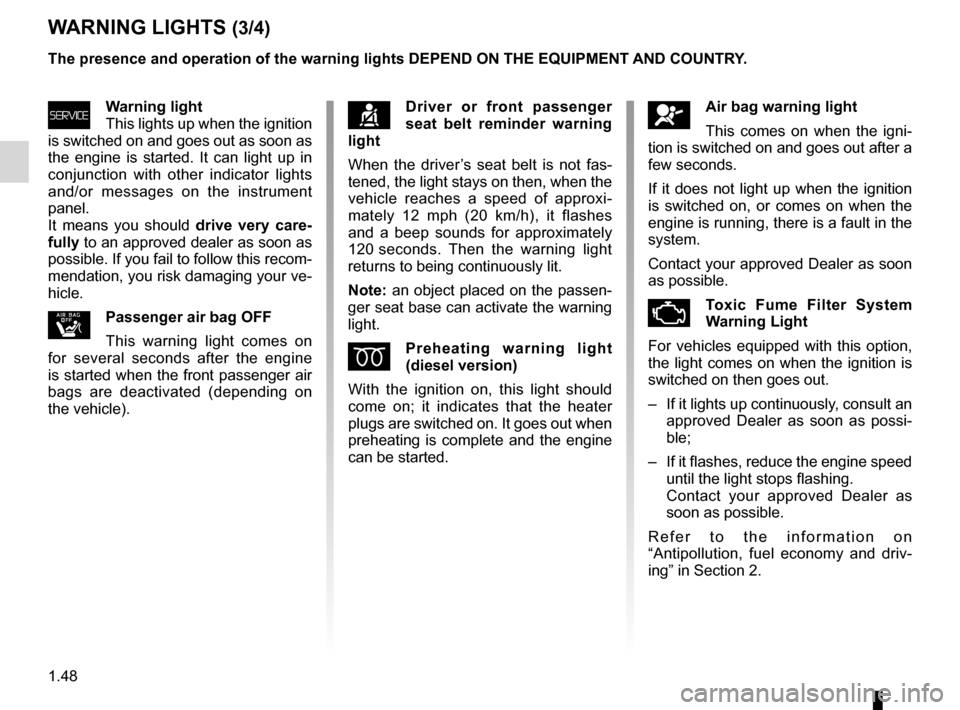
ãPassenger air bag Off
This warning light comes on
for several seconds after the engine
is started when the front passenger air
bags are deactivated (depending on
the vehicle). The presence and operation of the warning lights dePend On THe eQUIPMenT and cOUnTrY.
Page 166 of 267
3.44
ENG_UD20394_1
Appuis-tête convertible enfant (X81 - J81 - Renault)
ENG_NU_932-3_X81ph3_Renault_3
CHILD’S CONVERTIBLE HEADREST (continued)
For child use
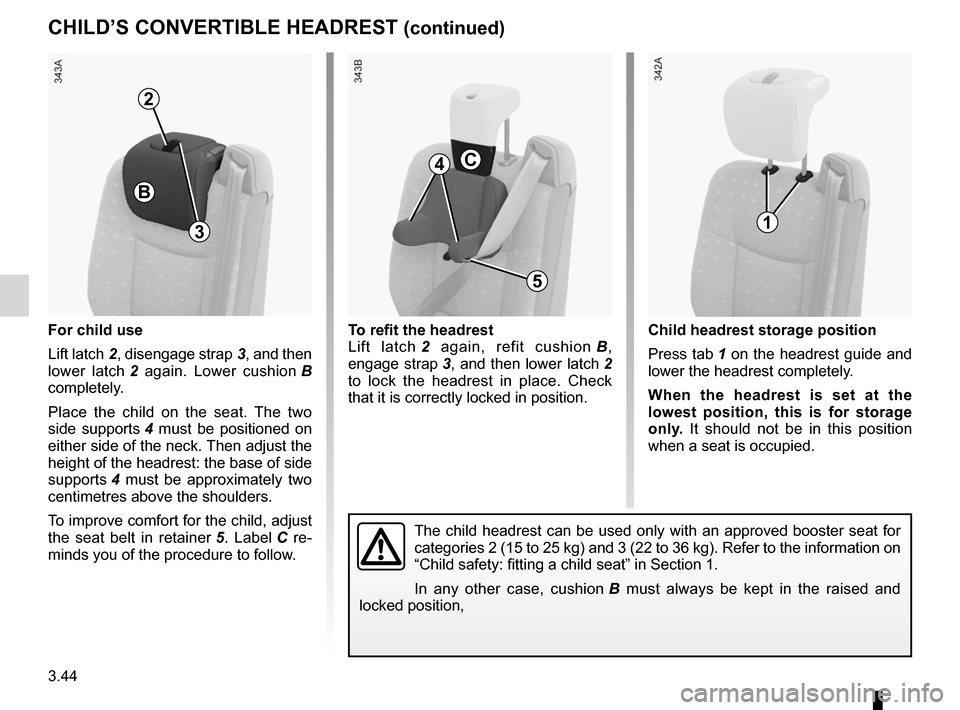
Lift latch 2, disengage strap 3, and then
lower latch 2 again. Lower cushion B
completely.
Place the child on the seat. The two
side supports 4 must be positioned on
either side of the neck. Then adjust the
height of the headrest: the base of side
supports 4 must be approximately two
centimetres above the shoulders.
To improve comfort for the child, adjust
the seat belt in retainer 5 . Label C re -
minds you of the procedure to follow. To refit the headrest
Lift latch
2 again, refit cushion B ,
engage strap 3, and then lower latch 2
to lock the headrest in place. Check
that it is correctly locked in position. Child headrest storage position
Press tab 1 on the headrest guide and
lower the headrest completely.
When the headrest is set at the
lowest position, this is for storage
only.
It should not be in this position
when a seat is occupied.
2
B
3
4
5
C
1
The child headrest can be used only with an approved booster seat for
categories 2 (15 to 25 kg) and 3 (22 to 36 kg). Refer to the information on
“Child safety: fitting a child seat” in Section 1.
In any other case, cushion B must always be kept in the raised and
locked position,
Page 177 of 267

transporting objectsin the luggage compartment ............................ (current page)
towing rings .......................................... (up to the end of the DU)
3.55
ENG_UD21779_2
Transport d’objets dans le coffre (X81 - Renault)
ENG_NU_932-3_X81ph3_Renault_3
Always position the objects transported
so that the largest surface is against:
– The rear seatbacks for normal loads
(example A).
– The folded rear seats for heavier
loads (example B).
– The front seats, having removed the
rear seats, for the heaviest loads (ex-
ample C).
Transporting objects in the luggage compartment
TRANSPORTING OBJECTS IN THE LUGGAGE COMPARTMENT
Lashing points
Always position the heavi -
est items directly on the
floor. Use the anchorage
points located on the lug -
gage compartment floor to secure
items. The luggage should be
loaded in such a way that no items
will be thrown forward and strike the
occupants if the driver has to brake
suddenly. Fasten the rear seat belts,
even if the seats are not occupied.
B
C
A
Page 198 of 267
maintenance:interior trim ...................................... (up to the end of the DU)
interior trim maintenance ................................... (up to the end of the DU)
cleaning: inside the vehicle ............................ (up to the end of the DU)
4.16
ENG_UD22866_8
Entretien des garnitures intérieures (X35 - X45 - X65 - J77 - X81 - \
J81 - X85 - X91 - B91 - K91 - D91 - X83 - X61 - X77 ph2 - X95 - B95 - D9\
5 - E95 - K95 - J95 - R95 -
ENG_NU_932-3_X81ph3_Renault_4
Jaune NoirNoir texte
Interior trim maintenance
Glass instrument panel(e.g. instrument panel, clock, exterior
temperature display, radio display, etc.)
Use a soft cloth (or cotton wool).
If this does not clean it properly, use a
soft cloth (or cotton wool) slightly mois-
tened with soapy water and then wipe
clean with a soft damp cloth or cotton
wool.
Finally, carefully dry off with a soft dry
cloth.
Cleaning products containing alco -
hol must not be used under any cir-
cumstances.
Seat belts
These must be kept clean.
Use products selected by our Technical
Department (Approved outlets) or
warm, soapy water and a sponge and
wipe with a dry cloth.
Detergents or dyes must not be used
under any circumstances.
InteRIoR tRIM MAIntenAnCe (1/2)
textiles (seats, door trim, etc)
Vacuum-clean the textiles regularly.
Liquid stain
Use soapy water.
Dab lightly (never rub) with a soft cloth,
rinse and remove the excess.
Solid or pasty stain
Carefully remove the excess solid or
pasty material immediately with a
spatula (working from the edges to the
centre to avoid spreading the stain).
Clean as for a liquid stain.
Special instructions for sweets or
chewing gum
Put an ice cube on the stain to solidify
it, then proceed as for a solid stain.
A well-maintained vehicle will last
longer. It is therefore recommended to
maintain the interior of the vehicle regu-
larly.
A stain should always be dealt with
swiftly.
Whatever type of stain is on the trim,
use
cold (or warm) soapy water with
natural soap.
Detergents (washing-up liquid, pow -
dered products, alcohol-based prod-
ucts) should not be used.
Use a soft cloth.
Rinse and soak up the excess.
For further recommendations for
maintaining the interior, and/or for
any unsatisfactory results, please
see an authorised dealer.
Page 264 of 267
7.4
FRA_UD25606_4
Index (X81 - J81 - Renault)
ENG_NU_932-3_X81ph3_Renault_7
Jaune NoirNoir texte
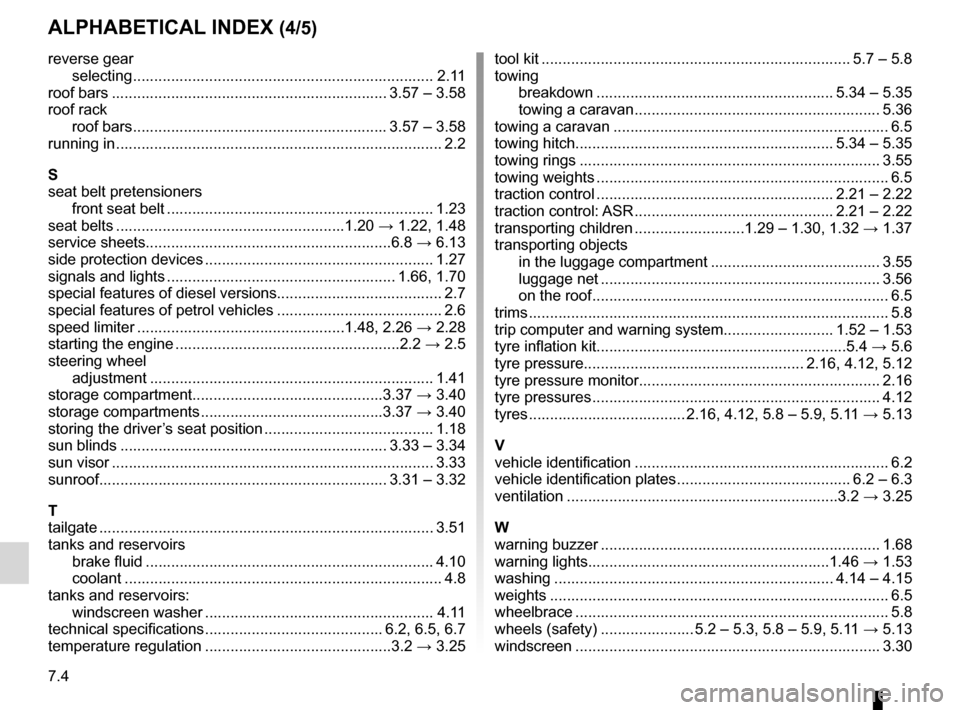
AlphAbeticAl index (4/5)
reverse gear
selecting ....................................................................... 2.11
roof bars ................................................................. 3.57 – 3.58
roof rack roof bars ............................................................ 3.57 – 3.58
running in ........................................................................\
..... 2.2
S
seat belt pretensioners front seat belt ............................................................... 1.23
seat belts ...................................................... 1.20 → 1.22, 1.48
service sheets .......................................................... 6.8 → 6.13
side protection devices ...................................................... 1.27
signals and lights ...................................................... 1.66, 1.70
special features of diesel versions .......................................2.7
special features of petrol vehicles ....................................... 2.6
speed limiter ................................................. 1.48, 2.26 → 2.28
starting the engine ..................................................... 2.2 → 2.5
steering wheel adjustment ................................................................... 1.41
storage compartment ............................................. 3.37 → 3.40
storage compartments ........................................... 3.37 → 3.40
storing the driver’s seat position ........................................ 1.18
sun blinds ............................................................... 3.33 – 3.34
sun visor ........................................................................\
.... 3.33
sunroof .................................................................... 3.31 – 3.32
t
tailgate ........................................................................\
....... 3.51
tanks and reservoirs brake fluid .................................................................... 4.10
coolant ........................................................................... 4.8
tanks and reservoirs: windscreen washer ...................................................... 4.11
technical specifications .......................................... 6.2, 6.5, 6.7
temperature regulation ............................................ 3.2 → 3.25tool kit
........................................................................\
. 5.7 – 5.8
towing breakdown ........................................................ 5.34 – 5.35
towing a caravan .......................................................... 5.36
towing a caravan ................................................................. 6.5
towing hitch ............................................................. 5.34 – 5.35
towing rings ....................................................................... 3.55
towing weights ..................................................................... 6.5
traction control ........................................................ 2.21 – 2.22
traction control: ASR ............................................... 2.21 – 2.22
transporting children .......................... 1.29 – 1.30, 1.32 → 1.37
transporting objects in the luggage compartment ........................................ 3.55
luggage net .................................................................. 3.56
on the roof ...................................................................... 6.5
trims ........................................................................\
............. 5.8
trip computer and warning system ..........................1.52 – 1.53
tyre inflation kit ........................................................... 5.4 → 5.6
tyre pressure .................................................... 2.16, 4.12, 5.12
tyre pressure monitor ......................................................... 2.16
tyre pressures .................................................................... 4.12
tyres ..................................... 2.16, 4.12, 5.8 – 5.9, 5.11 → 5.13
V
vehicle identification ............................................................ 6.2
vehicle identification plates ......................................... 6.2 – 6.3
ventilation ................................................................ 3.2 → 3.25
W
warning buzzer .................................................................. 1.68
warning lights ......................................................... 1.46 → 1.53
washing .................................................................. 4.14 – 4.15
weights ........................................................................\
........ 6.5
wheelbrace ........................................................................\
.. 5.8
wheels (safety) ...................... 5.2 – 5.3, 5.8 – 5.9, 5.11 → 5.13
windscreen ........................................................................\
3.30