Air bag RENAULT FLUENCE 2012 1.G User Guide
[x] Cancel search | Manufacturer: RENAULT, Model Year: 2012, Model line: FLUENCE, Model: RENAULT FLUENCE 2012 1.GPages: 241, PDF Size: 6.5 MB
Page 40 of 241

ENG_NU_891_892-7_L38-B32_Renault_1
Jaune NoirNoir texte
The table below summarises the information already")
1.36
ENG_UD23757_3
Sécurité enfants : installation du siège enfant (L38 - X38 - R\
enault)
ENG_NU_891_892-7_L38-B32_Renault_1
Jaune NoirNoir texte
The table below summarises the information already shown on the diagram on the previous page, to ensure the regula-
tions in force are respected.
Type of child seat
(Five-door version) Weight of
the child seat size Front
passenger
seat WITh air bag (1) (2) Front
passenger seat
WIThOUT air bag Rear side
seats Rear centre
seat
Carrycot fitted across the ve-
hicle
Group 0 < 10 kg
F, GXXU - IL (3) U (3)
Rear-facing shell seat
Group 0 or 0+ <
13 kg and 9 to
18 kg E, D
UUU - IL (4) U (4)
rear-facing seat
Group 0+ and 1 9 to 18 kg
CU UU (4) U (4)
Forward-facing seat
Group 1 9 to 18 kg
A, B, B1XU (5)U - IUF -
IL (5) U (5)
Booster seat
Group 2 and 3 15 to 25 kg and
22 to 36 kg
-
XU (5) U (5) U (5)
(1 RIsK OF DEATh OR sERIOUs INJURY: before installing a child seat on the front passenger seat, check that the
air bag has been deactivated (refer to “Child safety: deactivating/a\
ctivating the front passenger air bag” in Section 1).
ChILD sAFETY : Fitting a child seat (4/9)
Page 42 of 241

ENG_NU_891_892-7_L38-B32_Renault_1
Jaune NoirNoir texte
² Seat not suitable for fitting child
seat")
1.38
ENG_UD23757_3
Sécurité enfants : installation du siège enfant (L38 - X38 - R\
enault)
ENG_NU_891_892-7_L38-B32_Renault_1
Jaune NoirNoir texte
² Seat not suitable for fitting child
seats.
Child seat attached using the belt
¬ Seat which allows a child seat
with “Universal” approval to be attached
by a seat belt.
− Seat which only allows a rear-
facing seat with “Universal” approval
to be attached with a seat belt.
³ Check the status of the air bag
before fitting a child seat or allowing a
passenger to use the seat.
R I sK O F D E AT h O R
s ERIOU s INJURY: before
fitting a rear-facing child
seat in the front passenger
seat, check that the air bag has been
deactivated (refer to the information
on “Child safety: deactivating/acti -
vating the front passenger air bag”
at the end of the paragraph).
Child seat attached using the IsOFIX
mounting
ü Seat which allows an ISOFIX
child seat to be fitted.
± The rear seats are fitted with
an anchorage point which allows a
forward-facing ISOFIX child seat with
universal approval to be fitted. The an-
chorage points are located in the lug -
gage compartment and are visible.
The size of the ISOFIX child seat is in-
dicated by a letter:
– A, B and B1: for forward-facing seats
in group 1 (9 to 18 kg);
– C: rear-facing seats in group 1 (9 to
18 kg);
– D and E: shell seat or rear-facing
seats in group 0 or 0+ (less than
13 kg);
– F and G: cots in group 0 (less than
10 kg).
Using a child safety system which is not approved for this vehicle will not
correctly protect the baby or child. They risk serious or even fatal injury.
ChILD sAFETY : Fitting a child seat (6/9)
Four-door versions WITh front passenger air bag
Page 43 of 241

ENG_NU_891_892-7_L38-B32_Renault_1
ChILD sAFETY : Fitting a child seat (7/9)
² Seat")
JauneNoirNoir texte
1.39
ENG_UD23757_3
Sécurité enfants : installation du siège enfant (L38 - X38 - R\
enault)
ENG_NU_891_892-7_L38-B32_Renault_1
ChILD sAFETY : Fitting a child seat (7/9)
² Seat not suitable for fitting child
seats.
Child seat attached using the belt
¬ Seat which allows a child seat
with “Universal” approval to be attached
by a seat belt.
Child seat attached using the IsOFIX
mounting
ü Seat which allows an ISOFIX
child seat to be fitted.
± The rear seats are fitted with
an anchorage point which allows a
forward-facing ISOFIX child seat with
universal approval to be fitted. The an-
chorage points are located in the lug -
gage compartment and are visible.
The size of the ISOFIX child seat is in-
dicated by a letter:
– A, B and B1: for forward-facing seats
in group 1 (9 to 18 kg);
– C: rear-facing seats in group 1 (9 to
18 kg);
– D and E: shell seat or rear-facing
seats in group 0 or 0+ (less than
13 kg);
– F and G: cots in group 0 (less than
10 kg).
Using a child safety system
which is not approved for
this vehicle will not correctly
protect the baby or child.
They risk serious or even fatal injury.
Four-door versions WIThOUT front passenger air bag
Page 44 of 241

ENG_NU_891_892-7_L38-B32_Renault_1
Jaune NoirNoir texte
ChILD sAFETY : Fitting a child seat (8/9)
The tab")
1.40
ENG_UD23757_3
Sécurité enfants : installation du siège enfant (L38 - X38 - R\
enault)
ENG_NU_891_892-7_L38-B32_Renault_1
Jaune NoirNoir texte
ChILD sAFETY : Fitting a child seat (8/9)
The table below summarises the information already shown on the diagram on the previous page, to ensure the regula-
tions in force are respected.
Type of child seat
(Four-door version) Weight of
the child seat size Front
passenger
seat WITh air bag (1) (2) Front
passenger seat
WIThOUT air bag Rear side
seats Rear centre
seat
Carrycot fitted across the ve-
hicle
Group 0 < 10 kg
F, GXXU - IL (3) U (3)
Rear-facing shell seat
Group 0 or 0+ <
13 kg and 9 to
18 kg E, D
UUU - IL (4) U (4)
rear-facing seat
Group 0+ and 1 9 to 18 kg
CU UU - IL (4) U (4)
Forward-facing seat
Group 1 9 to 18 kg
A, B, B1XU (5)U - IUF -
IL (5) U (5)
Booster seat
Group 2 and 3 15 to 25 kg and 22
to 36 kg
-
XU (5) U (5) U (5)
(1 RIsK OF DEATh OR sERIOUs INJURY: before installing a child seat on the front passenger seat, check that the
air bag has been deactivated (refer to “Child safety: deactivating/a\
ctivating the front passenger air bag” in Section 1).
Page 46 of 241

air bagdeactivating the front passenger air bags ........ (current page)
front passenger air bag deactivation ..................... (current page)
child restraint/seat ................................ (up to the end of the DU)
child safety ............................................ (up to the end of the DU)
child restraint/seat ................................ (up to the end of the DU)
transporting children ............................. (up to the end of the DU)
1.42
ENG_UD17911_3
Sécurité enfants : désactivation/activation airbag passager ava\
nt (L38 - X38 - Renault)
ENG_NU_891_892-7_L38-B32_Renault_1
Jaune NoirNoir texte
deactivating/activating the front passenger air bag
2
Deactivating the front
passenger air bags
(on equipped vehicles)
You must deactivate certain devices
in addition to the front passenger seat
belt before fitting a child seat in the front
passenger seat. To deactivate the air bags: with the
vehicle stationary
, push and turn
lock 1 to the OFF position.
With the ignition on, it is essential to
check that warning light 2
¹ is lit
on the central display and, depend -
ing on the vehicle, that the message
“Passenger airbag off” is displayed.
This light remains permanently lit to
let you know that you can fit a child
seat.
ChILD sAFETY : deactivating/activating the front passenger air bag (1/3)
1
The passenger air bag must
only be deactivated or acti-
vated with the ignition off.
If it is interfered with when
the vehicle is being driven, indicator
lights
å and © will come
on.
Switch the ignition off then on again
to reset the air bag in accordance
with the lock.
Page 47 of 241

ENG_NU_891_892-7_L38-B32_Renault_1
3
ChILD sAFETY : deactivating/act")
JauneNoirNoir texte
1.43
ENG_UD17911_3
Sécurité enfants : désactivation/activation airbag passager ava\
nt (L38 - X38 - Renault)
ENG_NU_891_892-7_L38-B32_Renault_1
3
ChILD sAFETY : deactivating/activating the front passenger air bag (2/3)
DANgER
Since operation of the front
passenger air bag is not
compatible with the position
of a rear-facing child seat, NEVER
fit a rear-facing child seat on a front
passenger seat with an active front
air bag. The child may suffer very
serious injuries if the air bag is trig-
gered.
The markings on the dashboard and
labels A on each side of passenger sun
blind 3 (example: label shown above)
remind you of these instructions.
A
A
Page 48 of 241

1.44
ENG_UD17911_3
Sécurité enfants : désactivation/activation airbag passager ava\
nt (L38 - X38 - Renault)
ENG_NU_891_8")
air bagactivating the front passenger air bags ............ (current page)
1.44
ENG_UD17911_3
Sécurité enfants : désactivation/activation airbag passager ava\
nt (L38 - X38 - Renault)
ENG_NU_891_892-7_L38-B32_Renault_1
ChILD sAFETY : deactivating/activating the front passenger air bag (3/3)
2
Operating faults
It is forbidden to fit a rear-facing child
seat to the front passenger seat if the
air bag activation/deactivation system
is faulty.
Allowing any other passenger to sit in
that seat is not recommended.
Contact your approved dealer as soon
as possible.
Activating the front
passenger air bags
You should reactivate the air bag as
soon as you remove the child seat from
the front passenger seat to ensure the
protection of the front passenger in the
event of an impact.
To reactivate the air bags: when the
vehicle is stationary, push and turn
lock 1 to the ON position.
With the ignition on, you must check
that the
¹ warning light 2, is off.
1
The passenger air bag must
only be deactivated or acti-
vated with the ignition off.
If it is interfered with when
the vehicle is being driven, indicator
lights
å and © will come
on.
Switch the ignition off then on again
to reset the air bag in accordance
with the lock.
DANgER
Since operation of the front
passenger air bag is not
compatible with the position
of a rear-facing child seat, NEVER
fit a rear-facing child seat on a front
passenger seat with an active front
air bag. The child may suffer very
serious injuries if the air bag is trig-
gered.
Page 51 of 241
JauneNoirNoir texte
1.47
ENG_UD13633_1
Poste de conduite direction à gauche (L38 - X38 - Renault)
ENG_NU_891_892-7_L38-B32_Renault_1
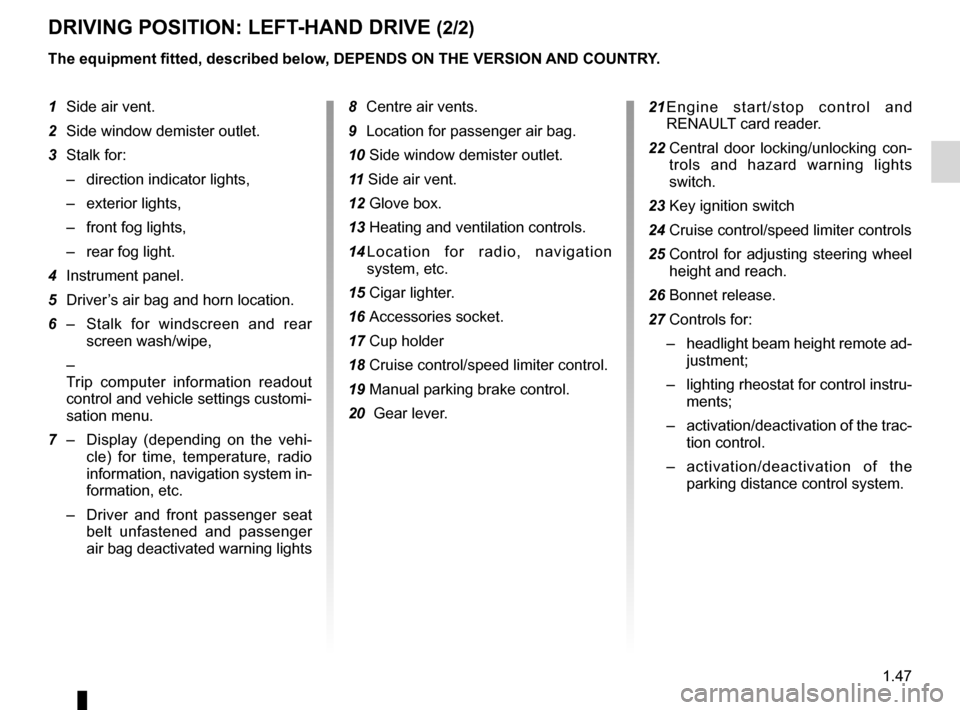
DRIVINg pOsITION: LEFT -hAND DRIVE (2/2)
The equipment fitted, described below, DEpENDs ON ThE VERsION AND COUNTRY.
1 Side air vent.
2 Side window demister outlet.
3 Stalk for:
– direction indicator lights,
– exterior lights,
– front fog lights,
– rear fog light.
4 Instrument panel.
5 Driver’s air bag and horn location.
6 – Stalk for windscreen and rear
screen wash/wipe,
–
Trip computer information readout
control and vehicle settings customi-
sation menu.
7 – Display (depending on the vehi -
cle) for time, temperature, radio
information, navigation system in-
formation, etc.
– Driver and front passenger seat
belt unfastened and passenger
air bag deactivated warning lights 8
Centre air vents.
9 Location for passenger air bag.
10 Side window demister outlet.
11 Side air vent.
12 Glove box.
13 Heating and ventilation controls.
14 L o c a t i o n f o r r a d i o , n a v i g a t i o n
system, etc.
15 Cigar lighter.
16 Accessories socket.
17 Cup holder
18 Cruise control/speed limiter control.
19 Manual parking brake control.
20 Gear lever. 21
E n g i n e s t a r t / s t o p c o n t r o l a n d
RENAULT card reader.
22 Central door locking/unlocking con -
trols and hazard warning lights
switch.
23 Key ignition switch
24 Cruise control/speed limiter controls
25 Control for adjusting steering wheel
height and reach.
26 Bonnet release.
27 Controls for:
– headlight beam height remote ad-
justment;
– lighting rheostat for control instru-
ments;
– activation/deactivation of the trac-
tion control.
– activation/deactivation of the
parking distance control system.
Page 53 of 241
JauneNoirNoir texte
1.49
ENG_UD13634_1
Poste de conduite direction à droite (L38 - X38 - Renault)
ENG_NU_891_892-7_L38-B32_Renault_1
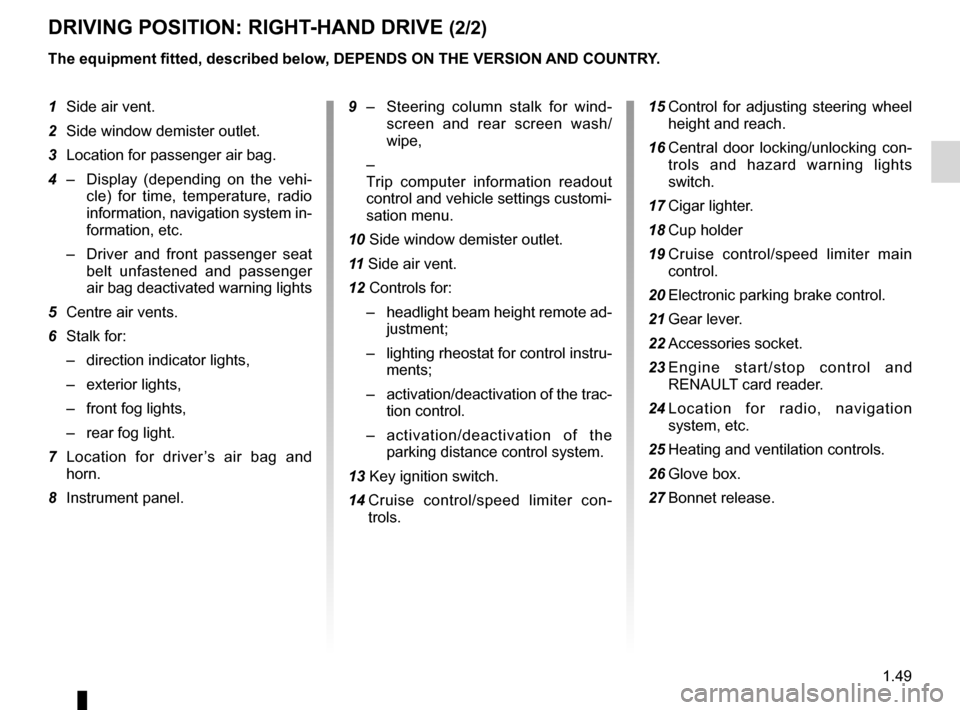
DRIVINg pOsITION: RIghT -hAND DRIVE (2/2)
The equipment fitted, described below, DEpENDs ON ThE VERsION AND COUNTRY.
1 Side air vent.
2 Side window demister outlet.
3 Location for passenger air bag.
4 – Display (depending on the vehi -
cle) for time, temperature, radio
information, navigation system in-
formation, etc.
– Driver and front passenger seat
belt unfastened and passenger
air bag deactivated warning lights
5 Centre air vents.
6 Stalk for:
– direction indicator lights,
– exterior lights,
– front fog lights,
– rear fog light.
7 Location for driver ’s air bag and
horn.
8 Instrument panel.
9 – Steering column stalk for wind -
screen and rear screen wash/
wipe,
–
Trip computer information readout
control and vehicle settings customi-
sation menu.
10 Side window demister outlet.
11 Side air vent.
12 Controls for:
– headlight beam height remote ad-
justment;
– lighting rheostat for control instru-
ments;
– activation/deactivation of the trac-
tion control.
– activation/deactivation of the
parking distance control system.
13 Key ignition switch.
14 Cruise control/speed limiter con -
trols. 15
Control for adjusting steering wheel
height and reach.
16 Central door locking/unlocking con -
trols and hazard warning lights
switch.
17 Cigar lighter.
18 Cup holder
19 Cruise control/speed limiter main
control.
20 Electronic parking brake control.
21 Gear lever.
22 Accessories socket.
23 E n g i n e s t a r t / s t o p c o n t r o l a n d
RENAULT card reader.
24 L o c a t i o n f o r r a d i o , n a v i g a t i o n
system, etc.
25 Heating and ventilation controls.
26 Glove box.
27 Bonnet release.
Page 55 of 241
ABS ....................................................................... (current page)
air bag .................................................................... (current page)
variable power-assisted steering ........................... (current page)
JauneNoirNoir texte
1.51
ENG_UD27258_6
Témoins lumineux (L38 - X38 - Renault)
ENG_NU_891_892-7_L38-B32_Renault_1
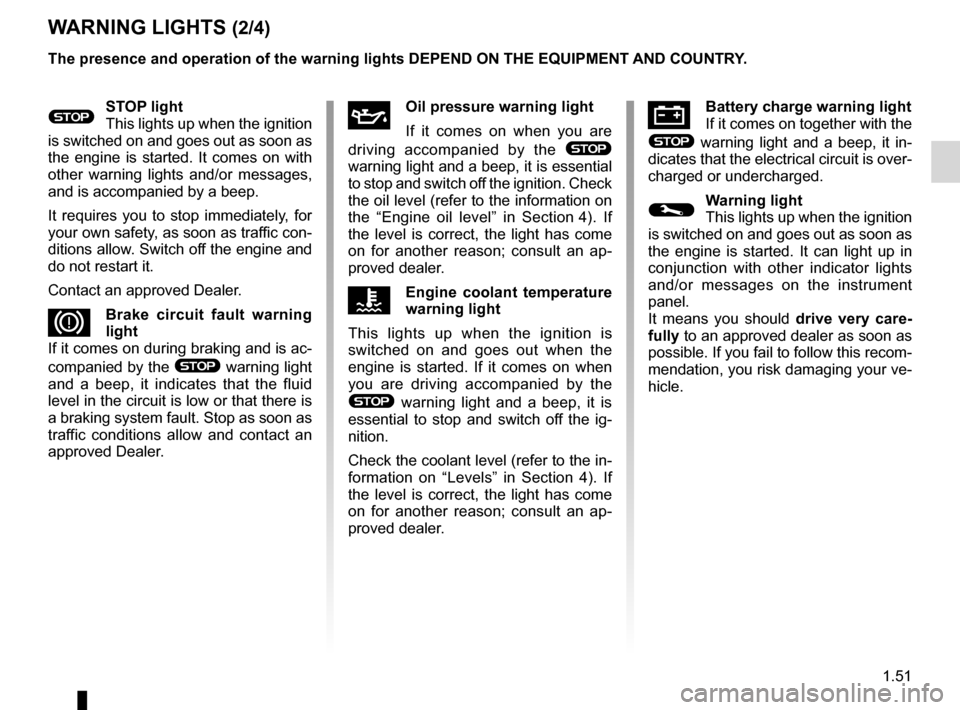
W ARNINg LIghTs (2/4)
ÚBattery charge warning light
If it comes on together with the
® warning light and a beep, it in-
dicates that the electrical circuit is over-
charged or undercharged.
©Warning light
This lights up when the ignition
is switched on and goes out as soon as
the engine is started. It can light up in
conjunction with other indicator lights
and/or messages on the instrument
panel.
It means you should drive very care-
fully to an approved dealer as soon as
possible. If you fail to follow this recom-
mendation, you risk damaging your ve-
hicle.
®sTOp light
This lights up when the ignition
is switched on and goes out as soon as
the engine is started. It comes on with
other warning lights and/or messages,
and is accompanied by a beep.
It requires you to stop immediately, for
your own safety, as soon as traffic con-
ditions allow. Switch off the engine and
do not restart it.
Contact an approved Dealer.
DBrake circuit fault warning
light
If it comes on during braking and is ac-
companied by the
® warning light
and a beep, it indicates that the fluid
level in the circuit is low or that there is
a braking system fault. Stop as soon as
traffic conditions allow and contact an
approved Dealer.
ÀOil pressure warning light
If it comes on when you are
driving accompanied by the
®
warning light and a beep, it is essential
to stop and switch off the ignition. Check
the oil level (refer to the information on
the “Engine oil level” in Section 4). If
the level is correct, the light has come
on for another reason; consult an ap -
proved dealer.
ÔEngine coolant temperature
warning light
This lights up when the ignition is
switched on and goes out when the
engine is started. If it comes on when
you are driving accompanied by the
® warning light and a beep, it is
essential to stop and switch off the ig -
nition.
Check the coolant level (refer to the in-
formation on “Levels” in Section 4). If
the level is correct, the light has come
on for another reason; consult an ap -
proved dealer.
The presence and operation of the warning lights DEpEND ON ThE EQUIpMENT AND COUNTRY.