Whil RENAULT FLUENCE 2012 1.G Owner's Manual
[x] Cancel search | Manufacturer: RENAULT, Model Year: 2012, Model line: FLUENCE, Model: RENAULT FLUENCE 2012 1.GPages: 241, PDF Size: 6.5 MB
Page 114 of 241

ENG_NU_891_892-7_L38-B32_Renault_2
Jaune NoirNoir texte
CRUISe CONtROL, SPeeD LIMIteR: speed")
2.26
ENG_UD24019_3
Régulateur-limiteur de vitesse : fonction limiteur (L38 - X38 - X32 \
- B32 - Renault)
ENG_NU_891_892-7_L38-B32_Renault_2
Jaune NoirNoir texte
CRUISe CONtROL, SPeeD LIMIteR: speed limiter (5/6)
Driving
When a limited speed has been stored
and this speed is not reached, driving is
similar to driving a vehicle without the
speed limiter function.
Once you have reached the stored
speed, no effort on the accelera-
tor pedal will allow you to exceed
the programmed speed except in an
emergency (refer to information on
“Exceeding the limit speed”).
Varying the limit speed
The limit speed may be changed by re-
peatedly pressing:
– switch 2 (+) to increase the speed;
– switch 3 (-) to decrease the speed.
exceeding the limit speed
It is possible to exceed the limit speed
at any moment. To do this: press the
accelerator pedal firmly and fully
(beyond the kickdown point).
While the speed is being exceeded, the
limit speed flashes on the instrument
panel and area C lights up red.
Then, as far as is possible, release
the accelerator pedal: the speed lim -
iter function will return as soon as you
reach a speed lower than the stored
speed.
Limited speed cannot be maintained
If driving up or down a steep gradient,
the system is unable to maintain the
limit speed: the stored speed on the
instrument panel will flash and zone C
will light up in red to inform you of this
situation.
The speed limiter function is
in no way linked to the brak-
ing system.
2354
C
Page 118 of 241

ENG_NU_891_892-7_L38-B32_Renault_2
Jaune NoirNoir texte
CRUISe CONtROL, SPeeD LIMIteR: cruise control")
2.30
ENG_UD24020_2
Régulateur-limiteur de vitesse : fonction régulateur (L38 - X38 -\
Renault)
ENG_NU_891_892-7_L38-B32_Renault_2
Jaune NoirNoir texte
CRUISe CONtROL, SPeeD LIMIteR: cruise control function (3/8)
The cruise control function
is in no way linked to the
braking system.
Adjusting the cruising speed
The cruising speed may be changed by
pressing the following repeatedly:
– switch 2 (+) to increase the speed,
– switch 3 (-) to decrease the speed.
exceeding the cruising speed
The cruising speed may be exceeded
at any time by depressing the accelera -
tor pedal. While it is being exceeded,
the cruising speed flashes on the in -
strument panel.
Then, release the accelerator: after a
few seconds, the vehicle will automati-
cally return to its set cruising speed.
Cruising speed cannot be
maintained
When driving down a steep gradient,
the system is unable to maintain the
cruising speed: the stored speed will
flash on the instrument panel informa -
tion display to inform you of this situ -
ation.
2354
Page 124 of 241
parking distance control........................(up to the end of the DU)
driving ................................................... (up to the end of the DU)
reversing sensor ................................... (up to the end of the DU)
2.36
ENG_UD21625_2
Aide au parking (L38 - X38 - Renault)
ENG_NU_891_892-7_L38-B32_Renault_2
Jaune NoirNoir texte
Parking distance control
Operating principle
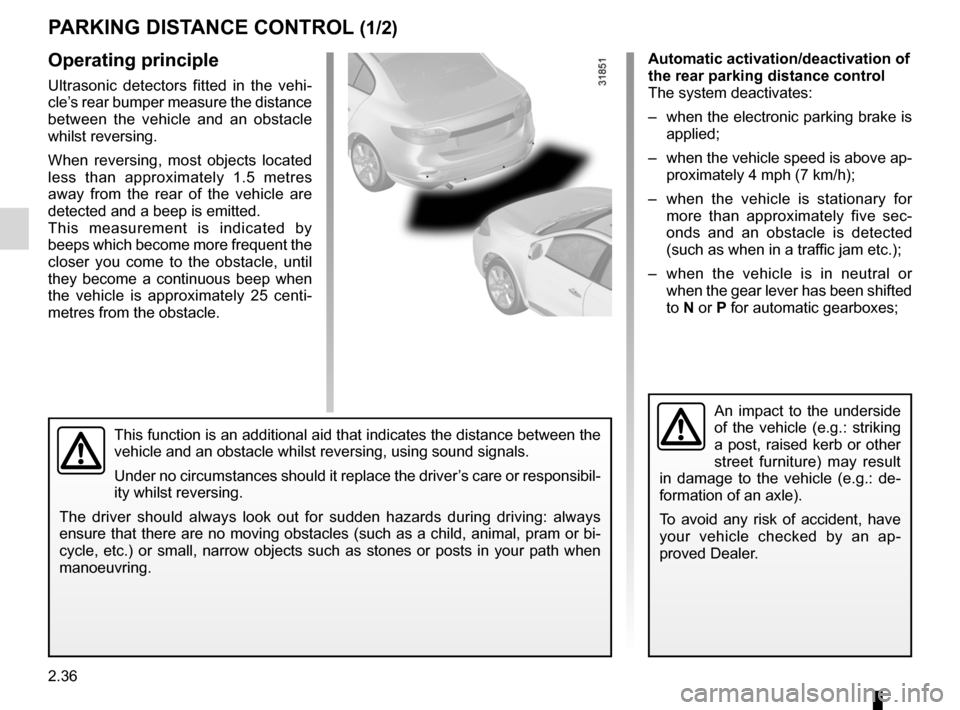
Ultrasonic detectors fitted in the vehi -
cle’s rear bumper measure the distance
between the vehicle and an obstacle
whilst reversing.
When reversing, most objects located
less than approximately 1.5 metres
away from the rear of the vehicle are
detected and a beep is emitted.
This measurement is indicated by
beeps which become more frequent the
closer you come to the obstacle, until
they become a continuous beep when
the vehicle is approximately 25 centi -
metres from the obstacle.
PARkING DISt ANCe CONtROL (1/2)
Automatic activation/deactivation of
the rear parking distance control
The system deactivates:
– when the electronic parking brake is
applied;
– when the vehicle speed is above ap-
proximately 4 mph (7 km/h);
– when the vehicle is stationary for
more than approximately five sec -
onds and an obstacle is detected
(such as when in a traffic jam etc.);
– when the vehicle is in neutral or
when the gear lever has been shifted
to N or P for automatic gearboxes;
This function is an additional aid that indicates the distance between the
vehicle and an obstacle whilst reversing, using sound signals.
Under no circumstances should it replace the driver’s care or responsibil -
ity whilst reversing.
The driver should always look out for sudden hazards during driving: always
ensure that there are no moving obstacles (such as a child, animal, pram or bi-
cycle, etc.) or small, narrow objects such as stones or posts in your path when
manoeuvring.
An impact to the underside
of the vehicle (e.g.: striking
a post, raised kerb or other
street furniture) may result
in damage to the vehicle (e.g.: de -
formation of an axle).
To avoid any risk of accident, have
your vehicle checked by an ap -
proved Dealer.
Page 127 of 241
JauneNoirNoir texte
2.39
ENG_UD27296_4
Boîte automatique (L38 - X38 - Renault)
ENG_NU_891_892-7_L38-B32_Renault_2
Parking the vehicle
When the vehicle is stopped, move the
lever to position P while keeping your
foot on the brake pedal: the gearbox is
in neutral and the drive wheels are me-
chanically locked by the driveshaft.
Apply the handbrake or, depending
on the vehicle, ensure that the elec-
tronic parking brake is applied.
Special circumstances
– If the road contours and bends
do not allow you to stay in auto -
matic mode (e.g.: in the mountains),
we recommend that you change to
manual mode.
This will prevent the automatic gear-
box from changing gears repeatedly
when climbing, and permit engine
braking on long descents.
– In cold weather, to prevent the
engine from stalling, wait a few mo-
ments before shifting the selector
lever from position P or N and en -
gaging D or R.
Driving in manual mode
With the selector lever in position D,
move the lever to the left. Shifting the
lever repeatedly allows you to change
gears manually:
– To move down through the gears,
push the lever backwards.
– To move up through the gears, push
the lever forwards.
The gear selected is displayed on the
instrument panel.
Special cases
Under certain driving conditions (e.g.
engine protection, electronic stability
program (ESP) operational etc.: ESC)
the automatic system may change gear
automatically.
Likewise, to prevent incorrect manoeu -
vres, a gear change may be refused by
the automatic system: in this case the
gear display flashes for a few seconds
as a warning.
AUt OMA tIC tRANSMISSION (2/3)
In very cold weather, the system
may prevent the gears from being
shifted in manual mode until the
gearbox reaches the right tempera-
ture.
An impact to the underside
of the vehicle (e.g.: striking
a post, raised kerb or other
street furniture) may result
in damage to the vehicle (e.g.: de -
formation of an axle).
To avoid any risk of accident, have
your vehicle checked by an ap -
proved Dealer.
Page 134 of 241

ENG_NU_891_892-7_L38-B32_Renault_3
Jaune NoirNoir texte
Automatic climate control
AuToMATIc clIMATE")
3.6
ENG_UD14525_3
Air conditionné automatique (X95 - B95 - D95 - L38 - X38 - X32 - B32\
- Renault)
ENG_NU_891_892-7_L38-B32_Renault_3
Jaune NoirNoir texte
Automatic climate control
AuToMATIc clIMATE coNTRol (1/5)
Automatic mode
The automatic climate control system
guarantees comfort in the passen -
ger compartment and good visibility
(except in the event of extreme condi -
tions), whilst optimising consumption.
The system controls the ventilation
speed, air distribution, air recircula -
tion, and starting and stopping the air
conditioning and air temperature. This
mode consists of a choice of three pro-
grammes:
A uTo : allows the selected comfort
level to be best attained, depending on
the exterior conditions. Press button 3.
SoFT: gently brings the temperature to
the desired comfort level. The comfort
level is then maintained gently and si -
lently. Press button 2.
FAST: increases the operation of the
system to reach the desired comfort
level more quickly. Use this programme
when you have passengers in the rear.
Press button 4.
12
4
9 De-icing/demisting of the rear screen
and, depending on the vehicle, the
door mirrors.
10 “Clear View” function.
11 Air recirculation.
12 Ventilation speed.
13 Display.
16
7891011
32
The controls
1 and 6 Air temperature.
2, 3 and 4 Automatic programmes.
5 Distribution of air in the passenger
compartment.
7 Off button.
8 Air conditioning.
13
5
Page 140 of 241
electric windows ................................... (up to the end of the DU)
child safety ............................................................. (current page)
children (safety) ..................................................... (current page)
sunroof .................................................. (up to the end of the DU)
3.12
ENG_UD21430_2
Lève-vitres électriques (L38 - X38 - Renault)
ENG_NU_891_892-7_L38-B32_Renault_3
Jaune NoirNoir texte
These systems operate with the igni -
tion on or off, until one of the front doors
is opened (limited to about 3 minutes).
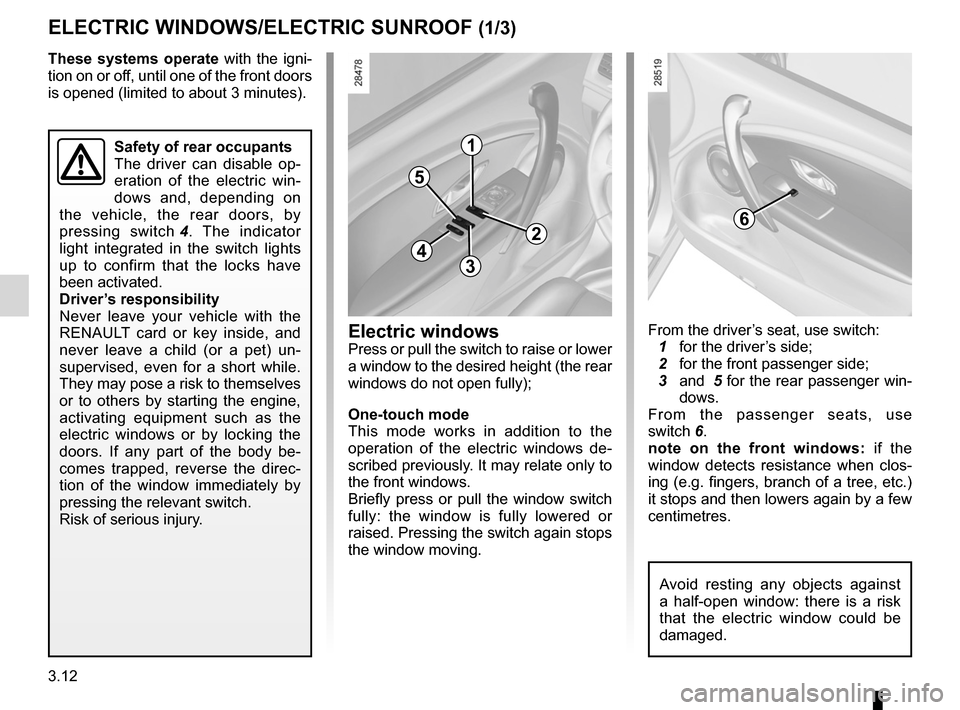
From the driver’s seat, use switch:
1 for the driver’s side;
2 for the front passenger side;
3 and 5 for the rear passenger win-
dows.
From the passenger seats, use
switch 6.
note on the front windows: if the
window detects resistance when clos -
ing (e.g. fingers, branch of a tree, etc.)
it stops and then lowers again by a few
centimetres.
Electric windows/Electric sunroof
ElEcTRIc wINDowS/ElEcTRIc SuNRooF (1/3)
Electric windows
Press or pull the switch to raise or lower
a window to the desired height (the rear
windows do not open fully);
one-touch mode
This mode works in addition to the
operation of the electric windows de -
scribed previously. It may relate only to
the front windows.
Briefly press or pull the window switch
fully: the window is fully lowered or
raised. Pressing the switch again stops
the window moving.
1
2
34
5
6
Safety of rear occupants
The driver can disable op -
eration of the electric win -
dows and, depending on
the vehicle, the rear doors, by
pressing switch 4 . The indicator
light integrated in the switch lights
up to confirm that the locks have
been activated.
Driver’s responsibility
Never leave your vehicle with the
RENAULT card or key inside, and
never leave a child (or a pet) un -
supervised, even for a short while.
They may pose a risk to themselves
or to others by starting the engine,
activating equipment such as the
electric windows or by locking the
doors. If any part of the body be -
comes trapped, reverse the direc -
tion of the window immediately by
pressing the relevant switch.
Risk of serious injury.
Avoid resting any objects against
a half-open window: there is a risk
that the electric window could be
damaged.
Page 141 of 241
JauneNoirNoir texte
3.13
ENG_UD21430_2
Lève-vitres électriques (L38 - X38 - Renault)
ENG_NU_891_892-7_L38-B32_Renault_3
ElEcTRIc wINDowS/ElEcTRIc SuNRooF (2/3)
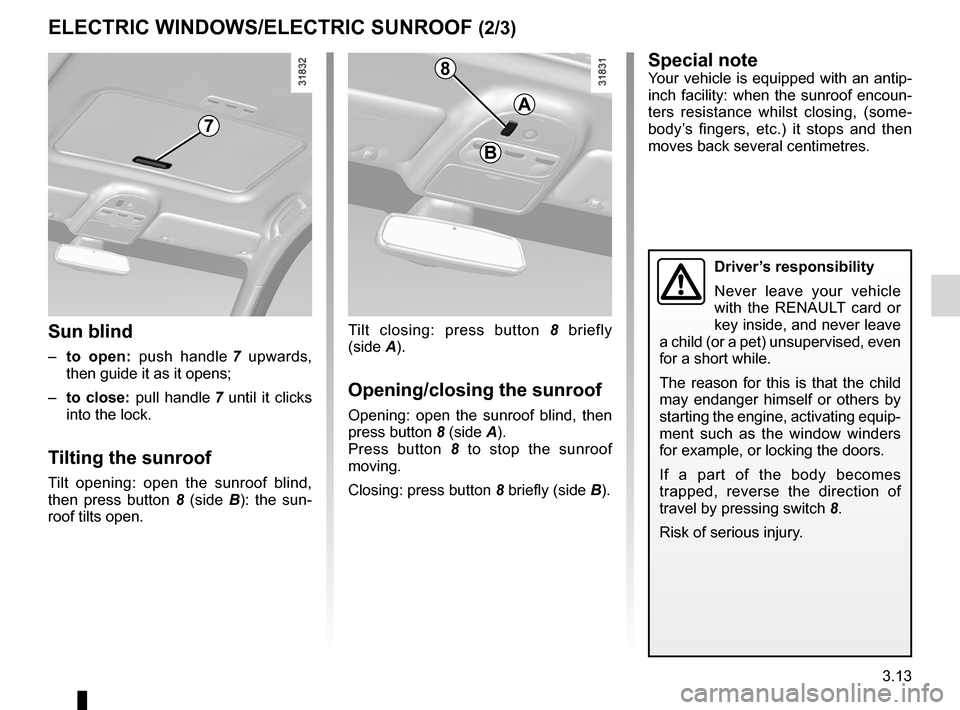
Tilt closing: press button 8 briefly
(side A).
opening/closing the sunroof
Opening: open the sunroof blind, then
press button 8 (side A).
Press button 8 to stop the sunroof
moving.
Closing: press button 8 briefly (side B).
Sun blind
– to open: push handle 7 upwards,
then guide it as it opens;
– to close: pull handle 7 until it clicks
into the lock.
Tilting the sunroof
Tilt opening: open the sunroof blind,
then press button 8 (side B ): the sun -
roof tilts open.
Special noteYour vehicle is equipped with an antip-
inch facility: when the sunroof encoun -
ters resistance whilst closing, (some -
body’s fingers, etc.) it stops and then
moves back several centimetres.
Driver’s responsibility
Never leave your vehicle
with the RENAULT card or
key inside, and never leave
a child (or a pet) unsupervised, even
for a short while.
The reason for this is that the child
may endanger himself or others by
starting the engine, activating equip-
ment such as the window winders
for example, or locking the doors.
If a part of the body becomes
trapped, reverse the direction of
travel by pressing switch 8.
Risk of serious injury.
7
8
B
A
Page 177 of 241
JauneNoirNoir texte
5.5
ENG_UD21559_4
Kit de gonflage (X95 - B95 - D95 - L38 - X38 - X32 - B32 - Renault)
ENG_NU_891_892-7_L38-B32_Renault_5
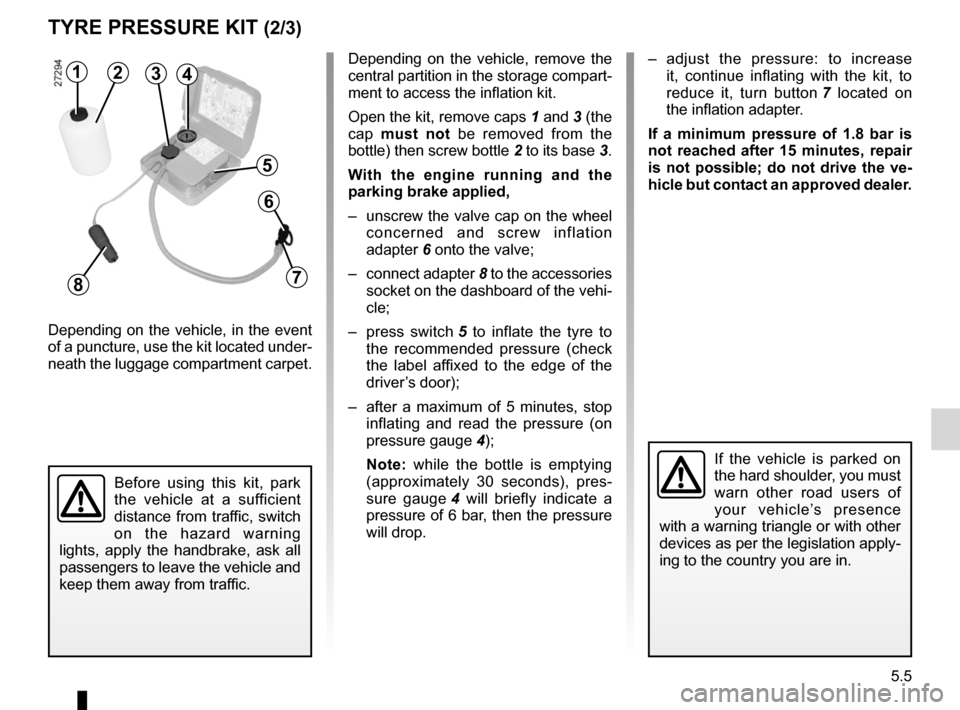
Depending on the vehicle, remove the
central partition in the storage compart-
ment to access the inflation kit.
Open the kit, remove caps 1 and 3 (the
cap must not be removed from the
bottle) then screw bottle 2 to its base 3.
w ith the engine running and the
parking brake applied,
– unscrew the valve cap on the wheel
concerned and screw inflation
adapter 6 onto the valve;
– connect adapter 8 to the accessories
socket on the dashboard of the vehi-
cle;
– press switch 5 to inflate the tyre to
the recommended pressure (check
the label affixed to the edge of the
driver’s door);
– after a maximum of 5 minutes, stop
inflating and read the pressure (on
pressure gauge 4);
n ote: while the bottle is emptying
(approximately 30 seconds), pres -
sure gauge 4 will briefly indicate a
pressure of 6 bar, then the pressure
will drop.
tyre Pressure KIt (2/3)
143
5
6
78
2– adjust the pressure: to increase
it, continue inflating with the kit, to
reduce it, turn button 7 located on
the inflation adapter.
If a minimum pressure of 1.8 bar is
not reached after 15 minutes, repair
is not possible; do not drive the ve-
hicle but contact an approved dealer.
Depending on the vehicle, in the event
of a puncture, use the kit located under -
neath the luggage compartment carpet.
Before using this kit, park
the vehicle at a sufficient
distance from traffic, switch
on the hazard warning
lights, apply the handbrake, ask all
passengers to leave the vehicle and
keep them away from traffic.
If the vehicle is parked on
the hard shoulder, you must
warn other road users of
your vehicle’s presence
with a warning triangle or with other
devices as per the legislation apply-
ing to the country you are in.
Page 206 of 241
wiper blades ......................................... (up to the end of the DU)
wipers blades ............................................. (up to the end of the DU)
5.34
ENG_UD21380_4
Balais d’essuie-vitres (X95 - B95 - D95 - L38 - X38 - X32 - B32 - Re\
nault)
ENG_NU_891_892-7_L38-B32_Renault_5
Wipers (replacing blades)
wInDscreen wIPer BlaDes
replacing windscreen wiper
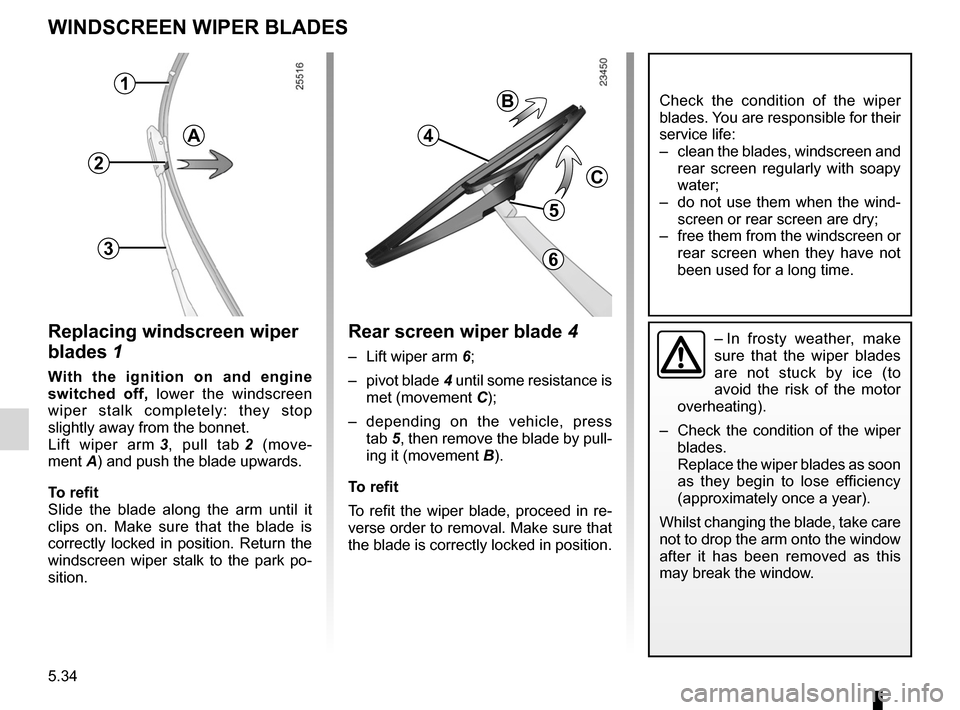
blades 1
w ith the ignition on and engine
switched off, lower the windscreen
wiper stalk completely: they stop
slightly away from the bonnet.
Lift wiper arm 3 , pull tab 2 (move -
ment A) and push the blade upwards.
t o refit
Slide the blade along the arm until it
clips on. Make sure that the blade is
correctly locked in position. Return the
windscreen wiper stalk to the park po-
sition.
1
2
3
Check the condition of the wiper
blades. You are responsible for their
service life:
– clean the blades, windscreen and
rear screen regularly with soapy
water;
– do not use them when the wind-
screen or rear screen are dry;
– free them from the windscreen or
rear screen when they have not
been used for a long time.
rear screen wiper blade 4
– Lift wiper arm 6;
– pivot blade 4 until some resistance is
met (movement C);
– depending on the vehicle, press
tab 5, then remove the blade by pull -
ing it (movement B).
t o refit
To refit the wiper blade, proceed in re-
verse order to removal. Make sure that
the blade is correctly locked in position.
4
5
B
c
a
6
– In frosty weather, make
sure that the wiper blades
are not stuck by ice (to
avoid the risk of the motor
overheating).
– Check the condition of the wiper
blades.
Replace the wiper blades as soon
as they begin to lose efficiency
(approximately once a year).
Whilst changing the blade, take care
not to drop the arm onto the window
after it has been removed as this
may break the window.
Page 211 of 241
JauneNoirNoir texte
5.39
ENG_UD17941_2
Anomalies de fonctionnement (X85 - L38 - X38 - Renault)
ENG_NU_891_892-7_L38-B32_Renault_5
OPeratIng F aults (3/8)
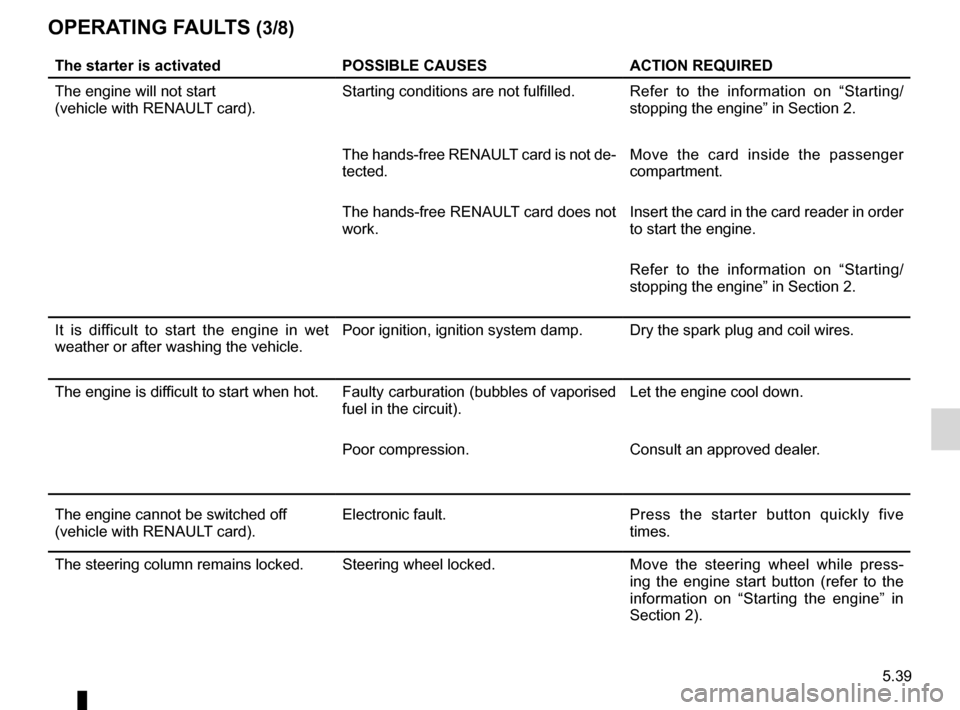
the starter is activated POssIBle causesactIOn requIreD
The engine will not start
(vehicle with RENAULT card). Starting conditions are not fulfilled.
Refer to the information on “Starting/
stopping the engine” in Section 2.
The hands-free RENAULT card is not de-
tected. Move the card inside the passenger
compartment.
The hands-free RENAULT card does not
work. Insert the card in the card reader in order
to start the engine.
Refer to the information on “Starting/
stopping the engine” in Section 2.
It is difficult to start the engine in wet
weather or after washing the vehicle. Poor ignition, ignition system damp.
Dry the spark plug and coil wires.
The engine is difficult to start when hot. Faulty carburation (bubbles of vaporised
fuel in the circuit).Let the engine cool down.
Poor compression. Consult an approved dealer.
The engine cannot be switched off
(vehicle with RENAULT card). Electronic fault.
Press the starter button quickly five
times.
The steering column remains locked. Steering wheel locked.Move the steering wheel while press-
ing the engine start button (refer to the
information on “Starting the engine” in
Section 2).