Whil RENAULT FLUENCE 2012 1.G User Guide
[x] Cancel search | Manufacturer: RENAULT, Model Year: 2012, Model line: FLUENCE, Model: RENAULT FLUENCE 2012 1.GPages: 241, PDF Size: 6.5 MB
Page 75 of 241
JauneNoirNoir texte
1.71
ENG_UD21621_3
Heure et température extérieure (L38 - X38 - Renault)
ENG_NU_891_892-7_L38-B32_Renault_1
2517725314
25314
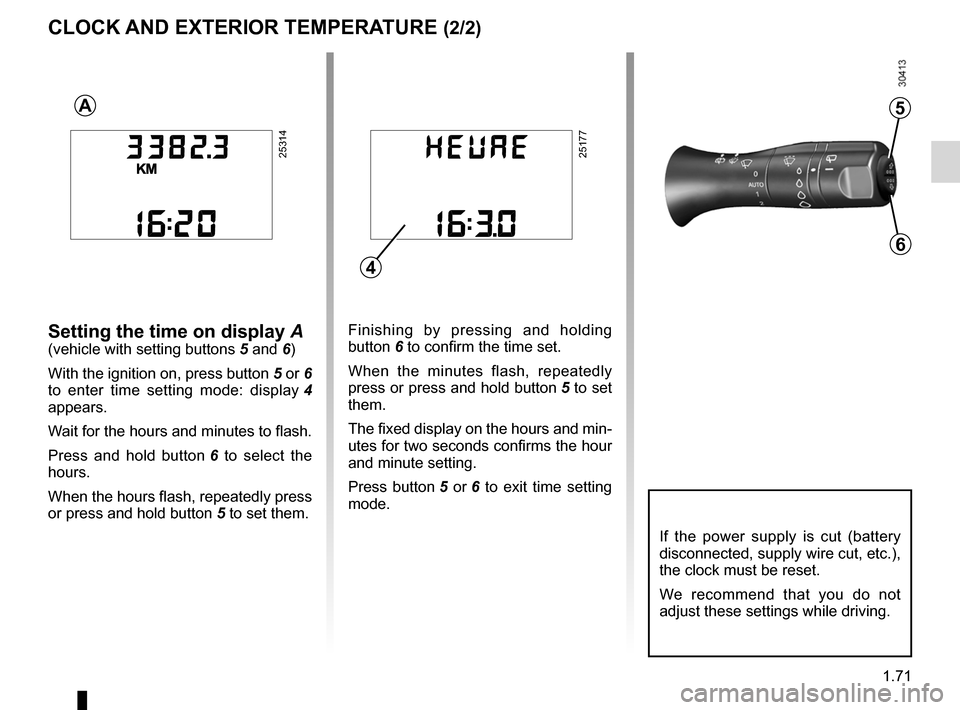
Finishing by pressing and holding
button 6 to confirm the time set.
When the minutes flash, repeatedly
press or press and hold button 5 to set
them.
The fixed display on the hours and min-
utes for two seconds confirms the hour
and minute setting.
Press button 5 or 6 to exit time setting
mode.setting the time on display A(vehicle with setting buttons 5 and 6)
With the ignition on, press button 5 or 6
to enter time setting mode: display 4
appears.
Wait for the hours and minutes to flash.
Press and hold button 6 to select the
hours.
When the hours flash, repeatedly press
or press and hold button 5 to set them.
A5
6
4
CLOCK AND EXTERIOR TEMpERATURE (2/2)
If the power supply is cut (battery
disconnected, supply wire cut, etc.),
the clock must be reset.
We recommend that you do not
adjust these settings while driving.
Page 90 of 241
running in .............................................. (up to the end of the DU)
driving ................................................... (up to the end of the DU)
2.2
ENG_UD25558_2
Rodage (L38 - X38 - Renault)
ENG_NU_891_892-7_L38-B32_Renault_2
Running in
RUNNING IN
Petrol version
Up to 600 miles (1,000 km) , do not
exceed 78 mph (130 km/h) in top gear
or 3,000 to 3,500 rpm.
You may only expect top performance
from your vehicle after approximately
1,800 miles (3 000 km).
Service intervals: please refer to your
vehicle’s maintenance document. Diesel version
For the first
900 miles (1,500 km), do
not exceed 2,500 rpm. After complet -
ing this mileage you may drive faster,
however, it is only after approximately
3600 miles (6,000 km) that you may
reasonably expect full performance.
During the running in period, do not ac-
celerate hard while the engine is still
cold and do not let the engine over-rev.
Service intervals: please refer to your
vehicle’s maintenance document.
Page 91 of 241
ignition switch ....................................... (up to the end of the DU)
starting the engine ................................ (up to the end of the DU)
starting the engine ................................ (up to the end of the DU)
switching on the vehicle ignition ........... (up to the end of the DU)
2.3
ENG_UD21624_2
Démarrage, arrêt moteur : véhicule avec clé (L38 - X38 - X3\
2 - B32 - Renault)
ENG_NU_891_892-7_L38-B32_Renault_2
Starting/stopping the engine: vehicle with key
Special note on vehicles with a
manual gearbox
Depending on the vehicle, warning
light
 flashes when the engine
is started to indicate that a gear is en-
gaged: select neutral or depress the
clutch.
Special note on vehicles with an
automatic gearbox
Before starting, move the lever to posi-
tion P.
Note: If a gear other than neutral is dis-
played, it flashes; starting is not pos -
sible unless you depress the brake
pedal, while holding the key in the start-
ing position.
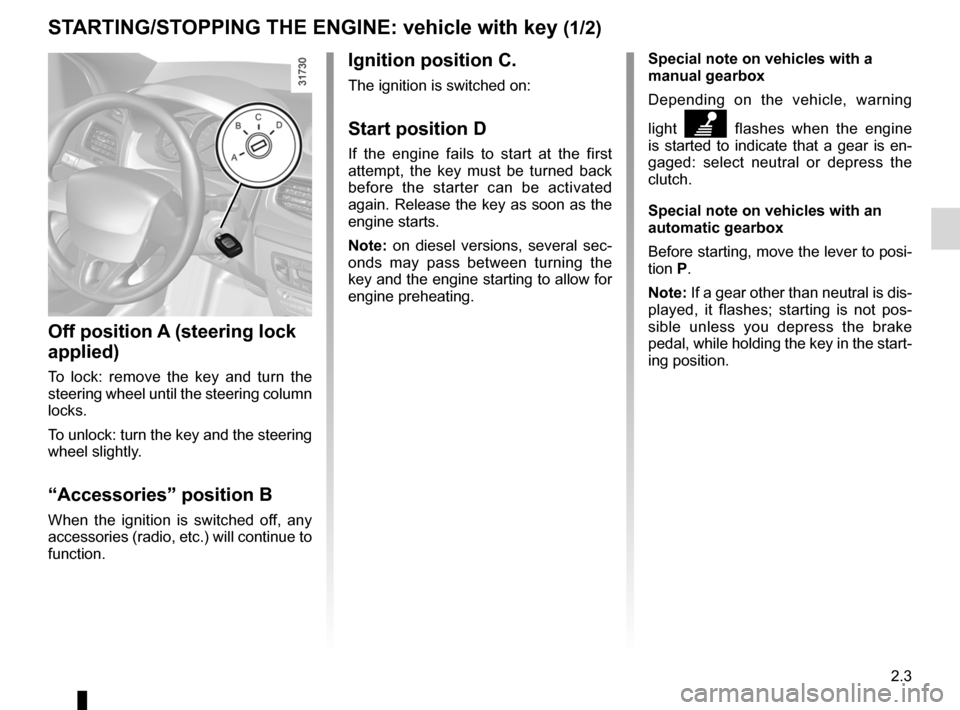
Ignition position C.
The ignition is switched on:
Start position D
If the engine fails to start at the first
attempt, the key must be turned back
before the starter can be activated
again. Release the key as soon as the
engine starts.
Note: on diesel versions, several sec -
onds may pass between turning the
key and the engine starting to allow for
engine preheating.
Off position A (steering lock
applied)
To lock: remove the key and turn the
steering wheel until the steering column
locks.
To unlock: turn the key and the steering
wheel slightly.
“Accessories” position B
When the ignition is switched off, any
accessories (radio, etc.) will continue to
function.
St ARtING/St OPPING the eNGINe: vehicle with key (1/2)
Page 92 of 241

2.4
ENG_UD21624_2
Démarrage, arrêt moteur : véhicule avec clé (L38 - X38 - X3\
2 - B32 - Renault)
ENG_NU_891_892-7_L38-")
stopping the engine .............................. (up to the end of the DU)
2.4
ENG_UD21624_2
Démarrage, arrêt moteur : véhicule avec clé (L38 - X38 - X3\
2 - B32 - Renault)
ENG_NU_891_892-7_L38-B32_Renault_2
Stopping the engine
With the engine idling, turn the key
back to the Stop position.ÉDiesel injection
Cold or warm engine
– Turn the key to the “Start” posi -
tion D without depressing the
accelerator pedal .
– release the key as soon as the
engine starts.
Note: several seconds may pass be -
tween turning the key and the engine
starting to allow for engine preheating.Starting the engine
Petrol injection
engine warm or cold
– Turn the key to the start position
without depressing the accel -
erator.
– release the key as soon as the
engine starts.
StARtING/St OPPING the eNGINe: vehicle with key (2/2)
Driver’s responsibility
Never leave your vehi -
cle with the key inside and
never leave a child (or a
pet) unsupervised, even for a short
while.
There is a risk that they could start
the engine or operate electrical
equipment (electric windows etc.)
and trap part of their body (neck,
arms, hands, etc.).
Risk of serious injury.
Never switch off the ignition before
the vehicle has stopped completely.
Once the engine has stopped, the
brake servo, power-assisted steer -
ing, etc., and the passive safety de-
vices such as the airbags and pre -
tensioners will no longer operate.
Page 93 of 241

starting the engine ................................ (up to the end of the DU)
engine start/stop button ........................ (up to the end of the DU)
starting the engine ................................ (up to the end of the DU)
driving ................................................... (up to the end of the DU)
2.5
ENG_UD13650_1
Démarrage / Arrêt moteur avec carte RENAULT mains libres (L38 - X38 - Renault)
ENG_NU_891_892-7_L38-B32_Renault_2
Starting/stopping the engine: vehicle with Renault card
St ARtING/St OPPING the eNGINe: vehicle with ReNAULt CARD (1/3)
hands-free ReNAUL t card
The RENAULT card must be inserted
in card reader 2 or in detection zone 3.
To start, depress the brake or clutch
pedal and press button 1 . If a gear
is engaged, the vehicle may only be
started by depressing the clutch pedal.
Starting
vehicles with an automatic gearbox
The lever should be in position P.
For all vehicles:
– if one of the starting conditions is
not met the message “Press brake +
START”, “Press clutch + START” or
“Gear lever to P” is displayed on the
instrument panel.
– In some cases it will be necessary to
move the steering wheel while press-
ing start button 1 to assist in unlock -
ing the steering column; a message
on the instrument panel “Turn steer-
ing wheel + START” warns of this.
3
12
Starting with the tailgate
open (in hands-free mode)
In this case, the RENAULT card must
not be located in the luggage compart-
ment.
Page 94 of 241

switching on the vehicle ignition ............................ (current page)
2.6
ENG_UD13650_1
Démarrage / Arrêt moteur avec carte RENAULT mains libres (L38 - X38 - Renault)
ENG_NU_891_892-7_L38-B32_Renault_2
Jaune NoirNoir texte
StARtING/St OPPING the eNGINe: vehicle with ReNAULt CARD (2/3)
Accessories function(switching on the ignition)
Once you have gained access to your
vehicle, you may use some of its func-
tions (radio, navigation, wipers, etc.).
To use the other functions, press
button 1 without touching the pedals, or
insert the card in the reader.
Note: depending on the vehicle, press-
ing button 1 starts the engine.
Operating faults
In certain cases, the hands-free
RENAULT card may not work:
– when the RENAULT card battery is
drained, flat battery, etc.
– near to appliances operating on the
same frequency as the card (moni -
tor, mobile phone, video game, etc.);
– vehicle located in a high electromag -
netic radiation zone.
The message “ Please insert keycard ”
appears on the instrument panel.
Insert the RENAULT card fully into card
reader 2.
Driver’s responsibility
Never leave your vehicle
with the RENAULT card
inside and never leave a
child (or a pet) unsupervised, even
for a short while.
There is a risk that they could start
the engine or operate electrical
equipment (electric windows etc.)
and trap part of their body (neck,
arms, hands, etc.).
Risk of serious injury.
Never switch off the ignition before
the vehicle has stopped completely.
Once the engine has stopped, the
brake servo, power-assisted steer -
ing, etc. and the passive safety de-
vices such as air bags and preten -
sioners will no longer operate.
12
Page 100 of 241

2.12
ENG_UD20973_7
Conseils antipollution, économie de carburant, conduite (X45 - H45 -\
X85 - B85 - C85 - S85 - X91 - X83 - X61 - F61 - K61 - K85 - X95 - B95 -\
D95 - J95 - R95 - L38 - X61
ENG_NU_891_892-7_L38-B32_Renault_2
Jaune NoirNoir texte
ADVICe: antipollution, fuel economy and driving (2/3)
– Sporty driving uses a lot of fuel: drive
with a light right foot.
– Brake as little as possible. If you an-
ticipate an obstacle or bend in ad -
vance, you may then simply release
the accelerator pedal.
– Do not try to maintain the same
speed up a hill, accelerate no more
than you would on the level. Keep
your foot in the same position on the
accelerator pedal.
– Double declutching and accelerating
before switching off are unnecessary
in modern vehicles.
– Bad weather, flooded roads:
Do not drive through floods
if the water is above the
lower edge of the wheel
rims.Driving– Drive carefully for the first few miles
until the engine reaches its normal
operating temperature, rather than
let it warm up while the vehicle is sta-
tionary.
– Speed is expensive.
– Do not overrev the engine in the in-
termediate gears.
Always use the highest gear possi -
ble without labouring the engine.
On versions with an automatic gear-
box, it is preferable to keep the gear
lever in position D.
– Avoid sudden acceleration.
exhaust gas monitoring
system
The exhaust gas monitoring system will
detect any operating faults in the vehi-
cle’s antipollution system.
If this system malfunctions, toxic sub -
stances may be released into the at -
mosphere or damage may occur.
ÄThis warning light on the in -
strument panel will indicate if
there are any faults in the system:
This lights up when the ignition is
switched on and goes out when the
engine is started.
– If it lights up continuously, consult an
approved Dealer as soon as possi -
ble;
– if it flashes, reduce the engine speed
until the light stops flashing. Contact
your approved dealer as soon as
possible.
Obstructions to the driver
On the driver ’s side, only
use mats adapted to the ve-
hicle that attach to the pre-
installed parts, and regularly check
their mounting. Do not place several
mats on top of each other.
Risk of pedals jamming
Page 102 of 241

2.14
ENG_UD25716_1
Environnement (sans marque) (X44 - X45 - X77 - X81 - X85 - X90 - X91 \
- X83 - X61 - TEST - X95 - J9")
environment .......................................... (up to the end of the DU)
2.14
ENG_UD25716_1
Environnement (sans marque) (X44 - X45 - X77 - X81 - X85 - X90 - X91 \
- X83 - X61 - TEST - X95 - J95 - R95 - F90 Ph2 - X33 - X47 - X43 - X38 - H79 - X62 - X32 -\
X09 -
ENG_NU_891_892-7_L38-B32_Renault_2
Environment
eNVIRONMeNt
emissions
Your vehicle has been designed to emit
fewer greenhouse gases (CO2) while in
use, and therefore to consume less fuel
(eg. 140 g/km, equivalent to 5.3 l/100
km for a diesel vehicle).
Our vehicles are also equipped with a
particle filter system including a cata -
lytic converter, an oxygen sensor and
an active carbon filter (the latter pre -
vents vapour from the fuel tank being
released into the open air).
For certain diesel vehicles, this system
also has a particle filter to reduce the
volume of soot particles emitted.
Please make your own
contribution towards
protecting the environment
too
– Worn parts replaced in the course of
routine vehicle maintenance (vehi -
cle battery, oil filter, air filter, batter -
ies, etc.) and oil containers (empty or
filled with used oil) must be disposed
of through specialist organisations. –
At the end of the vehicle’s service
life, it should be sent to approved
centres to ensure that it is recycled.
– In all cases, comply with local legis -
lation.
Recycling
Your vehicle is 85% recyclable and
95% recoverable.
To achieve these objectives, many of
the vehicle components have been de-
signed to enable them to be recycled.
The materials and structures have
been carefully designed to allow these
components to be easily removed and
reprocessed by specialist companies.
In order to preserve raw material re -
sources, this vehicle incorporates nu -
merous parts made from recycled plas-
tics or renewable materials (vegetable
or animal-derived materials such as
cotton or wool).
Your vehicle has been designed with
respect for the
environment in mind for
its entire service life: during production,
use and at the end of its life.
This commitment is illustrated by the of
the manufacturer eco² signature.Manufacture
Your vehicle has been manufactured at
a factory which complies with a policy
to reduce the environmental impact
on the surrounding areas (reduction of
water and energy consumption, visual
and noise pollution, atmospheric emis-
sions and waste water; sorting and re-
using waste).
Page 106 of 241
ABS ...................................................... (up to the end of the DU)
anti-lock braking system: ABS ..............(up to the end of the DU)
emergency brake assist ........................(up to the end of the DU)
emergency braking ............................... (up to the end of the DU)
driving ................................................... (up to the end of the DU)
ASR (traction control) ........................... (up to the end of the DU)
traction control: ASR .............................(up to the end of the DU)
traction control system: ASR ................(up to the end of the DU)
electronic stability control: ESC ............ (up to the end of the DU)
ESC: electronic stability control ............ (up to the end of the DU)
Hill Start Assist...................................... (up to the end of the DU)
hill descent control ................................ (up to the end of the DU)
2.18
ENG_UD26632_2
Dispositifs de correction et d’assistance à la conduite (X95 - B\
95 - D95 - E95 - K95 - Renault)
ENG_NU_891_892-7_L38-B32_Renault_2
Jaune NoirNoir texte
Driver correction devices and aids
DRIVeR CORReCtION DeVICeS/AIDS (1/4)
Depending on the vehicle, this is com-
posed of:
– t h e A B S ( a n t i - l o c k b r a k i n g
system);
– electronic stability control e SC
with understeer control and trac -
tion control ASR ;
– emergency brake assist with, de -
pending on the vehicle, braking
anticipation.
In an emergency, apply firm and
continuous pressure to the brake
pedal. There is no need to pump
it repeatedly. The ABS will modu -
late the force applied in the braking
system.
These functions are an ad-
ditional aid in the event of
critical driving conditions,
enabling the vehicle behav -
iour to be adapted to suit the driving
conditions.
However, the functions do not take
the place of the driver. they do
not increase the vehicle’s limits
and should not encourage you
to drive more quickly. Therefore,
they can under no circumstances
replace the vigilance or responsibil -
ity of the driver when manoeuvring
the vehicle (the driver must always
be ready for sudden incidents which
may occur when driving).
Yo u r b r a k i n g s y s t e m s
are partially operational.
However, it is dangerous
to brake suddenly and
it is essential to stop immediately,
as soon as traffic conditions allow.
Contact an approved dealer.
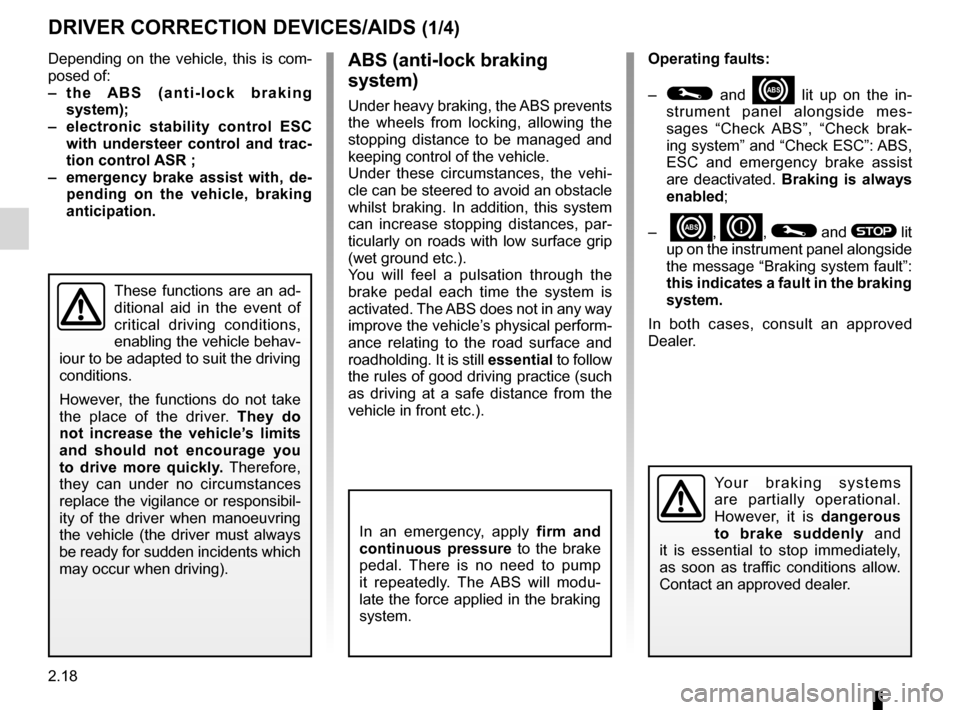
Operating faults:
–
© and x lit up on the in -
strument panel alongside mes -
sages “ Check ABS ”, “Check brak -
ing system” and “Check ESC”: ABS,
ESC and emergency brake assist
are deactivated. Braking is always
enabled;
–
x, D, © and ® lit
up on the instrument panel alongside
the message “Braking system fault”:
this indicates a fault in the braking
system.
In both cases, consult an approved
Dealer.
ABS (anti-lock braking
system)
Under heavy braking, the ABS prevents
the wheels from locking, allowing the
stopping distance to be managed and
keeping control of the vehicle.
Under these circumstances, the vehi -
cle can be steered to avoid an obstacle
whilst braking. In addition, this system
can increase stopping distances, par -
ticularly on roads with low surface grip
(wet ground etc.).
You will feel a pulsation through the
brake pedal each time the system is
activated. The ABS does not in any way
improve the vehicle’s physical perform-
ance relating to the road surface and
roadholding. It is still essential to follow
the rules of good driving practice (such
as driving at a safe distance from the
vehicle in front etc.).
Page 111 of 241

ENG_NU_891_892-7_L38-B32_Renault_2
Varying the limit speed
The limit spee")
JauneNoirNoir texte
2.23
ENG_UD24019_3
Régulateur-limiteur de vitesse : fonction limiteur (L38 - X38 - X32 \
- B32 - Renault)
ENG_NU_891_892-7_L38-B32_Renault_2
Varying the limit speed
The limit speed may be changed by re-
peatedly pressing:
– switch 2 (+) to increase the speed;
– switch 3 (-) to decrease the speed.
The speed limiter function is
in no way linked to the brak-
ing system.
CRUISe CONtROL, SPeeD LIMIteR: speed limiter (2/6)
Driving
When a limited speed has been stored
and this speed is not reached, driving is
similar to driving a vehicle without the
speed limiter function.
Once you have reached the stored
speed, no effort on the accelera-
tor pedal will allow you to exceed
the programmed speed except in an
emergency (refer to information on
“Exceeding the limit speed”).
exceeding the limit speed
It is possible to exceed the limit speed
at any moment. To do this: press the
accelerator pedal firmly and fully
(beyond the kickdown point).
While the speed is being exceeded, the
programmed speed displayed on the
instrument panel flashes.
Then, release the accelerator pedal:
the speed limiter function will return as
soon as you reach a speed lower than
the stored speed.
Limited speed cannot be maintained
When driving down a steep gradient,
the system is unable to maintain the
limit speed: the stored speed will flash
on the instrument panel information dis-
play to inform you of this situation.
2354