ignition RENAULT FLUENCE 2012 1.G Owner's Guide
[x] Cancel search | Manufacturer: RENAULT, Model Year: 2012, Model line: FLUENCE, Model: RENAULT FLUENCE 2012 1.GPages: 241, PDF Size: 6.5 MB
Page 103 of 241
tyres ...................................................... (up to the end of the DU)
tyre pressure monitor ............................(up to the end of the DU)
tyre pressure ......................................... (up to the end of the DU)
driving ................................................... (up to the end of the DU)
2.15
ENG_UD24232_3
Système de surveillance de pression des pneumatiques (L38 - X38 - Re\
nault)
ENG_NU_891_892-7_L38-B32_Renault_2
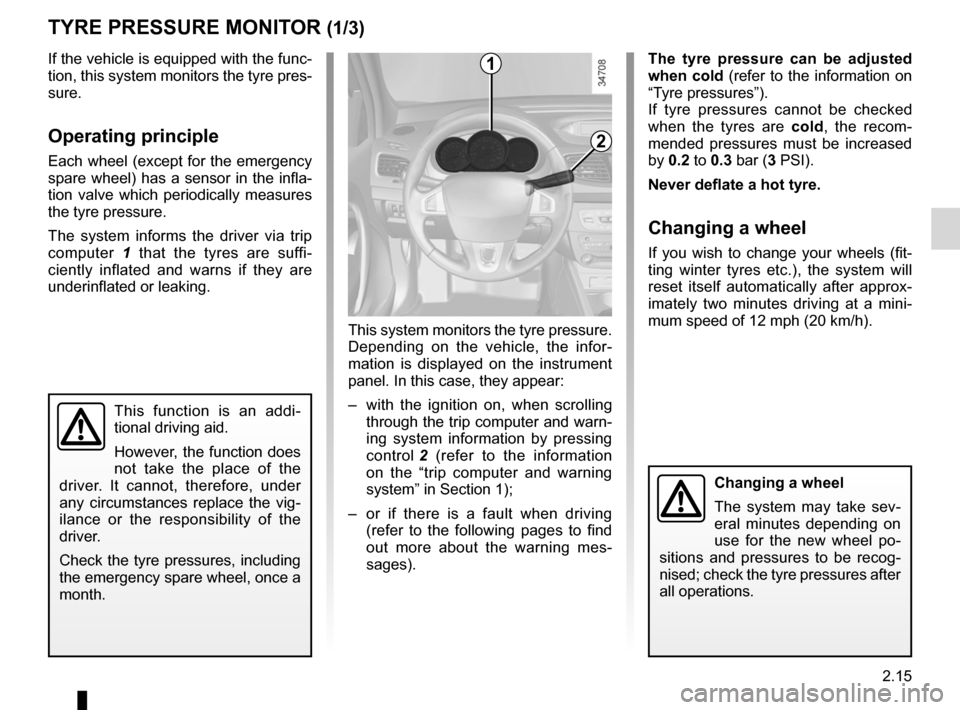
This system monitors the tyre pressure.
Depending on the vehicle, the infor -
mation is displayed on the instrument
panel. In this case, they appear:
– with the ignition on, when scrolling
through the trip computer and warn-
ing system information by pressing
control 2 (refer to the information
on the “trip computer and warning
system” in Section 1);
– or if there is a fault when driving
(refer to the following pages to find
out more about the warning mes -
sages).
Tyre pressure monitor
This function is an addi -
tional driving aid.
However, the function does
not take the place of the
driver. It cannot, therefore, under
any circumstances replace the vig -
ilance or the responsibility of the
driver.
Check the tyre pressures, including
the emergency spare wheel, once a
month.
tyRe PReSSURe MONIt OR (1/3)
If the vehicle is equipped with the func-
tion, this system monitors the tyre pres-
sure.
Operating principle
Each wheel (except for the emergency
spare wheel) has a sensor in the infla-
tion valve which periodically measures
the tyre pressure.
The system informs the driver via trip
computer 1 that the tyres are suffi -
ciently inflated and warns if they are
underinflated or leaking.
t he tyre pressure can be adjusted
when cold (refer to the information on
“Tyre pressures”).
If tyre pressures cannot be checked
when the tyres are cold, the recom -
mended pressures must be increased
by 0.2 to 0.3 bar (3 PSI).
Never deflate a hot tyre.
Changing a wheel
If you wish to change your wheels (fit-
ting winter tyres etc.), the system will
reset itself automatically after approx -
imately two minutes driving at a mini -
mum speed of 12 mph (20 km/h).
1
Changing a wheel
The system may take sev -
eral minutes depending on
use for the new wheel po -
sitions and pressures to be recog -
nised; check the tyre pressures after
all operations.
2
Page 109 of 241

ENG_NU_891_892-7_L38-B32_Renault_2
The traction control")
JauneNoirNoir texte
2.21
ENG_UD26632_2
Dispositifs de correction et d’assistance à la conduite (X95 - B\
95 - D95 - E95 - K95 - Renault)
ENG_NU_891_892-7_L38-B32_Renault_2
The traction control ASR offers addi -
tional safety, it is recommended that
you do not drive with the function disa-
bled. Correct this as soon as possible
by pressing switch 1 again.
Note: the function is reactivated auto -
matically when the ignition is switched
on or when a speed of approximately
24 mph (40 km/h) is exceeded.
emergency brake assist
This system supplements the ABS
and helps reduce vehicle stopping dis-
tances.
Operating principle
The system is for detecting an emer -
gency braking situation. In this case,
the braking assistance immediately de-
velops maximum power and may trig -
ger ABS regulation.
ABS braking is maintained as long as
the brake pedal is applied.
hazard warning lights switching on
Depending on the vehicle, these may
light up in the event of sudden decel -
eration.
Operating faults
When the system detects an operat -
ing fault the message “ Check brak-
ing system” appears on the instrument
panel along with the
© warning
light.
Consult an approved dealer.
Braking anticipation
Depending on the vehicle, when you
rapidly release the accelerator, the
system anticipates the braking ma -
noeuvre in order to reduce stopping
distances.
Special cases
When using the cruise control:
– if you use the accelerator, when you
release it, the system may be trig -
gered;
– if you do not use the accelerator, the
system will not be triggered.
DRIVeR CORReCtION DeVICeS/AIDS (4/4)
Disabling the function ASR
In some situations (driving on very wet
ground: snow, mud, etc. or driving with
snow chains fitted), the system may
reduce the engine output to limit wheel -
spin. If this is not required, it is possible
to deactivate the function by pressing
switch 1.
The message “ Traction control off ” is
displayed on the instrument panel to
inform you.
1
Page 126 of 241
automatic gearbox (use) ....................... (up to the end of the DU)
automatic gearbox selector lever ..........(up to the end of the DU)
changing gear ....................................... (up to the end of the DU)
reverse gear selecting .......................................... (up to the end of the DU)
driving ................................................... (up to the end of the DU)
2.38
ENG_UD27296_4
Boîte automatique (L38 - X38 - Renault)
ENG_NU_891_892-7_L38-B32_Renault_2
Jaune NoirNoir texte
Automatic gearbox
AUtOMA tIC tRANSMISSION (1/3)
Driving in automatic mode
Select position D. In most traffic con -
ditions, you will not have to touch the
gear selector lever again: the gears will
change automatically at the right time
and at the most suitable engine speed
because the automatic system takes
into account the vehicle load and road
contour and adjusts itself to the particu-
lar driving style you have chosen.
economical driving
When driving, always leave the lever
in position D, keeping the accelerator
pedal lightly depressed to ensure auto-
matic gear changes at a lower engine
speed.
Accelerating and overtaking
Depress the accelerator pedal firmly
and fully (so that it goes beyond the
kickdown point).
this will enable you to change down
to the optimum gear within the
engine range.
3
2
1
4
5
6
78
9
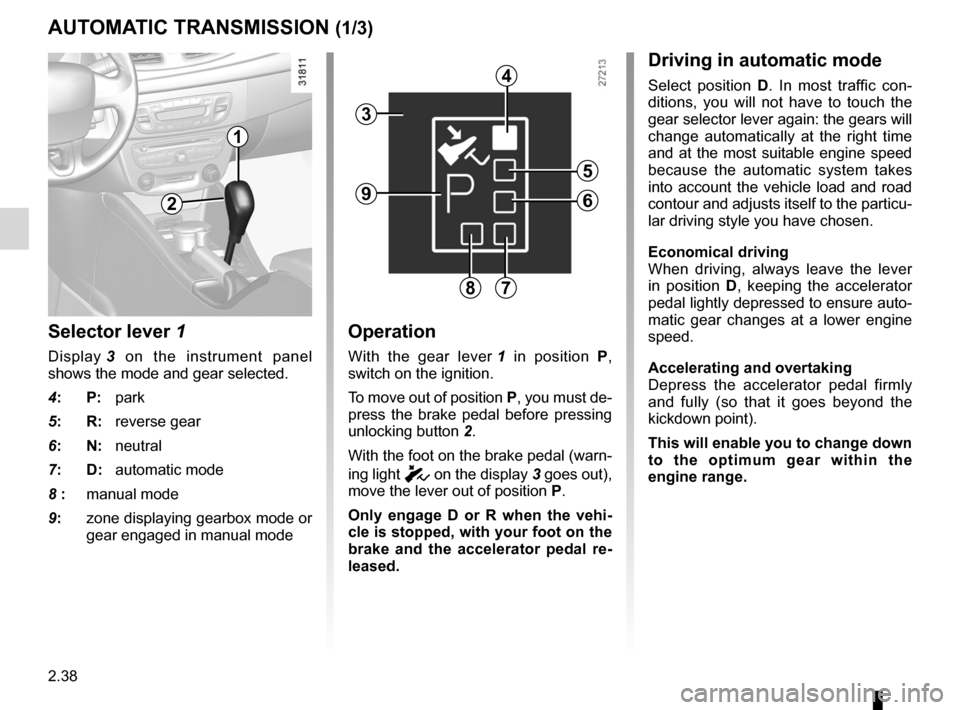
Selector lever 1
Display 3 on the instrument panel
shows the mode and gear selected.
4: P: park
5: R: reverse gear
6: N: neutral
7: D: automatic mode
8 : manual mode
9: zone displaying gearbox mode or
gear engaged in manual mode
Operation
With the gear lever 1 in position P,
switch on the ignition.
To move out of position P, you must de-
press the brake pedal before pressing
unlocking button 2.
With the foot on the brake pedal (warn-
ing light
c on the display 3 goes out),
move the lever out of position P.
Only engage D or R when the vehi -
cle is stopped, with your foot on the
brake and the accelerator pedal re -
leased.
Page 148 of 241
ashtray .................................................. (up to the end of the DU)
cigar lighter ........................................... (up to the end of the DU)
accessories socket ............................... (up to the end of the DU)
3.20
ENG_UD21627_2
Cendriers-Allume cigares (L38 - X38 - Renault)
ENG_NU_891_892-7_L38-B32_Renault_3
Accessories socket
Ashtray/cigar lighter
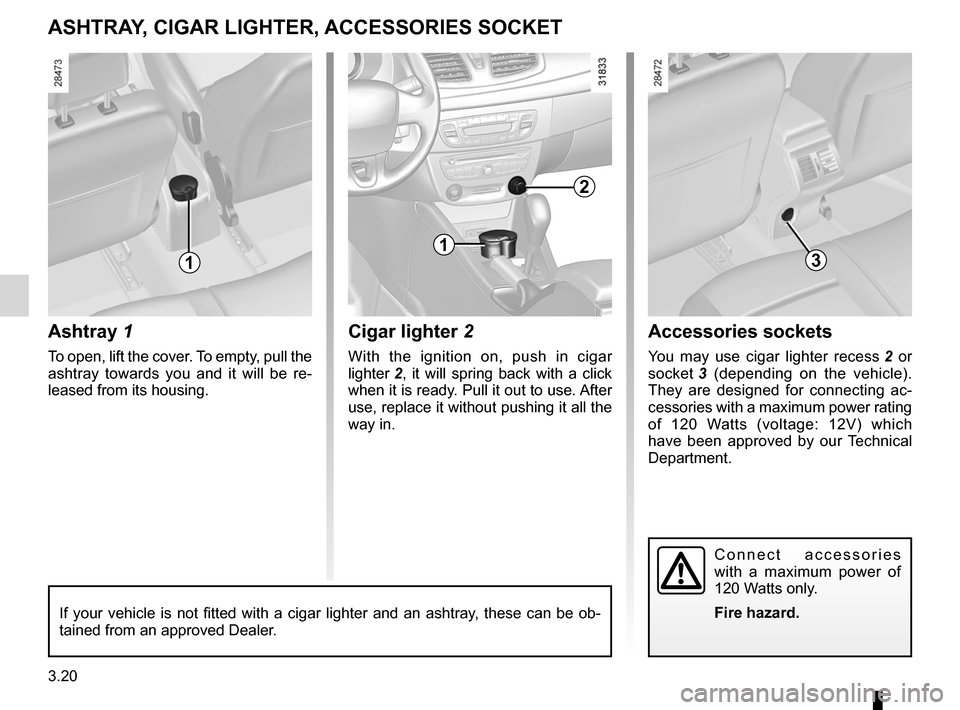
cigar lighter 2
With the ignition on, push in cigar
lighter 2, it will spring back with a click
when it is ready. Pull it out to use. After
use, replace it without pushing it all the
way in.
AShTRAY, cIgAR lIghTER, AccESSoRIES SockET
Accessories sockets
You may use cigar lighter recess 2 or
socket 3 (depending on the vehicle).
They are designed for connecting ac -
cessories with a maximum power rating
of 120 Watts (voltage: 12V) which
have been approved by our Technical
Department.
If your vehicle is not fitted with a cigar lighter and an ashtray, these can be ob-
tained from an approved Dealer.
2
1
13
Ashtray 1
To open, lift the cover. To empty, pull the
ashtray towards you and it will be re -
leased from its housing.
C o n n e c t a c c e s s o r i e s
with a maximum power of
120 Watts only.
Fire hazard.
Page 201 of 241

ENG_NU_891_892-7_L38-B32_Renault_5
Connect the positive cable A to the")
JauneNoirNoir texte
5.29
ENG_UD27186_3
Batterie : dépannage (X95 - B95 - D95 - K95 - L38 - X38 - X32 - B32 \
- Renault)
ENG_NU_891_892-7_L38-B32_Renault_5
Connect the positive cable A to the
support 1 on the (+) terminal, then to
the (+) terminal 2 of the battery sup -
plying the current.
Connect the negative cable B to the (–)
terminal 3 of the battery supplying the
current and then to the (–) terminal 4 of
the discharged battery.
Start the engine, and as soon as it starts
running, disconnect cables A and B in
reverse order ( 4 - 3 - 2 - 1 ).
starting the vehicle using the
battery from another vehicle
If you have to use the battery from an-
other vehicle to start, obtain suitable
jump leads (with a large cross section)
from an approved dealer or, if you al -
ready have jump leads, ensure that
they are in perfect condition.
the two batteries must have an iden-
tical nominal voltage of 12 volts. The
battery supplying the current should
have a capacity (amp-hours, Ah) which
is at least the same as that of the dis-
charged battery.
Ensure that there is no risk of contact
between the two vehicles (risk of short
circuiting when the positive terminals
are connected) and that the discharged
battery is properly connected. Switch
off your vehicle ignition.
Start the engine of the vehicle supply -
ing the current and run it at an interme-
diate engine speed.
Battery: troubleshooting (2/2)
Check that there is no con-
tact between leads A and B
and that the positive lead A
is not touching any metal
parts on the vehicle supplying the
current.
Risk of injury and/or damage to the
vehicle.
1
4
1
14
23
a
B
Page 206 of 241
wiper blades ......................................... (up to the end of the DU)
wipers blades ............................................. (up to the end of the DU)
5.34
ENG_UD21380_4
Balais d’essuie-vitres (X95 - B95 - D95 - L38 - X38 - X32 - B32 - Re\
nault)
ENG_NU_891_892-7_L38-B32_Renault_5
Wipers (replacing blades)
wInDscreen wIPer BlaDes
replacing windscreen wiper
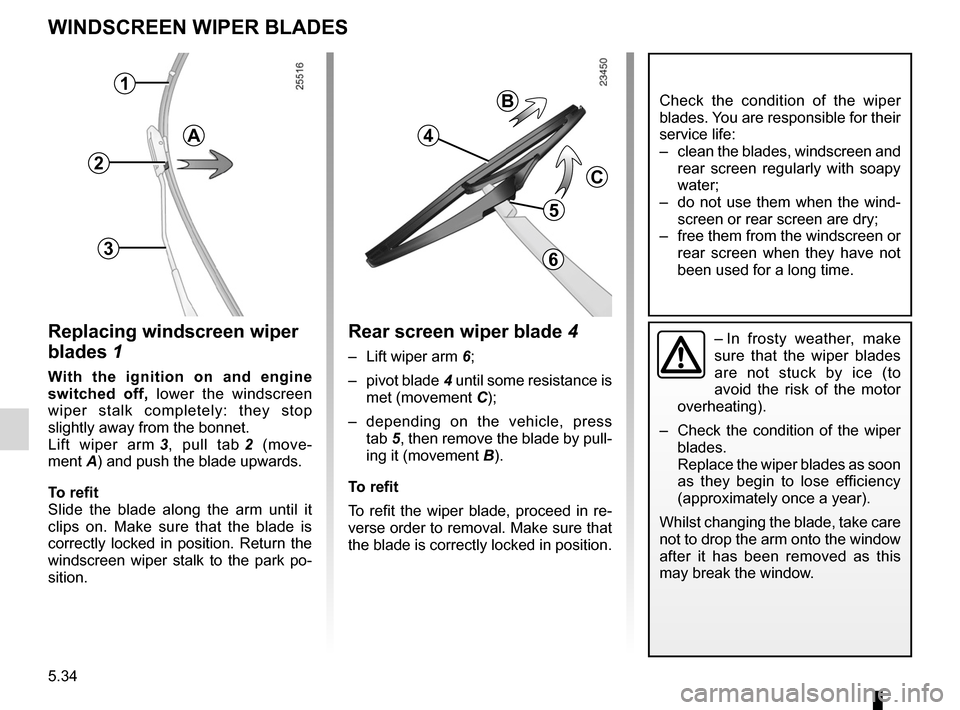
blades 1
w ith the ignition on and engine
switched off, lower the windscreen
wiper stalk completely: they stop
slightly away from the bonnet.
Lift wiper arm 3 , pull tab 2 (move -
ment A) and push the blade upwards.
t o refit
Slide the blade along the arm until it
clips on. Make sure that the blade is
correctly locked in position. Return the
windscreen wiper stalk to the park po-
sition.
1
2
3
Check the condition of the wiper
blades. You are responsible for their
service life:
– clean the blades, windscreen and
rear screen regularly with soapy
water;
– do not use them when the wind-
screen or rear screen are dry;
– free them from the windscreen or
rear screen when they have not
been used for a long time.
rear screen wiper blade 4
– Lift wiper arm 6;
– pivot blade 4 until some resistance is
met (movement C);
– depending on the vehicle, press
tab 5, then remove the blade by pull -
ing it (movement B).
t o refit
To refit the wiper blade, proceed in re-
verse order to removal. Make sure that
the blade is correctly locked in position.
4
5
B
c
a
6
– In frosty weather, make
sure that the wiper blades
are not stuck by ice (to
avoid the risk of the motor
overheating).
– Check the condition of the wiper
blades.
Replace the wiper blades as soon
as they begin to lose efficiency
(approximately once a year).
Whilst changing the blade, take care
not to drop the arm onto the window
after it has been removed as this
may break the window.
Page 207 of 241
towingbreakdown ...................................... (up to the end of the DU)
towing hitch ........................................... (up to the end of the DU)
5.35
ENG_UD27187_3
Remorquage : dépannage (L38 - X38 - Renault)
ENG_NU_891_892-7_L38-B32_Renault_5
Towing
tOwIng : breakdown (1/2)
Before towing, insert the key in the
switch or the RENAULT card in the
reader to unlock the steering column:
depress the clutch pedal, select first
gear (lever in position n or r for vehi-
cles with an automatic gearbox).
Reposition the lever to neutral (posi -
tion N for vehicles fitted with an auto -
matic transmission)
The steering column is unlocked, power
is supplied to the accessory functions:
the vehicle lights can be used (hazard
warning lights, brake lights etc.). At
night the vehicle must have its lights on.
Once you have finished towing, press
the engine start button twice (risk of
running down the battery). The speed specified by current legis
-
lation for towing must always be ob -
served. If your vehicle is the towing
vehicle, do not exceed the maximum
towing weight for your vehicle (refer
to the information on “Weights” in
Section 6).
t owing a vehicle with an
automatic gearbox
With the engine switched off, the trans-
mission is no longer lubricated. It is
preferable to tow this type of vehicle on
a trailer or tow it with the front wheels
off the ground.
u nder exceptional circumstances,
you may tow the vehicle with all four
wheels on the ground, only going for -
ward, with the gear lever in the n posi-
tion, and for a distance not exceeding
50 miles (80 km).
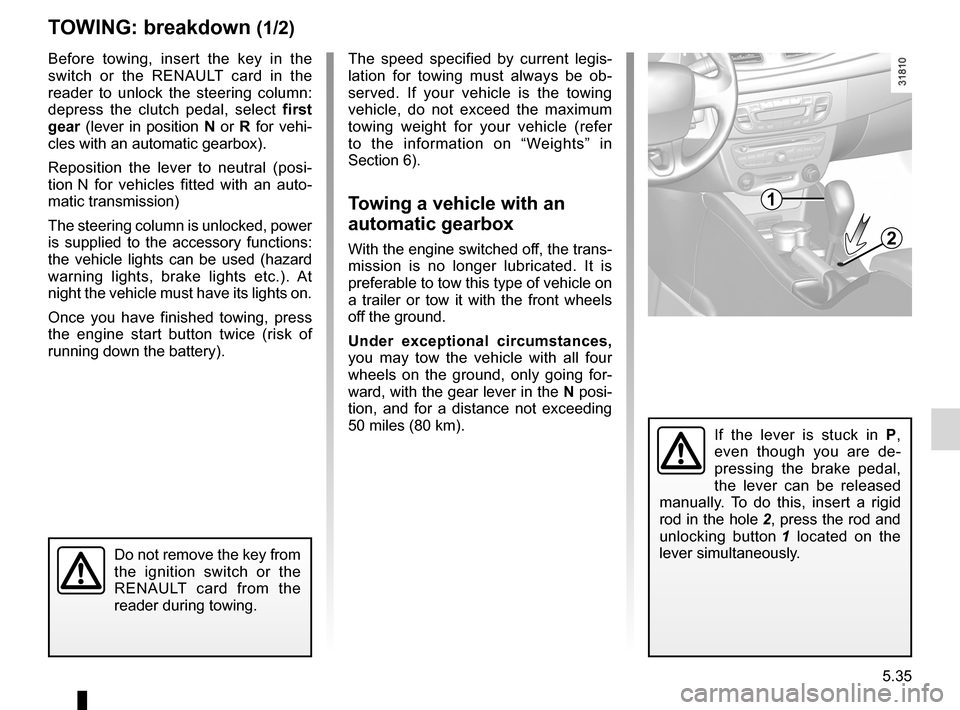
If the lever is stuck in P,
even though you are de -
pressing the brake pedal,
the lever can be released
manually. To do this, insert a rigid
rod in the hole 2, press the rod and
unlocking button 1 located on the
lever simultaneously.
1
2
Do not remove the key from
the ignition switch or the
RENAULT card from the
reader during towing.
Page 211 of 241
JauneNoirNoir texte
5.39
ENG_UD17941_2
Anomalies de fonctionnement (X85 - L38 - X38 - Renault)
ENG_NU_891_892-7_L38-B32_Renault_5
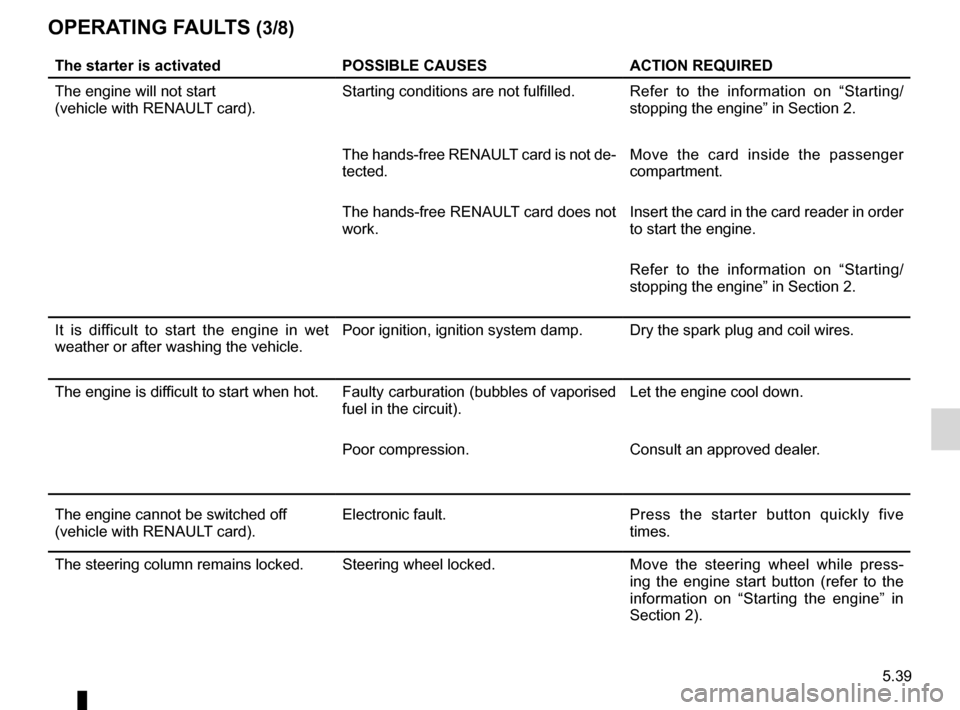
OPeratIng F aults (3/8)
the starter is activated POssIBle causesactIOn requIreD
The engine will not start
(vehicle with RENAULT card). Starting conditions are not fulfilled.
Refer to the information on “Starting/
stopping the engine” in Section 2.
The hands-free RENAULT card is not de-
tected. Move the card inside the passenger
compartment.
The hands-free RENAULT card does not
work. Insert the card in the card reader in order
to start the engine.
Refer to the information on “Starting/
stopping the engine” in Section 2.
It is difficult to start the engine in wet
weather or after washing the vehicle. Poor ignition, ignition system damp.
Dry the spark plug and coil wires.
The engine is difficult to start when hot. Faulty carburation (bubbles of vaporised
fuel in the circuit).Let the engine cool down.
Poor compression. Consult an approved dealer.
The engine cannot be switched off
(vehicle with RENAULT card). Electronic fault.
Press the starter button quickly five
times.
The steering column remains locked. Steering wheel locked.Move the steering wheel while press-
ing the engine start button (refer to the
information on “Starting the engine” in
Section 2).
Page 213 of 241
JauneNoirNoir texte
5.41
ENG_UD17941_2
Anomalies de fonctionnement (X85 - L38 - X38 - Renault)
ENG_NU_891_892-7_L38-B32_Renault_5
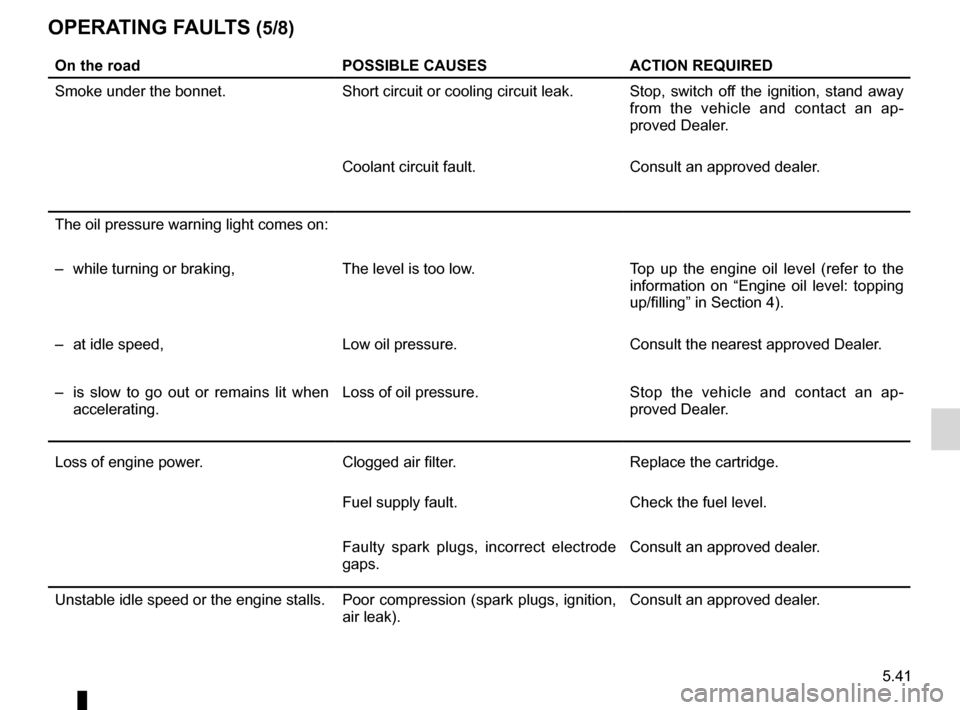
OPeratIng F aults (5/8)
On the road POssIBle causesactIOn requIreD
Smoke under the bonnet. Short circuit or cooling circuit leak.Stop, switch off the ignition, stand away
from the vehicle and contact an ap-
proved Dealer.
Coolant circuit fault. Consult an approved dealer.
The oil pressure warning light comes on:
– while turning or braking, The level is too low. Top up the engine oil level (refer to the
information on “Engine oil level: topping
up/filling” in Section 4).
– at idle speed, Low oil pressure. Consult the nearest approved Dealer.
– is slow to go out or remains lit when
accelerating. Loss of oil pressure.
Stop the vehicle and contact an ap-
proved Dealer.
Loss of engine power. Clogged air filter.Replace the cartridge.
Fuel supply fault. Check the fuel level.
Faulty spark plugs, incorrect electrode
gaps. Consult an approved dealer.
Unstable idle speed or the engine stalls. Poor compression (spark plugs, ignition,
air leak).Consult an approved dealer.
Page 239 of 241
JauneNoirNoir texte
7.3
FRA_UD27191_7
Index (L38 - X38 - Renault)
ENG_NU_891_892-7_L38-B32_Renault_7
AlphAbeticAl index (3/5)
i
ignition switch ............................................................. 2.3 – 2.4
indicators ............................................. 1.50, 1.74, 5.14 → 5.18
indicators: direction indicators .............................................. 1.74, 5.19
exterior temperature indicator ...................................... 1.70
instrument panel .............................................. 1.50 → 1.60
instrument panel ........................................... 1.50 → 1.60, 1.75
instrument panel messages ...................................1.58 → 1.60
interior trim maintenance ..................................................... 4.15 – 4.16
J
jack ........................................................................\
..... 5.7 – 5.8
K
keys ........................................................................\
.... 1.2 – 1.3
l
levels: brake fluid ...................................................................... 4.9
coolant .................................................................. 1.54, 4.8
fuel ............................................................................... 1.54
windscreen washer reservoir ....................................... 4.10
lifting the vehicle changing a wheel ................................................ 5.9 – 5.10
lighting: exterior ............................................................. 1.75 → 1.77
instrument panel .......................................................... 1.75
interior ........................................... 3.15 – 3.16, 5.24 – 5.25
lights additional ..................................................................... 5.18
adjustment ................................................................... 1.78
changing bulbs ................................................. 5.14 → 5.18
fog lights ...................................................................... 5.18
front .................................................................. 5.14 → 5.18mobile directional
......................................................... 1.76
lights: adjusting ...................................................................... 1.78
brake lights .................................................................. 5.19
dipped beam headlights .................1.50, 1.75, 5.14 → 5.18
direction indicators ......................... 1.50, 1.74, 5.14 → 5.19
fog lights ......................................... 1.50, 1.77, 5.18 – 5.19
hazard warning ............................................................ 1.74
main beam headlights .................... 1.50, 1.76, 5.14 → 5.18
number plate lights ...................................................... 5.23
reversing lights ............................................................. 5.19
side lights ............................................................ 1.75, 5.19
locking the doors ............................................ 1.2 → 1.12, 1.15
M
maintenance: bodywork .......................................................... 4.13 – 4.14
interior trim ........................................................ 4.15 – 4.16
mechanical .........................................4.2 – 4.3, 6.9 → 6.14
mileage before service ....................................... 6.9 → 6.14
map reading lights .................................................. 3.15 – 3.16
menu for customising the vehicle settings ......................... 1.69
methods of restraint in addition to the front seat belts ..............
1.22 → 1.24
methods of restraint in addition to the seat belts ... 1.22 → 1.27
multimedia equipment ....................................................... 3.27
n
navigation ........................................................................\
.. 3.27
navigation system .............................................................. 3.27
O
oil change .................................................................. 4.4 → 4.7
opening the doors .................................................. 1.11 → 1.14
operating faults ................................ 1.50 → 1.53, 5.37 → 5.44