wind RENAULT FLUENCE 2012 1.G Owners Manual
[x] Cancel search | Manufacturer: RENAULT, Model Year: 2012, Model line: FLUENCE, Model: RENAULT FLUENCE 2012 1.GPages: 241, PDF Size: 6.5 MB
Page 5 of 241
1.1
ENG_UD27174_7
Sommaire 1 (L38 - X38 - Renault)
ENG_NU_891_892-7_L38-B32_Renault_1
Section 1: Getting to know your vehicle
Key, radio frequency remote control: general information, use, deadlocking . . . . . . . . . . . . . . . . . . 1.2
RENAULT cards: general information, use, deadlocking . . . . . . . . . . . . . . . . . . . . . . . . . . . . . . . . . 1.4
Doors . . . . . . . . . . . . . . . . . . . . . . . . . . . . . . . . . . . . . . . . . . . . . . . . . . . . . . . . . . . . . . . . . . . . . . . . . 1.11
Automatic locking of opening elements when driving . . . . . . . . . . . . . . . . . . . . . . . . . . . . . . . . . . . . 1.15
Headrests - Seats . . . . . . . . . . . . . . . . . . . . . . . . . . . . . . . . . . . . . . . . . . . . . . . . . . . . . . . . . . . . . . . 1.16
Seat belts . . . . . . . . . . . . . . . . . . . . . . . . . . . . . . . . . . . . \
. . . . . . . . . . . . . . . . . . . . . . . . . . . . . . . . . . 1.19
Additional methods of restraint: . . . . . . . . . . . . . . . . . . . . . . . . . . . . . . . . . . . . . . . . . . . . . . . . . . . . . 1.22
to the front seat belts . . . . . . . . . . . . . . . . . . . . . . . . . . . . . . . . . . . . . . . . . . . . . . . . . . . . . . . 1.22
to the rear seat belts . . . . . . . . . . . . . . . . . . . . . . . . . . . . . . . . . . . . . . . . . . . . . . . . . . . . . . . 1.25
side protection . . . . . . . . . . . . . . . . . . . . . . . . . . . . . . . . . . . . . . . . . . . . . . . . . . . . . . . . . . . . 1.26
Child safety: general information . . . . . . . . . . . . . . . . . . . . . . . . . . . . . . . . . . . . . . . . . . . . . . . . . . . . 1.28
choosing a child seat mounting . . . . . . . . . . . . . . . . . . . . . . . . . . . . . . . . . . . . . . . . . . . . . . . 1.31
fitting a child seat . . . . . . . . . . . . . . . . . . . . . . . . . . . . . . . . . . . . . . . . . . . . . . . . . . . . . . . . . . 1.33
deactivating, activating the front passenger airbag . . . . . . . . . . . . . . . . . . . . . . . . . . . . . . . . 1.42
Steering wheel . . . . . . . . . . . . . . . . . . . . . . . . . . . . . . . . . . . . . . . . . . . . . . . . . . . . . . . . . . . . . . . . . . 1.45
Power-assisted steering . . . . . . . . . . . . . . . . . . . . . . . . . . . . . . . . . . . . . . . . . . . . . . . . . . . . . . . . . . 1.45
Driving position . . . . . . . . . . . . . . . . . . . . . . . . . . . . . . . . . . . . . . . . . . . . . . . . . . . . . . . . . . . . . . . . . 1.46
Warning lights . . . . . . . . . . . . . . . . . . . . . . . . . . . . . . . . . . . . . . . . . . . . . . . . . . . . . . . . . . . . . . . . . . 1.50
Instrument panel: displays and indicators . . . . . . . . . . . . . . . . . . . . . . . . . . . . . . . . . . . . . . . . . . . . . 1.54
on-board computer . . . . . . . . . . . . . . . . . . . . . . . . . . . . . . . . . . . . . . . . . . . . . . . . . . . . . . . . . 1.58
vehicle settings customisation menu . . . . . . . . . . . . . . . . . . . . . . . . . . . . . . . . . . . . . . . . . . . 1.69
Clock and exterior temperature . . . . . . . . . . . . . . . . . . . . . . . . . . . . . . . . . . . . . . . . . . . . . . . . . . . . . 1.70
Rear-view mirrors . . . . . . . . . . . . . . . . . . . . . . . . . . . . . . . . . . . . . . . . . . . . . . . . . . . . . . . . . . . . . . . 1.72
Audible and visual signals . . . . . . . . . . . . . . . . . . . . . . . . . . . . . . . . . . . . . . . . . . . . . . . . . . . . . . . . . 1.74
Exterior lighting and signals . . . . . . . . . . . . . . . . . . . . . . . . . . . . . . . . . . . . \
. . . . . . . . . . . . . . . . . . . . 1.75
Headlight beam adjustment . . . . . . . . . . . . . . . . . . . . . . . . . . . . . . . . . . . . . . . . . . . . . . . . . . . . . . . . 1.78
Windscreen washers and wipers . . . . . . . . . . . . . . . . . . . . . . . . . . . . . . . . . . . . . . . . . . . . . . . . . . . . 1.79
Fuel tank (filling with fuel) . . . . . . . . . . . . . . . . . . . . . . . . . . . . . . . . . . . . . . . . . . . . . . . . . . . . . . . . . 1.82
Page 7 of 241
keys ...................................................... (up to the end of the DU)
locking the doors .................................. (up to the end of the DU)
1.3
ENG_UD13739_1
Télécommande à radiofréquence : utilisation (L38 - X38 - X3\
2 - B32 - Renault)
ENG_NU_891_892-7_L38-B32_Renault_1
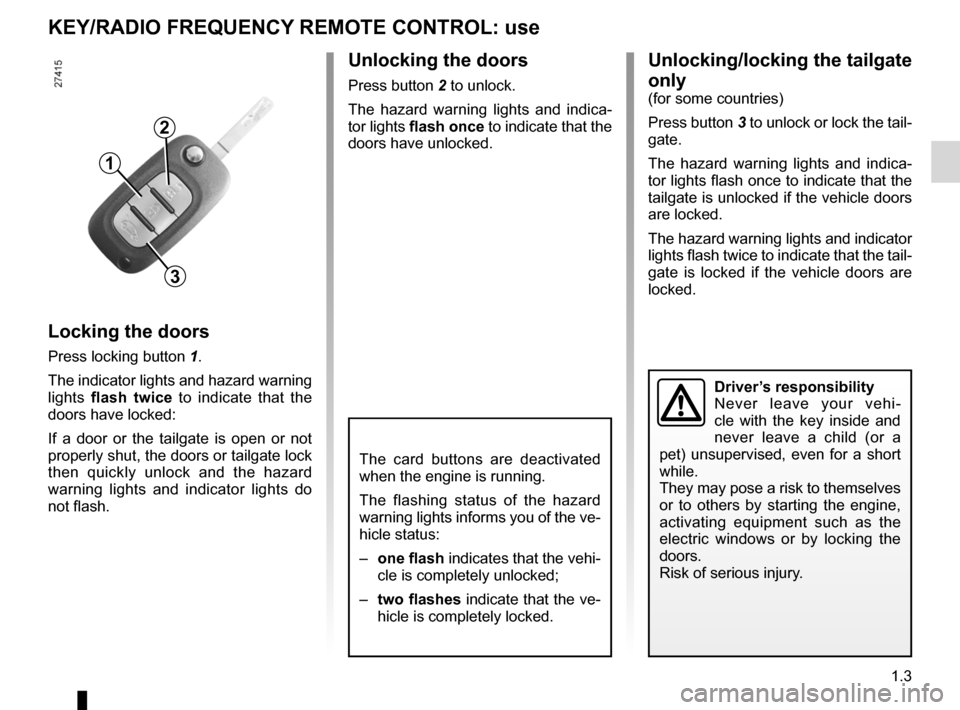
Unlocking the doors
Press button 2 to unlock.
The hazard warning lights and indica -
tor lights flash once to indicate that the
doors have unlocked.
KEY/RADIO FREQUENCY REMOTE CONTROL: use
Locking the doors
Press locking button 1.
The indicator lights and hazard warning
lights flash twice to indicate that the
doors have locked:
If a door or the tailgate is open or not
properly shut, the doors or tailgate lock
then quickly unlock and the hazard
warning lights and indicator lights do
not flash.
3
1
2
Unlocking/locking the tailgate
only
(for some countries)
Press button 3 to unlock or lock the tail-
gate.
The hazard warning lights and indica -
tor lights flash once to indicate that the
tailgate is unlocked if the vehicle doors
are locked.
The hazard warning lights and indicator
lights flash twice to indicate that the tail-
gate is locked if the vehicle doors are
locked.
Driver’s responsibility
Never leave your vehi -
cle with the key inside and
never leave a child (or a
pet) unsupervised, even for a short
while.
They may pose a risk to themselves
or to others by starting the engine,
activating equipment such as the
electric windows or by locking the
doors.
Risk of serious injury.
The card buttons are deactivated
when the engine is running.
The flashing status of the hazard
warning lights informs you of the ve-
hicle status:
– one flash indicates that the vehi-
cle is completely unlocked;
– two flashes indicate that the ve-
hicle is completely locked.
Page 8 of 241

locking the doors .................................. (up to the end of the DU)
emergency key ..................................... (up to the end of the DU)
child safety ............................................................. (current page)
children (safety) ..................................................... (current page)
RENAULT card use .................................................. (up to the end of the DU)
1.4
ENG_UD21347_2
Cartes RENAULT : généralités (L38 - X38 - Renault)
ENG_NU_891_892-7_L38-B32_Renault_1
Jaune NoirNoir texte
Battery lifeMake sure that the correct battery type
is being used, and that the battery is in
good condition and inserted correctly.
Its service life is approximately two
years: replace it when the message
“Keycard battery low ” appears on the
instrument panel (refer to the informa -
tion on the “RENAULT card: battery" in
section 5).
RENAULT card operating
range
This varies according to the surround -
ings. It is important to make sure when
handling the RENAULT card that you
do not lock or unlock the doors by inad -
vertently pressing the buttons.
RENAULT cards: General information, use, deadlocking
RENAULT CARDs: general information (1/2)
1 Unlocking the doors and tailgate.
2 Locking all doors and tailgate.
3 Switching on the lighting remotely.
4 Unlocking/locking the tailgate
5 Integrated key.
The RENAULT card is used
for:
– locking/unlocking the doors and tail-
gate (doors, tailgate) and the fuel
filler flap (see the following pages);
– switching on the vehicle lighting re -
motely (refer to the following pages);
– starting the engine; refer to the in -
formation on “Starting the engine” in
Section 2.
Driver’s responsibility
Never leave your vehicle
with the RENAULT card
inside and never leave a
child (or a pet) unsupervised, even
for a short while.
They may pose a risk to themselves
or to others by starting the engine,
activating equipment such as the
electric windows or by locking the
doors.
Risk of serious injury.
45123
When the battery is flat, you can
still lock/unlock and start your ve -
hicle. Refer to the information on
“Locking/unlocking the doors” in
Section 1 and “Starting the engine”
in Section 2.
Page 14 of 241
central door locking .............................. (up to the end of the DU)
doors/tailgate ........................................ (up to the end of the DU)
locking the doors .................................. (up to the end of the DU)
RENAULT card use .................................................. (up to the end of the DU)
deadlocking the doors ........................................... (current page)
1.10
ENG_UD13614_1
Cartes RENAULT : super-condamnation (L38 - X38 - Renault)
ENG_NU_891_892-7_L38-B32_Renault_1
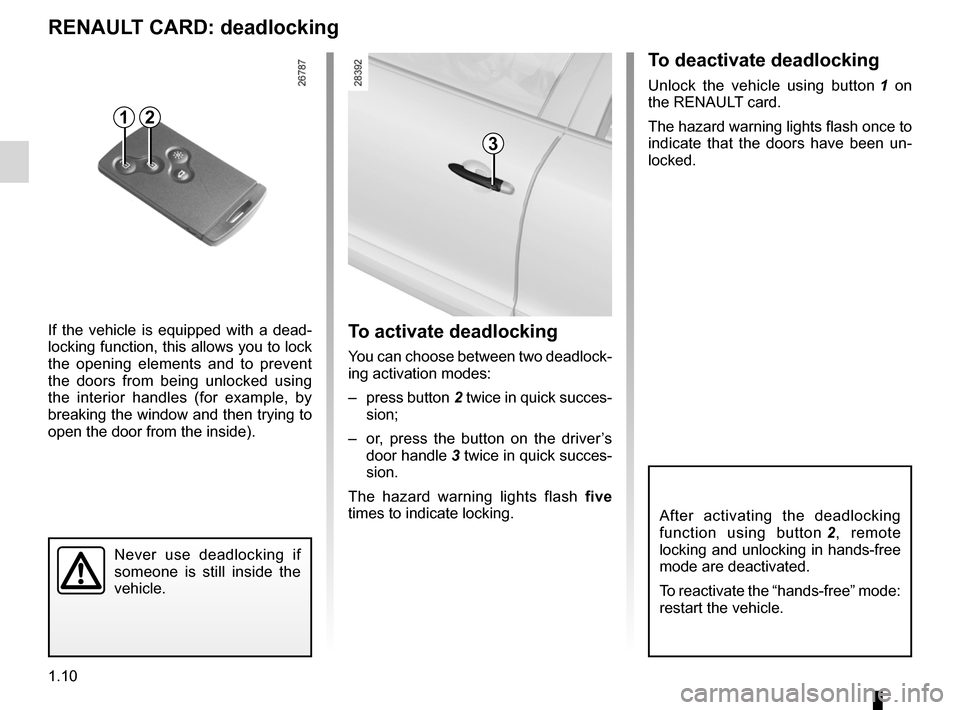
To deactivate deadlocking
Unlock the vehicle using button 1 on
the RENAULT card.
The hazard warning lights flash once to
indicate that the doors have been un -
locked.
Never use deadlocking if
someone is still inside the
vehicle.
To activate deadlocking
You can choose between two deadlock -
ing activation modes:
– press button 2 twice in quick succes-
sion;
– or, press the button on the driver’s
door handle 3 twice in quick succes-
sion.
The hazard warning lights flash five
times to indicate locking.
If the vehicle is equipped with a dead
-
locking function, this allows you to lock
the opening elements and to prevent
the doors from being unlocked using
the interior handles (for example, by
breaking the window and then trying to
open the door from the inside).
RENAULT CARD: deadlocking
2
After activating the deadlocking
function using button 2 , remote
locking and unlocking in hands-free
mode are deactivated.
To reactivate the “hands-free” mode:
restart the vehicle.
3
1
Page 16 of 241
1.12
ENG_UD21348_3
Ouverture et fermeture des portes (L38 - X38 - Renault)
ENG_NU_891_892-7_L38-B32_Renault_1
OpENINg AND CLOsINg ThE DOORs (2/2)
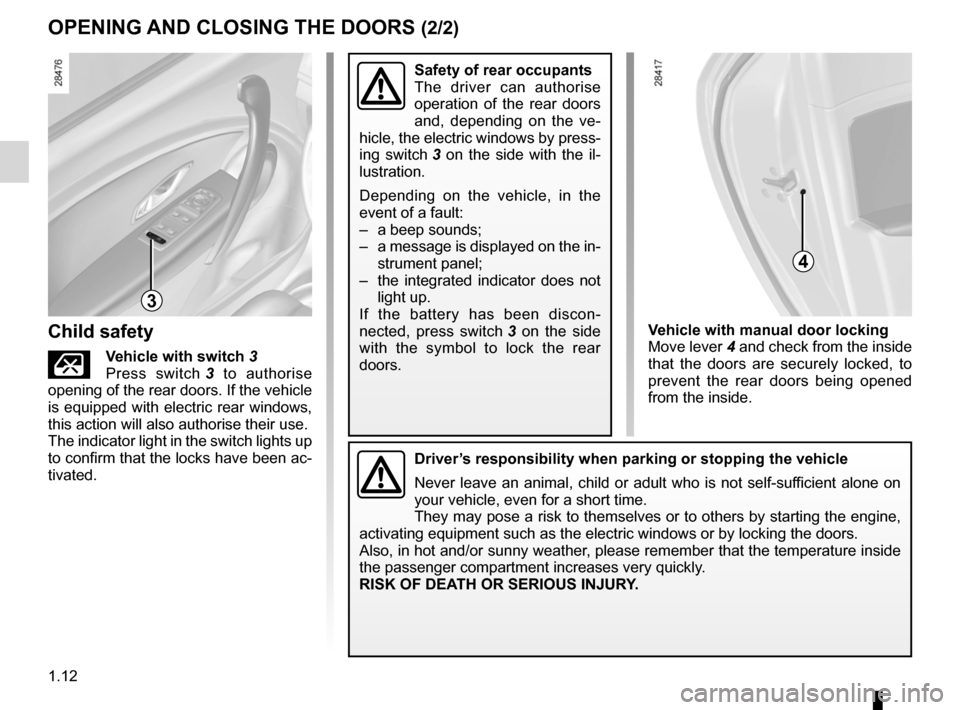
Vehicle with manual door locking
Move lever 4 and check from the inside
that the doors are securely locked, to
prevent the rear doors being opened
from the inside.
Driver’s responsibility when parking or stopping the vehicle
Never leave an animal, child or adult who is not self-sufficient alone on
your vehicle, even for a short time.
They may pose a risk to themselves or to others by starting the engine,
activating equipment such as the electric windows or by locking the door\
s.
Also, in hot and/or sunny weather, please remember that the temperature inside
the passenger compartment increases very quickly.
RIsK OF DEATh OR sERIOUs INJURY.
Child safety
ÇVehicle with switch 3
Press switch 3 to authorise
opening of the rear doors. If the vehicle
is equipped with electric rear windows,
this action will also authorise their use.
The indicator light in the switch lights up
to confirm that the locks have been ac-
tivated.
safety of rear occupants
The driver can authorise
operation of the rear doors
and, depending on the ve -
hicle, the electric windows by press-
ing switch 3 on the side with the il -
lustration.
Depending on the vehicle, in the
event of a fault:
– a beep sounds;
– a message is displayed on the in-
strument panel;
– the integrated indicator does not
light up.
If the battery has been discon -
nected, press switch 3 on the side
with the symbol to lock the rear
doors.
3
4
Page 24 of 241
1.20
ENG_UD25555_3
Ceintures de sécurité (L38 - X38 - Renault)
ENG_NU_891_892-7_L38-B32_Renault_1
Jaune NoirNoir texte
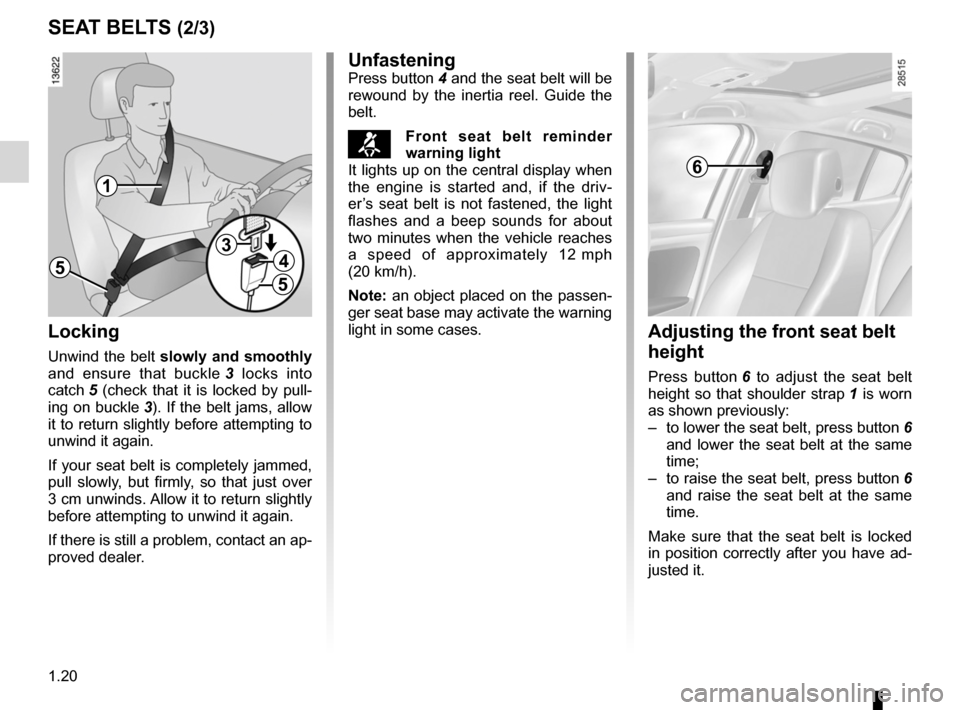
UnfasteningPress button 4 and the seat belt will be
rewound by the inertia reel. Guide the
belt.
™Front seat belt reminder
warning light
It lights up on the central display when
the engine is started and, if the driv -
er’s seat belt is not fastened, the light
flashes and a beep sounds for about
two minutes when the vehicle reaches
a speed of approximately 12 mph
(20 km/h).
Note: an object placed on the passen-
ger seat base may activate the warning
light in some cases.
sEAT BELTs (2/3)
Locking
Unwind the belt slowly and smoothly
and ensure that buckle 3 locks into
catch 5 (check that it is locked by pull -
ing on buckle 3). If the belt jams, allow
it to return slightly before attempting to
unwind it again.
If your seat belt is completely jammed,
pull slowly, but firmly, so that just over
3 cm unwinds. Allow it to return slightly
before attempting to unwind it again.
If there is still a problem, contact an ap-
proved dealer.
1
5
Adjusting the front seat belt
height
Press button 6 to adjust the seat belt
height so that shoulder strap 1 is worn
as shown previously:
– to lower the seat belt, press button 6
and lower the seat belt at the same
time;
– to raise the seat belt, press button 6
and raise the seat belt at the same
time.
Make sure that the seat belt is locked
in position correctly after you have ad-
justed it.
6
34
5
Page 27 of 241

ENG_NU_891_892-7_L38-B32_Renault_1
METhODs OF REsTRAINT IN ADDITION TO ThE FRONT sEAT BE")
JauneNoirNoir texte
1.23
ENG_UD21620_3
Dispositifs complémentaires aux ceintures avant (L38 - X38 - Renault\
)
ENG_NU_891_892-7_L38-B32_Renault_1
METhODs OF REsTRAINT IN ADDITION TO ThE FRONT sEAT BELTs (2/3)
Load limiter
Above a certain severity of impact, this
mechanism is used to limit the force of
the belt against the body so that it is at
an acceptable level.
Air bags for driver and front
passenger
Fitted to the driver and passenger side.
The presence of this equipment is indi -
cated by the word “Airbag” on the steer-
ing wheel and the dashboard (air bag
zone A ) and a label on the lower part
of the windscreen or on the sun visor.
Each air bag system consists of:
– an air bag and gas generator fitted
on the steering wheel for the driver
and in the dashboard for the front
passenger;
– an electronic unit for system monitor-
ing which controls the gas generator
electrical trigger system;
– a single warning light
å on the
instrument panel.
Operation
This system is only operational when
the ignition is switched on.
In a severe frontal impact, the air bags
inflate rapidly, cushioning the impact
of the driver’s head and chest against
the steering wheel and the front pas -
senger against the dashboard. The air
bags then deflate immediately so that
the passengers are not in any way hin-
dered from leaving the vehicle.
A
The air bag system uses
pyrotechnic principles. This
explains why, when the air
bag inflates, it will gener -
ate heat, produce smoke (this does
not mean that a fire is about to start)
and make a noise upon detonation.
In a situation where an air bag is
required, it will inflate immediately
and this may cause some minor, su-
perficial grazing to the skin or other
problems.
Page 30 of 241
1.26
ENG_UD13627_1
Dispositifs de protection latérale (L38 - X38 - Renault)
ENG_NU_891_892-7_L38-B32_Renault_1
side protection
sIDE pROTECTION DEVICEs
Warnings concerning the side air bag
– Fitting seat covers: seats equipped with an air bag require covers
specifically designed for your vehicle. Contact an approved Dealer to find
out if these covers are available. The use of any covers other than those
designed for your vehicle (and including those designed for another vehicle)
may affect the operation of the air bags and reduce your protection.
– Do not place any accessories, objects or even pets between the seatback, the
door and the internal fittings. Do not cover the seatback with any items such as
clothes or accessories. This may prevent the air bag from operating correctly
or cause injury when the air bag is deployed.
– No work or modification whatsoever may be carried out on the seat or internal
fittings, except by qualified personnel from an approved dealer.
– The area between the rear bench seatback and the trim is the area of air bag
operation: no objects must be placed here.
side air bags
These air bags are fitted to the front
seats and are activated at the sides of
the seats (door side) to protect the oc-
cupants in the event of a severe side
impact.
Curtain air bags
These are air bags fitted along the sides
of the vehicle in the ceiling which trigger
along the front and rear side windows
to protect the passengers in case of a
severe side impact.
A marking on the windscreen in -
forms you of the presence of addi -
tional means of restraint (air bags,
pretensioners, etc.) in the passen -
ger compartment.
Page 32 of 241
child safety............................................ (up to the end of the DU)
child restraint/seat ................................ (up to the end of the DU)
child restraint/seat ................................ (up to the end of the DU)
child restraint/seat ................................ (up to the end of the DU)
child seats ............................................. (up to the end of the DU)
transporting children ............................. (up to the end of the DU)
children ................................................. (up to the end of the DU)
1.28
ENG_UD20771_2
S curit enfants : g n ralit s (X35 - L35 - X45 - H45 - X65 - X81 \
- X85 - X83 - B95 - D95 - K95 - J95 - R95 - L38 - X38 - X32 - Renault)
ENG_NU_891_892-7_L38-B32_Renault_1
Jaune NoirNoir texte
Child safety: general information
ChILD sAFETY : general information (1/2)
Carrying children
Children, and adults, must be correctly
seated and strapped in for all journeys.
The children being carried in your vehi-
cle are your responsibility.
A child is not a miniature adult. Children
are at risk of specific injuries as their
muscles and bones have not yet fin -
ished growing. The seat belt alone
would not provide suitable protection.
Use an approved child seat and ensure
you use it correctly.
A collision at 30 mph
(50 km/h) is the same as fall-
ing a distance of 10 metres.
Transporting a child without
a restraint is the equivalent of allow-
ing him or her to play on a fourth -
floor balcony without railings.
Never travel with a child held in your
arms. In the event of an accident,
you will not be able to keep hold of
the child, even if you yourself are
wearing a seat belt.
If your vehicle has been involved in
a road accident, replace the child
seat and have the seat belts and
ISOFIX anchorage points checked.
To prevent the doors being
opened, use the “Child
safety” device (refer to the
information on “Opening
and closing the doors” in Section 1).
D r i v e r ’s r e s p o n s i b i l i t y
when parking or stopping
the vehicle
Never leave an animal,
child or adult who is not self-suffi -
cient alone on your vehicle, even for
a short time.
They may pose a risk to themselves
or to others by starting the engine,
activating equipment such as the
electric windows or by locking the
doors.
Also, in hot and/or sunny weather,
please remember that the tempera-
ture inside the passenger compart-
ment increases very quickly.
RI sK OF DEAT h OR sERIOU s
INJURY.
Page 33 of 241
child safety............................................ (up to the end of the DU)
child restraint/seat ................................ (up to the end of the DU)
child restraint/seat ................................ (up to the end of the DU)
child restraint/seat ................................ (up to the end of the DU)
child seats ............................................. (up to the end of the DU)
transporting children ............................. (up to the end of the DU)
children ................................................. (up to the end of the DU)
JauneNoirNoir texte
1.29
ENG_UD20771_2
S curit enfants : g n ralit s (X35 - L35 - X45 - H45 - X65 - X81 \
- X85 - X83 - B95 - D95 - K95 - J95 - R95 - L38 - X38 - X32 - Renault)
ENG_NU_891_892-7_L38-B32_Renault_1
ChILD sAFETY : general information (2/2)
Using a child seat
The level of protection offered by the
child seat depends on its ability to re -
strain your child and on its installation.
Incorrect installation compromises the
protection it offers the child in the event
of harsh braking or an impact.
Before purchasing a child seat, check
that it complies with the regulations for
the country you are in and that it can
be fitted in your vehicle. Consult an ap-
proved dealer to find out which seats
are recommended for your vehicle.
Before fitting a child seat, read the
manual and respect its instructions. If
you experience any difficulties during
installation, contact the manufacturer
of the equipment. Keep the instructions
with the seat.Set a good example by always fas-
tening your seat belt and teaching
your child:
– to strap themselves in correctly;
– to always get in and out of the car
at the kerb, away from busy traf-
fic.
Do not use a second-hand child
seat or one without an instruction
manual.
Check that there are no objects in
the vicinity of the child seat which
could impede its operation.
Never leave a child unat -
tended in the vehicle.
Check that your child is
always strapped in and that
the belt or safety harness used is
correctly set and adjusted. Avoid
wearing bulky clothing which could
cause the belts to slacken.
Never let your child put their head or
arms out of the window.
Check that the child is in the correct
position for the entire journey, espe-
cially if asleep.