Button RENAULT KADJAR 2018 User Guide
[x] Cancel search | Manufacturer: RENAULT, Model Year: 2018, Model line: KADJAR, Model: RENAULT KADJAR 2018Pages: 310, PDF Size: 8.35 MB
Page 22 of 310
1.16
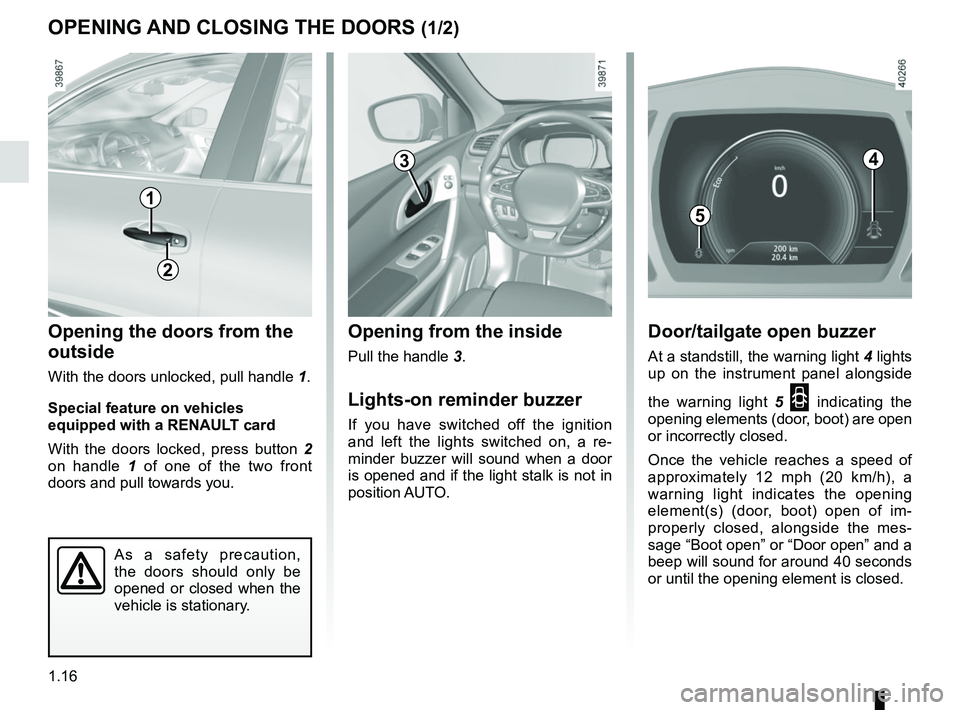
Opening from the inside
Pull the handle 3.
Lights-on reminder buzzer
If you have switched off the ignition
and left the lights switched on, a re-
minder buzzer will sound when a door
is opened and if the light stalk is not in
position AUTO.
Opening the doors from the
outside
With the doors unlocked, pull handle 1.
Special feature on vehicles
equipped with a RENAULT card
With the doors locked, press button 2
on handle 1 of one of the two front
doors and pull towards you.
OPENING AND CLOSING THE DOORS (1/2)
1
3
As a safety precaution,
the doors should only be
opened or closed when the
vehicle is stationary.
2
Door/tailgate open buzzer
At a standstill, the warning light 4 lights
up on the instrument panel alongside
the warning light 5
2 indicating the
opening elements (door, boot) are open
or incorrectly closed.
Once the vehicle reaches a speed of
approximately 12 mph (20 km/h), a
warning light indicates the opening
element(s) (door, boot) open of im-
properly closed, alongside the mes-
sage “Boot open” or “Door open” and a
beep will sound for around 40 seconds
or until the opening element is closed.
4
5
Page 25 of 310
1.19
FRONT HEADRESTS
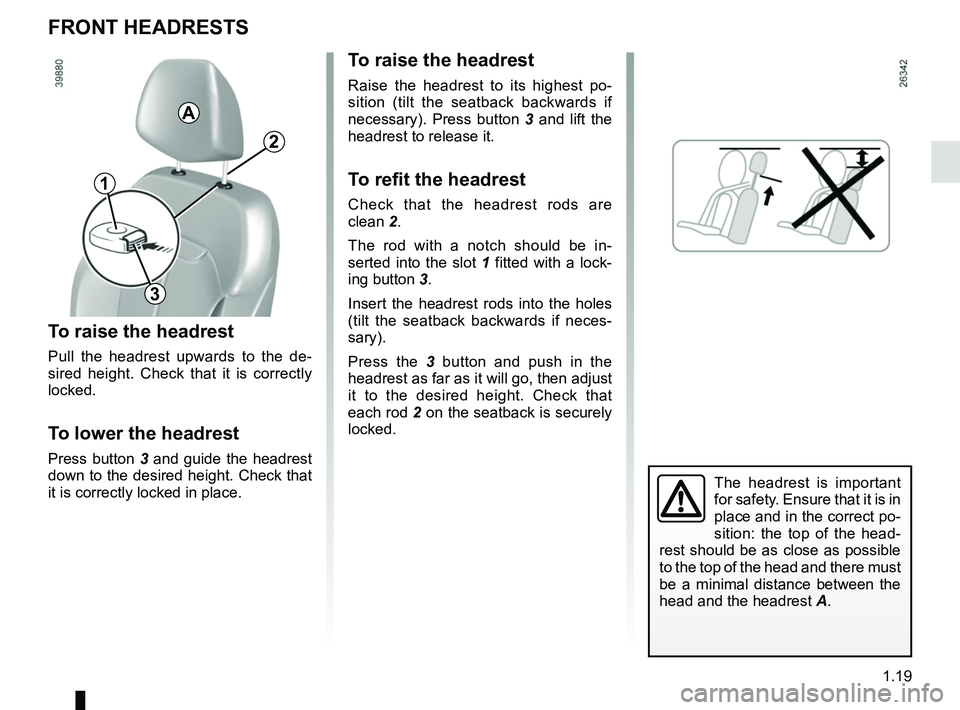
To raise the headrest
Pull the headrest upwards to the de-
sired height. Check that it is correctly
locked.
To lower the headrest
Press button 3 and guide the headrest
down to the desired height. Check that
it is correctly locked in place.
A
3
To raise the headrest
Raise the headrest to its highest po-
sition (tilt the seatback backwards if
necessary). Press button 3 and lift the
headrest to release it.
To refit the headrest
Check that the headrest rods are
clean 2.
The rod with a notch should be in-
serted into the slot 1 fitted with a lock-
ing button 3.
Insert the headrest rods into the holes
(tilt the seatback backwards if neces-
sary).
Press the 3 button and push in the
headrest as far as it will go, then adjust
it to the desired height. Check that
each rod 2 on the seatback is securely
locked.
The headrest is important
for safety. Ensure that it is in
place and in the correct po-
sition: the top of the head-
rest should be as close as possible
to the top of the head and there must
be a minimal distance between the
head and the headrest A.
2
1
Page 26 of 310
1.20
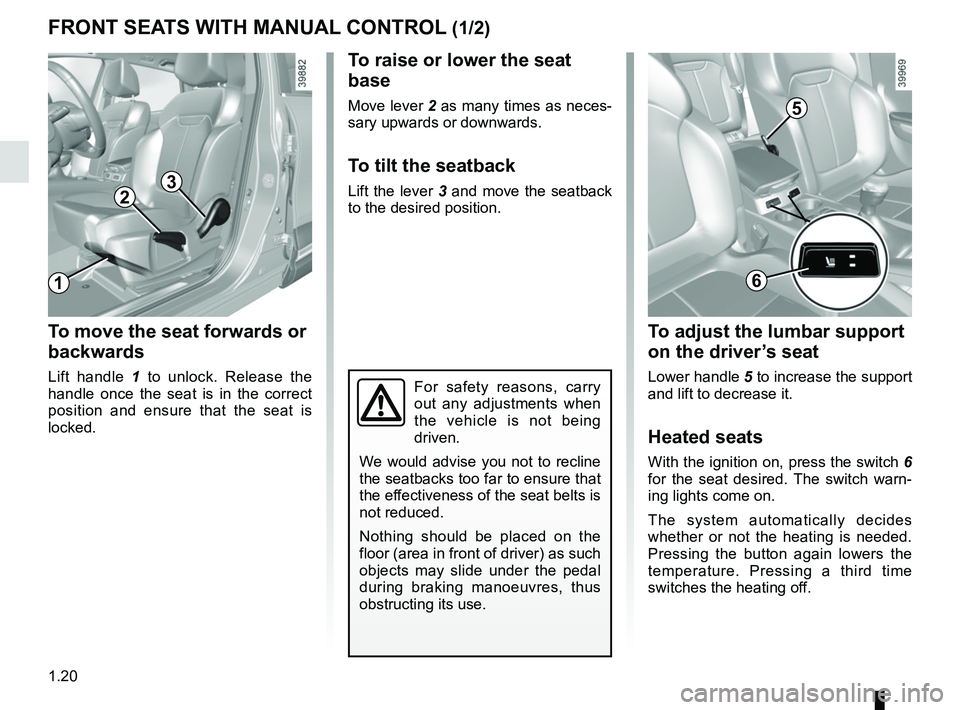
To raise or lower the seat
base
Move lever 2 as many times as neces-
sary upwards or downwards.
To tilt the seatback
Lift the lever 3 and move the seatback
to the desired position.
To move the seat forwards or
backwards
Lift handle 1 to unlock. Release the
handle once the seat is in the correct
position and ensure that the seat is
locked.
FRONT SEATS WITH MANUAL CONTROL (1/2)
2
1
3
For safety reasons, carry
out any adjustments when
the vehicle is not being
driven.
We would advise you not to recline
the seatbacks too far to ensure that
the effectiveness of the seat belts is
not reduced.
Nothing should be placed on the
floor (area in front of driver) as such
objects may slide under the pedal
during braking manoeuvres, thus
obstructing its use.
5
6
To adjust the lumbar support
on the driver’s seat
Lower handle 5 to increase the support
and lift to decrease it.
Heated seats
With the ignition on, press the switch 6
for the seat desired. The switch warn-
ing lights come on.
The system automatically decides
whether or not the heating is needed.
Pressing the button again lowers the
temperature. Pressing a third time
switches the heating off.
Page 28 of 310
1.22
DRIVER’S SEAT WITH ELECTRIC CONTROLS
For safety reasons, carry
out any adjustments when
the vehicle is not being
driven.
Make sure that the seatbacks are
correctly locked in place.
We would advise you not to recline
the seatbacks too far to ensure that
the effectiveness of the seat belts is
not reduced.
No object should be placed on the
floor (in front of the driver). such
objects may slide under the pedals
during sudden braking manoeuvres
and obstruct their use.
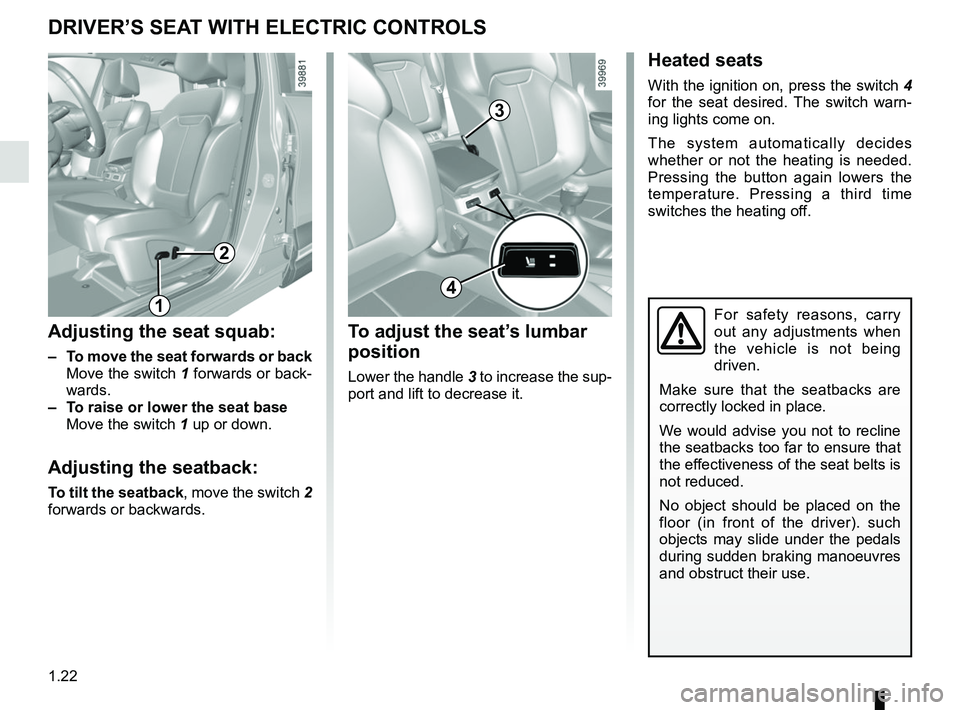
Adjusting the seat squab:
– To move the seat forwards or back
Move the switch 1 forwards or back- wards.
– To raise or lower the seat base
Move the switch 1 up or down.
Adjusting the seatback:
To tilt the seatback, move the switch 2
forwards or backwards.
Heated seats
With the ignition on, press the switch 4
for the seat desired. The switch warn-
ing lights come on.
The system automatically decides
whether or not the heating is needed.
Pressing the button again lowers the
temperature. Pressing a third time
switches the heating off.
1
2
To adjust the seat’s lumbar
position
Lower the handle 3 to increase the sup-
port and lift to decrease it.
3
4
Page 30 of 310
1.24
SEAT BELTS (2/4)
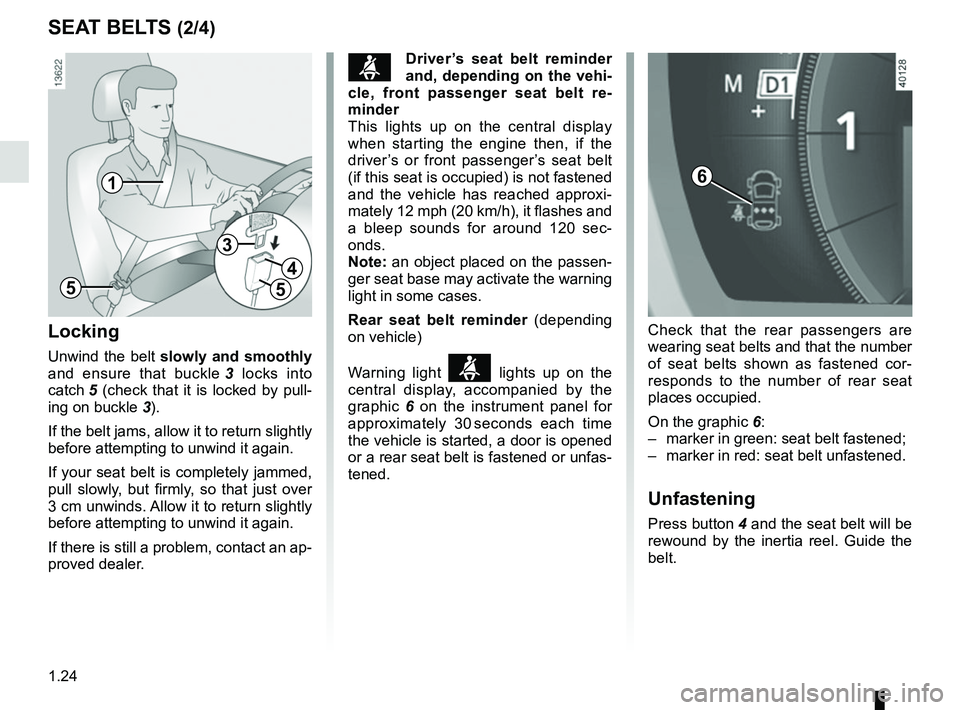
Locking
Unwind the belt slowly and smoothly
and ensure that buckle 3 locks into
catch 5 (check that it is locked by pull- ing on buckle 3).
If the belt jams, allow it to return slightly
before attempting to unwind it again.
If your seat belt is completely jammed,
pull slowly, but firmly, so that just over
3 cm unwinds. Allow it to return slightly
before attempting to unwind it again.
If there is still a problem, contact an ap-
proved dealer.
1
5
3
4
5
ßDriver’s seat belt reminder
and, depending on the vehi-
cle, front passenger seat belt re-
minder
This lights up on the central display
when starting the engine then, if the
driver’s or front passenger’s seat belt
(if this seat is occupied) is not fastened
and the vehicle has reached approxi-
mately 12 mph (20 km/h), it flashes and
a bleep sounds for around 120 sec-
onds.
Note: an object placed on the passen-
ger seat base may activate the warning
light in some cases.
Rear seat belt reminder (depending
on vehicle)
Warning light
ß lights up on the
central display, accompanied by the
graphic 6 on the instrument panel for
approximately 30 seconds each time
the vehicle is started, a door is opened
or a rear seat belt is fastened or unfas-
tened. Check that the rear passengers are
wearing seat belts and that the number
of seat belts shown as fastened cor-
responds to the number of rear seat
places occupied.
On the graphic 6:
– marker in green: seat belt fastened;
– marker in red: seat belt unfastened.
Unfastening
Press button 4 and the seat belt will be
rewound by the inertia reel. Guide the
belt.
6
Page 31 of 310

1.25
SEAT BELTS (3/4)
Check that the rear seat
belts are positioned and
operating correctly each
time the rear bench seat is
moved.
Rear seat belts 8
The belts are locked, unlocked and
adjusted in the same way as the front
belts.
Adjusting the height of the
front seat belts
Use button 7 to adjust the seat belt
height so that the shoulder strap is worn
as shown previously. Press the button 7
and raise or lower the seat belt. Make
sure that the seat belt is locked in posi-
tion correctly after you have adjusted it.
7
88
Page 57 of 310
1.51
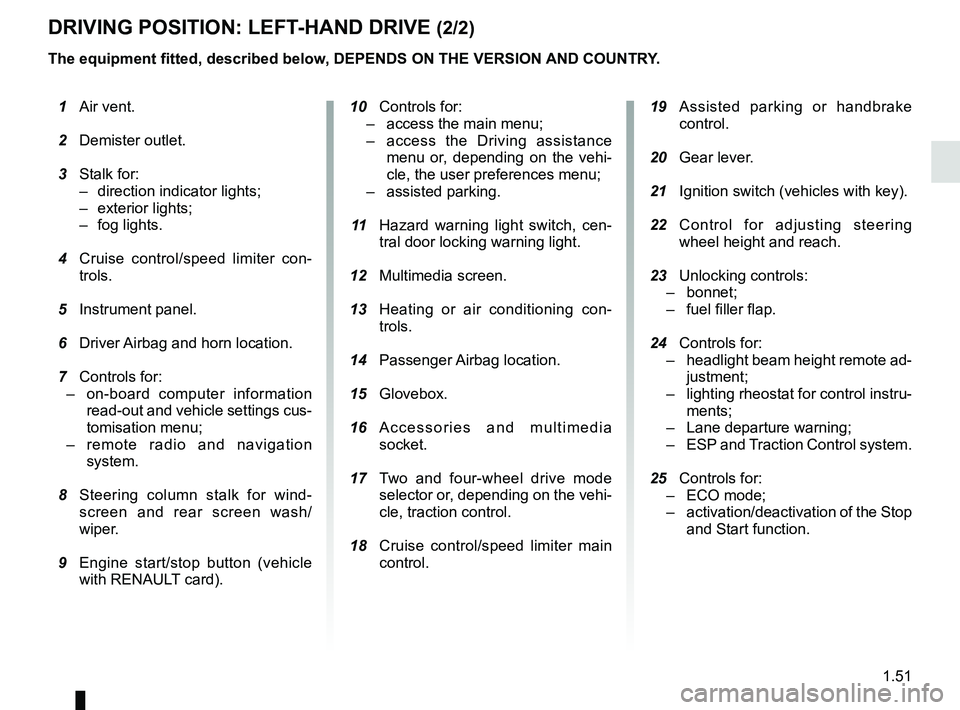
DRIVING POSITION: LEFT-HAND DRIVE (2/2)
The equipment fitted, described below, DEPENDS ON THE VERSION AND COUNTRY. 19 Assisted parking or handbrake
control.
20 Gear lever.
21 Ignition switch (vehicles with key).
22 Control for adjusting steering
wheel height and reach.
23 Unlocking controls:
– bonnet;
– fuel filler flap.
24 Controls for:
– headlight beam height remote ad-
justment;
– lighting rheostat for control instru-
ments;
– Lane departure warning;
– ESP and Traction Control system.
25 Controls for:
– ECO mode;
– activation/deactivation of the Stop
and Start function.
1 Air vent.
2 Demister outlet.
3 Stalk for:
– direction indicator lights;
– exterior lights;
– fog lights.
4 Cruise control/speed limiter con-
trols.
5 Instrument panel.
6 Driver Airbag and horn location.
7 Controls for:
– on-board computer information
read-out and vehicle settings cus-
tomisation menu;
– remote radio and navigation
system.
8 Steering column stalk for wind-
screen and rear screen wash/
wiper.
9 Engine start/stop button (vehicle
with RENAULT card).
10 Controls for:
– access the main menu;
– access the Driving assistance
menu or, depending on the vehi-
cle, the user preferences menu;
– assisted parking.
11 Hazard warning light switch, cen-
tral door locking warning light.
12 Multimedia screen.
13 Heating or air conditioning con-
trols.
14 Passenger Airbag location.
15 Glovebox.
16 Accessories and multimedia
socket.
17 Two and four-wheel drive mode
selector or, depending on the vehi-
cle, traction control.
18 Cruise control/speed limiter main
control.
Page 59 of 310
1.53
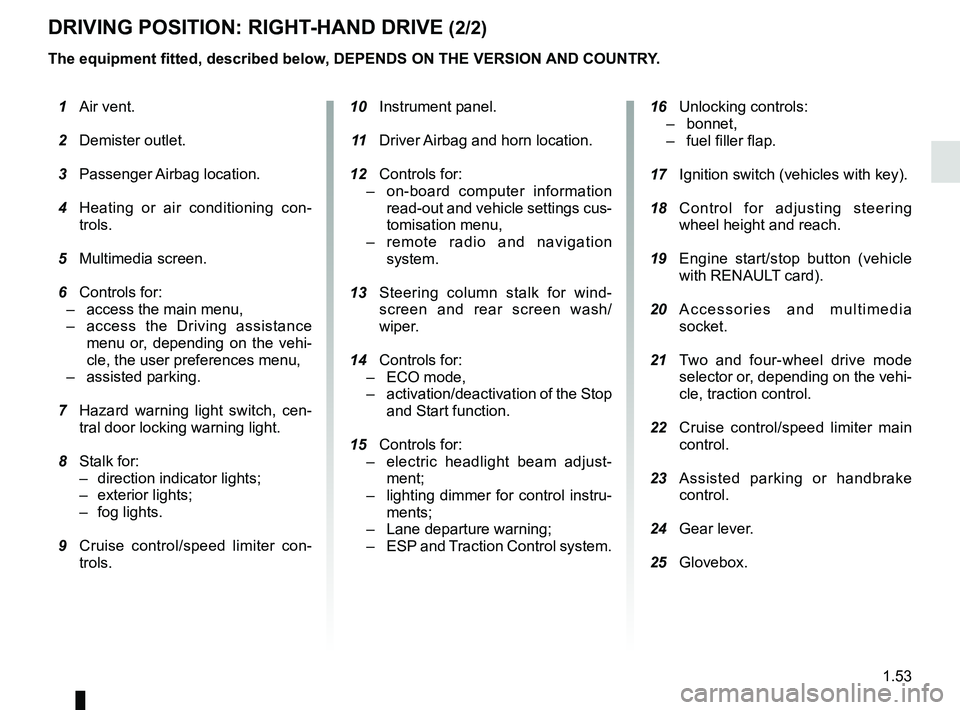
DRIVING POSITION: RIGHT-HAND DRIVE (2/2)
The equipment fitted, described below, DEPENDS ON THE VERSION AND COUNTRY.
16 Unlocking controls:
– bonnet,
– fuel filler flap.
17 Ignition switch (vehicles with key).
18 Control for adjusting steering
wheel height and reach.
19 Engine start/stop button (vehicle
with RENAULT card).
20 Accessories and multimedia
socket.
21 Two and four-wheel drive mode
selector or, depending on the vehi-
cle, traction control.
22 Cruise control/speed limiter main
control.
23 Assisted parking or handbrake
control.
24 Gear lever.
25 Glovebox.
1 Air vent.
2 Demister outlet.
3 Passenger Airbag location.
4 Heating or air conditioning con-
trols.
5 Multimedia screen.
6 Controls for:
– access the main menu,
– access the Driving assistance
menu or, depending on the vehi-
cle, the user preferences menu,
– assisted parking.
7 Hazard warning light switch, cen-
tral door locking warning light.
8 Stalk for:
– direction indicator lights;
– exterior lights;
– fog lights.
9 Cruise control/speed limiter con-
trols.
10 Instrument panel.
11 Driver Airbag and horn location.
12 Controls for:
– on-board computer information
read-out and vehicle settings cus-
tomisation menu,
– remote radio and navigation
system.
13 Steering column stalk for wind-
screen and rear screen wash/
wiper.
14 Controls for:
– ECO mode,
– activation/deactivation of the Stop
and Start function.
15 Controls for:
– electric headlight beam adjust-
ment;
– lighting dimmer for control instru-
ments;
– Lane departure warning;
– ESP and
Traction Control system.
Page 66 of 310
1.60
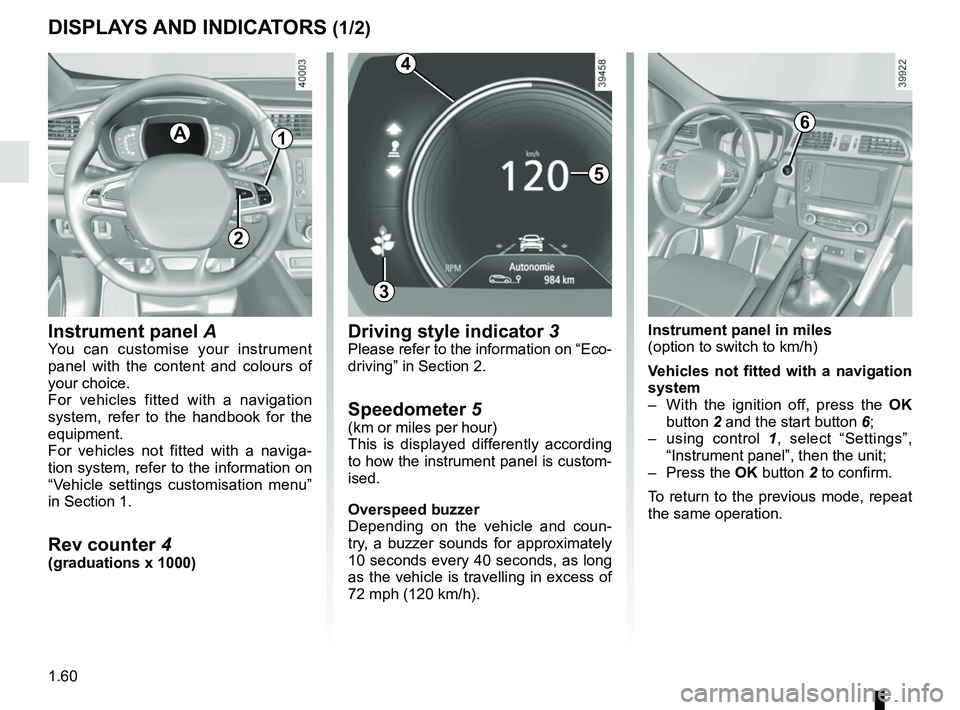
DISPLAYS AND INDICATORS (1/2)
Instrument panel A
You can customise your instrument
panel with the content and colours of
your choice.
For vehicles fitted with a navigation
system, refer to the handbook for the
equipment.
For vehicles not fitted with a naviga-
tion system, refer to the information on
“Vehicle settings customisation menu”
in Section 1.
Rev counter 4(graduations x 1000)
A
5
3
Driving style indicator 3Please refer to the information on “Eco-
driving” in Section 2.
Speedometer 5(km or miles per hour)
This is displayed differently according
to how the instrument panel is custom-
ised.
Overspeed buzzer
Depending on the vehicle and coun-
try, a buzzer sounds for approximately
10 seconds every 40 seconds, as long
as the vehicle is travelling in excess of
72 mph (120 km/h).
6
Instrument panel in miles
(option to switch to km/h)
Vehicles not fitted with a navigation
system
– With the ignition off, press the OK
button 2 and the start button 6;
– using control 1, select “Settings”,
“Instrument panel”, then the unit;
– Press the OK button 2 to confirm.
To return to the previous mode, repeat
the same operation.
4
1
2
Page 67 of 310
1.61
DISPLAYS AND INDICATORS (2/2)
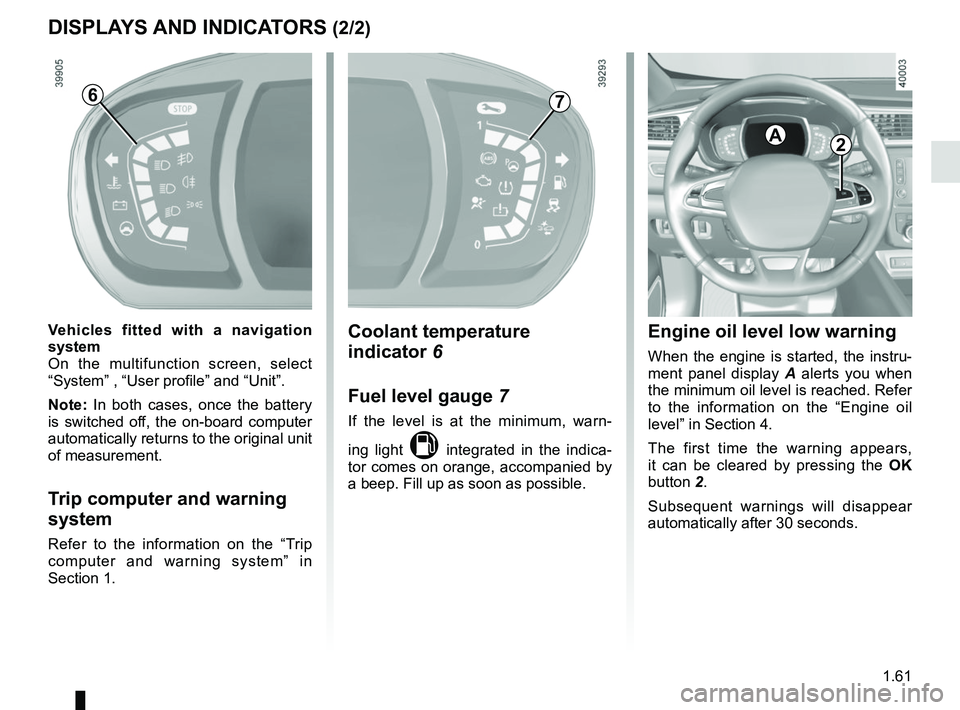
Engine oil level low warning
When the engine is started, the instru-
ment panel display A alerts you when
the minimum oil level is reached. Refer
to the information on the “Engine oil
level” in Section 4.
The first time the warning appears,
it can be cleared by pressing the OK
button 2.
Subsequent warnings will disappear
automatically after 30 seconds.
2A
Coolant temperature
indicator 6
Fuel level gauge 7
If the level is at the minimum, warn-
ing light
M integrated in the indica-
tor comes on orange, accompanied by
a beep. Fill up as soon as possible.
7
Vehicles fitted with a navigation
system
On the multifunction screen, select
“System” , “User profile” and “Unit”.
Note: In both cases, once the battery
is switched off, the on-board computer
automatically returns to the original unit
of measurement.
Trip computer and warning
system
Refer to the information on the “Trip
computer and warning system” in
Section 1.
6