key RENAULT KANGOO 2016 X61 / 2.G User Guide
[x] Cancel search | Manufacturer: RENAULT, Model Year: 2016, Model line: KANGOO, Model: RENAULT KANGOO 2016 X61 / 2.GPages: 173, PDF Size: 3.8 MB
Page 43 of 173
child safety............................................ (up to the end of the DU)
transporting children ............................. (up to the end of the DU)
child restraint/seat ................................ (up to the end of the DU)
child restraint/seat ................................ (up to the end of the DU)
air bag deactivating the front passenger air bags ........ (current page)
front passenger air bag deactivation ..................... (current page) 1.37
ENG_UD8776_1
Sécurité enfants : désactivation/Activation airbag passager (X\
76 - Renault)
ENG_NU_854-2_X76LL_Renault_1
Deactivating/activating the front passenger air bag
CHILD SAFETY : deactivating/activating the front passenger air bag (1/2)
Deactivating the front
passenger air bags
(on equipped vehicles)
In order to be able to install a rear-
facing child seat on the front passen-
ger seat you must deactivate the front
passenger seat belt additional restraint
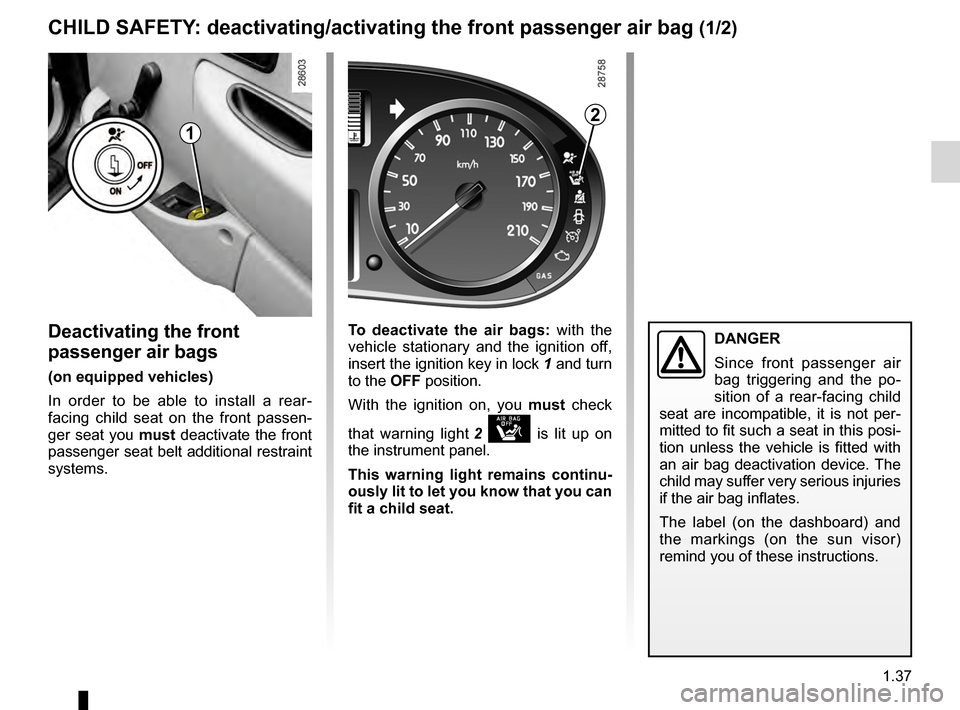
systems. To deactivate the air bags:
with the
vehicle stationary and the ignition off,
insert
the ignition key in lock 1 and turn
to the OFF position.
With the ignition on, you must check
t
hat warning light 2
ã is lit up on
the instrument panel.
This warning light remains continu-
ously lit to let you know that you can
fit a child seat.
DANGER
Since front passenger air
bag triggering and the po-
sition of a rear-facing child
seat are incompatible, it is not per-
mitted to fit such a seat in this posi-
tion unless the vehicle is fitted with
an air bag deactivation device. The
child may suffer very serious injuries
if the air bag inflates.
The label (on the dashboard) and
the markings (on the sun visor)
remind you of these instructions.
2
1
Page 44 of 173

1.38
ENG_UD8776_1
Sécurité enfants : désactivation/Activation airbag passager (X\
76 - Renault)
ENG_NU_854-2_X76LL_Renaul")
air bagactivating the front passenger air bags ............ (current page)
1.38
ENG_UD8776_1
Sécurité enfants : désactivation/Activation airbag passager (X\
76 - Renault)
ENG_NU_854-2_X76LL_Renault_1
CHILD SAFETY : deactivating/activating the front passenger air bag (2/2)
Activating the front
passenger air bags
You should reactivate the air bag as
soon as you remove the child seat from
the front passenger seat to ensure the
protection of the front passenger in the
event of an impact.
To reactivate the air bags: with the
vehicle stationary and the ignition off,
insert
the ignition key in lock 1 and turn
to the ON position.
With the ignition on, check that warning
light
2
ã is off. The front passenger
seat belt additional restraint systems
are activated.
The passenger air bag must
only be deactivated or acti-
vated when the vehicle is
stationary.
I f a n y o p e r a t i o n i s c a r r i e d
out with the ignition on, the
å
and
ø warning lights come on:
the passenger air bag is deacti-
vated.
Switch the ignition off then on again
to reset the air bag in accordance
with the lock position.
Operating faults
It is forbidden to fit a rear-facing child
seat to the front passenger seat if the
air bag activation/deactivation system
is faulty.
Allowing any other passenger to sit in
that seat is not recommended.
Contact your approved Dealer as soon
as possible.
2
1
Page 49 of 173
rear screendemisting ......................................................... (current page)
Jaune NoirNoir texte
1.43
ENG_UD7264_1
Tableau de bord : témoins lumineux (X76 - Renault)
ENG_NU_854-2_X76LL_Renault_1
INSTRUMENT PANEL: warning lights (2/4)
6
Electronic fault and water
present in diesel fuel warn-
ing light (on petrol and diesel
versions) and preheating warning
light (on diesel versions)
Electronic fault warning light (on
petrol and diesel versions). If it comes
on while driving, it indicates an electri-
cal or electronic fault or that water is
present in the fuel. Contact your ap-
proved Dealer as soon as possible.
Preheating and water present in
diesel fuel warning light (on diesel
version).
This light should come on when the ig-
nition key is in position M; it indicates
that the heater plugs are in operation.
It goes out after preheating is sufficient
and the engine can be started.
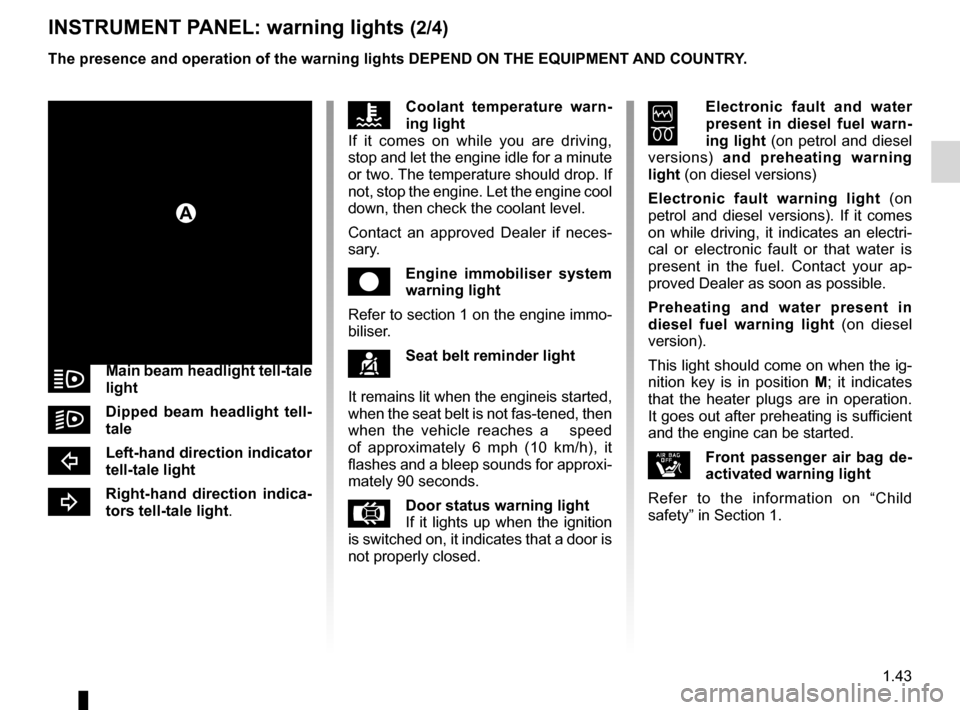
ãFront passenger air bag de-
activated warning light
Refer to the information on “Child
safety” in Section 1.
The presence and operation of the warning lights DEPEND ON THE EQUIPMENT\
AND COUNTRY.
A
oMain beam headlight tell-tale
light
mDipped beam headlight tell-
tale
cLeft-hand direction indicator
tell-tale light
bRight-hand direction indica-
tors tell-tale light .
ÔCoolant temperature warn-
ing light
If it comes on while you are driving,
stop and let the engine idle for a minute
or two. The temperature should drop. If
not, stop the engine. Let the engine cool
down, then check the coolant level.
Contact an approved Dealer if neces-
sary.
êEngine immobiliser system
warning light
Refer to section 1 on the engine immo-
biliser.
çSeat belt reminder light
It remains lit when the engineis started,
when the seat belt is not fas-tened, then
when the vehicle reaches a speed
of approximately 6 mph (10 km/h), it
flashes and a bleep sounds for approxi-
mately 90 seconds.
vDoor status warning light
If it lights up when the ignition
is switched on, it indicates that a door is
not properly closed.
Page 53 of 173
JauneNoirNoir texte
1.47
ENG_UD7265_1
Tableau de bord : afficheurs et indicateurs (X76 - Renault)
ENG_NU_854-2_X76LL_Renault_1
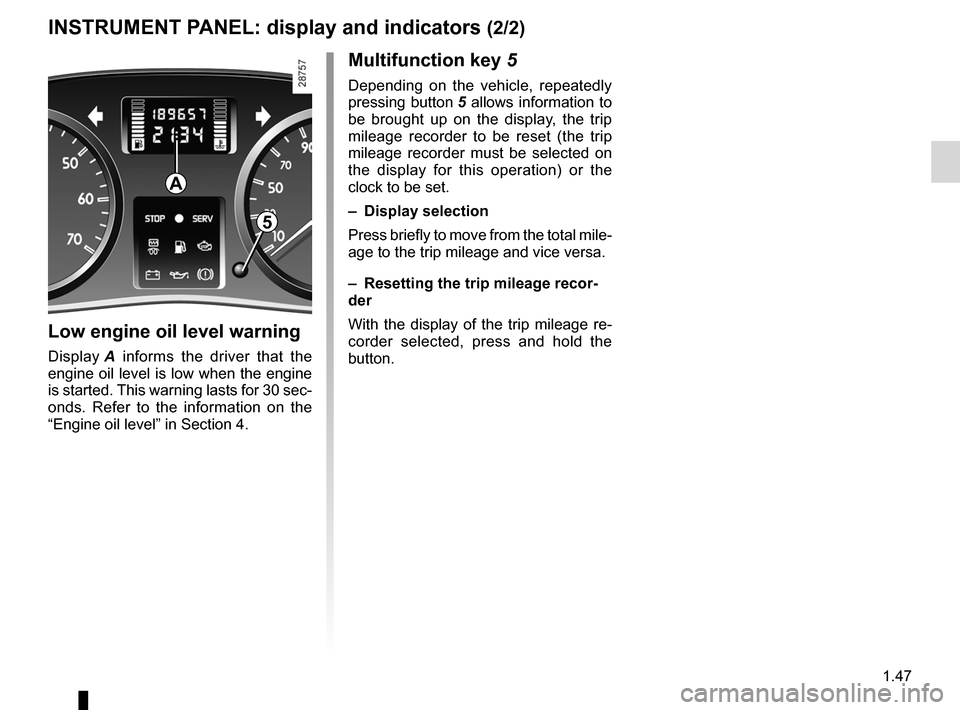
Multifunction key 5
Depending on the vehicle, repeatedly
pressing
button 5 allows information to
be brought up on the display, the trip
mileage recorder to be reset (the trip
mileage recorder must be selected on
the display for this operation) or the
clock to be set.
–
Display selection
Press briefly to move from the total mile-
age to the trip mileage and vice versa.
–
Resetting the trip mileage recor-
der
With the display of the trip mileage re-
corder selected, press and hold the
button.
INSTRUMENT PANEL: display and indicators (2/2)
5
Low engine oil level warning
Display A informs the driver that the
engine oil level is low when the engine
is started. This warning lasts for 30 sec-
onds. Refer to the information on the
“Engine oil level” in Section 4.
A
Page 64 of 173
starting the engine ................................................. (current page)
running in ............................................................... (current page)
ignition switch ........................................................ (current page)
2.2
ENG_UD13969_2
Rodage / Contacteur de démarrage (X76 - Renault)
ENG_NU_854-2_X76LL_Renault_2
Running in/Ignition switch
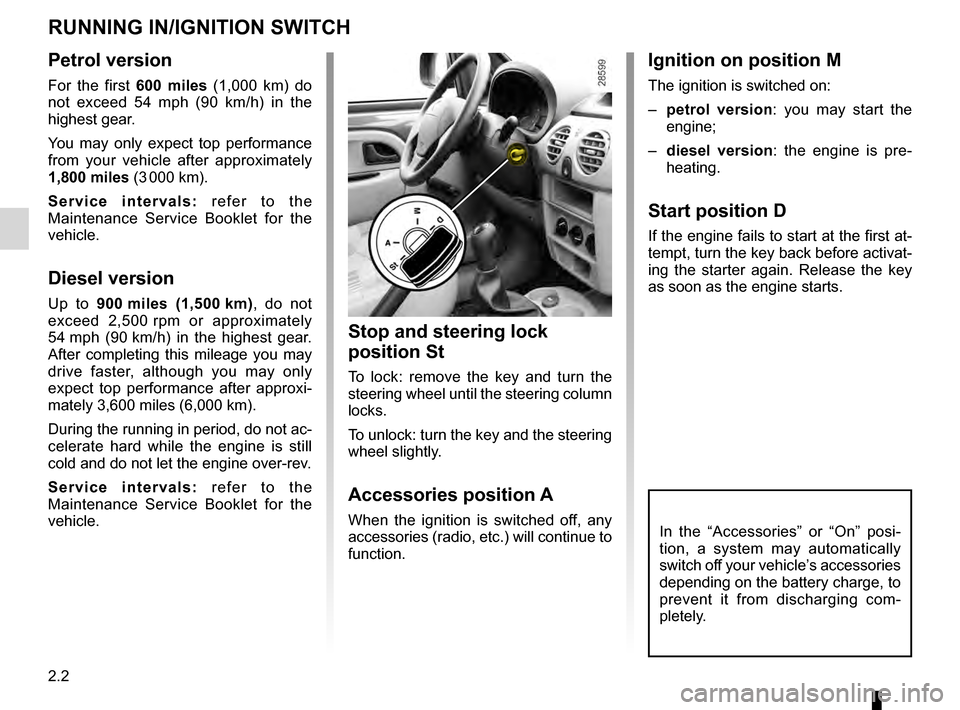
Ignition on position M
The ignition is switched on:
– p
etrol version : you may start the
engine;
– d
iesel version : the engine is pre-
heating.
Start position D
If the engine fails to start at the first at-
tempt, turn the key back before activat-
ing the starter again. Release the key
as soon as the engine starts.
Stop and steering lock
position St
To lock: remove the key and turn the
steering wheel until the steering column
locks.
To unlock: turn the key and the steering
wheel slightly.
Accessories position A
When the ignition is switched off, any
accessories (radio, etc.) will continue to
function.
Petrol version
For the first 600 miles (1,000 km) do
not exceed 54 mph (90 km/h) in the
highest gear.
You may only expect top performance
from your vehicle after approximately
1,800 miles (3
000 km).
S e r v i c e i n t e r v a l s : r e f e r t o t h e
Maintenance Service Booklet for the
vehicle.
Diesel version
Up to 900 miles (1,500 km) , do not
e
xceed 2,500 rpm or approximately
5
4 mph (90 km/h) in the highest gear.
After completing this mileage you may
drive faster, although you may only
expect top performance after approxi-
mately 3,600
miles (6,000 km).
During the running in period, do not ac-
celerate hard while the engine is still
cold and do not let the engine over-rev.
S e r v i c e i n t e r v a l s : r e f e r t o t h e
Maintenance Service Booklet for the
vehicle.
RUNNING IN/IGNItIoN SwItch
In the “Accessories” or “On” posi-
tion, a system may automatically
switch off your vehicle’s accessories
depending on the battery charge, to
prevent it from discharging com-
pletely.
Page 65 of 173
starting the engine ................................ (up to the end of the DU)
child safety............................................ (up to the end of the DU) 2.3
ENG_UD7277_1
Mise en route / Arrêt du moteur (X76 - Renault)
ENG_NU_854-2_X76LL_Renault_2
Starting/stopping the engine
Stopping the engine
With the engine idling, turn the key to
the “Stop” position St.ÉDiesel injection
Turn the ignition key to ignition on,
position M, and hold this position
until the preheating warning light
goes out.
Turn the key to starter position D
without depressing the accelerator
pedal.
Release the key as soon as the
engine starts.Starting the engine
Petrol injection
Engine warm or cold
–
Run the starter motor without ac-
celerating;
–
Release the key as soon as the
engine starts.
St ARtING/StoPPING thE ENGINE
Never leave your vehi-
cle with the key inside and
never leave a child (or pet)
unsupervised, even for a
short time.
There is a risk that they could start
the engine or operate electrical
equipment (electric windows etc.)
and trap part of their body (neck,
arms, hands, etc.).
Risk of serious injury.
Never switch off the ignition before
the vehicle has stopped completely.
Switching off the engine disables
the assistance equipment: brakes,
steering, etc., and passive safety
equipment such as air bags and
pretensioners.
Page 88 of 173
children .................................................................. (current page)
electric windows ................................... (up to the end of the DU)
child safety............................................................. (current page)
3.14
ENG_UD14027_2
Vitres (X76 - Renault)ENG_NU_854-2_X76LL_Renault_3
Jaune NoirNoir texte
Windows
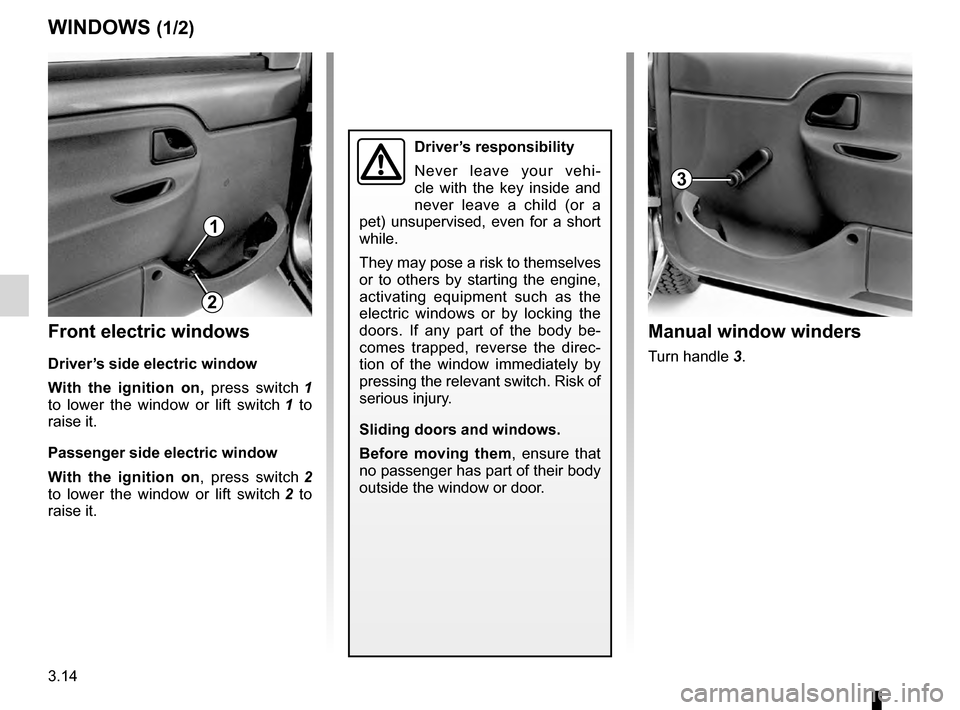
Manual window winders
Turn handle 3.
Front electric windows
Driver’s side electric window
With the ignition on,
press switch 1
t
o lower the window or lift switch 1 to
raise it.
Passenger side electric window
With the ignition on ,
press switch 2
t
o lower the window or lift switch 2 to
raise it.
WinDOWs (1/2)
1
2
3
Driver’s responsibility
Never leave your vehi-
cle with the key inside and
never leave a child (or a
pet) unsupervised, even for a short
while.
They may pose a risk to themselves
or to others by starting the engine,
activating equipment such as the
electric windows or by locking the
doors. If any part of the body be-
comes trapped, reverse the direc-
tion of the window immediately by
pressing the relevant switch. Risk of
serious injury.
s
liding doors and windows.
Before moving them , ensure that
no passenger has part of their body
outside the window or door.
Page 138 of 173
practical advice ..................................... (up to the end of the DU)
towing breakdown ...................................... (up to the end of the DU)
5.26
ENG_UD7325_1
Remorquage : dépannage (X76 - Renault)
ENG_NU_854-2_X76LL_Renault_5
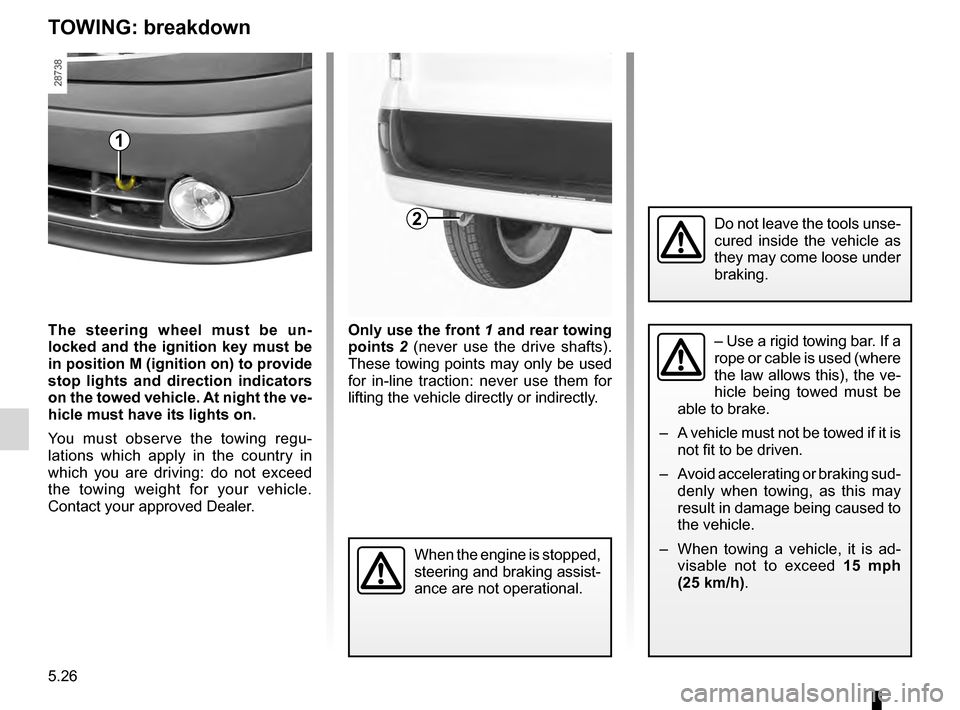
Only use the front 1 and rear towing
points 2 (never use the drive shafts).
These towing points may only be used
for in-line traction: never use them for
lifting the vehicle directly or indirectly.
Towing: breakdown
When the engine is stopped,
steering and braking assist-
ance are not operational.
t he steering wheel must be un-
locked
and the ignition key must be
in
position m (ignition on) to provide
s
top lights and direction indicators
on
the towed vehicle. At night the ve-
hicle
must have its lights on.
You must observe the towing regu-
lations which apply in the country in
which you are driving: do not exceed
the towing weight for your vehicle.
Contact your approved Dealer.
tOWing: breakdown
1
2
– Use a rigid towing bar. If a
rope or cable is used (where
the law allows this), the ve-
hicle being towed must be
able to brake.
–
A vehicle must not be towed if it is
not fit to be driven.
–
Avoid accelerating or braking sud -
denly when towing, as this may
result in damage being caused to
the vehicle.
–
When towing a vehicle, it is ad -
visable not to exceed 1
5 mph
(25 km/h).
Do not leave the tools unse-
cured inside the vehicle as
they may come loose under
braking.
Page 143 of 173

ENG_NU_854-2_X76LL_Renault_5
Replace battery 2 according to the di-
rection marked on the cover.
n o
te:")
5.31
ENG_UD14323_2
Clé / télécommande à radiofréquence : piles (X76 - Renau\
lt)
ENG_NU_854-2_X76LL_Renault_5
Replace battery 2 according to the di-
rection marked on the cover.
n o
te: It is not advisable to touch the
electronic circuit in the key cover when
replacing the battery.
Do not throw away your
used batteries; give them to
an organisation responsible
for collecting and recycling
batteries.
Batteries can be obtained from your
approved Dealer. These batteries
have a service life of approximately
two years.
There is a delay of 1 second be-
tween locking and unlocking ac-
tions.
rADiO FrEQuEncy rEmOtE cOntrOl: batteries
2
1
Radio frequency remote control: batteries
When refitting, ensure that the cover
is correctly clipped on and the screw
tightened.
Unclip remote control cover 1 (using a
coin).
Page 145 of 173

5.33
ENG_UD7332_1
Anomalies de fonctionnement (X76 - Renault)
ENG_NU_854-2_X76LL_Renault_5
Operating faults
OPErA ting FAults (1/4)
the following advice will enable you to carry out quick, temporary repairs. For safety reasons, you should always contact
an
approved Dealer as soon as possible.
the starter is activated POssiBlE cAusEsWhAt tO DO
Warning lights dim or fail to come on;
the starter does not run. Battery terminals disconnected,
oxidised or incorrectly secured.Retighten, reconnect or clean them if they
are oxidised.
Battery discharged or worn. Connect another battery to the faulty bat-
tery. Refer to the paragraph “Battery: trou-
bleshooting” in Section 5 or replace the bat-
tery if necessary.
Do not push the vehicle if the steering
column is locked.
The engine will not start. Starting conditions are not fulfilled. Refer to the information on “Starting/stop-
ping the engine” in Section 2.
The steering column remains locked. Steering wheel locked. To unlock, move the key and the steer-
ing wheel (refer to the information on the
“Ignition switch” in Section 2).