lock RENAULT KANGOO 2016 X61 / 2.G User Guide
[x] Cancel search | Manufacturer: RENAULT, Model Year: 2016, Model line: KANGOO, Model: RENAULT KANGOO 2016 X61 / 2.GPages: 173, PDF Size: 3.8 MB
Page 17 of 173
doors..................................................... (up to the end of the DU)
RENAULT ANTI-INTRUDER DEVICE (RAID) (up to the end of the DU) 1.11
ENG_UD7247_1
Condamnation automatique des ouvrants en roulage (X76 - Renault)
ENG_NU_854-2_X76LL_Renault_1
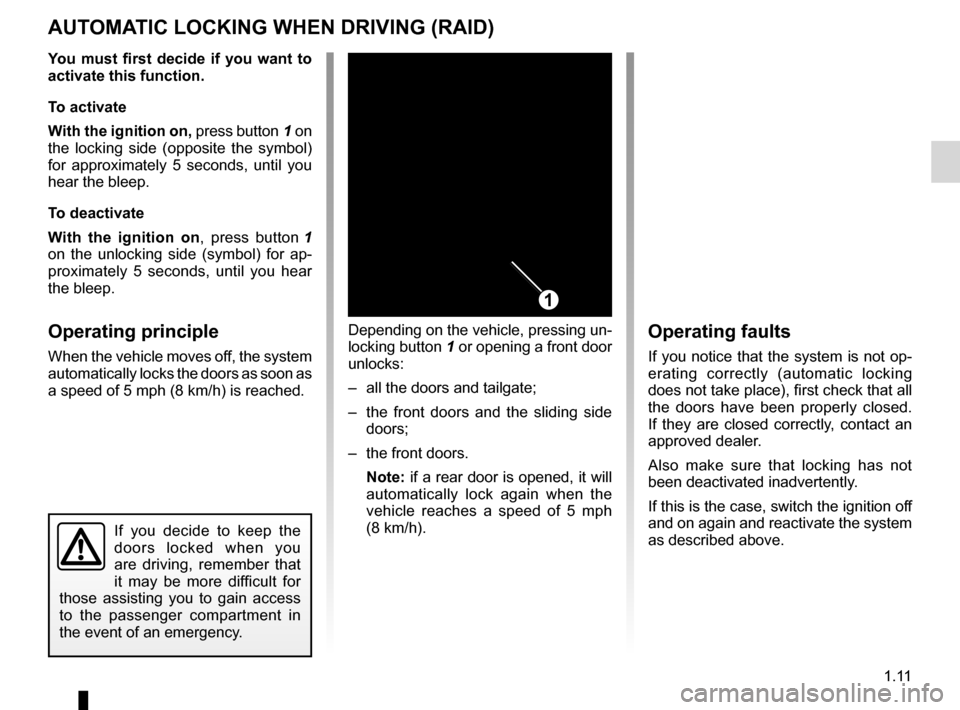
You must first decide if you want to
activate this function.
To activate
With the ignition on, press
button 1 on
the locking side (opposite the symbol)
for approximately 5 seconds, until you
hear the bleep.
To deactivate
With the ignition on ,
press button 1
on the unlocking side (symbol) for ap-
proximately 5 seconds, until you hear
the bleep.
Operating principle
When the vehicle moves off, the system
automatically locks the doors as soon as
a speed of 5 mph (8 km/h) is reached.
Automatic locking when driving
If you decide to keep the
doors locked when you
are driving, remember that
it may be more difficult for
those assisting you to gain access
to the passenger compartment in
the event of an emergency.
Operating faults
If you notice that the system is not op-
erating correctly (automatic locking
does not take place), first check that all
the doors have been properly closed.
If they are closed correctly, contact an
approved dealer.
Also make sure that locking has not
been deactivated inadvertently.
If this is the case, switch the ignition off
and on again and reactivate the system
as described above.
Depending on the vehicle, pressing un-
locking
button 1 or opening a front door
unlocks:
–
all the doors and tailgate;
– the front doors and the sliding side
doors;
–
the front doors.
Note: if a rear door is opened, it will
automatically lock again when the
vehicle reaches a speed of 5 mph
(8 km/h).
AUTOMATIC LOCKING WHEN DRIvING (RAID)
1
Page 21 of 173
front seatsadjustment ...................................... (up to the end of the DU) 1.15
ENG_UD7253_1
Sièges avant (X76 - Renault)
ENG_NU_854-2_X76LL_Renault_1
Front seats
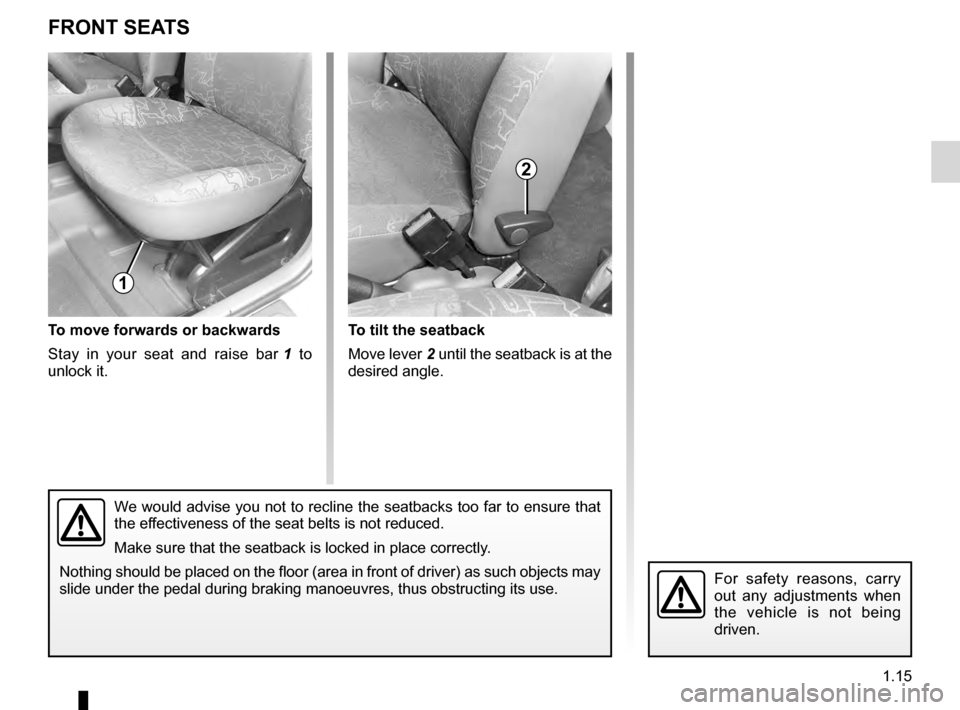
To tilt the seatback
Move lever 2 until the seatback is at the
desired angle.
To move forwards or backwards
S
tay in your seat and raise bar 1 to
unlock it.
FRONT SEATS
We would advise you not to recline the seatbacks too far to ensure that
the effectiveness of the seat belts is not reduced.
Make sure that the seatback is locked in place correctly.
Nothing should be placed on the floor (area in front of driver) as such objects may
slide under the pedal during braking manoeuvres, thus obstructing its us\
e.
1
2
For safety reasons, carry
out any adjustments when
the vehicle is not being
driven.
Page 22 of 173
partition ................................................. (up to the end of the DU)
1.16
ENG_UD7252_1
Cloison de séparation (X76 - Renault)
ENG_NU_854-2_X76LL_Renault_1
Note: before returning the swivelling
section to its original position, check
that
locking point 4 is clean and not ob-
structed.
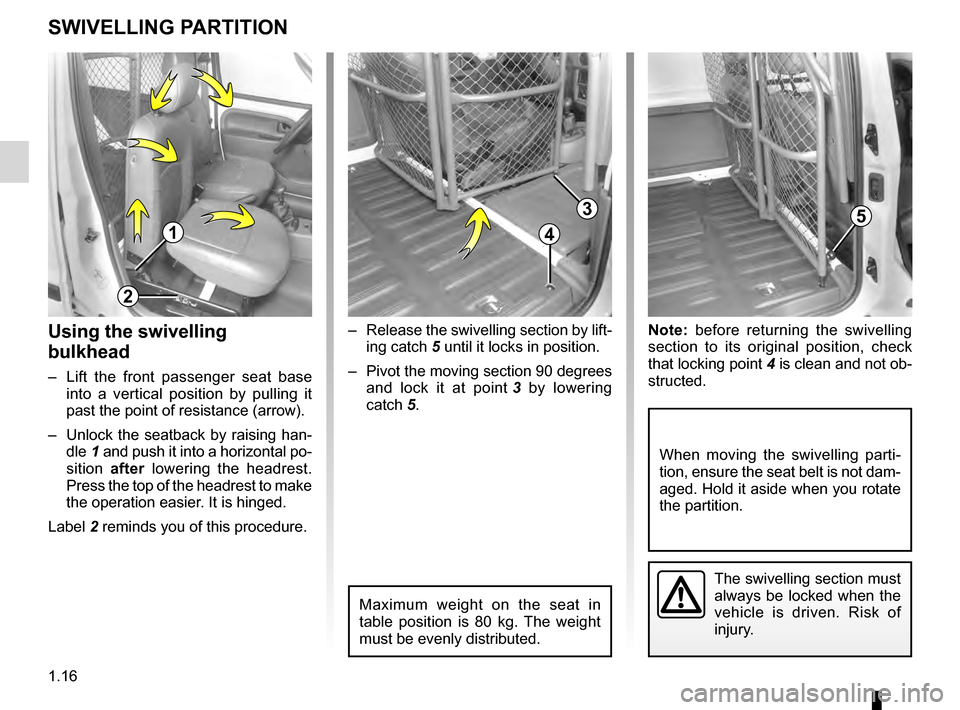
–
Release the swivelling section by lift -
ing catch
5 until it locks in position.
–
Pivot the moving section 90 degrees
a
nd lock it at point 3 by lowering
catch
5.
Partition
Using the swivelling
bulkhead
– Lift the front passenger seat base
into a vertical position by pulling it
past the point of resistance (arrow).
–
Unlock the seatback by raising han -
dle
1 and push it into a horizontal po-
sition after lowering the headrest.
Press the top of the headrest to make
the operation easier. It is hinged.
Label
2 reminds you of this procedure.
SWIvELLING PARTITION
1
2
3
4
5
When moving the swivelling parti-
tion, ensure the seat belt is not dam-
aged. Hold it aside when you rotate
the partition.
The swivelling section must
always be locked when the
vehicle is driven. Risk of
injury.
Maximum weight on the seat in
table position is 80 kg. The weight
must be evenly distributed.
Page 25 of 173
JauneNoirNoir texte
1.19
ENG_UD9537_2
Ceintures de sécurité (X76 - Renault)
ENG_NU_854-2_X76LL_Renault_1
SEAT BELTS (2/4)
61
534
5
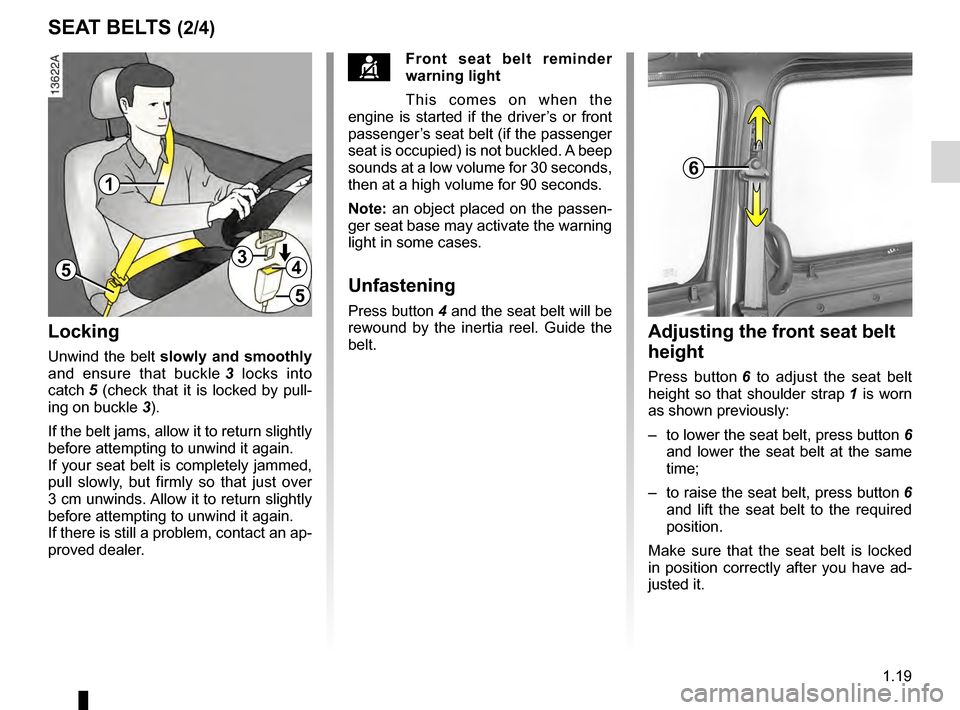
Adjusting the front seat belt
height
Press button 6 to adjust the seat belt
height
so that shoulder strap 1 is worn
as shown previously:
–
to lower the seat belt, press button 6
and lower the seat belt at the same
time;
–
to raise the seat belt, press button 6
and lift the seat belt to the required
position.
Make sure that the seat belt is locked
in position correctly after you have ad-
justed it.
Locking
Unwind the belt slowly and smoothly
a
nd ensure that buckle 3 locks into
catch
5 (check that it is locked by pull-
ing on buckle
3).
If the belt jams, allow it to return slightly
before attempting to unwind it again.
If your seat belt is completely jammed,
pull slowly, but firmly so that just over
3 cm unwinds. Allow it to return slightly
before attempting to unwind it again.
If there is still a problem, contact an ap-
proved dealer.
çFront seat belt reminder
warning light
This comes on when the
engine is started if the driver’s or front
passenger’s seat belt (if the passenger
seat is occupied) is not buckled. A beep
sounds at a low volume for 30 seconds,
then at a high volume for 90 seconds.
Note: an object placed on the passen-
ger seat base may activate the warning
light in some cases.
Unfastening
Press button 4 and the seat belt will be
rewound by the inertia reel. Guide the
belt.
Page 26 of 173
1.20
ENG_UD9537_2
Ceintures de sécurité (X76 - Renault)
ENG_NU_854-2_X76LL_Renault_1
Jaune NoirNoir texte
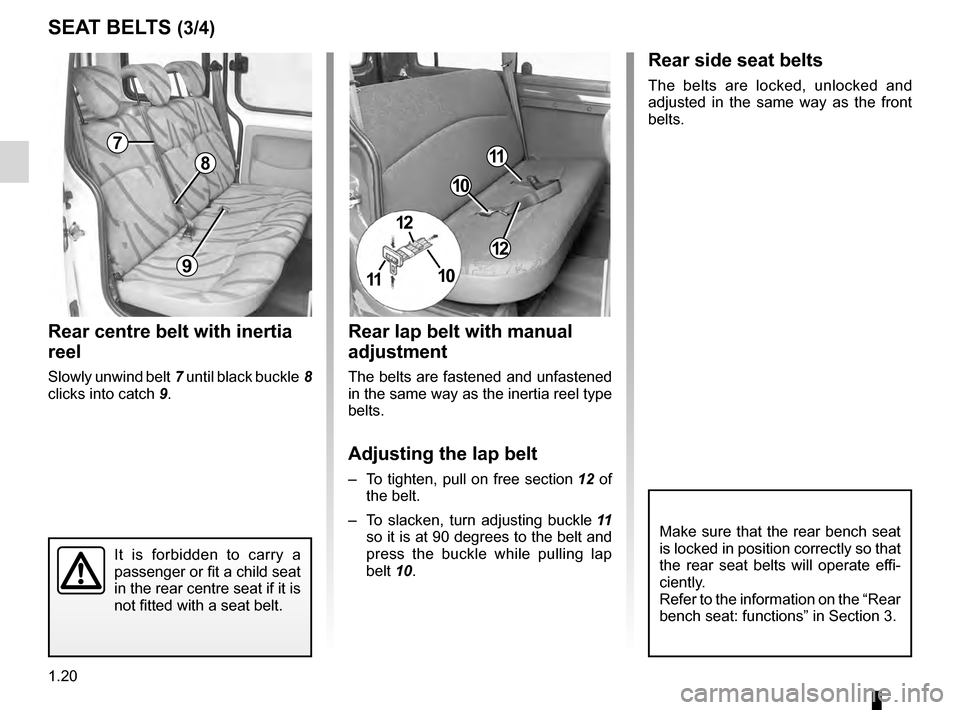
Rear centre belt with inertia
reel
Slowly unwind belt 7 until black buckle 8
clicks into catch
9.
Rear lap belt with manual
adjustment
The belts are fastened and unfastened
in the same way as the inertia reel type
belts.
Adjusting the lap belt
– To tighten, pull on free section 12 of
the belt.
–
To slacken, turn adjusting buckle 11
so it is at 90 degrees to the belt and
press the buckle while pulling lap
belt
10.
Rear side seat belts
The belts are locked, unlocked and
adjusted in the same way as the front
belts.
Make sure that the rear bench seat
is locked in position correctly so that
the rear seat belts will operate effi-
ciently.
Refer to the information on the “Rear
bench seat: functions” in Section 3.
It is forbidden to carry a
passenger or fit a child seat
in the rear centre seat if it is
not fitted with a seat belt.
SEAT BELTS (3/4)
7
8
9
11
10
12
12
1011
Page 31 of 173
JauneNoirNoir texte
1.25
ENG_UD14673_2
Dispositifs complémentaires à la ceinture avant (X76 - Renault)
ENG_NU_854-2_X76LL_Renault_1
METHODS OF RESTRAINT IN ADDITION TO THE FRONT SEAT BELTS (4/5)
All of the warnings below are given so that the air bag is not obstructed in any way when it is inflated and also to prevent
the risk of serious injuries caused by items which may be dislodged when\
the air bag inflates.
Warnings concerning the driver’s air bag
– Do not modify the steering wheel or the steering wheel boss.
– Do not cover the steering wheel boss under any circumstances.
– Do not attach any objects (badge, logo, clock, telephone holder, etc.) to the steering wheel boss.
– The steering wheel must not be removed (except by qualified personnel from our Network).
– When driving, do not sit too close to the steering wheel. Sit with your arms slightly bent (see the information on “Adjusting
your driving position” in Section 1). This will allow sufficient space for the air bag to deploy correctly and be fully effective.
Warnings concerning the passenger air bag
–
Do not attach or glue any objects (badge, logo, clock, telephone holder, etc.) to the dashboard on or near the air bag.
– Do not place anything between the dashboard and the passenger (pet, umbrella, walking stick, parcels, etc.).
– The passenger must not put his or her feet on the dashboard or seat as there is a risk that serious injuries may occur. In
general, parts of the body should be kept away from the dashboard (knee\
s, hands, head, etc.).
–
The devices in addition to the front passenger seat belt should be reactivated as soon as a child seat is removed, to ensure
the protection of the passenger in the event of an impact.
A CHILD SEAT MUST NOT BE FITTED TO THE FRONT PASSENGER SEAT UNLESS THE
ADDITIONAL
RESTRAINT SYSTEMS, I.E. THE PASSENGER AIR BAG, ARE DEACTIv ATED.
(refer to Section 1 “Child safety: deactivating/activating the front\
passenger air bag”)
Page 43 of 173
child safety............................................ (up to the end of the DU)
transporting children ............................. (up to the end of the DU)
child restraint/seat ................................ (up to the end of the DU)
child restraint/seat ................................ (up to the end of the DU)
air bag deactivating the front passenger air bags ........ (current page)
front passenger air bag deactivation ..................... (current page) 1.37
ENG_UD8776_1
Sécurité enfants : désactivation/Activation airbag passager (X\
76 - Renault)
ENG_NU_854-2_X76LL_Renault_1
Deactivating/activating the front passenger air bag
CHILD SAFETY : deactivating/activating the front passenger air bag (1/2)
Deactivating the front
passenger air bags
(on equipped vehicles)
In order to be able to install a rear-
facing child seat on the front passen-
ger seat you must deactivate the front
passenger seat belt additional restraint
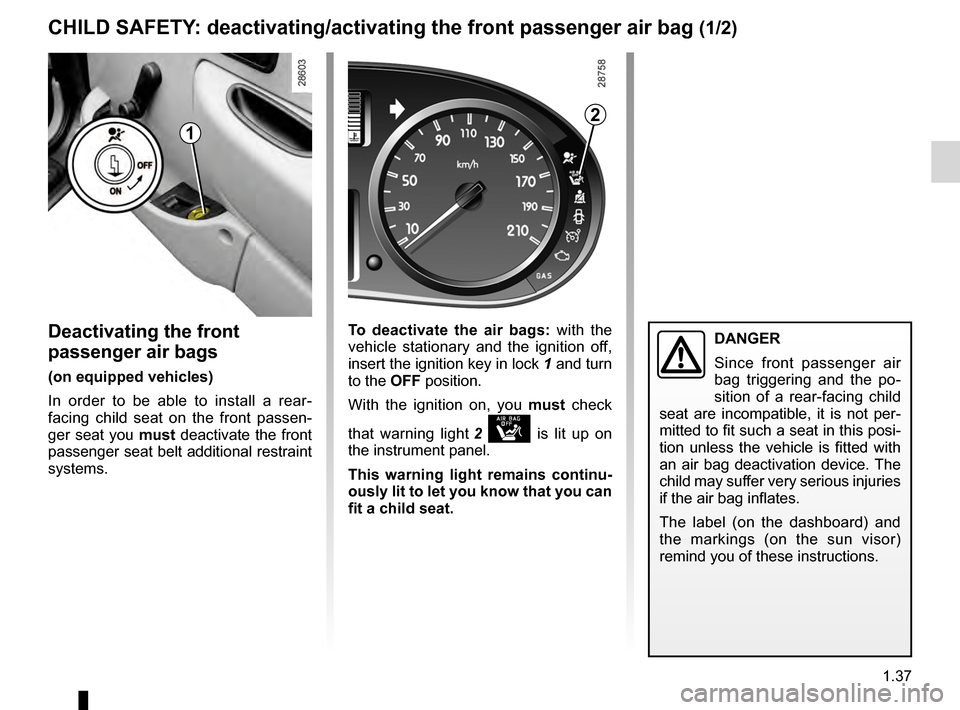
systems. To deactivate the air bags:
with the
vehicle stationary and the ignition off,
insert
the ignition key in lock 1 and turn
to the OFF position.
With the ignition on, you must check
t
hat warning light 2
ã is lit up on
the instrument panel.
This warning light remains continu-
ously lit to let you know that you can
fit a child seat.
DANGER
Since front passenger air
bag triggering and the po-
sition of a rear-facing child
seat are incompatible, it is not per-
mitted to fit such a seat in this posi-
tion unless the vehicle is fitted with
an air bag deactivation device. The
child may suffer very serious injuries
if the air bag inflates.
The label (on the dashboard) and
the markings (on the sun visor)
remind you of these instructions.
2
1
Page 44 of 173

1.38
ENG_UD8776_1
Sécurité enfants : désactivation/Activation airbag passager (X\
76 - Renault)
ENG_NU_854-2_X76LL_Renaul")
air bagactivating the front passenger air bags ............ (current page)
1.38
ENG_UD8776_1
Sécurité enfants : désactivation/Activation airbag passager (X\
76 - Renault)
ENG_NU_854-2_X76LL_Renault_1
CHILD SAFETY : deactivating/activating the front passenger air bag (2/2)
Activating the front
passenger air bags
You should reactivate the air bag as
soon as you remove the child seat from
the front passenger seat to ensure the
protection of the front passenger in the
event of an impact.
To reactivate the air bags: with the
vehicle stationary and the ignition off,
insert
the ignition key in lock 1 and turn
to the ON position.
With the ignition on, check that warning
light
2
ã is off. The front passenger
seat belt additional restraint systems
are activated.
The passenger air bag must
only be deactivated or acti-
vated when the vehicle is
stationary.
I f a n y o p e r a t i o n i s c a r r i e d
out with the ignition on, the
å
and
ø warning lights come on:
the passenger air bag is deacti-
vated.
Switch the ignition off then on again
to reset the air bag in accordance
with the lock position.
Operating faults
It is forbidden to fit a rear-facing child
seat to the front passenger seat if the
air bag activation/deactivation system
is faulty.
Allowing any other passenger to sit in
that seat is not recommended.
Contact your approved Dealer as soon
as possible.
2
1
Page 50 of 173
1.44
ENG_UD7264_1
Tableau de bord : témoins lumineux (X76 - Renault)
ENG_NU_854-2_X76LL_Renault_1
Jaune NoirNoir texte
INSTRUMENT PANEL: warning lights (3/4)
The presence and operation of the warning lights DEPEND ON THE EQUIPMENT\
AND COUNTRY.
A
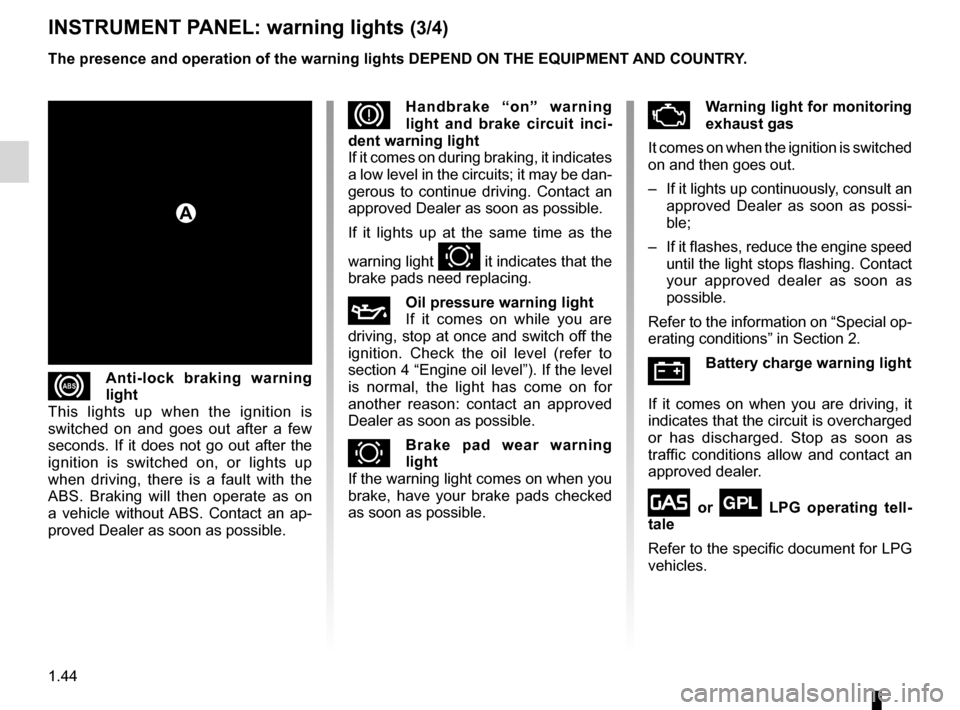
DHandbrake “on” warning
light and brake circuit inci-
dent warning light
If it comes on during braking, it indicates
a low level in the circuits; it may be dan-
gerous to continue driving. Contact an
approved Dealer as soon as possible.
If it lights up at the same time as the
warning light
z it indicates that the
brake pads need replacing.
ÀOil pressure warning light
If it comes on while you are
driving, stop at once and switch off the
ignition. Check the oil level (refer to
section 4 “Engine oil level”). If the level
is normal, the light has come on for
another reason: contact an approved
Dealer as soon as possible.
zBrake pad wear warning
light
If the warning light comes on when you
brake, have your brake pads checked
as soon as possible.
xAnti-lock braking warning
light
This lights up when the ignition is
switched on and goes out after a few
seconds. If it does not go out after the
ignition is switched on, or lights up
when driving, there is a fault with the
ABS. Braking will then operate as on
a vehicle without ABS. Contact an ap-
proved Dealer as soon as possible.
ÄWarning light for monitoring
exhaust gas
It comes on when the ignition is switched
on and then goes out.
–
If it lights up continuously, consult an
approved Dealer as soon as possi-
ble;
–
If it flashes, reduce the engine speed
until the light stops flashing. Contact
your approved dealer as soon as
possible.
Refer to the information on “Special op-
erating conditions” in Section 2.
ÚBattery charge warning light
If it comes on when you are driving, it
indicates that the circuit is overcharged
or has discharged. Stop as soon as
traffic conditions allow and contact an
approved dealer.
î or Z LPG operating tell-
tale
Refer to the specific document for LPG
vehicles.
Page 53 of 173
JauneNoirNoir texte
1.47
ENG_UD7265_1
Tableau de bord : afficheurs et indicateurs (X76 - Renault)
ENG_NU_854-2_X76LL_Renault_1
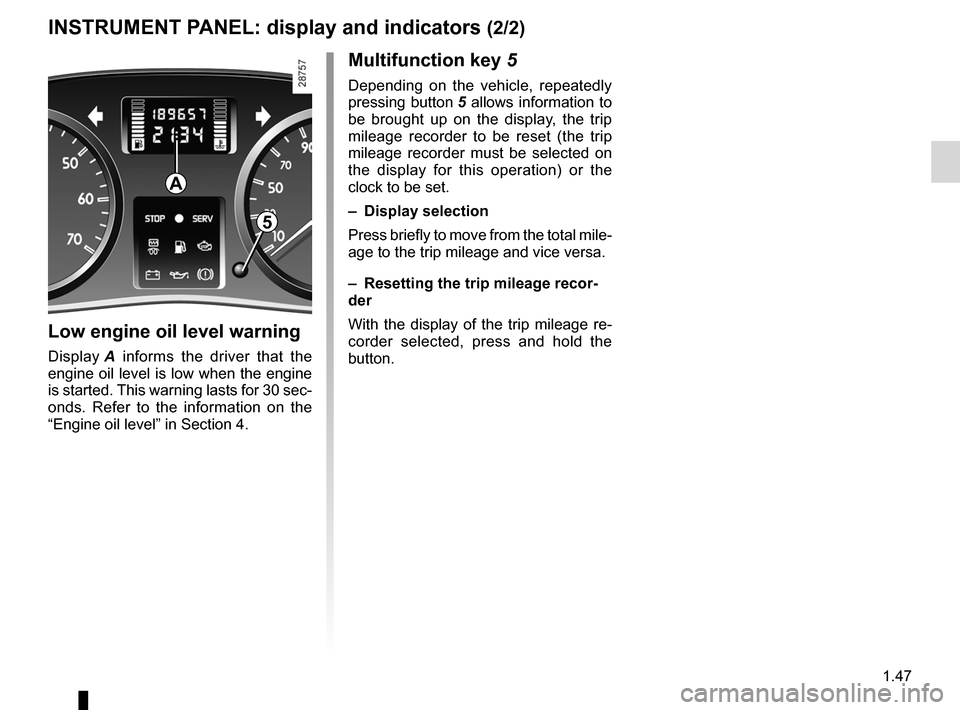
Multifunction key 5
Depending on the vehicle, repeatedly
pressing
button 5 allows information to
be brought up on the display, the trip
mileage recorder to be reset (the trip
mileage recorder must be selected on
the display for this operation) or the
clock to be set.
–
Display selection
Press briefly to move from the total mile-
age to the trip mileage and vice versa.
–
Resetting the trip mileage recor-
der
With the display of the trip mileage re-
corder selected, press and hold the
button.
INSTRUMENT PANEL: display and indicators (2/2)
5
Low engine oil level warning
Display A informs the driver that the
engine oil level is low when the engine
is started. This warning lasts for 30 sec-
onds. Refer to the information on the
“Engine oil level” in Section 4.
A