brake RENAULT KANGOO Z.E. 2018 Owner's Manual
[x] Cancel search | Manufacturer: RENAULT, Model Year: 2018, Model line: KANGOO Z.E., Model: RENAULT KANGOO Z.E. 2018Pages: 230, PDF Size: 5.03 MB
Page 159 of 230
4.5
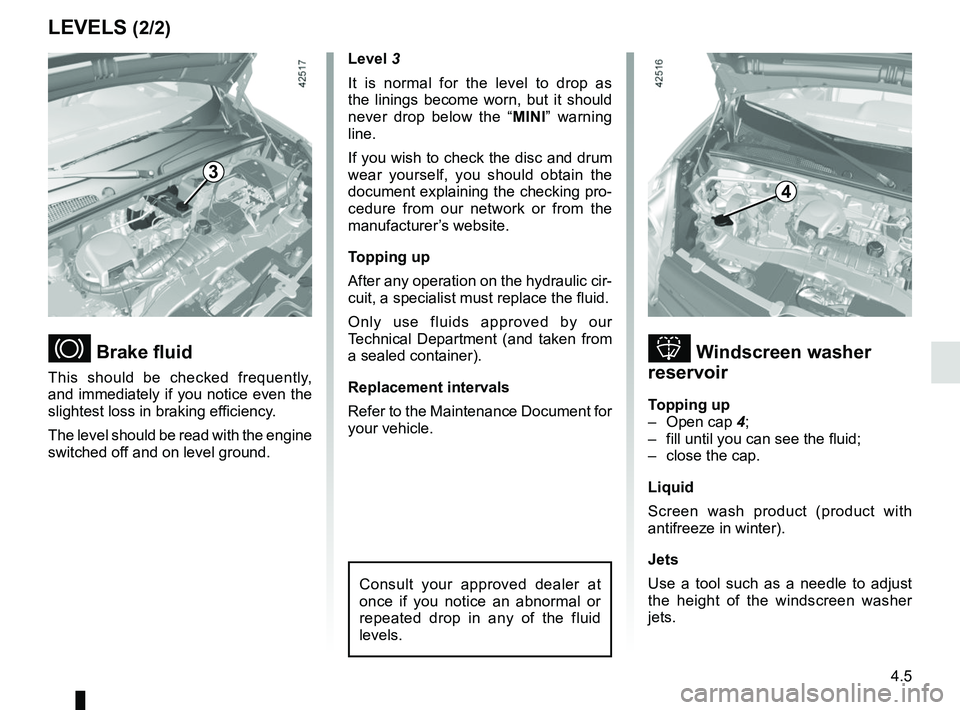
Windscreen washer
reservoir
Topping up
– Open cap 4;
– fill until you can see the fluid;
– close the cap.
Liquid
Screen wash product (product with
antifreeze in winter).
Jets
Use a tool such as a needle to adjust
the height of the windscreen washer
jets.
4
Level 3
It is normal for the level to drop as
the linings become worn, but it should
never drop below the “ MINI” warning
line.
If you wish to check the disc and drum
wear yourself, you should obtain the
document explaining the checking pro-
cedure from our network or from the
manufacturer’s website.
Topping up
After any operation on the hydraulic cir-
cuit, a specialist must replace the fluid.
Only use fluids approved by our
Technical Department (and taken from
a sealed container).
Replacement intervals
Refer to the Maintenance Document for
your vehicle.
Consult your approved dealer at
once if you notice an abnormal or
repeated drop in any of the fluid
levels.
Brake fluid
This should be checked frequently,
and immediately if you notice even the
slightest loss in braking efficiency.
The level should be read with the engine
switched off and on level ground.
3
LEVELS (2/2)
Page 172 of 230
5.4
TYRE INFLATION KIT (2/3)
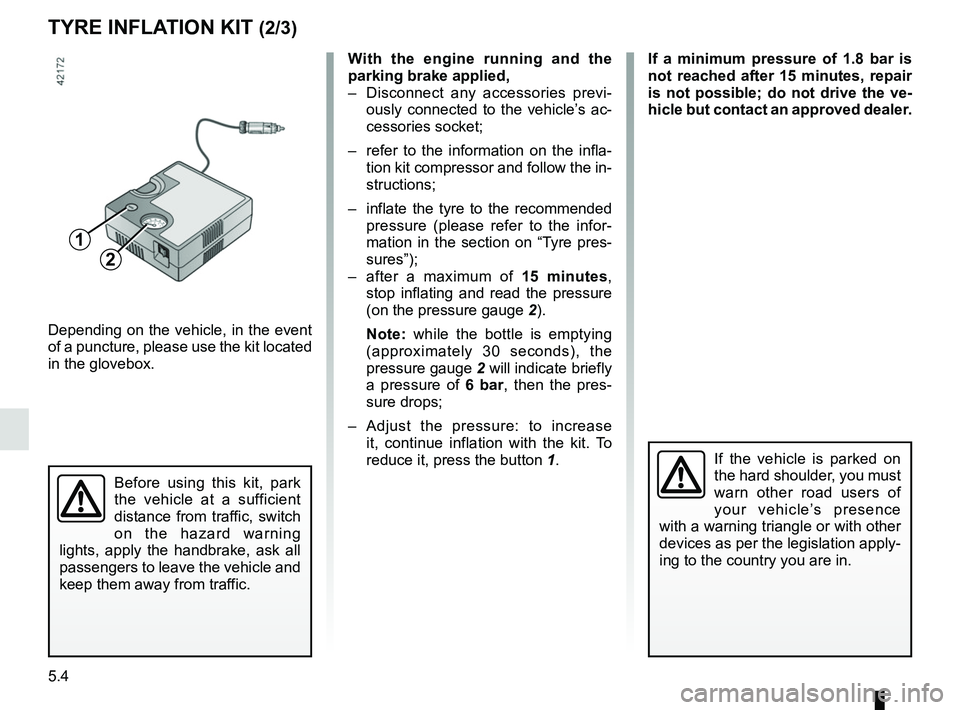
Depending on the vehicle, in the event
of a puncture, please use the kit located
in the glovebox.
Before using this kit, park
the vehicle at a sufficient
distance from traffic, switch
on the hazard warning
lights, apply the handbrake, ask all
passengers to leave the vehicle and
keep them away from traffic.
If the vehicle is parked on
the hard shoulder, you must
warn other road users of
your vehicle’s presence
with a warning triangle or with other
devices as per the legislation apply-
ing to the country you are in.
With the engine running and the
parking brake applied,
– Disconnect any accessories previ- ously connected to the vehicle’s ac-
cessories socket;
– refer to the information on the infla- tion kit compressor and follow the in-
structions;
– inflate the tyre to the recommended pressure (please refer to the infor-
mation in the section on “Tyre pres-
sures”);
– after a maximum of 15 minutes, stop inflating and read the pressure
(on the pressure gauge 2).
Note: while the bottle is emptying
(approximately 30 seconds), the
pressure gauge 2 will indicate briefly
a pressure of 6 bar, then the pres-
sure drops;
– Adjust the pressure: to increase it, continue inflation with the kit. To
reduce it, press the button 1.
2
1
If a minimum pressure of 1.8 bar is
not reached after 15 minutes, repair
is not possible; do not drive the ve-
hicle but contact an approved dealer.
Page 176 of 230
5.8
2
4
1
3
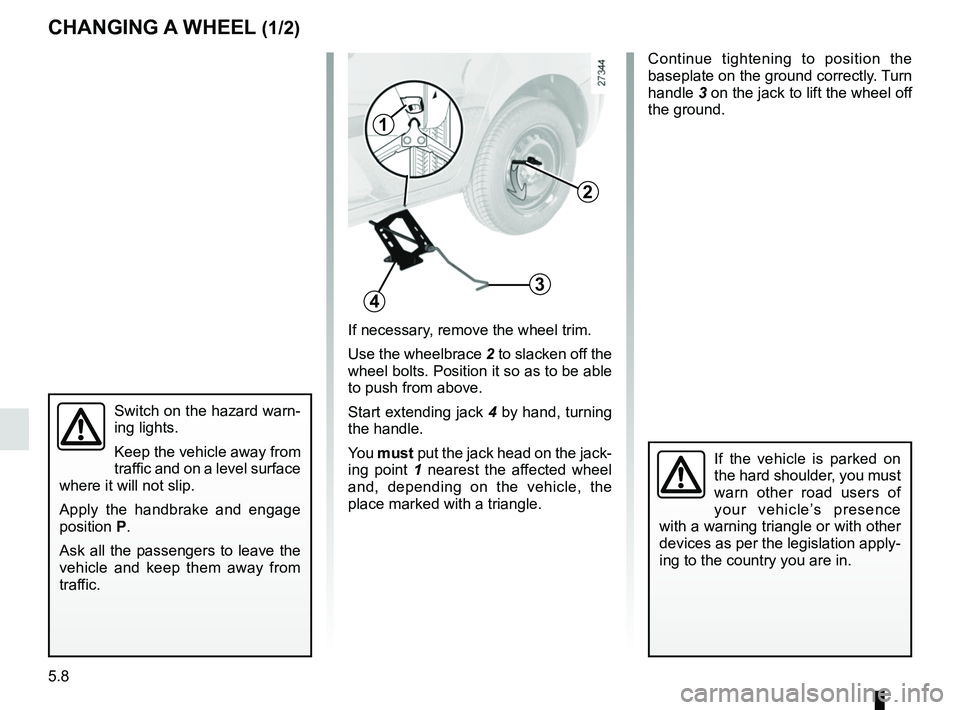
If necessary, remove the wheel trim.
Use the wheelbrace 2 to slacken off the
wheel bolts. Position it so as to be able
to push from above.
Start extending jack 4 by hand, turning
the handle.
You must put the jack head on the jack-
ing point 1 nearest the affected wheel
and, depending on the vehicle, the
place marked with a triangle.
Switch on the hazard warn-
ing lights.
Keep the vehicle away from
traffic and on a level surface
where it will not slip.
Apply the handbrake and engage
position P.
Ask all the passengers to leave the
vehicle and keep them away from
traffic.
CHANGING A WHEEL (1/2)
Continue tightening to position the
baseplate on the ground correctly. Turn
handle 3 on the jack to lift the wheel off
the ground.
If the vehicle is parked on
the hard shoulder, you must
warn other road users of
your vehicle’s presence
with a warning triangle or with other
devices as per the legislation apply-
ing to the country you are in.
Page 184 of 230
5.16
The bulbs are under pres-
sure and can break when
replaced.
Risk of injury.
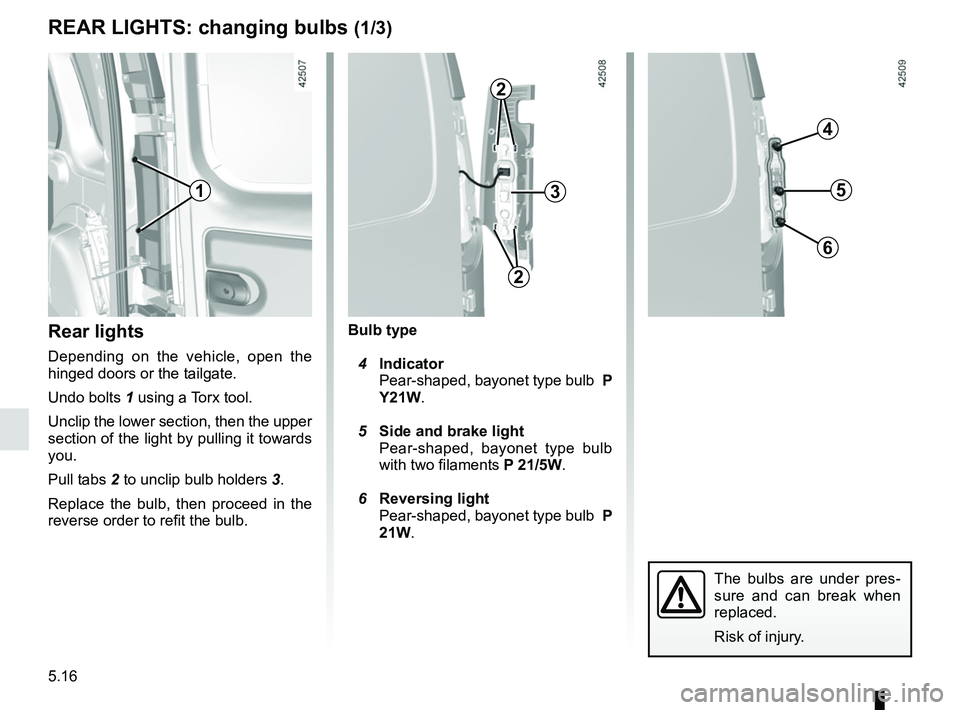
Bulb type
4 Indicator
Pear-shaped, bayonet type bulb P
Y21W.
5 Side and brake light
Pear-shaped, bayonet type bulb
with two filaments P 21/5W.
6 Reversing light
Pear-shaped, bayonet type bulb P
21W.Rear lights
Depending on the vehicle, open the
hinged doors or the tailgate.
Undo bolts 1 using a Torx tool.
Unclip the lower section, then the upper
section of the light by pulling it towards
you.
Pull tabs 2 to unclip bulb holders 3.
Replace the bulb, then proceed in the
reverse order to refit the bulb.
REAR LIGHTS: changing bulbs (1/3)
31
2
2
5
4
6
Page 185 of 230
5.17
REAR LIGHTS: changing bulbs (2/3)
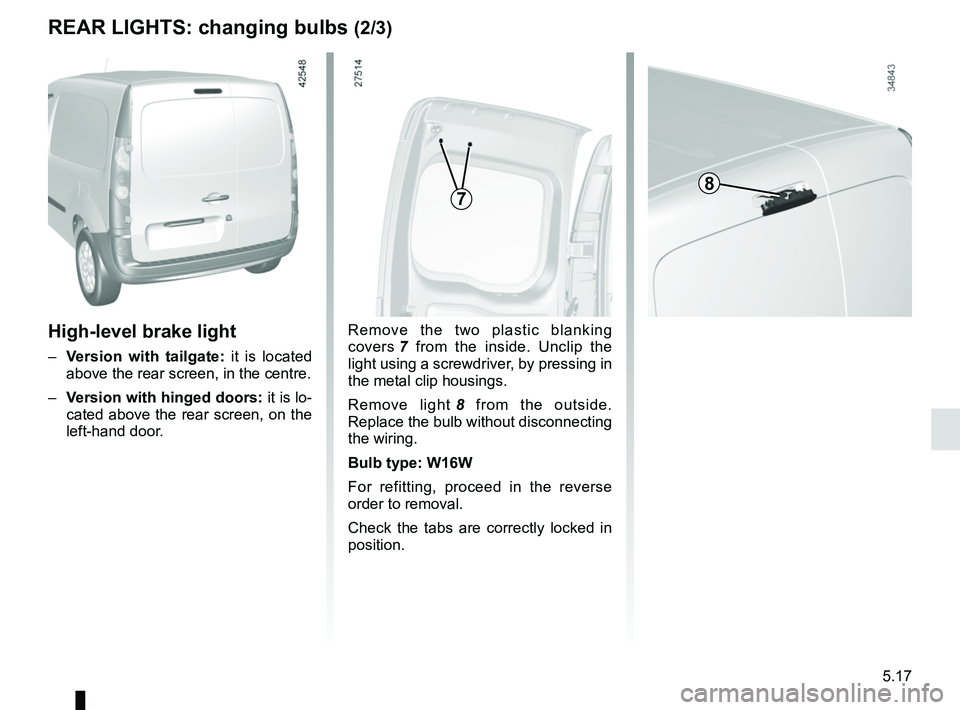
High-level brake light
– Version with tailgate: it is located
above the rear screen, in the centre.
– Version with hinged doors: it is lo-
cated above the rear screen, on the
left-hand door. Remove the two plastic blanking
covers 7
from the inside. Unclip the
light using a screwdriver, by pressing in
the metal clip housings.
Remove light 8 from the outside.
Replace the bulb without disconnecting
the wiring.
Bulb type: W16W
For refitting, proceed in the reverse
order to removal.
Check the tabs are correctly locked in
position.
78
Page 190 of 230

5.22
FUSES (2/2)
Number Allocation
1 Not used
2 Not used
3 Air conditioning, pedestrian
horn
4 heating, traction battery
5 Rear windscreen wiper
6 Horn, diagnostic socket
7 Heated seats, telematic box
8 Traction battery
9 Passenger compartment
ECU
10 Windscreen washer
11 Brake lights
12 Passenger compartment
ECU
13 Electric window, ECO mode
14 Heated rear screen
15 Starter
12
3456
78910
11121314
15161718
19202122
23242526
27
28
29
Allocation of fusesThe presence of certain fuses de-
pends on the vehicle equipment
level.
Number Allocation
16 Brake lights, additional
equipment, ABS, ESP,
luggage compartment light,
courtesy light, rain and light
sensor
17 Radio, navigation system,
display, alarm
18 Additional equipment
19 Heated door mirrors
20 Hazard lights, rear fog lights
21 Central locking of opening
elements
22 Instrument panel
23 Not used
24 Radio, heated seats, brake
lights
25 Front accessories socket
26 Towbar
27 Electric front windows
28 Rear-view mirror control
29 Passenger compartment
motor-driven fan assembly
Page 194 of 230
5.26
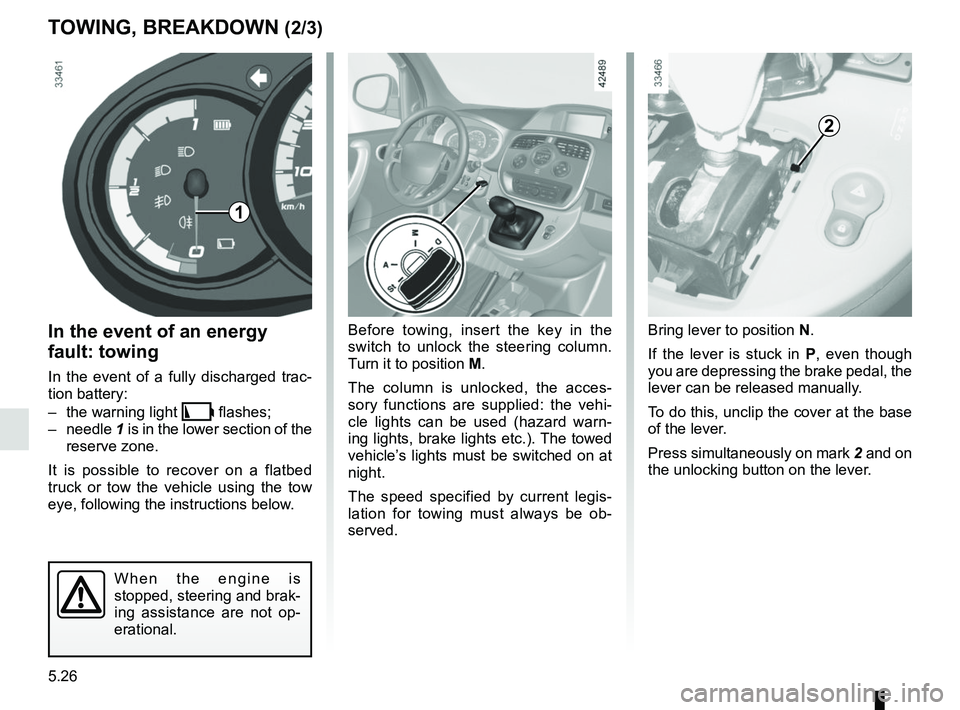
Bring lever to position N.
If the lever is stuck in P , even though
you are depressing the brake pedal, the
lever can be released manually.
To do this, unclip the cover at the base
of the lever.
Press simultaneously on mark 2 and on
the unlocking button on the lever.
TOWING, BREAKDOWN (2/3)
In the event of an energy
fault: towing
In the event of a fully discharged trac-
tion battery:
– the warning light
Ṏ flashes;
– needle 1 is in the lower section of the
reserve zone.
It is possible to recover on a flatbed
truck or tow the vehicle using the tow
eye, following the instructions below.
When the engine is
stopped, steering and brak-
ing assistance are not op-
erational.
Before towing, insert the key in the
switch to unlock the steering column.
Turn it to position M.
The column is unlocked, the acces-
sory functions are supplied: the vehi-
cle lights can be used (hazard warn-
ing lights, brake lights etc.). The towed
vehicle’s lights must be switched on at
night.
The speed specified by current legis-
lation for towing must always be ob-
served.
4
1
2
Page 198 of 230

Using the diagnostic socket
The use of electronic accessories on the diagnostic socket may cause ser\
ious disturbance to the vehicle’s electro-
nic systems. For your safety w")
5.30
ACCESSORIES (2/2)
Using the diagnostic socket
The use of electronic accessories on the diagnostic socket may cause ser\
ious disturbance to the vehicle’s electro-
nic systems. For your safety we recommend that you use only electronic a\
ccessories approved by the manufacturer,
consult an Approved Dealer. Serious accident risk.
Use of transmission/receiving devices (telephones, CB equipment etc.).\
Telephones and CB equipment with integrated aerials may cause interferenc\
e to the electronic systems originally fitted to the
vehicle: it is advisable only to use equipment with an external aerial. \
Furthermore, we remind you of the need to conform
to the legislation in force concerning the use of such equipment.
Fitting after-market accessories
If you wish to install accessories on the vehicle: please contact an aut\
horised dealer. Also, to ensure the correct operation o f
your vehicle, and to avoid any risk to your safety, we recommend that you use only accessories specifically designed for y\
our
vehicle, which are the only accessories for which the manufacturer will \
provide a warranty.
If you are using an anti-theft device, only attach it to the brake pedal\
.
Obstructions to the driver
On the driver’s side, only use mats suitable for the vehicle, attached with the pre-fi\
tted components, and check the fitting re gu-
larly. Do not lay one mat on top of another. There is a risk of wedging the pedals
Page 210 of 230

The weights indicated are for a basic vehicle without options: they vary\
depending on the your vehicle’s equipment.
Contact an approved Dealer.
Maximum permissible all-up weig")
6.6
WEIGHTS (in kg)
The weights indicated are for a basic vehicle without options: they vary\
depending on the your vehicle’s equipment.
Contact an approved Dealer.
Maximum permissible all-up weight (MMAC)
Total train weight (MTR)Medium long
Weights are indicated on the vehicle identification plate (refer to the information on “Vehicle identification plates” in Section 6)
Braked Trailer Weight * found by calculating: MTR - MMAC
Unbraked trailer weight * 374 322
Permissible nose weight * 75
Maximum permissible load on roof 80 (including the carrying device)
* Towing weight (Towing a caravan, boat, etc.)
Towing is prohibited when the GTW - MAM calculation is equal to zero, or \
when the GTW is equal to zero (or is not listed) on th e
identification plate.
– It is important to comply with the towing weights, governed by local leg\
islation in each country and, in particular, laid down in the Road Traffic Regulations. Contact an approved Dealer about any towing equipment.
– When towing, under no circumstances may the total train weight (vehicle + trailer) be exceeded . However the following is
permitted:
– the Maximum permissible weight at the rear may be exceeded by no more th\
an 15%,
– the maximum permissible all-up weight may be exceeded by no more than 10\
% or 100 kg (whichever occurs first).
In either case, the maximum speed of the towing assembly must not exceed\
48 mph (80 km/h) and the tyre pressure must be increased by 0.2 bar (3 PSI).
Page 223 of 230

A
ABS ....................................................................\
...2.15 → 2.17
accessories............................................................. 5.29")
7.1
ALPHABETICAL INDEX (1/5)
A
ABS ....................................................................\
...2.15 → 2.17
accessories............................................................. 5.29 – 5.30
accessories socket ............................................................ 3.18
additional heating fuel........................................................ 1.93
additional heating tank....................................................... 1.93
additional methods of restraint .......................................... 1.45
additional heating ................................................... 3.10 – 3.11 additional heating fuel tank .......................................... 1.93
additional tank capacity ..................................................... 1.93
additional tank filling .......................................................... 1.93
air bag....................................................................1.41 → 1.45
activating the front passenger air bags ............1.58 → 1.60
deactivating the front passenger air bags ........1.58 → 1.60
air conditioning ......................................3.4 → 3.7, 3.12 – 3.13
air vents ...................................................................... 3.2 – 3.3
anti-corrosion check ..............................................6.14 → 6.18
anti-corrosion protection .................................................... 4.10
anti-lock braking system: ABS ...............................2.15 → 2.17
ashtrays ...............................................................\
.............. 3.18
audible and visual signals.................................................. 1.83
B
12 volt battery maintenance ......................................................... 4.6 – 4.7
12 volt battery ............................................1.2 → 1.7, 4.6 – 4.7
battery (remote control) ..................................................... 5.31
bonnet........................................................................\
. 4.2 – 4.3
brake fluid ........................................................................\
.... 4.5
brake lights changing bulbs .................................................. 5.16 – 5.17
bulbs changing ..........................................................5.13 → 5.20
C
central door locking ........................................................... 1.21 changing a bulb .................................5.13
→ 5.15, 5.19 – 5.20
changing a wheel................................................................. 5.8
changing gear ............................................................. 2.4 – 2.5
charge meter ....................................................1.70, 2.6 → 2.8
charging cord ..................................................1.9 → 1.16, 1.19
charging flap ............................................................1.8 → 1.16
charging socket ..................................... 1.2 → 1.7, 1.9 → 1.16
child minder mirror ............................................................. 3.16
child restraint/seat .............................1.46 – 1.47, 1.49 → 1.60
child safety.....1.17, 1.19, 1.23, 1.46 – 1.47, 1.49 → 1.60, 3.17
child seats..........................................1.46 – 1.47, 1.49 → 1.57
children ................................................................... 1.46 – 1.47
cigar lighter ........................................................................\
3.18
cleaning: inside the vehicle .............................................. 4.13 – 4.14
clock ..................................................................\
................ 1.81
closing the doors ...................................................1.22 → 1.25
connected services .............................................................. 1.3
control instruments ................................................1.69 → 1.77
controls ...............................................................\
...1.62 → 1.65
coolant ................................................................\
................. 4.4
courtesy light ..................................................................... 3.15
courtesy mirrors ................................................................. 3.16
cruise control .........................................................2.21 → 2.24
D
dashboard..............................................................1.62 → 1.65
deadlocking the doors ....................................................... 1.19
de-icing ...............................................................\
................. 3.5
dimensions ................................................................. 6.4 – 6.5
display ................................................................\
...1.66 → 1.71
doors......................................................................1.22 → 1.28
driver’s position .....................................................1.62 → 1.68
driving .................................................. 2.4 → 2.9, 2.11 → 2.26
driving position settings ............................................................1.37 →
1.40