battery RENAULT KANGOO Z.E. 2018 Owners Manual
[x] Cancel search | Manufacturer: RENAULT, Model Year: 2018, Model line: KANGOO Z.E., Model: RENAULT KANGOO Z.E. 2018Pages: 230, PDF Size: 5.03 MB
Page 8 of 230
1.2
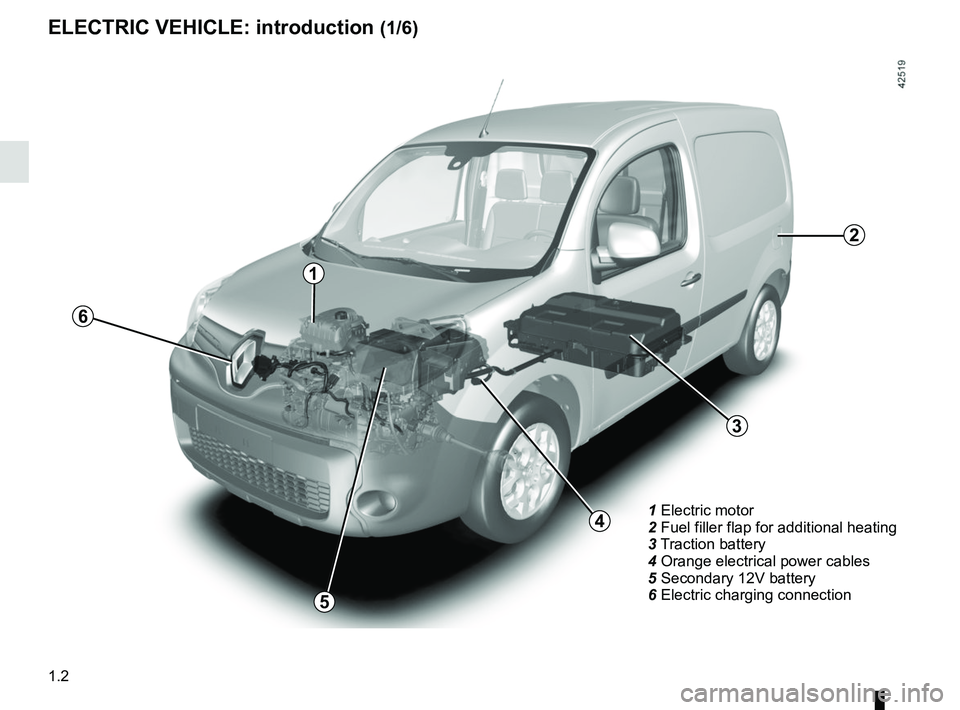
1 Electric motor
2 Fuel filler flap for additional heating
3 Traction battery
4 Orange electrical power cables
5 Secondary 12V battery
6 Electric charging connection
3
4
5
1
6
ELECTRIC VEHICLE: introduction (1/6)
2
Page 10 of 230
1.4
ELECTRIC VEHICLE: introduction (3/6)
Batteries
Your electric vehicle has two types of
battery:
– a 400V traction battery;
– a standard 12V battery, identical to the one used in conventional vehi-
cles. Traction battery
This battery stores the energy neces-
sary to operate the motor in your elec-
tric vehicle properly. As with any bat-
tery, it discharges after use, and must
be regularly recharged.
You do not have to wait until the traction
battery hits the reserve level in order to
recharge it.
Battery charging times vary depending
on the type of specific wall unit socket
or public terminal you connect to.
Your vehicle range will depend on the
charge level of the traction battery, and
also on your driving style, the outdoor
temperature and the type of road.
Please refer to information on “Vehicle
range: recommendations” in Section 2. 12 volt battery
The second battery on your vehicle is
a 12V battery, similar to those used
on conventional vehicles: this supplies
the energy required to operate vehicle
equipment (lights, windscreen wipers,
ABS, etc).
Page 11 of 230
1.5
ELECTRIC VEHICLE: introduction (4/6)
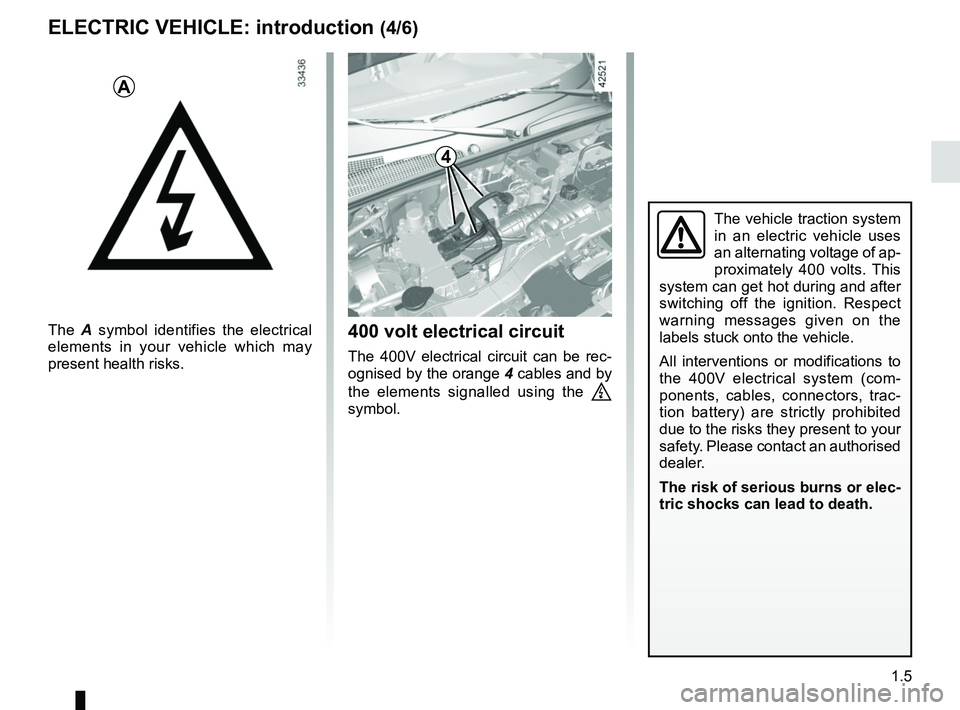
The A symbol identifies the electrical
elements in your vehicle which may
present health risks.
A
400 volt electrical circuit
The 400V electrical circuit can be rec-
ognised by the orange 4 cables and by
the elements signalled using the
ṑ
symbol.
The vehicle traction system
in an electric vehicle uses
an alternating voltage of ap-
proximately 400 volts. This
system can get hot during and after
switching off the ignition. Respect
warning messages given on the
labels stuck onto the vehicle.
All interventions or modifications to
the 400V electrical system (com-
ponents, cables, connectors, trac-
tion battery) are strictly prohibited
due to the risks they present to your
safety. Please contact an authorised
dealer.
The risk of serious burns or elec-
tric shocks can lead to death.
4
Page 12 of 230
1.6
The engine brake should
under no circumstances be
used as a substitute for the
brake pedal.
ELECTRIC VEHICLE: introduction (5/6)
Driving
As with a car with an automatic gear-
box, you will have to get used to not
using your left foot, and not using this
foot to brake.
When driving, if you lift your foot off the
accelerator pedal or depress the brake
pedal, the motor generates electrical
current during deceleration, and this
energy is used to brake the vehicle and
recharge the traction battery. Please
refer to the information on the “Charge
meter” in Section 2.
Special conditions
After a maximum charge of the battery
and during the first few miles of using
the vehicle, the engine brake will be
temporarily reduced. Please adapt your
driving style appropriately. Bad weather, flooded roads:Do not drive through
floods if the depth of water
is above the lower edge of
the wheel rims.
Obstructions to the driver
On the driver’s side, only
use mats suitable for the
vehicle, attached with the
pre-fitted components, and check
the fitting regularly. Do not lay one
mat on top of another.
There is a risk of wedging the
pedals
Page 14 of 230
1.8
IMPORTANT RECOMMENDATIONS
Please read these instructions carefully. Failure to follow these instructions may lead to a risk of fire, serious injury
or electric shock which may present a risk to life.
In the event of an accident or impact
In the event of an accident or an impact to the underside of the vehicle\
(e.g.: striking a post, raised kerb or other street fu rni-
ture), this may damage the electric circuit or the traction battery.
Have the vehicle checked by an authorised dealer.
Never touch the “400 volt” components or orange cables which are e\
xposed and visible inside or outside the vehicle.
In the event of serious damage to the traction battery, leaks may occur:
– never touch the liquids (fluids, etc.) coming from the traction batter\
y;
– in the event of contact with the body, wash the affected area with plenty of water and consult a doctor as soon as possibl\
e.
In the event of an impact, even slight, against the charging flap and/or\
valve, have them checked by an authorised dealer as
soon as possible.
In the event of fire
In the event of fire, make everyone evacuate the vehicle immediately and\
contact the emergency services, informing them that
this is an electric vehicle.
Only use extinguishing agents ABC or BC that are permitted for use with electrical fires. Do not use w\
ater or other extinguish-
ing agents.
In the event of damage to the electrical circuit, please call an authori\
sed dealer.
All towing operations
Please refer to the information on “Towing, breakdowns” in Section 5.
Washing the vehicle
Never wash the engine compartment, the charging connection or the tracti\
on battery with a high-pressure jet.
This risks damaging the electric circuit.
Never wash the vehicle while it is charging.
Risk of electric shock and a risk to life.
Page 17 of 230
1.11
ELECTRIC VEHICLE: charging (3/8)
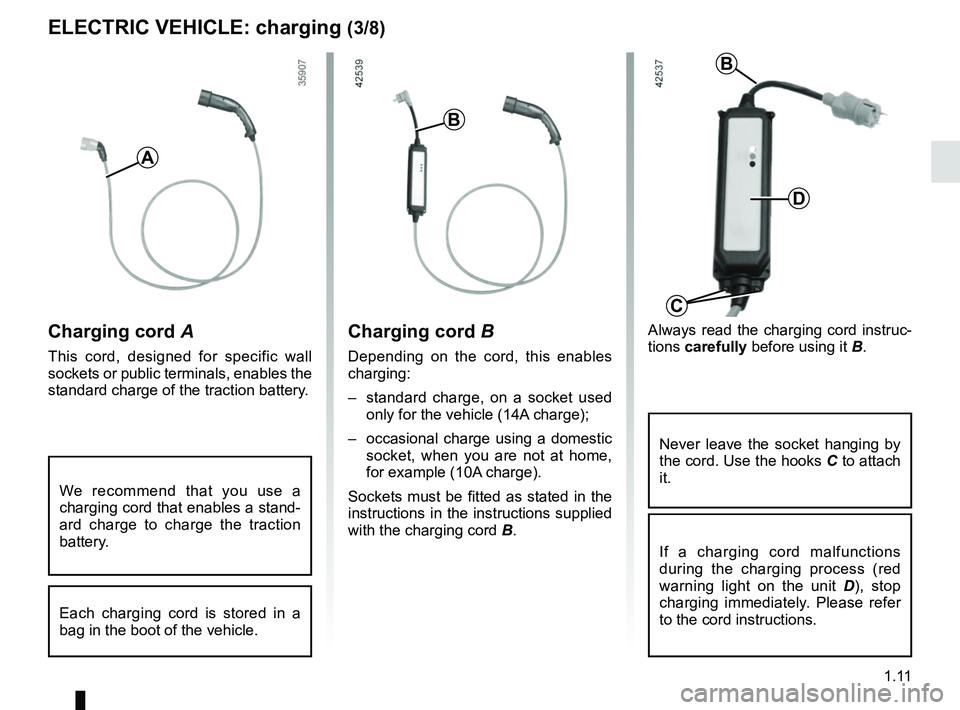
Charging cord A
This cord, designed for specific wall
sockets or public terminals, enables the
standard charge of the traction battery.
A
Always read the charging cord instruc-
tions carefully before using it B.
B
Charging cord B
Depending on the cord, this enables
charging:
– standard charge, on a socket used
only for the vehicle (14A charge);
– occasional charge using a domestic socket, when you are not at home,
for example (10A charge).
Sockets must be fitted as stated in the
instructions in the instructions supplied
with the charging cord B.
C
If a charging cord malfunctions
during the charging process (red
warning light on the unit D), stop
charging immediately. Please refer
to the cord instructions.
We recommend that you use a
charging cord that enables a stand-
ard charge to charge the traction
battery.
Each charging cord is stored in a
bag in the boot of the vehicle.
Never leave the socket hanging by
the cord. Use the hooks C to attach
it.
B
D
Page 19 of 230

1.13
ELECTRIC VEHICLE: charging (5/8)
Charging connection 2
The vehicle has a charging connection
located at the front of the vehicle. Avoid charging and parking your ve-
hicle in extreme temperatures (hot or
cold).
When the vehicle is parked in tempera-
tures lower than around -25°C, the bat-
tery cannot be charged.
To preserve the service life of your trac-
tion battery, avoid parking the vehicle
for more than three months with high
charge, especially when the weather is
very hot.
You must charge the traction bat-
tery after driving in very cold weather.
Otherwise, charging may take a longer
period of time or even become impos-
sible.
Recommendations
– In extreme heat, favour parking and
recharging the vehicle in a shaded/
covered location.
– Charging can be performed in the rain or snow.
2
In the absence of any protection
against overvoltage, you are recom-
mended not to charge the vehicle in
stormy weather (lightning, etc.).
Note:
If in a snowy environment, remove
snow from the vehicle charging area
before plugging in or disconnecting.
Snow in the socket may block the in-
sertion of the charging cord plug.
The traction battery charging time
depends on the amount of energy
remaining, the power delivered by
the charging terminal and the tem-
perature conditions (hot or cold).
The information is displayed on
the instrument panel during charg-
ing. Please see the information on
“Displays and indicators” in
Section 1.
In the event of a problem, we rec-
ommend that you replace it with an
identical cord. Please see an autho-
rised dealer.
Page 20 of 230
1.14
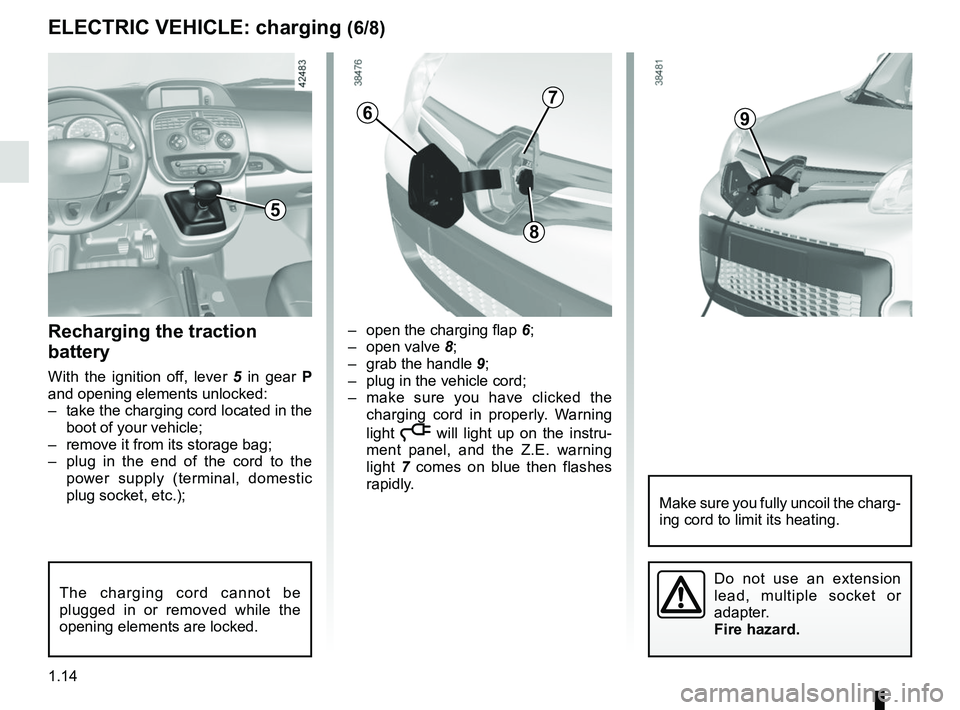
– open the charging flap 6;
– open valve 8;
– grab the handle 9;
– plug in the vehicle cord;
– make sure you have clicked the charging cord in properly. Warning
light
ṋ will light up on the instru-
ment panel, and the Z.E. warning
light 7 comes on blue then flashes
rapidly.
Recharging the traction
battery
With the ignition off, lever 5 in gear P
and opening elements unlocked:
– take the charging cord located in the boot of your vehicle;
– remove it from its storage bag;
– plug in the end of the cord to the power supply (terminal, domestic
plug socket, etc.);
ELECTRIC VEHICLE: charging (6/8)
6
8
The charging cord cannot be
plugged in or removed while the
opening elements are locked.
9
Make sure you fully uncoil the charg-
ing cord to limit its heating.
5
Do not use an extension
lead, multiple socket or
adapter.
Fire hazard.
7
Page 22 of 230
1.16
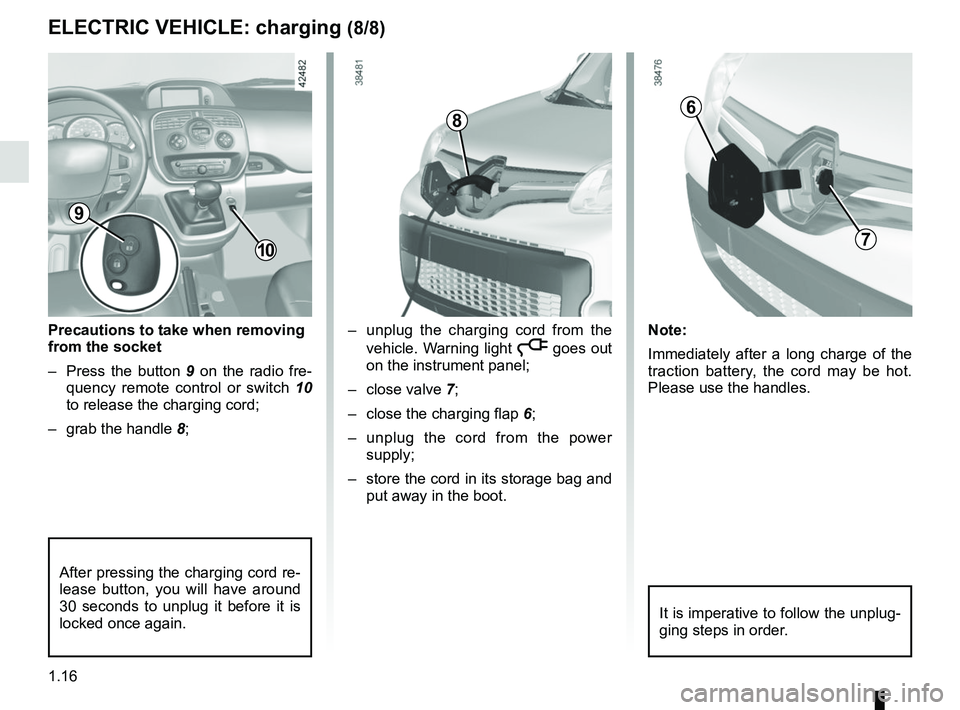
Precautions to take when removing
from the socket
– Press the button 9 on the radio fre-
quency remote control or switch 10
to release the charging cord;
– grab the handle 8;– unplug the charging cord from the
vehicle. Warning light
ṋ goes out
on the instrument panel;
– close valve 7;
– close the charging flap 6;
– unplug the cord from the power supply;
– store the cord in its storage bag and put away in the boot.
ELECTRIC VEHICLE: charging (8/8)
10
6
7
After pressing the charging cord re-
lease button, you will have around
30 seconds to unplug it before it is
locked once again.
Note:
Immediately after a long charge of the
traction battery, the cord may be hot.
Please use the handles.
8
It is imperative to follow the unplug-
ging steps in order.
9
Page 24 of 230

1.18
Radio frequency remote
control operating range
This varies according to the surroun-
dings: take care not to lock or unlock
the doors by inadvertently pressing the
buttons on the remote control.
Interference
Interference by factors in the imme-
diate vicinity (external installations or
the use of equipment operating on the
same frequency as the remote control)
may affect the operation of the remote
control.
Note: if a door is not opened within
approximately 2 seconds of the door
being unlocked by remote control, the
doors will lock again automatically.
KEY, RADIO FREQUENCY REMOTE CONTROL: general information (2/2)
For replacement, or if you
require an additional remote
control.
You must only contact an approved
Dealer.
– To replace a remote control, the vehicle must be taken to an ap-
proved Dealer as both the vehi-
cle and the remote control are
needed to initialise the system.
– Depending on the vehicle, you have the option of using up to
four remote controls.
Remote control unit failure
Make sure that the correct battery
type is being used, and that the bat-
tery is in good condition and inser-
ted correctly. These batteries have
a service life of approximately two
years.
To learn how to change the battery,
please refer to the information on
the “Key, radio frequency remote
control: Batteries” in Section 5.