transmission RENAULT KOLEOS 2012 1.G User Guide
[x] Cancel search | Manufacturer: RENAULT, Model Year: 2012, Model line: KOLEOS, Model: RENAULT KOLEOS 2012 1.GPages: 233, PDF Size: 7.81 MB
Page 105 of 233
downhill speed control ........................................... (current page)
JauneNoirNoir texte
2.27
ENG_UD27148_7
Dispositifs de correction et d’assistance la conduite (X45 - H45 - Renault)
ENG_NU_977-2_H45_Ph2_Renault_2
DRIvER CORRECTION DEvICES (4/5)
Hill descent control
This function enables the vehicle speed
to be limited to approximately 4 mph
(7 km/h), without depressing the brake
pedal (when driving down a steep hill).
Activating/deactivating the system
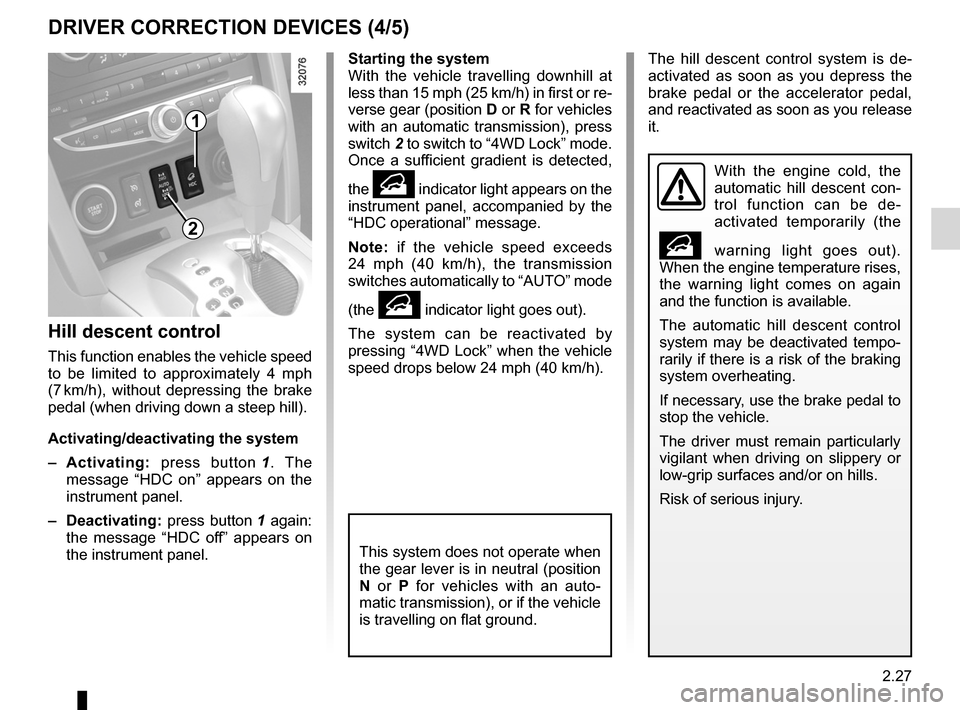
– Activating: press button 1 . The
message “ HDC on” appears on the
instrument panel.
– Deactivating: press button 1 again:
the message “ HDC off” appears on
the instrument panel.
Starting the system
With the vehicle travelling downhill at
less than 15 mph (25 km/h) in first or re-
verse gear (position D or R for vehicles
with an automatic transmission), press
switch 2 to switch to “4WD Lock” mode.
Once a sufficient gradient is detected,
the
• indicator light appears on the
instrument panel, accompanied by the
“HDC operational ” message.
Note: if the vehicle speed exceeds
24 mph (40 km/h), the transmission
switches automatically to “AUTO” mode
(the
• indicator light goes out).
The system can be reactivated by
pressing “4WD Lock” when the vehicle
speed drops below 24 mph (40 km/h).
1
With the engine cold, the
automatic hill descent con -
trol function can be de -
activated temporarily (the
• warning light goes out).
When the engine temperature rises,
the warning light comes on again
and the function is available.
The automatic hill descent control
system may be deactivated tempo-
rarily if there is a risk of the braking
system overheating.
If necessary, use the brake pedal to
stop the vehicle.
The driver must remain particularly
vigilant when driving on slippery or
low-grip surfaces and/or on hills.
Risk of serious injury.
This system does not operate when
the gear lever is in neutral (position
N or P for vehicles with an auto -
matic transmission), or if the vehicle
is travelling on flat ground.
2
The hill descent control system is de -
activated as soon as you depress the
brake pedal or the accelerator pedal,
and reactivated as soon as you release
it.
Page 113 of 233
JauneNoirNoir texte
2.35
ENG_UD23498_5
Régulateur-limiteur de vitesse : fonction régulateur (X45 - H45 - Renault)
ENG_NU_977-2_H45_Ph2_Renault_2
CRUISE CONTROL, SPEED LIMITER: cruise control function (4/4)
Putting the function on
standby
The function is suspended when you:
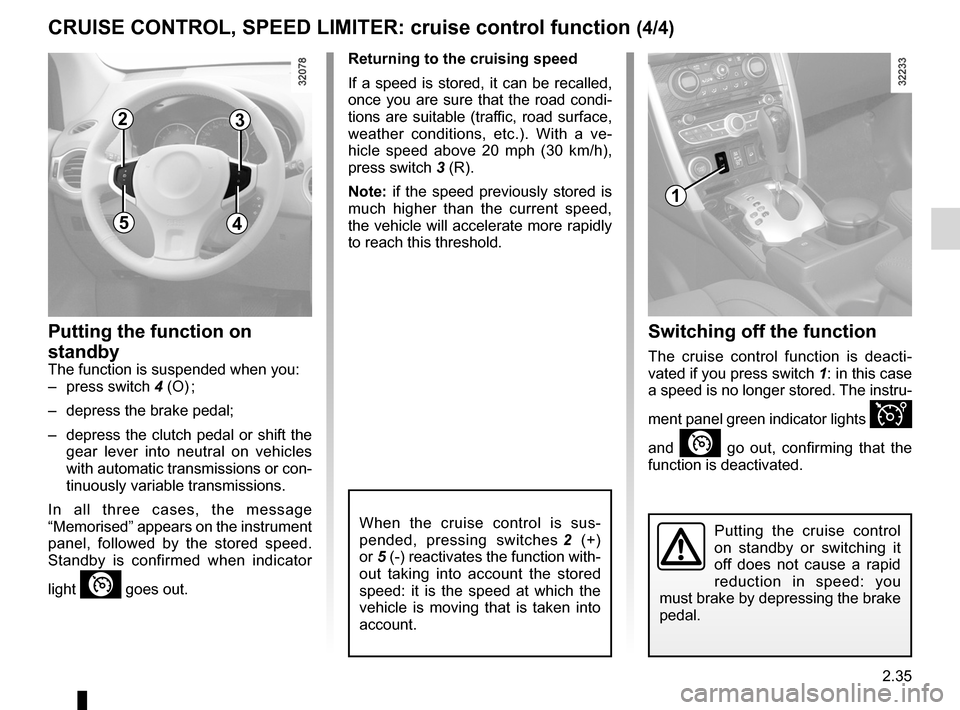
– press switch 4 (O) ;
– depress the brake pedal;
– depress the clutch pedal or shift the
gear lever into neutral on vehicles
with automatic transmissions or con-
tinuously variable transmissions.
In all three cases, the message
“Memorised ” appears on the instrument
panel, followed by the stored speed.
Standby is confirmed when indicator
light
” goes out.
Returning to the cruising speed
If a speed is stored, it can be recalled,
once you are sure that the road condi -
tions are suitable (traffic, road surface,
weather conditions, etc.). With a ve -
hicle speed above 20 mph (30 km/h),
press switch 3 (R).
Note: if the speed previously stored is
much higher than the current speed,
the vehicle will accelerate more rapidly
to reach this threshold.
When the cruise control is sus -
pended, pressing switches 2 (+)
or 5 (-) reactivates the function with-
out taking into account the stored
speed: it is the speed at which the
vehicle is moving that is taken into
account.
Switching off the function
The cruise control function is deacti -
vated if you press switch 1: in this case
a speed is no longer stored. The instru-
ment panel green indicator lights
Î
and
” go out, confirming that the
function is deactivated.
Putting the cruise control
on standby or switching it
off does not cause a rapid
reduction in speed: you
must brake by depressing the brake
pedal.
1
23
45
Page 117 of 233

automatic gearbox (use) ....................... (up to the end of the DU)
automatic gearbox selector lever ..........(up to the end of the DU)
driving ................................................... (up to the end of the DU)
reverse gear selecting .......................................... (up to the end of the DU)
changing gear ....................................... (up to the end of the DU)
continuous variation ..............................(up to the end of the DU)
continuously variable transmission ....... (up to the end of the DU)
2.39
ENG_UD27292_7
Bo tes de vitesses automatiques ou variation continue (X45 - H45 - Renault)
ENG_NU_977-2_H45_Ph2_Renault_2
Automatic or continuously variable transmission
AUTOMATIC OR CONTINUOUSLY vARIABLE TRANSMISSION (1/3)
Depending on the vehicle, the vehicle is
either fitted with an automatic transmis-
sion, or a continuously variable trans -
mission.
Selector lever 2
Display A on the instrument panel
shows the mode and gear selected.
3: P: park
4: R: reverse gear
5: N: neutral
6: D: automatic mode
7: manual mode
8: zone displaying gearbox mode or
gear engaged in manual mode
1
2
8
3
6
5
4
7
Operation
N With the gear lever 2 in position P,
switch on the ignition.
To move out of position P, you must de-
press the brake pedal before pressing
the unlocking button 1.
With the foot on the brake pedal (warn-
ing light
c on display A goes out),
move the lever out of position P.
Only engage D or R when the vehi -
cle is stopped, with your foot on the
brake and the accelerator pedal re -
leased.
A
Driving in automatic mode
Select position D. In most traffic con -
ditions, you will not have to touch the
gear selector lever again: the gears will
change automatically at the right time
and at the most suitable engine speed
because the automatic system takes
into account the vehicle load and road
contour and adjusts itself to the particu-
lar driving style you have chosen.
Economical driving
When driving, always leave the lever
in position D, keeping the accelerator
pedal lightly depressed to ensure auto-
matic gear changes at a lower engine
speed.
Accelerating and overtaking
Depress the accelerator pedal firmly
and fully (so that it goes beyond the
kickdown point).
This will enable you to change down
to the optimum gear within the
engine range.
Page 118 of 233
2.40
ENG_UD27292_7
Bo tes de vitesses automatiques ou variation continue (X45 - H45 - Renault)
ENG_NU_977-2_H45_Ph2_Renault_2
Jaune NoirNoir texte
AUTOMATIC OR CONTINUOUSLY vARIABLE TRANSMISSION (2/3)
Driving in manual mode
With the selector lever in position D,
move the lever to the left. Shifting the
lever repeatedly allows you to change
gears manually:
– backwards to shift down the gears;
– forwards to shift up the gears.
The gear selected is displayed on the
instrument panel.
Special cases
Under certain driving conditions (e.g.
engine protection, or electronic stability
control (ESC) operational etc.) the au -
tomatic system may change gear auto-
matically.
Likewise, to prevent incorrect manoeu -
vres, a gear change may be refused by
the automatic system: in this case the
gear display flashes for a few seconds
as a warning.
Special circumstances
– If the bends and road surface do
not allow you to stay in automatic
mode (e.g. in the mountains), we
recommend that you change to
manual mode.
This will prevent repeated gear
changes when climbing and will
enable engine braking on long de -
scents.
– In very cold weather, to avoid stall-
ing the engine, start the engine and
wait a few seconds before moving
the lever from position P or N to po-
sition D or R.
– v ehicles not fitted with traction
control: to avoid wheelspin when
starting on a slippery or low grip sur-
face, change to manual mode and
select second gear before moving
off.
Parking the vehicle
When the vehicle is stopped, move the
lever to position P while keeping your
foot on the brake pedal: the gearbox is
in neutral and the drive wheels are me-
chanically locked by the driveshaft.
Depending on the vehicle, apply the
handbrake or check that the elec -
tronic parking brake is on (refer to
the information on the Parking brake in
Section 2).
In very cold weather, the system may prevent the gears from being shifted in
manual mode until the gearbox reaches the right temperature.
An impact to the under -
side of the vehicle while
manoeuvring (e.g.: strik -
ing a post, raised kerb or
other street furniture) may result in
damage to the vehicle (e.g.: defor -
mation of an axle).
To avoid any risk of accident, have
your vehicle checked by an ap -
proved Dealer.
Page 119 of 233
JauneNoirNoir texte
2.41
ENG_UD27292_7
Bo tes de vitesses automatiques ou variation continue (X45 - H45 - Renault)
ENG_NU_977-2_H45_Ph2_Renault_2
AUTOMATIC OR CONTINUOUSLY vARIABLE TRANSMISSION (3/3)
Operating faults
– when driving, if the “Check auto
gearbox ” message appears on the
instrument panel, it indicates a fault.
Contact your approved Dealer as
soon as possible.
– when driving , if the message “Auto
gearbox overheating ” appears on
the instrument panel, shift the gear
lever into position N, as soon as pos-
sible.
Contact your approved dealer as
soon as possible.
– If a vehicle with an automatic
gearbox breaks down , refer to the
information on “Towing” in Section 5.
Special note for vehicles equipped
with continuously variable
transmissions:
Under certain driving conditions at high
speeds, the gearbox may temporarily
limit the maximum engine speed. This
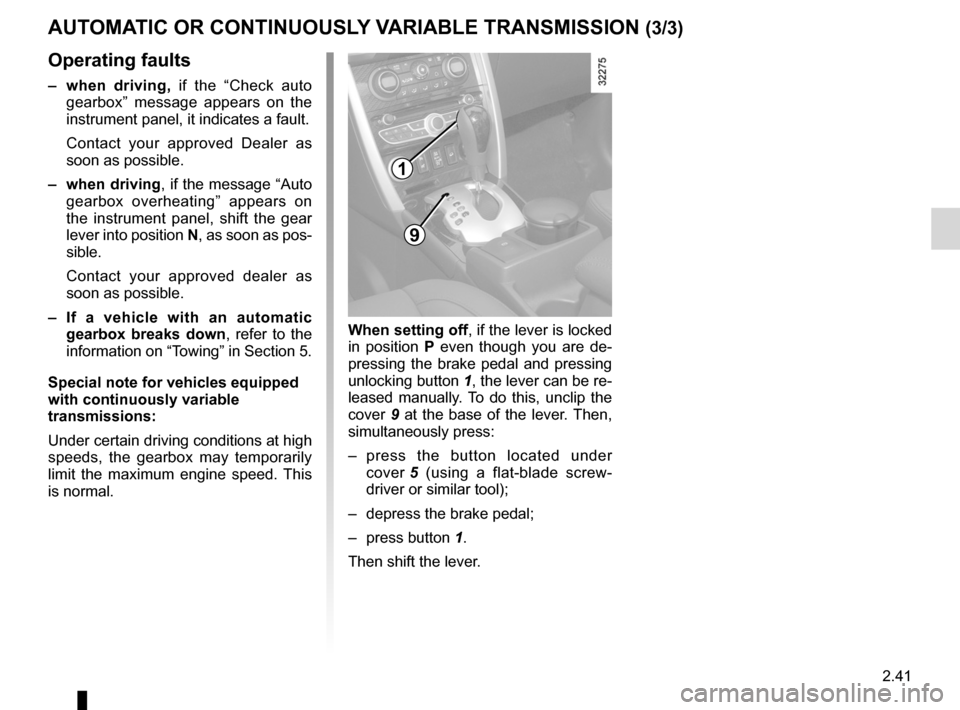
is normal. when setting off, if the lever is locked
in position
P even though you are de -
pressing the brake pedal and pressing
unlocking button 1, the lever can be re-
leased manually. To do this, unclip the
cover 9 at the base of the lever. Then,
simultaneously press:
– press the button located under
cover 5 (using a flat-blade screw -
driver or similar tool);
– depress the brake pedal;
– press button 1.
Then shift the lever.
9
1
Page 178 of 233
changing a wheel.................................. (up to the end of the DU)
puncture ................................................ (up to the end of the DU)
lifting the vehicle changing a wheel ............................ (up to the end of the DU)
jack ....................................................... (up to the end of the DU)
5.4
ENG_UD21005_5
Changement de roue (X45 - H45 - Renault)
ENG_NU_977-2_H45_Ph2_Renault_5
Jaune NoirNoir texte
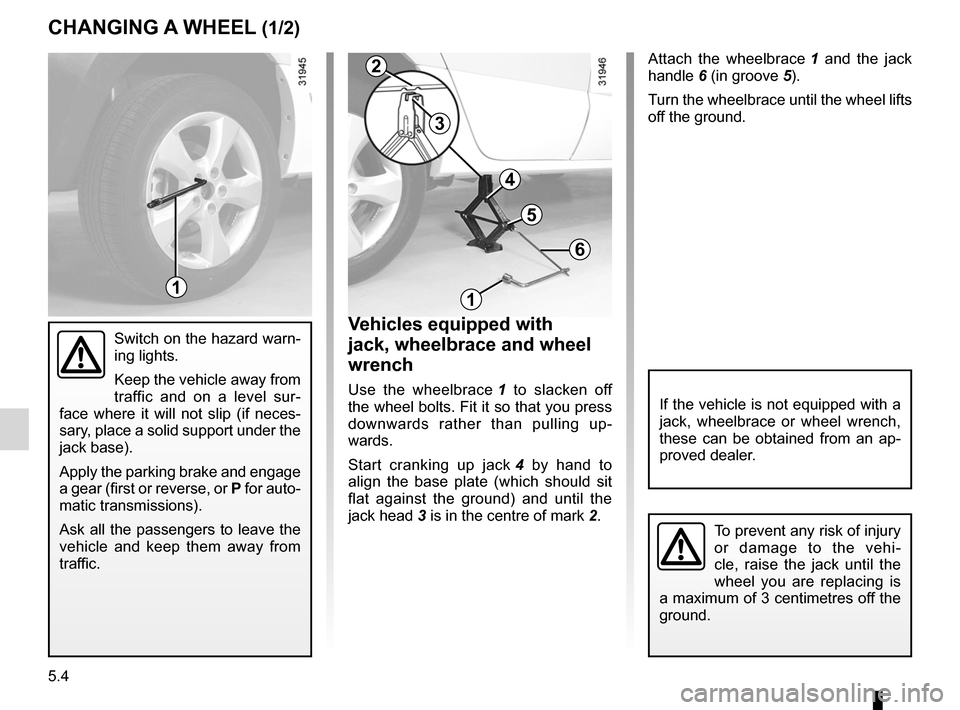
Attach the wheelbrace 1 and the jack
handle 6 (in groove 5).
Turn the wheelbrace until the wheel lifts
off the ground.
Changing a wheel
changIng a wheel (1/2)
Vehicles equipped with
jack, wheelbrace and wheel
wrench
Use the wheelbrace 1 to slacken off
the wheel bolts. Fit it so that you press
downwards rather than pulling up -
wards.
Start cranking up jack 4 by hand to
align the base plate (which should sit
flat against the ground) and until the
jack head 3 is in the centre of mark 2.
1
2
3
4
5
6
1
Switch on the hazard warn-
ing lights.
Keep the vehicle away from
traffic and on a level sur -
face where it will not slip (if neces -
sary, place a solid support under the
jack base).
Apply the parking brake and engage
a gear (first or reverse, or P for auto-
matic transmissions).
Ask all the passengers to leave the
vehicle and keep them away from
traffic.
To prevent any risk of injury
or damage to the vehi -
cle, raise the jack until the
wheel you are replacing is
a maximum of 3 centimetres off the
ground.
If the vehicle is not equipped with a
jack, wheelbrace or wheel wrench,
these can be obtained from an ap -
proved dealer.
Page 182 of 233
5.8
ENG_UD21006_4
Pneumatiques (X45 - H45 - Renault)
ENG_NU_977-2_H45_Ph2_Renault_5
studded tyres
This type of equipment may only be
used for a limited period and as laid
down by local legislation. It is neces -
sary to observe the speed specified by
current legislation.
These tyres must, at a minimum, be
fitted to the two front wheels.use in winter
chains
For safety reasons, fitting snow
chains to the rear axle is strictly for-
bidden.
chains cannot be fitted to tyres which
are larger than those originally fitted to
the vehicle.
snow or w inter tyres
We would recommend that these be
fitted to all four wheels to ensure that
your vehicle retains maximum adhe -
sion.
w arning: These tyres sometimes have
a specific direction of rotation and a
maximum speed index which may be
lower than the maximum speed of your
vehicle.
tyres (3/3)
Chains may only be fitted
to tyres of the same size
as those originally fitted to
your vehicle.
In all cases, we would recommend
that you contact an approved dealer
who will be able to advise you on
the choice of equipment which is
most suitable for your vehicle.
Fitting new tyres
Always ensure tyres with identi -
cal specifications are fitted to all four
wheels (brand, size, structure, wear
etc.). Fitting tyres of different sizes to
the front and rear wheels and/or left
and right wheels may have serious
consequences for the tyres, gearbox,
transfer gearbox and the rear differen-
tial pinions.
For safety reasons, this op-
eration must be carried out
by a specialist.
Fitting different tyres may
change your vehicle as follows:
– it may mean that your vehicle no
longer conforms to current regu-
lations;
– it may change the way it handles
when cornering;
– it may cause the steering to be
heavy;
– It may affect the use of snow
chains.
When changing a tyre, make sure all four tyres are changed at the same
time in order to preserve the transmission system.
Page 197 of 233
accessories...........................................(up to the end of the DU)
5.23
ENG_UD21015_4
Accessoires (X35 - X45 - H45 - S65 - X77 - X81 - J81 - X84 - B84 - C84 - E84 - L84 - K84 - J84 - X85 - B85 - C85 - S85 - X91 - B91 - K91 - D91 - X76 - X83 - X61 - F61 -
ENG_NU_977-2_H45_Ph2_Renault_5
Accessories
accessOrIes
use of transmission/
receiving devices
(telephones, cB
equipment etc.).
Telephones and CB equipment with
integrated aerials may cause inter -
ference to the original electronic
systems fitted to the vehicle: it is ad-
visable only to use equipment with
an external aerial.
Furthermore, we remind you of
the need to comply with the legis-
lation in force concerning the use
of such equipment.
electrical and electronic
accessories
– C o n n e c t a c c e s s o r i e s
with a maximum power of
120 Watts only.
Fire hazard.
– No work may be carried out on
the vehicle’s electrical or radio
circuits, except by approved
Dealers: an incorrectly con -
nected system may result in
damage being caused to the
electrical equipment and/or the
components connected to it;
– if the vehicle is fitted with any
aftermarket electrical equip -
ment, make sure that the unit
is correctly protected by a fuse.
Establish the rating and position
of this fuse.
Before fitting an electrical or
electronic device (particu -
larly for transmitters/receiv-
ers: frequency bandwidth,
power level, position of the aerial
etc.), ensure that it is compatible
with your vehicle.
Contact an approved dealer for this
information.
Fitting after-market
accessories
If you wish to install acces-
sories on the vehicle: con -
sult an approved dealer.
Also, to ensure the correct opera -
tion of your vehicle, and to avoid
any risk to your safety, we recom -
mend that you use only specific ac-
cessories, designed for your vehi -
cle, which are the only accessories
for which the manufacturer will pro-
vide a warranty.
If you are using an anti-theft
device, only attach it to the
brake pedal.
Page 200 of 233

5.26
ENG_UD23537_3
Remorquage : dépannage (X45 - H45 - Renault)
ENG_NU_977-2_H45_Ph2_Renault_5
Jaune NoirNoir texte
tOwIng : breakdown (2/4)
3233032331
2wD vehicles
Vehicles fitted with an automatic
transmission or continuously vari -
able transmission.
w ith the ignition off, the gearbox is no
longer lubricated. If it is not, the vehi -
cle must be transported on a trailer or
be towed with the front wheels off the
ground.If the lever is stuck in P,
even though you are de -
pressing the brake pedal,
the lever can be released
manually.
To do this, first remove the cover 2
on the left-hand side of the gear
lever.
While depressing the brake pedal,
shift the gear lever into neutral ( n )
and simultaneously press the
button 1 on the lever and on the
button under the cover 2.
2
1
Page 227 of 233
7.1
ENG_UD27169_2
Index (X45 - H45 - Renault)
ENG_NU_977-2_H45_Ph2_Renault_7
AlphAbeticAl index (1/5)
A
ABS ....................................................................... 2.24 → 2.28
accessories........................................................................ 5.23
accessories socket ............................................................ 3.28
additional methods of restraint .......................................... 1.27
side protection ............................................................. 1.26
to the front seat belts ....................................... 1.21 → 1.24
to the rear seat belts .................................................... 1.25
adjusting your driving position ................................ 1.17 – 1.18
advice on antipollution ........................................... 2.14 → 2.16
air bag .................................................................... 1.21 → 1.27
activating the front passenger air bags ........................ 1.38
deactivating the front passenger air bags .................... 1.36
air conditioning ........................................................ 3.4 → 3.13
air vents ...................................................................... 3.2 – 3.3
all-wheel drive system ........................................... 2.21 → 2.23
anti-corrosion check .............................................. 6.14 → 6.18
anti-corrosion protection ......................................... 4.12 – 4.13
anti-lock braking system: ABS ...............................2.24 → 2.28
antipollution advice .......................................................................... 2.14
armrest: front .............................................................................. 3.23
rear .............................................................................. 3.24
ashtray ............................................................................... 3.28
automatic gearbox (use) ........................................ 2.39 → 2.41
automatic gearbox selector lever ...........................2.39 → 2.41
b
battery ................................................................................ 4.11
troubleshooting ................................................. 5.20 – 5.21
bonnet .................................................................................. 4.2
brake fluid ............................................................................ 4.8
bulbs changing ............................................................ 5.9 → 5.14c
catalytic converter
......................................................... 2.6, 2.8
central door locking ........................................ 1.8, 1.11 → 1.13
changing a bulb ....................................................... 5.9 → 5.14
changing a wheel ........................................................ 5.4 – 5.5
changing gear ................................................. 2.9, 2.39 → 2.41
child minder mirror ............................................................. 3.19
child restraint/seat ............................. 1.28 – 1.29, 1.31 → 1.35
child safety ...1.2 – 1.3, 1.28 – 1.29, 1.31 → 1.35, 3.14 → 3.17
child seats .......................................... 1.28 – 1.29, 1.31 → 1.35
children ................................................................... 1.28 – 1.29
children (safety) ..................................... 1.2 – 1.3, 3.14 → 3.17
cigar lighter ........................................................................ 3.28
cleaning: inside the vehicle .............................................. 4.14 – 4.15
outside the vehicle ............................................ 4.12 – 4.13
clock .................................................................................. 1.39
closing the doors ..................................................... 1.9 → 1.12
continuous variation ............................................... 2.39 → 2.41
continuously variable transmission ........................ 2.39 → 2.41
control instruments ................................................ 1.48 → 1.59
controls ................................................................... 1.40 – 1.41
coolant ........................................................................ 1.48, 4.7
courtesy light ..................................... 3.20 – 3.21, 5.15 → 5.17
courtesy mirrors ................................................................. 3.18
cruise control ......................................................... 2.29 → 2.35
cruise control-speed limiter.................................... 2.29 → 2.35
d
dashboard ............................................................... 1.40 – 1.41
deadlocking the doors ......................................................... 1.8
dimensions .......................................................................... 6.4
display ................................................................... 1.44 → 1.49
doors ................................................................ 1.9 – 1.10, 1.13
doors/tailgate ....................................................................... 1.8
downhill speed control ....................................................... 2.27