uch RENAULT KOLEOS 2012 1.G Owner's Guide
[x] Cancel search | Manufacturer: RENAULT, Model Year: 2012, Model line: KOLEOS, Model: RENAULT KOLEOS 2012 1.GPages: 233, PDF Size: 7.81 MB
Page 146 of 233
3.26
ENG_UD23672_6
Rangements, aménagements habitacle (X45 - H45 - Renault)
ENG_NU_977-2_H45_Ph2_Renault_3
Jaune NoirNoir texte
PASSENgER coMPARTMENT ST oRAgE, FITTINgS (5/6)
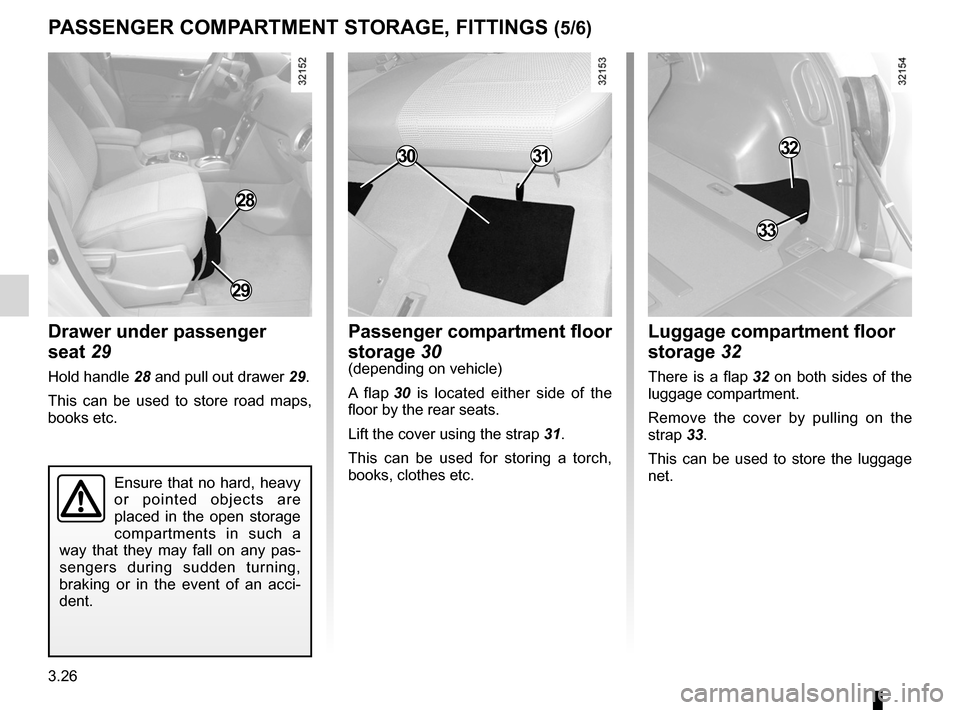
Drawer under passenger
seat 29
Hold handle 28 and pull out drawer 29.
This can be used to store road maps,
books etc.
Passenger compartment floor
storage 30
(depending on vehicle)
A flap 30 is located either side of the
floor by the rear seats.
Lift the cover using the strap 31.
This can be used for storing a torch,
books, clothes etc.
luggage compartment floor
storage 32
There is a flap 32 on both sides of the
luggage compartment.
Remove the cover by pulling on the
strap 33.
This can be used to store the luggage
net.
28
29
3132
33
30
Ensure that no hard, heavy
or pointed objects are
placed in the open storage
compartments in such a
way that they may fall on any pas -
sengers during sudden turning,
braking or in the event of an acci -
dent.
Page 155 of 233
transporting objectsin the luggage compartment ........... (up to the end of the DU)
towing rings .......................................... (up to the end of the DU)
towing towing equipment ............................ (up to the end of the DU)
towing equipment fitting ............................................... (up to the end of the DU)
towing a caravan .................................. (up to the end of the DU)
tailgate .................................................. (up to the end of the DU)
3.35
ENG_UD23502_5
Transport d’objets dans le coffre, remorquage (attelage) (X45 - H45 - Renault)
ENG_NU_977-2_H45_Ph2_Renault_3
32323
Transporting objects in the boot/towing
TRANSPoRTINg oBjEcTS IN ThE luggAgE coMPARTMENT/TowINg (towing equipment)
B
c
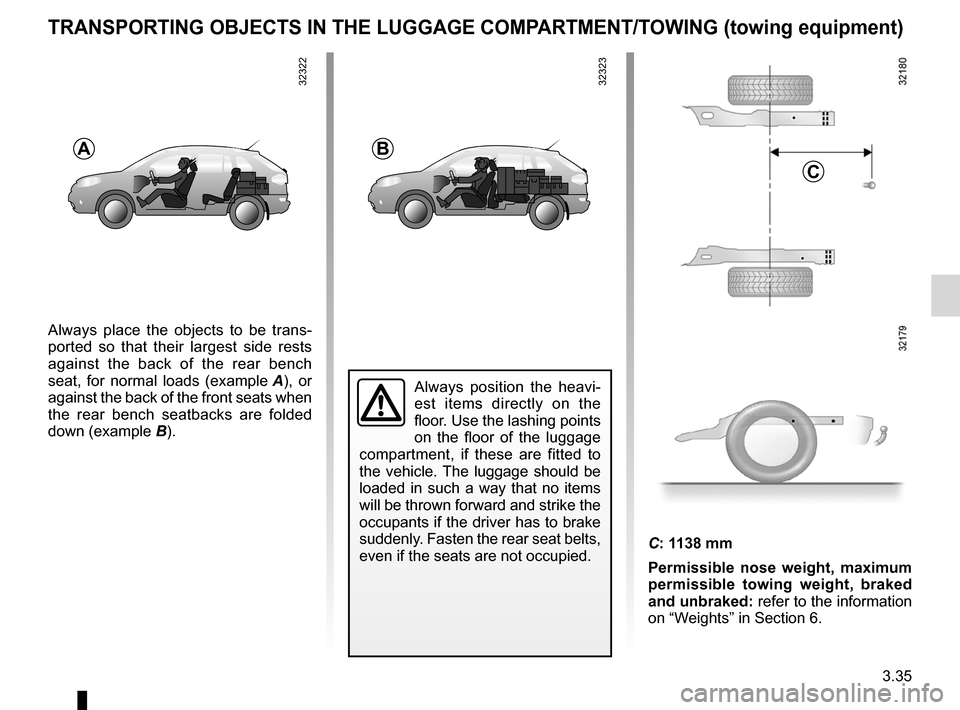
Always place the objects to be trans -
ported so that their largest side rests
against the back of the rear bench
seat, for normal loads (example A ), or
against the back of the front seats when
the rear bench seatbacks are folded
down (example B).
A
Always position the heavi -
est items directly on the
floor. Use the lashing points
on the floor of the luggage
compartment, if these are fitted to
the vehicle. The luggage should be
loaded in such a way that no items
will be thrown forward and strike the
occupants if the driver has to brake
suddenly. Fasten the rear seat belts,
even if the seats are not occupied.
C: 1138 mm
Permissible nose weight, maximum
permissible towing weight, braked
and unbraked: refer to the information
on “Weights” in Section 6.
32322
Page 156 of 233
towing rings .......................................... (up to the end of the DU)
luggage retaining net ............................ (up to the end of the DU)
transporting objects luggage net ..................................... (up to the end of the DU)
3.36
ENG_UD20993_3
Points d’arrimage / Filet de retenue de bagages (X45 - H45 - Renault)
ENG_NU_977-2_H45_Ph2_Renault_3
Anchorage points/luggage net
ANchoRAgE PoINTS/luggAgE NET
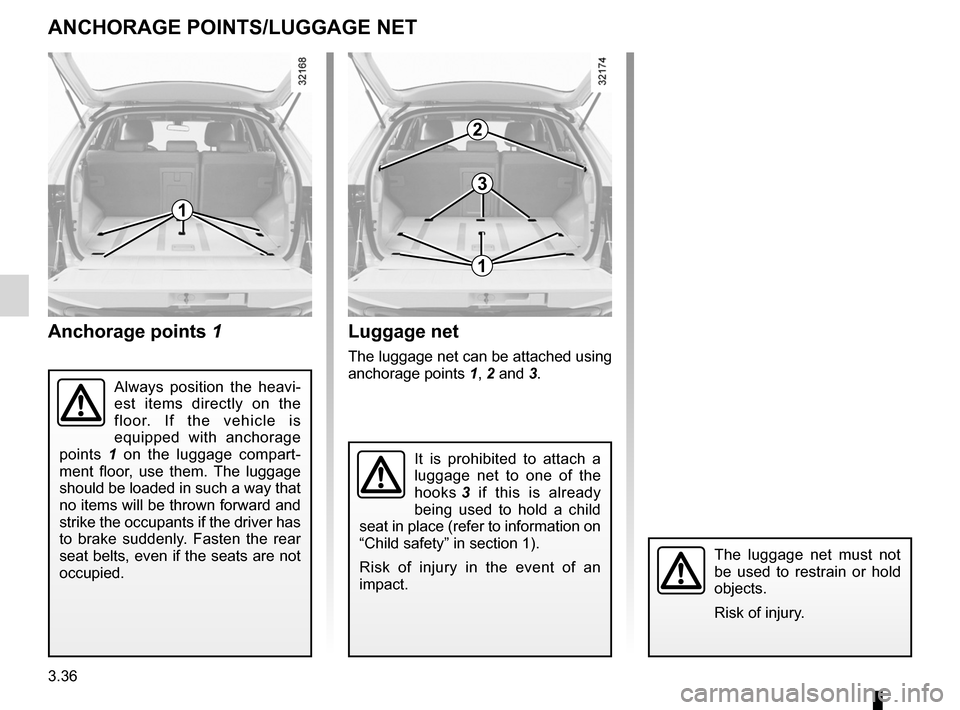
Anchorage points 1
It is prohibited to attach a
luggage net to one of the
hooks 3 if this is already
being used to hold a child
seat in place (refer to information on
“Child safety” in section 1).
Risk of injury in the event of an
impact.
luggage net
The luggage net can be attached using
anchorage points 1, 2 and 3.
2
Always position the heavi -
est items directly on the
floor. If the vehicle is
equipped with anchorage
points 1 on the luggage compart -
ment floor, use them. The luggage
should be loaded in such a way that
no items will be thrown forward and
strike the occupants if the driver has
to brake suddenly. Fasten the rear
seat belts, even if the seats are not
occupied.
3
1
1
The luggage net must not
be used to restrain or hold
objects.
Risk of injury.
Page 158 of 233
multimedia equipment .......................... (up to the end of the DU)
telephone .............................................. (up to the end of the DU)
navigation system ................................. (up to the end of the DU)
hands-free telephone integrated control
(up to the end of the DU)
navigation ............................................. (up to the end of the DU)
radio...................................................... (up to the end of the DU)
3.38
ENG_UD20995_3
Equipement multimédia (X45 - H45 - Renault)
ENG_NU_977-2_H45_Ph2_Renault_3
Multimedia equipment
Mul TIMEDIA EQuIPMENT
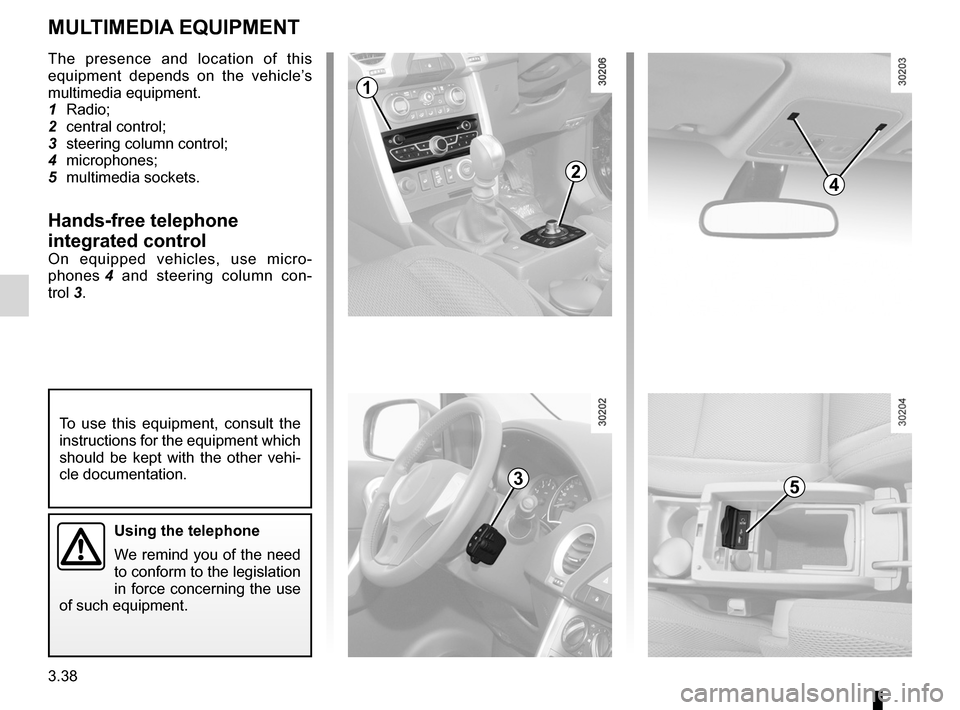
The presence and location of this
equipment depends on the vehicle’s
multimedia equipment.
1 Radio;
2 central control;
3 steering column control;
4 microphones;
5 multimedia sockets.
hands-free telephone
integrated control
On equipped vehicles, use micro -
phones 4 and steering column con -
trol 3.
To use this equipment, consult the
instructions for the equipment which
should be kept with the other vehi -
cle documentation.
1
3
using the telephone
We remind you of the need
to conform to the legislation
in force concerning the use
of such equipment.
2
5
4
Page 167 of 233
levels:windscreen washer reservoir ........................... (current page)
windscreen washer ................................................ (current page)
filter air filter ............................................................. (current page)
filter passenger compartment filter .......................... (current page)
filter diesel filter ........................................................ (current page)
tanks and reservoirs: windscreen washer .......................................... (current page)
JauneNoirNoir texte
4.9
ENG_UD20999_4
Niveaux / filtres (X45 - H45 - Renault)
ENG_NU_977-2_H45_Ph2_Renault_4
windscreen/headlight washer reservoir
Filters
LeVeLS (3/3)/FIL teRS
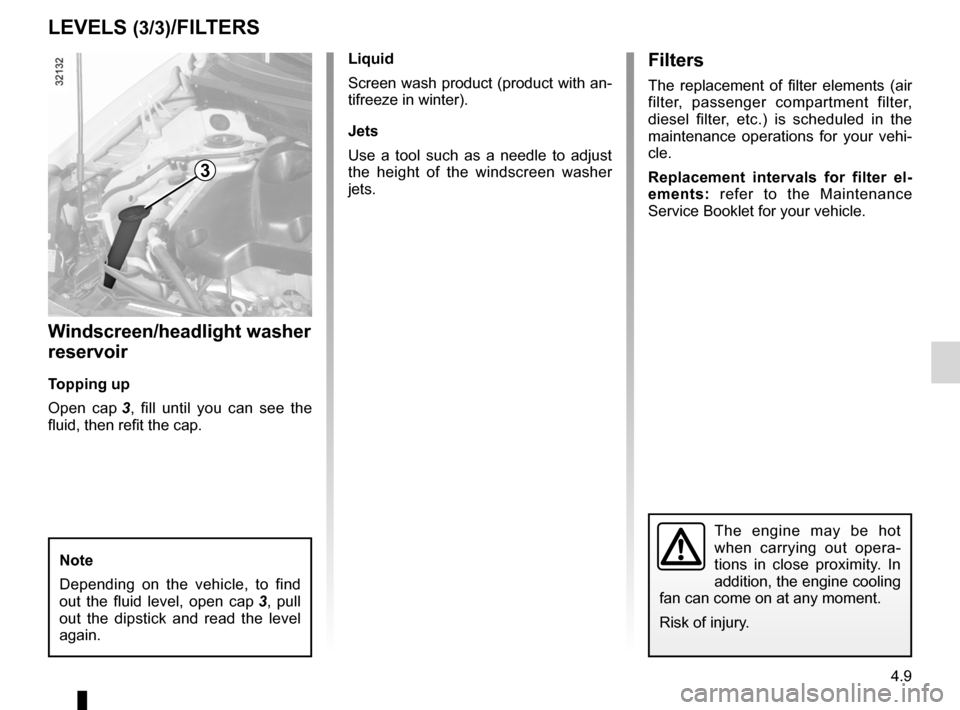
note
Depending on the vehicle, to find
out the fluid level, open cap 3 , pull
out the dipstick and read the level
again.
3
Windscreen/headlight washer
reservoir
t opping up
Open cap 3 , fill until you can see the
fluid, then refit the cap. Liquid
Screen wash product (product with an-
tifreeze in winter).
Jets
Use a tool such as a needle to adjust
the height of the windscreen washer
jets.
Filters
The replacement of filter elements (air
filter, passenger compartment filter,
diesel filter, etc.) is scheduled in the
maintenance operations for your vehi
-
cle.
Replacement intervals for filter el -
ements: refer to the Maintenance
Service Booklet for your vehicle.
The engine may be hot
when carrying out opera -
tions in close proximity. In
addition, the engine cooling
fan can come on at any moment.
Risk of injury.
Page 170 of 233
maintenance:bodywork ........................................ (up to the end of the DU)
washing ................................................ (up to the end of the DU)
paintwork maintenance ................................... (up to the end of the DU)
anti-corrosion protection ....................... (up to the end of the DU)
cleaning: outside the vehicle .......................... (up to the end of the DU)
4.12
ENG_UD22865_9
Entretien de la carrosserie (X45 - H45 - J77 - X81 - X85 - B85 - C85 - S85 - X91 - B91 - K91 - D91 - X83 - X61 - X77 ph2 - K85 - X95 - B95 - D95 - K95 - J95 - R95 - L38 -
ENG_NU_977-2_H45_Ph2_Renault_4
Jaune NoirNoir texte
Bodywork maintenance
BODyWORk MAIntenAnCe (1/2)
– Allow rust to form following minor im-
pacts.
– Use solvents not approved by our
Technical Department to remove
stains as this could damage the
paintwork.
– Drive frequently in snow or muddy
conditions without washing the ve -
hicle, particularly under the wheel
arches and body.
–
minor impacts
You should take a minimum number of
precautions in order to safeguard your
vehicle against such risks and not to
lose the benefit of your vehicle’s anti -
corrosion protection.
What you should not do
– Degrease or clean mechanical com-
ponents (e.g. the engine compart -
ment), underneath the body, parts
with hinges (e.g. inside the fuel tank
flap) and painted plastic external
fittings (e.g. bumpers) using high-
pressure cleaning equipment or by
spraying on products not approved
by our Technical Department. If ade-
quate precautions are not taken, this
could give rise to corrosion or opera-
tional faults.
– Wash the vehicle in bright sunlight or
freezing temperatures.
– Scrape off mud or dirt without
prewetting.
– Allow dirt to accumulate.
A well-maintained vehicle will last
longer. It is therefore recommended to
maintain the exterior of the vehicle reg-
ularly.
protection against the effects
of corrosive agents
Although your vehicle has been treated
with very effective anti-corrosion prod
-
ucts, it nevertheless remains subject to
the effects of:
– corrosives in the atmosphere
– atmospheric pollution (built-up
and industrial areas),
– saline atmospheres (near the
sea, particularly in hot weather),
– seasonal and damp climatic con-
ditions, (e.g.: road salt in winter,
water from road cleaners, etc.).
– abrasives
Wind-borne dust and sand, mud,
road grit thrown up by other vehi -
cles, etc.
Page 173 of 233
JauneNoirNoir texte
4.15
ENG_UD22866_8
Entretien des garnitures intérieures (X35 - X45 - X65 - J77 - X81 - J81 - X85 - X91 - B91 - K91 - D91 - X83 - X61 - X77 ph2 - X95 - B95 - D95 - E95 - K95 - J95 - R95 -
ENG_NU_977-2_H45_Ph2_Renault_4
You are strongly recom -
mended not to use high -
pressure or spray cleaning
equipment inside the pas -
senger compartment: use of such
equipment could impair the correct
functioning of the electrical or elec-
tronic components in the vehicle, or
have other detrimental effects.
InteRIOR tRIM MAIntenAnCe (2/2)
y ou should not:
You are strongly advised not to po -
sition objects such as deodorants,
scents, etc. near air vents, as this could
damage your dashboard trim.
Removal/replacing removable
equipment originally fitted in
the vehicle
If you need to remove equipment in
order to clean the passenger com -
partment (for example, mats), always
ensure that they are correctly refitted
and are the right way around (the driv-
er’s mat should be fitted on the driver’s
side, etc.) and fit them with the compo-
nents supplied with the equipment (for
example, the driver mat should always
be fixed using the pre-fitted mounting
components).
With the vehicle stationary, ensure that
nothing will impede driving (anything
obstructing the pedals, heel wedged by
the mat, etc.).
Page 180 of 233
tyres ...................................................... (up to the end of the DU)
wheels (safety) ..................................... (up to the end of the DU)
5.6
ENG_UD21006_4
Pneumatiques (X45 - H45 - Renault)
ENG_NU_977-2_H45_Ph2_Renault_5
Jaune NoirNoir texte
Tyres (tyre and wheel safety, use in winter)
tyres (1/3)
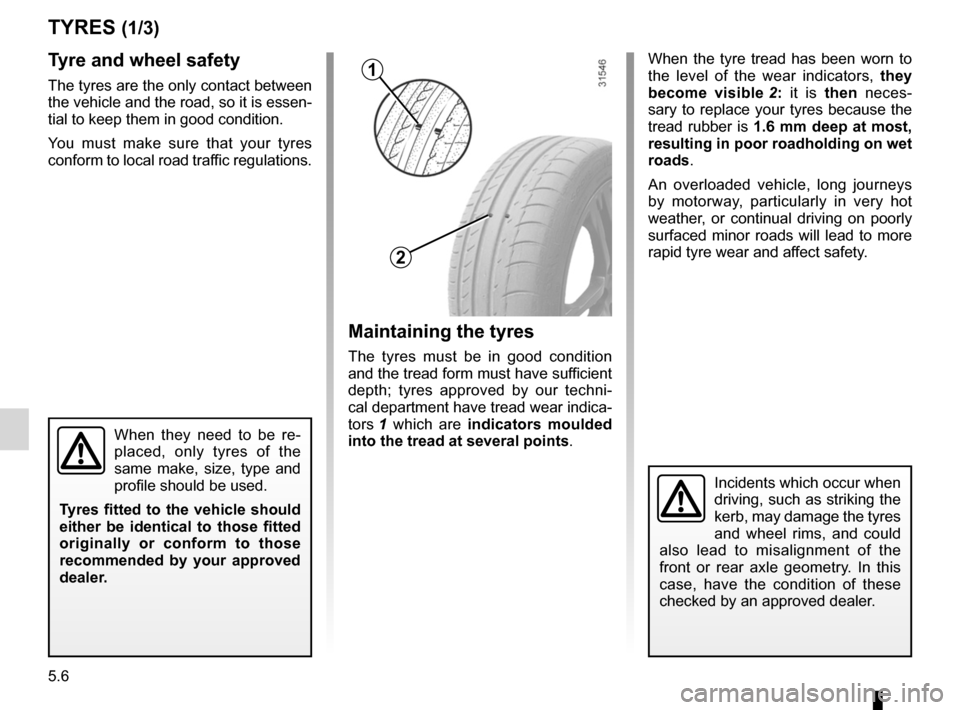
maintaining the tyres
The tyres must be in good condition
and the tread form must have sufficient
depth; tyres approved by our techni -
cal department have tread wear indica -
tors 1 which are indicators moulded
into the tread at several points .
tyre and wheel safety
The tyres are the only contact between
the vehicle and the road, so it is essen-
tial to keep them in good condition.
You must make sure that your tyres
conform to local road traffic regulations. When the tyre tread has been worn to
the level of the wear indicators,
they
become visible 2 : it is then neces -
sary to replace your tyres because the
tread rubber is 1.6 mm deep at most,
resulting in poor roadholding on wet
roads.
An overloaded vehicle, long journeys
by motorway, particularly in very hot
weather, or continual driving on poorly
surfaced minor roads will lead to more
rapid tyre wear and affect safety.
When they need to be re -
placed, only tyres of the
same make, size, type and
profile should be used.
t yres fitted to the vehicle should
either be identical to those fitted
originally or conform to those
recommended by your approved
dealer.
Incidents which occur when
driving, such as striking the
kerb, may damage the tyres
and wheel rims, and could
also lead to misalignment of the
front or rear axle geometry. In this
case, have the condition of these
checked by an approved dealer.
1
2
Page 183 of 233
lightsfront ................................................. (up to the end of the DU)
lights changing bulbs ................................ (up to the end of the DU)
changing a bulb .................................... (up to the end of the DU)
indicators .............................................. (up to the end of the DU)
bulbs changing ......................................... (up to the end of the DU)
lights: dipped beam headlights .................. (up to the end of the DU)
lights: main beam headlights ..................... (up to the end of the DU)
lights: side lights ........................................ (up to the end of the DU)
lights: direction indicators .......................... (up to the end of the DU)
bulbs changing ......................................... (up to the end of the DU)
5.9
ENG_UD23533_3
Projecteurs lampes halogène : remplacement des lampes (H45 - X65 - Renault)
ENG_NU_977-2_H45_Ph2_Renault_5
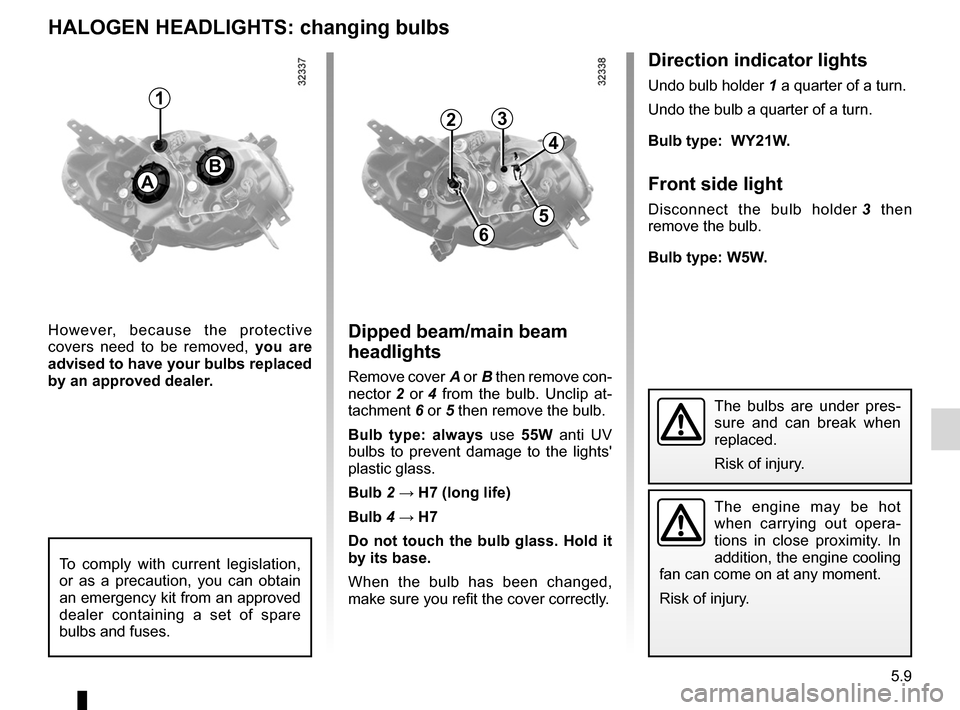
Direction indicator lights
Undo bulb holder 1 a quarter of a turn.
Undo the bulb a quarter of a turn.
Bulb type: wy21w .
Front side light
Disconnect the bulb holder 3 then
remove the bulb.
Bulb type: w5w .
Headlights (changing bulbs)
halOgen heaDlIghts: changing bulbs
Dipped beam/main beam
headlights
Remove cover A or B then remove con-
nector 2 or 4 from the bulb. Unclip at -
tachment 6 or 5 then remove the bulb.
Bulb type: always use 55w anti UV
bulbs to prevent damage to the lights'
plastic glass.
Bulb 2 → h7 (long life)
Bulb 4 → h7
Do not touch the bulb glass. hold it
by its base.
When the bulb has been changed,
make sure you refit the cover correctly.
The bulbs are under pres -
sure and can break when
replaced.
Risk of injury.
1
aB
3
6
2
4
5
However, because the protective
covers need to be removed, you are
advised to have your bulbs replaced
by an approved dealer.
To comply with current legislation,
or as a precaution, you can obtain
an emergency kit from an approved
dealer containing a set of spare
bulbs and fuses.
The engine may be hot
when carrying out opera -
tions in close proximity. In
addition, the engine cooling
fan can come on at any moment.
Risk of injury.
Page 186 of 233
bulbschanging ......................................... (up to the end of the DU)
changing a bulb .................................... (up to the end of the DU)
lights: side lights ......................................................... (current page)
lights: brake lights ...................................................... (current page)
bulbs changing ......................................... (up to the end of the DU)
lights: direction indicators ........................................... (current page)
5.12
ENG_UD23303_3
Feux arrière : remplacement des lampes (X45 - H45 - Renault)
ENG_NU_977-2_H45_Ph2_Renault_5
Jaune NoirNoir texte
Rear lights and side lights (changing bulbs)
rear lIghts anD sIDe lIghts: changing bulbs (1/3)
However, because bodywork compo -
nents need to be removed, you are ad-
vised to have your bulbs replaced by
an approved dealer.
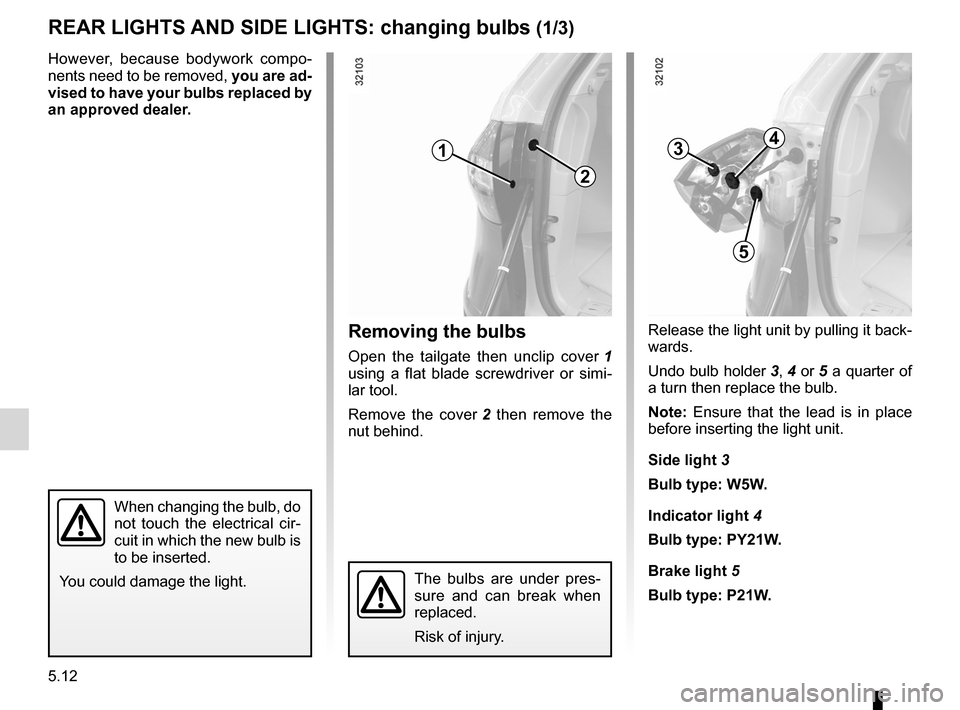
removing the bulbs
Open the tailgate then unclip cover 1
using a flat blade screwdriver or simi -
lar tool.
Remove the cover 2 then remove the
nut behind.
When changing the bulb, do
not touch the electrical cir -
cuit in which the new bulb is
to be inserted.
You could damage the light.
The bulbs are under pres -
sure and can break when
replaced.
Risk of injury.
Release the light unit by pulling it back-
wards.
Undo bulb holder 3, 4 or 5 a quarter of
a turn then replace the bulb.
n ote: Ensure that the lead is in place
before inserting the light unit.
side light 3
Bulb type: w5w .
Indicator light 4
Bulb type: Py21w .
Brake light 5
Bulb type: P21w .
1
2
43
5