ECU RENAULT LAGUNA 2012 X91 / 3.G Owner's Manual
[x] Cancel search | Manufacturer: RENAULT, Model Year: 2012, Model line: LAGUNA, Model: RENAULT LAGUNA 2012 X91 / 3.GPages: 241, PDF Size: 7.82 MB
Page 181 of 241
JauneNoirNoir texte
5.5
ENG_UD29151_1
Kit de gonflage des pneumatiques (X91 - B91 - K91 - D91 - Renault)
ENG_NU_936-5_BK91_Renault_5
tYre InFLA tIOn KIt (3/5)
Once the tyre is inflated correctly:
– stop using the kit;
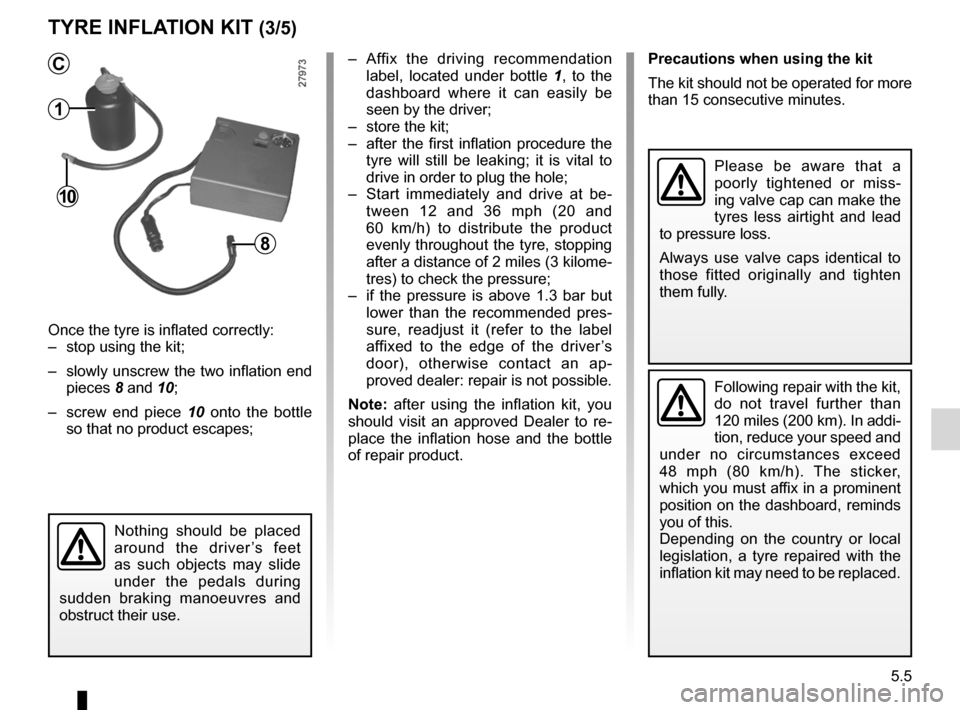
– slowly unscrew the two inflation end
pieces 8 and 10;
– screw end piece 10 onto the bottle
so that no product escapes;
– Affix the driving recommendation
label, located under bottle 1 , to the
dashboard where it can easily be
seen by the driver;
– store the kit;
– after the first inflation procedure the
tyre will still be leaking; it is vital to
drive in order to plug the hole;
– Start immediately and drive at be -
tween 12 and 36 mph (20 and
60 km/h) to distribute the product
evenly throughout the tyre, stopping
after a distance of 2 miles (3 kilome-
tres) to check the pressure;
– if the pressure is above 1.3 bar but
lower than the recommended pres -
sure, readjust it (refer to the label
affixed to the edge of the driver ’s
door), otherwise contact an ap -
proved dealer: repair is not possible.
n ote: after using the inflation kit, you
should visit an approved Dealer to re -
place the inflation hose and the bottle
of repair product. Precautions when using the kit
The kit should not be operated for more
than 15 consecutive minutes.
Following repair with the kit,
do not travel further than
120 miles (200 km). In addi
-
tion, reduce your speed and
under no circumstances exceed
48 mph (80 km/h). The sticker,
which you must affix in a prominent
position on the dashboard, reminds
you of this.
Depending on the country or local
legislation, a tyre repaired with the
inflation kit may need to be replaced.
Nothing should be placed
around the driver ’s feet
as such objects may slide
under the pedals during
sudden braking manoeuvres and
obstruct their use.
Please be aware that a
poorly tightened or miss -
ing valve cap can make the
tyres less airtight and lead
to pressure loss.
Always use valve caps identical to
those fitted originally and tighten
them fully.
1
8
10
c
Page 183 of 241
JauneNoirNoir texte
5.7
ENG_UD29151_1
Kit de gonflage des pneumatiques (X91 - B91 - K91 - D91 - Renault)
ENG_NU_936-5_BK91_Renault_5
tYre InFLA tIOn KIt (5/5)
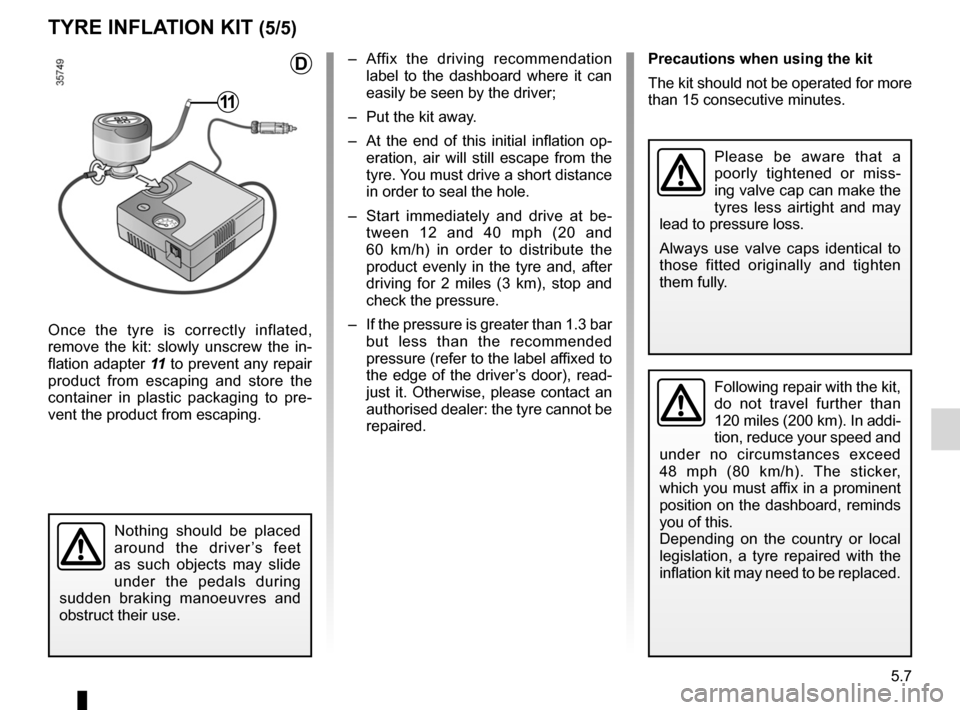
Once the tyre is correctly inflated,
remove the kit: slowly unscrew the in -
flation adapter 11 to prevent any repair
product from escaping and store the
container in plastic packaging to pre -
vent the product from escaping.
– Affix the driving recommendation
label to the dashboard where it can
easily be seen by the driver;
– Put the kit away.
– At the end of this initial inflation op-
eration, air will still escape from the
tyre. You must drive a short distance
in order to seal the hole.
– Start immediately and drive at be -
tween 12 and 40 mph (20 and
60 km/h) in order to distribute the
product evenly in the tyre and, after
driving for 2 miles (3 km), stop and
check the pressure.
– If the pressure is greater than 1.3 bar
but less than the recommended
pressure (refer to the label affixed to
the edge of the driver’s door), read-
just it. Otherwise, please contact an
authorised dealer: the tyre cannot be
repaired. Precautions when using the kit
The kit should not be operated for more
than 15 consecutive minutes.
Nothing should be placed
around the driver ’s feet
as such objects may slide
under the pedals during
sudden braking manoeuvres and
obstruct their use.
11
Please be aware that a
poorly tightened or miss -
ing valve cap can make the
tyres less airtight and may
lead to pressure loss.
Always use valve caps identical to
those fitted originally and tighten
them fully.
Following repair with the kit,
do not travel further than
120 miles (200 km). In addi -
tion, reduce your speed and
under no circumstances exceed
48 mph (80 km/h). The sticker,
which you must affix in a prominent
position on the dashboard, reminds
you of this.
Depending on the country or local
legislation, a tyre repaired with the
inflation kit may need to be replaced.
D
Page 184 of 241
tool kit ................................................... (up to the end of the DU)
hubcap tool ........................................... (up to the end of the DU)
jack ....................................................... (up to the end of the DU)
puncture ................................................ (up to the end of the DU)
wheelbrace ........................................... (up to the end of the DU)
trims ...................................................... (up to the end of the DU)
emergency spare wheel ....................... (up to the end of the DU)
wheelbrace ............................................................ (current page)
5.8
ENG_UD20513_1
Bloc outils / enjoliveur - roue (X91 - B91 - K91 - Renault)
ENG_NU_936-5_BK91_Renault_5
Tool kit (jack, wheelbrace, etc.)
Hubcap
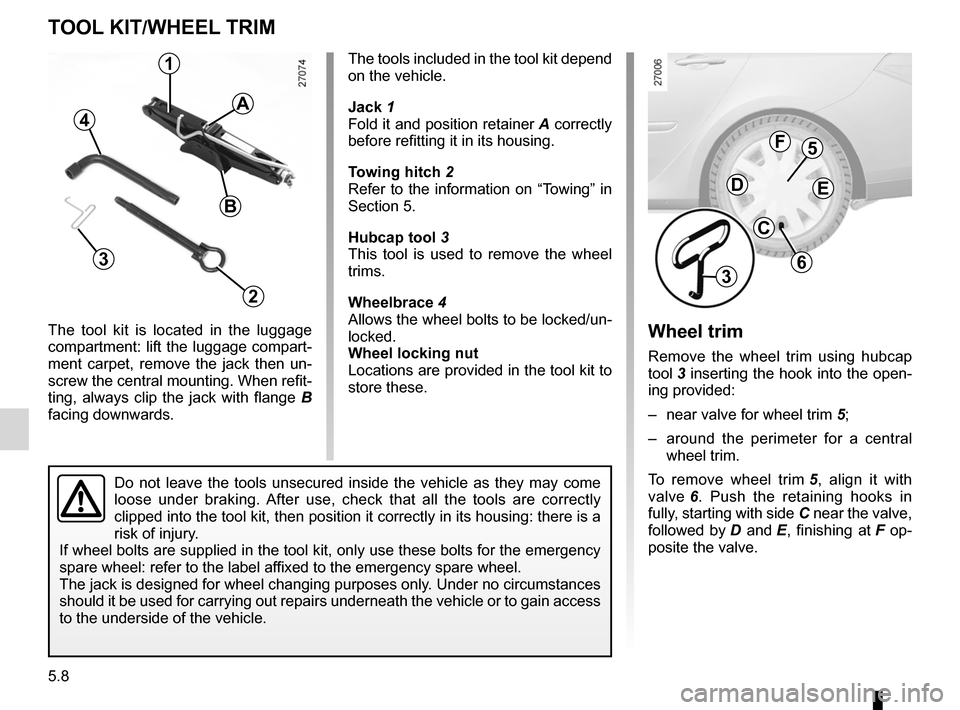
The tool kit is located in the luggage
compartment: lift the luggage compart-
ment carpet, remove the jack then un-
screw the central mounting. When refit-
ting, always clip the jack with flange B
facing downwards.
The tools included in the tool kit depend
on the vehicle.
Jack 1
Fold it and position retainer A correctly
before refitting it in its housing.
t owing hitch 2
Refer to the information on “Towing” in
Section 5.
Hubcap tool 3
This tool is used to remove the wheel
trims.
Wheelbrace 4
Allows the wheel bolts to be locked/un-
locked.
Wheel locking nut
Locations are provided in the tool kit to
store these.
t OOL KIt/WHeeL trIM
Do not leave the tools unsecured inside the vehicle as they may come
loose under braking. After use, check that all the tools are correctly
clipped into the tool kit, then position it correctly in its housing: there is a
risk of injury.
If wheel bolts are supplied in the tool kit, only use these bolts for the emergency
spare wheel: refer to the label affixed to the emergency spare wheel.
The jack is designed for wheel changing purposes only. Under no circumstances
should it be used for carrying out repairs underneath the vehicle or to gain access
to the underside of the vehicle.
1
A
B
2
3
4
Wheel trim
Remove the wheel trim using hubcap
tool 3 inserting the hook into the open -
ing provided:
– near valve for wheel trim 5;
– around the perimeter for a central
wheel trim.
To remove wheel trim 5 , align it with
valve 6 . Push the retaining hooks in
fully, starting with side C near the valve,
followed by D and E, finishing at F op -
posite the valve.
36
e
5F
D
c